

By Martyn Walker
Published in Letters from a Nation in Decline
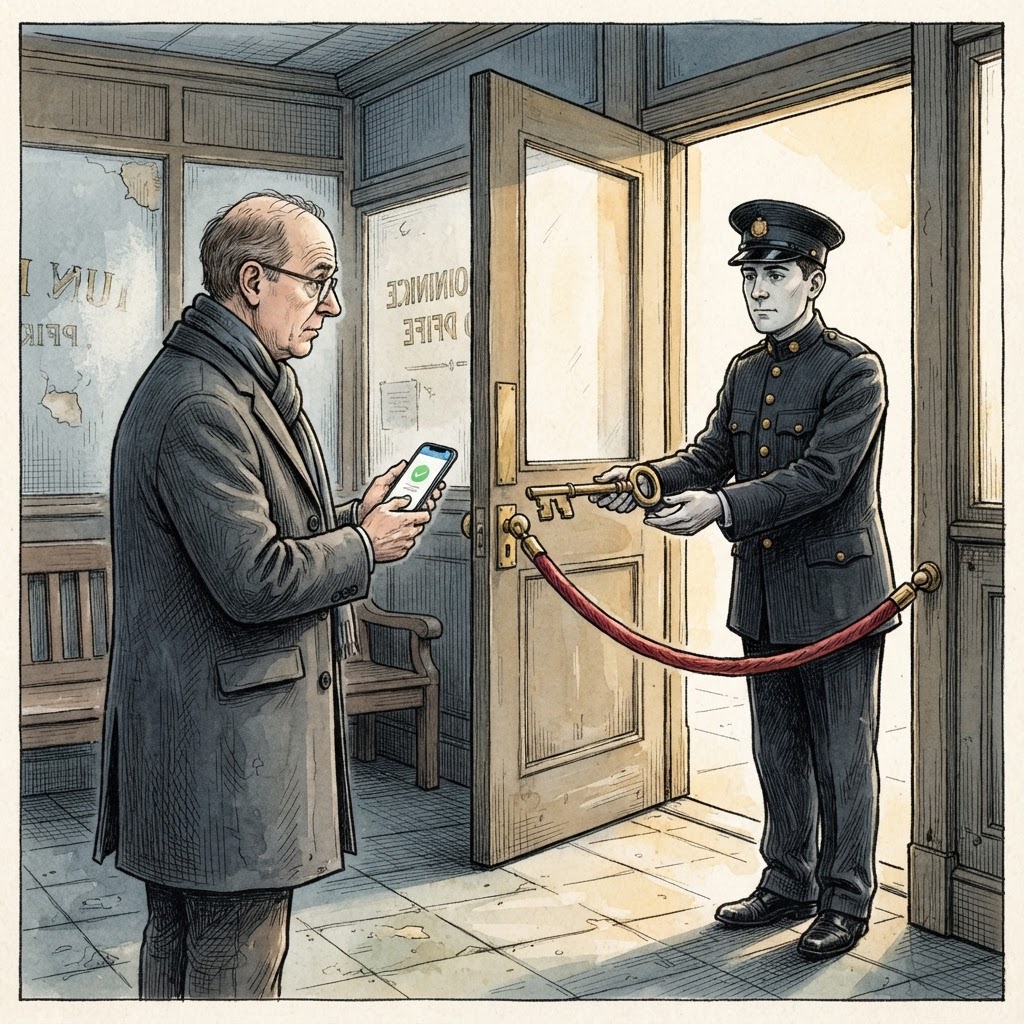
I look at my iPhone. It recognises me. Bitwarden fills in the long, unique password I chose never to have to remember. Then, between me and the account I came to use, up pops a banner inviting me to set up a passkey so that, in future, I can sign in more quickly.
I could have signed in more quickly this time. The banner was in the way.
I have been round this loop before. In August, when I changed my iPhone, back came the passkey settings I thought I had put to bed. The obvious switch also controlled the Bitwarden autofill I wanted to keep. By September I was asking, again, how to retain my passwords and two-factor authentication while dispensing with the invitations. By November I find myself wondering how a device capable of remembering my face has such difficulty remembering my answer.
There is a sound technical case for passkeys. A passkey is tied to the genuine website, so a convincing imitation cannot collect it and use it to sign in as me. That protection against phishing is real, even for someone who already uses strong passwords. It explains why the National Cyber Security Centre recommends passkeys. It does rather less to explain why I must keep declining one. Once I have made an informed choice, the next banner offers me no benefit whatever.
My father was a test pilot. One of his objections to bundling safety systems together was that each could make a perfectly good case for itself while the pilot had to deal with all of them at once. Eventually the distractions could make flying less safe. I think of him when a security prompt appears so often that my hand goes straight to the button that dismisses it. If you want me to read the next genuine warning, that is a peculiar habit to cultivate.
Then there is the question of whose security we are improving. I know where my Bitwarden passwords live and how I would recover them. If I accept a passkey on a shared tablet, who else can use it? GOV.UK’s own guidance warns that anyone able to unlock a shared device may also be able to use its passkey. I might quite reasonably let someone unlock a family tablet without intending to let them into my government account. In that household, accepting the invitation could weaken a boundary that mattered. I would like to weigh that decision at leisure, preferably somewhere other than halfway through doing something else.
The saving on the other side of the screen is easier to measure. In a FIDO Alliance case study, the insurer Branch reported that support tickets about authentication fell by half after it introduced passkeys. Its product manager identified fewer tickets as a principal business objective. Fair enough. Password resets cost money. What I should like to see alongside that figure is the total time spent by customers declining the offer. The help desk keeps accounts. Apparently my afternoon is free.
I would have liked regulators to intervene before government adopted the practice. In Britain we are already late. GOV.UK One Login offers passkeys, retains a password-and-code route and says explicitly that people who have yet to create a passkey will be prompted periodically when they sign in. A retailer that tries my patience may lose my custom. I have rather less scope to take my tax affairs elsewhere.
The Competition and Markets Authority should examine repeated enrolment prompts as part of its work on how online design steers consumer choices. The Government Digital Service can act on its own login screen now. Give “No, and don’t ask me again” the same prominence as “Set up a passkey”. Honour the answer across visits. Leave the option in account settings for anyone who changes their mind, and keep a secure alternative available to citizens who prefer it.
There is a petty tyranny in giving only one answer permanent effect. If I say yes, the asking stops. I should like the same courtesy when I say no.
Previous letter: Letter XXII: Provider, Provide — Do Not Prescribe.
Discover more from Verbal Alchemy
Subscribe to get the latest posts sent to your email.


One Reply to “”