

How to Keep a Snail Alive

Garden snail moving slowly across stone, a quiet reminder of patience and gentle care

I keep a garden snail
not in a box
not in a jar
but in an agreement.

The agreement is simple.
I do not rush.
He does not explain.

Each morning I leave
a damp leaf
as if it were a letter
saying I remembered you.

He answers
by remaining alive.

The snail requires very little:
shade that means it,
water that arrives quietly,
and a world that does not suddenly decide
to be important.

When I forget myself
and think speed is truth,
he retracts.
When I calm down,
he resumes the future.

He has no ambition
beyond crossing a stone
by Tuesday
and surviving the birds’ opinions.

And yet
if I can keep this creature content—
with no plans,
no praise,
no comprehension of my efforts—
then perhaps living is not mastery.

Perhaps it is maintenance.

If I can keep a snail happy,
fed,
unpanicked,
unharmed by my cleverness,
then I can live anything.

Even me.


The story behind this story.

Thanks to my very great friend Alicia, my reading and writing life has been enriched with her curiosity and her vast knowledge of the book world. From authors long forgotten to those still weaving every story from mystery to culture to comedy to the most unusual authors I would never have considered without her most welcome interference.

Imagine my surprise when she sent me a photo of a snail and said “Meet my new pet”. So out of character, but then my knowledge of Alicia tells me there is something deep and profound in this peculiar statement, I just need to find it.

The result is the above poem which, as you have probably gathered, isn’t really about a snail. The snail is simply a quiet way into something more human.

At its heart, the poem explores what it feels like to care for something that cannot be hurried, impressed, or persuaded. A garden snail doesn’t respond to effort or intention in the way people do. It doesn’t reward anxiety or ambition. It simply reacts to calm, consistency, and gentleness. That makes the relationship oddly honest.

Many of us live with a constant sense of pressure — to do more, be quicker, justify ourselves, explain our choices, and keep up with an ever-moving world. The snail exists outside all of that. It has no interest in explanations or outcomes. When the poem says, “I do not rush. He does not explain,” it captures a rare peace: a space where nothing needs defending or proving.

The small daily acts in the poem — leaving a damp leaf, choosing shade, moving quietly — reflect a form of care that modern life often overlooks. This isn’t dramatic or self-sacrificing love. It’s ordinary attention. And that ordinariness is what makes it powerful. The snail’s only response is that it continues to live. Somehow, that feels like enough.

The poem also gently reverses the usual idea of control. When the person becomes stressed or hurried, the snail retreats. When calm returns, so does the snail. In this way, the animal mirrors something very familiar: how our own inner world tightens under pressure and opens when treated kindly.

The final lines offer the poem’s quiet insight. If we can keep something small, slow, and vulnerable safe and content — without needing recognition or success — then living isn’t about achievement at all. It’s about learning not to harm what is fragile, including ourselves.

I hope people like this poem not because it is clever, but because it feels like permission. Permission to slow down. Permission to care without justification. Permission to believe that gentleness, consistency, and patience are not weaknesses, but ways of staying alive.

In that sense, the snail becomes a reminder: living well doesn’t always mean doing more. Sometimes it simply means being careful enough to let life continue.

Living Off the Grid: The Journey of ‘Lucky the Lacky’

I met him because someone thought I ought to. That was the reason given, anyway. I was visiting Yosemite about twenty years ago, staying long enough to fall into conversation with a park employee who, after a day or two of small talk, said, almost casually, “You should meet a friend of mine.” He paused, gauging whether I was the sort of person who might laugh. “He lives off the grid. Completely.”

We drove for a while after leaving the park boundary. That mattered, I was told. Inside Yosemite, the rules were absolute, and rightly so. Preservation there was not a slogan but a discipline. You could admire nature, walk through it, photograph it, but you could not negotiate with it. My host’s friend had no quarrel with that. He simply knew the difference between stewardship and suffocation.

His land lay on the side of a mountain, far enough from the road that the last stretch was done slowly, deliberately, as if the place resisted being arrived at too quickly. He was a hunter, a fisherman, a farmer, but not in the romanticised way of catalogues and television. He knew where bears crossed and gave them room. He knew which rocks warmed snakes in the afternoon and left them alone. The wild boar were another matter—hybrids, aggressive, clever—and he spoke of them with the wary respect you reserve for something that can beat you if it chooses. Wolves, he said, were fewer every year. Farmers still poisoned and trapped them, not out of cruelty so much as habit. That observation came without anger, only with the calm note-taking of a man who preferred facts to outrage.

He kept a horse and goats, grazing them on land that had been measured and remeasured, not by surveyors this time but by weather, yield, and patience. Everything he needed was there, and almost nothing he didn’t.

His name was Patrick Murphy, though no one called him that. He had been christened “Lucky the Lacky” on an oil rig in his youth, a name that had clung because it was earned. Fresh out of college, qualifications in hand, his father had sent him offshore with a blunt instruction: to become an engineer, he had to start where engineering was least glamorous. That meant a year living and working with men who took pride in muscle, routine, and relentless teasing. They called him Lacky at first, and the name was not kind. He carried tools, cleaned messes, learned the rhythms of machinery and people. The teasing persisted, but so did the respect. Friendship grew where condescension was expected.

The day the name changed, a pressure system failed. A safety valve did its job too well. Shrapnel tore through the air, punched through a hut, and vanished into the sea beyond. Patrick had just sat down inside. Had he still been standing, he would not have walked away. The men who saw it happen decided that Lacky no longer fit. From then on he was Lucky, though “Lucky the Lacky” remained his formal title whenever ceremony demanded it.

He went on to live what most people would call a successful life. Marriage, children, good money, a future inheritance. Then came the divorce. It did not ruin him, but it rearranged him. He began to notice how much of his life was spent maintaining things he did not particularly want, under rules that assumed he could not be trusted to manage himself. The problem, as he saw it, was not rules in themselves. He had lived with them on rigs and respected them there. The problem was excess—regulation without purpose, oversight without understanding.

So he bought a mountain.

By forty, he had stripped his life back to what he considered essential. He obeyed the laws that mattered—licenses, taxes, insurance—and did so meticulously. A former engineer with an almost pathological respect for tolerances, he designed everything to exceed requirements. If an inspector came, they left reassured, if slightly puzzled. Beyond that, he kept authority at arm’s length.

Power came first from the sun. Solar panels fed an array of ten forty-eight-volt lead-acid batteries, the best available at the time. That power pumped water into a tower-mounted tank, gravity doing the rest. When he opened a tap, the descending water turned a small generator, reclaiming a fraction of the energy used to lift it. “It’s not much,” he said, almost apologetically, “but it offends me to waste effort.”

A river ran through his property. On it he built a water wheel, properly licensed, inspected, and documented. It produced about thirty amps at one hundred and fifteen volts, day and night. That, he said, was the only part of his life that required anyone else’s permission, and he accepted that without complaint. Left unregulated, rivers were abused. Some rules, he believed, existed because people had earned them.

He was not, despite appearances, cut off. He had internet access. He wrote, studied, made videos. An address existed where parcels could find him. He used these connections sparingly, but effectively. People sent him tools and gadgets to review. He obliged, not as an influencer but as an engineer who enjoyed explaining why something worked—or didn’t.

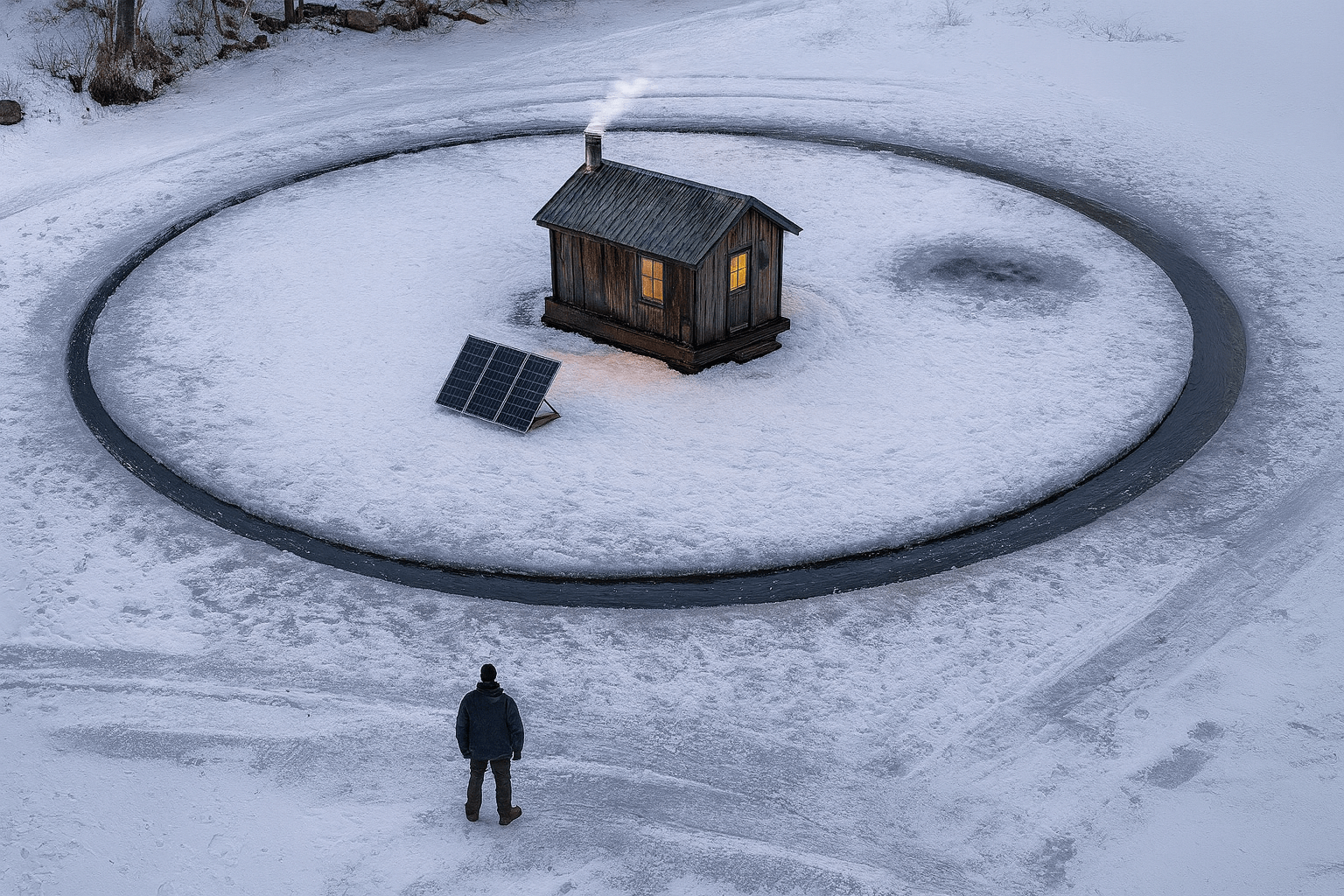
I visited him in winter, the year after he finished building his reservoir. It was fully permitted, fully documented, and entirely his own work. We walked down to it together. The lake had frozen nearly a foot thick. Near the centre, he had created an island.

He explained it with the quiet pride of someone who knew the explanation would land eventually. He had anchored a rope at the centre, drawn a perfect circle, and cut it by hand with a massive steel saw. Sixty feet across. In the middle sat an ice-fishing hut he had built himself. Double-glazed windows. A lamp. An electric cooker. Power came through a cable beneath the ice, fitted with a mechanism that allowed endless rotation without twisting. The island turned slowly during the day, driven by a small solar motor at its edge.

“Of course,” he said, watching it move, “it doesn’t run at night, or when the weather’s foul. But who wants to be out here then?”

Standing there, in the cold, watching an island turn because someone had thought carefully enough and been left alone long enough to make it happen, I felt something unexpected. Not awe at nature—I had plenty of that—but recognition. A sense that civilisation was not concrete and paperwork, not forms and permissions, but competence applied with restraint. Rules that protect, not smother. Freedom that assumes responsibility, not its absence.

When I left his mountain, I drove back towards towns and signs and instructions. I remember thinking, quite seriously, that I had just visited civilisation for the first time.

Steve and Alex – Builders of the World

A Minecraft Story for 6-8 year olds


The Ender Dragon’s Secret

The End portal was already awake.

“That shouldn’t happen,” Alex said.

They stepped through.

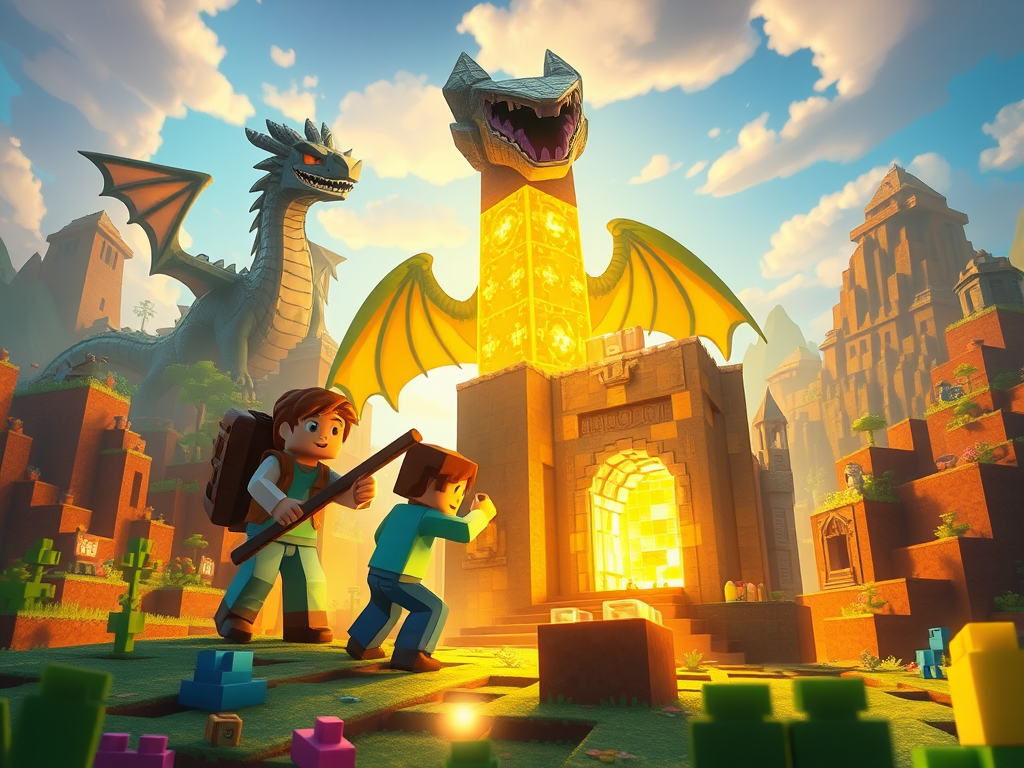
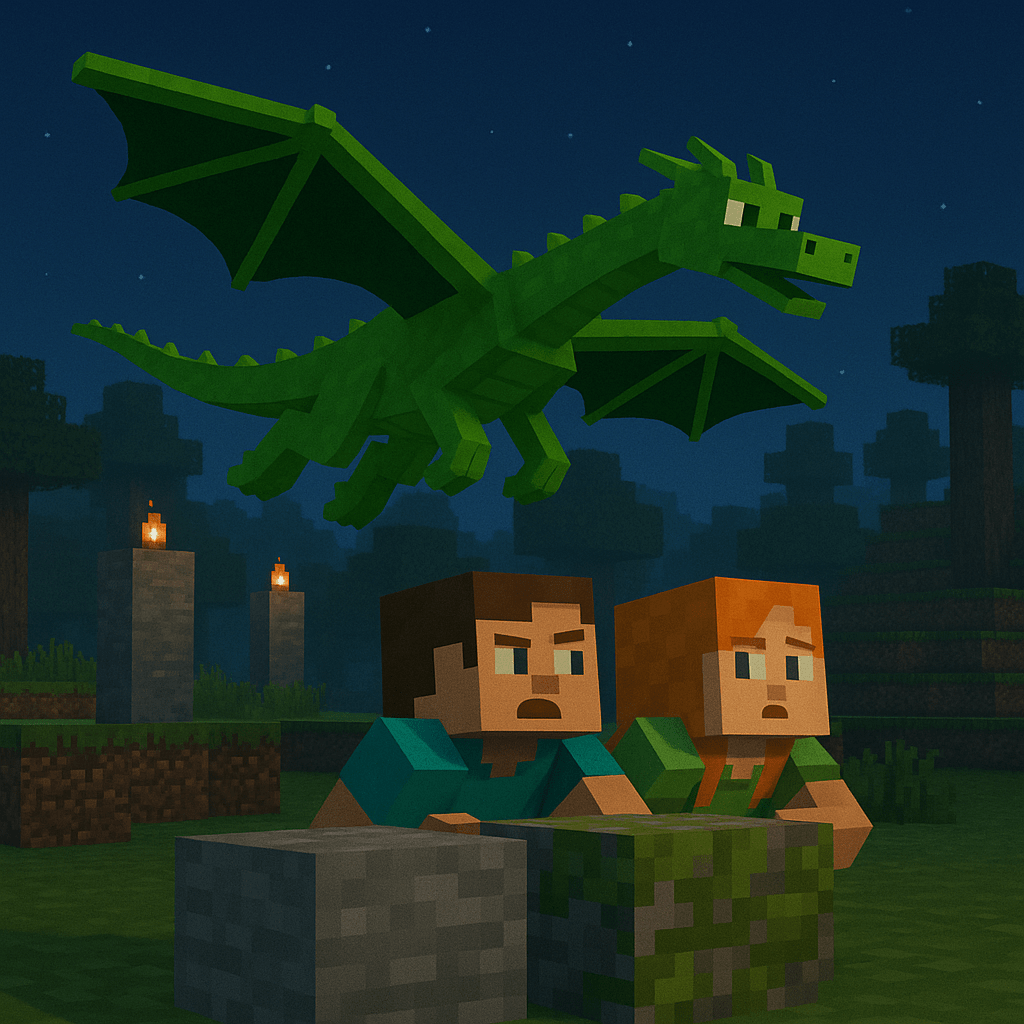
The End was quiet. The dragon circled high above, not attacking. Watching.

At the centre of the island, beneath cracked End Stone, they found an ancient lock — a stabiliser holding the world together.

The dragon landed between them and the structure. Not as an enemy. As a guardian.

The dragon blocks Alex and Steve's way

Steve put his sword away. Alex did the same.

They spoke the words together, gently.

“Block by block.
Stone and wood.
Build it straight.
Build it good.”

The structure opened. They repaired it.

The cracks sealed. The End steadied.

The dragon bowed.

Some things, Steve realised, don’t need defeating.


Chris’s Story — The Frozen Builders

The village in the snow wasn’t broken.

It was paused.

Ice covered doors and wells, but nothing was damaged. Beneath the village, Steve and Alex found a cooling engine that had done its job too well.

“We don’t need to smash it,” Alex whispered.

Image of the village covered in ice

They worked gently, one block at a time.

“Block by block.”
“Stone and wood.”
“Build it straight.”
“Build it good.”

The ice softened. The village woke quietly.

Steve thought of Chris — patient, careful, knowing when to stop.

Snow fell softly, just as it should.


Chris stands in front of the dragon

Jonathan’s Story — The Jungle That Builds Back

The jungle copied everything.

Towers. Bridges. Clever tricks.

Each time Steve and Alex built, the temple rebuilt it stronger.

“It’s learning,” Alex said.

They stopped trying to be clever.

One block. Then another.

“Block by block.”
“Stone and wood.”
“Build it straight.”
“Build it good.”

The jungle slowed. The path opened.

Steve smiled. Jonathan would have understood — think ahead, build wisely.


Epilogue — By the Campfire

That night, Steve and Alex sat by a campfire.

A map lay between them.
One mark in snow.
One in jungle green.

“The problems were different,” Alex said.

“But the answer wasn’t,” Steve replied.

They said the words one last time, quietly now — not a chant, just something true.

“Block by block.
Stone and wood.
Build it straight.
Build it good.”

The fire crackled.
The world rested.
And two builders slept, ready for tomorrow.

The Village That Forgot How to Build

A Minecraft Story for 6-8 year olds

Steve noticed something was wrong the moment his pickaxe snapped.

It wasn’t old. It wasn’t damaged. It had barely touched the stone before it broke clean in two.

Alex stopped and looked at her shovel. “That makes three tools today.”

They stood in a village they both knew well. The houses were still standing, the paths still tidy, but the villagers were restless. One hurried past carrying a door that was clearly too small for its doorway.

“Hrrm,” the villager muttered, turning it sideways. It still didn’t fit.

At the crafting table, Steve laid out four wooden planks. Perfectly placed.

Nothing happened.

Alex tried next. Still nothing.

The villagers gathered, whispering. One showed them a chest that wouldn’t open. Another held a hoe that bent when it touched the soil.

“We haven’t forgotten how to build,” said the village elder. “The world has forgotten how to fit.”

That night, Alex lit a torch and held it steady. The flame flickered strangely.

Steve took a breath. “If the world’s rules are loose,” he said, “then something underground is pulling them apart.”

Alex nodded. “The old mine.”

Before they set off, Steve placed one last block by the path. He spoke quietly, more to himself than anyone else.

“Block by block,
Stone and wood,
Build it straight,
Build it good.”

Alex smiled — and repeated it.

The mine lay beyond the hills, dark and silent. Inside, the rails twisted oddly, and Redstone dust hummed like it was thinking too hard.

Deep underground, they found the cause.

An ancient Redstone engine, once built to help shape the world, was still running — but badly. Circuits crossed where they shouldn’t. Power flowed the wrong way. Blocks shuddered slightly, as if unsure where they belonged.

“It’s not broken,” Alex said. “It’s confused.”

They set to work.

Steve realigned the circuits, one by one. Alex replaced cracked blocks and reset the levers. As they worked, they spoke the words together, each line matching their hands.

“Block by block,” Steve said, tightening a circuit.
“Stone and wood,” Alex replied, fitting a block into place.
“Build it straight,” they said together, stepping back.
“Build it good.”

The engine slowed.

Then it stopped.

The mine went quiet.

When they returned to the village, the sun rose exactly where it should.

A villager placed wood on the crafting table.

Thunk.

A perfect chest appeared.

Doors fit. Tools held. Crops grew straight and tall. The village felt solid again, as if the world had taken a deep breath.

The elder raised his hands. Slowly, the villagers began to speak — not loudly, not proudly, but carefully.

“Block by block,” one said.
“Stone and wood,” said another.
“Build it straight,” said a child.
“Build it good,” they finished together.

Steve lifted his pickaxe. Strong. Reliable.

Alex grinned. “Good thing,” she said. “Because builders are still needed.”

And deep underground, the Redstone slept — exactly as it should.

Celebrating Hump Day: Poems for Wednesday Motivation

Midweek’s here, they call it hump—
A Wednesday pause, a middle bump.
We glance behind at days now done,
Yet weekend’s not yet quite begun.

It’s that awkward sort of middle ground,
Too far from either end we’ve found.
Not quite enough to call it a win,
Not enough time to really begin.

But here we are on Wednesday’s hill,
Halfway up and onward still.
A little poem to mark the day,
As we push through the week’s halfway.

Wednesday—the day caught between what hasn’t happened and what won’t.

Letter XX – The Municipal Mirage

A once-civic institution, now hollowed by bureaucracy and central control.

By Martyn Walker
Published in Letters from a Nation in Decline

Once upon a time—within living memory, though now spoken of as though it were some sepia-toned idyll—the local council was exactly that: local. A modest civic body, often dull, occasionally officious, but recognisably part of the community whose money it spent. One imagines the town clerk of 1958, sleeves rolled, spectacles perched, frowning over the drainage budget with the stoicism of a man who knows he will meet the ratepayers in the butcher’s queue tomorrow morning. He was not a visionary, a strategist, a consultant, or a “stakeholder partner.” He merely fixed the roads, emptied the bins, and ensured the library opened on time. He did so because the town needed these things, and because the town paid for them.

Compare that modest creature with today’s municipal apparatus, a body swollen to the point of deformity, draped in managerial jargon and trembling under a hundred mutually contradictory regulations. Instead of the honest if plodding civil servant, we have entire platoons of officers whose professional identity is built not on service but on compliance. They do not shape the town; they interpret guidance. They do not defend local interests; they “engage” with frameworks. Their task is not to steward a place but to satisfy a central state that increasingly views local government as one more branch office—an outpost of Whitehall’s neurotic empire.

The transfiguration began when successive governments, each convinced of its own modernising brilliance, decided that the real problem with councils was that they were too responsive to their residents. Better, they thought, to strip away those old provincial arrangements and replace them with uniform “administrative units,” reorganised, rationalised and sanitised to within an inch of their lives. The result was the 1970s map: fewer councils, larger councils, and officials less likely to know the names of the streets they regulated. Efficiency, we were told. Progress, we were told. It has been downhill ever since.

A once-civic institution, now hollowed by bureaucracy and central control.

Then came the centralisers. Rate-capping, council tax limits, mandatory duties without matching funds: every lever was pulled to ensure that no local authority could so much as adjust a streetlight without permission from the capital. A Section 114 notice—local government’s version of sticking a “CLOSED FOR LACK OF MONEY” sign in the window—now hangs over dozens of authorities. The modern councillor governs nothing; he monitors a collapse, anxiously hoping that the Treasury might, in its mercy, approve a little more debt to keep the lights on.

And so to the regulations. If the older council was a steward, the modern council is a defendant—permanently awaiting judgement from a tribunal of auditors, inspectors, commissioners, ombudsmen, regulators and activist lawyers. Procurement law alone could cripple a lesser civilisation: tomes of directives dictating the precise choreography by which a council may purchase so much as a mop. The process is so paralysing that only the largest and most expensive corporations can complete it, creating a tidy cartel of outsourcers who speak the language of “KPIs” and “transformation pathways” while delivering services that are, at best, adequate and, at worst, catastrophic.

The tragedy is not merely the cost, though the cost is obscene. It is the culture. Preventive services, those quiet institutions that make a town bearable—youth centres, libraries, local works, the unobtrusive odd-jobbing that keeps a place civilised—have been amputated so that councils can funnel their remaining budget into statutory duties that grow more demanding every year. Social care now consumes the lion’s share of municipal budgets, not because councils have suddenly discovered humanitarian zeal, but because the law compels it and the courts enforce it.

Thus we inhabit the paradox of the British state: councils more elaborate than ever, producing worse public spaces than at any time since rationing. Potholes gape like geological features. Parks resemble the aftermath of a sullen strike. Planning departments take years to produce decisions that amount to artful apologies for not producing any decisions at all. What the average citizen sees is decay. What the average council produces is paperwork.

If the England of the post-war decades possessed a municipal ethic, it has been replaced by a municipal mirage: a swollen bureaucracy masquerading as governance, a system designed chiefly to protect itself from blame. It consumes money without delivering value, enforces rules without delivering order, and utters slogans about “communities” while retreating from the very notion of civic duty.

The state tells us this is progress: professionalism, standardisation, compliance, equality. But a town that cannot fix its own pavements is not progressing. A council that answers to Whitehall more readily than to its residents is not local. And a nation in which the simplest act of governance costs three times what it did half a century ago—and delivers a third of the quality—is not declining by accident.

It is declining by design. The design, as usual, belongs to people who do not have to live with the consequences.


When the state expands its procedures faster than its competence, decline arrives not as a crisis but as a schedule—issued quarterly, audited annually, and noticed by the public only when the bins stop being emptied.

The Turbine that Ate the Forest

One of the small but telling scandals of our age is the polite silence surrounding balsa wood. Not the stuff of children’s model aeroplanes, but the industrial-scale harvest that feeds the fashionable addiction to wind turbines. Balsa became the miracle ingredient of the green priesthood: light, strong, resin-friendly. And so the forests of Ecuador were stripped with the zeal of a Victorian naval yard, only without the dignity of purpose. Criminal gangs moved in, communities were gutted, and tracts of land were left as bald as a ministerial briefing note. All this so that Europe could congratulate itself on its moral cleanliness while importing a product cut from other people’s hillsides.

The turbine itself is a monument to selective blindness. One begins with a thousand tonnes of concrete—an unlovely material normally denounced by environmentalists until the moment it becomes necessary to bury it under a wind farm. Add a steel tower with a carbon footprint large enough to keep a small nation in warmth for a decade. Crown it with vast blades made from fibreglass, petrochemical resins, and the aforementioned balsa stripped from South American forests. Then transport it all by lorry, ship, and crane, every step soaked in diesel. Install it in a wind regime that fails to meet the advertised output for all but a few postcard days a year. This, we are told, is progress.

We are further assured that the “lifetime carbon payback” justifies the exercise. That is true only in the same sense that a government budget is “balanced” when one introduces assumptions about perfect weather, flawless machinery, and twenty years of uninterrupted operation. The turbine must spin at its daily optimum for two decades, the wind must behave like a Swiss railway timetable, the grid must remain stable without the usual frantic interventions, and the maintenance crews must exist in a state of immaculate readiness. The moment reality intrudes—repairs, downtime, suboptimal wind, or a cold still winter—the ledger curls up like an old leaf and deposits itself in the bin.

Then comes the end of life, that undisclosed chapter in the Book of Green Miracles. The blades cannot be recycled; they are not aluminium cans. They are thermoset composites, cured forever, doomed to burial. So they are chainsawed into pieces and entombed in vast pits, where they will outlast most of the modern political class. One wonders whether future archaeologists will conclude that the early twenty-first century worshipped giant fibreglass idols until the cult ran out of subsidies.

But the greatest deception—the one so ingrained that ministers repeat it without hesitation—is that wind replaces conventional generation. It does not. It decorates it. Behind every elegant white tower stands a gas turbine humming away like an anxious understudy, ready to spring on stage the moment the wind drops. That backup runs inefficiently, gulping fuel in stop–start cycles that nobody includes in the official figures because it ruins the story. The whole scheme resembles a child’s puppet theatre: all charm at the front, frantic scrambling behind.

Why are we investing in this? Because it is symbolic. Because it makes the correct people feel virtuous. Because it allows officials to commission glossy reports full of charts trending in pleasing directions. And because nothing flatters a modern government more than a technology which is large, visible, and useless at the precise moment one needs it.

If we possessed any genuine environmental seriousness, we would build nuclear plants and grid storage systems, and stop pretending that intermittency is a virtue. We would stop chewing through rainforest timber to construct machines that are nowhere near as green as the press releases suggest. Instead we cheer the arrival of another imported turbine, another scar on the landscape, another concrete tomb for future generations to puzzle over.

A civilisation that congratulates itself while paving fields with foreign timber and unrecyclable plastic, all in the name of purity, is not merely declining; it is losing its mind.

Letter XIX: The Mark of Progress

Black-and-white woodcut-style illustration of a man refused bread at a market stall because he lacks a glowing mark, while a towering bureaucratic figure with a paper face and rubber stamp looms overhead, with “666” in the clouds.

By Martyn Walker
Published in Letters from a Nation in Decline

When the state makes life itself conditional on its seal, the mark of the beast is already upon us.

It is a curious thing that whenever governments extend their reach into private life, they never describe it as such. They speak instead of convenience, safety, modernisation. Sir Keir Starmer’s championing of digital identity sounds like a minor administrative adjustment, the bureaucratic equivalent of changing the colour of the tax return form. Yet the reality is rather less trivial.

Digital identity, once imposed, is not a marginal innovation but a centralising revolution. Every man, woman, and child becomes a data entry in a state-authorised ledger, their existence vouched for only so long as the system continues to recognise them. Enter a shop, book a train ticket, apply for a job, or access a bank account — all remain possible only if the digital credential functions. The promise is efficiency; the reality is conditional existence.

The most arresting commentary on such systems does not come from libertarian pamphlets or academic studies, though both have their place. It comes from an ancient text often dismissed as melodrama: the thirteenth chapter of the Book of Revelation. There, the writer describes a society in which “all, both small and great, rich and poor, free and bond” must carry a mark, without which “no man might buy or sell.” Scholars debate whether this was first-century allegory, coded critique of Rome, or apocalyptic vision. The detail is precise: the universal credential is the universal chain.

Black-and-white etching of a man receiving a glowing stamp on his hand under a sign reading “RECEIVE THE MARK,” while a faceless bureaucrat with a paper document for a head looms above, and others queue in line.
The state’s seal presented as progress, the moment of ownership disguised as efficiency.

No theological commitment is required to see the parallel. The mark on the hand or forehead is today’s biometric key. The exclusion from buying or selling is today’s digital wallet frozen by an unseen hand. The beastly system, whether religious or secular, rests not on spectacular cruelty but on the quiet, routine denial of access. Prison walls are unnecessary if the till refuses the card.

Sir Keir presents himself as a moderniser. His case for digital ID is couched in terms of security, fraud prevention, and border control. He would bristle at any comparison with scripture. Yet it is precisely his mildness that makes the matter more sinister. Tyranny that announces itself can be resisted. Tyranny that drapes itself in the language of efficiency is harder to unpick. One does not wake one morning to discover the mark branded on the hand; one drifts into a world where participation in daily life depends on presenting the correct token at every doorway.

Defenders of such schemes protest that the British state is not tyrannical, that it will never abuse such power. This is a charming thought. It is also historically illiterate. Every government abuses the powers it acquires, and powers are never surrendered. The veto inherent in a digital ID scheme — the ability to prevent a man from buying or selling — may sit dormant, but it will never be dismantled. It rests there, like a coiled spring in Whitehall, ready to be activated at the moment of political convenience.

Nor should the economic logic be ignored. The Bank of England has spoken openly about programmable currency, which requires, by definition, a universal identifier. To know what money is being spent on, or to restrict its use to particular purposes, the state must know who is doing the spending. The marriage of digital ID and programmable money creates precisely the world Revelation describes: life conditional on permission.

That the Labour leadership fails to see this is damning enough. That it understands and proceeds regardless is worse. The old Labour Party liked to talk about liberty and dignity. The new one is content to speak of databases and compliance. Sir Keir’s tone is calm, legalistic, mildly reassuring. The punchline is that he offers Britain not security but servitude by spreadsheet.

What makes this especially grotesque is Britain’s history. This was the nation that prided itself on habeas corpus, on common law, on the principle that the citizen was free unless explicitly restrained. The imposition of a universal ID, tethered to one’s ability to transact, inverts that principle. It assumes restraint, lifted only when the system gives its blessing. The state does not prove its case against the citizen; the citizen must prove his case to the state.

Some will accuse this argument of melodrama, of importing biblical language to dignify a mundane administrative reform. In truth the melodrama belongs to Starmer, who dresses coercion in the robes of progress. Revelation, for all its imagery, is coolly accurate. It identified, nearly two millennia ago, the core of what makes such systems intolerable. They do not merely control trade. They redefine freedom itself.

The polite suggestion is that Sir Keir has not reflected on the full implications. The impolite truth is that he has. Either way the effect is identical: a government that sees its citizens not as free men and women, but as registered users, liable to be suspended. And the suspension is not noisy, with trumpets and banners. It is silent, invisible: the card declined, the ticket refused, the door that no longer opens.

Sir Keir will be remembered. He will be remembered as the man who sought to baptise bureaucracy with the language of progress. Britain can weather his speeches; what it may not weather is the architecture he is so keen to build. The peril is not a number burned into the flesh. It is a system so ordinary, so seamless, that the nation scarcely notices it already carries the mark.

The writer of Revelation recognised the pattern. The mark of the beast was never about the hand or the forehead. It was about ownership — about the moment a man’s life ceased to be his own, and became conditional on another’s approval. That is what digital ID represents today. A mark not of safety, but of possession. And the question, as always, is whether the British people are still spirited enough to refuse it.

Grandfather’s Farewell to England

Cartoon of a young boy in a red England football shirt sitting by a ferry window, gazing sadly at the White Cliffs of Dover across calm blue waters.

By Martyn Walker
Published in Letters from a Nation in Decline

Come, sit with me a while.
There’s something I need to say—before we go.

You see that hill? I played there once,
Chased kites and kicked a ball until the light gave out.
Down that lane was your great-grandmother’s cottage,
With roses round the door and jam jars cooling on the sill.
It was a good life, not rich, but honest.
We belonged here, then.

But now…
Now the country I gave my youth to,
The one we sang for in school halls and stood for at Remembrance—
She’s gone and signed herself away.
Again. Quietly. Like a servant handing over keys.

They’ll call it progress. Integration.
But I know surrender when I see it.
We’ve lost something, lad. Something we may never get back.

So we’re leaving. All of us.
Not because we stopped loving England—
But because she stopped being England.

I’ll not come back. Not even for the spring bluebells in the woods,
Or the sound of the choir practising on a Thursday evening.
Even the things I love most would hurt to see again.
Because they’ll still look the same…
But they won’t be the same.

And one day, when you’re older,
You might ask why I speak of her the way I do—like an old friend lost.
And I’ll tell you:
She was kind. She was proud. She was ours.
And we let her slip through our fingers.

So goodbye, my England.
You were the last of something gentle in a world growing hard.
I leave with nothing but my memories,
And a tear I never thought I’d shed.

Letter XVIII: The Poverty Mirage

Children in a dusty village play in front of a crumbling mural depicting a futuristic Western skyline across water.

When Help Makes Things Worse

By Martyn Walker
Published in Letters from a Nation in Decline

Dear Reader,

There is a cruel illusion that stalks Western policymaking—an illusion we not only believe, but wrap in moral grandeur. It is the idea that if we lift a handful of people out of poverty, we have changed the world. A hundred million rescued, a headline for the BBC, a documentary narrated by Bono. Job done.

But what if this is the ultimate vanity project of the West? What if our relentless urge to “help” is a gilded form of sabotage?

Someone recently wrote online, with uncharacteristic clarity, that you could take 100 million people living in third-world poverty, move them to the United States, and still—still—billions would remain in that same poverty. The implication is hard to miss: the problem isn’t where the poor live. The problem is why poverty remains the dominant condition of those countries in the first place. And importing the poor to richer nations doesn’t solve the problem—it just relocates it and inflames a host of new ones.

We are encouraged to pity the migrants, not question the migration. Yet every one of those 100 million would cost billions to house, educate, subsidise, and absorb—while their departure does nothing to change the systems, cultures, or kleptocracies that bred their misery. Meanwhile, those left behind—numbering in the billions—are quietly erased from the ledger of Western concern.

And there is the sting: by rescuing the few, we abandon the many.


The road to this absurdity is paved with theological potholes and moral landmines. I recall the story of Pope John Paul II—beloved in the West for standing up to Soviet tyranny—visiting India during a time of desperate national struggle. The Indian government had, with considerable difficulty, built a network of family planning services, attempting to slow a spiralling birth rate in areas already plagued by malnutrition and drought. Charities worked hand in hand with officials to promote responsible contraception. It was not about ideology. It was about rice, water, and survival.

Then came the Pope.

With a few papal words, he condemned birth control in a country battling to feed its children. In an instant, years of careful groundwork were torched. His holiness departed in a plume of incense and rhetoric, leaving the consequences behind. He had the luxury of eternal principles. The people of India did not. The famine doesn’t care about doctrine.

This is what the West does best: it interferes. With speeches. With dogma. With chequebooks and conditions. And always, it leaves the bill with the locals.


Woodcut-style illustration of a Western aid billboard in a crumbling village, with locals ignoring the sign and walking past with broken tools and containers.
A billboard proclaims “Western Solutions Available Here!”—offering solar panels, checklists, gender policy, and injections—while villagers walk past with broken carts and weary expressions.

Let us speak plainly. The developing world does not suffer from a lack of Western help—it suffers from an excess of it. Help that creates dependency. Help that erodes initiative. Help that demands ideological obedience in return. We tie aid to carbon compliance, to gender theory, to imported bureaucracy. The IMF does not give loans—it issues control. The charities do not build capacity—they replace it.

We have reached a point where the so-called “help” from the West has become more dangerous than its absence. We call it development, but it resembles colonisation wearing a rainbow lanyard.

And when the help fails, we blame the locals for “corruption” as if the World Bank is a convent of saints. Or we propose the unthinkable: that a coalition of successful nations should once again assume managerial control of the “failing” ones. We are back to empire, except this time it’s run by NGOs and ESG consultants.

And if not that, we shrug—and let nature take its course.


So what, then? Do we retreat?

Yes, actually.

But not with malice. Not with neglect. With discipline. With humility. With the honest admission that teaching a man to fish is no good if we’ve already leased his lake to China, banned his nets under EU regulation, and filled the water with World Economic Forum pamphlets.

We must learn to get out of the way. Not walk away from the world, but stop trying to run it.

Give tools, not rules. Invest without conditions. Respect local agency. Stop importing problems into Western cities just to feel temporarily virtuous. And never again should we let theology—of any kind—override common sense in a starving country.


Let us finally admit it: we have become too proud of our pity, too in love with the mirror image of our benevolence. The poor do not need our rescue. They need their freedom—from us.

Faithfully yours,
M.W.
Letters from a Nation in Decline