

Letter XXII: Provider, Provide — Do Not Prescribe

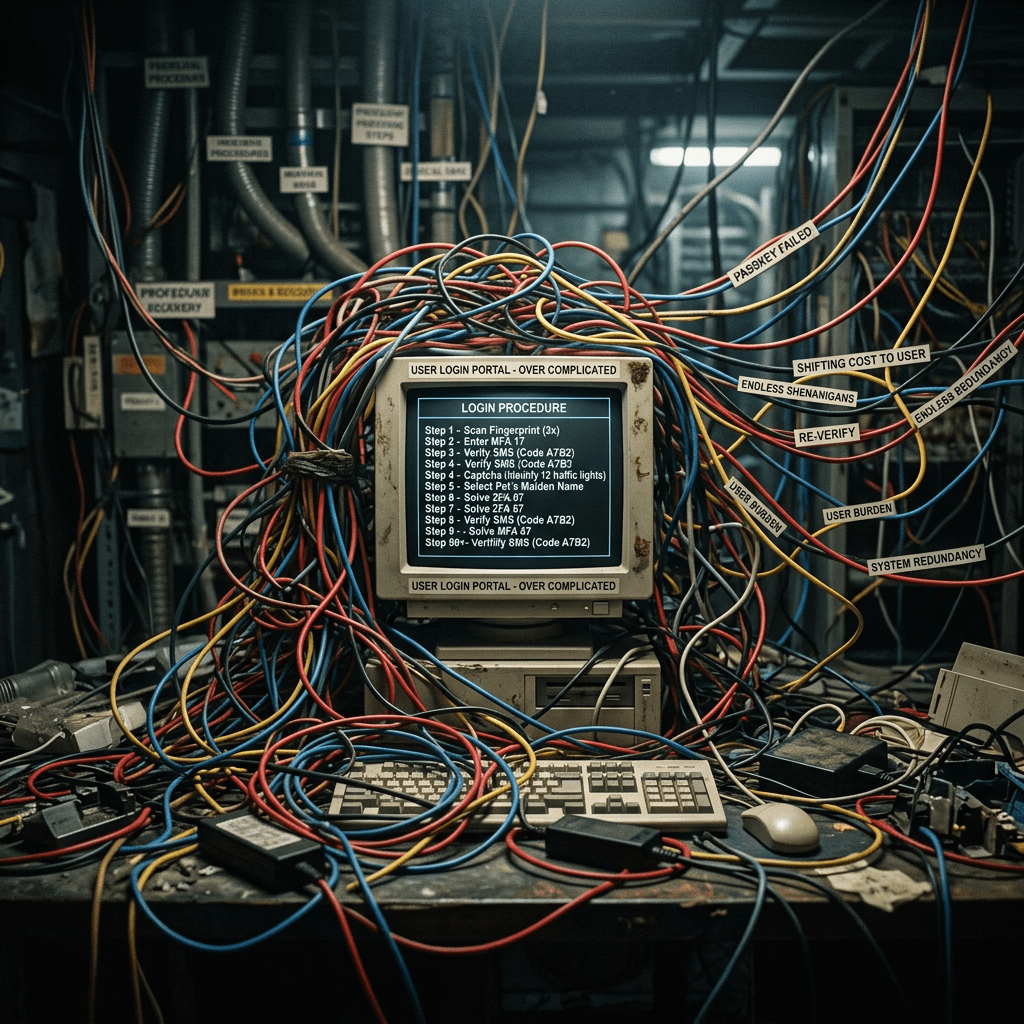
Monitor labeled USER LOGIN PORTAL - OVER COMPLICATED displays ten-step login procedure; tangled cables labeled PASSKEY FAILED, RE-VERIFY, USER BURDEN, and SYSTEM REDUNDANCY surround it.

By Martyn Walker
Published in Letters from a Nation in Decline

This morning, I attempted to log in to a different company account on QuickBooks.

It should have taken perhaps ten seconds. Instead, passkeys turned it into an intense five-to-ten-minute project involving repeated attempts, rejected routes and the usual digital guessing game in which the customer must discover what the software has decided to do on his behalf.

Eventually I checked the settings which I had previously disabled. They had somehow been re-enabled. I had not changed them. Perhaps an update had restored the provider’s preferred defaults; perhaps some other piece of helpful automation had intervened. Either way, my expressed choice had not survived.

A setting which silently reverses itself is not a setting. It is a temporary stay of execution.

Passkeys are presented as the civilised successor to passwords: simpler, safer and resistant to phishing. The cryptography is undoubtedly clever. A passkey is tied to the genuine website and cannot be handed innocently to a convincing imitation. This tackles a real problem, particularly among people who reuse memorable passwords or type credentials into whatever page appears before them.

But the sales pitch quietly substitutes one security problem for another. It concentrates identity, authentication and often account recovery in the same small object carried everywhere in a pocket.

Put down an unlocked telephone and someone else can pick it up. Phones are snatched from people’s hands by thieves on bicycles. Criminals observe PINs before stealing devices. Ministers, officials and businesspeople have all demonstrated that possession of an important telephone is not a theoretical risk confined to careless teenagers. Yet the technology industry increasingly treats possession of the device, assisted by a face, fingerprint or short PIN, as proof of possession of the identity.

The answer from security specialists is that a properly locked telephone still requires biometric or PIN verification. This is true in the same way that a properly locked front door keeps out a burglar who has neither the key nor a window. It describes the security model while avoiding the circumstances in which the security actually fails.

Once a thief gains access to a phone, he may acquire the passkey, email account, text messages, authenticator, password-reset route and banking applications together. We are told this is multifactor authentication. Physically, it is often several differently named functions living inside one stolen box.

I have used Bitwarden since its early days. I do not know any of my account passwords. Each is unique and generated by the password manager; I know only my personal master password. I have never been hacked. My family know that master password, so when I die they will be able to gain access to the accounts and information they will need.

That is not an accidental arrangement devised for my convenience. It is a considered security and succession policy. It has one deliberate trust anchor, controlled by me, with a comprehensible route for inheritance.

Passkeys intrude upon that arrangement by creating a parallel collection of credentials distributed among Apple, Google, individual devices, browser profiles, password managers and service providers. Some synchronise; some do not. Some can be deleted; some appear again. Some sites remember the right account; others offer a passkey for the wrong one. Death, incapacity, loss of a device or a disputed cloud account can turn the promised simplicity into an archaeological expedition through systems nobody consciously chose.

This is not merely an objection to passkeys. Those who want them should be free to use them. The objection is to prescription disguised as provision: automatic creation, persistent prompting, passkey-first login screens and updates which restore settings the customer has already rejected.

The provider benefits handsomely. Fewer forgotten-password calls reduce support costs. Phishing losses decline. Authentication is outsourced to devices and platform companies. The customer supposedly receives convenience, but when the machinery fails, the provider’s saving becomes the customer’s unpaid labour.

Multiply my lost five or ten minutes by millions of users, then add every compulsory application, broken identity portal, circular chatbot, unexplained verification request and setting restored after an update. None appears in the national accounts as waste. It is simply removed from the productive day in fragments too small to invoice and too dispersed to attract ministerial attention.

Britain can no longer indulge this casually. As Ross Clark puts it with admirable economy in the title of his forthcoming book, Britain Is Bust. His subject is the approaching sovereign debt crisis and the unavoidable rationalisation of public spending. Passkeys will neither cause nor cure that crisis. They are, however, a neat specimen of the culture accompanying it: institutions lower their own visible costs by exporting effort, delay and frustration to citizens and businesses, then call the result innovation.

A country does not become unproductive only through grand strategic errors. It also does so ten minutes at a time.

The proper policy is neither difficult nor technologically reactionary. Providers should offer passwords, independent authenticator applications, physical security keys and passkeys. They should explain the differences. They should allow the customer to choose. A rejected method should remain rejected, and an update should not constitute fresh consent. No credential should be created silently. No customer should be repeatedly funnelled towards the provider’s cheapest option.

Security should also permit genuine separation. The credential, the device approving its use and the route for recovery need not all occupy the same phone. People handling valuable businesses or sensitive information should be able to keep authentication on a separate device or physical key. Those planning sensibly for death or incapacity should not have their arrangements defeated by credentials imprisoned inside a dead person’s biometric ecosystem.

The password was not perfect. Neither is the passkey. The difference is that I was permitted to manage the former intelligently, whereas the latter is increasingly imposed upon me by organisations convinced that their preferred system must also be mine.

Let providers provide. Let customers decide. And when we have decided, leave the bloody setting alone.

Living Off the Grid: The Journey of ‘Lucky the Lacky’

I met him because someone thought I ought to. That was the reason given, anyway. I was visiting Yosemite about twenty years ago, staying long enough to fall into conversation with a park employee who, after a day or two of small talk, said, almost casually, “You should meet a friend of mine.” He paused, gauging whether I was the sort of person who might laugh. “He lives off the grid. Completely.”

We drove for a while after leaving the park boundary. That mattered, I was told. Inside Yosemite, the rules were absolute, and rightly so. Preservation there was not a slogan but a discipline. You could admire nature, walk through it, photograph it, but you could not negotiate with it. My host’s friend had no quarrel with that. He simply knew the difference between stewardship and suffocation.

His land lay on the side of a mountain, far enough from the road that the last stretch was done slowly, deliberately, as if the place resisted being arrived at too quickly. He was a hunter, a fisherman, a farmer, but not in the romanticised way of catalogues and television. He knew where bears crossed and gave them room. He knew which rocks warmed snakes in the afternoon and left them alone. The wild boar were another matter—hybrids, aggressive, clever—and he spoke of them with the wary respect you reserve for something that can beat you if it chooses. Wolves, he said, were fewer every year. Farmers still poisoned and trapped them, not out of cruelty so much as habit. That observation came without anger, only with the calm note-taking of a man who preferred facts to outrage.

He kept a horse and goats, grazing them on land that had been measured and remeasured, not by surveyors this time but by weather, yield, and patience. Everything he needed was there, and almost nothing he didn’t.

His name was Patrick Murphy, though no one called him that. He had been christened “Lucky the Lacky” on an oil rig in his youth, a name that had clung because it was earned. Fresh out of college, qualifications in hand, his father had sent him offshore with a blunt instruction: to become an engineer, he had to start where engineering was least glamorous. That meant a year living and working with men who took pride in muscle, routine, and relentless teasing. They called him Lacky at first, and the name was not kind. He carried tools, cleaned messes, learned the rhythms of machinery and people. The teasing persisted, but so did the respect. Friendship grew where condescension was expected.

The day the name changed, a pressure system failed. A safety valve did its job too well. Shrapnel tore through the air, punched through a hut, and vanished into the sea beyond. Patrick had just sat down inside. Had he still been standing, he would not have walked away. The men who saw it happen decided that Lacky no longer fit. From then on he was Lucky, though “Lucky the Lacky” remained his formal title whenever ceremony demanded it.

He went on to live what most people would call a successful life. Marriage, children, good money, a future inheritance. Then came the divorce. It did not ruin him, but it rearranged him. He began to notice how much of his life was spent maintaining things he did not particularly want, under rules that assumed he could not be trusted to manage himself. The problem, as he saw it, was not rules in themselves. He had lived with them on rigs and respected them there. The problem was excess—regulation without purpose, oversight without understanding.

So he bought a mountain.

By forty, he had stripped his life back to what he considered essential. He obeyed the laws that mattered—licenses, taxes, insurance—and did so meticulously. A former engineer with an almost pathological respect for tolerances, he designed everything to exceed requirements. If an inspector came, they left reassured, if slightly puzzled. Beyond that, he kept authority at arm’s length.

Power came first from the sun. Solar panels fed an array of ten forty-eight-volt lead-acid batteries, the best available at the time. That power pumped water into a tower-mounted tank, gravity doing the rest. When he opened a tap, the descending water turned a small generator, reclaiming a fraction of the energy used to lift it. “It’s not much,” he said, almost apologetically, “but it offends me to waste effort.”

A river ran through his property. On it he built a water wheel, properly licensed, inspected, and documented. It produced about thirty amps at one hundred and fifteen volts, day and night. That, he said, was the only part of his life that required anyone else’s permission, and he accepted that without complaint. Left unregulated, rivers were abused. Some rules, he believed, existed because people had earned them.

He was not, despite appearances, cut off. He had internet access. He wrote, studied, made videos. An address existed where parcels could find him. He used these connections sparingly, but effectively. People sent him tools and gadgets to review. He obliged, not as an influencer but as an engineer who enjoyed explaining why something worked—or didn’t.

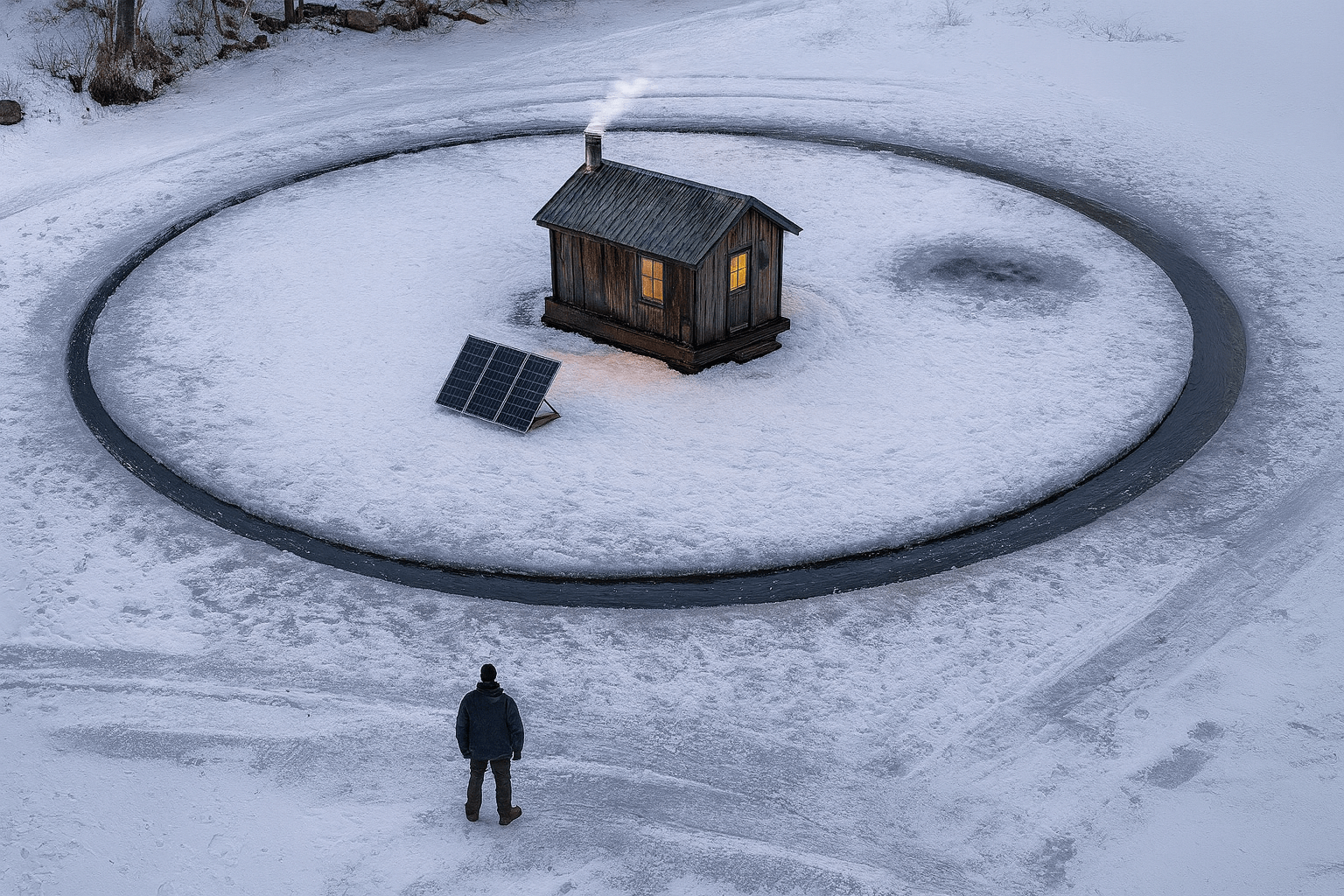
I visited him in winter, the year after he finished building his reservoir. It was fully permitted, fully documented, and entirely his own work. We walked down to it together. The lake had frozen nearly a foot thick. Near the centre, he had created an island.

He explained it with the quiet pride of someone who knew the explanation would land eventually. He had anchored a rope at the centre, drawn a perfect circle, and cut it by hand with a massive steel saw. Sixty feet across. In the middle sat an ice-fishing hut he had built himself. Double-glazed windows. A lamp. An electric cooker. Power came through a cable beneath the ice, fitted with a mechanism that allowed endless rotation without twisting. The island turned slowly during the day, driven by a small solar motor at its edge.

“Of course,” he said, watching it move, “it doesn’t run at night, or when the weather’s foul. But who wants to be out here then?”

Standing there, in the cold, watching an island turn because someone had thought carefully enough and been left alone long enough to make it happen, I felt something unexpected. Not awe at nature—I had plenty of that—but recognition. A sense that civilisation was not concrete and paperwork, not forms and permissions, but competence applied with restraint. Rules that protect, not smother. Freedom that assumes responsibility, not its absence.

When I left his mountain, I drove back towards towns and signs and instructions. I remember thinking, quite seriously, that I had just visited civilisation for the first time.

Grounded by Green: How the RAF’s Net-Zero Crusade Risks Leaving Britain Defenceless

Imagine the sirens sound in London.

Typhoon pilots sprint for cockpits that have flown ten per cent fewer hours this year so their squadrons could meet an emissions cap.

Tankers sit on the apron topped up with scarce Sustainable Aviation Fuel that costs four times more than kerosene, so the wing commander releases just two instead of the required four.

The calculus is brutal, and it is instant: fewer jets in the air, slimmer magazines, thinner margins.

The adversary—be it Russian bombers, Chinese hypersonic glide vehicles, or a swarm of weaponised drones smuggled across Europe’s southern flank—does not care that our bases run on wind power or that our hangars are net‑zero.

All that matters in that moment is whether we can fight and win.


Survival first, stewardship second

Climate policy is a long‑term struggle for habitability; war is an immediate struggle for survival.

Lose the second and the first becomes irrelevant.

An occupied nation has no agency over carbon prices, land‑use policy, or green R & D.

Remember how Ukraine’s grid decarbonisation goals evaporated the instant Russian missiles targeted Kyiv’s substations; the only metric that counted was megawatts restored quickly enough to keep lights on and radars spinning.

The same brutal arithmetic would apply here.

If Portsmouth is cratered or RAF Lossiemouth is reduced to rubble, our gleaming solar arrays and impeccably sorted recycling streams will not defend the Channel, guard data cables in the Atlantic, or shield cash machines from cyber‑extortion.


The illusion of choice

Proponents of the current programme argue the United Kingdom can “walk and chew gum”, greening Defence while preserving deterrence.

That phrase rings hollow when budgets are already stretched between replacing Trident, recapitalising land forces gutted after the last review, and standing up an AUKUS submarine fleet.

Every pound poured into retro‑fitting hangars is a pound not spent on stocks of medium‑range air‑to‑air missiles; every hour an F‑35B sits in a simulator to save carbon is an hour the pilot is not honing instinctive reactions to a real, air‑combat merge.

The hard truth is that Defence cannot buy itself out of physics.

Hydro‑treated plant oils and e‑fuels hold less energy per kilogram than Jet A‑1.
Batteries steal payload and range.

“Do more with less fuel” eventually becomes “do less”.


A realistic hierarchy of need

  1. Win the fight.
    Deterrence that fails costs cities, not credit‑rating points. War‑winning mass and readiness must sit at the top of the spending stack.
  2. Harden the force.
    Where green technologies also add resilience—micro‑grids that keep a station alive when the national grid is hacked, for example—they should be accelerated. But they serve the war‑fighting aim first.
  3. Cut emissions without cutting capability.
    Capitalise on incremental gains already proven in conflict—formation flying software that trims fuel burn, synthetic training that substitutes only the least valuable live sorties—not the most.
  4. Hold ambition to account.
    Net‑zero deadlines must carry a readiness‑override clause: if a target compromises deterrence, it slips. Not the other way round.

A closing vision

Picture a different headline five years hence: “RAF repels barrage on UK airspace; combat air wing retains 92 % mission‑capable rate.”

In the footnotes, you learn the bases ran on a hybrid micro‑grid, and the tankers blended 20 % SAF because supply chains allowed it—not because doctrine demanded it.

That is how sustainability should look in a world of peer conflict: a dividend of strength, never a substitute for it.

Climate change may shape the century, but if the Union Flag is replaced over Whitehall, the climate debate—along with every other public good—ends at the barrel of someone else’s gun.

First secure the realm. Then, in the peace our readiness secures, we can afford the luxury of arguing about carbon.