This morning, I attempted to log in to a different company account on QuickBooks.
It should have taken perhaps ten seconds. Instead, passkeys turned it into an intense five-to-ten-minute project involving repeated attempts, rejected routes and the usual digital guessing game in which the customer must discover what the software has decided to do on his behalf.
Eventually I checked the settings which I had previously disabled. They had somehow been re-enabled. I had not changed them. Perhaps an update had restored the provider’s preferred defaults; perhaps some other piece of helpful automation had intervened. Either way, my expressed choice had not survived.
A setting which silently reverses itself is not a setting. It is a temporary stay of execution.
Passkeys are presented as the civilised successor to passwords: simpler, safer and resistant to phishing. The cryptography is undoubtedly clever. A passkey is tied to the genuine website and cannot be handed innocently to a convincing imitation. This tackles a real problem, particularly among people who reuse memorable passwords or type credentials into whatever page appears before them.
But the sales pitch quietly substitutes one security problem for another. It concentrates identity, authentication and often account recovery in the same small object carried everywhere in a pocket.
Put down an unlocked telephone and someone else can pick it up. Phones are snatched from people’s hands by thieves on bicycles. Criminals observe PINs before stealing devices. Ministers, officials and businesspeople have all demonstrated that possession of an important telephone is not a theoretical risk confined to careless teenagers. Yet the technology industry increasingly treats possession of the device, assisted by a face, fingerprint or short PIN, as proof of possession of the identity.
The answer from security specialists is that a properly locked telephone still requires biometric or PIN verification. This is true in the same way that a properly locked front door keeps out a burglar who has neither the key nor a window. It describes the security model while avoiding the circumstances in which the security actually fails.
Once a thief gains access to a phone, he may acquire the passkey, email account, text messages, authenticator, password-reset route and banking applications together. We are told this is multifactor authentication. Physically, it is often several differently named functions living inside one stolen box.
I have used Bitwarden since its early days. I do not know any of my account passwords. Each is unique and generated by the password manager; I know only my personal master password. I have never been hacked. My family know that master password, so when I die they will be able to gain access to the accounts and information they will need.
That is not an accidental arrangement devised for my convenience. It is a considered security and succession policy. It has one deliberate trust anchor, controlled by me, with a comprehensible route for inheritance.
Passkeys intrude upon that arrangement by creating a parallel collection of credentials distributed among Apple, Google, individual devices, browser profiles, password managers and service providers. Some synchronise; some do not. Some can be deleted; some appear again. Some sites remember the right account; others offer a passkey for the wrong one. Death, incapacity, loss of a device or a disputed cloud account can turn the promised simplicity into an archaeological expedition through systems nobody consciously chose.
This is not merely an objection to passkeys. Those who want them should be free to use them. The objection is to prescription disguised as provision: automatic creation, persistent prompting, passkey-first login screens and updates which restore settings the customer has already rejected.
The provider benefits handsomely. Fewer forgotten-password calls reduce support costs. Phishing losses decline. Authentication is outsourced to devices and platform companies. The customer supposedly receives convenience, but when the machinery fails, the provider’s saving becomes the customer’s unpaid labour.
Multiply my lost five or ten minutes by millions of users, then add every compulsory application, broken identity portal, circular chatbot, unexplained verification request and setting restored after an update. None appears in the national accounts as waste. It is simply removed from the productive day in fragments too small to invoice and too dispersed to attract ministerial attention.
Britain can no longer indulge this casually. As Ross Clark puts it with admirable economy in the title of his forthcoming book, Britain Is Bust. His subject is the approaching sovereign debt crisis and the unavoidable rationalisation of public spending. Passkeys will neither cause nor cure that crisis. They are, however, a neat specimen of the culture accompanying it: institutions lower their own visible costs by exporting effort, delay and frustration to citizens and businesses, then call the result innovation.
A country does not become unproductive only through grand strategic errors. It also does so ten minutes at a time.
The proper policy is neither difficult nor technologically reactionary. Providers should offer passwords, independent authenticator applications, physical security keys and passkeys. They should explain the differences. They should allow the customer to choose. A rejected method should remain rejected, and an update should not constitute fresh consent. No credential should be created silently. No customer should be repeatedly funnelled towards the provider’s cheapest option.
Security should also permit genuine separation. The credential, the device approving its use and the route for recovery need not all occupy the same phone. People handling valuable businesses or sensitive information should be able to keep authentication on a separate device or physical key. Those planning sensibly for death or incapacity should not have their arrangements defeated by credentials imprisoned inside a dead person’s biometric ecosystem.
The password was not perfect. Neither is the passkey. The difference is that I was permitted to manage the former intelligently, whereas the latter is increasingly imposed upon me by organisations convinced that their preferred system must also be mine.
Let providers provide. Let customers decide. And when we have decided, leave the bloody setting alone.
The world’s narrow places are still there. Britain simply stopped standing in them.
I have lived long enough to watch Britain surrender the sea without firing a shot.
I remember when the sea still answered to us.
Not in the childish way the history books tell it now, with red patches on maps and brass bands playing under tropical suns. The real power was quieter than that. It lived in harbours and ledgers, in insurance slips signed at Lloyd’s, in grey destroyers slipping through cold water before dawn. It lived in the knowledge—shared by merchants, admirals and bankers alike—that the narrow places of the world were watched.
That was the arrangement. The world traded. Britain guarded the hinges.
We did not own every port, but we knew which ones mattered. Gibraltar watched the gate to the Mediterranean. Cyprus looked over the Levant. Aden kept an eye on the mouth of the Red Sea until 1967 when we abandoned it in a hurry that still smells of defeat. Singapore and Hong Kong anchored the East. Diego Garcia — a lonely coral ring in the Indian Ocean — became the great unsinkable airfield from which American bombers could reach half the planet. Even when the empire dissolved, the structure remained. The Americans would carry the heaviest guns. We would keep the old knowledge: the cables, the shipping markets, the insurance, the bases.
The arrangement worked because each side understood its role.
Alfred Thayer Mahan, the American prophet of sea power, studied the Royal Navy like a priest studying scripture. The United States Navy was built on lessons written in British salt water. Washington spent the money, built the fleets, and fought the large wars. Britain remained the world’s maritime brain — the keeper of chokepoints, charts and commerce. London insured the cargoes. Lloyd’s underwrote the risk. If pirates, missiles or revolutions threatened a shipping lane, the Royal Navy was still expected to appear somewhere on the horizon, perhaps with American company, perhaps not. Either way, the merchant fleets of the world slept easier.
That was the quiet deal that sustained the post-war order.
And now, as I lie here with the curtain half drawn and the breath not coming quite so easily, I look back at the slow abandonment of it — the long surrender carried out by men who congratulated themselves on every retreat.
First the bases went.
Aden was given up in 1967, not after a great battle, but after a weary withdrawal that marked the end of Britain’s formal role “east of Suez”. Hong Kong was returned to China in 1997 under treaty obligations Britain could no longer enforce, though the city’s later fate should make any honest man wonder what those signatures were worth. The Falklands remain British, defended by a permanent garrison since the Argentine invasion of 1982, yet even there the Navy now fields fewer escort ships than it once kept idling in Portsmouth.
Even Diego Garcia — the great American-British bastion in the Indian Ocean — has been handed back in sovereignty to Mauritius under the 2025 agreement, though the military base itself will remain under long-term lease. The government insists the arrangement secures the base for generations. Perhaps it does. But when a nation begins surrendering territory while insisting nothing has changed, the tone tells its own story.
Then came the thinning of the fleet.
During the Cold War the Royal Navy’s task in the North Atlantic was brutally clear. Soviet submarines had to pass through the GIUK Gap — the waters between Greenland, Iceland and the United Kingdom — before reaching the Atlantic sea lanes. British frigates, submarines and maritime patrol aircraft hunted them relentlessly. It was dangerous work and quietly decisive. The shipping lifeline between America and Europe depended upon it.
Today the Royal Navy still contributes to that task through NATO, but with a fleet that numbers fewer than twenty major escort vessels. In 1982 there were roughly three times as many.
We built two aircraft carriers, HMS Queen Elizabeth and HMS Prince of Wales, handsome ships and impressive on paper. Yet carriers are not symbols; they are systems. They require escorts, supply ships, aircraft, trained crews, and a political will to deploy them. Possessing a carrier without the fleet to support it is like owning a cathedral without priests.
And the humiliations come in smaller forms too.
Gibraltar — British since 1713 and besieged repeatedly by Spain — now exists within a delicate arrangement whereby Spanish officers will conduct Schengen border checks at its port and airport under a new UK-EU framework. Ministers assure us that sovereignty is untouched. Perhaps so. But one suspects the old garrison commanders of Gibraltar would stare rather hard at that arrangement.
Meanwhile London debates whether China should be permitted to construct its largest embassy in Europe at Royal Mint Court beside the Tower of London. Members of Parliament have raised concerns about proximity to sensitive communications infrastructure and the potential intelligence implications. Yet the argument drifts on through planning committees and consultations, as though the capital of a strategic ally were merely deciding the height of a garden wall.
Once we understood that cables, data, finance and naval power were parts of the same nervous system.
Now we discuss them as though they belonged to separate universes.
Even Lloyd’s — the old citadel of maritime risk — now finds itself cancelling or repricing war-risk cover in places where the Royal Navy once helped maintain confidence. Insurance has always depended upon force somewhere in the background. Without credible security, underwriting becomes guesswork.
And then there is the English Channel itself.
This narrow strip of grey water defeated Napoleon’s fleets and frustrated Hitler’s invasion plans. It was once the most heavily guarded maritime frontier on earth. Yet in recent years thousands of migrants have crossed it in inflatable boats launched from the French coast. Governments announce new schemes and patrols, and the numbers rise and fall with the seasons, but the symbolism is painful. When a nation cannot convincingly police the narrowest of its own waters, lectures about global order begin to sound hollow.
None of this occurred overnight.
That is the cruelest part.
Empires sometimes fall in fire and cannon. Britain declined politely, with policy papers and conferences. Each surrender was explained as realism. Each retreat was framed as progress. Each reduction in power was described as “modernisation”.
And those who questioned the process were told they were nostalgic men clinging to ghosts.
Perhaps we were.
But ghosts are what remain when memory outlives courage.
The Americans still try to hold the system together, though even they are tiring of it. They built the fleets and wrote the cheques because the arrangement once made sense. Britain guarded the gateways of the old world — the straits, the insurance markets, the cables — while Washington carried the heavier military burden. Together the structure kept global trade moving.
Now the chokepoints falter one by one, and the world looks to Washington to fix problems that once belonged partly to London.
And Britain?
Britain drafts climate frameworks for shipping at the International Maritime Organization, debates planning permission for foreign embassies beside strategic infrastructure, and congratulates itself on moral leadership while the old machinery rusts.
Perhaps the country still believes it has outgrown the rough duties of power.
But trade still moves through straits. Tankers still pass through Hormuz. Submarines still patrol the North Atlantic. Insurance still depends on force somewhere over the horizon.
The world did not change.
Britain did.
And as I lie here, watching the evening creep slowly across the room, I find that the saddest thought is not that Britain became smaller.
All nations grow smaller in the end.
The tragedy is that we surrendered the habits of seriousness long before we surrendered the means.
We had the ships.
We had the ports.
We had the credit.
We had the knowledge of how the world’s narrow places held the great machine of trade together.
And we let it slip away — strait by strait, base by base — while telling ourselves we were becoming wiser.
History, I suspect, will judge that differently.
But by then, of course, we shall all be safely dead.
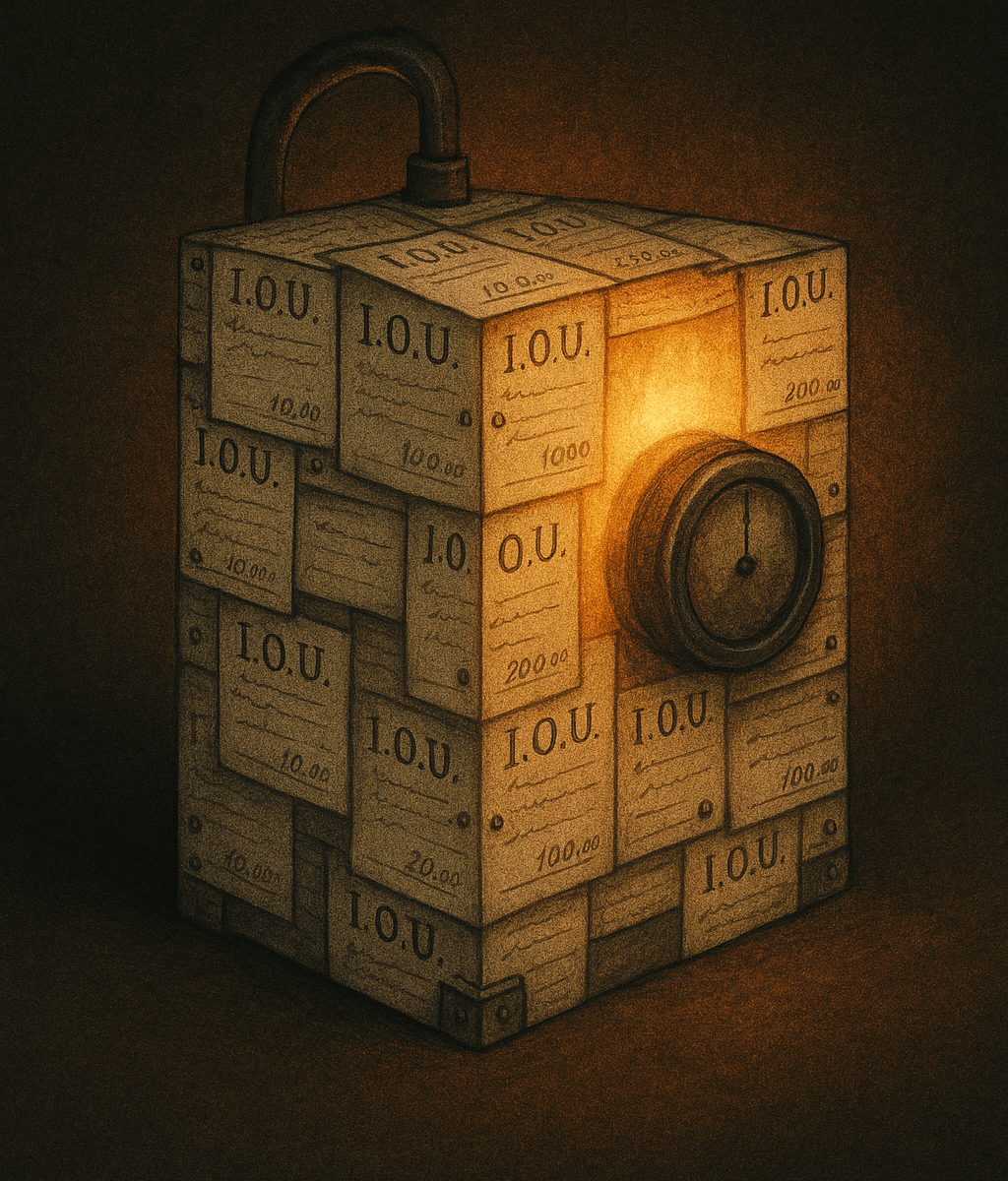
The Bonfire of Ownership – The slow dismantling of the institutions that once made Britain serious.
Nations do not lose power in a single dramatic collapse. More often it erodes quietly through the slow dismantling of the institutions that once made Britain serious.
Nations do not collapse in spectacles of ruin. They decline administratively. The erosion of liberty rarely arrives with banners or barricades. It appears instead as guidance, optimisation, and protection, introduced through processes so mundane that resistance feels faintly unreasonable. The modern citizen is not ordered to surrender autonomy. He is persuaded to misplace it.
The evidence is seldom dramatic. It begins in trivial irritations: a device, purchased outright, quietly reconfigured by its manufacturer in the name of preservation. A setting deliberately chosen by the owner reappears in its default state following an update issued without consultation. The justification is rational, even defensible. The owner, it is implied, cannot be trusted to act in the best interests of his own property. The device must be protected from the individual who paid for it.
Such incidents would once have been regarded as impertinent. Today they are routine. Ownership has been replaced by conditional authorship. The citizen is permitted to configure his environment, provided he accepts that it will be periodically corrected by those who know better.
This transformation was not unforeseen. Early scholars of digital governance warned that authority would migrate most effectively when it ceased to rely upon legislation and embedded itself instead within technical architecture. Laws could be challenged, debated, and repealed. Systems, once operational, simply persisted. These thinkers argued that code would not merely enforce regulation but would become regulation — invisible, automatic, and resistant to democratic revision. They were regarded as imaginative theorists. Experience has quietly promoted their warnings into operational reality.
The same migration of authority is visible across British institutional life. The Post Office Horizon scandal demonstrated with exceptional clarity how technological infallibility, once declared, can displace both justice and reason. Hundreds of sub-postmasters were prosecuted, bankrupted, and socially destroyed because an institution found it easier to criminalise human testimony than to question the reliability of its own system. The tragedy was not simply technological failure. It was administrative certainty. The machine could not be wrong because the institution could not afford for it to be wrong. Authority defended software and prosecuted citizens.
The lesson was received with remarkable efficiency, though not in the manner one might have hoped. Banking, once an archetype of reciprocal commercial trust, has undergone a similar evolution. Open banking and strong customer authentication were introduced under the language of empowerment and security. In practice, they have entrenched a regime in which access to one’s own finances requires continuous verification, behavioural monitoring, and tolerance of persistent inconvenience. Banks contact customers urgently when information is required, typically through messages that cannot be answered. When customers require assistance, they encounter automated barriers, rationed human contact, and communication channels designed less for dialogue than for containment.
The commercial asymmetry would be remarkable if it were not now so familiar. Customers deposit capital, entrust personal data, and assume institutional risk, yet must compete for access to services they themselves finance. Increasing numbers have responded with understated pragmatism by withdrawing funds and transferring them to organisations still willing to communicate through email, telephone, or direct messaging. Traditional banks appear increasingly content to retreat from service provision and reconstitute themselves as regulated custodians of trust, extracting revenue from payment infrastructure while ceding innovation to more agile intermediaries.
Energy policy provides an equally instructive example. The smart meter rollout was presented as an instrument of transparency, enabling consumers to monitor consumption and reduce costs. In reality, it created a technological platform capable not merely of measurement but of behavioural enforcement. Pricing, usage, and consumption patterns increasingly fall within the administrative discretion of infrastructure operators rather than household decision-makers. The consumer is encouraged to regard this transfer of authority as environmental virtue. Choice remains available, but only within parameters determined by those insulated from the consequences of their decisions.
Speech, once regarded as the cornerstone of democratic legitimacy, has been subjected to similar administrative refinement. The Online Safety Act establishes a regulatory framework in which lawful expression may nonetheless be suppressed through platform enforcement incentives. Companies are encouraged to remove content pre-emptively, not because the law demands such caution explicitly, but because regulatory penalties reward over-compliance and punish hesitation. Authority is exercised indirectly, through incentive structures that render dissent economically hazardous rather than legally prohibited.
What unites these developments is not ideology but method. Authority has ceased to argue and begun to embed. Political choices are recast as technical necessities. Opposition is reframed as misunderstanding. Compliance becomes the default condition of participation in modern society.
British legal tradition once contained formidable defences against such encroachments. The common law principle that a man’s home is his castle expressed more than property rights; it embodied a presumption of personal sovereignty. The doctrine of administrative reasonableness required state decisions to withstand rational scrutiny. These traditions assumed that authority required justification and that power, to remain legitimate, must remain visible. Contemporary governance increasingly operates through mechanisms that evade these safeguards by translating decisions into technical processes and automated compliance frameworks. Authority is no longer asserted. It is compiled.
The genius of this transformation lies in its civility. No one is dragged from his home for criticising a regulatory regime. Instead, his account is restricted. His transactions are delayed. His content is deprioritised. His choices narrow quietly until dissent becomes administratively exhausting. Coercion is replaced by friction. Consent is replaced by fatigue.
The modern bank exemplifies this evolution. Once sustained by personal relationships and local accountability, it now survives primarily as a certified intermediary between the citizen and financial infrastructure. Trust, formerly cultivated through accessibility and service, is increasingly reduced to regulatory compliance and institutional branding. Payments, lending, and savings services are steadily migrating to technologically agile platforms. The bank’s remaining utility lies in its authority to validate identity and satisfy regulatory expectation. It becomes less a merchant and more a notary.
The small acts of resistance that persist — closing accounts, disabling unwanted functions, declining digital credentials — acquire symbolic significance precisely because their practical impact is limited. They represent attempts to preserve authorship within systems designed to reduce the citizen to a user. They recall an older constitutional settlement in which instructions, once given, remained in force until deliberately changed.
But symbolism cannot substitute for structure. A society that relies upon individual vigilance to preserve autonomy has already conceded the principle of autonomy. Freedom that survives only through constant technical alertness is freedom in retreat.
The transformation of authority into architecture carries one further and rarely acknowledged consequence. When power embeds itself within systems, it becomes insulated not only from public debate but from moral responsibility. Decisions appear as outcomes rather than choices. Accountability dissolves into process. The citizen is left negotiating with interfaces rather than institutions.
It may yet be that none of this is malicious. Indeed, it is far more unsettling if it is not. A society that relinquishes autonomy not through oppression but through administrative convenience demonstrates a subtler and more permanent form of decline. When citizens grow accustomed to being managed rather than represented, corrected rather than persuaded, and optimised rather than trusted, they cease to notice the distinction between governance and supervision. By the time they do, if they do, they will discover that the mechanisms designed to protect them from inconvenience have succeeded only in protecting power from accountability. Nations rarely lose their freedoms in a moment of catastrophe. They misplace them gradually, misfiled among compliance procedures, customer journeys, and software updates that nobody remembers requesting.
Afterword
By Laurence J. Peter (Posthumously, and With Considerable Relief That He Cannot Be Blamed for Any of This)
The study of bureaucratic expansion demonstrates that institutions rise to meet the limits of their competence and then continue rising with admirable indifference to gravity. In previous centuries, this phenomenon expressed itself through memoranda, filing cabinets, and committees convened to explain why earlier committees had failed to produce sufficient memoranda. Modern technology has improved the efficiency of this process while preserving its essential spirit.
One should never underestimate the capacity of a system to protect itself from the inconvenience of the public. The moment a service becomes essential, its providers begin the delicate transition from assistance to administration. This transformation is achieved not through declaration but through refinement. Procedures multiply. Access narrows. Compliance acquires moral overtones.
Several governing principles may be observed. Institutions invariably mistake longevity for legitimacy. Any organisation that describes itself as customer-focused has already redirected its focus elsewhere. The more a system promises frictionless interaction, the more elaborate its hidden mechanisms of friction become. Technology does not eliminate bureaucracy; it digitises it, accelerates it, and renders it permanently accessible.
When an institution assures the public that it acts for their safety, the prudent observer determines whose safety is under discussion. Access that can be granted can be withdrawn with admirable administrative efficiency. Trust transferred from personal relationship to institutional certification becomes indistinguishable from compliance. Citizens repeatedly required to confirm their identity eventually begin to doubt its permanence.
Processes described as streamlined have typically removed the element that permitted dissent. Efficiency, pursued as a moral objective rather than a practical one, produces systems that function flawlessly for everyone except their users. Incompetence rarely destroys institutions. It reorganises them. Failure, sufficiently systematised, becomes policy. Policy, sufficiently complex, becomes immune to reform. Reform, sufficiently delayed, becomes heritage.
The citizen confronting this landscape is advised to cultivate a modest but persistent scepticism toward any authority that offers convenience in exchange for discretion. He should distrust the large promises, read the small print, and retain, wherever possible, the habit of asking why. This will not prevent decline, but it may delay its paperwork.
References
• Post Office Horizon IT Inquiry, Final and Interim Reports, UK Statutory Public Inquiry chaired by Sir Wyn Williams, 2020–present
• House of Commons Business and Trade Committee, Post Office and Horizon IT Inquiry Evidence Sessions and Reports, 2022–2024
• European Union Revised Payment Services Directive (PSD2), Directive (EU) 2015/2366 on payment services in the internal market
• UK Open Banking Implementation Entity, Open Banking Standards and Framework Documentation, mandated by the Competition and Markets Authority following the Retail Banking Market Investigation Order 2017
• Competition and Markets Authority, Retail Banking Market Investigation Final Report, 2016
• Financial Conduct Authority, Strong Customer Authentication and Secure Communication under PSD2, Regulatory Technical Standards and FCA Guidance, 2019 onwards
• National Audit Office, Rolling Out Smart Meters, HC 12 Session 2018–2019
• Department for Energy Security and Net Zero, Smart Meter Implementation Programme Annual Reports, various years
• Associated Provincial Picture Houses Ltd v Wednesbury Corporation [1948] 1 KB 223, establishing the Wednesbury principle of administrative reasonableness
• Semayne’s Case (1604) 5 Co Rep 91a, foundational common law authority for the doctrine that a person’s home is their castle
• Dicey, A. V., Introduction to the Study of the Law of the Constitution, first published 1885, for classical articulation of rule of law and limits on administrative authority
• House of Lords Constitution Committee, The Legislative Process: The Delegation of Powers, HL Paper 225, 2017–2018
• National Cyber Security Centre, Guidance on Secure Customer Authentication and Fraud Prevention, supporting regulatory approaches to digital identity and verification
• UK Government, Department for Science, Innovation and Technology, UK Digital Identity and Attributes Trust Framework, updated editions 2022–2024
• House of Commons Public Accounts Committee, Smart Meter Rollout Progress Reports, various sessions 2018–2024
• Bank of England and HM Treasury, The Digital Pound Consultation Paper, 2023, discussing centralisation of payment infrastructures and identity verification implications
• Zuboff, Shoshana, The Age of Surveillance Capitalism, 2019, widely cited academic work on behavioural data control and digital governance trends
• Lessig, Lawrence, Code and Other Laws of Cyberspace, 1999 (and Version 2.0, 2006), foundational theory on technological architecture as regulatory authority
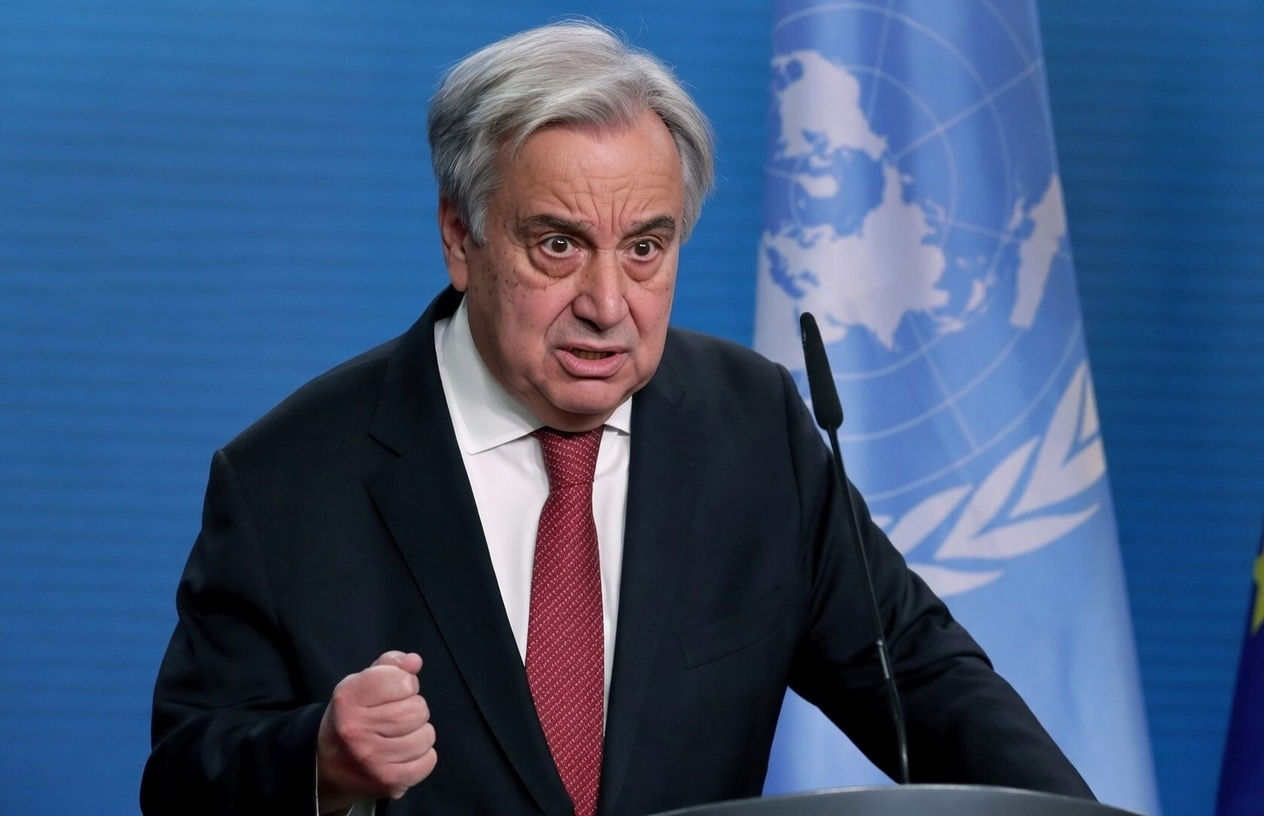
I am the Secretary-General. This time the collapse is financial. Not moral — those have been rolling since the flag was stitched.
We are owed money. A record sum. We like records. Most meetings per outcome. Most languages per problem solved. Most observers per massacre.
In 1994 eight hundred thousand people were killed in Rwanda. We were present. Presence is important. We watched carefully. We took notes. Then we left. Leaving is called restraint when you have name badges.
In 1995 we declared Srebrenica safe. The word safe survived. Eight thousand people did not. We reviewed our processes. The processes survived.
Our peacekeepers went to Haiti to help. Ten thousand people died of cholera. From the help. We apologised. Apologies do not require logistics.
We are neutral. That is why the strong and the weak get one vote each. The United States pays a fifth and speaks once. Tuvalu speaks once. Population eleven thousand. Equality is very tidy on paper.
China pays. China votes. China sits on the Human Rights Council. So do Eritrea and Sudan. We put “human rights” in the title to keep them nearby.
We condemn things. Strongly. Sometimes strongly-er. The things continue. But now they are condemned. This is progress you cannot see.
We investigated Oil-for-Food. Found billions missing. Named thousands. Prosecuted none. Published a report long enough to stop a door.
We have rules. The rules say unused money must be returned to states that did not pay. This is sustainability as understood by people who quote Kafka instead of fixing things.
Our peacekeepers have guidelines. The guidelines say do not abuse the people you are meant to protect. The abuse continues. But now it is against the guidelines. This is accountability.
We may run out of cash by July. This will affect operations. Operations such as watching and expressing concern.
Please send money. We promise to give some of it back to those who didn’t send any. That is the system. We designed it.
Changing it would require a resolution. The resolution would be optional. Optional means ignorable.
I am not good at arithmetic. Or prevention. Or stopping things.
I run the United Nations.
Dedicated to Kenule Beeson Saro-Wiwa — Ken — who spoke when silence was safer, who wrote when truth was unwelcome, and who stood for the land, the people, and the dignity of voice against power that mistook brutality for order. May remembrance outlive repression, and may words continue where courage once paid the ultimate price.
With Grieg’s Solveig’s Song murmuring in the room like a memory that refused to settle, I regarded the object on my desk as one might regard a moral problem rather than a tool. Its yellow-and-black casing had the crude confidence of a warning sign, a thing that announced danger not by subtlety but by volume. It did not invite curiosity; it challenged it. The marketing bravado still echoed in my head — stop a bull — a phrase so casually obscene in its certainty that it reduced violence to a cartoon. Even the packaging had rehearsed the lie: rage on the outside, tranquillity within, as though brutality could be switched off by presentation alone.
Pickles moved beneath my chin, her tail brushing my face with deliberate intimacy. Cats have a way of interrupting abstraction with life. She was warm, alive, heedless of symbols. For a moment I wondered whether she sensed the wrongness of the thing in front of me, whether animals possess an instinct for objects whose sole purpose is domination. The thought that followed — uninvited and instantly abhorrent — stopped me cold. I dismissed it with shame. Curiosity has a habit of disguising itself as reason, but there are lines that announce themselves clearly once approached.
And yet the question remained, stripped of excuses: what does it do to a human being?
A moment of hesitation: a man contemplates a device designed for control, while his cat, Pickles, looks outward, indifferent to the decision at hand.
Not in theory. Not in specifications or warnings. In the flesh. In consciousness.
Schrödinger intruded, as he so often does when one is tempted to confuse knowing with imagining. Until observed, the outcome remains mercifully abstract. Pain exists only as a concept until it does not. Pickles, in her indifferent wisdom, offered me two futures with equal plausibility and no commentary.
I sat there, absurd in my running shorts, contemplating how easily language softens reality. Non-lethal. Deterrent. Compliance. Words that tidy up what they conceal. I told myself I was healthy, rational, informed. I told myself many things.
What I did not tell myself — what no brochure ever tells you — is what happens when the body’s private contract with itself is broken.
When it came, it was not pain in the familiar sense. There was no warning, no sharpness, no escalation. It arrived whole. A total occupation. Every nerve seemed to scream at once, not loudly but absolutely, as though the very idea of sensation had been weaponised. Thought did not race; it vanished. Language collapsed. There was no where it hurt, because the body ceased to be a collection of parts and became a single, screaming fact.
Muscles betrayed their purpose. They did not spasm; they revolted. The body folded in on itself, not to protect but to obey, as though some deeper authority had seized control and issued a single command: cease. Breath was no longer an action but an obstacle. Time fragmented. A second stretched into an eternity dense with terror, because terror was all that remained.
There was no dignity in it. No heroism. No lesson beyond the most primitive one: this thing does not persuade, it overrides. It does not warn, it annihilates. The mind, so fond of metaphors and music and philosophy, is reduced to a silent witness while the body is informed — with brutal clarity — that it is no longer sovereign.
When it ended, the silence was worse. Not relief, but aftermath. A trembling void where confidence had been. The knowledge that something had reached inside and demonstrated, beyond argument, how easily the human animal can be switched off.
If this reads like curiosity, let it not. It is a caution written in retrospect. Some questions do not reward answers. Some doors, once opened, do not leave you unchanged. And some devices exist not to be understood, but to be refused — on the simple, hard-won principle that anything capable of unmaking you so completely has no business being tested for interest, amusement, or proof.
I met him because someone thought I ought to. That was the reason given, anyway. I was visiting Yosemite about twenty years ago, staying long enough to fall into conversation with a park employee who, after a day or two of small talk, said, almost casually, “You should meet a friend of mine.” He paused, gauging whether I was the sort of person who might laugh. “He lives off the grid. Completely.”
We drove for a while after leaving the park boundary. That mattered, I was told. Inside Yosemite, the rules were absolute, and rightly so. Preservation there was not a slogan but a discipline. You could admire nature, walk through it, photograph it, but you could not negotiate with it. My host’s friend had no quarrel with that. He simply knew the difference between stewardship and suffocation.
His land lay on the side of a mountain, far enough from the road that the last stretch was done slowly, deliberately, as if the place resisted being arrived at too quickly. He was a hunter, a fisherman, a farmer, but not in the romanticised way of catalogues and television. He knew where bears crossed and gave them room. He knew which rocks warmed snakes in the afternoon and left them alone. The wild boar were another matter—hybrids, aggressive, clever—and he spoke of them with the wary respect you reserve for something that can beat you if it chooses. Wolves, he said, were fewer every year. Farmers still poisoned and trapped them, not out of cruelty so much as habit. That observation came without anger, only with the calm note-taking of a man who preferred facts to outrage.
He kept a horse and goats, grazing them on land that had been measured and remeasured, not by surveyors this time but by weather, yield, and patience. Everything he needed was there, and almost nothing he didn’t.
His name was Patrick Murphy, though no one called him that. He had been christened “Lucky the Lacky” on an oil rig in his youth, a name that had clung because it was earned. Fresh out of college, qualifications in hand, his father had sent him offshore with a blunt instruction: to become an engineer, he had to start where engineering was least glamorous. That meant a year living and working with men who took pride in muscle, routine, and relentless teasing. They called him Lacky at first, and the name was not kind. He carried tools, cleaned messes, learned the rhythms of machinery and people. The teasing persisted, but so did the respect. Friendship grew where condescension was expected.
The day the name changed, a pressure system failed. A safety valve did its job too well. Shrapnel tore through the air, punched through a hut, and vanished into the sea beyond. Patrick had just sat down inside. Had he still been standing, he would not have walked away. The men who saw it happen decided that Lacky no longer fit. From then on he was Lucky, though “Lucky the Lacky” remained his formal title whenever ceremony demanded it.
He went on to live what most people would call a successful life. Marriage, children, good money, a future inheritance. Then came the divorce. It did not ruin him, but it rearranged him. He began to notice how much of his life was spent maintaining things he did not particularly want, under rules that assumed he could not be trusted to manage himself. The problem, as he saw it, was not rules in themselves. He had lived with them on rigs and respected them there. The problem was excess—regulation without purpose, oversight without understanding.
So he bought a mountain.
By forty, he had stripped his life back to what he considered essential. He obeyed the laws that mattered—licenses, taxes, insurance—and did so meticulously. A former engineer with an almost pathological respect for tolerances, he designed everything to exceed requirements. If an inspector came, they left reassured, if slightly puzzled. Beyond that, he kept authority at arm’s length.
Power came first from the sun. Solar panels fed an array of ten forty-eight-volt lead-acid batteries, the best available at the time. That power pumped water into a tower-mounted tank, gravity doing the rest. When he opened a tap, the descending water turned a small generator, reclaiming a fraction of the energy used to lift it. “It’s not much,” he said, almost apologetically, “but it offends me to waste effort.”
A river ran through his property. On it he built a water wheel, properly licensed, inspected, and documented. It produced about thirty amps at one hundred and fifteen volts, day and night. That, he said, was the only part of his life that required anyone else’s permission, and he accepted that without complaint. Left unregulated, rivers were abused. Some rules, he believed, existed because people had earned them.
He was not, despite appearances, cut off. He had internet access. He wrote, studied, made videos. An address existed where parcels could find him. He used these connections sparingly, but effectively. People sent him tools and gadgets to review. He obliged, not as an influencer but as an engineer who enjoyed explaining why something worked—or didn’t.
I visited him in winter, the year after he finished building his reservoir. It was fully permitted, fully documented, and entirely his own work. We walked down to it together. The lake had frozen nearly a foot thick. Near the centre, he had created an island.
He explained it with the quiet pride of someone who knew the explanation would land eventually. He had anchored a rope at the centre, drawn a perfect circle, and cut it by hand with a massive steel saw. Sixty feet across. In the middle sat an ice-fishing hut he had built himself. Double-glazed windows. A lamp. An electric cooker. Power came through a cable beneath the ice, fitted with a mechanism that allowed endless rotation without twisting. The island turned slowly during the day, driven by a small solar motor at its edge.
“Of course,” he said, watching it move, “it doesn’t run at night, or when the weather’s foul. But who wants to be out here then?”
Standing there, in the cold, watching an island turn because someone had thought carefully enough and been left alone long enough to make it happen, I felt something unexpected. Not awe at nature—I had plenty of that—but recognition. A sense that civilisation was not concrete and paperwork, not forms and permissions, but competence applied with restraint. Rules that protect, not smother. Freedom that assumes responsibility, not its absence.
When I left his mountain, I drove back towards towns and signs and instructions. I remember thinking, quite seriously, that I had just visited civilisation for the first time.
Once upon a time—within living memory, though now spoken of as though it were some sepia-toned idyll—the local council was exactly that: local. A modest civic body, often dull, occasionally officious, but recognisably part of the community whose money it spent. One imagines the town clerk of 1958, sleeves rolled, spectacles perched, frowning over the drainage budget with the stoicism of a man who knows he will meet the ratepayers in the butcher’s queue tomorrow morning. He was not a visionary, a strategist, a consultant, or a “stakeholder partner.” He merely fixed the roads, emptied the bins, and ensured the library opened on time. He did so because the town needed these things, and because the town paid for them.
Compare that modest creature with today’s municipal apparatus, a body swollen to the point of deformity, draped in managerial jargon and trembling under a hundred mutually contradictory regulations. Instead of the honest if plodding civil servant, we have entire platoons of officers whose professional identity is built not on service but on compliance. They do not shape the town; they interpret guidance. They do not defend local interests; they “engage” with frameworks. Their task is not to steward a place but to satisfy a central state that increasingly views local government as one more branch office—an outpost of Whitehall’s neurotic empire.
The transfiguration began when successive governments, each convinced of its own modernising brilliance, decided that the real problem with councils was that they were too responsive to their residents. Better, they thought, to strip away those old provincial arrangements and replace them with uniform “administrative units,” reorganised, rationalised and sanitised to within an inch of their lives. The result was the 1970s map: fewer councils, larger councils, and officials less likely to know the names of the streets they regulated. Efficiency, we were told. Progress, we were told. It has been downhill ever since.
A once-civic institution, now hollowed by bureaucracy and central control.
Then came the centralisers. Rate-capping, council tax limits, mandatory duties without matching funds: every lever was pulled to ensure that no local authority could so much as adjust a streetlight without permission from the capital. A Section 114 notice—local government’s version of sticking a “CLOSED FOR LACK OF MONEY” sign in the window—now hangs over dozens of authorities. The modern councillor governs nothing; he monitors a collapse, anxiously hoping that the Treasury might, in its mercy, approve a little more debt to keep the lights on.
And so to the regulations. If the older council was a steward, the modern council is a defendant—permanently awaiting judgement from a tribunal of auditors, inspectors, commissioners, ombudsmen, regulators and activist lawyers. Procurement law alone could cripple a lesser civilisation: tomes of directives dictating the precise choreography by which a council may purchase so much as a mop. The process is so paralysing that only the largest and most expensive corporations can complete it, creating a tidy cartel of outsourcers who speak the language of “KPIs” and “transformation pathways” while delivering services that are, at best, adequate and, at worst, catastrophic.
The tragedy is not merely the cost, though the cost is obscene. It is the culture. Preventive services, those quiet institutions that make a town bearable—youth centres, libraries, local works, the unobtrusive odd-jobbing that keeps a place civilised—have been amputated so that councils can funnel their remaining budget into statutory duties that grow more demanding every year. Social care now consumes the lion’s share of municipal budgets, not because councils have suddenly discovered humanitarian zeal, but because the law compels it and the courts enforce it.
Thus we inhabit the paradox of the British state: councils more elaborate than ever, producing worse public spaces than at any time since rationing. Potholes gape like geological features. Parks resemble the aftermath of a sullen strike. Planning departments take years to produce decisions that amount to artful apologies for not producing any decisions at all. What the average citizen sees is decay. What the average council produces is paperwork.
If the England of the post-war decades possessed a municipal ethic, it has been replaced by a municipal mirage: a swollen bureaucracy masquerading as governance, a system designed chiefly to protect itself from blame. It consumes money without delivering value, enforces rules without delivering order, and utters slogans about “communities” while retreating from the very notion of civic duty.
The state tells us this is progress: professionalism, standardisation, compliance, equality. But a town that cannot fix its own pavements is not progressing. A council that answers to Whitehall more readily than to its residents is not local. And a nation in which the simplest act of governance costs three times what it did half a century ago—and delivers a third of the quality—is not declining by accident.
It is declining by design. The design, as usual, belongs to people who do not have to live with the consequences.
When the state expands its procedures faster than its competence, decline arrives not as a crisis but as a schedule—issued quarterly, audited annually, and noticed by the public only when the bins stop being emptied.
One of the small but telling scandals of our age is the polite silence surrounding balsa wood. Not the stuff of children’s model aeroplanes, but the industrial-scale harvest that feeds the fashionable addiction to wind turbines. Balsa became the miracle ingredient of the green priesthood: light, strong, resin-friendly. And so the forests of Ecuador were stripped with the zeal of a Victorian naval yard, only without the dignity of purpose. Criminal gangs moved in, communities were gutted, and tracts of land were left as bald as a ministerial briefing note. All this so that Europe could congratulate itself on its moral cleanliness while importing a product cut from other people’s hillsides.
The turbine itself is a monument to selective blindness. One begins with a thousand tonnes of concrete—an unlovely material normally denounced by environmentalists until the moment it becomes necessary to bury it under a wind farm. Add a steel tower with a carbon footprint large enough to keep a small nation in warmth for a decade. Crown it with vast blades made from fibreglass, petrochemical resins, and the aforementioned balsa stripped from South American forests. Then transport it all by lorry, ship, and crane, every step soaked in diesel. Install it in a wind regime that fails to meet the advertised output for all but a few postcard days a year. This, we are told, is progress.
We are further assured that the “lifetime carbon payback” justifies the exercise. That is true only in the same sense that a government budget is “balanced” when one introduces assumptions about perfect weather, flawless machinery, and twenty years of uninterrupted operation. The turbine must spin at its daily optimum for two decades, the wind must behave like a Swiss railway timetable, the grid must remain stable without the usual frantic interventions, and the maintenance crews must exist in a state of immaculate readiness. The moment reality intrudes—repairs, downtime, suboptimal wind, or a cold still winter—the ledger curls up like an old leaf and deposits itself in the bin.
Then comes the end of life, that undisclosed chapter in the Book of Green Miracles. The blades cannot be recycled; they are not aluminium cans. They are thermoset composites, cured forever, doomed to burial. So they are chainsawed into pieces and entombed in vast pits, where they will outlast most of the modern political class. One wonders whether future archaeologists will conclude that the early twenty-first century worshipped giant fibreglass idols until the cult ran out of subsidies.
But the greatest deception—the one so ingrained that ministers repeat it without hesitation—is that wind replaces conventional generation. It does not. It decorates it. Behind every elegant white tower stands a gas turbine humming away like an anxious understudy, ready to spring on stage the moment the wind drops. That backup runs inefficiently, gulping fuel in stop–start cycles that nobody includes in the official figures because it ruins the story. The whole scheme resembles a child’s puppet theatre: all charm at the front, frantic scrambling behind.
Why are we investing in this? Because it is symbolic. Because it makes the correct people feel virtuous. Because it allows officials to commission glossy reports full of charts trending in pleasing directions. And because nothing flatters a modern government more than a technology which is large, visible, and useless at the precise moment one needs it.
If we possessed any genuine environmental seriousness, we would build nuclear plants and grid storage systems, and stop pretending that intermittency is a virtue. We would stop chewing through rainforest timber to construct machines that are nowhere near as green as the press releases suggest. Instead we cheer the arrival of another imported turbine, another scar on the landscape, another concrete tomb for future generations to puzzle over.
A civilisation that congratulates itself while paving fields with foreign timber and unrecyclable plastic, all in the name of purity, is not merely declining; it is losing its mind.
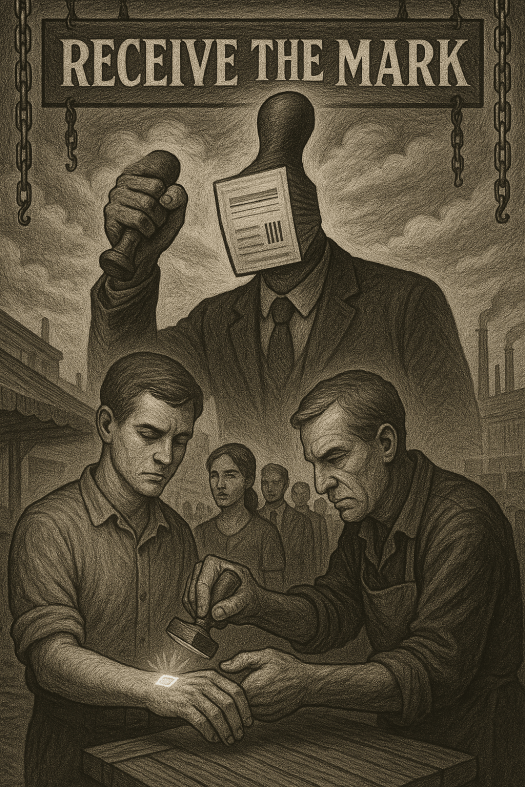
When the state makes life itself conditional on its seal, the mark of the beast is already upon us.
It is a curious thing that whenever governments extend their reach into private life, they never describe it as such. They speak instead of convenience, safety, modernisation. Sir Keir Starmer’s championing of digital identity sounds like a minor administrative adjustment, the bureaucratic equivalent of changing the colour of the tax return form. Yet the reality is rather less trivial.
Digital identity, once imposed, is not a marginal innovation but a centralising revolution. Every man, woman, and child becomes a data entry in a state-authorised ledger, their existence vouched for only so long as the system continues to recognise them. Enter a shop, book a train ticket, apply for a job, or access a bank account — all remain possible only if the digital credential functions. The promise is efficiency; the reality is conditional existence.
The most arresting commentary on such systems does not come from libertarian pamphlets or academic studies, though both have their place. It comes from an ancient text often dismissed as melodrama: the thirteenth chapter of the Book of Revelation. There, the writer describes a society in which “all, both small and great, rich and poor, free and bond” must carry a mark, without which “no man might buy or sell.” Scholars debate whether this was first-century allegory, coded critique of Rome, or apocalyptic vision. The detail is precise: the universal credential is the universal chain.
The state’s seal presented as progress, the moment of ownership disguised as efficiency.
No theological commitment is required to see the parallel. The mark on the hand or forehead is today’s biometric key. The exclusion from buying or selling is today’s digital wallet frozen by an unseen hand. The beastly system, whether religious or secular, rests not on spectacular cruelty but on the quiet, routine denial of access. Prison walls are unnecessary if the till refuses the card.
Sir Keir presents himself as a moderniser. His case for digital ID is couched in terms of security, fraud prevention, and border control. He would bristle at any comparison with scripture. Yet it is precisely his mildness that makes the matter more sinister. Tyranny that announces itself can be resisted. Tyranny that drapes itself in the language of efficiency is harder to unpick. One does not wake one morning to discover the mark branded on the hand; one drifts into a world where participation in daily life depends on presenting the correct token at every doorway.
Defenders of such schemes protest that the British state is not tyrannical, that it will never abuse such power. This is a charming thought. It is also historically illiterate. Every government abuses the powers it acquires, and powers are never surrendered. The veto inherent in a digital ID scheme — the ability to prevent a man from buying or selling — may sit dormant, but it will never be dismantled. It rests there, like a coiled spring in Whitehall, ready to be activated at the moment of political convenience.
Nor should the economic logic be ignored. The Bank of England has spoken openly about programmable currency, which requires, by definition, a universal identifier. To know what money is being spent on, or to restrict its use to particular purposes, the state must know who is doing the spending. The marriage of digital ID and programmable money creates precisely the world Revelation describes: life conditional on permission.
That the Labour leadership fails to see this is damning enough. That it understands and proceeds regardless is worse. The old Labour Party liked to talk about liberty and dignity. The new one is content to speak of databases and compliance. Sir Keir’s tone is calm, legalistic, mildly reassuring. The punchline is that he offers Britain not security but servitude by spreadsheet.
What makes this especially grotesque is Britain’s history. This was the nation that prided itself on habeas corpus, on common law, on the principle that the citizen was free unless explicitly restrained. The imposition of a universal ID, tethered to one’s ability to transact, inverts that principle. It assumes restraint, lifted only when the system gives its blessing. The state does not prove its case against the citizen; the citizen must prove his case to the state.
Some will accuse this argument of melodrama, of importing biblical language to dignify a mundane administrative reform. In truth the melodrama belongs to Starmer, who dresses coercion in the robes of progress. Revelation, for all its imagery, is coolly accurate. It identified, nearly two millennia ago, the core of what makes such systems intolerable. They do not merely control trade. They redefine freedom itself.
The polite suggestion is that Sir Keir has not reflected on the full implications. The impolite truth is that he has. Either way the effect is identical: a government that sees its citizens not as free men and women, but as registered users, liable to be suspended. And the suspension is not noisy, with trumpets and banners. It is silent, invisible: the card declined, the ticket refused, the door that no longer opens.
Sir Keir will be remembered. He will be remembered as the man who sought to baptise bureaucracy with the language of progress. Britain can weather his speeches; what it may not weather is the architecture he is so keen to build. The peril is not a number burned into the flesh. It is a system so ordinary, so seamless, that the nation scarcely notices it already carries the mark.
The writer of Revelation recognised the pattern. The mark of the beast was never about the hand or the forehead. It was about ownership — about the moment a man’s life ceased to be his own, and became conditional on another’s approval. That is what digital ID represents today. A mark not of safety, but of possession. And the question, as always, is whether the British people are still spirited enough to refuse it.