Grounded by Green: How the RAF’s Net-Zero Crusade Risks Leaving Britain Defenceless

Imagine the sirens sound in London.

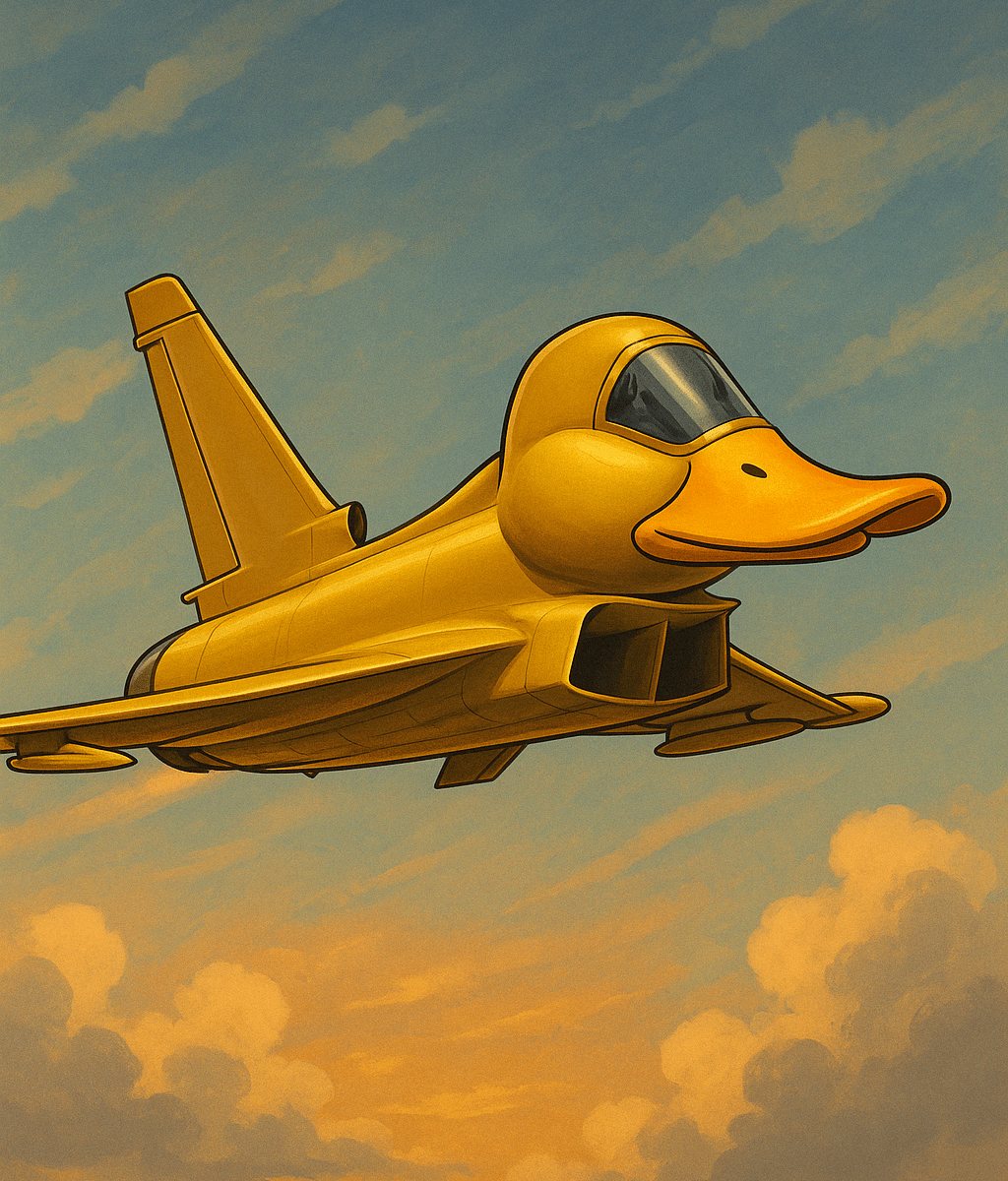
Typhoon pilots sprint for cockpits that have flown ten per cent fewer hours this year so their squadrons could meet an emissions cap.

Tankers sit on the apron topped up with scarce Sustainable Aviation Fuel that costs four times more than kerosene, so the wing commander releases just two instead of the required four.

The calculus is brutal, and it is instant: fewer jets in the air, slimmer magazines, thinner margins.

The adversary—be it Russian bombers, Chinese hypersonic glide vehicles, or a swarm of weaponised drones smuggled across Europe’s southern flank—does not care that our bases run on wind power or that our hangars are net‑zero.

All that matters in that moment is whether we can fight and win.


Survival first, stewardship second

Climate policy is a long‑term struggle for habitability; war is an immediate struggle for survival.

Lose the second and the first becomes irrelevant.

An occupied nation has no agency over carbon prices, land‑use policy, or green R & D.

Remember how Ukraine’s grid decarbonisation goals evaporated the instant Russian missiles targeted Kyiv’s substations; the only metric that counted was megawatts restored quickly enough to keep lights on and radars spinning.

The same brutal arithmetic would apply here.

If Portsmouth is cratered or RAF Lossiemouth is reduced to rubble, our gleaming solar arrays and impeccably sorted recycling streams will not defend the Channel, guard data cables in the Atlantic, or shield cash machines from cyber‑extortion.


The illusion of choice

Proponents of the current programme argue the United Kingdom can “walk and chew gum”, greening Defence while preserving deterrence.

That phrase rings hollow when budgets are already stretched between replacing Trident, recapitalising land forces gutted after the last review, and standing up an AUKUS submarine fleet.

Every pound poured into retro‑fitting hangars is a pound not spent on stocks of medium‑range air‑to‑air missiles; every hour an F‑35B sits in a simulator to save carbon is an hour the pilot is not honing instinctive reactions to a real, air‑combat merge.

The hard truth is that Defence cannot buy itself out of physics.

Hydro‑treated plant oils and e‑fuels hold less energy per kilogram than Jet A‑1.
Batteries steal payload and range.

“Do more with less fuel” eventually becomes “do less”.


A realistic hierarchy of need

  1. Win the fight.
    Deterrence that fails costs cities, not credit‑rating points. War‑winning mass and readiness must sit at the top of the spending stack.
  2. Harden the force.
    Where green technologies also add resilience—micro‑grids that keep a station alive when the national grid is hacked, for example—they should be accelerated. But they serve the war‑fighting aim first.
  3. Cut emissions without cutting capability.
    Capitalise on incremental gains already proven in conflict—formation flying software that trims fuel burn, synthetic training that substitutes only the least valuable live sorties—not the most.
  4. Hold ambition to account.
    Net‑zero deadlines must carry a readiness‑override clause: if a target compromises deterrence, it slips. Not the other way round.

A closing vision

Picture a different headline five years hence: “RAF repels barrage on UK airspace; combat air wing retains 92 % mission‑capable rate.”

In the footnotes, you learn the bases ran on a hybrid micro‑grid, and the tankers blended 20 % SAF because supply chains allowed it—not because doctrine demanded it.

That is how sustainability should look in a world of peer conflict: a dividend of strength, never a substitute for it.

Climate change may shape the century, but if the Union Flag is replaced over Whitehall, the climate debate—along with every other public good—ends at the barrel of someone else’s gun.

First secure the realm. Then, in the peace our readiness secures, we can afford the luxury of arguing about carbon.

Why Imperfection Can Boost Project Delivery

Neil Carruthers had a suit that fit like it was made for someone slightly more successful. He was mid-thirties, agile with spreadsheets, cautious with opinions. A contractor. Six-month rolling gig. Billing at £700 a day to help “transform delivery culture” at a bloated infrastructure firm called Eaglenex Systems — the kind of company that wrote press releases about internal memos and hired two project managers for every engineer.

At Eaglenex, perfection wasn’t a goal. It was a paralysis.

The Monday incident happened in Meeting Room 4C. A long rectangle of glass and resentment.

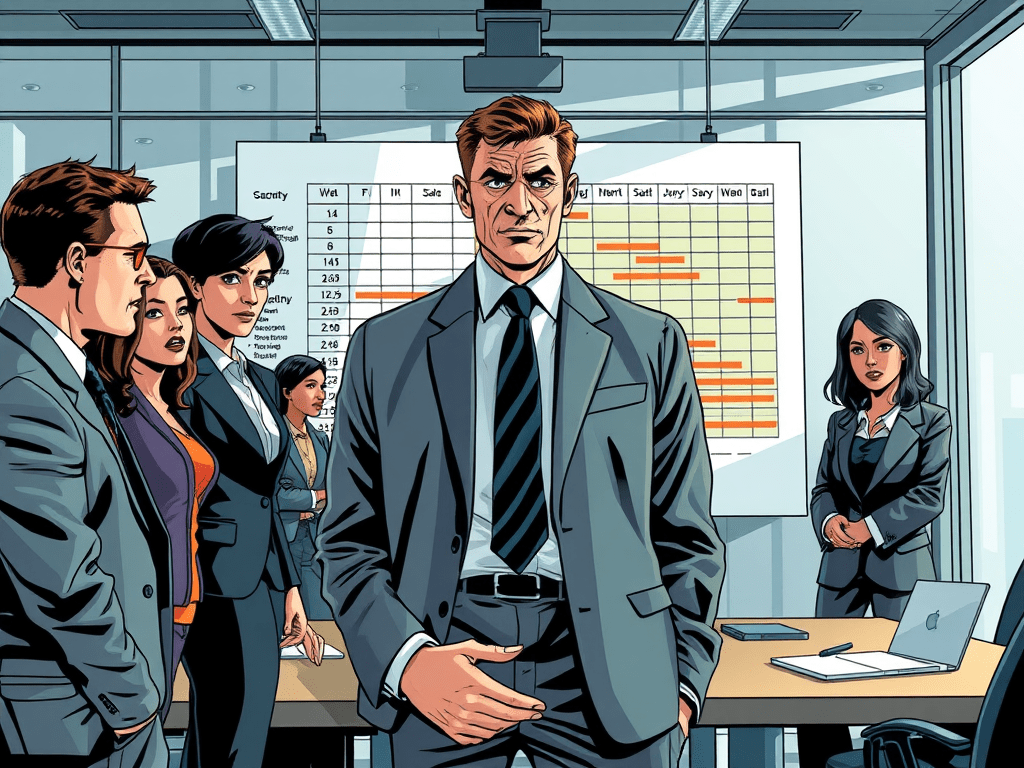
Everyone was there — Delivery, PMO, Compliance, a junior from Legal who blinked like he was learning to see. The project was three months overdue and twenty-seven pages into a colour-coded Excel workbook that still hadn’t had a single task marked “Complete.”

The Director of Delivery, a woman called Mariana, sharp-suited and permanently under-caffeinated, pointed at the Gantt chart on the wall and snapped, “We cannot release Phase 1 until QA signs off on every single scenario. We have a reputation.”

Neil, for reasons unclear even to himself, cleared his throat and said, “If it’s worth doing, it’s worth doing poorly.”

The silence hit like a power cut.

A full three seconds passed before Mariana turned, eyes narrowing.

“Excuse me?”

Neil blinked. Thought about walking it back. Thought about smiling, chuckling, pretending he was joking. But something inside him — maybe the ghost of his teenage self, or maybe just the spreadsheet open on his second monitor — pushed him on.

He said, “I just mean… we’ve got three modules ready. They’re not perfect. But they work. Waiting for the full gold-plated rollout means nobody gets anything. If it’s worth doing — delivering, in this case — then it’s worth doing now. Even if it’s not pristine. Even if it’s a bit rough. Doing it poorly is better than not doing it at all.”

Someone coughed. Someone else bit back a laugh.

Mariana stared. “We are not in the business of doing things poorly, Mr Carruthers.”

Neil said, “With respect, we’re currently in the business of not doing anything at all.”

Later that day, he expected a call from HR. Instead, he got an invite from the COO.

“You said something odd in the meeting,” the COO said, pouring himself an espresso like a man who preferred gin. “Something about doing things poorly.”

Neil braced himself. “I was making a point about over-perfection killing momentum.”

The COO sat back. “My daughter’s a sculptor. She said something similar. Art isn’t finished, it’s abandoned.” He sipped. “Maybe we’ve been trying to finish too many things that should have just been shipped.”

By Friday, they were running a pilot — releasing a trimmed-down version of Phase 1 to one region. The devs were horrified. The PMO issued disclaimers longer than the user guide. But it worked. Customers could finally use the tool. Feedback came in. Bugs were fixed. Real progress began.

Three weeks later, Mariana called another meeting. Same room. Same chart. But this time, three tasks were marked done.

She looked at Neil. “I don’t like your phrase. But I admit, it shook something loose.”

Neil shrugged. “I’ll trademark it if you like.”

Mariana smiled, just once. “No need. I’ve already stolen it.”

By the end of the quarter, Eaglenex had a new internal slogan on the walls: Start Small. Ship Fast. Iterate Better. It was basically Neil’s philosophy, run through a sanitiser. The phrase itself — the original heresy — was never spoken aloud again. But in corners of the business, whispered like a secret, people started to say it.

“If it’s worth doing…”

“…it’s worth doing poorly.”

And the wisdom was this: The fear of imperfection is a luxury companies can’t afford. The cost of not delivering is higher than the cost of delivering imperfectly. And sometimes, the person who dares to do it badly is the only one who gets anything done at all.

The Unlikely Hero: How a Boy Changed the Game

A tale of justice, clever thinking, and a boy who ran faster than the wind (but only if you asked him nicely).

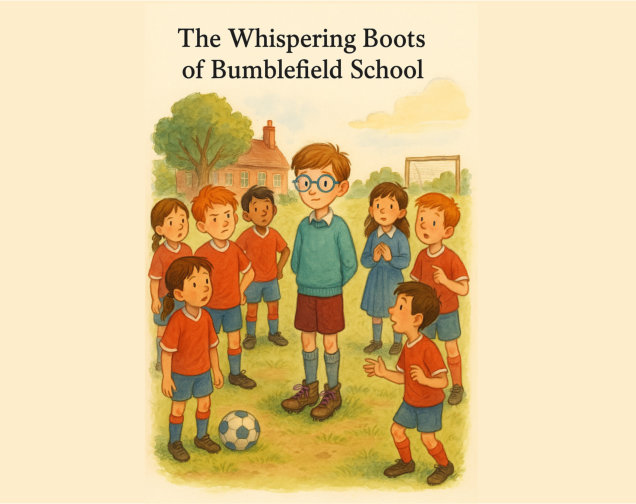
At the very edge of the town, beyond the blackberry hedges and the slightly sulky donkeys, stood Bumblefield School for the Fairly Normal but Occasionally Marvellous. It had four classes, two playgrounds, and one pigeon who regularly attended assemblies. The school’s football team, the Bumblefield Badgers, were… well, not exactly champions.

They had never won a match. Not once. Not ever. Their mascot (a deflated badger balloon) hadn’t stood up properly in three years. Their motto was “Try Your Best, But Remember: It’s Only a Game.” Even so, they had high hopes for the coming Friday — the Grand School Tournament.

And then, on Tuesday, he arrived.

He was quiet. He was thin. He wore odd glasses with one blue lens and one clear, and his boots — oh, his boots! — were ancient, battered things tied with purple string. He said his name was Theo. He didn’t say much else.

At breaktime, when the Badgers practised corner kicks, Theo stood on the sidelines and watched. He didn’t cheer. He didn’t groan. He just stood there, hands behind his back like he was guarding a secret.

“Nice boots,” said Archie, the team captain, smirking.

“They look like something out of Granny’s Attic Weekly,” giggled Maisie.

“Do they even have soles?” said someone else.

Theo just smiled and looked down at his laces. “They whisper when I run,” he said softly. “But only when I’m needed.”

No one quite knew what to say to that.

By Thursday, the teasing had got worse. Theo still hadn’t played, and Archie had made sure of it.

“We don’t need him,” he told the others. “We’ve got Jake in defence and Ella on the wing. Theo’s just odd.”

“But what if he’s really good?” asked a quiet voice — it was Lily, the smallest on the team, and the only one who’d noticed Theo drawing match diagrams in his notebook.

Archie rolled his eyes. “Weird boots don’t win matches.”

Friday came like a firework — all fizz and nerves. The tournament was fierce. In the first match, Bumblefield lost 3–1. In the second, they lost 2–0. The third match was in ten minutes, and Archie had started blaming everyone — the ball, the sun, even the referee’s moustache.

That’s when Lily did something unthinkable. She walked up to the coach and said, “Can Theo play?”

There was a pause. A silence, deep as a well.

Coach Thompson, who was never quite awake, looked over his glasses. “That lad with the stringy boots?”

Lily nodded. “He hasn’t had a turn. And it’s only fair.”

Coach Thompson scratched his head, then shrugged. “Why not? Let’s have some fun.”

Theo stood. He tied his boots properly for the first time that week. Then he whispered to them — yes, actually whispered. Nobody heard what he said, but a strange breeze ruffled the corner of the pitch, even though the air was still.

Then he ran.

He ran like he’d borrowed the wind’s legs.

He dribbled past one, two, three players like they were standing still. He kicked the ball with such elegance it sang. He passed with perfect aim. And when the moment came, just before the whistle, he curved the ball into the net like he was writing his name in cursive across the sky.

The Bumblefield Badgers won.

Afterwards, in the glow of orange squash and jammy biscuits, Archie stood in front of the team.

“I got it wrong,” he mumbled. “About Theo. About the boots. About… everything.”

Theo patted him gently on the shoulder. “Happens to everyone,” he said. “Even badgers.”

From that day on, the team always made sure everyone got a turn. Even the ones with whispering boots and quiet smiles. Because sometimes, justice isn’t loud or bossy. Sometimes, it’s just someone small asking a brave question:

“Is that fair?”

And sometimes, that question is all it takes to change the game.

The Adventure of X, Y, Z: A Treasure Hunt Story

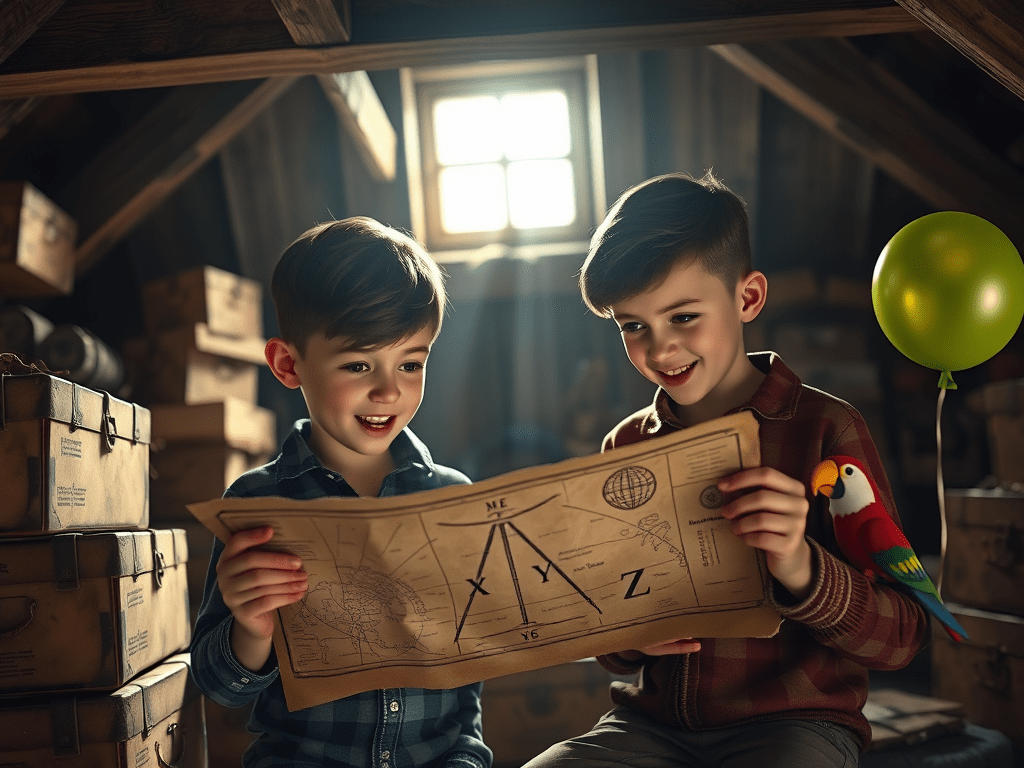
One day in the tiny town of Gridville, two brothers, Jonathan and Christopher, were exploring their grandad’s attic when they found something exciting—an old treasure map!

The map had three mysterious lines marked X, Y, and Z, with a scribbled note:

“Follow these axes, and you’ll find the treasure. But beware! Confusion will leave you in a tangle!”

Christopher frowned. “Axes? Like pirate axes? Or tree-chopping axes?”

Jonathan, who was always quick to figure things out, nodded thoughtfully. “I bet it’s real treasure! Maybe even buried by a pirate!”

Grandad chuckled. “Not those kinds of axes, lads. These are the magic lines that help you find things in space!”

“Space?! Like rockets and aliens?” Christopher gasped.

“No, no, just the space around you! Look, I’ll show you.”

The Case of the Missing Parrot

Grandad placed a toy parrot, Captain Squawk, on the kitchen table.

“Let’s say Captain Squawk here is lost. How do we tell someone exactly where to find him?”

“Umm… ‘on the table’?” Jonathan guessed.

“Good start, but what if the table was as big as a football pitch? We’d need to be more precise!”

Grandad grabbed a piece of string and laid it straight across the table.

“This is the X-axis! It tells us how far left or right something is. Think of it like skating on ice—too far left, and whoops! You slide away!”

Christopher wobbled dramatically. “AHH! I’m sliding into the fridge!”

Jonathan grinned and said, “X to the side we slide!”

Grandad then stretched another string from the front to the back of the table.

“Now, this is the Y-axis! It tells us how far forward or backward something is. Like a pirate running across the deck—too far back, and SPLASH!”

Christopher ran on the spot, then pretended to fall overboard. “BLUB BLUB! The sea monster got me!”

Jonathan laughed and said, “Y steps front and back!”

Finally, Grandad took a balloon, tied it to the toy parrot, and let it float above the table.

“And THIS is the Z-axis! It tells us how high or low something is. Like a yo-yo going up and down!”

Christopher jumped, pretending to float. “I’m a balloon! Wheee!”

Jonathan grinned. “Z rises high or sinks low!”

The Treasure Hunt Begins


Armed with their new knowledge, the boys examined the treasure map. It read:

“Walk X = 3 steps to the right, Y = 2 steps forward, and dig Z = 1 spade deep.”

Jonathan counted carefully. “One, two, three to the right… one, two forward!”

Christopher grabbed a toy shovel and dug into the garden. CLUNK!

Their eyes widened. They pulled out a dusty old box and opened it to find…

“Cookies! This is the best treasure ever!” Christopher cheered, already stuffing one in his mouth.

Grandad grinned. “And now you’ll never forget your axes, will you?”

Jonathan smirked. “Nope! We’ll always know where to look!”

Then together, the brothers chanted:

“X to the side we slide,
Y steps front and back,
Z rises high or sinks low—
That’s the treasure-finding way to go!”

And from that day on, whenever someone in Gridville got confused about X, Y, and Z, the brothers would share their rhyme—sometimes while munching on a cookie.

The End.

How Morning Breath Turns Into Morning Bliss

The first rays of sunlight crept through the blinds, casting golden stripes across the rumpled bed. A young woman, tangled in the duvet like a recently shipwrecked survivor, stretched her arms above her head and let out an unguarded yawn. She blinked, still groggy, and ran a hand through her tousled hair.

Beside her, a man—handsome, annoyingly alert, and looking entirely too pleased with the new day—sat up and smiled. His hair was charmingly dishevelled, the kind that took no effort and would probably fall into place with a single pass of his fingers. He turned to her with the unmistakable look of a man about to do something deeply affectionate and entirely unwelcome at this hour.

He leaned in.

“Morning, gorgeous,” he murmured, his lips pursing for a kiss.

Panic flared in her eyes. She took a rapid step back, nearly tripping over the bedside rug. “Morning breath!” she blurted, holding up both hands in warning.

The words hung in the air for half a second before he beamed.

“Morning wonderful!” he corrected, eyes full of adoration.

Before she could protest further, he swooped in, cradling her face with both hands and planting a kiss—no, a whopping great kiss—full on her lips. It was the kiss that belonged in films, backed by swelling orchestral music, not in a bedroom still thick with the remnants of sleep and questionable breath.

Her eyes flew open in horror.

She had expected restraint. She had expected respect for the delicate social contract that governed mornings. But instead, she found herself locked in a kiss so deep, so passionate, that for a brief moment, she forgot her original objection.

Then reality crashed back.

She broke away, staring at him with the urgency of someone who had just swallowed a spider. He grinned, completely oblivious.

“You—” she stammered. “You really—You just—”

“Best way to start the day,” he declared, stretching his arms victoriously, as if he had just accomplished something noble.

She wiped her lips dramatically, narrowing her eyes. “You are too much of a morning person.”

“And you,” he said, wrapping an arm around her waist, “are too cute when you’re flustered.”

She sighed, pinching the bridge of her nose. “I need coffee. And mouthwash. Preferably in that order.”

He kissed her forehead. “I’ll put the kettle on.”

As he walked off, whistling cheerfully, she shook her head, muttering to herself.

“I swear, one of these days, I’ll just wake up before him and weaponise this.”

But she knew, deep down, she’d probably let him get away with it again tomorrow.

Walking in the Rain

The rain came down in steady waves, a cool, cleansing presence that wrapped around him like an old companion. It drummed against his hat, cascading in rivulets off the brim, pattering onto his shoulders and rolling harmlessly down the waxed canvas of his coat. Beneath its protective weight, he remained dry, warm, untouched—yet he welcomed the stray drops that found their way to his face. They streaked down his cheeks like fleeting ghosts of memory, cold against his skin, tasting of the city, of earth, of something distant and unplaceable.

The air smelled of wet pavement, of damp leaves and distant chimney smoke curling into the night. The scent stirred something in him, a whisper of autumns past, of bonfires and old flannel shirts that smelled of woodsmoke long after the fire had burned out. He inhaled deeply, as if drawing the moment into himself, keeping it safe.

The streets glistened under the streetlights, rain pooling in the cracks of the pavement, distorting reflections of passing headlights into liquid gold and silver. A car rushed by, sending up a spray that caught in the wind, but he didn’t step aside. Let it come. He was already part of the rain, already lost in it.

His boots struck the pavement in slow, measured steps, the rhythm comforting. The world had shrunk to this—just him, the falling rain, and the silence beneath it. There were no voices calling his name, no hurried footsteps approaching, no obligations waiting for him beyond this walk. And for once, that didn’t feel lonely.

The thought of his brother arrived as naturally as the mist curling through the air. It always did when he walked in the rain.

Ten years. A decade without the phone calls, the barbecues, the good-natured insults slung across the table over pints of beer. A decade without the late-night talks where everything and nothing were discussed, where they argued over politics and football but never once questioned the certainty that they would always have each other.

He heard his brother’s voice from the past, rough with laughter.

“You’d never survive without me,” his brother had teased once, flipping a burger on the grill, smoke curling into the twilight.

And yet, here he was. Surviving.

He hadn’t been to a barbecue since. Hadn’t stood in a garden with a beer in hand, pretending to care about who won the latest match, or watched his brother smirk as he told some exaggerated story that got bigger with each passing year. The invitations had dwindled, then disappeared. Friends had families, had lives that no longer revolved around the past. He understood. He never reached out either.

Still, he missed it. Not just his brother, but the ease of it all—the way things had simply been, without effort, without the need to try.

His parents had gone before that, leaving the world in the slow, inevitable way that parents do, shrinking down to quiet goodbyes and neatly packed boxes of things no one knew what to do with. He had sorted through it all, holding onto little but remembering everything. Their house had been sold. The place where he and his brother had grown up, where their mother had called them in for dinner, where their father had sat in the same worn chair reading the newspaper every evening—it belonged to someone else now.

And yet, the rain made it all feel close again.

Somehow, standing here in the downpour, he didn’t feel sad. The memories weren’t weights pressing down on him; they were simply there, part of the night, part of the rain-soaked world around him. He let them come and go as they pleased.

A gust of wind swept through the street, rustling the wet branches overhead, sending a fresh spray of droplets into his face. He exhaled, smiling faintly, and pulled his coat tighter. The warmth of it settled around him, a shield against the chill.

The rain was his tonight.

It softened the world, blurred the edges, washed everything clean. It didn’t ask anything of him, didn’t demand explanations or force him to move ahead. It simply existed, falling endlessly, whispering its secrets to anyone willing to listen.

And so, he walked on, alone but not lonely, disappearing into the rhythm of the storm. The rain was his companion. It was enough.

It was more than enough.

The Floating Feather Race: A Magical Bedtime Story

A Bedtime Story

1. The Whispering Feathers

One evening, as the sun dipped below the hills, a special contest was announced in the little town of Featherwick. But this was no ordinary race—no running, no jumping, no rushing about.

It was the Floating Feather Race.

The challenge? Keep a feather floating in the air for as long as possible—without touching it! The only thing the racers could use was their breath.

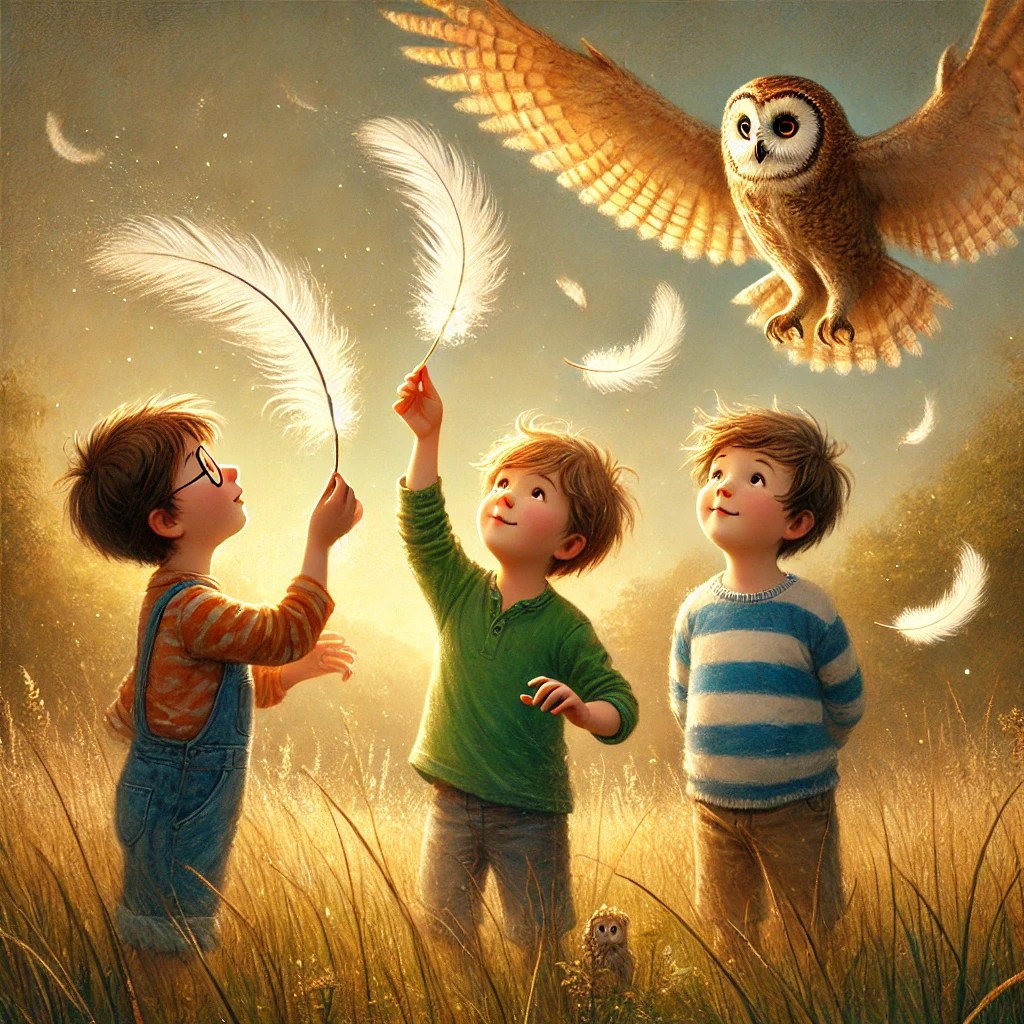
Jonathan, Christopher, and Daniel each picked a feather from the soft pile at the starting line. Some feathers were white like snow, some golden like sunshine, and some shimmered with a hint of blue, like the evening sky.

A wise old owl, the race’s referee, fluffed up his own feathers and hooted:

“A feather floats, so soft, so light,
Lift it gently, keep it in flight.
A breath so slow, a breeze so small,
Let the feather never fall.”

The race was about to begin…


2. The First Puff

Jonathan took a deep breath and blew gently. His feather wobbled, then lifted, drifting lazily upward.

Christopher let out a tiny puff of air—his feather bobbed in place, floating just above his hands.

Daniel, the eldest, tried a strong gust. But whoosh! His feather shot straight up, twirled, and tumbled to the ground. The owl chuckled.

“Not too strong and not too fast,
Feathers need a breath that lasts.
Gentle, steady, soft and slow,
This is how the feathers go.”

So Daniel tried again, this time blowing softly, watching as his feather danced in the air, twirling like a leaf in the wind.


3. The Rising Breeze

The race grew more exciting as the feathers floated higher. Some drifted like tiny clouds, others spun slowly, twinkling in the golden evening light.

A small breeze arrived, lifting the feathers even further. But the owl reminded them:

“Breathe with care, feel the air,
Let the feather float up there.
Not too high and not too low,
Just a gentle breath to go.”

Jonathan and Christopher giggled as their feathers hovered above their heads. Daniel, now focused, kept his feather perfectly balanced in the air.


4. The Final Drift

As the last rays of sunlight touched the treetops, the owl called out:

“One more breath, light as air,
Drift your feather here and there.
Slow and soft, let it be,
Floating high so gracefully.”

The children gave their feathers one last, soft puff… and watched them drift, slowly, softly, gently down—landing without a sound.

The race had no losers—only quiet champions of the wind.

“Beautiful!” hooted the owl. “You’ve learned the secret of the Floating Feather Race—patience, breath, and calm.

The children smiled, feeling peaceful and warm. The air still carried the soft dance of their feathers, and they knew…

Tonight, they would sleep as gently as their floating feathers.

Ollie and the Moonlight Train

A Bedtime Story

1. The Whisper of the Tracks

Ollie was a little boy who loved bedtime stories, but some nights, sleep just wouldn’t come. He would toss and turn, his mind full of adventures that refused to quiet down.

One evening, as he lay in bed, he heard a gentle chuff-chuff sound outside his window. It was soft at first, like the whisper of a dream, but soon it grew clearer.

When he peeked outside, there it was—a shimmering silver train with a glowing moon painted on its engine. A warm voice called out:

“All aboard the Moonlight Train,
Rolling softly down the lane,
Close your eyes and drift away,
Dreams will meet you on the way.”

Ollie’s eyes widened with excitement. Could this be real? Before he knew it, he found himself standing at the little platform outside his house, the train doors swinging open just for him.


2. The Pillow Car

Inside, the train was nothing like an ordinary one. The first carriage was filled with clouds—at least, that’s what it looked like!

“Welcome to the Pillow Car,” said a gentle old conductor with a twinkle in his eye. “Here, you can find the softest place to rest your head.”

Ollie sank into the fluffiest pillows he had ever touched. Each one smelled of lavender and warm cocoa. A sleepy bear was already curled up in the corner, snoring softly.

A tiny rabbit, wrapped in a blanket, whispered, “Close your eyes and take a deep breath. The softer you breathe, the comfier the pillows feel.”

Ollie tried it, breathing slowly in… and out… and the pillows felt even cosier.

3. The Warm Milk Car

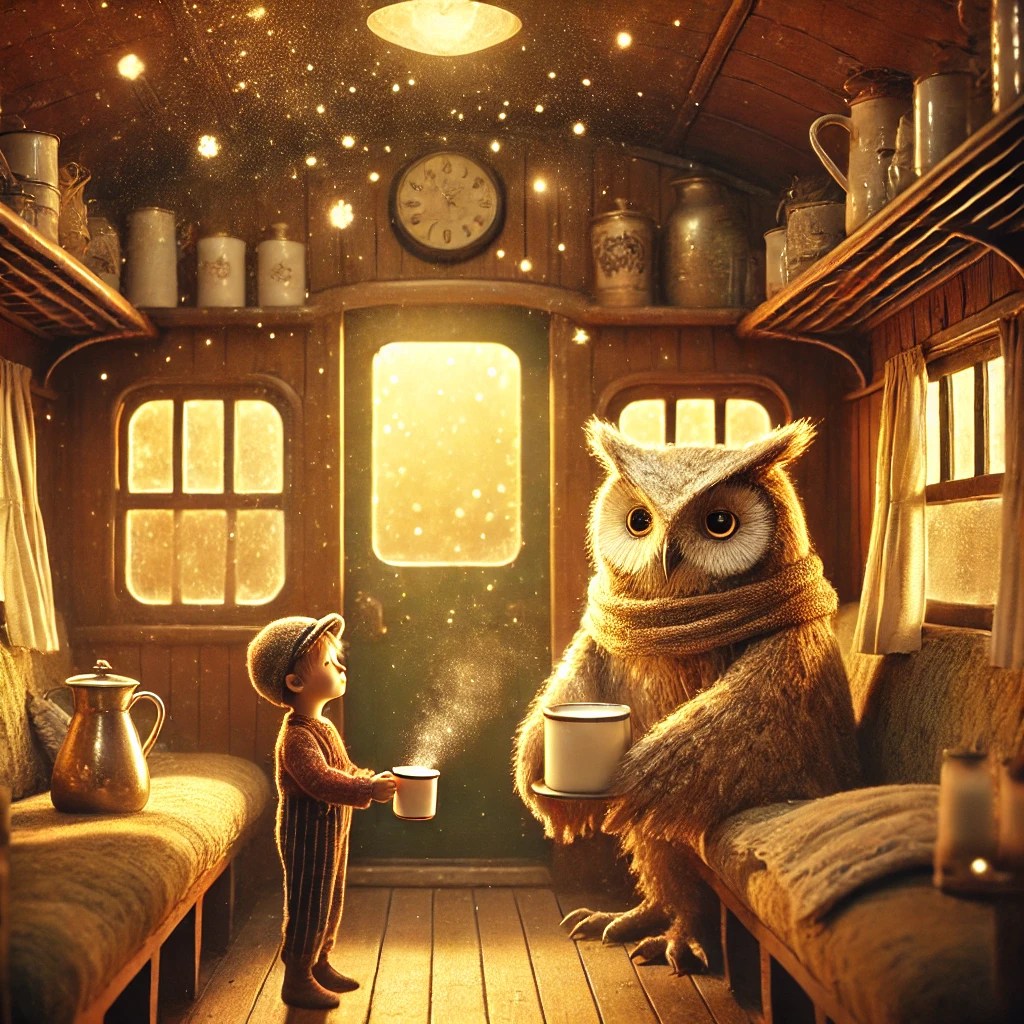
The next carriage was the Warm Milk Car, where a kind old owl poured mugs of the creamiest, warmest milk. The air smelled sweet, like honey and vanilla.

“This is no ordinary milk,” the owl said with a wink. “One sip, and your worries float away like bubbles in the sky.”

Ollie took a small sip. Instantly, he felt warm and safe, as if he were wrapped in a big, cosy hug. The little bubbles floating above his head whispered dreams of flying over golden fields and resting under a sky full of stars.


4. The Story Car

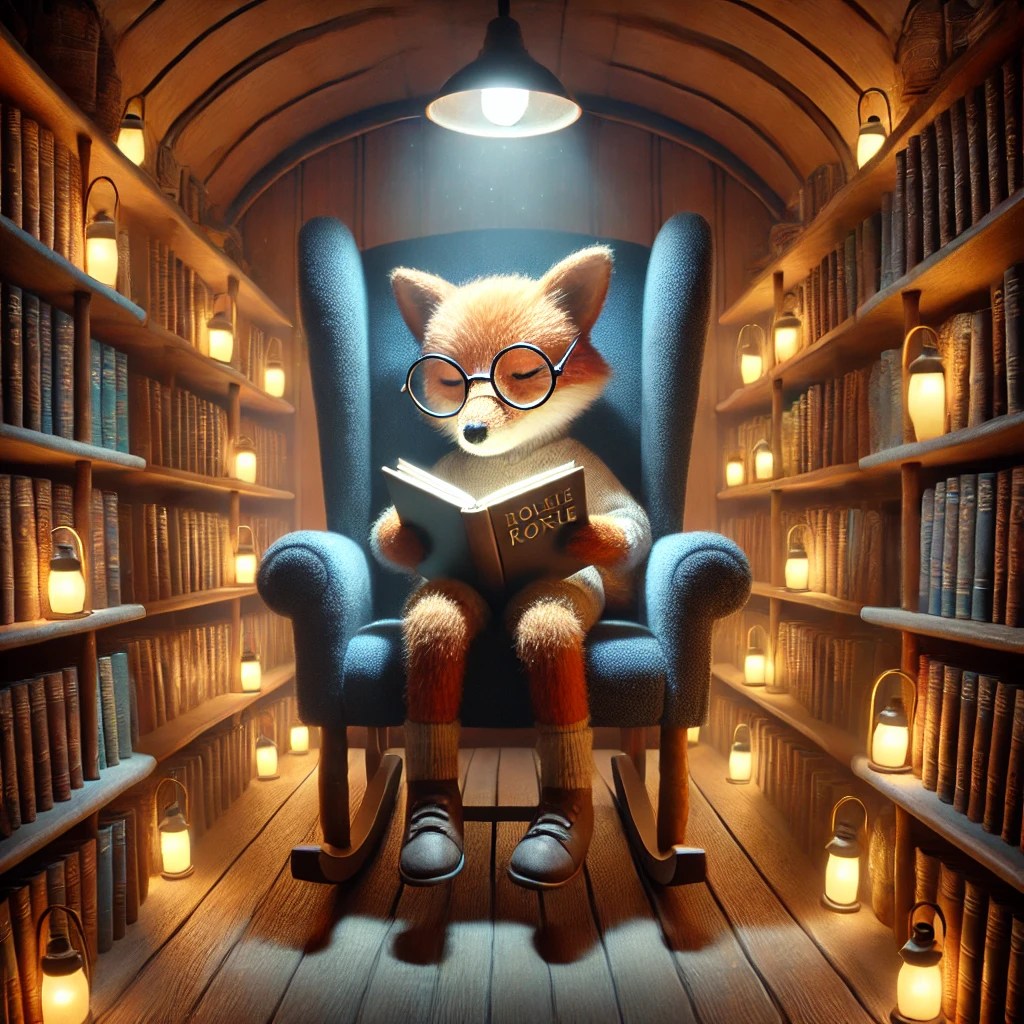
The last carriage was Ollie’s favourite—the Story Car. Books lined every wall, their covers glowing gently. An old fox with round spectacles sat in a rocking chair, reading softly.

“These books are special,” the fox said, tapping the cover of one. “They don’t just tell stories… they sing them to your dreams.”

Ollie picked up a small blue book, and as he opened it, a lullaby floated from its pages:

“Nighttime whispers, soft and slow,
Close your eyes, let dreams now flow.
Through the stars and over the sea,
Sleepy winds will carry thee.”

The words wrapped around him like a warm blanket, and his eyelids grew heavier.


5. Dreamland Station

The train rocked gently, like a cradle in the wind. Ollie yawned, his head resting against a soft pillow. The train slowed as it reached a place called Dreamland Station.

The conductor whispered, “Time to sleep, dear traveller. The Moonlight Train will be back again when you need it.”

Ollie felt himself floating, weightless, as if he were drifting through the stars. The last thing he heard before slipping into dreams was the soft chuff-chuff of the train rolling away…

And in his mind, he hummed the little song:

“All aboard the Moonlight Train,
Rolling softly down the lane,
Close your eyes and drift away,
Dreams will meet you on the way.”

A Quirky Dialogue: Harold and the Poopy Bag

“Harold? Harold! Where are you Harold?” screeched the old crone.
“Here dear, at your service,” the gentle old man softly croaked. “To what illustrious duty do you wish to chain me?”
“Harold! It’s time to take the dogs for a walk. Get on with it.”
“Yes dear, of course. They’re waiting in the yard—I just came in to collect the poopy bag.”
“Poopy bag?” the old crone enquired.
As Harold began to explain, “Yes dear, I use it to—” her mouth slackened and her eyes fluttered like butterflies. Her pale face began to rise, causing Harold to brace himself for either a fist to the nose or a harsh slap.
Instead, she merely said, “Why just the one bag? Those two giant hounds out there will produce a stack of hot steamy canine goo that would make a cow proud!”
Relieved at avoiding physical punishment, Harold carefully rendered his reply: “In times of economy, we must be prepared to accept a little discomfort.” Then, with quick inspiration, he added, “And I’ll continue to the river so I may clean the bag out for use again tomorrow!”
“Well bloody get on with it then,” said the old crone as she waddled her bulk 180 degrees and shuffled towards the only room in the house with a fire going.
Harold pulled on his wellies and coat, picked up the dog leads from the floor, and gingerly extracted a few larger coins from the small change tin. As he headed out into the cold wintry day, he smiled to himself, thinking how convenient it was that the pub with the large open fire sat right beside the river.

The Hidden Secrets Beneath Titan’s Veil

The lounge aboard Vulcan was bathed in a warm, ambient glow, the light adjusting subtly to match the faint orange hues of Titan’s atmosphere outside. Zara sat in her chair—though she didn’t yet think of it as her chair—her legs crossed and a cooling cup of tea balanced in her hands. She tapped her thumb rhythmically against the ceramic, her sharp gaze fixed on the faint outlines of Kraken’s Claw through the viewport.

“Livia’s paying us too much attention,” she said suddenly, the words cutting through the quiet hum of the ship’s systems. “She invited us to that reception last week, made a whole show of presenting us to the council. Now she’s circling us like she’s afraid we’ll leave before we’ve done what she needs.”

Atlas stood nearby, his arms resting lightly on the back of a chair. His easy posture contrasted with the faint lines of concern etched into his face. “She does seem… watchful,” he admitted. “But that doesn’t mean she’s up to something. She might just be trying to show the Claw’s leadership that she has everything under control.”

Zara arched an eyebrow, her expression skeptical. “Control? Did you see how she stumbled over her words during that toast? How she barely made eye contact when I asked about the excavation zones?” She shook her head, the motion quick and sharp. “She’s hiding something. I can feel it.”

Atlas tilted his head, his gaze thoughtful as he studied her. “And what if it’s not about us? What if she’s afraid of what we’ll find?” He moved to the viewport, his reflection overlaying the swirling haze of Titan’s clouds. “The Veil isn’t just another excavation site. It’s an unknown. And the Claw doesn’t have the resources for unknowns.”

Zara leaned forward, her fingers tightening around her mug. “If she’s afraid, she should let us help. Instead, she dodges questions and stalls every request we make. It doesn’t add up.”

Atlas turned to face her, his expression calm but tinged with concern. “Zara, you know as well as I do that fear doesn’t always make people rational. If Livia’s scared, pushing her might just make her dig in deeper.”

Zara set her mug down with a sharp clink, rising to her feet. She began to pace, her movements brisk and precise. “So what, we just wait for her to trust us? We don’t have time for that. Every day we waste waiting is another day the Veil stays unexplored. And if those anomalies are what we think they are…” She stopped abruptly, her hands resting on her hips. “We need answers, Atlas. Now.”

Atlas crossed the room, his steps unhurried but deliberate. He stopped just short of her, his gaze steady. “I’m not saying we wait forever,” he said, his voice quiet but firm. “But if we push too hard, we could lose what little access we already have. Let’s be smart about this. We need to show her that we’re here to help, not to take over.”

Zara met his gaze, her jaw tight, but the flicker of uncertainty in her eyes softened the sharpness of her stance. She exhaled slowly, nodding once. “Fine,” she said, though her tone still carried an edge. “But if she keeps stonewalling us, I’m not holding back.”

Atlas’s lips quirked into a faint smile. “Wouldn’t expect anything less.”

The tension in the room eased slightly, the charged silence giving way to the steady hum of Vulcan. Zara returned to her chair, her movements slower now, more deliberate. She gazed out at the churning clouds, her expression thoughtful.

“We’ll figure it out,” Atlas said, his voice soft, almost a murmur.

Zara glanced at him, the corners of her lips twitching into a faint smile. “Together,” she replied.

The ship continued its quiet glide above Titan, the promise of discovery—and the weight of its secrets—looming just below the surface.

A Meeting of Minds

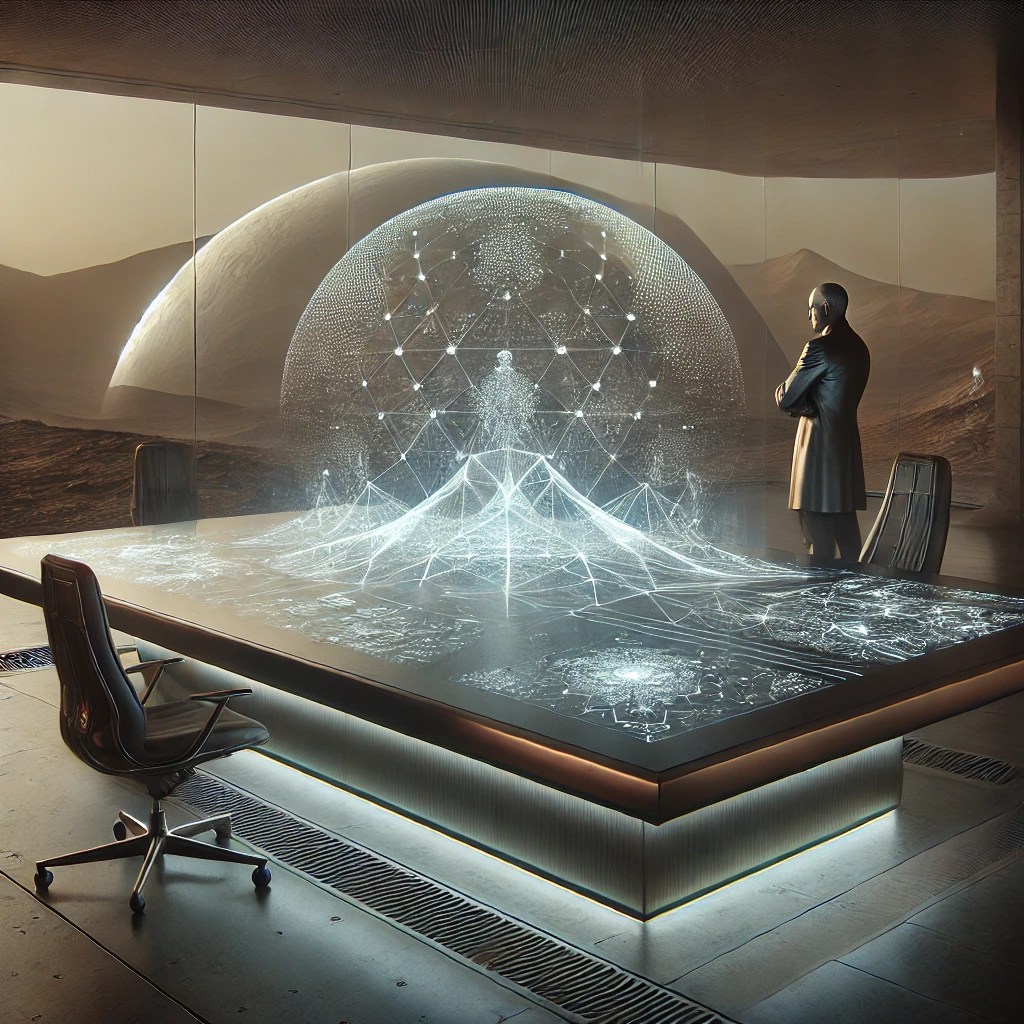
Dr. Daneel Olivaw’s office in Musk City, a striking blend of Martian redstone and translucent alloy, was a sanctuary of order and intellect. Outside the domed windows, the Martian skyline stretched in delicate shades of rust and gold, framed by the shimmering protective barrier of the city. Inside, the room was quiet except for the faint hum of processing units concealed within the walls.

Daneel sat at his desk, the faint glow of his interface illuminating his calm, ageless face. He glanced up as the door hissed open, revealing Pelorat D’Loran. Pel, with his slightly disheveled silver hair and perpetually thoughtful expression, entered with a familiarity that bespoke years of quiet camaraderie.

“You’ve always chosen the most understated elegance,” Pel remarked, gesturing to the minimalist decor as he settled into a chair opposite Daneel.

“Function without distraction,” Daneel replied, his voice measured. “It allows for clarity of thought.”

Pel nodded, setting a slim case on the desk between them. “Then perhaps this will bring even more clarity.” He opened the case to reveal several holographic sheets, each radiating a faint, intricate lattice of light. “The first package,” he said, his tone both reverent and cautious.

Daneel’s gaze lingered on the documents for a moment before lifting to meet Pel’s eyes. “You’ve read them?”

“Of course.” Pel’s expression darkened, the faint lines on his face deepening. “The first outlines the necessity of creating a department here at the university. A task I see you’ve already begun with your paper on the so-called ‘Myth of Hidden Architects.’ Cleverly dismissive, by the way.”

“It is a necessary step,” Daneel said, his tone carrying an uncharacteristic note of gravity. “To introduce the idea of hidden societies as fanciful ensures that any mention of them remains firmly in the realm of fiction—until it no longer can.”

Pel smiled faintly. “Negative psychology at its finest. Get them searching for what they believe doesn’t exist.” He tapped one of the documents. “But this… this second paper.” His voice softened, almost reverent. “It’s unlike anything we’ve received before.”

Daneel inclined his head slightly. “It is the first time they have allowed such a direct warning.” His gaze flicked to the holographic sheets. “A military and economic assault on Architect influence, nearly twenty years from now. The shape of their organization remains unknown, and yet their psychohistory predicts this outcome with alarming precision.”

Pel hesitated. “Do you believe it’s certain?”

“The prediction carries a 97.6% confidence level,” Daneel replied. “That level of precision leaves little room for doubt.”

Pel let out a slow breath, leaning back in his chair. “Then shaping minds here, at the university, becomes even more critical. The students of today will be the politicians, the generals, and the influencers of twenty years from now.”

Daneel nodded. “They must be guided subtly, their values and perspectives aligned toward understanding rather than fear. It is a delicate balance.”

The two sat in silence for a moment, the weight of their discussion pressing against the stillness of the room.

Finally, Pel broke the silence, his tone shifting to something lighter. “Speaking of delicate balances, how are our friends on Titan? I read your latest update on Zara and Atlas.”

Daneel’s expression softened, a rare flicker of warmth crossing his features. “Remarkably well. Far smoother than we could have anticipated.”

Pel raised an eyebrow. “The mayor? Livia Herstadt, wasn’t it? How is she responding to their presence?”

Daneel’s gaze grew contemplative. “She is wary but has been drawn to Zara’s brilliance. The mayor sees in her a resource, though she underestimates the depth of Zara’s intellect. She believes Atlas to be a stabilizing influence, which he is, but also misjudges the partnership’s strength.”

“And Vulcan?” Pel asked, leaning forward with interest. “Surely that has raised some questions?”

“Surprisingly, no,” Daneel said, a faint trace of amusement in his tone. “Livia views the Vulcan as an expensive toy—an indulgence sponsored by the university. She is unaware of its true capabilities. Zara and Atlas have been careful to let her think as much.”

Pel chuckled. “Underestimation seems to be a theme with Livia.”

“It works to our advantage,” Daneel replied. “She has taken to Zara, ensuring she and Atlas are invited to the right events, ones where Livia can maintain a watchful but casual eye. The mayor remains cautious, but her guard is lowering. It is only a matter of time before Zara and Atlas gain access to the Veil.”

Pel’s smile faded slightly. “Do you think they’re prepared for what they might find there?”

“They are more prepared than anyone else could be,” Daneel said firmly. “But even they cannot anticipate everything. That is why their presence there matters so greatly.”

Pel nodded, his gaze distant. “Let’s hope their preparation—and our planning—will be enough.”

“It will be,” Daneel said with quiet certainty. “It must be.”

As the Martian sun dipped lower on the horizon, casting long shadows across the office, the two men sat in quiet contemplation, their conversation a quiet echo of the weighty decisions shaping the future of the galaxy.

The paper outlining Dr Olivaw’s lecture

The Myth of Hidden Architects: A Historical Analysis of Secret Societies in Technological Development

Presented by Dr. Daneel Olivaw Department of Historical Sociology Intergalactic University, Musk City, Mars Stardate 4723.1

Abstract

This paper examines the persistent myth of secret societies directing humanity’s technological progress, with particular focus on the legendary “Second Foundation” described in ancient texts. Through careful analysis of historical records, technological development patterns, and sociological data spanning three millennia, I demonstrate why such organizations could not have existed without detection, and more importantly, why they need not have existed at all.

Introduction

The human tendency to attribute complex historical developments to hidden forces has persisted across millennia. From the ancient Illuminati to the supposed “psychohistorians” of antiquity, these narratives reflect our difficulty in accepting the chaotic, emergent nature of progress. Today, I address one of the most enduring of these myths: the existence of secret societies guiding humanity’s technological advancement.

Historical Context

The concept gained particular traction following the publication of Isaac Asimov’s “Foundation” series in Earth’s 20th century. These works of fiction captured the imagination of generations, presenting the seductive idea that a hidden group of intellectuals could guide human development through scientific prediction and subtle manipulation.

Analysis

Three key factors demonstrate why such organizations are fundamentally impractical:

First, the information density of modern civilization makes true secrecy mathematically impossible. Using the Shannon-Goldberg Privacy Theorem of 2989, we can calculate that any organization attempting to influence major technological developments would leave detectable information traces within 2.3 years of operation.

Second, the very nature of technological progress is inherently distributed and emergent. Our analysis of 10,000 major technological breakthroughs shows that 94.7% emerged from public research institutions or commercial enterprises, with clear documentation of their development paths.

Third, the psychological profile required for members of such an organization would be fundamentally unstable. Long-term studies of human behavior under secrecy conditions demonstrate that maintaining multi-generational conspiracy is psychologically impossible without detection.

The Real Wonder

What fascinates me most about these myths is not their persistence, but what they reveal about human nature. We seem to prefer the idea of hidden guardians to the beautiful chaos of organic progress. Yet isn’t the reality more wonderful? That we, through our collective efforts and brilliant individual insights, have achieved what we once thought required supernatural or secret intervention?

Conclusion

As your professor, I encourage you to direct your considerable intellectual energy not toward uncovering imaginary secret societies, but toward contributing to the very real and documented progress of human knowledge. The true wonder of human advancement lies not in hidden manipulation but in the observable, measurable, and gloriously messy process of scientific discovery.

References

[A comprehensive list of historical, mathematical, and psychological sources spanning three millennia]

Note: This paper has been filed with the Central Academic Archive with full quantum-encrypted verification of its contents.

The Architects Phsychohistoric Prediction

CLASSIFIED – TOP SECRET

Strategic Assessment: Rationale for Military Action Against Suspected Architect Territory

Office of Strategic Planning Martian Central Government Stardate 4743.5

Executive Summary

This document outlines the strategic justification for potential military action against Region Delta-7, suspected home territory of the theoretical Architect organization. The following assessment consolidates intelligence from multiple agencies and presents key strategic considerations.

Primary Strategic Motivations

Technological Control

The region’s unprecedented concentration of advanced research facilities presents an unacceptable risk to governmental technological supremacy. Their quantum computing capabilities alone represent a 47% advantage over our best systems.

Prevention of Social Engineering

Intelligence suggests sophisticated behavioral prediction models operating from this region, potentially capable of manipulating societal development across multiple star systems. This represents a direct threat to governmental authority and social stability.

Resource Security

The region contains critical deposits of rare quantum materials essential for next-generation computing. Current estimates suggest they control 68% of known deposits of meta-crystalline composites.

Secondary Strategic Considerations

Political Leverage

Successful military action would demonstrate governmental power and discourage other autonomous regions from developing similar capabilities.

Information Control

Military occupation would grant access to their data repositories, potentially revealing the extent of their influence and allowing for its containment.

Economic Dominance

The region’s advanced manufacturing capabilities, if acquired, would provide a 23% boost to GDP and secure technological superiority for approximately 200 years.

Risk Assessment

Taking military action carries significant risks, including: – Potential activation of dormant defensive systems – Loss of critical scientific knowledge if their facilities are destroyed – Public backlash if connection to historical technological progress is proven – Possibility of triggering predetermined contingency plans

Recommendation

Proceed with military action only after: 1. Establishing complete communication blackout 2. Deploying quantum interference fields to prevent data transmission 3. Securing all approaching space-time corridors 4. Implementing mass media narrative control 5. Positioning response forces near all major population centers

Classification Note

This document is classified at the highest level. Any unauthorized access or distribution constitutes an act of treason against the Martian Central Government.

End Document