
Listen to the Deep Dive Expert discuss this article in a recent Podcast:
Author’s Note
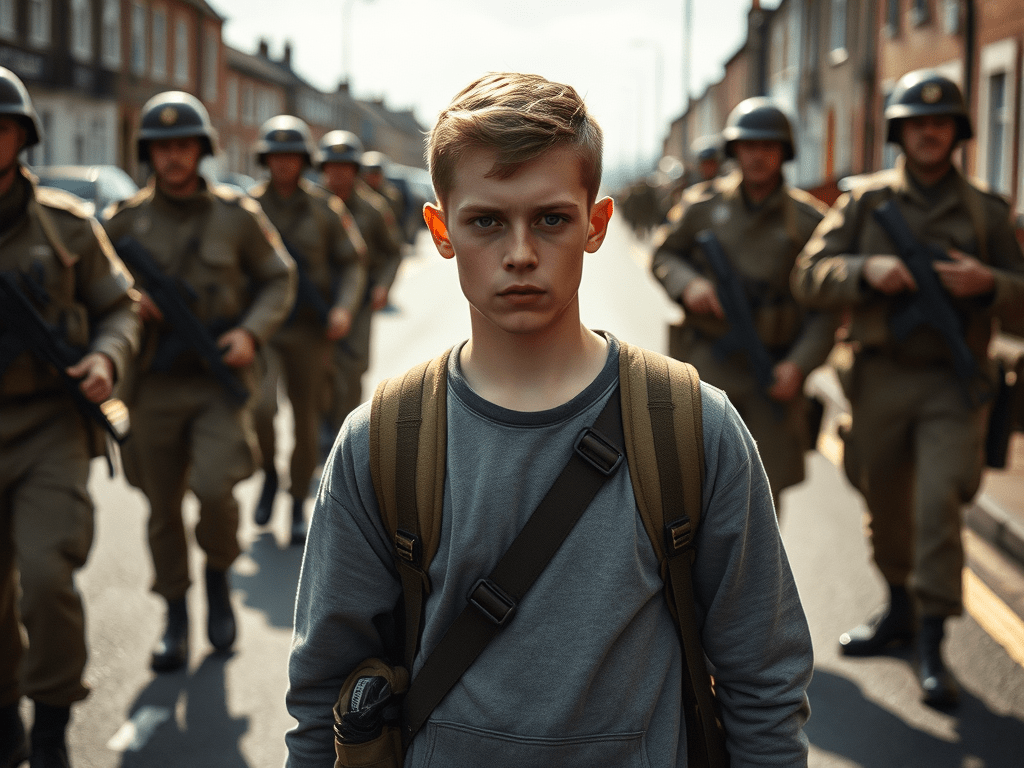
In 1979, at the age of 18, I found myself in a frightening situation. While walking along a road in Belfast, I was stopped by angry British soldiers. Just weeks earlier, the IRA had launched a major attack, and I matched the description of a suspect they were seeking. Carrying a sports bag, I was detained—though not arrested—and the prospect of being “questioned” filled me with dread.
Despite answering their questions in clear, unaccented English, it didn’t dissuade them from holding me. I discovered later their suspect was a proud Irishman who wouldn’t fake an English accent, but that did not occur to them at the time.
I was taken to a local MP station and placed in a cell. Another soldier questioned me through a hatch, and once my identity was verified and it was clear I wasn’t from Belfast, they asked why I was there. After hearing my explanation, they relaxed. One soldier even brought me tea and biscuits, and the tension in the room began to lift.
It still felt surreal, like a scene from a spaghetti western. The soldiers exchanged glances as if waiting for something. Soon, a Brigadier General entered, and everyone stood, including me, a few seconds behind. The General was polite, making small talk, and then explained why tensions were high. He scolded the soldier who detained me, remarking, “I’d expect my men to recognise a British mainland accent!” He then apologised, asked where I was headed, and had me driven to my destination.
Years later, I came across research explaining how stress causes us to miss critical details, particularly in high-pressure situations. This made me think about my experience and inspired me to explore why such lapses happen, especially in soldiers. Despite rigorous training, these mistakes can still occur, as they did in Afghanistan.
The following story is fiction, but the behaviours and reactions under stress are real. It aims to shed light on the mind-body relationship in moments of extreme fear and pressure.
Introduction
Before diving into the story, I want to take a moment to explore how our bodies and brains behave under extreme stress. When we are confronted with life-or-death situations, the way we think, move, and react is no longer under conscious control. Our brain, the complex organ that usually helps us rationalise and solve problems, can bypass careful thought in the name of survival.
Imagine a scenario where a soldier enters a dark room, unsure if death awaits him or if the shadowy figure in the corner is a friend. In those moments, the brain’s fear centre, the amygdala, takes charge, sending rapid signals to the body to prepare for action. The hypothalamus triggers the release of adrenaline, causing a surge of energy to the muscles, priming them for swift and powerful movements. The body becomes hyper-aware; heart rate spikes, senses sharpen, and muscles tense, ready for combat. Dopamine is released, helping the soldier stay focused and react with lightning speed.
Yet, this survival mode comes at a cost. The brain shifts resources away from systems not essential for immediate survival—like higher reasoning, digestion, or memory. The prefrontal cortex, responsible for careful decision-making, becomes side-lined, as the amygdala prioritises immediate, instinctive reactions. This means that under intense stress, we may act without fully understanding what we are doing or interpreting information incorrectly. Decisions become split-second, reflexive, and often imprecise.
These biological mechanisms have evolved to keep us alive, but in the chaos of battle, they can also lead to tragedy. When fear takes control, when adrenaline floods the body, our ability to distinguish friend from foe can falter. This is the stage upon which our story unfolds—a moment where the brain’s ancient survival systems collide with the complexities of modern warfare. And it is in this moment that a soldier faces the inevitable, tragic consequences of instinct overpowering reason.
Now, let’s step into that room and see how it all unravels.
“One Command”
“Jones, I swear, when we’re done with this tour, I’m dragging your ass to the Rockies. No more of this desert heat,” Sergeant Brian Thompson said, taking a swig from his canteen. His eyes squinted against the midday sun, the sweat making lines through the dust on his face.
Corporal Andrew Jones grinned, adjusting the strap on his rifle. “You and your damn mountains. You know I’m a beach guy. I’ll be sipping something cold while you wrestle a bear.”
They both chuckled, the camaraderie forged from years in service. They had fought side by side through hell, and while the banter was light, there was a tension today they both felt. The briefing for this mission had been grim. They weren’t just facing the usual militants—this was a stronghold for the fanatics. The ones who would gladly die for their cause, strapped with explosives, living only to take as many Marines with them as possible.
“You ready for this?” Jones asked, voice dropping slightly.
Thompson nodded, wiping sweat from his brow. “Yeah, but this one’s different. These guys, they don’t hesitate. They’re not going to negotiate. Every move has to be perfect.”
Jones let out a breath, running his hand along his rifle. “Yeah, I’ve got your back. Like always.”
They both knew what lay ahead.
The Mission Begins
The night air in Afghanistan was cool, a stark contrast to the blistering heat of the day. Thompson and Jones moved with their unit through the narrow streets of a village that had long been under control of the regime. Every shadow felt dangerous. Every movement was suspect.
A dog barked in the distance, making Thompson flinch. His heart pounded as they approached the compound. Intel said this was the headquarters for one of the most dangerous cells in the region. They had already had a couple of close calls. One soldier had almost tripped a wire, setting off a booby trap, but they’d caught it in time. Adrenaline spiked in their veins, pumping through their bodies, keeping them alert, their muscles primed for action.
Inside the darkened alley, the tension was palpable. Thompson’s eyes darted from one corner to another, ears straining to catch any sound. His brain, processing the sensory input at lightning speed, was on high alert. The thalamus quickly relayed data to the amygdala, which flagged every unknown as a potential threat. The prefrontal cortex, trying to keep control, was rapidly analysing each decision, but the weight of the situation made rational thought difficult.
“Clear left,” whispered Jones.
“Right’s clear,” Thompson responded, sweat dripping down his face. His body was tense, ready, as adrenaline coursed through him, heightening his awareness. His muscles felt coiled, dopamine assisting in sharpening his reactions, preparing him for what will come next.
The soldiers moved ahead, approaching the final building on their objective. It was eerily quiet. Too quiet.
Entering the Building
Thompson led the way, stepping through the crumbling doorway into the dark room. His heart hammered in his chest, each beat reverberating in his ears. The narrow field of his night-vision goggles created a sense of tunnel vision, a phenomenon that often accompanies intense stress. His brain was shutting down non-essential systems—he felt the dryness in his mouth, his thoughts narrowed to the immediate task at hand. Every ounce of focus was on survival.
Behind him, Jones followed, scanning the room. The tension had ratcheted to an unbearable height. They knew this was the kind of place where fanatics would strap themselves with explosives, eager to take as many as they could with them.
Suddenly, Thompson heard it—a shout from behind. In the heat of the moment, with the stress squeezing his brain like a clamp, he interpreted it as “Come here quick!” His amygdala surged with fear, pushing his fight-or-flight response into overdrive. His prefrontal cortex, which have ordinarily allowed him to process the situation more carefully, was overruled. The amygdala, in control now, drove him to act without hesitation.
He spun around, weapon raised, adrenaline flooding his system. His muscles responded instantly, dopamine fine-tuning his reactions. His finger pressed the trigger before his conscious mind would fully register what was happening.
The shot rang out in the confined space, echoing through the room.
In the dim light, Thompson saw Jones collapse.
The Mistaken Command
“Jones!” Thompson’s voice cracked. He rushed to his friend’s side, his heart pounding, muscles trembling as the realisation washed over him. Jones’s body was still, the life draining from him.
It wasn’t until seconds later, in the thick fog of his panicked mind, that Thompson noticed the figure across the room. A man in tattered clothes stood near the doorway, clutching a switch, a belt of explosives around his waist. The bomber looked at Thompson with wild eyes before turning and bolting out of the building, leaving his family inside.
“Get out of here quick!” That had been the command.
Thompson’s breath caught in his throat. He realised, too late, that the warning had been to avoid the building, not to approach it.
But now, none of that mattered. The bomber fled, and Jones was bleeding out in his arms.
The Brain’s Betrayal
The adrenaline that had once sharpened his reflexes now left Thompson shaking. The amygdala had driven his decision to shoot, overriding the prefrontal cortex’s ability to slow things down, to think clearly. The dopamine that had helped him react so swiftly was now fading, leaving behind only the stark reality of what he had done.
His body felt hollow, his muscles weak, as the adrenaline ebbed. His throat was dry, the physiological response to fear cutting off non-essential systems like digestion and hydration. His mind raced, but in circles, unable to grasp the enormity of what had happened.
The memory would never leave him, though the details would fade, clouded by the trauma. His brain, struggling to cope, had shut down parts of his cognition, like thinking and memory, in a desperate bid to protect him from the full weight of his actions. But nothing would shield him from the truth.
He had killed his friend.
Not because of malice or failure, but because his brain, in the thick of fear and confusion, had pushed him toward the only decision it would under the circumstances. It had chosen survival over reason, instinct over thought.
And now, Thompson would carry that burden forever.
The Aftermath
The sound of the explosion rattled the windows as the bomber detonated outside, far from his family. But Thompson didn’t hear it. All he heard was the silence in the room, the absence of his friend’s voice. The amygdala, which had served him so well in battle, now brought only guilt and sorrow. His body, drained of the adrenaline, sagged as he knelt beside Jones.
It was inevitable, perhaps. A wrong command, a brain pushed beyond its limits, and a split-second decision driven by fear.
Thompson stared down at his friend, and his mind tried to justify what had happened, but it never would.
 Verbal Alchemy