He has my pension, sitting somewhere it no longer remembers me.
He has my property, brick and paper converted into silence.
He has my investments, years folded neatly into his pocket, creased beyond recognition.
He owes me the remnants of a vast loan— vast when it was mine, residual now it is his.
He owes me four years’ salary, four winters of restraint, four summers of “next quarter”.
He took my business, and with it the simple dignity of earning my own living.
He does not speak to me. Silence has become his chief operating system.
I do not know what he is doing to our business— I still call it ours out of habit, or grief.
He will not reveal the revenue, despite the healthy turnover, despite the noise it makes when mentioned to others.
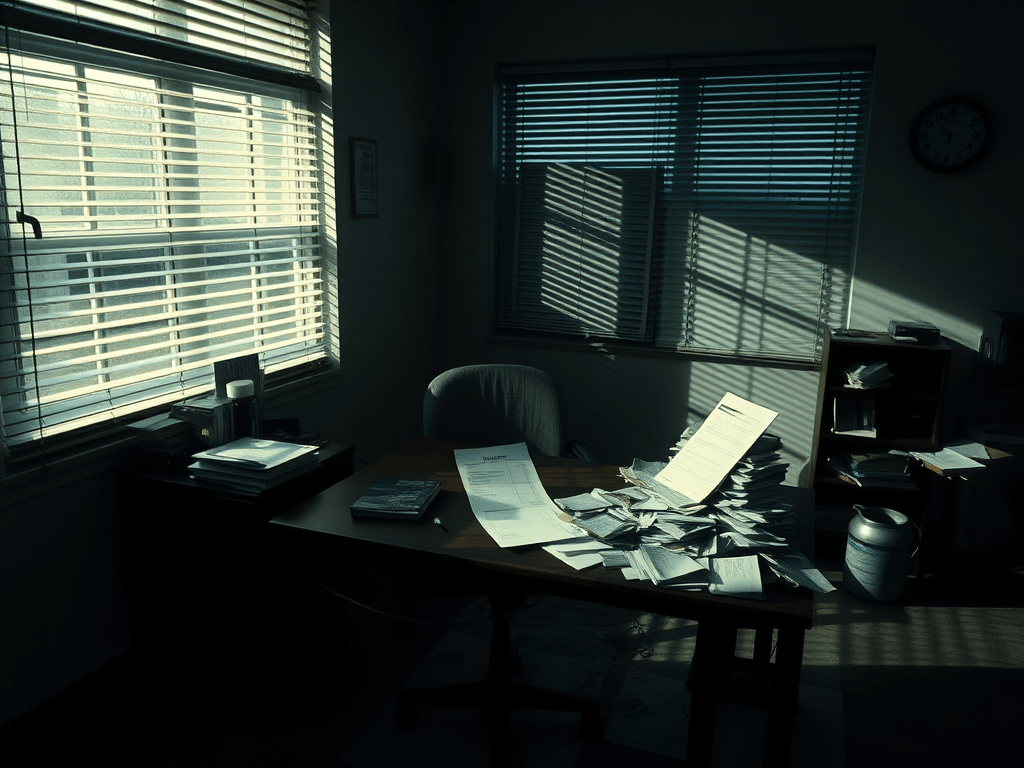
He will not let me see the books. They are balanced, he says, like a glass placed just out of reach.
He refuses to meet his commitments, but meets his reflections daily without discomfort.
He loses focus each time he draws breath, as if attention itself is an intolerable cost.
He thinks I am scary. He thinks I am angry. His imagination does the heavy lifting now, running ahead of facts, inventing menace where questions live.
He accuses me of disrespect, of lacking faith— faith, he says, without evidence.
But faith is not required when the truth is present. Faith is a substitute, not a virtue.
Respect has room for secrets— for privacy, for timing, for restraint— but it has no shelter for lies.
And somewhere between the numbers I am not allowed to see and the answers I am not allowed to ask, my life waits like an unpaid invoice, long overdue, still polite enough not to shout.
Authors Note: I was surprised to learn that some people don’t like Disturbed’s version of The Sound of Silence. Paul Simon, however, called it “very much accomplished” and “one of the greatest covers ever,” which reassured me—it’s not just me!
Reflecting on why I love Disturbed’s version, I realised it comes down to tone and politics (hear me out). While Simon and Garfunkel’s original is brilliant, it carries a youthful, almost ‘college’ quality. Disturbed’s rendition, on the other hand, injects grown-up depth and soul (sorry, Paul—I love your work too). Their version feels more relevant to today, telling a story for the current era rather than the 1960s.
This inspired me to adapt the song for the current mess in which the UK wallows. And honestly, I’d love to hear Disturbed sing it! If you haven’t heard their version yet, I’ve included the YouTube version below—you’re in for a treat. To be played at maximum volume.
Confounded Silence
Verse 1 Hello freedom, my old friend, It seems you’ve come to meet your end. Your voice once roared, but now it falters, Bound by chains and broken altars. And the vision of a nation free and brave, It cannot be saved— Drowned beneath the sound of silence.
Verse 2 In restless halls of power they scheme, To dim the light of freedom’s gleam. And leaders speak with voices hollow, Demanding truths that we must follow. And the words they spread are twisted, cold, and bare, But none dare declare— For fear of the sound of silence.
Verse 3 “Fools,” said I, “you do not see, Freedom dies in apathy.” Silenced cries and muted faces, Fear entrenched in public spaces. And the dreams of the people drift to ash, As shadows amass— And drown us in the sound of silence.
Bridge The prophets wrote in ink and fire, But now their voices conspire To echo only what they’re told, No dissent, no truths bold. And the walls of democracy begin to crack, As speech turns back— To whispers in the sound of silence.
Outro And the people bowed and prayed, To the lies their leaders made. And the truth was cast as treason, Bound and gagged without a reason. And the warnings flashed, “Freedom must be saved!” But no one was brave— Lost within the sound of silence.
In the heart of the storm, where the winds cry for peace, The land of the people who’ve long sought release— Israel, surrounded, stands firm in the fight, But shadows grow darker; the day fades from light.
Once friends now fall silent, their voices grown cold, While the flames of injustice take root and grow bold. Politicians, once steadfast, bow low to the crowd, Drowning the truth in the noise, false and loud.
They court the few voices that scream with disdain, Turning from justice, embracing the pain. Forgotten are those who stand silent, but strong, For their courage and reason, no place they belong.
“Silence in the face of evil is evil itself,” Bonhoeffer warned us, though left on the shelf. His words, like a beacon, call out from the past— Yet still, we allow wrongs to amass.
The people of Israel, their history profound, Are left in the cold as their cries are unbound. A people of strength, through centuries long, Yet betrayed once again by a world gone wrong.
Golda once asked, “Where is the shame?” When good men are silent, we’re all to blame. “Our task is not to curse the darkness, but to light a candle,” But instead, we let fear our resolve dismantle.
We watch and we wait, as history repeats, While the fire of injustice consumes the streets. And what of the leaders who turn away now? Shamed beyond words, but they still take a bow.
We must remember, as the dark curtains fall, That a voice raised for truth is a voice raised for all. The cries of the weak, the pleas of the strong, Will one day break through the silence, lifelong.
So to those in the shadows, who cower and flee— History will judge what you neglected to decree. When the world turns its back and refuses to stand, We betray not just Israel, but every land.
Quotes Referenced:
Dietrich Bonhoeffer: “Silence in the face of evil is itself evil. Not to speak is to speak. Not to act is to act.” – Dietrich Bonhoeffer, German theologian and anti-Nazi dissident.
Golda Meir: “Where is the shame?” – Golda Meir, fourth Prime Minister of Israel, referring to the global indifference to Jewish suffering.
Rabbi Abraham Joshua Heschel: “Our task is not to curse the darkness, but to light a candle.” – Abraham Joshua Heschel, Polish-born American rabbi and Jewish theologian, emphasising action in the face of injustice.
Note
Every Saturday, we witness crowds marching, not for justice or peace, but in twisted support of murder and rape—their chants reverberating around the globe. Even more alarming is the sight of weak politicians, crumbling under the weight of these cries, giving in to demands drenched in hatred. This is not the 1930s, but once again, the stench of treachery spreads, no longer confined to Europe—it metastasises like a cancer, poisoning hearts and minds across nations.
Here in the UK, our own government, rather than standing resolute against terrorism, has instead chosen complicity. By resuming payments to the UNRWA, an organisation that brazenly supports terror, they act in the interests of those who seek Israel’s destruction. And now, they move to restrict arms sales to Israel—stripping a nation of its right to defend itself against the forces of evil encircling it. These are not mere policy decisions; they are acts of betrayal, paving the way for further violence, leaving Israel defenceless while terror is emboldened.

 Verbal Alchemy