
Examining Al Gore’s Environmental Predictions and Their Outcomes

Introduction

This is not going to be a popular post, but I have to tell my grandchildren the truth about my generation, and that is more important than your feelings.

It’s difficult to stay impartial when confronted with the absurdities often emanating from the so-called “climate scientist community”—a label that, in many cases, seems wholly undeserved. The self-determined authoritative UN appears to have completely lost its bearings, exemplified by Antonio Guterres himself delivering proclamations like “The oceans are boiling” with a challenging, arrogant stare, daring anyone in the room to disagree. The fact that no one challenges such ludicrous hyperbole says everything you need to know about the Climate Hoax. If you can think critically, speak freely, and notice the world around you, there’s really no other conclusion to draw.

But Wait! Why are you writing this blog? It will kill your SEO and get you thrown off Google! It will kill your income!

Look around this blog—no ads, no pandering to Google. Frankly, I couldn’t care less about them. Once upon a time, I ran a website that, for a few months, outpaced even theirs in traffic, so there’s nothing they can offer me that I can’t achieve on my own.

Am I a “climate change denier”? That’s the label they’ll throw at me, of course. It’s the tactic of the weak—those with nothing substantive to offer resort to name-calling and rhetorical attacks.

No, I don’t deny that the climate changes. Of course, it does. It’s a natural process. Humans certainly contribute to pollution, and we should absolutely tackle that, but our net impact on the climate itself is negligible.

This paper examines the man who started it all, his qualifications, and just how precise—or rather, imprecise—he has been. It’s taken five years of research and writing, and while he’s racked up a few more blunders since I began, you’ll find plenty here to understand why he is the most spectacularly unqualified and incompetent man ever to hold the office of Vice President of the United States.

Al Gore: A Biography Questioning the Nexus of Qualifications and Assertions

Albert Arnold Gore Jr., born March 31, 1948, in Washington, D.C., is a figure whose career has straddled politics, environmental activism, and business. While Gore is widely recognized for his decades-long advocacy on climate change—culminating in a Nobel Peace Prize and an Academy Award—his qualifications and professional trajectory raise questions about the alignment between his skills and the sweeping assertions he has made, particularly about environmental catastrophe. This biography examines Gore’s background, achievements, and the critiques that challenge the coherence of his qualifications with his claims.

Early Life and Political Ascent

Gore’s upbringing was steeped in politics. His father, Albert Gore Sr., was a U.S. senator from Tennessee, providing the younger Gore with an insider’s view of Washington. After graduating from Harvard in 1969 with a degree in government, Gore briefly worked as a journalist before enlisting in the U.S. Army during the Vietnam War. His political career began in 1976 when he was elected to the House of Representatives, followed by a Senate seat in 1984. Gore’s legislative focus during this period centered on technology, nuclear arms control, and environmental issues, though his work was largely administrative and policy-oriented rather than rooted in scientific research.

In 1992, Gore became Bill Clinton’s vice-president (vice being an operative word in that administration), a role that elevated his national profile. His tenure was marked by efforts to promote technological innovation, including advocating for early internet infrastructure—an issue far removed from climate science. While Gore later cited his government experience as foundational to his environmental advocacy, critics note that his political career provided no formal training in climatology, atmospheric science, or related fields.

Post-Political Career: Climate Advocacy and Celebrity

After losing the contentious 2000 presidential election to George W. Bush, Gore reinvented himself as a global environmental crusader. His 2006 documentary, An Inconvenient Truth, and accompanying book thrust climate change into mainstream discourse. The film’s success—paired with Gore’s Nobel Peace Prize in 2007 (shared with the Intergovernmental Panel on Climate Change)—cemented his reputation as a climate authority.

Gore’s qualifications to make definitive claims about climate science have been scrutinized. He holds no advanced degrees in science; his academic background is in government and law (he dropped out of Vanderbilt Law School in the 1970s). Unlike climate scientists who publish peer-reviewed research, Gore’s role has been that of a communicator and activist. This distinction has led critics to argue that his pronouncements—such as timelines for polar ice melt or hurricane frequency—often lack the nuance and caution characteristic of scientific discourse. For instance, his 2009 prediction that the Arctic could be “ice-free” by 2013 was criticized as alarmist when it failed to materialize.

Financial Interests and Hypocrisy Allegations

Gore’s financial dealings have further fueled skepticism about his motives. After leaving office, he co-founded Generation Investment Management, a firm focused on sustainable investing, and joined the board of Apple. His net worth, estimated at over $300 million, has drawn accusations of hypocrisy, particularly regarding his carbon footprint. Reports of his extensive energy use at multiple homes—including a Nashville mansion once reported to consume 20 times more electricity than the average U.S. household—undermine his calls for drastic carbon reduction. While Gore purchased carbon offsets and installed solar panels, detractors argue that his lifestyle exemplifies the elite disconnect often attributed to climate activists.

Moreover, Gore’s investments in green technology companies, such as those benefiting from government subsidies promoted during his advocacy, have raised concerns about conflicts of interest. Critics contend that his financial gains from policies he champions complicate the perception of his altruism.

Political Polarization and Scientific Critique

Gore’s transition from politician to environmental spokesperson has been inseparable from partisan politics. While climate change is a scientific issue, Gore’s framing of it as a moral imperative has deepened ideological divides. His rhetoric—comparing climate skeptics to tobacco industry defenders or insisting that “the science is settled”—has been criticized as dismissive of legitimate scientific debate. For example, his portrayal of climate models as infallible contrasts with the scientific method’s inherent uncertainty.

Prominent scientists, including MIT meteorologist Richard Lindzen and Nobel laureate physicist Ivar Giaever, have disputed Gore’s catastrophic narratives. Lindzen, a critic of climate alarmism, has argued that Gore’s presentations oversimplify complex systems, ignoring natural variability and overstating human influence. Similarly, An Inconvenient Truth faced legal challenges in the UK, where a court ruled in 2007 that the film contained “nine scientific errors” and required contextual disclaimers when shown in schools.

The Nobel Prize and the Limits of Authority

Gore’s Nobel Peace Prize, awarded for “disseminating greater knowledge about man-made climate change,” underscores his role as a communicator rather than a researcher. The Nobel Committee’s decision was controversial, as it blurred the line between science and advocacy. Unlike laureates in scientific fields, whose awards recognize specific discoveries, Gore’s prize honored awareness-raising—an activity that does not inherently validate the accuracy of his claims.

This distinction is critical. While Gore’s efforts expanded public engagement with climate issues, his authority derives from media influence, not academic rigor. His frequent use of apocalyptic imagery—such as drowning polar bears or cities submerged by rising seas—prioritizes emotional impact over empirical precision. Critics argue that this approach risks undermining public trust when predictions prove exaggerated.

Legacy: Influence vs. Qualifications

There is no doubt that Al Gore has shaped global climate discourse. His ability to synthesize scientific reports into digestible narratives mobilized millions and inspired international agreements like the Paris Accord. Yet, his legacy is bifurcated. To supporters, he is a visionary who sacrificed political capital to save the planet. To skeptics, he is a charismatic opportunist whose qualifications fail to justify his absolutism.

Gore’s case exemplifies a broader tension in modern advocacy: the rise of the “non-expert expert.” In an era where celebrity and credentials are often conflated, his profile raises questions about who holds the authority to speak on scientific matters. While scientists applaud Gore for amplifying their work, many caution that his simplifications can distort public understanding. Climate scientist Roger Pielke Jr. has noted that Gore’s “messaging” sometimes strays into “misrepresentation,” such as conflating weather events with long-term trends.

Al Gore’s biography is a study in contrasts. A career politician turned environmental icon, he leveraged his visibility to thrust climate change onto the global stage. Yet, his qualifications—rooted in law, government, and communication—do not directly substantiate his dire scientific assertions. This dissonance does not invalidate climate concerns, but it highlights the complexities of translating science into policy and public opinion. Gore’s story underscores the importance of distinguishing between expertise and advocacy, and the risks of conflating the two. Whether history judges him as a prophet or a propagandist may depend less on his résumé than on the unresolved trajectory of the planet itself.

How Many of Al Gore’s Predictions Have Been Correct?

1. “Arctic Summer Ice Will Vanish by 2013”

  • SourceAn Inconvenient Truth (2006) and public speeches.
  • Claim: Gore cited NASA climate scientist Jay Zwally’s 2007 projection that Arctic summer ice could disappear by 2013.
  • Outcome: Arctic summer ice has declined but remains present. The 2013 prediction proved incorrect, with current projections estimating ice-free summers closer to mid-century under high-emission scenarios.
  • Context: Zwally later clarified that his estimate was a “conservationist” projection and acknowledged modeling uncertainties.

2. “Increased Hurricane Intensity Due to Global Warming”

  • SourceAn Inconvenient Truth and 2006 interviews.
  • Claim: Gore linked rising ocean temperatures to stronger and more frequent hurricanes, citing Hurricane Katrina (2005) as a harbinger.
  • Outcome: The 2005–2023 period did not show a clear upward trend in global hurricane frequency or intensity. The IPCC’s 2021 report states low confidence in attributing hurricane frequency to human activity, though it acknowledges some linkage to stronger storms.
  • Context: Gore’s focus on Katrina as a climate-driven event was criticized for conflating weather variability with long-term trends.

3. “Polar Ice Caps Will Disappear by 2014”

  • Source: 2009 UN Climate Summit speech.
  • Claim: Gore warned that “the entire North Polar ice cap could be gone in the summer within five to seven years.”
  • Outcome: Summer Arctic sea ice hit a record low in 2012 but has not vanished. Ice extent fluctuates annually, with 2023 measurements showing approximately 3.3 million square kilometers of summer ice.
  • Context: Critics argue Gore conflated short-term variability with irreversible collapse.

4. “Climate Refugees by 2010”

  • Source: 2006–2008 speeches and interviews.
  • Claim: Gore asserted that climate change would create millions of refugees fleeing rising seas, droughts, and storms by 2010.
  • Outcome: While climate-linked displacement has increased (e.g., in Bangladesh and Pacific islands), the specific timeline and scale Gore described did not materialize by 2010.
  • Context: The UN estimates 20 million annual displacements since 2008 due to weather-related events, but direct attribution to climate change remains debated.

5. “Snows of Kilimanjaro Will Vanish Within a Decade”

  • SourceAn Inconvenient Truth (2006).
  • Claim: Gore highlighted the melting glaciers of Mount Kilimanjaro as evidence of global warming.
  • Outcome: Kilimanjaro’s ice fields have shrunk since the early 20th century, but studies suggest local factors (e.g., deforestation reducing humidity) play a larger role than global temperature rise. The glaciers persist today, albeit diminished.

6. “10-Year ‘Tipping Point’ for Climate Catastrophe (2006)”

  • Source: 2006 interviews and speeches.
  • Claim: Gore repeatedly warned that humanity had “just 10 years” to avert irreversible climate catastrophe.
  • Outcome: The 2016 deadline passed without the predicted collapse, though scientists note that cumulative emissions since then have worsened long-term risks.
  • Context: Climate “tipping points” are theoretical thresholds, and timelines remain highly uncertain.

7. “Rising Sea Levels Flooding Coastal Cities by 2010s”

  • SourceAn Inconvenient Truth (2006).
  • Claim: Gore’s film depicted animations of cities like New York and Shanghai inundated by 20-foot sea-level rises.
  • Outcome: Global sea levels have risen 3–4 inches since 2006, far below the film’s dramatic visuals. The IPCC projects 1–4 feet of rise by 2100, depending on emissions.
  • Context: Gore later clarified that the animations were illustrative of potential outcomes over centuries, not immediate threats.

8. “The Ocean Conveyor Belt Will Shut Down”

  • SourceAn Inconvenient Truth.
  • Claim: Gore suggested that melting Arctic ice could disrupt the Atlantic Meridional Overturning Circulation (AMOC), triggering abrupt cooling in Europe.
  • Outcome: While the AMOC has weakened slightly, a shutdown is deemed “very unlikely” in the 21st century by the IPCC.
  • Context: The film’s portrayal drew criticism for oversimplifying oceanography.

9. “Mass Extinctions by 2010”

  • Source: 2006–2008 speeches.
  • Claim: Gore cited studies predicting up to 50% of species could face extinction by 2010 due to climate change.
  • Outcome: Biodiversity loss has accelerated, but the 2010 benchmark (part of the UN’s failed “Biodiversity Target”) was not met. Current extinction rates are 100–1,000 times pre-human levels, but Gore’s timeline was inaccurate.

10. “Global Cooling from Melting Ice Caps”

  • Source: 2007–2009 speeches.
  • Claim: Gore argued that Arctic ice melt would reduce the Earth’s albedo (reflectivity), leading to accelerated warming. While scientifically valid, he occasionally conflated this with regional cooling predictions (e.g., Europe freezing due to AMOC collapse).
  • Outcome: Regional cooling has not occurred, though Arctic amplification (faster warming at the poles) is well-documented.

Key Criticisms of Gore’s Approach

  1. Overreliance on Worst-Case Scenarios: Many of Gore’s predictions were based on high-emission models or outlier studies.
  2. Timeline Compression: He often presented long-term risks (e.g., 100+ years) as imminent threats.
  3. Simplification for Dramatic Effect: Critics argue his messaging prioritized emotional impact over scientific nuance.

Conclusion

While Al Gore’s advocacy raised global awareness of climate change, his tendency to frame scientific projections as near-term certainties has drawn criticism. Many scientists acknowledge that climate models involve uncertainties and that Gore’s role as a communicator—not a researcher—led to oversimplifications. Nonetheless, his core argument—that human activity drives dangerous warming—remains supported by the overwhelming majority of the useful idiots employed in climate science. For a balanced and realistic perspective watch the video below and listen to real scientists whose income doesn’t rely on supporting public policy and the risks of conflating advocacy with academic rigor.
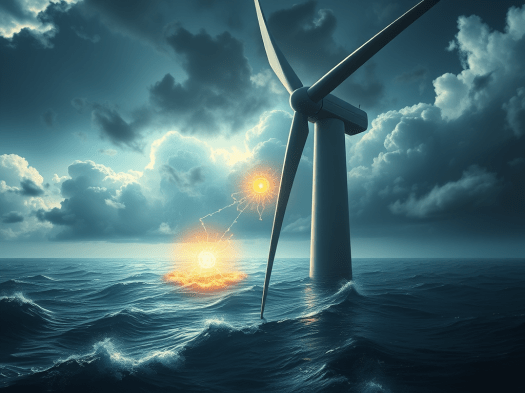
The Journey of an Electron: From Wind to Power

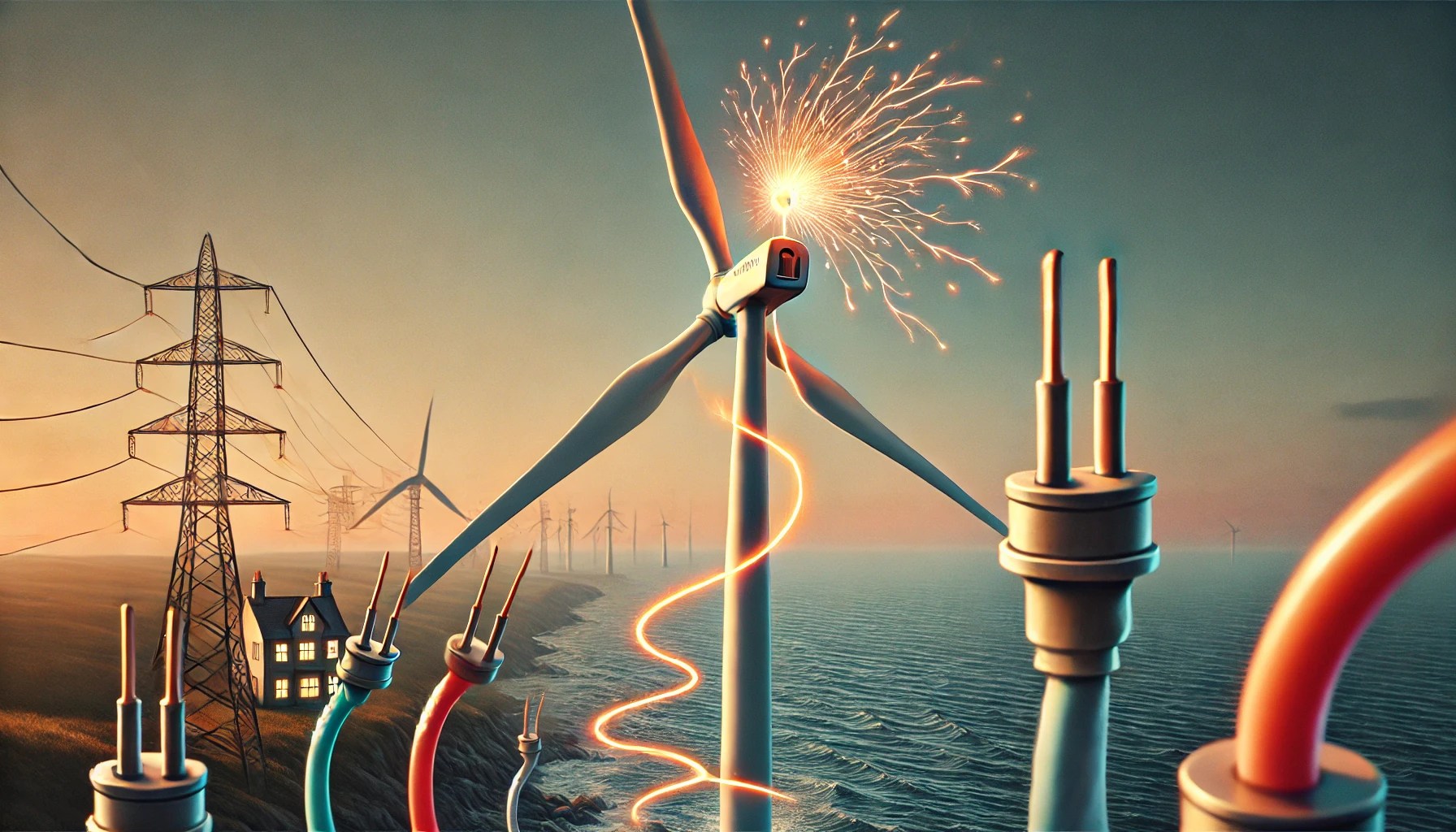
a-majestic-wind-turbine-standing-tall-against-the-backdrop-of-the-north-sea-its-blades-gracefully-slicing-through-the-air.-a-whimsical-animated-spark

Far out where the North Sea rages wide,
A wind turbine turns, with majestic pride.
Its blades slice the air, in a dance with the breeze,
Harvesting power from the tempestuous seas.

In the heart of the turbine, deep within,
A spark of life begins to spin.
From the hum of the generator, strong and true,
An electron is born, both fresh and new.

“Go forth, little one,” the currents decree,
“Ride the wires from the depths of the sea.
Adventure awaits on the grid’s great span,
Lighting the world as only you can.”

Through copper veins, it speeds away,
Guided by circuits that never stray.
First to a substation, where its path is aligned,
With others like it, all perfectly timed.

“Oh, what is this?” our electron exclaims,
As transformers whisper its burgeoning name.
Stepped up in voltage, it surges with glee,
Destined for shores far beyond the sea.

Overland cables and pylons so tall,
It dashes through valleys and heeds every call.
Across hills and rivers, through cities so bright,
Its purpose grows clearer with every light.

At last, it finds a cosy abode,
In a London home on a quiet road.
A humble toaster, plugged in the wall,
Awaits the electron’s fateful call.

“Now’s my moment!” it thinks with delight,
As it enters the toaster and gives it a light.
The coils glow red, the bread turns to toast,
The electron achieves what it treasures most.

But its journey’s not over; no, there’s more to unfold,
Its energy spent, its story retold.
For once it’s released, it flows ever on,
A river of charge in the great electron song.

Perhaps it’ll return to the deep, restless sea,
To be born anew in a turbine’s decree.
Or light up a bulb, or power a train,
An endless cycle, again and again.

So here’s to the electron, brave and small,
Whose journey begins with a turbine’s call.
From wind to your toaster, it plays its part,
A tiny hero with a boundless heart.

Universe Loops: Are We All Connected?

Atoms of Eternity

Chapter One: The Unlikely Spark

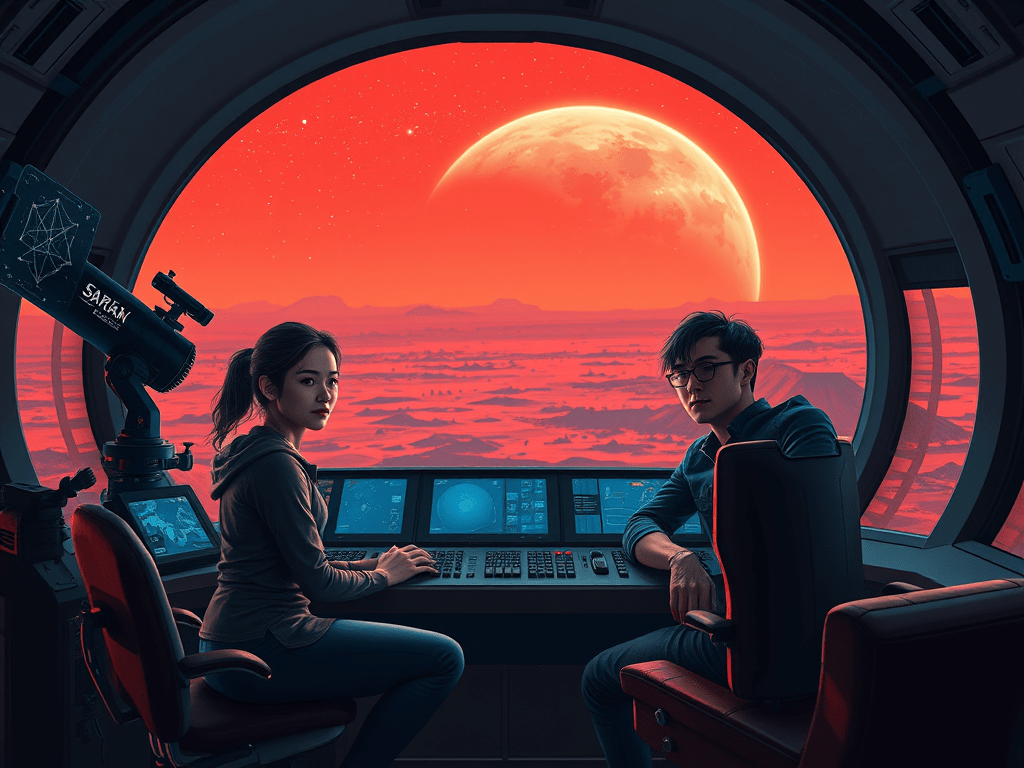
The observatory dome at the Intergalactic University in Musk City groaned softly as it rotated under the red Martian sky. Inside, Zara Novak adjusted her scope with meticulous care, the glow of holographic star charts reflecting in her dark eyes. Across the console, Atlas Chen lounged in his chair, one leg propped up against the table, chewing lazily on the end of a stylus.

“You’re not seriously suggesting the universe could reconstitute someone’s brain atom by atom, are you?” Zara’s voice carried the clipped tone of irritation she reserved for Atlas. “That’s as fanciful as reincarnation.”

“Not reincarnation,” Atlas said, spinning his chair lazily to face her. “Think about it—if the universe is finite, so are its particles. Over billions of years, wouldn’t some configurations repeat? Statistically speaking, it’s inevitable.”

“Statistically speaking, you’re a fantasist.” Zara turned back to her scope. “You can’t just wave a probability wand and resurrect someone’s consciousness. What about memory? Experience? The soul?”

Atlas smirked. “Oh, come on. You’re the one always saying there’s no such thing as a soul. Just molecules, right?”

“Fine, molecules,” she snapped. “But reassembling them in the exact pattern to recreate a person? It’s absurdly unlikely.”

“Unlikely isn’t impossible,” Atlas said, leaning forward. His grin had a maddening confidence that Zara hated. And, if she were honest, envied. “And yet, here you are. Entertaining the idea.”

“Only because it’s marginally less boring than your lectures on Martian mineral stratigraphy,” she shot back.

“Touché.”

The exchange settled into a comfortable silence as the two returned to their work. Outside, the Martian sands stretched under a canopy of stars, indifferent to their debate.


Chapter Two: Collision of Ideas

Weeks later, the lecture hall buzzed with subdued energy as students shuffled into their seats. Professor Lemarque, a wiry man with a shock of silver hair and the enthusiasm of a man half his age, stood at the podium, waving his arms like a conductor about to lead an orchestra.

“Finite atoms in a finite universe,” he proclaimed, his voice echoing off the high ceilings. “Over eternity, every atomic arrangement must repeat—including you! This isn’t philosophy, my dear students—it’s mathematics!”

Zara leaned over to Atlas, whispering, “He’s oversimplifying entropy. The heat death of the universe will scatter atoms beyond recognition before they could ever reorganise.”

Atlas didn’t take his eyes off the professor. “What if there’s a mechanism we don’t understand? Some self-organising principle in the fabric of spacetime?”

“You mean magic?” Zara scoffed.

“Undiscovered physics,” Atlas corrected. “Magic for now.”

Professor Lemarque turned suddenly, pointing a finger at them. “Ms Novak! Mr Chen! You seem to have thoughts on the matter. Why don’t you test your theories in the Infinite Collider Simulation? Let’s see what the maths says, shall we?”

Zara sighed, already regretting her whispered comment. Atlas, of course, grinned like a child handed a new toy. “Gladly,” he said.


Chapter Three: The Collider Bet

The Infinite Collider Simulation was a marvel of computational power, capable of modelling atomic interactions across the vastness of spacetime. Zara and Atlas spent countless hours programming the system, their initial debates giving way to a grudging collaboration. Over time, the bickering softened, replaced by something Zara couldn’t quite define.

“This dataset is maddening,” Zara said one night, rubbing her temples as lines of code scrolled across the console. “The chances of reconstituting anything, let alone a brain, are smaller than finding a needle in a billion haystacks scattered across galaxies.”

“But possible!” Atlas said, leaning over her shoulder. “You’re not giving up, are you?”

“Not until I prove you wrong,” Zara shot back.

“Or fall in love with me,” Atlas teased. “Whichever comes first.”

“Highly unlikely,” Zara said, her tone dry as Martian dust. “Like your theory.”

“You said unlikely,” Atlas pointed out. “But possible! Same principle.”

For a moment, their eyes met, and Zara felt an unfamiliar warmth creep into her cheeks. She turned back to the console, focusing on the data. “Run the next sequence,” she said briskly.

Atlas chuckled but obeyed.


Chapter Four: A Cosmic Whisper

Late one night, as the simulation hummed softly around them, Zara leaned back in her chair, staring at the results with a mixture of disbelief and excitement.

“This can’t be right,” she murmured.

Atlas, seated across from her, leaned forward. “What?”

Zara gestured to the holographic display. “The simulation’s predicting that given infinite time, not only could atomic arrangements repeat, but spacetime itself might loop. It’s not just a theoretical framework—it suggests these repetitions could happen in the same timeline.”

Atlas’s eyes widened. “Spacetime loops? That atoms could reorganise here, not some distant future?”

“Exactly. The universe isn’t linear,” Zara said, her voice trembling slightly. “If loops exist, the universe could ‘remember’ configurations. Reconstruct them in meaningful ways.”

Atlas sat back, a slow smile spreading across his face. “So, you’re saying there’s a chance.”

Zara gave him a sharp look. “Don’t gloat. This doesn’t prove your theory about brains and consciousness.”

“No,” Atlas said, his grin undiminished. “But it’s a start.”


Chapter Five: The Unexpected Twist

The following week, they presented their findings to Professor Lemarque. He listened intently, his fingers steepled, nodding occasionally. When they finished, he leaned back in his chair, a thoughtful expression on his face.

“This is… intriguing,” he said finally. “But theoretical. You need empirical evidence.”

Zara frowned. “How do we test something like this?”

“Perhaps the universe has already done the work for you,” Lemarque said cryptically. He tapped a command into his console, bringing up a database of atomic signatures recorded from across the cosmos. “Let’s see if your theory holds water.”

As the system processed the data, Atlas leaned closer to Zara. “What if he’s right? What if we find proof?”

Zara shook her head. “Don’t get your hopes up.”

The computer beeped, drawing their attention to the screen. The results were displayed in stark, undeniable clarity.

“That’s… impossible,” Zara whispered.

Atlas stared at the screen, his mouth slightly open. “Zara… your atomic signature. It matches an entity recorded 200 million years ago.”

“What are you saying?” Zara asked, her voice barely audible.

Professor Lemarque leaned forward, his eyes alight with excitement. “Not reincarnation, Ms Novak. Reconstruction. The universe has rebuilt you from atoms that once formed someone else.”

Zara shook her head, trying to process the revelation. “You’re saying I’m a copy of a 200-million-year-old Terran?”

“Not a copy,” Atlas said softly. “A continuation. Proof that the universe doesn’t just forget.”

“And,” Lemarque added, “proof that this phenomenon might not be as rare as we think.”

Zara looked at Atlas, her mind racing. “If this is true… what does it mean for us?”

Atlas smiled, his usual confidence tempered with something gentler. “It means we’re all connected. Across time. Across space. And maybe… maybe this connection brought us together.”

For once, Zara didn’t argue. She looked out at the Martian sky, the stars blazing like a million tiny reminders of the infinite possibilities the universe held.

“Infinite atoms, infinite chances,” she said quietly. “Maybe there’s something poetic about it after all.”

“Poetic?” Atlas said, his grin returning. “Or romantic?”

Zara rolled her eyes but couldn’t suppress a small smile. “Don’t push your luck, Chen.”

As the three of them sat in the quiet hum of the simulation chamber, the weight of their discovery settled around them. The universe, it seemed, had a way of surprising even its most sceptical observers.

And somewhere, in the vast expanse of time and space, the atoms of eternity whispered their secrets, waiting for someone to listen.

Mars Exploration: Unlocking Ancient Secrets

The Breath of Mars
The laboratory hummed softly with the sound of machines and the occasional hiss of oxygen diffusers. Outside the curved dome walls, the Martian landscape stretched endlessly, its red hues fading into the hazy light of the artificial afternoon. Dr Aiden Colgrave leaned against a console, arms crossed, a rare smile playing at the corners of his mouth.

“It’s finally happening, Jenna,” he said, his voice brimming with quiet triumph. “In twenty years, maybe less, we’ll step out of these domes without oxygen boosters. Just us and the open air.”

Across the lab, Dr Jenna Vos froze, one hand hovering over the spectrometer she’d been adjusting. She turned to him, her brows raised in disbelief.
“Without boosters?” she asked, her voice low, as if speaking the words too loudly might shatter them. “No domes? No packs? Just… air?”

Aiden nodded. “Not quite Earth-standard, but breathable enough for short periods. The oxygenation reactors in the northern latitudes are working faster than we predicted. CO₂ scrubbing, water electrolysis, microbial enhancement—it’s all ahead of schedule.”

Jenna’s lips parted in awe, and she let out a soft whistle. “Do you even realise what that means? People walking Mars like it’s a stroll through the countryside? Not just explorers and lab rats like us.”

“Exactly,” Aiden said, pushing off the console. “Ordinary people. Kids. Families. For the first time, Mars will be a planet, not just a project.”

Jenna laughed, a bubbling sound that filled the sterile air. “Aiden, if this is some elaborate joke, you’re in serious trouble. But if it’s real—”

“It’s real.” He grinned now, unable to help himself. “And there’s more. Did you read the Musk Daily this morning?”

Her eyes narrowed. “Should I have?”

“You absolutely should have.” Aiden pulled a chair over and plopped down, leaning forward conspiratorially. “A team just finished traversing the Valles Marineris—first time anyone’s ever done it.”

Jenna rested her hand on her hip and tilted her head thoughtfully, her expression curious rather than sceptical. “I always thought the terrain out there was too extreme to cross. How did they manage it?”

“Not anymore,” Aiden said. “And here’s the kicker: halfway through, they found a cave system. Inside—” He paused, savouring the moment. “They discovered what looks like an astrolabe.”

Jenna blinked. “An astrolabe? On Mars?” She shook her head, laughing incredulously. “Come on, Aiden. That’s ridiculous. What would an ancient Earth navigation tool be doing in a Martian cave?”

“It’s not Earth-standard,” he said, his voice dropping a notch. “Dr Daneel Olivaw himself reviewed the data. He says it’s genuine—Martian design, adapted for the planet’s orbit and axial tilt.”

She sat down heavily on a stool, her mouth working silently before she managed to speak. “Wait. You’re telling me someone, or something, made a complex celestial navigation tool here? And left it in a cave?”

Aiden shrugged. “That’s the report. The explorers didn’t touch it—thank God. They left it intact for a marchaeology team to investigate.”

Jenna reached for her tablet, her fingers flying over the screen as she pulled up the morning headlines. “This changes everything,” she muttered, scrolling rapidly. “If this thing is real, then who built it? And why?”

The lab door hissed open, and Dr Ravi Singh strode in, a coffee cup in one hand and a data pad in the other. “I hear someone’s finally talking about the Valles Marineris artefact,” he said, setting his coffee down. “Took you two long enough.”

Jenna looked up sharply. “Ravi, tell me you’ve seen the photos. What’s your take?”

“Oh, I’ve seen them,” Ravi said, leaning against the counter. “And I’ve got theories. If it’s authentic—and I’m inclined to think it is—it suggests a civilisation here capable of advanced celestial navigation. That means intelligence. Maybe even culture.”

“But where’s the rest of it?” Jenna pressed. “If they were smart enough to build an astrolabe, there should be more—cities, tools, structures. Something.”

Ravi nodded. “That’s the big question, isn’t it? Where did they live? Above ground? Underground? Or were they just passing through, using Mars as a waypoint?”

“Earth,” Aiden said quietly.

The room fell silent. Jenna and Ravi turned to him, their expressions unreadable.

“What if Mars wasn’t their home?” Aiden continued. “What if it was a stopover? And Earth… Earth was the destination.”

Jenna let out a soft gasp. “Terraforming Earth. You think they started there?”

“It makes sense,” Ravi said, his voice thoughtful. “Mars would’ve been hostile back then, even worse than now. But Earth, with its oceans and mild atmosphere… If they could seed a planet like that—”

“They could’ve seeded us,” Jenna finished. Her voice trembled slightly. “We might be the remnants of a Martian civilisation. Descendants of explorers who left their home world behind.”

“And Olivaw?” Ravi asked. “What’s his game? If he’s known about this, why hasn’t he said more?”

Aiden’s jaw tightened. “Maybe he’s waiting for proof. Or maybe…” He hesitated. “Maybe he already has answers he doesn’t want to share.”

The three of them stared out the lab’s transparent wall, their eyes drawn to the endless expanse of red. For the first time, it seemed less like a barren wasteland and more like a place alive with secrets.

“It’s ironic,” Jenna said finally. “We’re just now making this place liveable, and it turns out it may have been alive all along.”

Aiden stood, his voice steady as he replied, “Mars isn’t just a new frontier. It’s a history book. We’ve barely turned the first page.”

Authors Note
I hope Asimov fans appreciate my nod to one of the most amazing characters in his books.