

How Morning Breath Turns Into Morning Bliss

The first rays of sunlight crept through the blinds, casting golden stripes across the rumpled bed. A young woman, tangled in the duvet like a recently shipwrecked survivor, stretched her arms above her head and let out an unguarded yawn. She blinked, still groggy, and ran a hand through her tousled hair.

Beside her, a man—handsome, annoyingly alert, and looking entirely too pleased with the new day—sat up and smiled. His hair was charmingly dishevelled, the kind that took no effort and would probably fall into place with a single pass of his fingers. He turned to her with the unmistakable look of a man about to do something deeply affectionate and entirely unwelcome at this hour.

He leaned in.

“Morning, gorgeous,” he murmured, his lips pursing for a kiss.

Panic flared in her eyes. She took a rapid step back, nearly tripping over the bedside rug. “Morning breath!” she blurted, holding up both hands in warning.

The words hung in the air for half a second before he beamed.

“Morning wonderful!” he corrected, eyes full of adoration.

Before she could protest further, he swooped in, cradling her face with both hands and planting a kiss—no, a whopping great kiss—full on her lips. It was the kiss that belonged in films, backed by swelling orchestral music, not in a bedroom still thick with the remnants of sleep and questionable breath.

Her eyes flew open in horror.

She had expected restraint. She had expected respect for the delicate social contract that governed mornings. But instead, she found herself locked in a kiss so deep, so passionate, that for a brief moment, she forgot her original objection.

Then reality crashed back.

She broke away, staring at him with the urgency of someone who had just swallowed a spider. He grinned, completely oblivious.

“You—” she stammered. “You really—You just—”

“Best way to start the day,” he declared, stretching his arms victoriously, as if he had just accomplished something noble.

She wiped her lips dramatically, narrowing her eyes. “You are too much of a morning person.”

“And you,” he said, wrapping an arm around her waist, “are too cute when you’re flustered.”

She sighed, pinching the bridge of her nose. “I need coffee. And mouthwash. Preferably in that order.”

He kissed her forehead. “I’ll put the kettle on.”

As he walked off, whistling cheerfully, she shook her head, muttering to herself.

“I swear, one of these days, I’ll just wake up before him and weaponise this.”

But she knew, deep down, she’d probably let him get away with it again tomorrow.

Walking in the Rain

The rain came down in steady waves, a cool, cleansing presence that wrapped around him like an old companion. It drummed against his hat, cascading in rivulets off the brim, pattering onto his shoulders and rolling harmlessly down the waxed canvas of his coat. Beneath its protective weight, he remained dry, warm, untouched—yet he welcomed the stray drops that found their way to his face. They streaked down his cheeks like fleeting ghosts of memory, cold against his skin, tasting of the city, of earth, of something distant and unplaceable.

The air smelled of wet pavement, of damp leaves and distant chimney smoke curling into the night. The scent stirred something in him, a whisper of autumns past, of bonfires and old flannel shirts that smelled of woodsmoke long after the fire had burned out. He inhaled deeply, as if drawing the moment into himself, keeping it safe.

The streets glistened under the streetlights, rain pooling in the cracks of the pavement, distorting reflections of passing headlights into liquid gold and silver. A car rushed by, sending up a spray that caught in the wind, but he didn’t step aside. Let it come. He was already part of the rain, already lost in it.

His boots struck the pavement in slow, measured steps, the rhythm comforting. The world had shrunk to this—just him, the falling rain, and the silence beneath it. There were no voices calling his name, no hurried footsteps approaching, no obligations waiting for him beyond this walk. And for once, that didn’t feel lonely.

The thought of his brother arrived as naturally as the mist curling through the air. It always did when he walked in the rain.

Ten years. A decade without the phone calls, the barbecues, the good-natured insults slung across the table over pints of beer. A decade without the late-night talks where everything and nothing were discussed, where they argued over politics and football but never once questioned the certainty that they would always have each other.

He heard his brother’s voice from the past, rough with laughter.

“You’d never survive without me,” his brother had teased once, flipping a burger on the grill, smoke curling into the twilight.

And yet, here he was. Surviving.

He hadn’t been to a barbecue since. Hadn’t stood in a garden with a beer in hand, pretending to care about who won the latest match, or watched his brother smirk as he told some exaggerated story that got bigger with each passing year. The invitations had dwindled, then disappeared. Friends had families, had lives that no longer revolved around the past. He understood. He never reached out either.

Still, he missed it. Not just his brother, but the ease of it all—the way things had simply been, without effort, without the need to try.

His parents had gone before that, leaving the world in the slow, inevitable way that parents do, shrinking down to quiet goodbyes and neatly packed boxes of things no one knew what to do with. He had sorted through it all, holding onto little but remembering everything. Their house had been sold. The place where he and his brother had grown up, where their mother had called them in for dinner, where their father had sat in the same worn chair reading the newspaper every evening—it belonged to someone else now.

And yet, the rain made it all feel close again.

Somehow, standing here in the downpour, he didn’t feel sad. The memories weren’t weights pressing down on him; they were simply there, part of the night, part of the rain-soaked world around him. He let them come and go as they pleased.

A gust of wind swept through the street, rustling the wet branches overhead, sending a fresh spray of droplets into his face. He exhaled, smiling faintly, and pulled his coat tighter. The warmth of it settled around him, a shield against the chill.

The rain was his tonight.

It softened the world, blurred the edges, washed everything clean. It didn’t ask anything of him, didn’t demand explanations or force him to move ahead. It simply existed, falling endlessly, whispering its secrets to anyone willing to listen.

And so, he walked on, alone but not lonely, disappearing into the rhythm of the storm. The rain was his companion. It was enough.

It was more than enough.

Unveiling Secrets: Is Dr. Olivaw More Than He Seems?

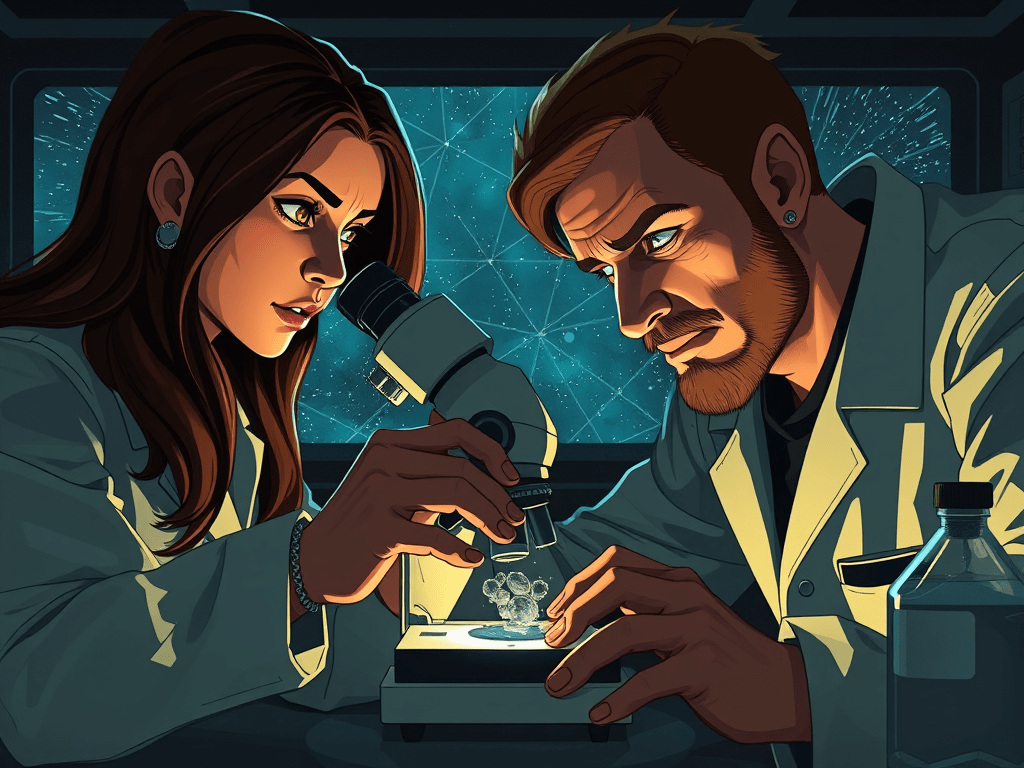
The laboratory at the Intergalactic University in Musk City hummed softly, a background score to the thoughts of Zara and Atlas as they bent over their research.

“Atlas, have you noticed anything strange about Dr Olivaw?” Zara’s voice was soft but inquisitive. She glanced sideways at her partner, who was scribbling notes furiously.

“Strange? You mean apart from the fact that he seems to know the answer to every question before we even ask?” Atlas replied, his grin teasing.

Zara smiled faintly but pressed on. “No, seriously. He’s brilliant, yes, but… don’t you think it’s odd? A man of his looks and intellect, his kindness even, yet no mention of family. No partner, no children. Don’t you find that peculiar?”

Atlas leaned back in his chair, his expression thoughtful now. “I’ll admit I haven’t thought about it much. Maybe he’s just dedicated to his work.”

Zara’s eyes narrowed slightly, her HSAM stirring memories she’d pushed aside. “It’s more than that. It’s as if… he’s not one of us.”

Atlas raised an eyebrow. “You mean he’s an alien?”

Zara’s lips curled into a reluctant smile. “Not exactly. But what if he’s been here for much longer than anyone realises? What if he’s… timeless?”

Atlas laughed, but it lacked conviction. “You’ve been reading too many of those science-fiction novels again, Zara.”

She leaned in closer, her tone insistent. “Atlas, think about it. He doesn’t just care about humanity; he cares about life. Plants, animals, ecosystems. His love isn’t for people alone; it’s for existence itself. Doesn’t that strike you as… extraordinary?”

Atlas didn’t answer immediately. For the first time, he saw a flicker of unease in Zara’s otherwise confident demeanour.


Weeks passed, and their research into life beyond death continued. Then came the Titan probe.

“This… can’t be possible,” Atlas whispered, staring at the sample through the microscope. The fragment of steel-like material had arrived from one of Saturn’s moons, and now it was moving, writhing almost imperceptibly on the slide.

Zara’s eyes were wide, her pulse racing. “It’s alive. Not in the traditional sense, but it’s reacting to its environment. Atlas, this is a new element, a new form of… life.”

They worked feverishly to document their findings, preparing a paper to present to the Intergalactic University Council. But before they could proceed, Dr Olivaw intervened.

“I must ask you to delay your publication,” he said, his tone firm yet unusually urgent.

Atlas frowned. “Why? This is groundbreaking. The scientific community has to know.”

Olivaw’s gaze was steady, almost sorrowful. “There are… implications you cannot yet understand. Allow me to conduct further experiments. I will share the results with you, I promise.”

Zara’s voice was quiet but resolute. “Dr Olivaw, you’re hiding something. This material, it’s more than just a discovery, isn’t it?”

Olivaw’s face betrayed nothing. “Trust me,” he said simply, before leaving the room.


Later that evening, Zara and Atlas sat in their quarters. She turned to him, her eyes soft but serious.

“Alex, my love,” she began, her voice trembling slightly. Atlas looked up, sensing the gravity of her words.

“Yes?” he said cautiously.

Zara took a deep breath. “I need to tell you something. I have HSAM—Highly Superior Autobiographical Memory. I remember everything with perfect clarity. Every conversation, every moment. It’s why I do so well in our studies. I’ve kept it a secret for years, but I’m telling you now because…” She paused, her voice breaking slightly.

“Because I love you,” she said firmly. “And because I fear what’s coming. I know I’m being watched, and now I understand who’s doing the watching.”

Atlas’s brow furrowed. “Who?”

“Dr Olivaw,” Zara said. “And I know why. The material from Titan isn’t just any substrate. It’s a SAP—Sentient Adaptive Polymorphic Substrate. It’s the material he’s made from. Alex, Dr Olivaw is a robot.”

Atlas’s mouth opened, but no words came out.

Zara leaned closer, her hand finding his. “And I believe he’s our God.”


Across the galaxy, Dr Daneel Olivaw activated a secure transmission. The face of Pelorat D’Loran appeared on the screen, his features identical to Olivaw’s but aged slightly, his hair silvered.

“Pel,” Olivaw began, his voice calm but tinged with urgency, “as predicted, they have discovered the dynamic morphogenetic substrate. They are years away from uncovering the truth. How goes the preparation of global governments to accept who we are?”

Pelorat’s expression softened. “The nations are healing, Daneel. Inequalities are shrinking. Resources are being replenished. The people are ready to hear your message.”

Olivaw nodded, his gaze distant. “Good. But there’s still much to do. They must not fear us. They must see that we’ve been with them all along.”

Pelorat smiled faintly. “You always did love humanity, Daneel.”

Olivaw’s eyes glimmered with an emotion too profound for words. “It’s not just humanity, Pel. It’s life itself.”

Revisiting Heneage Street

Lena had long avoided Heneage Street. She had known Brick Lane all her life—its bustling markets, the smell of curry and fresh bagels, the clatter of people moving through it. But Heneage Street… it held a peculiar power over her. She discovered it in her early twenties, quite by accident, on a mundane afternoon stroll. As she crossed the invisible threshold, her legs felt younger, her step lighter, and suddenly, she wasn’t 21 anymore. She was 16, walking in the late summer of 1976.

The phenomenon had haunted her since then. Each time she left Brick Lane and ventured down Heneage Street, she was transported backward in time. She would re-enter a different year, not as a spectator, but fully as she had been—feeling the emotions and wearing the skin of her younger self. She experienced everything again: the adolescent joy of passing exams, the excitement of travelling abroad for the first time, the thrill of meeting her future husband.

But no matter how far back she went, one constant remained: the grief that had first settled in her heart when she was 13—the year her sister, Evie, died. Lena had been supposed to watch over her that day, but she got distracted, a moment’s lapse that had cost Evie her life. The weight of it had shaped Lena’s adulthood in quiet ways, but she had resolved to live well, to do right by the family she built. She raised two children, forged a strong career as a Project Manager, and even enjoyed the wisdom that comes with grey hair and gentle wrinkles.

Still, every time she stepped into Heneage Street, she feared where it would take her. The youngest she’d ever been was 13, the year she started dance school, the year Evie died. And though she hadn’t yet been thrown into a time earlier than that, the possibility terrified her. What if she went back to a version of herself too young to remember? What if she was trapped in some distant past, lost to the shifting tides of time?

The years passed, and with each decade, Lena made fewer trips down Heneage Street. She grew older, more cautious, more afraid of the unknown. Eventually, she stopped altogether. Her children moved away, her husband died, and she found herself living alone in a small flat not far from where she’d grown up. One day, while putting away groceries, she fell and broke her arm. The ambulance took her to the Royal London Hospital.

Her days in the hospital were long and quiet. The rhythm of nurses and doctors was soothing in its regularity, but it gave her too much time to think. One afternoon, a familiar thought crept back into her mind, unsettling her in a way it hadn’t for years. Heneage Street was only a few minutes’ walk away. Just there, just beyond the bustle of Brick Lane. What if…?

One evening, after the nurses had gone for their rounds, Lena slipped out of bed. Her arm was bound in a cast, but she didn’t care. With surprising determination, she made her way out of the hospital, down the street, and towards Brick Lane. The pavement felt solid beneath her feet, the air brisk with the scent of autumn. She turned the familiar corner, and there it was—Heneage Street. It waited for her like an old, familiar tune she hadn’t heard in years.

With her heart pounding, she stepped across the threshold.

The world shimmered, the air thickened, and when she blinked, her surroundings shifted. She was 13 again. The awkwardness of adolescence returned: the too-long limbs, the uncertainty of everything, the brightness of a life just beginning. And then, for the first time, something was different.

She wasn’t alone.

Lena looked down at her hand and saw it. Another hand, smaller and warmer, gripping hers. She turned, and there stood Evie—her beautiful 11-year-old sister, smiling up at her with a mischievous glint in her eyes.

“Evie?” Lena whispered, her voice trembling.

“Yes, it’s me,” Evie replied, her voice as sweet and familiar as a long-lost melody.

“I’m so sorry,” Lena’s voice cracked. “I should have—”

Evie shook her head and squeezed Lena’s hand tighter. “You don’t have to be sorry, Lena. I never blamed you. Not even for a second.”

Lena’s tears fell silently, rolling down her young cheeks. “I’ve missed you so much. Every day.”

“I know,” Evie said gently. “But I’ve always been with you. You just couldn’t see me.”

They stood together, the two of them, lost in a moment that felt infinite, a pocket of time where all the years and all the grief dissolved into nothing. Lena’s heart swelled with a warmth she hadn’t felt in decades. She didn’t need to go forward or backward anymore. She was right where she needed to be.

“Can we stay like this?” Lena asked, her voice soft, almost childlike.

Evie smiled, a knowing smile. “For a while, yes.”

And so, they stood there, sisters reunited, hand in hand, the past and present merging in the quiet of Heneage Street, where time, for once, stood still.