

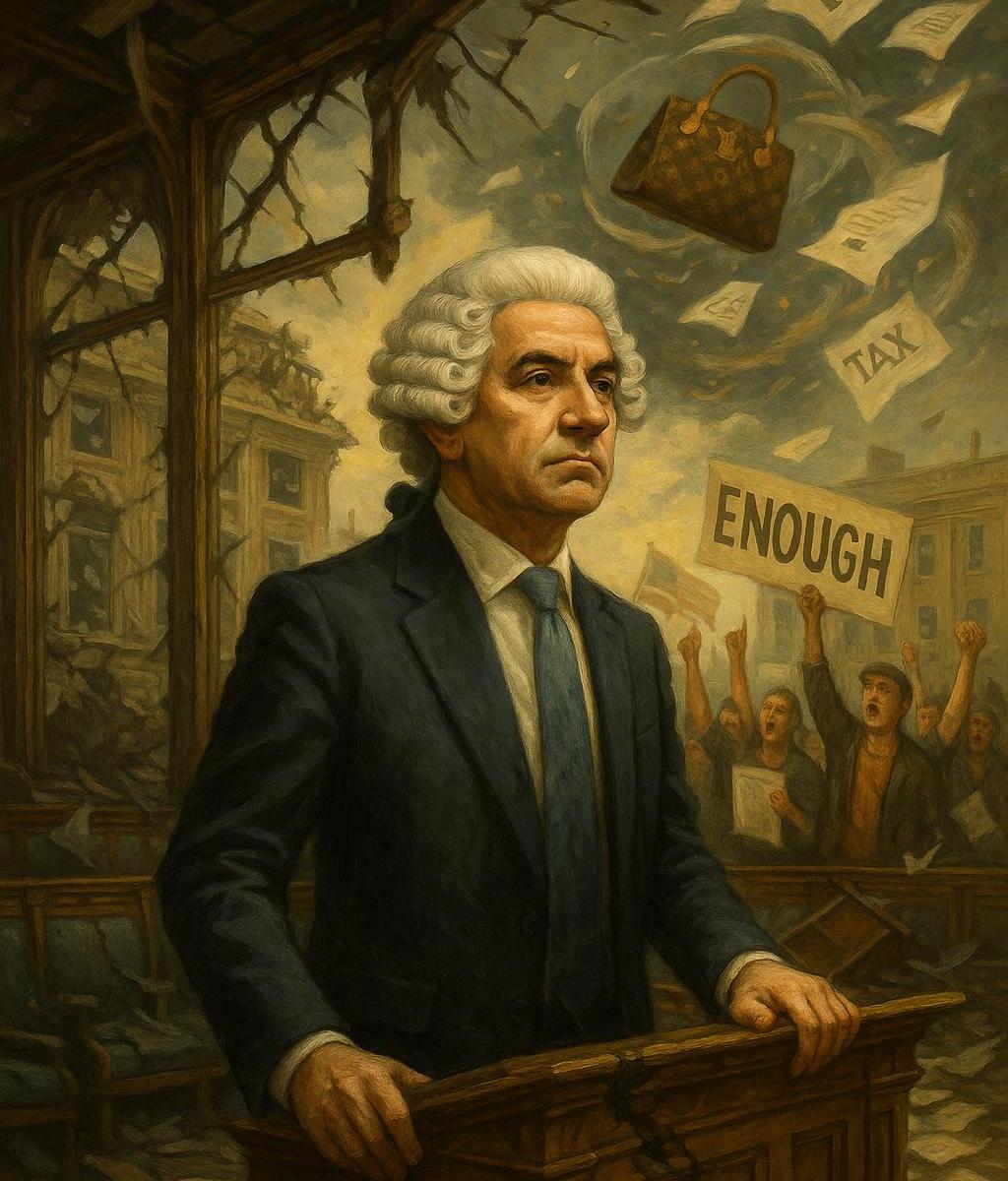
History doesn’t repeat, but it hums the same tune. And if you listen closely, the melody of revolt is never far from the surface. Whether it’s a Parisian mob in 1789 or a furloughed factory worker scrolling Twitter in 2025, the triggers of revolution are eerily consistent.
So here it is: the ingredients list for a classic popular uprising. Mix and stir until boiling.
1. Popular Discontent
The yeast of any revolution. When ordinary people feel overworked, overtaxed, underheard and overruled, they ferment. In pre-revolutionary France, the sans-culottes were starving while the court danced at Versailles. In modern Britain, it’s workers using food banks while MPs remodel their second kitchens.
Discontent isn’t just about poverty — it’s the insult added to injury. When people suffer and see that no one in power cares, the pot simmers.
2. Politicians Smelling Opportunity
Revolutions need opportunists — politicians who realise the tide is turning and paddle accordingly. Sometimes they’re the Robespierres or the Cromwells, elbowing their way into history. Other times they’re more cautious, waiting to back the right crowd once it’s safe.
In 2025, political leaders flip-flopping on immigration, net zero, or free speech aren’t being strategic — they’re sniffing for the wind.
3. The Wealthy Playing Both Sides
There’s always a merchant class trying to protect their ledgers. In Tsarist Russia, the oligarchs funded moderate reformers to avoid Bolshevik firebrands. In our era, billionaires fund both progressive NGOs and Conservative think tanks — not because they care, but because they want influence whichever way the revolution tips.
Modern revolutions are rarely purely ideological — they’re part investment strategy.
4. Byzantine Taxation with Invisible Benefits
The more complicated the tax system, the easier it is to fleece the public — and the angrier they get. In 18th century France, it was the taille, the gabelle, the vingtième — arbitrary, unequal, and infuriating. In Britain today, it’s IR35, VAT tweaks, stealth inheritance freezes, and green levies hiding in energy bills.
When people can’t see where their money is going, or worse — see it going to something stupid — that’s when sparks fly.
5. Vanity Projects & Public Graft
In revolutionary France it was Versailles. In revolutionary America, tea taxes and imperial bribes. In 21st-century Britain? HS2, Test & Trace, Net Zero levies, and consultancy addiction. Enormous sums vanish, yet your local GP surgery still has a 3-week wait.
When the elite waste national wealth on baubles and boondoggles while essential services collapse, people get creative — with pitchforks.
6. Wars the People Don’t Support
Wars have always played a dual role: distraction for rulers, devastation for the ruled. The American Revolution was triggered in part by taxes to fund Britain’s wars elsewhere. Vietnam split the U.S. in half. Iraq and Afghanistan bred cynicism.
In the modern world, it’s subtler. Proxy wars, arms shipments, and military-industrial lobbying — while your town loses its library. A public who doesn’t believe in the war will start questioning who the real enemy is.
7. A Widening Gap Between Rule and Reality
When law becomes performative and leadership becomes cosplay, the people notice. Marie Antoinette played shepherdess in silk. Today’s elites preach austerity from private jets. The rules don’t apply to them — and they don’t care if you know it.
This ingredient isn’t always on the original recipe, but it’s the spice that brings it all together: visible hypocrisy.
8. Cultural Estrangement Between Rulers and Ruled
Revolutions aren’t just about bread; they’re about values. When those who rule speak a different language — metaphorically or literally — from those they govern, it breeds resentment. It might be nobles speaking French in Russia, or metropolitan elites sneering at “low information voters” in Mansfield.
Revolutions often start when the majority feel mocked, ignored, and legislated against by people who neither understand nor respect them.
9. A Trigger Event
One moment, it’s grumbling. The next, it’s barricades. A bread riot. A police shooting. A smug remark from someone in power. The Boston Tea Party, the Storming of the Bastille, the Arab Spring — all started with moments that, in hindsight, were inevitable.
What will ours be? A fuel tax? Another pandemic? A digital ID law?
We won’t know until it happens — but when it does, it’ll feel like it was always coming.
10. A Story to Believe In
Revolutions don’t start with spreadsheets — they start with narratives. A vision of a better world. Liberty. Bread. Justice. Take Back Control. People need something to believe in — even if it’s ill-defined. Especially if it is.
That belief, however messy, can move millions.
Conclusion: Are We There Yet?
Britain today has:
- Widespread discontent ✔
- Out-of-touch elites ✔
- Complex taxation ✔
- Unpopular projects draining wealth ✔
- War spending and foreign entanglements ✔
- Political opportunism and wealthy string-pullers ✔
And still, the nation simmers quietly. But no one turns off the heat.
History warns us: all it takes is one spark.
 Verbal Alchemy