

Atoms of Eternity
Chapter One: The Unlikely Spark
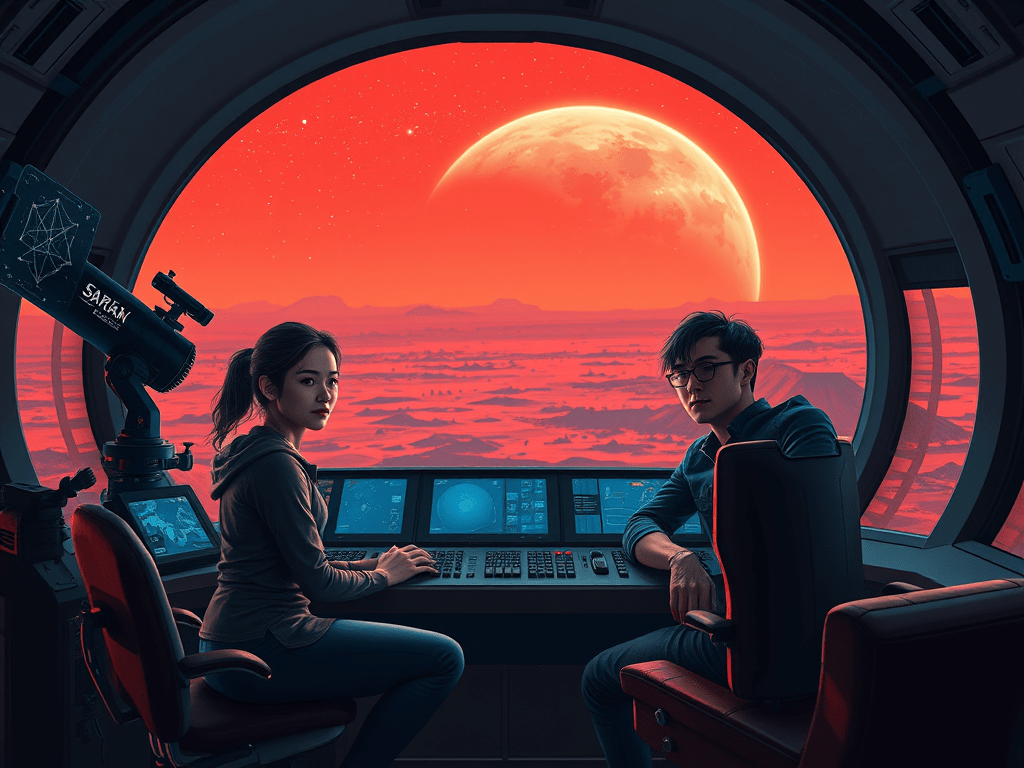
The observatory dome at the Intergalactic University in Musk City groaned softly as it rotated under the red Martian sky. Inside, Zara Novak adjusted her scope with meticulous care, the glow of holographic star charts reflecting in her dark eyes. Across the console, Atlas Chen lounged in his chair, one leg propped up against the table, chewing lazily on the end of a stylus.
“You’re not seriously suggesting the universe could reconstitute someone’s brain atom by atom, are you?” Zara’s voice carried the clipped tone of irritation she reserved for Atlas. “That’s as fanciful as reincarnation.”
“Not reincarnation,” Atlas said, spinning his chair lazily to face her. “Think about it—if the universe is finite, so are its particles. Over billions of years, wouldn’t some configurations repeat? Statistically speaking, it’s inevitable.”
“Statistically speaking, you’re a fantasist.” Zara turned back to her scope. “You can’t just wave a probability wand and resurrect someone’s consciousness. What about memory? Experience? The soul?”
Atlas smirked. “Oh, come on. You’re the one always saying there’s no such thing as a soul. Just molecules, right?”
“Fine, molecules,” she snapped. “But reassembling them in the exact pattern to recreate a person? It’s absurdly unlikely.”
“Unlikely isn’t impossible,” Atlas said, leaning forward. His grin had a maddening confidence that Zara hated. And, if she were honest, envied. “And yet, here you are. Entertaining the idea.”
“Only because it’s marginally less boring than your lectures on Martian mineral stratigraphy,” she shot back.
“Touché.”
The exchange settled into a comfortable silence as the two returned to their work. Outside, the Martian sands stretched under a canopy of stars, indifferent to their debate.
Chapter Two: Collision of Ideas
Weeks later, the lecture hall buzzed with subdued energy as students shuffled into their seats. Professor Lemarque, a wiry man with a shock of silver hair and the enthusiasm of a man half his age, stood at the podium, waving his arms like a conductor about to lead an orchestra.
“Finite atoms in a finite universe,” he proclaimed, his voice echoing off the high ceilings. “Over eternity, every atomic arrangement must repeat—including you! This isn’t philosophy, my dear students—it’s mathematics!”
Zara leaned over to Atlas, whispering, “He’s oversimplifying entropy. The heat death of the universe will scatter atoms beyond recognition before they could ever reorganise.”
Atlas didn’t take his eyes off the professor. “What if there’s a mechanism we don’t understand? Some self-organising principle in the fabric of spacetime?”
“You mean magic?” Zara scoffed.
“Undiscovered physics,” Atlas corrected. “Magic for now.”
Professor Lemarque turned suddenly, pointing a finger at them. “Ms Novak! Mr Chen! You seem to have thoughts on the matter. Why don’t you test your theories in the Infinite Collider Simulation? Let’s see what the maths says, shall we?”
Zara sighed, already regretting her whispered comment. Atlas, of course, grinned like a child handed a new toy. “Gladly,” he said.
Chapter Three: The Collider Bet
The Infinite Collider Simulation was a marvel of computational power, capable of modelling atomic interactions across the vastness of spacetime. Zara and Atlas spent countless hours programming the system, their initial debates giving way to a grudging collaboration. Over time, the bickering softened, replaced by something Zara couldn’t quite define.
“This dataset is maddening,” Zara said one night, rubbing her temples as lines of code scrolled across the console. “The chances of reconstituting anything, let alone a brain, are smaller than finding a needle in a billion haystacks scattered across galaxies.”
“But possible!” Atlas said, leaning over her shoulder. “You’re not giving up, are you?”
“Not until I prove you wrong,” Zara shot back.
“Or fall in love with me,” Atlas teased. “Whichever comes first.”
“Highly unlikely,” Zara said, her tone dry as Martian dust. “Like your theory.”
“You said unlikely,” Atlas pointed out. “But possible! Same principle.”
For a moment, their eyes met, and Zara felt an unfamiliar warmth creep into her cheeks. She turned back to the console, focusing on the data. “Run the next sequence,” she said briskly.
Atlas chuckled but obeyed.
Chapter Four: A Cosmic Whisper
Late one night, as the simulation hummed softly around them, Zara leaned back in her chair, staring at the results with a mixture of disbelief and excitement.
“This can’t be right,” she murmured.
Atlas, seated across from her, leaned forward. “What?”
Zara gestured to the holographic display. “The simulation’s predicting that given infinite time, not only could atomic arrangements repeat, but spacetime itself might loop. It’s not just a theoretical framework—it suggests these repetitions could happen in the same timeline.”
Atlas’s eyes widened. “Spacetime loops? That atoms could reorganise here, not some distant future?”
“Exactly. The universe isn’t linear,” Zara said, her voice trembling slightly. “If loops exist, the universe could ‘remember’ configurations. Reconstruct them in meaningful ways.”
Atlas sat back, a slow smile spreading across his face. “So, you’re saying there’s a chance.”
Zara gave him a sharp look. “Don’t gloat. This doesn’t prove your theory about brains and consciousness.”
“No,” Atlas said, his grin undiminished. “But it’s a start.”
Chapter Five: The Unexpected Twist
The following week, they presented their findings to Professor Lemarque. He listened intently, his fingers steepled, nodding occasionally. When they finished, he leaned back in his chair, a thoughtful expression on his face.
“This is… intriguing,” he said finally. “But theoretical. You need empirical evidence.”
Zara frowned. “How do we test something like this?”
“Perhaps the universe has already done the work for you,” Lemarque said cryptically. He tapped a command into his console, bringing up a database of atomic signatures recorded from across the cosmos. “Let’s see if your theory holds water.”
As the system processed the data, Atlas leaned closer to Zara. “What if he’s right? What if we find proof?”
Zara shook her head. “Don’t get your hopes up.”
The computer beeped, drawing their attention to the screen. The results were displayed in stark, undeniable clarity.
“That’s… impossible,” Zara whispered.
Atlas stared at the screen, his mouth slightly open. “Zara… your atomic signature. It matches an entity recorded 200 million years ago.”
“What are you saying?” Zara asked, her voice barely audible.
Professor Lemarque leaned forward, his eyes alight with excitement. “Not reincarnation, Ms Novak. Reconstruction. The universe has rebuilt you from atoms that once formed someone else.”
Zara shook her head, trying to process the revelation. “You’re saying I’m a copy of a 200-million-year-old Terran?”
“Not a copy,” Atlas said softly. “A continuation. Proof that the universe doesn’t just forget.”
“And,” Lemarque added, “proof that this phenomenon might not be as rare as we think.”
Zara looked at Atlas, her mind racing. “If this is true… what does it mean for us?”
Atlas smiled, his usual confidence tempered with something gentler. “It means we’re all connected. Across time. Across space. And maybe… maybe this connection brought us together.”
For once, Zara didn’t argue. She looked out at the Martian sky, the stars blazing like a million tiny reminders of the infinite possibilities the universe held.
“Infinite atoms, infinite chances,” she said quietly. “Maybe there’s something poetic about it after all.”
“Poetic?” Atlas said, his grin returning. “Or romantic?”
Zara rolled her eyes but couldn’t suppress a small smile. “Don’t push your luck, Chen.”
As the three of them sat in the quiet hum of the simulation chamber, the weight of their discovery settled around them. The universe, it seemed, had a way of surprising even its most sceptical observers.
And somewhere, in the vast expanse of time and space, the atoms of eternity whispered their secrets, waiting for someone to listen.

 Verbal Alchemy