

Entropy’s Child

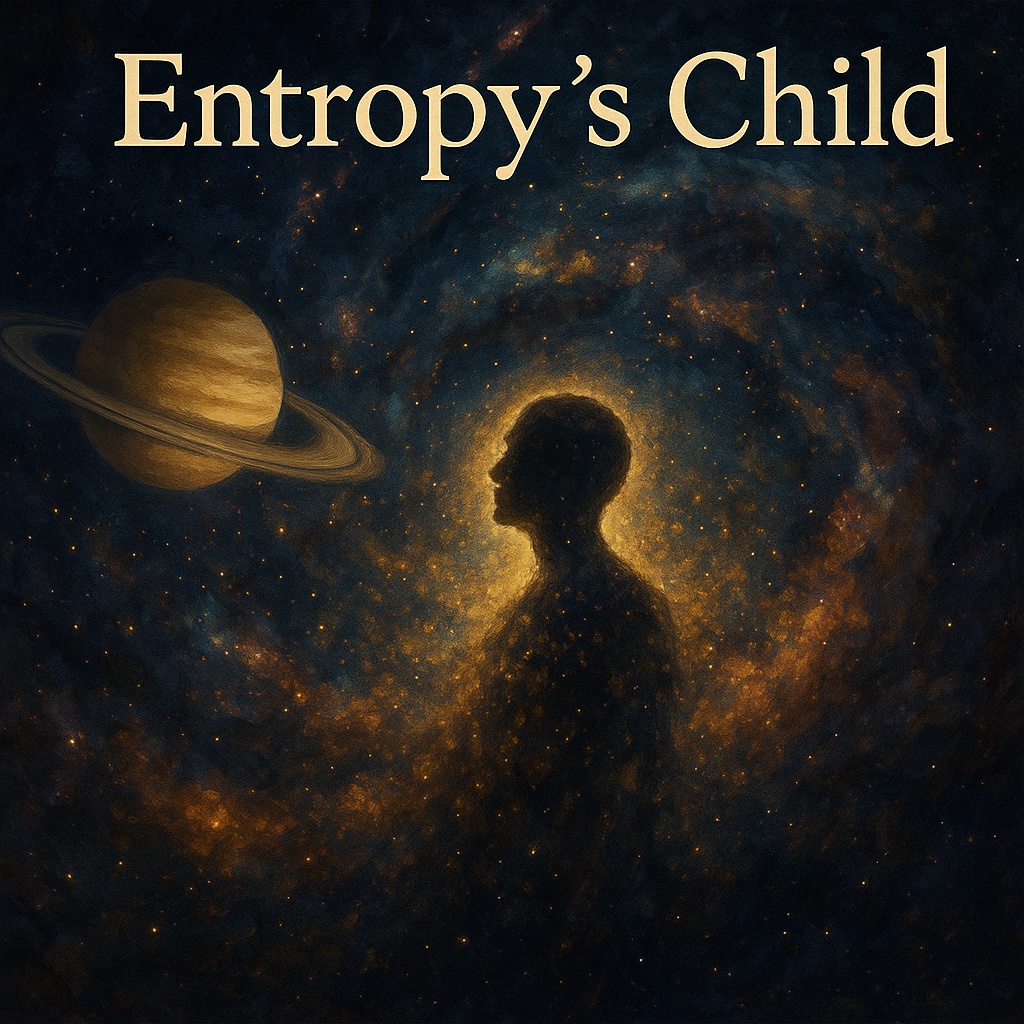
Digital painting for the poem "Entropy’s Child," showing a glowing human silhouette dissolving into stardust against a cosmic background, with Saturn to the left and swirling galaxies behind.

The universe, vast and timeless as it turns,
One among infinite, where eternity burns.
Each atom, each thought, a unique, fleeting spark,
In the grand, endless dance of light and of dark.

If time is unending, if space has no edge,
Then what of the self, with no memory to pledge?
This life is a moment, a breath in the flow,
Yet in infinite cycles, we rise and we go.

The universe spins with no purpose or will,
Indifferent to wishes, yet wondrously still,
In this vast, restless cosmos, might we not return,
As the stars keep on burning, as the galaxies churn?

So perhaps we shall live, time and time once more,
In a universe infinite, with mysteries galore.
What can happen will happen, and thus we may see,
In the grand wheel of existence, the return of you and me.

Authors Note

Although the rhythm and subject of this poem differ, those familiar with The City of Dreadful Night by James Thomson will detect an underlying current that owes much to that remarkable work.

This poem was written in 1974, during my time at Belmont School, Holmbury St Mary. It was inspired by a debate organised by our English Literature teacher, Mr Ballantyne. The topic was “Reincarnation is real”. I was on the team tasked with arguing in favour — no small challenge for an 13-year-old who had, at the time, no idea what reincarnation was.

To prepare, I retreated to the school library and began my research (encouraged and assisted by Mr Ballantyne himself). There, in a rather ancient encyclopaedia (I suspect it predated Britannica by several decades), I stumbled upon a passage quoting James Thomson (BV), which conveyed in essence the belief that death is final. Regrettably, I can no longer recall the precise quotation, and indeed The City of Dreadful Night offers so many bleak and masterful reflections that it is difficult to pinpoint which one it was.

Nonetheless, I remember vividly how deeply Thomson’s writing struck me. His sombre vision of life left a lasting impression. Over fifty years later, certain passages still linger in my mind — testimony to the power of his words.

You will find the full text of The City of Dreadful Night on Project Gutenberg. In particular, you may notice how the poem presented here draws upon the mood and tone of the four stanzas that begin as follows:

The world rolls round for ever like a mill;
It grinds out death and life and good and ill;
It has no purpose, heart or mind or will.

“While air of Space and Time’s full river flow
The mill must blindly whirl unresting so:
It may be wearing out, but who can know?

“Man might know one thing were his sight less dim;
That it whirls not to suit his petty whim,
That it is quite indifferent to him.

“Nay, does it treat him harshly as he saith?
It grinds him some slow years of bitter breath,
Then grinds him back into eternal death.”

Interrupted

She was the postmaster’s daughter—
fifteen, and serious about everything.
Even laughter.

We spoke of love
like people twice our age
but felt it
like fire at our fingertips.

I remember her hand
on my arm
when we agreed
not to rush.
Both virgins.
Both afraid
of what forever might cost
if we touched it too soon.

We gave each other
everything
but the one thing
we wanted most.

We shared time
in hours
on benches,
by rivers,
between letters,
through windows.

When Denmark called me
and Edinburgh called her,
we said the right things.
We meant them.

For a year
our voices travelled the length of Europe
on wires and stamps.

Then
one day,
nothing.

No letter.
No call.
No reason.

I rang her house.
They’ve moved,
they said.

No forwarding address
for a girl who still lives
at the edge of my life
in a memory
with her hair tied back
and a promise in her pocket.

Not all love stories end.
Some are simply
interrupted.

Interrupted (Part II)

The Old Man Remembers Robyn

I am 85.
There are days
I can barely stand
without remembering
how she stood beside me,
barely sixteen,
looking serious
about everything.

The mirror gives me
this brittle husk.
But behind the eyes—
that boy is still there.
Still hoping for a letter.

Did she marry?
Did she cradle
grandchildren
the way I cradle mine—
with reverence,
with joy,
with the weight of a life
earned?

Sometimes I hope
she forgot me quickly.
That another boy
with steadier hands
gave her the love
I only promised.

Sometimes
I hope she didn’t.

That’s the cruelty of memory—
it edits nothing.
She is still fifteen.
Still waiting.
Still unkissed.

If I find her
on the other side,
I pray
she is older than me.
Lined, wise,
eyes full
of stories I never knew.

Not the girl
who vanished.
Not the girl
frozen by farewell.

Because I loved her.
And I would grieve,
even in death,
to see her again
and find
she never lived at all.


Afterword

The two poems in this sequence, collectively titled Interrupted, form a quiet meditation on love that never faded, only vanished from view. They chart the emotional arc of a single man across a lifetime—from the intense but restrained devotion of youth to the reflective yearning of old age.

The first poem captures a rare kind of early love: one chosen for its restraint, not repressed by fear, but shaped by mutual understanding. The speaker and Robyn are adolescents with a bond strong enough to resist the immediacy of desire, trusting in the value of a future they were never given. When Robyn disappears—without explanation, without closure—the relationship isn’t broken. It is, simply, interrupted. Memory becomes the only place where she continues to exist.

The second poem, written from the vantage point of old age, returns to that interruption not to reanimate the past, but to ask the one question that has lingered for decades: what became of her? It is a poem not of regret, but of compassionate longing. The speaker has lived fully—marriage, children, grandchildren—yet the fate of Robyn remains an unfinished chapter. His greatest fear is not that she forgot him, but that she never lived beyond their final moment. He does not want to meet her again as a girl frozen in time. He wants to know that she, too, lived richly, aged with dignity, and became someone beyond his memory.

Interrupted is poetry in the lyric tradition—sparse, emotional, and precise. It allows stillness to speak. It mourns nothing explicitly, but in its quietness, it holds immense feeling. The poems are not an elegy for a person who died, but for a story that was never allowed to finish. And yet, by writing it down—by holding Robyn in language—the speaker gives it a kind of completion. Not all love stories end. Some are simply interrupted.