


By Martyn Walker
Published in Letters from a Nation in Decline
When the state makes life itself conditional on its seal, the mark of the beast is already upon us.
It is a curious thing that whenever governments extend their reach into private life, they never describe it as such. They speak instead of convenience, safety, modernisation. Sir Keir Starmer’s championing of digital identity sounds like a minor administrative adjustment, the bureaucratic equivalent of changing the colour of the tax return form. Yet the reality is rather less trivial.
Digital identity, once imposed, is not a marginal innovation but a centralising revolution. Every man, woman, and child becomes a data entry in a state-authorised ledger, their existence vouched for only so long as the system continues to recognise them. Enter a shop, book a train ticket, apply for a job, or access a bank account — all remain possible only if the digital credential functions. The promise is efficiency; the reality is conditional existence.
The most arresting commentary on such systems does not come from libertarian pamphlets or academic studies, though both have their place. It comes from an ancient text often dismissed as melodrama: the thirteenth chapter of the Book of Revelation. There, the writer describes a society in which “all, both small and great, rich and poor, free and bond” must carry a mark, without which “no man might buy or sell.” Scholars debate whether this was first-century allegory, coded critique of Rome, or apocalyptic vision. The detail is precise: the universal credential is the universal chain.
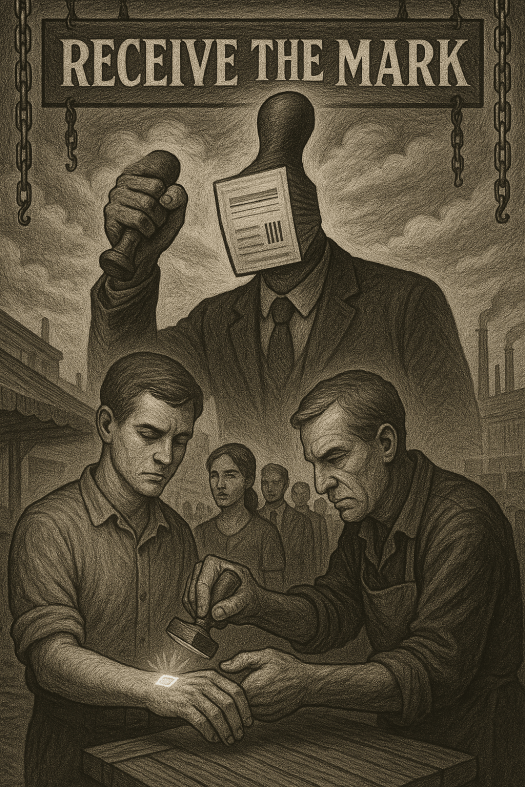
No theological commitment is required to see the parallel. The mark on the hand or forehead is today’s biometric key. The exclusion from buying or selling is today’s digital wallet frozen by an unseen hand. The beastly system, whether religious or secular, rests not on spectacular cruelty but on the quiet, routine denial of access. Prison walls are unnecessary if the till refuses the card.
Sir Keir presents himself as a moderniser. His case for digital ID is couched in terms of security, fraud prevention, and border control. He would bristle at any comparison with scripture. Yet it is precisely his mildness that makes the matter more sinister. Tyranny that announces itself can be resisted. Tyranny that drapes itself in the language of efficiency is harder to unpick. One does not wake one morning to discover the mark branded on the hand; one drifts into a world where participation in daily life depends on presenting the correct token at every doorway.
Defenders of such schemes protest that the British state is not tyrannical, that it will never abuse such power. This is a charming thought. It is also historically illiterate. Every government abuses the powers it acquires, and powers are never surrendered. The veto inherent in a digital ID scheme — the ability to prevent a man from buying or selling — may sit dormant, but it will never be dismantled. It rests there, like a coiled spring in Whitehall, ready to be activated at the moment of political convenience.
Nor should the economic logic be ignored. The Bank of England has spoken openly about programmable currency, which requires, by definition, a universal identifier. To know what money is being spent on, or to restrict its use to particular purposes, the state must know who is doing the spending. The marriage of digital ID and programmable money creates precisely the world Revelation describes: life conditional on permission.
That the Labour leadership fails to see this is damning enough. That it understands and proceeds regardless is worse. The old Labour Party liked to talk about liberty and dignity. The new one is content to speak of databases and compliance. Sir Keir’s tone is calm, legalistic, mildly reassuring. The punchline is that he offers Britain not security but servitude by spreadsheet.
What makes this especially grotesque is Britain’s history. This was the nation that prided itself on habeas corpus, on common law, on the principle that the citizen was free unless explicitly restrained. The imposition of a universal ID, tethered to one’s ability to transact, inverts that principle. It assumes restraint, lifted only when the system gives its blessing. The state does not prove its case against the citizen; the citizen must prove his case to the state.
Some will accuse this argument of melodrama, of importing biblical language to dignify a mundane administrative reform. In truth the melodrama belongs to Starmer, who dresses coercion in the robes of progress. Revelation, for all its imagery, is coolly accurate. It identified, nearly two millennia ago, the core of what makes such systems intolerable. They do not merely control trade. They redefine freedom itself.
The polite suggestion is that Sir Keir has not reflected on the full implications. The impolite truth is that he has. Either way the effect is identical: a government that sees its citizens not as free men and women, but as registered users, liable to be suspended. And the suspension is not noisy, with trumpets and banners. It is silent, invisible: the card declined, the ticket refused, the door that no longer opens.
Sir Keir will be remembered. He will be remembered as the man who sought to baptise bureaucracy with the language of progress. Britain can weather his speeches; what it may not weather is the architecture he is so keen to build. The peril is not a number burned into the flesh. It is a system so ordinary, so seamless, that the nation scarcely notices it already carries the mark.
The writer of Revelation recognised the pattern. The mark of the beast was never about the hand or the forehead. It was about ownership — about the moment a man’s life ceased to be his own, and became conditional on another’s approval. That is what digital ID represents today. A mark not of safety, but of possession. And the question, as always, is whether the British people are still spirited enough to refuse it.


 Verbal Alchemy