

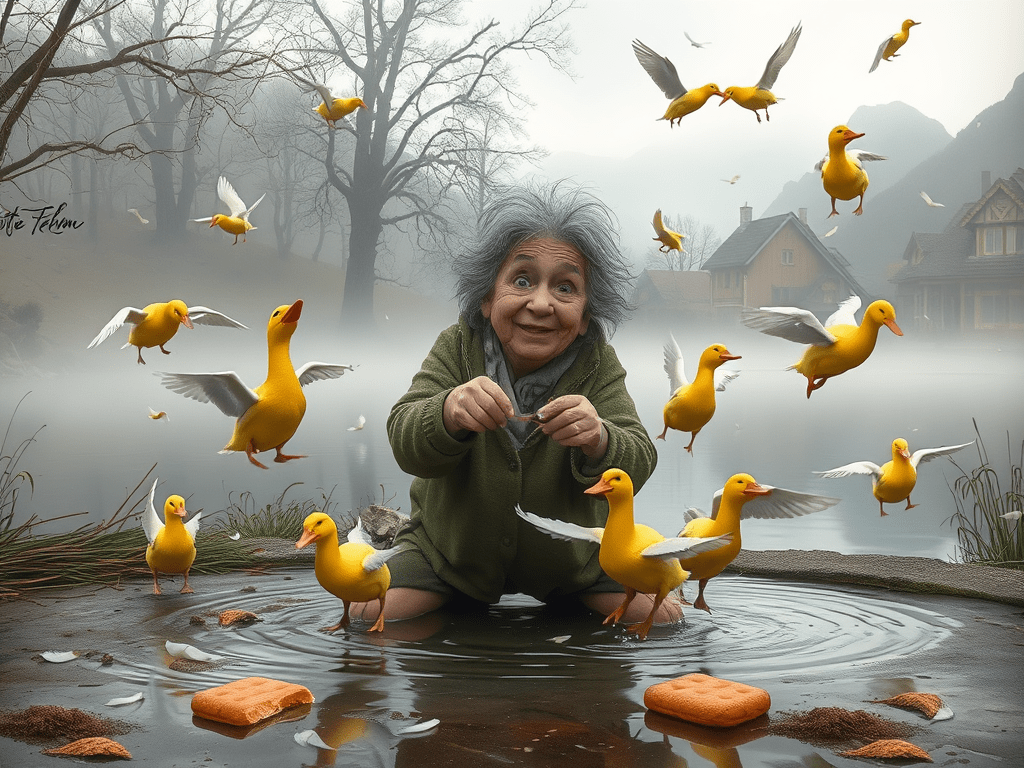
In a small, foggy village nestled between jagged hills and an ever-receding horizon, lived Granny Harmer, a character so notorious for her incompetence that even the crows avoided her roof, fearing her bungling touch. Yet, Granny Harmer was oblivious to her reputation. She considered herself the lynchpin of the village—a solver of problems, a doer of deeds, a fixer of what wasn’t broken.
One misty morning, Granny Harmer awoke with a start. She had dreamed of eagles soaring majestically over the village and resolved that she, too, would achieve greatness by teaching her ducks to fly like those regal birds. She bustled about her cluttered kitchen, rummaging through dusty cupboards for anything that might aid her grand endeavour: some old string, a jar of glue, and a half-eaten biscuit.
With her “training kit” in hand, she waddled out to the pond, where her ducks quacked happily, blissfully unaware of their impending adventure. Granny Harmer began tying wings together, fastening feathers to beaks, and attempting to throw the ducks into the air like kites. The scene quickly descended into chaos. Ducks flailed, feathers scattered, and Granny Harmer, drenched in pond water, declared the day a success despite no duck ever leaving the ground.
The villagers shook their heads in despair. One whispered to another, “Why does she keep trying?”
Granny Harmer, undeterred by failure, marched back home. Her mind buzzed with new schemes—grand ideas to fix problems that didn’t exist. She decided to install a mechanical weather vane on her roof to “calm the storms.” She ended up electrocuting herself when she wired it to the lightning rod. She attempted to build a new bridge over the stream but diverted the water straight into the village square.
Her failures piled up like the heaps of broken contraptions in her garden. The villagers, initially amused, grew weary of cleaning up her messes. One day, the mayor knocked on her door.
“Granny Harmer,” he said, trying to keep his tone polite, “perhaps you should take some time to think things through before acting.”
She squinted at him. “Think things through? Why, that’s the job of Mr Common Sense!”
“Who’s Mr Common Sense?” the mayor asked, perplexed.
“Oh, he used to be my closest companion,” she sighed dramatically, “always there to tell me what to do. But he disappeared years ago, and I lost touch with him!”
The mayor didn’t know how to respond, so he left her to her delusions.
That night, Granny Harmer sat by the hearth, her apron singed from an earlier mishap with the kettle. She clasped her hands and stared into the flickering flames. “Mr Common Sense,” she whispered, “wherever you are, I need you. Please come back! I cannot fix things without you!”
The fire crackled, and the shadows danced on the walls. For a brief moment, Granny Harmer thought she heard a faint chuckle, as if the missing Mr Common Sense was laughing at her from inside her garage.
Days turned into weeks, but Mr Common Sense did not return. Granny Harmer, however, refused to accept this. She decided that if he wouldn’t come to her, she would find him. She packed a bag filled with mismatched socks, a leaky flask, and a broken compass, and she marched out into the wild.
The villagers watched her go with a mixture of pity and relief. “She’ll be back,” one said.
“No, she won’t,” said another.
Granny Harmer wandered for days, calling out for Mr Common Sense as if he were a wayward sheep. She stumbled through forests, across rivers, and into a barren wasteland where the wind howled like an unanswered question.
There, in the desolation, she realised something profound. She sat on a rock and muttered, “Maybe Mr Common Sense isn’t coming back because he’s tired of cleaning up my messes.”
At that moment, a bedraggled duck waddled into view, quacking plaintively. Granny Harmer stared at it, and a glimmer of clarity—faint as moonlight on a cloudy night—passed over her.
“You’re a duck,” she said. “And ducks aren’t eagles.”
The duck tilted its head, as if to say, “Quack?”
Granny Harmer returned to her village, a little humbler and a little wiser. She dismantled her failed contraptions, and stopped meddling in things she didn’t understand. Though she never quite mastered common sense, she learned one important lesson:
You shouldn’t send your ducks to eagle school.
And from that day on, the village grew a little quieter, the crows returned to her roof, and her ducks relocated to Clacton-on-Sea.
 Verbal Alchemy