AI – The Hollow Masquerade: A Portrait of Folly Behind the Façade

Author’s Note:
Attempting to generate an image for this satirical play using AI was a soul-sapping exercise in futility. At one point, I was one error message away from launching my laptop out the window like a rock star in a midlife crisis.

If this had been the 1970s, I’d have hurled the hotel TV into the car park and lit a cigarette over the smouldering remains.

Enter NotebookLM from Google—like a calm librarian walking into a bar fight. It actually made sense. Do yourself a favour: give it a listen before reading on.

In a faded council chamber, Stan Laurel and Ollie Hardy debate whether to conduct a local or national inquiry amid public pressure and political delays. Laurel emphasizes the need for accountability, while Hardy evades responsibility, fearing voter backlash. Their discussion reveals government inefficiency and avoidance of truth.

INT. A FADED COUNCIL CHAMBER — SOMEWHERE BETWEEN WESTMINSTER AND NOWHERE

(Stan Laurel is flicking through a thick stack of enquiry reports. Ollie Hardy is adjusting his mayoral chain, which is obviously too small and keeps getting stuck in his double chin.)


HARDY:
Stanley, this is a serious matter. The people are demanding answers. So we must decide: Do we want a local inquiry… or a national inquiry?

LAUREL:
Well… why don’t we have a national local inquiry? That way it only applies in some places but makes everyone feel involved!

HARDY (huffing):
You can’t have a national local inquiry! That’s like ordering a medium large coffee!

LAUREL:
But Ollie, last week we said we wanted a national one. Then the week before that, we said we didn’t. Then we did. Then we didn’t. Then we sort of did, but only if nobody asked too many questions…

HARDY:
That’s called government policy, Stanley.

LAUREL (scratching his head):
I thought it was called panic.


HARDY (stepping forward, speaking as if to a public gallery):
We are faced with a delicate issue — one that could cost votes, credibility, and the last wafer-thin biscuit of public trust. Therefore, we shall respond with… a Taskforce! A working group! An inter-departmental roundtable! With refreshments!

LAUREL:
But what about the girls, Ollie?

HARDY (pausing):
What girls?

LAUREL:
The ones they’re supposed to be asking about. The ones who got hurt.

HARDY:
Oh, those girls. Yes, yes. Well, we’ve drafted a Statement of Concern and a Provisional Framework for a Potential Expression of Regret. Pending further votes.


LAUREL (innocently):
You mean you’re not going to find out who did it?

HARDY:
Stanley, don’t be ridiculous! If we found out who did it, we might have to say something. Then somebody might get offended — and then what? We lose the whole constituency!

LAUREL (genuinely confused):
But I thought we were in charge.

HARDY:
Oh no, Stanley. We’re not in charge. We just act like it until the next election.


(Laurel produces a map of Britain with red Xs all over it.)

LAUREL:
I counted. There’ve been eight of these cases that we didn’t really look into.

HARDY (snatching the map):
That’s not a map! That’s a career suicide note! Take it away!

LAUREL:
But what if the voters start noticing?

HARDY:
We’ll tell them it’s local police responsibility. Or historic. Or complicated. Or “currently under review pending further scoping assessments”.


LAUREL:
That’s a lot of words for doing nothing.

HARDY (exasperated):
Stanley, doing nothing is a time-honoured British tradition! If we did something, there’d be… consequences!

LAUREL (thinking):
Like justice?

HARDY:
Don’t say that word in here!


(Laurel picks up a newspaper with the headline: “Enquiry Postponed Again” and sighs.)

LAUREL:
You know Ollie, if this keeps up, they won’t vote for Labour or anyone else. They’ll just stay home.

HARDY:
Exactly! And then nobody loses! Democracy at its finest!


(Beat. Laurel starts sobbing.)

LAUREL:
But I don’t want to be part of a country that can’t tell the truth because it might lose a seat in Bradford.

HARDY (quietly):
Neither do I, Stanley… But we’ve got a press release going out that says we’re deeply committed to transparency, so chin up, eh?


(As they leave, Laurel turns back and pins a single sign to the wall. It reads: “DO THE RIGHT THING.”)

HARDY (scoffing):
Now you’ve done it. Someone will definitely be offended.

LAUREL (smiling faintly):
I hope so.


[FADE OUT to sound of filing cabinet drawers being slammed, one after the other, into the same unopened enquiry folder.]
A Modest Proposal for the Equal and Efficient Distribution of the Living and the Dead

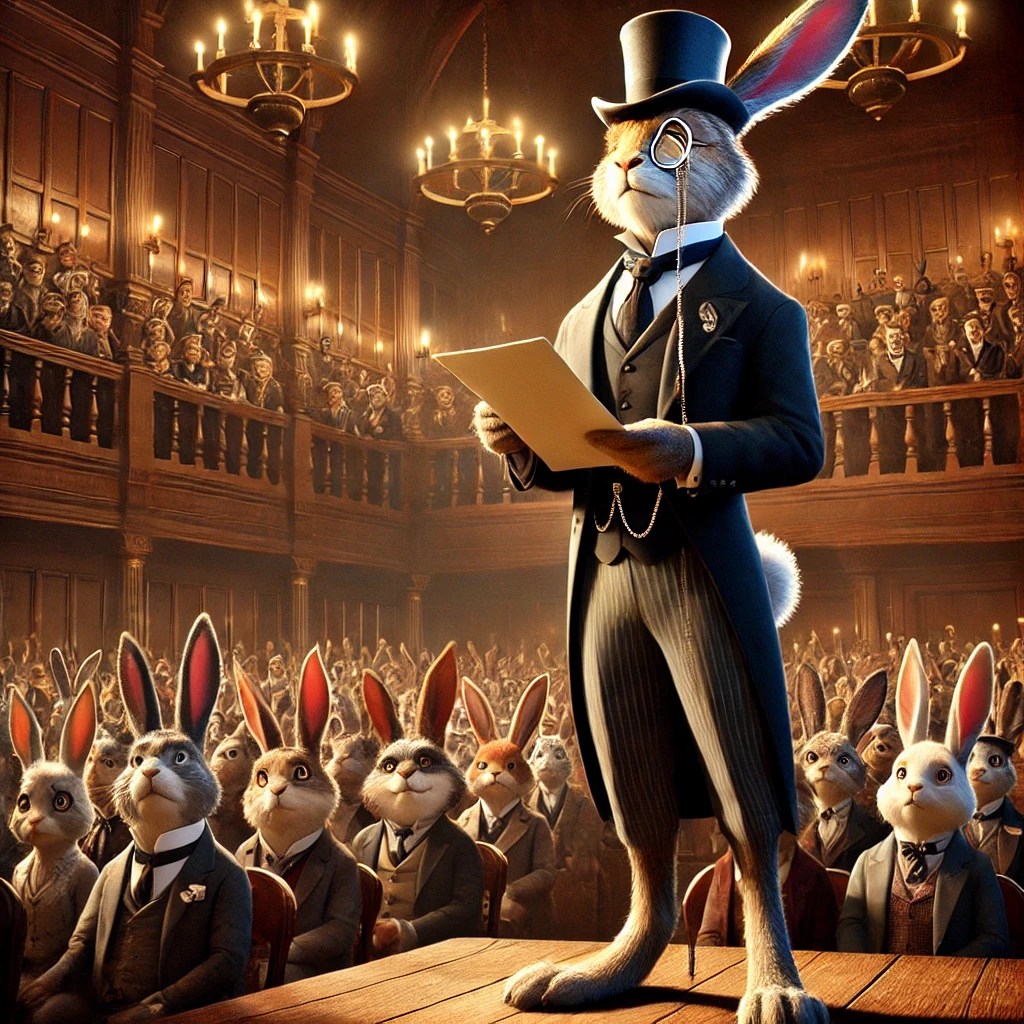
By Thumper O’Lagomorph, Esq.

Preface

It has long been observed by the more reasoned minds of our warren that the natural world suffers from an untenable crisis: a surfeit of the living and an insufficiency of the dead. While all creatures are guaranteed the equal right to exist in this great and bounteous world, it is a truth universally acknowledged that not all lives are of equal worth. The great foxes and wolves must eat; the snakes must coil and consume; the brutal hares must wage their ceaseless wars against badgers. And yet, in their noble pursuit of the natural order, they find themselves hindered by an inefficiency most lamentable: the unstructured, chaotic proliferation of the small and meek.

Chief among the burdens of our age is the matter of the rabbits, my own species, whose unchecked population growth has long threatened to destabilise the ecosystem. Our prolific breeding has led to overcrowding, disputes over territory, and—most grievously—a dangerous shortage of edible rabbits for the foxes and wolves. Furthermore, our brethren, in their misguided insistence on survival, have resisted their natural obligation to provide themselves as sustenance for their betters, leading to distressing incidents in which our noble predators have been reduced to devouring lesser meats such as voles, shrews, and, on occasion, their own kind.

To this end, I humbly submit a practical and benevolent solution: the centralisation and redistribution of rabbits as a shared planetary resource, ensuring that no fox, wolf, or snake need ever go hungry again. This plan, while radical, is perfectly in line with our longstanding policy of sharing resources, particularly in the realm of space exploration, wherein the great powers have so graciously agreed that no one nation may claim celestial bodies for themselves—despite, of course, their continued mining operations on the Moon and asteroids, undertaken solely for the betterment of all.

This paper shall outline the principles of my modest proposal, which I believe will be embraced with the enthusiasm of reason and the warmth of self-interest.


Chapter One: The Burden of the Meek

It is a common grievance among foxes that the modern rabbit has become insufferably individualistic. Where once they roamed in docile herds, happily bounding into the jaws of their natural masters, today’s rabbit exhibits a regrettable tendency toward self-preservation. They burrow, they scatter, they even—most disgracefully—form alliances with their natural predators in the form of deceitful trade agreements. Many a wolf has been left gnawing on the dry sinew of a badger carcass, while an enterprising rabbit sells its kin to the mice in exchange for shelter or surplus grain.

The mice, of course, play their own pitiful role in this tragicomedy. Ever eager to serve, they scurry at the heels of the rats, mistaking their tyranny for wisdom. The rats, in turn, are clever enough to avoid the foxes’ teeth, preferring to whisper in the ears of their lupine overlords, advocating for policies that ensure their own survival. It is the mice who praise the system, who laud the generosity of their superiors, and who eagerly cast ballots in favour of their own extermination, provided they believe it is a necessary sacrifice for the greater good.

The badgers, meanwhile, are too engaged in their endless skirmishes with the brutal hares to contribute meaningfully to the conversation. The hares, with their great bulk and powerful hind legs, refuse to acknowledge their relation to the common rabbit, considering themselves a superior breed—an aristocracy of sorts. They slaughter badgers by the dozens, proclaiming it a noble and necessary act, and, when questioned, simply declare that they have always been at war with the badgers and that it would be a great injustice to cease now.

Thus, it falls upon the rational minds of the rabbit intelligentsia to offer an elegant solution, one that satisfies all parties except, of course, those for whom satisfaction is irrelevant.


Chapter Two: A Solution Both Just and Practical

It is, as has been observed, a matter of utmost urgency that we tackle the issue of predatory hunger. The foxes, wolves, and snakes—our most esteemed and noble figures—must not be permitted to suffer in silence. And yet, to date, no system has been devised that ensures a consistent and adequate supply of rabbits for consumption. It is, hence, my modest proposal that all rabbits be registered at birth and categorised according to their eventual contribution to society.

Those of us who prove useful—either through bureaucratic service, entertainment, or skilled labour—may be granted an extension of life, provided we do not burden the system with excessive reproduction. The remainder, however, must be allocated accordingly. A portion will be designated for immediate consumption, ensuring that no fox goes to bed hungry. Others will be kept in reserve, their bodies maintained at optimal weight and tenderness, to be dispatched as needed during times of scarcity.

Naturally, some among us will object, claiming that to surrender ourselves so willingly is an affront to nature. But I say to them: what is nature, if not the very system that has placed us at the mercy of the fox? What is progress, if not the rational acceptance of our station? And what is fairness, if not the equal opportunity for all rabbits to be eaten in due course?

Moreover, should our policy prove successful, there is no reason we cannot expand the programme beyond rabbits. The mice, after all, are of even lesser worth and could be rendered into a most agreeable paste. The badgers, while coarse, may yet be of use in emergencies. And the brutal hares—though they will object most violently—may, in the end, be persuaded to see reason.


Chapter Three: The Objections of the Weak

It is inevitable that some will resist. Already, whispers circulate among the warren, suggesting that this plan serves not the common rabbit but rather the foxes and their insatiable appetites. Others claim that the policy of sharing must be applied with equity—that is to say, that the foxes, too, must be made to share of themselves, to offer their own as meat when times grow lean.

This, of course, is absurd. To suggest that the foxes be consumed as they consume us is to deny the fundamental structure of our world. The fox is not merely another creature; he is an institution. To disrupt him is to unravel the very fabric of society, to risk plunging us into anarchy. Besides, were we to consider such a proposal, we would immediately find ourselves at the mercy of the wolves, who would take great offence at such an impertinent suggestion and swiftly put an end to the matter.

There will be, too, the sentimentalists—those who insist that life, even the life of a rabbit, has intrinsic value. These creatures, in their delusion, fail to see the beauty of the system: the perfect, unbroken chain of necessity that binds us all. To be consumed is not a tragedy but an honour. It is the only truly equitable solution.


Conclusion: The Dawn of a New Era

I leave it to the wise and reasonable minds of the warren to implement this policy as they see fit. The foxes, I have no doubt, will welcome it with enthusiasm. The wolves will offer their approval. The snakes will, as always, observe in silence, waiting for their turn to partake. And the mice—dear, foolish mice—will cheer, believing that they have won.

As for the rabbits, they will do as they have always done: they will multiply. And when the time comes, they will fulfil their purpose.

For the good of all.

Laughing at Morality: Sir Keir Starmer and UK Politics

In the land where the sun rarely shines,
A steely-faced knight gives stern lines.
Sir Keir of Starmer, born without cheer,
His lectures make holidays disappear.

“Be serious!” he cries, as we sit and we yawn,
His jokes are as lively as a damp, misty dawn.
But fear not, dear Britons, satire’s not dead,
For this government’s gaffes keep the humour well-fed.

The Tories before were a fine running joke,
From Liz Truss’s delusions to Boris’s cloak.
But Labour’s new ministers, oh what a treat!
They puff up with pride and trip over their feet.

Caught in a muddle with cash and a pass,
Sir Keir plays the part of the man with no sass.
“The doors are now open!” he proudly declares,
But only, it seems, if your wallet’s prepared.

The garden’s reclaimed, from parties and cheer,
Though Alli’s own shindig was just held right here.
Larry the Cat now serves us with pride,
While Starmer attempts to keep cronies outside.

His problem, you see, is his righteous air,
A halo that slips as the truth grows bare.
Critics arise, but Keir cannot see,
Why the nation is laughing at his morality.

Reporters with questions, how dare they inquire?
“This cronyism’s rubbish!” he snorts, full of ire.
For in his pure heart, how could he be wrong?
It’s the Tories to blame, we’ve heard all along.

But now, as the British public observes,
This knight of no humour is testing our nerves.
With pomp and with priss, his speeches unfold,
But his charm, I’m afraid, is already old.

So here’s to the future, as bright as it seems,
With Sir Keir’s dull lectures and lofty dreams.
The public may tire, but satirists cheer,
For in this new era, the joke’s crystal clear.