

IPSO FACTO: WHEN THE PRESS REGULATOR FORGETS WHAT A PRESS IS FOR

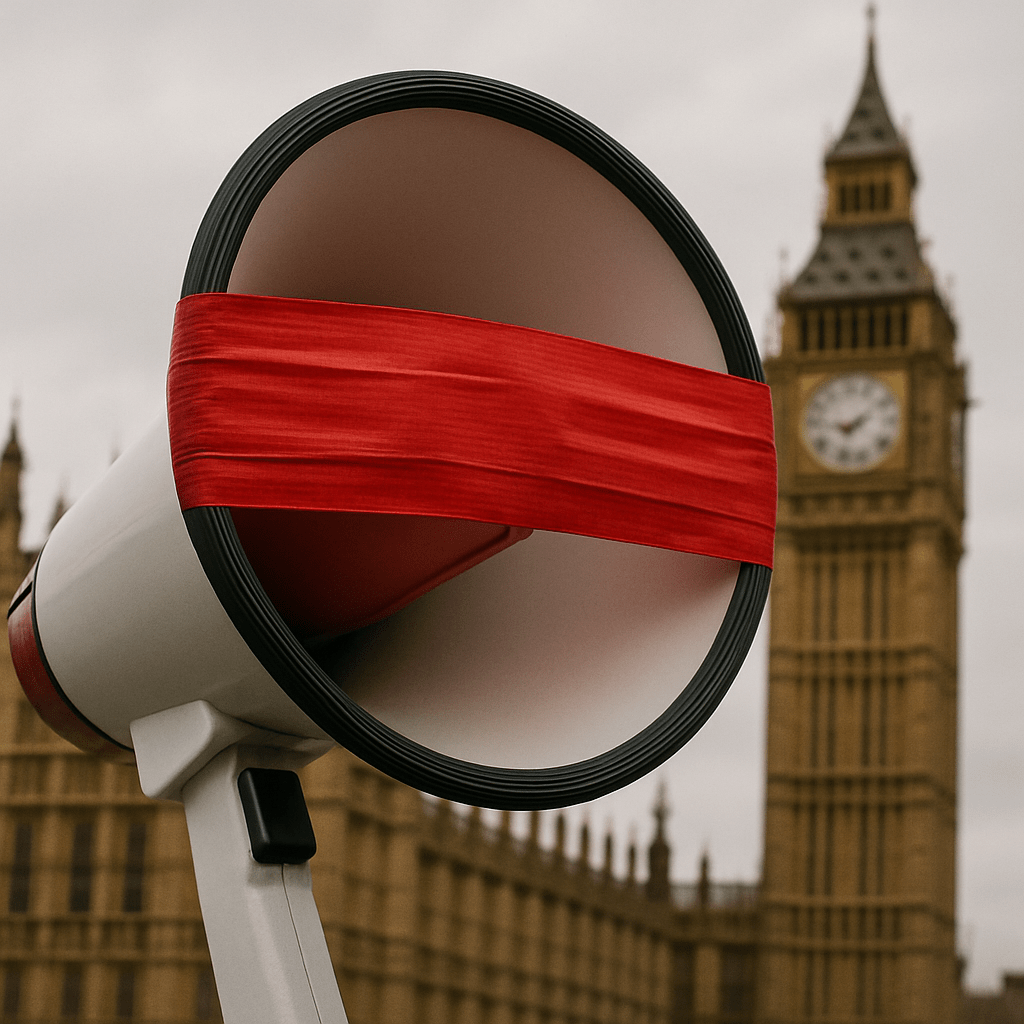
A press megaphone bound with red tape, placed in front of the Houses of Parliament — symbolising censorship of media speech in the UK.

By Common Sense, Reporting from the Edge of Reason.
Opinion | Media Regulation | United Kingdom | April 2025

When a press regulator penalises newspapers for quoting Parliament without ritual appeasement, we are no longer defending journalism — we are regulating tone, not truth.

Ipso, as any modestly educated schoolchild once knew, means by the fact itself. Today, it appears to mean by the feelings of a preferred complainant, or more precisely, by the fact that someone, somewhere, might be offended, retroactively.

The Independent Press Standards Organisation — let us pause to admire the audacity of the word “Independent” — has declared that The Telegraph erred by quoting, without seeking fresh rebuttal, remarks made under the protection of Parliamentary privilege. The offending quote? A Cabinet Minister — Michael Gove — made reference in the Commons to alleged links between the Muslim Association of Britain (MAB) and the Muslim Brotherhood[1].

“Ipso has ruled that quoting Parliament is now misleading — unless you ask the accused to deny it again.”

The comments were made in Parliament. They were reported accurately. They included a denial from the MAB, already in the public domain. And yet: Ipso upheld the complaint[2].

Ipso facto, accuracy is no longer the standard. Deference is.

Under the Editors’ Code, publications must not print inaccurate or misleading content. Yet somehow, Ipso ruled that quoting Parliament, while accurate, was still misleading — because The Telegraph did not re-ask the MAB to deny it again. This isn’t regulation. It’s a form of compelled courtesy.

Let us reflect on the implications:
If newspapers must now solicit fresh reactions every time a parliamentary statement is quoted — even when the response is already publicly known — then press freedom has become contingent not on facts, but on feelings and repetition rituals.

Parliamentary privilege now risks becoming a historical footnote — overruled by feelings and rituals.

Michael Gove, now also editor of The Spectator, rightly warns that such rulings have a chilling effect. “Groups suspected of extremism rarely want scrutiny,” he wrote, “They seek to present themselves as a peaceable association of co-religionists who simply want to get along and do good works.”[3]

Parliamentary privilege, once a bulwark of British democracy, now risks becoming a historical footnote — overruled by the sensitivities of groups that may be under scrutiny.

And Ipso’s record gives little comfort:

  • In 2021, it entertained an 87-page complaint from Yevgeny Prigozhin, the Wagner mercenary boss, who insisted he was merely a successful restaurateur. The Telegraph had to prepare a formal response. He later withdrew the complaint — after publicly confirming his role as Wagner’s founder[4].
  • In 2023, Ipso ruled against The Spectator for referring to a transgender journalist as “a man who claims to be a woman”, citing discrimination[5].
  • In 2019, it drafted guidance warning journalists against “insensitivities” when reporting on Islam, language more suited to cultural outreach than impartial regulation[6].

These are not the decisions of a neutral arbiter. These are the reflexes of an organisation that now regulates not truth, but tone — not accuracy, but atmosphere.

Breaking news (that everyone already knows):
A free press must be free to offend. Free to quote. Free to scrutinise. That includes the right to repeat what elected representatives say in the Commons — without asking permission from those criticised.

Otherwise, we are not defending journalism.
We are auditioning for Ofcom’s little sibling, with a clipboard and a mood ring.

Ipso, by the very fact itself, has become part of the problem.

References:

  1. Hansard, House of Commons debate, March 2023 – Statement by Michael Gove naming three Muslim organisations, including the MAB, for review.
  2. IPSO ruling against The Telegraph, April 2025 – Complaint upheld for failing to seek new response from MAB.
  3. Michael Gove, “Groups suspected of extremism don’t want scrutiny,” The Telegraph, April 2025.
  4. The Telegraph, April 2021 – Coverage of complaint by Yevgeny Prigozhin, later withdrawn after public admission of Wagner affiliation.
  5. IPSO ruling against The Spectator, 2023 – Discrimination ruling over gender language.
  6. IPSO draft guidance, 2019 – Recommendations for reporting on Islam with caution to avoid “insensitivities.”

Author: Common Sense is a recovering civil servant and occasional contributor to The Last Remaining Sane Newspaper, where he writes under a variety of pseudonyms for his own protection and amusement. He identifies as reality-adjacent and accepts correspondence by pigeon.

Column Metadata:

  • Title: IPSO Facto: When the Press Regulator Forgets What a Press Is For
  • Author: Common Sense
  • Published: April 2025
  • Word count: approx. 1,050
  • Categories: Media, Regulation, Free Speech, UK Politics, Journalism
  • License: Opinion / Commentary — standard editorial fair use
  • Keywords: IPSO, press regulation, Michael Gove, MAB, Muslim Brotherhood, Parliamentary privilege, free speech, journalism

A New Era of Lacedaemonian Guise

The Dangers of Pursuing a Controlled Speech in a Modern Democracy

Deep Dive Podcasts discuss WTAF is A New Era of Lacedaemonian Guise:

In the 17th century, John Milton penned Areopagitica, a powerful defence of free speech against the rigid licensing of the press imposed by the British government. Milton argued that the suppression of ideas and opinions, even those deemed dangerous or heretical, stifled the pursuit of truth and intellectual progress. Nearly four centuries later, the British government seems intent on reviving these antiquated and authoritarian practices by proposing measures to restrict freedom of speech on social media, ostensibly to combat misinformation. But as history has shown, such attempts to control the narrative are fraught with peril, not least because the government itself has, on multiple occasions, propagated misinformation. This irony, or rather, this danger, is akin to Milton’s experiences in his time, where the state sought to limit what could be thought, said, and published. Today, we must recognise the echoes of this “Lacedaemonian guise,” a stark return to a Spartan-like rigidity, where the free exchange of ideas is viewed not as a societal good but as a threat to be tightly regulated.

The Mirage of Misinformation

It is important to acknowledge that misinformation is a real issue in our digital age, with the rapid spread of falsehoods having tangible consequences. However, the government’s claim that the solution lies in reining in social media platforms neglects a crucial point: those in power are not infallible arbiters of truth. In recent memory, we have witnessed various official narratives later proven to be misleading or outright false. The COVID-19 pandemic, economic policies, and even national security issues have all seen governments backpedal or amend their stances as new information comes to light. To grant any government the authority to define “misinformation” is to empower it to suppress dissenting views, inconvenient facts, and alternative perspectives under the guise of public safety. The danger here is that such measures do not merely combat misinformation but silence criticism, foster conformity, and eliminate the essential friction that drives democratic discourse.

The Rebirth of Licensing: A Spartan Decree in Digital Form

Milton wrote with disdain about the idea of licensing speech, equating it to the practices of ancient Lacedaemon (Sparta), a society known for its uncompromising discipline and suppression of individualism. In modern terms, this equates to the state seeking to monitor and regulate the content shared on social media platforms—a digital licensing of the press, if you will. Under the proposed framework, social media companies would be obliged to police their users, removing content deemed “harmful” or face punitive measures. But who decides what is harmful? The government’s claim to be acting in the public interest must be critically examined, as the history of power reveals that today’s harm is often tomorrow’s truth.

The Lacedaemonians were staunchly opposed to intellectual diversity, favouring a rigid conformity that preserved their way of life. In the same vein, imposing restrictions on social media under the pretence of combating misinformation reflects a desire to control the boundaries of acceptable discourse, a desire that bears the hallmarks of the very tyranny Milton warned against. If we cede to the government the power to determine what may or may not be spoken, we do not safeguard the truth—we instead endanger it by making it susceptible to political whim.

The Necessity of Free Expression for a Vibrant Democracy

A democratic society thrives on the free flow of ideas. It is in the marketplace of ideas that the strongest arguments emerge, and errors or falsehoods are exposed through scrutiny and debate. In Milton’s view, the pursuit of truth is an active process requiring the engagement of many minds, not the fiat of a single authority. If we look to history, it is evident that truth is not static; it evolves as new evidence and interpretations come to light. Many ideas once dismissed as radical or dangerous later became widely accepted, not because they were mandated by the state, but because they withstood rigorous debate and empirical challenge.

The notion that social media platforms should act as the gatekeepers of acceptable speech, guided by government mandates, runs contrary to the principles of free expression. The digital sphere has allowed marginalised voices, dissenters, and reformers to challenge the status quo in ways that traditional media often could not. Any legislation that aims to curb this potential under the banner of fighting misinformation risks not only silencing these voices but also insulating the powerful from accountability.

The Perils of Authoritarian Drift

As we face a “new era of Lacedaemonian guise,” we must be wary of the steady creep toward authoritarianism under the pretext of public protection. The willingness to limit free speech, even if motivated by genuine concerns, sets a dangerous precedent. Today, it may be misinformation; tomorrow, it may be political dissent, scientific critique, or artistic expression that comes under scrutiny. History is replete with examples where laws intended for one purpose were later applied to stifle legitimate discourse.

The government’s pursuit to control speech reflects not the confidence of a state assured in its legitimacy, but rather, a nervous reaction to a more democratised information landscape where narratives can be questioned and authorities held to account. Milton argued that to reject free speech is to reject the potential for individual and collective growth. He recognised that, in pursuing truth, errors and falsehoods would arise, but the remedy was not to prevent people from speaking but to allow a fuller, richer debate. The role of the state should be to facilitate this open dialogue, not to dictate its parameters.

Conclusion: Towards a Truly Free Marketplace of Ideas

The government’s attempts to rein in social media and control the spread of information through legislation are reminiscent of the licensing ordinances that Milton so passionately opposed. By invoking the Lacedaemonian guise, we acknowledge the danger of such an endeavour: it seeks not to protect the public but to insulate the powerful from the scrutiny of the governed. It is an absurd and perilous pursuit for a modern government to play the role of truth’s gatekeeper, for truth is not born from decrees but from the clash of diverse ideas and experiences.

If we allow ourselves to be lulled into accepting such restrictions, we risk embracing a new form of censorship that, while dressed in the language of safety and public interest, will, in reality, erode the very freedoms upon which our democracy rests. The true defence against misinformation is not less speech, but more—a dynamic, open marketplace of ideas where individuals are free to engage with, challenge, and, ultimately, discover the truth. To adopt a Lacedaemonian approach would be to surrender this hard-won liberty, exchanging it for a dangerous comfort in state-sanctioned conformity.