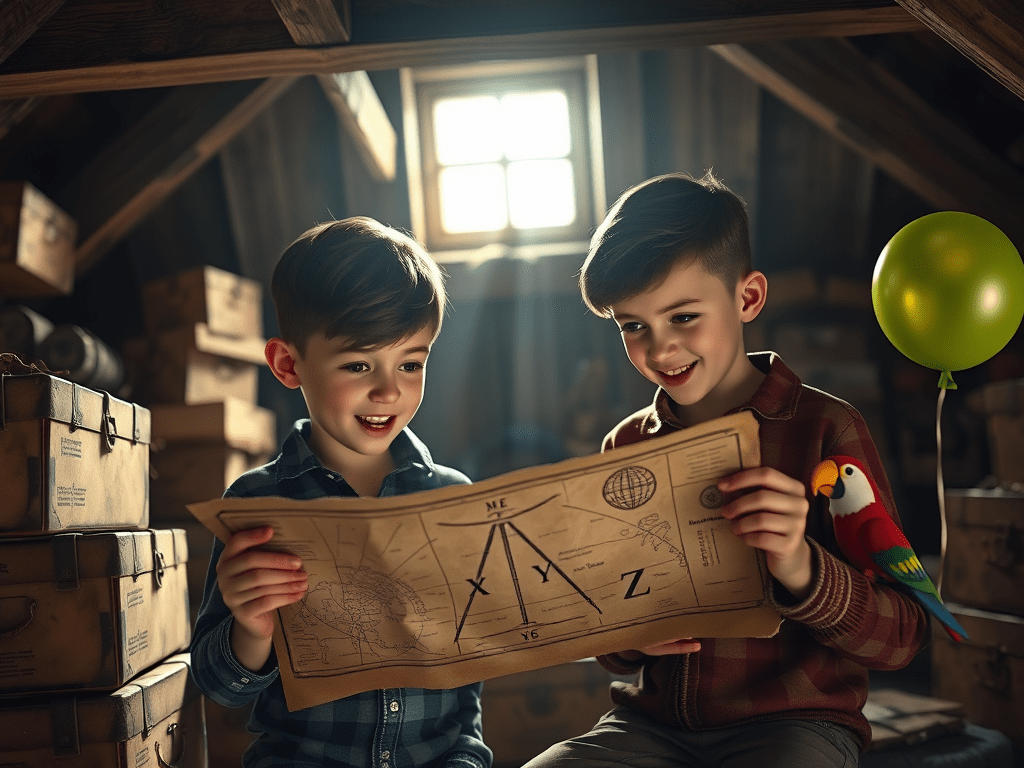
The Adventure of X, Y, Z: A Treasure Hunt Story

One day in the tiny town of Gridville, two brothers, Jonathan and Christopher, were exploring their grandad’s attic when they found something exciting—an old treasure map!

The map had three mysterious lines marked X, Y, and Z, with a scribbled note:

“Follow these axes, and you’ll find the treasure. But beware! Confusion will leave you in a tangle!”

Christopher frowned. “Axes? Like pirate axes? Or tree-chopping axes?”

Jonathan, who was always quick to figure things out, nodded thoughtfully. “I bet it’s real treasure! Maybe even buried by a pirate!”

Grandad chuckled. “Not those kinds of axes, lads. These are the magic lines that help you find things in space!”

“Space?! Like rockets and aliens?” Christopher gasped.

“No, no, just the space around you! Look, I’ll show you.”

The Case of the Missing Parrot

Grandad placed a toy parrot, Captain Squawk, on the kitchen table.

“Let’s say Captain Squawk here is lost. How do we tell someone exactly where to find him?”

“Umm… ‘on the table’?” Jonathan guessed.

“Good start, but what if the table was as big as a football pitch? We’d need to be more precise!”

Grandad grabbed a piece of string and laid it straight across the table.

“This is the X-axis! It tells us how far left or right something is. Think of it like skating on ice—too far left, and whoops! You slide away!”

Christopher wobbled dramatically. “AHH! I’m sliding into the fridge!”

Jonathan grinned and said, “X to the side we slide!”

Grandad then stretched another string from the front to the back of the table.

“Now, this is the Y-axis! It tells us how far forward or backward something is. Like a pirate running across the deck—too far back, and SPLASH!”

Christopher ran on the spot, then pretended to fall overboard. “BLUB BLUB! The sea monster got me!”

Jonathan laughed and said, “Y steps front and back!”

Finally, Grandad took a balloon, tied it to the toy parrot, and let it float above the table.

“And THIS is the Z-axis! It tells us how high or low something is. Like a yo-yo going up and down!”

Christopher jumped, pretending to float. “I’m a balloon! Wheee!”

Jonathan grinned. “Z rises high or sinks low!”

The Treasure Hunt Begins


Armed with their new knowledge, the boys examined the treasure map. It read:

“Walk X = 3 steps to the right, Y = 2 steps forward, and dig Z = 1 spade deep.”

Jonathan counted carefully. “One, two, three to the right… one, two forward!”

Christopher grabbed a toy shovel and dug into the garden. CLUNK!

Their eyes widened. They pulled out a dusty old box and opened it to find…

“Cookies! This is the best treasure ever!” Christopher cheered, already stuffing one in his mouth.

Grandad grinned. “And now you’ll never forget your axes, will you?”

Jonathan smirked. “Nope! We’ll always know where to look!”

Then together, the brothers chanted:

“X to the side we slide,
Y steps front and back,
Z rises high or sinks low—
That’s the treasure-finding way to go!”

And from that day on, whenever someone in Gridville got confused about X, Y, and Z, the brothers would share their rhyme—sometimes while munching on a cookie.

The End.

The Floating Feather Race: A Magical Bedtime Story

A Bedtime Story

1. The Whispering Feathers

One evening, as the sun dipped below the hills, a special contest was announced in the little town of Featherwick. But this was no ordinary race—no running, no jumping, no rushing about.

It was the Floating Feather Race.

The challenge? Keep a feather floating in the air for as long as possible—without touching it! The only thing the racers could use was their breath.

Jonathan, Christopher, and Daniel each picked a feather from the soft pile at the starting line. Some feathers were white like snow, some golden like sunshine, and some shimmered with a hint of blue, like the evening sky.

A wise old owl, the race’s referee, fluffed up his own feathers and hooted:

“A feather floats, so soft, so light,
Lift it gently, keep it in flight.
A breath so slow, a breeze so small,
Let the feather never fall.”

The race was about to begin…


2. The First Puff

Jonathan took a deep breath and blew gently. His feather wobbled, then lifted, drifting lazily upward.

Christopher let out a tiny puff of air—his feather bobbed in place, floating just above his hands.

Daniel, the eldest, tried a strong gust. But whoosh! His feather shot straight up, twirled, and tumbled to the ground. The owl chuckled.

“Not too strong and not too fast,
Feathers need a breath that lasts.
Gentle, steady, soft and slow,
This is how the feathers go.”

So Daniel tried again, this time blowing softly, watching as his feather danced in the air, twirling like a leaf in the wind.


3. The Rising Breeze

The race grew more exciting as the feathers floated higher. Some drifted like tiny clouds, others spun slowly, twinkling in the golden evening light.

A small breeze arrived, lifting the feathers even further. But the owl reminded them:

“Breathe with care, feel the air,
Let the feather float up there.
Not too high and not too low,
Just a gentle breath to go.”

Jonathan and Christopher giggled as their feathers hovered above their heads. Daniel, now focused, kept his feather perfectly balanced in the air.


4. The Final Drift

As the last rays of sunlight touched the treetops, the owl called out:

“One more breath, light as air,
Drift your feather here and there.
Slow and soft, let it be,
Floating high so gracefully.”

The children gave their feathers one last, soft puff… and watched them drift, slowly, softly, gently down—landing without a sound.

The race had no losers—only quiet champions of the wind.

“Beautiful!” hooted the owl. “You’ve learned the secret of the Floating Feather Race—patience, breath, and calm.

The children smiled, feeling peaceful and warm. The air still carried the soft dance of their feathers, and they knew…

Tonight, they would sleep as gently as their floating feathers.

A Quirky Dialogue: Harold and the Poopy Bag

“Harold? Harold! Where are you Harold?” screeched the old crone.
“Here dear, at your service,” the gentle old man softly croaked. “To what illustrious duty do you wish to chain me?”
“Harold! It’s time to take the dogs for a walk. Get on with it.”
“Yes dear, of course. They’re waiting in the yard—I just came in to collect the poopy bag.”
“Poopy bag?” the old crone enquired.
As Harold began to explain, “Yes dear, I use it to—” her mouth slackened and her eyes fluttered like butterflies. Her pale face began to rise, causing Harold to brace himself for either a fist to the nose or a harsh slap.
Instead, she merely said, “Why just the one bag? Those two giant hounds out there will produce a stack of hot steamy canine goo that would make a cow proud!”
Relieved at avoiding physical punishment, Harold carefully rendered his reply: “In times of economy, we must be prepared to accept a little discomfort.” Then, with quick inspiration, he added, “And I’ll continue to the river so I may clean the bag out for use again tomorrow!”
“Well bloody get on with it then,” said the old crone as she waddled her bulk 180 degrees and shuffled towards the only room in the house with a fire going.
Harold pulled on his wellies and coat, picked up the dog leads from the floor, and gingerly extracted a few larger coins from the small change tin. As he headed out into the cold wintry day, he smiled to himself, thinking how convenient it was that the pub with the large open fire sat right beside the river.

Granny Harmer’s Hilarious Misadventures in the Village

In a small, foggy village nestled between jagged hills and an ever-receding horizon, lived Granny Harmer, a character so notorious for her incompetence that even the crows avoided her roof, fearing her bungling touch. Yet, Granny Harmer was oblivious to her reputation. She considered herself the lynchpin of the village—a solver of problems, a doer of deeds, a fixer of what wasn’t broken.

One misty morning, Granny Harmer awoke with a start. She had dreamed of eagles soaring majestically over the village and resolved that she, too, would achieve greatness by teaching her ducks to fly like those regal birds. She bustled about her cluttered kitchen, rummaging through dusty cupboards for anything that might aid her grand endeavour: some old string, a jar of glue, and a half-eaten biscuit.

With her “training kit” in hand, she waddled out to the pond, where her ducks quacked happily, blissfully unaware of their impending adventure. Granny Harmer began tying wings together, fastening feathers to beaks, and attempting to throw the ducks into the air like kites. The scene quickly descended into chaos. Ducks flailed, feathers scattered, and Granny Harmer, drenched in pond water, declared the day a success despite no duck ever leaving the ground.

The villagers shook their heads in despair. One whispered to another, “Why does she keep trying?”

Granny Harmer, undeterred by failure, marched back home. Her mind buzzed with new schemes—grand ideas to fix problems that didn’t exist. She decided to install a mechanical weather vane on her roof to “calm the storms.” She ended up electrocuting herself when she wired it to the lightning rod. She attempted to build a new bridge over the stream but diverted the water straight into the village square.

Her failures piled up like the heaps of broken contraptions in her garden. The villagers, initially amused, grew weary of cleaning up her messes. One day, the mayor knocked on her door.

“Granny Harmer,” he said, trying to keep his tone polite, “perhaps you should take some time to think things through before acting.”

She squinted at him. “Think things through? Why, that’s the job of Mr Common Sense!”

“Who’s Mr Common Sense?” the mayor asked, perplexed.

“Oh, he used to be my closest companion,” she sighed dramatically, “always there to tell me what to do. But he disappeared years ago, and I lost touch with him!”

The mayor didn’t know how to respond, so he left her to her delusions.

That night, Granny Harmer sat by the hearth, her apron singed from an earlier mishap with the kettle. She clasped her hands and stared into the flickering flames. “Mr Common Sense,” she whispered, “wherever you are, I need you. Please come back! I cannot fix things without you!”

The fire crackled, and the shadows danced on the walls. For a brief moment, Granny Harmer thought she heard a faint chuckle, as if the missing Mr Common Sense was laughing at her from inside her garage.

Days turned into weeks, but Mr Common Sense did not return. Granny Harmer, however, refused to accept this. She decided that if he wouldn’t come to her, she would find him. She packed a bag filled with mismatched socks, a leaky flask, and a broken compass, and she marched out into the wild.

The villagers watched her go with a mixture of pity and relief. “She’ll be back,” one said.

“No, she won’t,” said another.

Granny Harmer wandered for days, calling out for Mr Common Sense as if he were a wayward sheep. She stumbled through forests, across rivers, and into a barren wasteland where the wind howled like an unanswered question.

There, in the desolation, she realised something profound. She sat on a rock and muttered, “Maybe Mr Common Sense isn’t coming back because he’s tired of cleaning up my messes.”

At that moment, a bedraggled duck waddled into view, quacking plaintively. Granny Harmer stared at it, and a glimmer of clarity—faint as moonlight on a cloudy night—passed over her.

“You’re a duck,” she said. “And ducks aren’t eagles.”

The duck tilted its head, as if to say, “Quack?”

Granny Harmer returned to her village, a little humbler and a little wiser. She dismantled her failed contraptions, and stopped meddling in things she didn’t understand. Though she never quite mastered common sense, she learned one important lesson:

You shouldn’t send your ducks to eagle school.

And from that day on, the village grew a little quieter, the crows returned to her roof, and her ducks relocated to Clacton-on-Sea.

Embracing Uniqueness: Not Everyone Will Like You

Not everyone will like you—this is true,
A truth as simple as the sky is blue.
Their whispers may sting, their glances may stray,
But life carries on in its resolute way.

To offend and be offended is part of the game,
Moments of discord, moments of blame.
Yet no great disaster will darken the air,
For the heart learns to mend, to forgive, to repair.

The weight of this world is not yours alone,
Nor is the task to carve it in stone.
It’s in the trying that life finds its grace—
Trying to love, to uplift, to embrace.

Try to care for another, to lend them your hand,
To nurture a dream, to help them to stand.
Try to see beauty where others see none,
In the shadow of dusk, in the rise of the sun.

You can do anything; your path is your own,
As long as no harm by your steps is sown.
Strive to be happy, let joy light your way,
Even as troubles may colour your day.

Never stop seeking the wonder that gleams,
In laughter, in stillness, in unspoken dreams.
For life is a treasure—each breath, every hue,
And not everyone will like you. That’s okay, too.

Learning and Growing Together: A Brothers’ Tale

Jonathan and Christopher lived in a small, cheerful house near their school, Orwell Academy. The school was perched on the banks of the River Orwell, surrounded by tall trees and the gentle lapping of water. Every morning, Jonathan, nearly eight and full of energy, danced his way down the garden path while Christopher, nearly five, bounded behind him with a rugby ball tucked under his arm.

“Let’s see who gets to the gate first!” Jonathan called out. Christopher grinned. He loved a good race. They darted down the path, Jonathan’s quick, graceful steps just ahead of Christopher’s determined sprints.

At school, Jonathan’s favourite part of the day was practising dance routines during break. Today, he twirled in a quick waltz pattern on the playground, imagining himself in a grand ballroom. Christopher, watching from a bench, clapped enthusiastically.

“You’re amazing, Jon!” Christopher shouted. “Can you teach me that spin?”

Jonathan laughed. “You’d be great at it! Let’s try after school.”

Christopher puffed up his chest, proud that his big brother believed in him. “And after that, I’ll show you my rugby moves!”

Jonathan smiled. Although he was good at rugby too, he knew how much Christopher loved being the expert. He found Christopher’s teaching style impressive and always made sure to pay close attention. Jonathan had a knack for making Christopher feel like a star, and in return, he learned more about rugby than he expected.

A New Challenge

That afternoon, they had their Chinese lesson together. Their teacher, Mrs. Zhou, showed them how to write the Chinese character for “family” (家). Jonathan, always neat and focused, carefully traced the strokes. Christopher’s lines wobbled a bit, but he held up his paper proudly.

“It’s not perfect,” Christopher said, “but I’ll get it!”

Jonathan leaned over. “It’s great, Chris. Want to practise together later?”

Christopher nodded. Whenever Jonathan encouraged him, he felt like he could do anything.

A Visit to Bulgaria

The boys’ next big adventure came during the holidays when they flew to Bulgaria to visit their grandparents, Bini and Ivan. The journey was always exciting, from the hum of the airplane to the warm hugs waiting for them at the other end.

Bini was a marvellous cook, and her kitchen always smelled of sweet pastries. Ivan had a little garden with a patch of grass perfect for practising rugby. But this time, Bini had a surprise.

“Jonathan, Christopher,” she said, “I’ve heard about your talents. Why don’t you put on a show for us?”

The boys exchanged a look. They hadn’t planned anything, but they were always up for a challenge. Jonathan started teaching Christopher a simple dance step while Christopher taught Jonathan how to throw a rugby pass. Together, they choreographed a performance: Jonathan danced with the ball, spinning and leaping, while Christopher raced around, passing and catching.

When they finished, Bini clapped her hands, and Ivan let out a loud cheer. “You two are unstoppable!”

Back to Orwell

When the boys returned home, they felt inspired. Jonathan spent hours perfecting a new ballroom routine, while Christopher practised his rugby kicks on the school field. But no matter how busy they got, they always found time to share their skills with each other. Jonathan helped Christopher learn more dance moves, and Christopher helped Jonathan get better at rugby.

One day, as they sat on a bench overlooking the River Orwell, Jonathan asked, “Chris, do you think we’ll always do things together?”

Christopher nodded firmly. “Always. Even when I’m scoring tries and you’re twirling on stage, we’ll still be a team.”

Jonathan smiled. “Deal.”

And from that day on, whether they were dancing, playing rugby, or trying to master Chinese, they remembered that everything was more fun when they tackled it together.

Auntie Gladys and the Du Maurier Connection

Q – Angela

If you’ve ever lived in Fowey, Cornwall, you’ve been blessed to dwell among giants—not only of industry and political scandal, but also of poetry, literature, and history. It’s a place where the past feels alive, where the echoes of ancient civilisations cling to the rugged cliffs, and the wind carries whispers of stories untold.

My first visit to Fowey was in 1970. I was nine years old, giddy with the promise of adventure. My family had just purchased a brand-new campervan, a marvel of modern convenience to us, and our holiday plans were ambitious: a couple of days in Fowey followed by a jaunt to Sennen Cove near Land’s End. But what thrilled me most was the prospect of meeting Auntie Gladys—”crazy Auntie Gladys,” as the family lovingly called her.

Gladys was the woman who left an impression on everyone she met. She was sharp as a tack and fearless in conversation. Years later, I learned that the “crazy” part of her nickname stemmed from a court case where she’d been called as a prosecution witness. Faced with a smirking defence lawyer intent on tripping her up, she didn’t just answer his questions—she turned them into a masterclass in wit. When the judge admonished her to “just answer the question,” she replied with a perfectly straight face, “Oh, Your Honour, I would answer the question, but I thought the truth deserved a little company along the way.”

That summer, Auntie Gladys had promised my brother Richard and me something extraordinary: a visit to The Haven, once the home of Sir Arthur Quiller-Couch. She knew the Quiller-Couch family and wanted to show us his famous library. As we explored, she regaled us with tales of his mentorship of a young Daphne du Maurier. She spoke with reverence about the bond between the two authors, and as she described Daphne’s eventual success, her voice seemed to glow with pride. “Rebecca,” she said, “wasn’t just a book—it was a revolution. She gave us Manderley, a place we’ve all dreamt of visiting.”

I hung on every word, but Richard was particularly taken with the story. Even then, I think, he had a gift for making connections, for seeing the humanity behind the legend.


Seven years later, when we’d moved to Fowey, Richard and I found ourselves caught up in an unusual situation. Our rowing boat had broken free from its moorings and drifted downstream, ending up at Ferryside, the du Maurier family’s home in Bodinnick. By some miracle—or perhaps Dad’s habit of labelling everything—the phone number scrawled on the deck had led Angela du Maurier to call us.

When the phone rang, Richard answered. I still remember how his voice changed when she introduced herself. He straightened, his tone becoming both careful and warm, as though he realised the significance of the moment even before the name fully registered.

“You’re Angela du Maurier?” he asked, his voice just above a whisper. He paused, and I imagined him standing there, hand gripping the receiver, his face lit with excitement. Then, after an audible breath, he added, “Oh, it’s an honour. Truly. My brother and I… we’ve heard so much about you.”

Angela’s voice, though I couldn’t hear it from the other end, must have been kind because Richard seemed to relax slightly. “Yes, of course, we’ll come right away. Thank you for letting us know.”

After hanging up, Richard turned to me, his face flushed. “Do you know who that was?” he asked, almost breathless. “Angela du Maurier.”

“I know!” I said, grabbing the oars.

As we rowed to Ferryside, Richard seemed distracted, his strokes less precise than usual. “I wonder what she’s like,” he murmured, half to himself. “I hope… I hope she’s not sick of people talking about Daphne.”


When we arrived at Ferryside, Angela met us at the gate. She was older than I’d expected, with sharp eyes that seemed to take in everything. She greeted us warmly, and I was struck by how unassuming she seemed for someone from such a storied family.

Richard stepped forward, his smile broad but not overbearing. “Thank you for calling us about the boat,” he said. There was a slight hesitation in his voice, as though he was searching for the right words. “I hope it wasn’t too much trouble.”

“Not at all,” Angela replied. Her voice was soft but firm, with a lilting cadence that seemed to echo the river’s flow.

As we walked toward the boat, Richard began talking—tentatively at first, then with growing confidence. “My brother and I had a wonderful aunt, Auntie Gladys. She knew the Quiller-Couch family… and, well, she once showed us Sir Arthur’s library. She told us about how he encouraged young writers. Your book, It’s Only the Sister, was there.”

Angela’s step faltered slightly, and Richard, noticing, quickly added, “I mean, we didn’t get to stay long enough to read it. But she spoke so highly of it—of you.”

Angela stopped and turned to him, her expression unreadable at first. Then, slowly, a smile broke across her face, genuine and touched. “Did she now?” she said, her voice quieter. “That’s… kind of her to say. And of you to remember.”

Richard nodded, his enthusiasm bubbling up again. “I’ve always wanted to know—what was it like, growing up with all those stories around you? With people expecting so much?”

For a moment, Angela seemed lost in thought. “It was… complicated,” she said at last. “There’s always more to a story than people see from the outside.”

Richard nodded, his expression thoughtful. “I can imagine,” he said softly. “But I hope you know… you’ve inspired people too.”

Angela smiled again, this time with a warmth that seemed to dissolve any lingering tension. “You’re very kind,” she said. “I don’t often hear that.”


Later, as we rowed back home, I asked Richard why he’d mentioned Auntie Gladys and the library. “I don’t remember her talking about Angela,” I said.

“She didn’t,” Richard admitted, his voice light but thoughtful. “I made it up. I just… I wanted to say something that would make her feel seen, not compared to Daphne for once.”

I looked at him, struck by the quiet depth of his kindness. “That was clever,” I said. “And brave.”

He shrugged, a faint smile on his lips. “She deserved it.”

Q – Daphne

Authors Note: Every time I visit Fowey and pass by The Haven, two questions surface in my mind. The first is simple enough: How much of the garden still remains? Over the years, I’ve watched as more of this once magnificent garden has succumbed to the river, with at least a quarter of it lost in my lifetime. The second question, however, is far more elusive, perhaps impossible to answer. As a writer, I can’t help but wonder: How did Sir Arthur Quiller-Couch mentor Daphne du Maurier? Was his influence limited to encouragement, or did he play a more profound role in shaping her extraordinary talent for crafting such vivid, unforgettable characters?

What follows is not history, but the story as I imagine it might have unfolded.

adjusts spectacles and leans forward with a kindly but scholarly demeanor

My dear young Daphne, sit closer and listen well. Writing, you must understand, is not merely the arrangement of words upon a page, but the delicate art of revealing the human soul’s most intimate tremors.

Dialogue, child, is the marrow of storytelling – but not dialogue that merely speaks, no! Dialogue that breathes, that quivers with the unspoken. When characters converse, they are not reciting lines, but performing an intricate dance of emotion, where what is unsaid often thunders louder than what is spoken.

Consider the human voice – that remarkable instrument of revelation. A tremor, a sudden catch, a pitch that rises like a startled bird – these are not mere sounds, but symphonies of feeling. When your character speaks, let their voice be more than sound; let it be a messenger of their inner landscape.

And watch the body, my dear! We are not static creatures, but living canvases upon which emotion paints its wild and unpredictable strokes. A hand that clenches, a shoulder that tightens, eyes that dart away – these are not mere movements, but poetry in physical form. Each character will compose their own unique bodily language, as distinctive as a fingerprint.

The mind, ah, the mind! It is a labyrinth where thoughts dart and weave like silvered fish. Do not be afraid to plunge into those interior waters. A character’s thoughts are not always rational, not always kind – they are raw, mercurial, leaping from one shore of consciousness to another with startling agility.

But take care with what I shall call visceral reactions – those primal, uncontrolled responses that surge through our mortal frames. A racing heart, a sudden chill, that electric moment when the body knows something before the mind can comprehend – these are powerful, but like potent spirits, they must be used sparingly. A drop can illuminate; a flood can drown.

Remember, Daphne, great writing is not about displaying emotion, but about allowing emotion to reveal itself through the most delicate of touches. You are not a painter hurling color, but an embroiderer threading the most gossamer of silks.

Now, shall we speak of how one might begin to master this sublime craft?

peers at her over his spectacles, a twinkle of encouragement in his eye

Life Beyond Death: Further Discoveries on Mars

Authors Note: This rewrite of Life Beyond Death: Discoveries on Mars shifts the focus to the dialogue between its two central characters, letting their voices carry the story. Dialogue is my preferred way to write—it breathes life into the narrative, allowing personalities to clash, connect, and evolve. Yet, after countless hours spent crafting technical documents, I sometimes forget the joy of breaking free from the constraints of business writing. This version is a return to that joy, a chance to rediscover the freedom and creativity that comes from letting characters speak for themselves.


The atrium buzzed with the chaotic energy of orientation day. Beneath the sprawling glass dome of the Intergalactic University, streams of students navigated between mineral-blue walkways and holographic displays. Zara Novak stood off to the side, arms crossed, her gaze flicking across the room like a hawk sizing up its prey. Her restless energy crackled in the space around her, a sharp contrast to the serenity of Mars’ reddish glow filtering through the dome.

“Lost, or just plotting how to outsmart the universe?”

The voice was calm, steady, and laced with a quiet humour. Zara turned to see a man standing a few steps away, his features softened by a warm smile. He carried a compact case tucked under one arm, the faint trace of dust clinging to his sleeves suggesting he’d been handling Martian soil.

“Neither,” she replied coolly, straightening. “Just figuring out where the quantum physics lab is.”

“Atlas Chen,” he said, offering a hand she ignored. “Terraforming. Soil chemistry. All the dirty work.”

She tilted her head, her dark eyes scrutinising him with the precision of someone dissecting a flawed equation. “And you think I care because…?”

“Because you’re Zara Novak,” he said, the corners of his mouth quirking up. “Dark matter prodigy. Word travels fast.”

Zara’s brow twitched. “Let me guess—you think dark matter is ‘too abstract,’ don’t you? Not practical enough for someone who spends their time digging in dirt.”

Atlas chuckled, a rich sound that carried an infuriating ease. “Not at all. It’s fascinating. But practical?” He shrugged. “That’s another story. Me? I’m about making things grow where they shouldn’t. I’ll leave bending the universe to people like you.”

She smirked, though it didn’t reach her eyes. “Spoken like someone who doesn’t understand how lethal cosmic forces are. Without shielding, your precious plants won’t last a week.”

“Maybe. But without soil, your shielding is just an empty shell,” he countered, his voice unflappable. “I guess that makes us complementary.”

“Complementary?” Zara let out a derisive snort, but there was a spark of intrigue in her eyes. “Don’t get ahead of yourself, soil boy.”


Their paths crossed again two days later. It wasn’t by design—not entirely—but neither of them could deny the strange pull that seemed to draw them together. Zara was in the lab, hunched over her dark matter detector, her brow furrowed as data scrolled across her screen. Atlas appeared in the doorway, carrying a tray of soil samples like some offering to a deity.

“You’re in my way,” she snapped without looking up.

“You’re welcome,” he replied, unbothered by her hostility. He set the tray on a nearby bench and leaned casually against the wall, watching her work. “What are you hunting?”

“Disturbances in dark matter flow,” she said absently. “I’ve modified the detector to pick up anomalies down to a scale no one’s measured before.”

Atlas nodded thoughtfully. “And what happens if you find one?”

Her hands paused over the keyboard. She looked up, meeting his gaze for the first time. “Then I’ll know we’ve been wrong about everything.”

“Everything, huh?” He gestured to his soil samples. “I’ve got my own anomaly. The soil here isn’t just barren—it’s responding to inputs in ways it shouldn’t. As if it remembers life.”

Zara’s sharp mind latched onto the word. “Remembers?”

Atlas nodded. “Yeah. It’s faint, but there’s a kind of… echo in it. A latent energy that’s not just chemical.”

She leaned back, crossing her arms. “That’s impossible.”

“Is it?” He smiled, and there was something maddeningly patient about the gesture. “I thought you were the one questioning everything.”


It was late that night when they made the breakthrough. Side by side in the dimly lit lab, Zara’s detector emitted a faint ping, a sound she had trained herself to listen for. She froze, staring at the screen as the data materialised.

“There it is,” she whispered.

Atlas leaned in, his brow furrowing. “What am I looking at?”

“An imprint,” she murmured, her voice laced with awe and a touch of fear. “A signature. It’s faint, but it’s there—a disturbance clinging to the material, like… like an echo of life.”

Atlas studied the readings, his mind racing. “That matches the response in the soil,” he said. “It’s as if something—some essence—lingers after life is gone.”

Zara’s heart thudded in her chest. The implications unfurled in her mind like a puzzle she couldn’t quite solve. “What if life doesn’t just vanish? What if it disperses? Dissolves into the fabric of the universe itself?”

Atlas sat back, the weight of her words sinking in. “And what if it’s not just Earth? What if this cycle is universal? Life as a shared resource, flowing and reborn, scattered across planets and stars.”

For a moment, neither of them spoke. The lab seemed to hum with a deeper energy, a resonance that matched the gravity of their discovery.


Weeks passed, and their work grew more radical. The anomaly deepened their understanding of existence, but it also brought something else: a strange sense of familiarity. As they pieced together the nature of this universal cycle, fragments of memories—moments neither of them could explain—began to surface.

One evening, under the Martian sky, Zara stared at the horizon, her voice barely audible. “It’s as if we’ve done this before.”

Atlas nodded, his gaze fixed on the stars. “We have. Or something like us has. Maybe that’s why we’re here—why we found each other.”

She turned to him, her sharp edges softening. “What if this is the purpose of humanity? Not to conquer, but to nurture? To carry life wherever it’s needed?”

His hand found hers, and she didn’t pull away. “Then we have work to do,” he said simply.


Decades later, as green spread across Mars and humanity took its first true steps into the stars, Zara and Atlas sat together under the same sky. Their faces were lined with age, their hands clasped tightly. They watched the sun dip below the horizon, the crimson glow casting long shadows over the fields they had helped create.

“Do you think we’ll meet again?” Zara asked, her voice quiet but steady.

Atlas smiled, his warmth unchanged. “We always do.”

And as the stars blinked into view, they closed their eyes, knowing their part in the endless dance of life was far from over.

Healing Through Dialogue: End the Conflict

In fields where bullets meet the cries,
Where broken skies shield weary eyes,
Two sides have turned their tongues to dust,
And left behind the bonds of trust.

Leaders play their age-old game,
Trading peace for fleeting fame.
As war’s cold fingers, cruel and thin,
Entangle hopes and hemmed-in kin.

In homes where empty chairs await,
The echoes whisper tales of fate—
Of children lost and love that grieves,
Of letters soaked by tears and leaves.

Scholz spoke words that cut the air,
With courage rare to make them care.
A voice that dared to break the cold,
While others watched as war unfolds.

A “Pandora’s box”—they cried, enraged—
But peace cannot be cheaply gauged.
It takes more than warlike might—
It takes the will to dim the fight.

Zelensky stands, his people torn,
In trenches deep and weary worn.
He fears the talk, the weight of cost,
Each compromise a line that’s crossed.

Yet hearts can tire, the will can fade,
When war and death the earth invade.
The call for talks—be it naive?—
Is still a hope we must believe.

Families broken, homes now gone,
The breath of peace could right the wrong.
So lay aside the guns and pride;
Let courage draw the lines less wide.

For leaders who would feed the flames,
Who shield themselves with shifting claims—
May their tongues be tempered, soft,
May they learn to lift not scoff.

Peace is frail, its strands so thin,
But bold and brave souls can begin.
The war must end—the talk must start—
To heal the world and mend the heart.

Unintended Consequences

Chapter 1:

The Muffled Shots

David had been out in his garden, tending to the small but meticulously kept flowerbeds when he heard what sounded like muffled gunshots. A sound so out of place that his first instinct was to dismiss it.

“Must be the telly,” David muttered, standing upright. His gaze shifted towards his neighbour’s house, the imposing home of Gerry, Jenny, and their daughter Alice. A happy family. He saw something out of the corner of his eye, a shadow darting along the fence line. It moved too quickly for him to properly make out. “Sheppy, you rascal,” he chuckled to himself, referring to their energetic sheepdog.

It wasn’t until the wail of approaching sirens disturbed the idyllic tranquillity of the village that David’s heart rate began to pick up. The sight of police cars and an ambulance turning onto the long, winding driveway of his neighbours’ home caused a sinking feeling in his chest.

“That can’t be right…” David whispered, slipping on his jacket and lacing up his shoes with uncharacteristic haste.

He arrived at the property just as a police officer was stretching a line of yellow tape across the gate.

“Excuse me!” David called out, hurrying towards the officer. “I’m David, the neighbour. I heard something, but I thought it was—well, the telly, to be honest. But now… I’m a trained medic, ex-marine. Is there anything I can do?”

The officer, a burly man with a serious expression, held up a hand to stop David’s advance. “Sir, I appreciate your concern, but this is an active scene. We’re doing everything we can.”

David’s brow furrowed. “Please, if someone’s hurt, I can help. I know the family well, they’re my friends.”

The officer looked back towards the house, hesitating for a moment before addressing David again. “Sir, an incident has occurred. Unfortunately, someone was seriously injured. We have medics on site already, and we’re securing the area.”

David’s heart sank at the confirmation that this was no misunderstanding. “Injured? Who?”

“I can’t release details at the moment,” the officer replied firmly. “But I do need you to remain outside the cordon. We’ve got an inspector on the way, and he’ll be speaking with witnesses. If you could wait here, he’ll want to talk to you shortly.”

David took a step back, nodding numbly. He glanced up the driveway towards the house. The familiar home, once full of life, now seemed eerily still.

Chapter 2:

The Body

Inside the house, the scene was grim. Gerry lay face down on the pristine hardwood floor, his body lifeless, a crimson pool beneath him. Detective Inspector Rice stood just outside the living room door, speaking to one of the first officers on site.

“A single entry wound through the heart, another through the back of the skull,” the officer was saying. “The wife and daughter were present. They’re in the lounge, distraught.”

Rice nodded, his face grim, then turned his attention to Becky, the police liaison officer. “The family’s neighbour is outside. Ex-marine, medically trained. Can the women handle seeing him right now?”

Becky hesitated. “It’s hard to tell. They’re… they’re really shaken. Should I ask them?”

Rice nodded, watching as Becky gently approached Jenny and Alice, both of them huddled on the sofa, their faces tear-streaked and eyes vacant with shock.

“Jenny,” Becky said softly, kneeling in front of them. “There’s a neighbour of yours outside, David. He’s worried, and he wanted to check on you both. Should I send him away, or…?”

The women exchanged glances. Alice buried her face deeper into her mother’s side. Jenny opened her mouth to speak, but no words came. She shook her head, clinging tighter to her daughter.

Becky stood back up and turned to Rice, shaking her head. “They’re not ready.”

Rice gave a curt nod before heading outside to speak with David.

David stood just outside the cordon, his eyes fixed on the house. When Rice approached, he straightened. “Inspector, I… I heard the shots. And the screaming. I thought at first it was a loud TV. But then I saw something—a shadow, I think—running along the back of the property. At first, I thought it was the dog, but now…”

Rice raised an eyebrow. “A shadow? Did you see who or what it was?”

David shook his head, his face creased in frustration. “No. It was moving fast. It could’ve been Sheppy, but on reflection, maybe not. The sun was behind me, so it was hard to tell. It might’ve been someone.”

The inspector noted down the details. “We’ll need your contact information, David. You’ve been very helpful, but I think it’s best you head home for now. We’ll be in touch if we need anything else.”

David reluctantly nodded, casting one last look at the house before turning away.

Chapter 3:

The Witnesses

Inside the house, Alice was still trembling, her hands balled into tight fists in her lap. Jenny stroked her daughter’s hair absent-mindedly, staring off into the distance, her eyes unfocused. The room felt heavy, like the very air was thick with grief.

Rice crouched down in front of them, his voice calm and gentle. “Jenny, Alice, I need to ask you some questions, if that’s alright.”

Alice sniffled, but didn’t speak. Jenny nodded slowly, her lips trembling as she fought to hold back more tears.

“Did either of you see what happened?”

Alice shook her head violently, as if trying to shake the memory away. “I heard the gunshots,” she whispered. “And Mum… Mum screamed. But I didn’t see anything.”

Rice turned to Jenny. She swallowed hard before speaking, her voice barely above a whisper. “We’d just come back from walking the dog… Gerry and I. And then… a man, he jumped out of the bushes. Two shots. And then he was gone. Just like that.”

Forensics would be combing the property for days. But Rice already knew this case wouldn’t be simple. Nothing ever was.

Chapter 4:

Uncovering the Past

Detective Inspector Rice sat in his office, a few days after the initial investigation had begun. The evidence was minimal, and no obvious leads had surfaced. Forensics had combed the house meticulously, but there was little to work with beyond the bullets and Jenny’s vague description of the assailant. He knew cases like this could go cold quickly without something concrete.

He leaned back in his chair, rubbing his temples. Something about the way Jenny had described the incident felt off, but there was nothing tangible to act on. She had been emotional, of course. Who wouldn’t be after witnessing their husband’s murder? But her reluctance to part with her phone had lingered in his mind.

“Let’s see what’s there,” Rice murmured, opening the file with the mobile data. He had requested the family’s phones to be fully analysed, and the forensic techs had taken a complete image of each one. He started with Jenny’s. Thousands of photos and messages from years past—nothing seemed out of place. The normal snapshots of a happy family, holidays, and charity events.

Then, he stumbled upon a name.

Webby.

A message thread dating back to 2010. Rice clicked through it. The messages seemed innocent enough at first, reminiscing about school days and catching up on old times. Webby—Michael Webb—had apparently been a school sweetheart. Rice’s instinct sharpened. There was no overt flirtation, but there was a familiarity to their tone that suggested the conversations had once meant something more.

He scrolled down further, looking for anything that might have relevance to the case. Webby disappeared from Jenny’s inbox after 2011. But as Rice examined the data, he caught something odd in the more recent messages.

Mick Webster.

The name didn’t immediately jump out, but after seeing “Webby,” it was impossible not to make the connection. The tone of these more recent conversations was less innocent, with occasional flirtatious undertones, the kind that made Rice sit up straight in his chair. He clicked through several exchanges from just a few months before the murder, noting the subtle shifts in conversation. Nothing too alarming—yet—but it didn’t feel right either.

Rice frowned, his fingers drumming on the desk. “Why didn’t she mention this?”

He requested a search on Mick Webster and found that he worked as a mechanic, his details lining up with the recent hospital visit due to an accident at work. The timing of Mick’s accident gave him a firm alibi, but something still gnawed at Rice. There was a connection here, one Jenny hadn’t mentioned, and it was worth pursuing.

That afternoon, Rice decided to interview Mick at his place of work.

At the Garage

The garage was a noisy, oil-slicked environment, with cars in various stages of repair and a few mechanics going about their business. Mick Webster, a stocky man with grease-stained overalls, looked up as Rice approached. His leg was still in a cast, propped up on a stool.

“Inspector Rice,” the detective introduced himself. “I’d like to ask you a few questions about Jenny Telford.”

Mick’s face flickered with recognition at Jenny’s name. He set down the wrench he was holding and leaned back, wiping his hands on a rag. “Jenny, huh? What’s this about?”

“We’re investigating her husband’s murder,” Rice said bluntly. “We’ve found some messages between you and her from a few months ago.”

Mick’s eyebrows shot up, and he gave a slow whistle. “That’s a blast from the past. Yeah, we kept in touch. She reached out a while ago—chatted here and there. But murder? Gerry? What’s this got to do with me?”

“Just routine,” Rice assured, watching him closely. “I have to explore every lead. Your conversations seemed… personal.”

Mick laughed, shaking his head. “Nah, not really. Look, Jenny and I go way back to school, but that’s all it ever was. She’s a good woman, but there wasn’t anything going on if that’s what you’re hinting at. Besides,” he tapped his cast, “I’ve been in and out of hospital since the accident, couldn’t have shot anyone even if I wanted to.”

Rice nodded but wasn’t quite ready to let him off the hook. “Anyone from Jenny’s past who might have had a grudge against her? Or against Gerry?”

Mick’s expression darkened. He leaned back, thinking hard. “Jenny, huh… Look, she was always the kind of girl who could get people riled up. She liked attention, let’s put it that way. I remember back in school, she liked to play boys off each other. Not saying she’s a bad person, but she could be manipulative. She told me once about how she set up this guy—got him expelled. All because he wouldn’t fall for her charms.”

Rice leaned forward, intrigued. “Do you remember the name of the boy?”

Mick frowned, trying to recall. “No… it was ages ago. But if you’re thinking someone’s holding a grudge, it wouldn’t surprise me. She wasn’t always kind when things didn’t go her way.”

The detective’s mind raced. “So you’re saying Jenny had a reputation for leading boys on, and when things didn’t work out, she’d lash out?”

“Yeah,” Mick confirmed, “but we’re talking about school days. I doubt anyone’s carrying that kind of baggage now, surely?”

“People hold grudges for less,” Rice muttered.

Before leaving, Rice asked one final question. “Do you know anyone else who might’ve been close to Jenny? Someone who might’ve wanted to hurt her or her family?”

Mick shrugged. “Honestly, I wouldn’t know. I’ve been out of touch with that whole crowd for years. But if you’re digging into her past, you might find something. She wasn’t always the saint she pretends to be now.”

As Rice left the garage, his mind turned over Mick’s words. The family had seemed perfect—too perfect. Now, cracks were starting to show. Could Jenny’s past have resurfaced, leading to this violent end?

The case had just taken a new direction. It wasn’t about the loving wife grieving her husband anymore. It was about what lay beneath the surface.

Chapter 5:

Secrets Unraveling

Detective Inspector Rice sat at his desk, reviewing the conversation he’d had with Mick Webster. The more he thought about it, the more something gnawed at him—Jenny wasn’t the murderer, that much he was beginning to feel confident about. But she wasn’t telling the full truth either. The puzzle pieces weren’t quite fitting together, and something about Mick’s story, the casual reference to how Jenny used to manipulate boys in school, stuck in Rice’s mind.

There was someone missing from the picture.

Rice clicked through the social media profiles again, tracing back through connections, old photos, school reunions. And then he found him. Tom Webster, Mick’s younger brother. A few photos of Tom and Jenny as teenagers, standing close, too close, suggested something more than casual friendship. Rice leaned back in his chair, eyes narrowing. Tom Webster, unlike his brother, hadn’t exactly made much of himself. No job, no steady income, and according to local gossip, still living with his parents in his mid-30s.

Rice’s pulse quickened as he dialled his team. “I need everything you can find on Tom Webster,” he said brusquely. “Background, current whereabouts, the works. And get me any traffic or phone data between him and Jenny Telford over the past year.”

Something was off. Jenny wasn’t a murderer, but she was hiding something.

Later That Day

Jenny sat at the kitchen table in the Telford house, nursing a cold cup of tea. Alice had finally gone to stay with a friend for the weekend, giving her some space. The weight of the past few weeks had grown unbearable. The police hadn’t been able to link anyone to Gerry’s murder, and she knew it was only a matter of time before her secrets started to catch up with her.

Her phone buzzed on the table, breaking her from her thoughts. She hesitated before picking it up, seeing Tom’s name flash across the screen. Her stomach churned, and for a moment, she considered ignoring the call. But she knew she couldn’t run from this anymore.

“Tom,” she answered softly.

“Jenny, we need to talk,” his voice was tense, almost desperate. “I’ve been thinking about everything. What happened to Gerry… you know I did it for us.”

Her breath caught in her throat, and a cold wave of dread washed over her. “What? What do you mean, you did it?”

“You don’t need to pretend with me anymore. I know you wanted him gone. I thought you were asking me to—”

“Tom, no!” Jenny’s voice shook as she interrupted him. Her hands trembled as she gripped the phone tighter. “I never wanted you to kill Gerry! I—this was never what I wanted, Tom. I didn’t ask for this.”

There was silence on the other end of the line, and she could hear Tom’s shaky breathing. “But… you always talked about how unhappy you were, how you couldn’t stand the life you had with him. You kept saying how things could be different if only he weren’t around.”

Jenny’s heart raced as she realised just how horribly she had underestimated Tom’s attachment to her. He’d taken her casual complaints, her frustrations, and twisted them into something dark. She had enjoyed the time they spent together—the stolen moments, the excitement—but she had never considered replacing Gerry with Tom. He was never part of the real picture for her.

“You don’t understand, Tom,” she whispered, her voice thick with regret. “I was never serious. I was just… just being selfish. I didn’t mean for you to do anything.”

Tom’s voice became a low growl. “Selfish? So you were just using me, then? Was it all just a game to you? All the times we spent together, you didn’t mean any of it?”

Jenny blinked back tears, her mind swirling. She had liked the intimacy, the attention Tom gave her—after years of being the perfect wife and mother, Tom had made her feel young and alive again. But she had never seen him as more than that—a fleeting escape.

“I never thought it would come to this,” Jenny whispered. “You’ve misunderstood everything.”

“No, I haven’t misunderstood,” Tom said coldly. “I did this for you. For us.”

Before Jenny could say another word, the line went dead. She stared at her phone in disbelief, her heart pounding in her chest. She had never imagined it would get this far. She hadn’t seen Tom for what he really was: obsessed, unstable, and now, a killer.

At the Police Station

The next morning, DI Rice stood in front of a whiteboard, his team gathered around. He had been up all night, piecing together the new information.

“Tom Webster,” he began, circling the name he had written on the board. “He’s Mick’s younger brother. What we’ve discovered is that Tom has been having an affair with Jenny Telford for over a year.”

Sullivan raised an eyebrow. “An affair? We knew there was something off with Jenny, but that’s a bit of a leap from an affair to a murder.”

Rice leaned forward, his expression serious. “It would be, but Jenny called me not long after we picked up Tom. She was in a state. She said she hadn’t told the full truth earlier because she didn’t want to destroy what little remained of her family. But after Tom’s confession, she couldn’t keep it in any longer. She admitted to the affair with Tom Webster. Told me she’d led him on, never intending for it to go this far.”

Sullivan blinked, clearly surprised. “So she confessed everything?”

Rice nodded grimly. “Jenny hadn’t realised just how deeply Tom had fallen for her. She thought he was harmless, that it was just a bit of fun for her. But when she heard that he believed he killed Gerry for her, she knew the game was up. She said she never asked him to do anything, but she understands now that her manipulations led him to believe it was what she wanted.”

Sullivan let out a low whistle. “She must be reeling.”

“She is,” Rice said. “But it doesn’t change the fact that her lies and misdirection created the environment for this to happen. Now we have the whole story.”

As the team listened, the air grew thick with tension.

“So Tom thought Jenny wanted her husband dead,” Sullivan said slowly. “But she didn’t.”

“Exactly,” Rice replied. “Jenny was leading him on, playing her old game of manipulation. But Tom, he was different. He took her frustrations and ran with them. He genuinely believed she wanted Gerry out of the picture.”

“Tom’s not exactly a mastermind,” another detective muttered. “No job, no home, still living with his parents. But if he’s desperate and in love…”

Rice nodded grimly. “Desperation can be a powerful motivator. He saw Gerry as the only obstacle standing in the way of a life with Jenny. So he took matters into his own hands.”

Sullivan sighed. “So what’s the next step?”

“We bring in Tom,” Rice said firmly. “He’s confessed in his own twisted way. But we still need a full confession. And we’ll need to talk to Jenny again. She’s been hiding the affair and we need to know what else she’s been hiding, it’s time to see if she’ll come clean.”

Later That Day

Jenny sat in the small interview room at the police station, her eyes red from crying. DI Rice sat across from her, a sympathetic but firm look on his face.

“You’ve been protecting Tom, Jenny,” Rice said softly. “I know you didn’t want your family to fall apart, but your husband is dead. You need to tell us the truth.”

Jenny sniffed, wiping her nose with a tissue. “I didn’t mean for any of this to happen. I never thought Tom would actually—” She choked on her words, unable to finish the sentence.

Rice leaned forward, his voice calm. “Tell me about the affair. How long has it been going on?”

Jenny looked down at her hands, twisting the tissue in her fingers. “It started about a year ago. Tom… he made me feel alive again. But I never loved him. I was never going to leave Gerry. Tom just misunderstood everything.”

Rice studied her, his mind working through the information. “Did you ever tell Tom you wanted Gerry dead?”

She shook her head violently. “No! Never. I might have complained about my life, about how hard things could be sometimes. But I never, ever asked him to do anything like this.”

Rice nodded. “We believe you, Jenny. But we need you to help us bring Tom in. He’s dangerous, and he’s convinced he did this for you. If you don’t help, he might try to hurt someone else.”

Jenny’s eyes filled with fresh tears, and she nodded, realising that the mess she had created was about to come crashing down around her. She had thought she could control everything—the affair, the lies, the double life—but it had spiralled out of control.

And now, it was time to face the consequences.

Epilogue:

Months had passed since the arrest of Tom Webster, but the quiet streets of Holmbury St Mary had yet to regain their former sense of peace. The scandal of Gerry Telford’s murder had rippled through the village, shattering the illusion of the perfect life the Telford family had projected.

Detective Inspector Rice sat at his desk, going over the final reports. Tom had eventually confessed to the murder, breaking down during his second interview. It had taken hours of coaxing and questioning, but the full picture had come into focus. Tom, consumed by his feelings for Jenny, had interpreted her frustrations as a cry for help. He believed that by eliminating Gerry, he could finally be the man she needed. It was only after pulling the trigger that Tom realised he had misunderstood everything. Jenny’s flirtations, her intimacy—it had all been a game to her, not an invitation to rewrite her life. And now, Gerry was dead because of it.

Rice exhaled deeply as he closed the case file, feeling the weight of it lift from his shoulders. The investigation had revealed more than just the shocking reality of a murder driven by obsession and confusion; it had exposed the dangers of misdirection, even when it came from a place of unintended harm.

Jenny Telford, though not a criminal in the legal sense, had been a master of deceit in her own way. Throughout her life, she had manipulated, twisted, and led people on without ever considering the consequences. In school, her games had been harmless, just youthful indulgences. But as an adult, she hadn’t let go of those habits, and they had come back to haunt her in the most devastating way.

She had underestimated Tom, thinking of him as nothing more than a distraction, a brief escape from her responsibilities as a wife and mother. She had believed she could control him, keep him dangling on a string for her own amusement. But Tom had seen something entirely different. To him, Jenny’s affection was real, and her complaints about her marriage were the foundation of a shared future.

In the end, Jenny had been left with nothing. Gerry was dead, Alice was distant, and Tom, the man she had used, was behind bars for a crime he believed she wanted him to commit. She had become trapped in a web of her own making, a web of lies and misdirection that had unravelled in the most tragic way imaginable.

In the months following the murder, Jenny had retreated from public life. The Women’s Institute meetings, the charity events, the community functions—everything that had once defined her social presence was now out of reach. The people of the village no longer looked at her with admiration or warmth. They whispered behind her back, exchanging glances of pity and suspicion. She had once been a pillar of the community, but now, she was a pariah.

Alice had moved in with her aunt in the nearby town. The relationship between mother and daughter had fractured in the wake of the revelations. Alice couldn’t bear the weight of the deceit, the knowledge that her mother’s selfish actions had set off the chain of events that led to her father’s death. Jenny had tried to explain, to make Alice understand that she had never meant for any of this to happen. But Alice didn’t want to hear it. In her eyes, the damage was done.

Jenny now lived alone in the large, empty house, haunted by memories of what once was. The house, once filled with life and laughter, now felt cold, a monument to the lies she had told and the people she had hurt. Every corner of it reminded her of Gerry, of Alice, of the family she had destroyed.

For DI Rice, the case had been one of the most complex of his career, not in terms of evidence or forensics, but in terms of human emotion. It wasn’t a simple crime of passion, nor was it a calculated murder-for-hire. It was a crime born from misdirection, misunderstanding, and unchecked desire. The people involved weren’t evil—they were flawed, deeply so, and their inability to be honest with themselves and each other had led to a tragedy no one could have predicted.

Rice stood by the window of his office, looking out at the rain-soaked streets. The case had been closed, but the lessons it left behind lingered. Misdirection, deceit, and manipulation didn’t always come from malicious places. Sometimes, they came from desperation, from longing, from the need to feel something in a life that had become stifling. Jenny hadn’t intended for anyone to die. She hadn’t planned any of it. But in her pursuit of momentary pleasure, in her failure to be honest with herself and others, she had set the stage for a terrible and irreversible outcome.

In the end, the lesson wasn’t just about the dangers of deceit, but about the quiet, insidious ways in which misdirection can creep into our lives. It can start small—a little white lie, a harmless flirtation, a moment of selfishness—and before you know it, you’re trapped in a web of your own making. The truth, once distorted, becomes impossible to unravel. And sometimes, the people you least expect—the ones who seem the most trustworthy, the most reliable—are the very ones capable of leading you down a path of destruction.

As Rice left the office that evening, he couldn’t help but think about Jenny Telford, sitting alone in her grand house, a prisoner of her own choices. She had thought she could control everything, but in the end, her misdirection had destroyed her.

And perhaps that was the greatest tragedy of all.