
By Martyn Walker
Published in Letters from a Nation in Decline
“A nation that cannot feed itself, house its people, or keep its lights on is not a nation at all—it is a tenant on borrowed land.”
It began, as these things often do, with envy dressed as fairness.
The farmer, like the landlord before him, is no longer a pillar of rural economy or local enterprise. He is a target. Not because he committed a crime, but because he owns something—a field, a barn, an orchard, a right to pass his land on without forfeiting half its value to HMRC. That, in modern Britain, is now enough to condemn him.
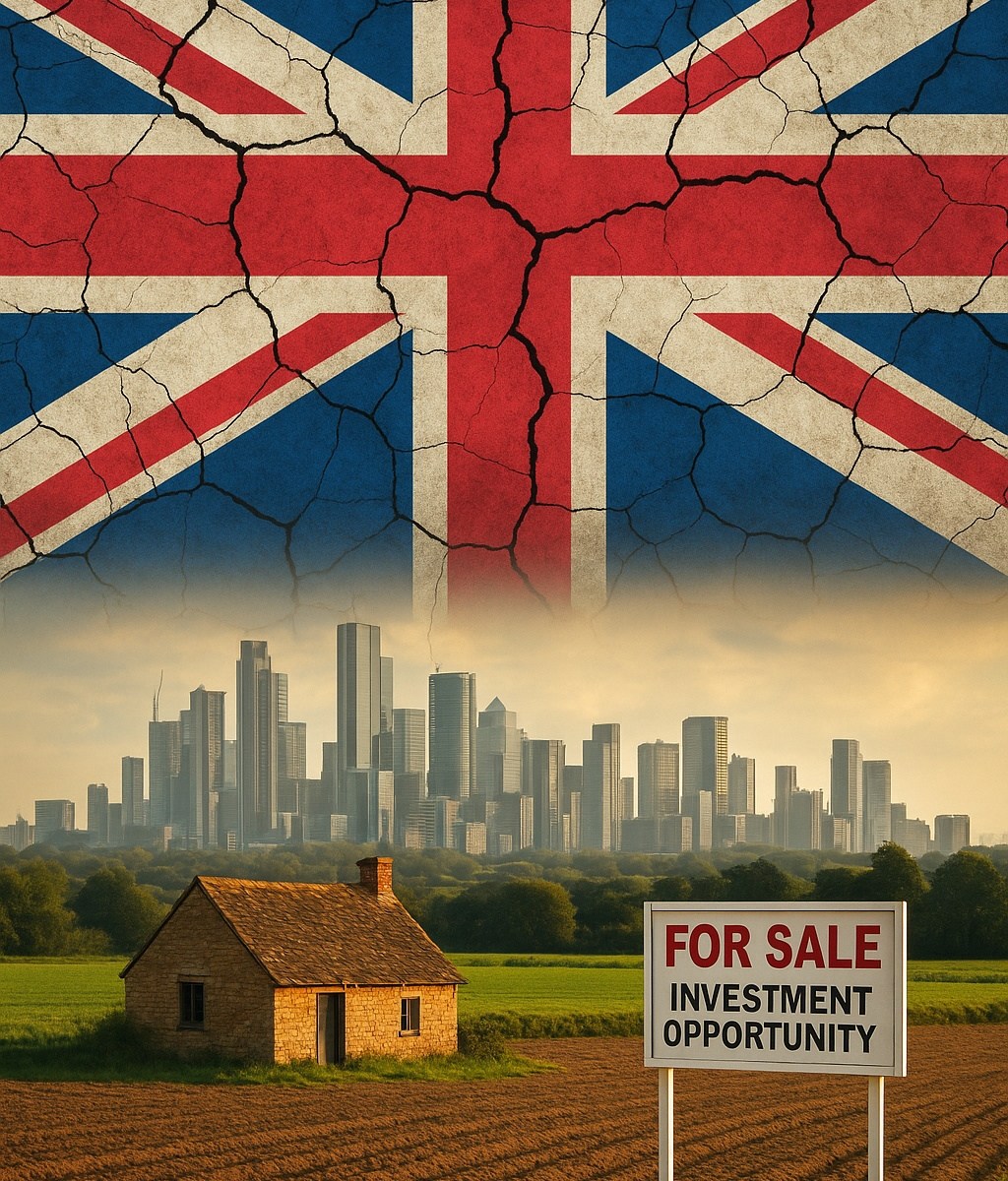
Rachel Reeves’ quiet tax raid on inherited farms isn’t just a tweak to inheritance rules; it is a scalpel, poised to carve up what’s left of the countryside. The attack mirrors the one launched earlier against landlords. In both cases, the Treasury knows its prey: those who are asset-rich but cash-poor. They cannot pay without selling. And once they sell, the land—and power—flows ever upward.
We’ve seen this movie before.
The water companies were sold off and siphoned into off-shore debt-ridden shells. The energy market was deregulated, then re-regulated into chaos. Rents are now controlled not by market forces but by policy distortions so severe that small landlords have been squeezed to death—leaving only corporate agents and institutional buyers standing. A whole district in Newcastle—Jesmond—has effectively been parcelled off to a few landlords with managing agents acting like 21st-century barons.
We are told this is progress.
But what it really is—what it always is—is consolidation. The dismantling of small-scale, dispersed ownership in favour of oligopoly. A slow, deliberate war of attrition against the middle classes and independent actors. Not just in housing or farming or utilities, but in all the vital organs of the nation: food, shelter, water, and energy.
And it has a rhythm now:
- Phase one: demonise the owner. Call him greedy, idle, privileged.
- Phase two: introduce ‘reforms’—a little stamp duty here, a little tax break removed there.
- Phase three: offer them time. The ‘soft landing’—eighteen months for landlords, a year and a half for farmers. Time not to prepare, but to exit.
- Phase four: acquisition. Quiet, foreign-backed, unopposed.
What emerges is a Britain where no one owns anything—except a handful of conglomerates with DEI departments and asset managers in Frankfurt.
The result is strategic dependence:
- On foreign food, when our farms are broken.
- On global energy markets, when our North Sea lies dormant.
- On imported capital, when our own is taxed, banned, or discouraged.
We have become a nation allergic to ownership—suspicious of those who steward land, build homes, provide for themselves or their heirs. The old Thatcherite dream of a property-owning democracy has not only been abandoned—it has been exiled.
Our civil service wets and pseudo-socialist conservatives long ago surrendered the idea of self-reliance. They do not want a strong yeomanry or entrepreneurial base. They want managed decline, administered by technocrats, who will outsource our essentials and tax what remains.
No empire can survive when it imports its grain, its bricks, its firewood.
But here we are—importing all three, and still congratulating ourselves on the fairness of it all. If the landlord must go, if the farmer must sell, if ownership must be sacrificed—so be it, they say. At least we’ve punished the “rich.”
The rich, of course, will be fine. They always are. It’s the rest of us—the renters, the buyers, the families trying to live between rent hikes and grocery bills—who will inherit nothing but dependency.
 Verbal Alchemy