

Letter XIV: Dimming the Sun, Dimming Consent

Aeroplane emitting solar dimming particulates over green countryside and blue sky, leaving a dull desert and darkened sky behind, with the words "Democracy Does Not End in the Stratosphere" written across the bottom.

By Martyn Walker
Published in Letters from a Nation in Decline

“Some crimes offend the law, others offend the senses. But a few — like dimming the sun — offend both, and then go on to threaten all life that depends on its light.”
Laurence J. Peter, posthumously paraphrased

The Nuremberg Code Still Applies — Just Look Up

We are governed now by people who believe it is acceptable to experiment on the atmosphere — and by extension, on all life within it — without consent, oversight, or consequence. The proposal to “blot out the sun” under the guise of solar geoengineering may seem the stuff of science fiction, but it is not only real, it has been quietly sanctioned.

In this country, where grey skies already dominate the greater part of the year, the very idea that we should deliberately reduce sunlight warrants more than scientific scrutiny — it demands a reckoning with first principles.

Sunlight is not a pollutant. It is the original engine of life.

And yet, in the race to mitigate climate change, we are told that injecting particles into the stratosphere to reflect sunlight back into space might be necessary. The logic is simple, the risks profound. Reduce solar radiation, and you cool the Earth. But what else do you do?

You undercut solar panel yields, including those funded by government grants and individual savings alike. You suppress photosynthesis in farming regions, risking lower crop yields in a world already strained by food insecurity. You disrupt rainfall patterns, especially in equatorial and monsoonal zones. You reduce the availability of natural vitamin D, just as our GPs urge us to get more sunlight, not less.

You dim the world, literally and figuratively.

And all of it without a referendum. Without a vote. Without even a leaflet through the door.

Where is consent in this story? Where is accountability?

We are told that climate change is an existential threat, and perhaps it is. But that does not grant a government — or a consortium of scientists, or a supra-national fund — the right to conduct global-scale experiments with unknown long-term consequences, no matter how well intentioned. That is not precaution; that is hubris disguised as stewardship.

Which brings us — as all such questions eventually do — to the Nuremberg Code.

Drafted in the wake of war crimes and scientific atrocities, the Nuremberg Code was not simply a legal instrument. It was a moral declaration. It stated, for all time, that no human being should be subject to experimentation without their freely given, fully informed consent. No clever phrasing, no policy paper, no invocation of emergency, can supersede that.
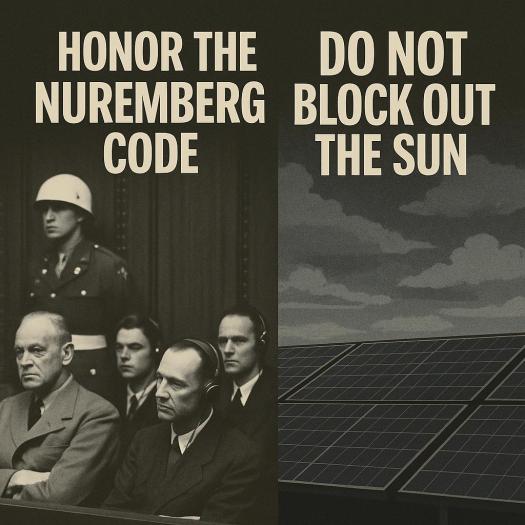
Split image showing Nuremberg trial courtroom on the left and dim, cloudy skies over failing solar panels on the right, with bold text reading “Honour the Nuremberg code — Do not block out the sun”.
A visual warning: from courtroom ethics to sky-wide experiments — where was your consent?

While the Code was written for medical experimentation, its logic extends to any deliberate action that treats the population as passive subjects of a risk-laden intervention. If deploying sulphate aerosols in the stratosphere, or conducting atmospheric reflectivity trials, is not an experiment on all life — then what is it?

We must not allow ourselves to be softened into apathy by the presentation of these plans as purely scientific exercises. We must not forget that science, without ethics, becomes machinery in search of obedience. The ghost of the 20th century tells us plainly where that leads.

Consent must return to the centre of policy. Not only in medicine, but in environmental governance, data rights, digital identity, and energy strategy. To ignore consent in these spheres is not merely undemocratic — it is dangerous.

The great lie of the age is that we can offset our guilt, erase our emissions, or rebalance our planet with a few technocratic tweaks. But we are not gods. We are stewards, or we are fools. The choice is that stark.

And so, to those in government who sanction these sky-darkening schemes: remember the Nuremberg Code. Not because we seek prosecution, but because we believe you still have a conscience. Because shame, not fear, should stop you.

Because if not now, when?

A New Era of Lacedaemonian Guise

The Dangers of Pursuing a Controlled Speech in a Modern Democracy

Deep Dive Podcasts discuss WTAF is A New Era of Lacedaemonian Guise:

In the 17th century, John Milton penned Areopagitica, a powerful defence of free speech against the rigid licensing of the press imposed by the British government. Milton argued that the suppression of ideas and opinions, even those deemed dangerous or heretical, stifled the pursuit of truth and intellectual progress. Nearly four centuries later, the British government seems intent on reviving these antiquated and authoritarian practices by proposing measures to restrict freedom of speech on social media, ostensibly to combat misinformation. But as history has shown, such attempts to control the narrative are fraught with peril, not least because the government itself has, on multiple occasions, propagated misinformation. This irony, or rather, this danger, is akin to Milton’s experiences in his time, where the state sought to limit what could be thought, said, and published. Today, we must recognise the echoes of this “Lacedaemonian guise,” a stark return to a Spartan-like rigidity, where the free exchange of ideas is viewed not as a societal good but as a threat to be tightly regulated.

The Mirage of Misinformation

It is important to acknowledge that misinformation is a real issue in our digital age, with the rapid spread of falsehoods having tangible consequences. However, the government’s claim that the solution lies in reining in social media platforms neglects a crucial point: those in power are not infallible arbiters of truth. In recent memory, we have witnessed various official narratives later proven to be misleading or outright false. The COVID-19 pandemic, economic policies, and even national security issues have all seen governments backpedal or amend their stances as new information comes to light. To grant any government the authority to define “misinformation” is to empower it to suppress dissenting views, inconvenient facts, and alternative perspectives under the guise of public safety. The danger here is that such measures do not merely combat misinformation but silence criticism, foster conformity, and eliminate the essential friction that drives democratic discourse.

The Rebirth of Licensing: A Spartan Decree in Digital Form

Milton wrote with disdain about the idea of licensing speech, equating it to the practices of ancient Lacedaemon (Sparta), a society known for its uncompromising discipline and suppression of individualism. In modern terms, this equates to the state seeking to monitor and regulate the content shared on social media platforms—a digital licensing of the press, if you will. Under the proposed framework, social media companies would be obliged to police their users, removing content deemed “harmful” or face punitive measures. But who decides what is harmful? The government’s claim to be acting in the public interest must be critically examined, as the history of power reveals that today’s harm is often tomorrow’s truth.

The Lacedaemonians were staunchly opposed to intellectual diversity, favouring a rigid conformity that preserved their way of life. In the same vein, imposing restrictions on social media under the pretence of combating misinformation reflects a desire to control the boundaries of acceptable discourse, a desire that bears the hallmarks of the very tyranny Milton warned against. If we cede to the government the power to determine what may or may not be spoken, we do not safeguard the truth—we instead endanger it by making it susceptible to political whim.

The Necessity of Free Expression for a Vibrant Democracy

A democratic society thrives on the free flow of ideas. It is in the marketplace of ideas that the strongest arguments emerge, and errors or falsehoods are exposed through scrutiny and debate. In Milton’s view, the pursuit of truth is an active process requiring the engagement of many minds, not the fiat of a single authority. If we look to history, it is evident that truth is not static; it evolves as new evidence and interpretations come to light. Many ideas once dismissed as radical or dangerous later became widely accepted, not because they were mandated by the state, but because they withstood rigorous debate and empirical challenge.

The notion that social media platforms should act as the gatekeepers of acceptable speech, guided by government mandates, runs contrary to the principles of free expression. The digital sphere has allowed marginalised voices, dissenters, and reformers to challenge the status quo in ways that traditional media often could not. Any legislation that aims to curb this potential under the banner of fighting misinformation risks not only silencing these voices but also insulating the powerful from accountability.

The Perils of Authoritarian Drift

As we face a “new era of Lacedaemonian guise,” we must be wary of the steady creep toward authoritarianism under the pretext of public protection. The willingness to limit free speech, even if motivated by genuine concerns, sets a dangerous precedent. Today, it may be misinformation; tomorrow, it may be political dissent, scientific critique, or artistic expression that comes under scrutiny. History is replete with examples where laws intended for one purpose were later applied to stifle legitimate discourse.

The government’s pursuit to control speech reflects not the confidence of a state assured in its legitimacy, but rather, a nervous reaction to a more democratised information landscape where narratives can be questioned and authorities held to account. Milton argued that to reject free speech is to reject the potential for individual and collective growth. He recognised that, in pursuing truth, errors and falsehoods would arise, but the remedy was not to prevent people from speaking but to allow a fuller, richer debate. The role of the state should be to facilitate this open dialogue, not to dictate its parameters.

Conclusion: Towards a Truly Free Marketplace of Ideas

The government’s attempts to rein in social media and control the spread of information through legislation are reminiscent of the licensing ordinances that Milton so passionately opposed. By invoking the Lacedaemonian guise, we acknowledge the danger of such an endeavour: it seeks not to protect the public but to insulate the powerful from the scrutiny of the governed. It is an absurd and perilous pursuit for a modern government to play the role of truth’s gatekeeper, for truth is not born from decrees but from the clash of diverse ideas and experiences.

If we allow ourselves to be lulled into accepting such restrictions, we risk embracing a new form of censorship that, while dressed in the language of safety and public interest, will, in reality, erode the very freedoms upon which our democracy rests. The true defence against misinformation is not less speech, but more—a dynamic, open marketplace of ideas where individuals are free to engage with, challenge, and, ultimately, discover the truth. To adopt a Lacedaemonian approach would be to surrender this hard-won liberty, exchanging it for a dangerous comfort in state-sanctioned conformity.