

Letter XVII: The Illusion of Choice

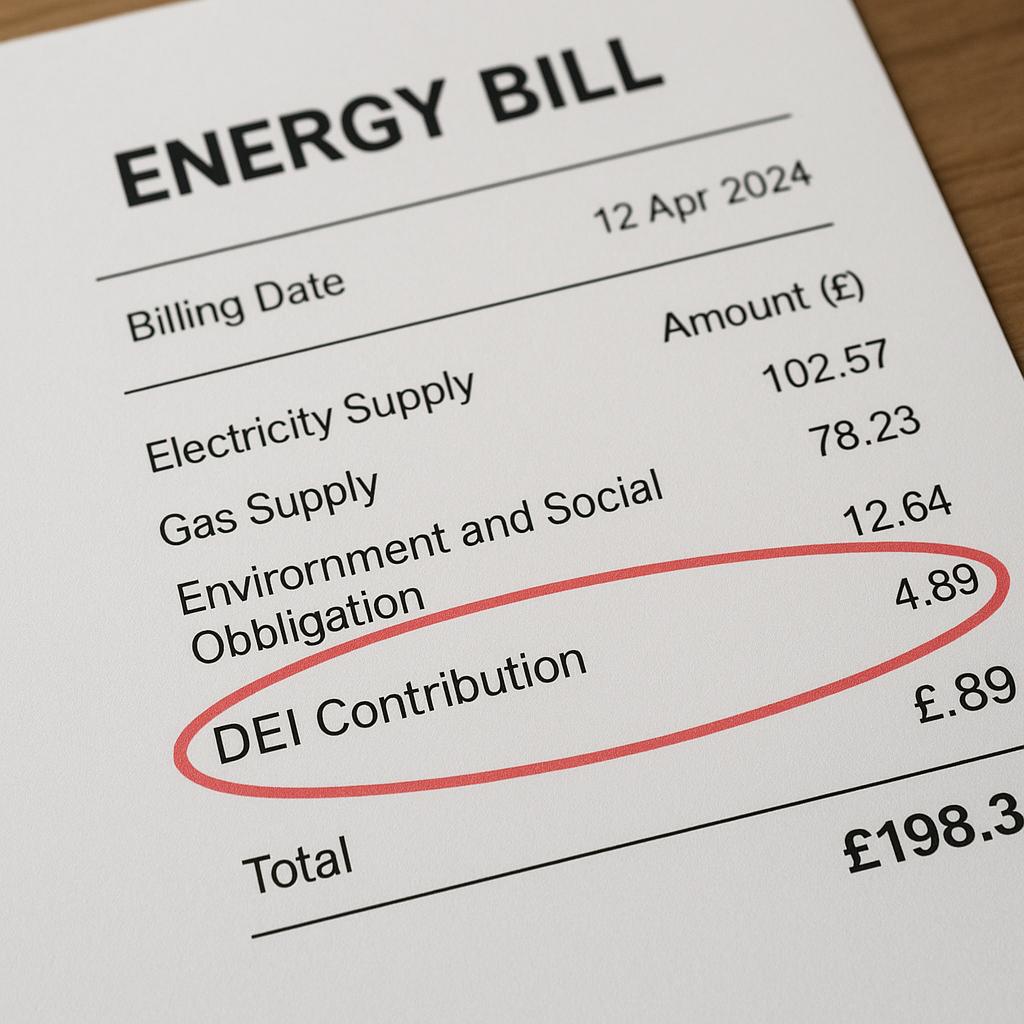
Close-up of a UK energy bill with a highlighted “DEI Contribution” fee circled in red ink, illustrating involuntary ideological charges.

The Illusion of Choice – How DEI and BLM Strip British Citizens of Freedom | Letters from a Nation in Decline

By Martyn Walker
Published in Letters from a Nation in Decline

Foreword by “Peter” – a voice of weary British reason

I often find that the decline of nations is not marked by great explosions, nor by the whirring of guillotines. Instead, it comes with the quiet compliance of people who, while free in theory, are corralled in practice. Today’s Briton is less a citizen than a permitted consumer. He is permitted to complain—as long as he uses the right hashtags. He is permitted to vote—as long as both parties are aligned. And he is permitted to choose—between six identical options, all preaching the same gospel of “equity, sustainability, and inclusion.”

We are governed not by law or Parliament, but by marketing departments, HR compliance officers, and the oblique tyranny of “stakeholder capitalism.” We are a nation slowly smothered in the language of progress. And the saddest thing is this: most people don’t even notice it.

Let the following letter stand as a reminder that consent matters, that ideology must not be compulsory, and that choice—genuine choice—is the first casualty of modernity masquerading as virtue.


The Illusion of Choice

In every civilised society, the principle of consent is sacred. You do not coerce. You do not assume. You do not impose ideology on people through the back door—least of all under the guise of corporate responsibility.

Yet that is precisely what is happening in Britain today.

From our energy suppliers to our banks, from supermarkets to the National Trust, there is no longer a refuge from the ideology of Diversity, Equity and Inclusion (DEI). What was once a voluntary gesture of goodwill—an awareness of pluralism—has now metastasised into a compulsory framework. It is no longer “Would you like to support these causes?” but “You already are, and you have no alternative.”

We are not being asked to participate—we are being auto-enrolled.


Unwanted Activism on Your Energy Bill

Try switching your energy supplier in 2025, and you’ll be met with a cascade of rainbow banners, carbon offset pledges, and “anti-racist” manifestos. EDF has a Head of Equity, Diversity and Inclusion. Octopus Energy brags about its internal DEI board. National Grid runs inclusive hiring campaigns and aligns itself with “decolonisation of energy” discourse. [¹]

Ask yourself: When did keeping the lights on become a political act?

As it stands, every major UK energy provider is signed up to DEI targets or “inclusive hiring” goals. Some explicitly support Black Lives Matter, others frame their ethos around “anti-racist systems,” “unconscious bias,” or “climate justice”—the latter of which almost always entails a suite of unrelated ideological attachments.

The problem is not that these companies have views. The problem is you are paying for them, and you cannot opt out.


The DEI Industrial Complex

What began as a noble-sounding aspiration—to ensure people aren’t discriminated against—has become a sprawling ideological complex, complete with its own language, hierarchies, punishments, and rewards.

You are no longer hired for your skill. You are hired for your alignment.
You are no longer promoted for your merit. You are promoted for your “representation.”
And you are no longer protected by equal treatment. You are filtered through “equity lenses” to determine how you must be judged.

This is not hypothetical. It is written into policy:

  • The BBC’s “50% ethnic minority internships” were later ruled unlawful in design, despite being allowed under “Positive Action” exemptions.
  • NHS England’s DEI strategy includes a framework in which departments must set internal “diversity targets” and report upward on “representation gaps.” [²]
  • KPMG set a target for 29% of its partners to be from ethnic minority backgrounds. [³]

If a company were to set targets for hiring more white working-class boys from Bradford, it would be deemed racist. But reverse it, and it’s “progress.”


The Imported Workforce: A Nation That Trains No One

In 2023, net migration into the UK reached 745,000—a staggering figure in a country already facing housing, healthcare, and infrastructure strain. [⁴]

Rather than invest in British education and skills, our institutions import dependency. Skilled visa schemes are handed out to foreign graduates while British-born apprenticeships collapse. The percentage of white working-class boys attending university is now lower than any other group. [⁵]

This is not an accident. It is a result of deliberate policy.

For too long, the British state has treated its own people—of all colours—as expendable in favour of foreign labour pools. It is not xenophobia to say: we must educate our own before we import others. That is sovereignty. That is duty.


Funding Terror Through Ideology

Perhaps the most egregious example of ideological coercion lies in the quiet endorsement and financial support of organisations like Black Lives Matter Global Network Foundation (BLMGNF)—an organisation now mired in fraud, embezzlement, and open revolutionary rhetoric. [⁶]

Despite this, corporate Britain lined up to donate, sponsor, and publicly endorse the movement in 2020 and beyond. Why? Because it was fashionable. Because the HR department said so. Because to question it was to risk cancellation.

Now we learn that BLM funds were used to buy multi-million-dollar mansions, line the pockets of “activists,” and support policies far beyond race—policies that include abolishing the nuclear family and defunding the police. [⁷]

Still, the energy companies didn’t apologise. The banks didn’t reverse course. Because ideology now trumps prudence.


What Real Choice Would Look Like

Imagine a world in which you could:

  • Choose an energy supplier that doesn’t funnel money into social campaigns.
  • Choose a job without declaring your pronouns or skin colour.
  • Choose an education system that teaches excellence over identity.
  • Choose a bank that isn’t running mandatory “inclusion training” seminars.

That world used to exist.

And if we want it back, we must demand it—not with violence, nor with outrage, but with precision, defiance, and alternatives.


The Cost of Cowardice

The illusion of choice is maintained only through the cowardice of elites. I say this as someone who still receives invitations to City dinner parties—those glossy evenings where equity partners murmur their frustrations over venison and Malbec but dare not speak aloud what they know to be true.

They know this system is wrong. They know it will implode. They know DEI is a smokescreen, not a solution.

But like they did in 2008, they wait, hoping to be last in line when the crash comes. I warned them then, and I warn them now:

You are not immune. You are simply insulated—temporarily.


Conclusion: The Right to Refuse

What this country needs is not more slogans, but fewer mandates. It needs the right to refuse ideological capture in consumer life, employment, and state services.

It needs leaders willing to say:

“We serve everyone, but we do not worship ideology.”

It needs companies who will say:

“We provide energy, not indoctrination.”

It needs citizens who will say:

“I do not consent.”

Because the moment we are forced to pay for, live with, and promote ideas we do not believe in—we are no longer free.

And the British people, whether white, black, or anything in between, deserve better than servitude by algorithm.

Let the illusion of choice be exposed for what it is—a cartel of conformity dressed in the robes of compassion.

And let the revolt begin, not with fire, but with ink.


Sources

[1] https://www.nationalgrid.com/careers/inclusion-and-diversity
[2] https://www.england.nhs.uk/publication/equality-diversity-and-inclusion-strategy-2022-2025/
[3] https://www.kpmg.com/uk/en/home/media/press-releases/2021/06/kpmg-sets-new-diversity-targets.html
[4] https://www.ons.gov.uk/peoplepopulationandcommunity/populationandmigration/internationalmigration
[5] https://www.suttontrust.com/our-research/access-in-white-working-class-communities/
[6] https://www.politico.com/news/2023/04/10/blm-founder-patrisse-cullors-investigation-00090906
[7] https://www.nationalreview.com/news/blm-leaders-accused-of-funneling-10-million-to-themselves/

Letter XV: The Bonfire of Ownership

A fractured Union Jack overlays a rural countryside with a stone cottage and a "For Sale" sign, as corporate towers loom on the horizon.

By Martyn Walker
Published in Letters from a Nation in Decline

“A nation that cannot feed itself, house its people, or keep its lights on is not a nation at all—it is a tenant on borrowed land.”

It began, as these things often do, with envy dressed as fairness.

The farmer, like the landlord before him, is no longer a pillar of rural economy or local enterprise. He is a target. Not because he committed a crime, but because he owns something—a field, a barn, an orchard, a right to pass his land on without forfeiting half its value to HMRC. That, in modern Britain, is now enough to condemn him.

Rachel Reeves’ quiet tax raid on inherited farms isn’t just a tweak to inheritance rules; it is a scalpel, poised to carve up what’s left of the countryside. The attack mirrors the one launched earlier against landlords. In both cases, the Treasury knows its prey: those who are asset-rich but cash-poor. They cannot pay without selling. And once they sell, the land—and power—flows ever upward.

We’ve seen this movie before.

The water companies were sold off and siphoned into off-shore debt-ridden shells. The energy market was deregulated, then re-regulated into chaos. Rents are now controlled not by market forces but by policy distortions so severe that small landlords have been squeezed to death—leaving only corporate agents and institutional buyers standing. A whole district in Newcastle—Jesmond—has effectively been parcelled off to a few landlords with managing agents acting like 21st-century barons.

We are told this is progress.

But what it really is—what it always is—is consolidation. The dismantling of small-scale, dispersed ownership in favour of oligopoly. A slow, deliberate war of attrition against the middle classes and independent actors. Not just in housing or farming or utilities, but in all the vital organs of the nation: food, shelter, water, and energy.

And it has a rhythm now:

  • Phase one: demonise the owner. Call him greedy, idle, privileged.
  • Phase two: introduce ‘reforms’—a little stamp duty here, a little tax break removed there.
  • Phase three: offer them time. The ‘soft landing’—eighteen months for landlords, a year and a half for farmers. Time not to prepare, but to exit.
  • Phase four: acquisition. Quiet, foreign-backed, unopposed.

What emerges is a Britain where no one owns anything—except a handful of conglomerates with DEI departments and asset managers in Frankfurt.

The result is strategic dependence:

  • On foreign food, when our farms are broken.
  • On global energy markets, when our North Sea lies dormant.
  • On imported capital, when our own is taxed, banned, or discouraged.

We have become a nation allergic to ownership—suspicious of those who steward land, build homes, provide for themselves or their heirs. The old Thatcherite dream of a property-owning democracy has not only been abandoned—it has been exiled.

Our civil service wets and pseudo-socialist conservatives long ago surrendered the idea of self-reliance. They do not want a strong yeomanry or entrepreneurial base. They want managed decline, administered by technocrats, who will outsource our essentials and tax what remains.

No empire can survive when it imports its grain, its bricks, its firewood.

But here we are—importing all three, and still congratulating ourselves on the fairness of it all. If the landlord must go, if the farmer must sell, if ownership must be sacrificed—so be it, they say. At least we’ve punished the “rich.”

The rich, of course, will be fine. They always are. It’s the rest of us—the renters, the buyers, the families trying to live between rent hikes and grocery bills—who will inherit nothing but dependency.

The Hidden Costs of DEI Policies in the Workplace

Introduction

In recent years, the principles of Diversity, Equity, and Inclusion (DEI) have been widely adopted across public and private sectors, often positioned as essential for modern workplace culture. However, despite their well-intended aspirations, DEI initiatives have led to significant unintended consequences, particularly when prioritised over meritocracy. For small and medium enterprises (SMEs), corporations, and public services, the emphasis on DEI over merit can erode efficiency, undermine employee morale, and weaken institutional effectiveness.

This paper explores how the replacement of merit-based selection with DEI-led policies can lead to discrimination, inefficiency, and ultimately, a decline in organisational performance. The discussion will highlight the adverse effects on recruitment, operational effectiveness, and broader socio-economic stability.

1. The Shift from Meritocracy to Ideology in Hiring Practices

Traditionally, meritocracy has been the cornerstone of economic and institutional progress. The principle that individuals should be hired and promoted based on ability, experience, and performance has been fundamental to organisational success. However, DEI-driven hiring practices often prioritise demographic characteristics over competence, leading to:

• Skills Dilution – Hiring less capable candidates over more qualified ones in the name of diversity compromises organisational effectiveness.

• Workplace Resentment – Employees who are overlooked for positions due to DEI quotas may become disengaged and demoralised.

• Reduced Competition – When positions are filled based on non-performance-related criteria, there is little incentive for employees to strive for excellence.

For SMEs, where resources are limited and every hire matters, these effects are particularly damaging. Unlike large corporations, SMEs do not have the luxury of carrying inefficiencies caused by poor hiring choices.

2. Discrimination Against the Majority

A key paradox of DEI policies is that they often result in systemic discrimination against the majority workforce. The drive to meet diversity quotas has led to:

• Exclusion of the Most Capable – If selection is based on identity over ability, highly competent individuals can be passed over in favour of those fitting preferred demographic criteria.

• ‘Positive Discrimination’ Undermining Fairness – While intended to correct past injustices, policies that favour one group inherently discriminate against another, creating fresh inequalities.

• Lower Morale and Workplace Division – Employees who perceive promotions or opportunities being handed out based on factors unrelated to merit often feel alienated, leading to division within teams.

Rather than fostering genuine inclusivity, DEI policies often breed resentment and reduce trust in leadership, particularly when those implementing such strategies appear detached from their consequences.

3. The Deterioration of Public Services

The public sector has embraced DEI at an aggressive pace, often at the cost of operational efficiency. In critical areas such as healthcare, law enforcement, and education, the prioritisation of DEI over merit has led to:

• Lower Standards – Public service providers lowering entry and qualification requirements to meet DEI targets.

• Compromised Safety – The police and military, for example, have faced scrutiny for lowering physical and cognitive standards to achieve diversity quotas, potentially affecting public safety.

• Declining Performance and Accountability – When individuals are appointed based on DEI policies rather than skill, accountability diminishes as failure is often shielded from criticism to avoid political backlash.

This decline in public service effectiveness is then used by governments to justify increased taxation, further burdening productive members of society while failing to address the root causes of inefficiency.

4. Corporate Performance and Investor Confidence

Large corporations implementing DEI policies often do so under pressure from activist shareholders, regulatory bodies, or social movements. However, the long-term impact of these policies can be detrimental:

• Declining Productivity – Workforces selected based on identity rather than ability perform worse, reducing productivity and innovation.

• Investor Withdrawal – Shareholders prioritising returns over political agendas may divest from companies whose hiring practices reduce profitability.

• Reputational Risks – Companies that prioritise ideological commitments over customer service and performance often suffer reputational damage when the impact of such policies becomes evident.

Many of the world’s most successful businesses have historically thrived due to competition and meritocracy, rather than ideological hiring mandates.

5. The Economic Cost of DEI Overreach

The economic ramifications of prioritising DEI over merit are wide-reaching, with consequences including:

• Reduced Global Competitiveness – Nations and industries that abandon meritocracy in favour of ideological hiring may find themselves outpaced by competitors who focus on ability and efficiency.

• Wage and Tax Burdens on the Productive – As inefficient organisations struggle, governments turn to higher taxation to cover shortfalls, punishing those who are productive while subsidising ineffective systems.

• A Culture of Compliance Over Innovation – Employees in DEI-focused organisations often prioritise conforming to mandated narratives rather than thinking critically, reducing innovative output.

In effect, DEI policies risk creating an artificial economy where competence is secondary to ideological adherence, placing a significant drag on long-term economic growth.

6. The Path Forward: Reclaiming Meritocracy

If organisations wish to thrive, a return to meritocracy is essential. This does not mean ignoring diversity, but rather ensuring that all hiring and promotion decisions are rooted in:

• Competence Over Quotas – The best candidate for the job should always be chosen, regardless of background.

• Equal Opportunity, Not Equal Outcomes – Organisations should ensure a level playing field rather than enforcing demographic representation.

• Freedom of Thought and Expression – Employees should be encouraged to challenge ideas rather than conform to mandated ideological positions.

For businesses and public services alike, efficiency, excellence, and innovation should remain the primary objectives.

Conclusion

While DEI policies were originally designed to address historic inequalities, their implementation in modern organisations has created new challenges that threaten operational effectiveness, fairness, and economic stability. Prioritising ideology over ability has led to inefficiency, workplace division, and economic stagnation.

For SMEs, corporations, and public services to remain effective and competitive, a shift back to meritocratic principles is necessary. Only by selecting the best individuals based on talent, effort, and ability—rather than identity—can organisations and societies prosper.