

The Illusion of Choice – How DEI and BLM Strip British Citizens of Freedom | Letters from a Nation in Decline
By Martyn Walker
Published in Letters from a Nation in Decline
Foreword by “Peter” – a voice of weary British reason
I often find that the decline of nations is not marked by great explosions, nor by the whirring of guillotines. Instead, it comes with the quiet compliance of people who, while free in theory, are corralled in practice. Today’s Briton is less a citizen than a permitted consumer. He is permitted to complain—as long as he uses the right hashtags. He is permitted to vote—as long as both parties are aligned. And he is permitted to choose—between six identical options, all preaching the same gospel of “equity, sustainability, and inclusion.”
We are governed not by law or Parliament, but by marketing departments, HR compliance officers, and the oblique tyranny of “stakeholder capitalism.” We are a nation slowly smothered in the language of progress. And the saddest thing is this: most people don’t even notice it.
Let the following letter stand as a reminder that consent matters, that ideology must not be compulsory, and that choice—genuine choice—is the first casualty of modernity masquerading as virtue.
The Illusion of Choice
In every civilised society, the principle of consent is sacred. You do not coerce. You do not assume. You do not impose ideology on people through the back door—least of all under the guise of corporate responsibility.
Yet that is precisely what is happening in Britain today.
From our energy suppliers to our banks, from supermarkets to the National Trust, there is no longer a refuge from the ideology of Diversity, Equity and Inclusion (DEI). What was once a voluntary gesture of goodwill—an awareness of pluralism—has now metastasised into a compulsory framework. It is no longer “Would you like to support these causes?” but “You already are, and you have no alternative.”
We are not being asked to participate—we are being auto-enrolled.
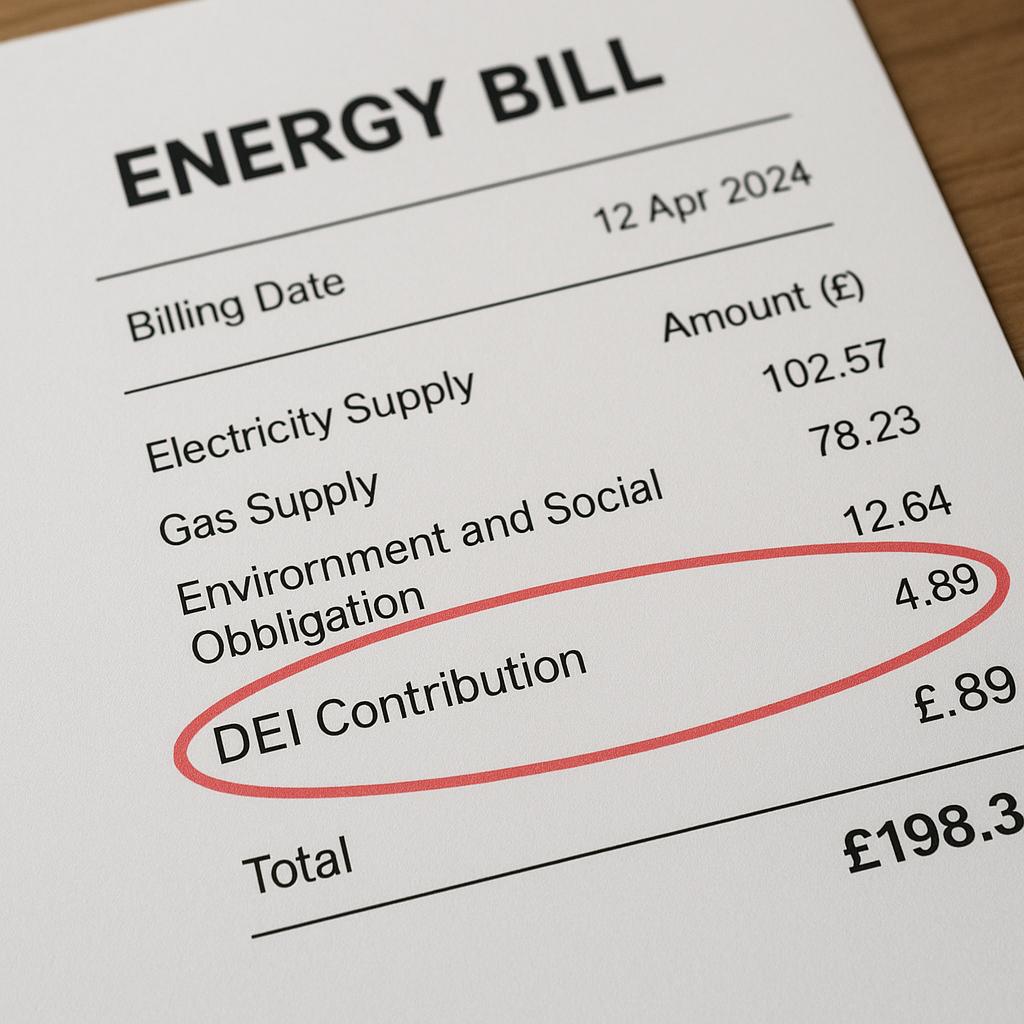
Unwanted Activism on Your Energy Bill
Try switching your energy supplier in 2025, and you’ll be met with a cascade of rainbow banners, carbon offset pledges, and “anti-racist” manifestos. EDF has a Head of Equity, Diversity and Inclusion. Octopus Energy brags about its internal DEI board. National Grid runs inclusive hiring campaigns and aligns itself with “decolonisation of energy” discourse. [¹]
Ask yourself: When did keeping the lights on become a political act?
As it stands, every major UK energy provider is signed up to DEI targets or “inclusive hiring” goals. Some explicitly support Black Lives Matter, others frame their ethos around “anti-racist systems,” “unconscious bias,” or “climate justice”—the latter of which almost always entails a suite of unrelated ideological attachments.
The problem is not that these companies have views. The problem is you are paying for them, and you cannot opt out.
The DEI Industrial Complex
What began as a noble-sounding aspiration—to ensure people aren’t discriminated against—has become a sprawling ideological complex, complete with its own language, hierarchies, punishments, and rewards.
You are no longer hired for your skill. You are hired for your alignment.
You are no longer promoted for your merit. You are promoted for your “representation.”
And you are no longer protected by equal treatment. You are filtered through “equity lenses” to determine how you must be judged.
This is not hypothetical. It is written into policy:
- The BBC’s “50% ethnic minority internships” were later ruled unlawful in design, despite being allowed under “Positive Action” exemptions.
- NHS England’s DEI strategy includes a framework in which departments must set internal “diversity targets” and report upward on “representation gaps.” [²]
- KPMG set a target for 29% of its partners to be from ethnic minority backgrounds. [³]
If a company were to set targets for hiring more white working-class boys from Bradford, it would be deemed racist. But reverse it, and it’s “progress.”
The Imported Workforce: A Nation That Trains No One
In 2023, net migration into the UK reached 745,000—a staggering figure in a country already facing housing, healthcare, and infrastructure strain. [⁴]
Rather than invest in British education and skills, our institutions import dependency. Skilled visa schemes are handed out to foreign graduates while British-born apprenticeships collapse. The percentage of white working-class boys attending university is now lower than any other group. [⁵]
This is not an accident. It is a result of deliberate policy.
For too long, the British state has treated its own people—of all colours—as expendable in favour of foreign labour pools. It is not xenophobia to say: we must educate our own before we import others. That is sovereignty. That is duty.
Funding Terror Through Ideology
Perhaps the most egregious example of ideological coercion lies in the quiet endorsement and financial support of organisations like Black Lives Matter Global Network Foundation (BLMGNF)—an organisation now mired in fraud, embezzlement, and open revolutionary rhetoric. [⁶]
Despite this, corporate Britain lined up to donate, sponsor, and publicly endorse the movement in 2020 and beyond. Why? Because it was fashionable. Because the HR department said so. Because to question it was to risk cancellation.
Now we learn that BLM funds were used to buy multi-million-dollar mansions, line the pockets of “activists,” and support policies far beyond race—policies that include abolishing the nuclear family and defunding the police. [⁷]
Still, the energy companies didn’t apologise. The banks didn’t reverse course. Because ideology now trumps prudence.
What Real Choice Would Look Like
Imagine a world in which you could:
- Choose an energy supplier that doesn’t funnel money into social campaigns.
- Choose a job without declaring your pronouns or skin colour.
- Choose an education system that teaches excellence over identity.
- Choose a bank that isn’t running mandatory “inclusion training” seminars.
That world used to exist.
And if we want it back, we must demand it—not with violence, nor with outrage, but with precision, defiance, and alternatives.
The Cost of Cowardice
The illusion of choice is maintained only through the cowardice of elites. I say this as someone who still receives invitations to City dinner parties—those glossy evenings where equity partners murmur their frustrations over venison and Malbec but dare not speak aloud what they know to be true.
They know this system is wrong. They know it will implode. They know DEI is a smokescreen, not a solution.
But like they did in 2008, they wait, hoping to be last in line when the crash comes. I warned them then, and I warn them now:
You are not immune. You are simply insulated—temporarily.
Conclusion: The Right to Refuse
What this country needs is not more slogans, but fewer mandates. It needs the right to refuse ideological capture in consumer life, employment, and state services.
It needs leaders willing to say:
“We serve everyone, but we do not worship ideology.”
It needs companies who will say:
“We provide energy, not indoctrination.”
It needs citizens who will say:
“I do not consent.”
Because the moment we are forced to pay for, live with, and promote ideas we do not believe in—we are no longer free.
And the British people, whether white, black, or anything in between, deserve better than servitude by algorithm.
Let the illusion of choice be exposed for what it is—a cartel of conformity dressed in the robes of compassion.
And let the revolt begin, not with fire, but with ink.
Sources
[1] https://www.nationalgrid.com/careers/inclusion-and-diversity
[2] https://www.england.nhs.uk/publication/equality-diversity-and-inclusion-strategy-2022-2025/
[3] https://www.kpmg.com/uk/en/home/media/press-releases/2021/06/kpmg-sets-new-diversity-targets.html
[4] https://www.ons.gov.uk/peoplepopulationandcommunity/populationandmigration/internationalmigration
[5] https://www.suttontrust.com/our-research/access-in-white-working-class-communities/
[6] https://www.politico.com/news/2023/04/10/blm-founder-patrisse-cullors-investigation-00090906
[7] https://www.nationalreview.com/news/blm-leaders-accused-of-funneling-10-million-to-themselves/

 Verbal Alchemy