

The Risks of Disconnection: When Government Investments Ignore Public Opinion

Deep Dive Podcast:

Listen to this article:

When a government prioritises large-scale investments that lack public support, the consequences can be profound, affecting everything from economic stability to the well-being of its citizens. This essay explores the broader implications of a government persisting with controversial projects that a majority of the public disapproves of, even if these initiatives are justified by officials as necessary for long-term national development. In this scenario, we imagine successive governments backing high-cost infrastructure or development schemes that the public sees as misaligned with their needs and priorities. As dissatisfaction grows, the government finds itself with a rising disapproval rating, eventually reaching a critical point where its decisions are perceived as both wasteful and emblematic of cronyism.

Public Trust and the Social Contract

At the heart of any democratic system lies the social contract, an implicit agreement between the government and its people. This contract is predicated on the understanding that elected officials will act in the public’s best interest and be good stewards of taxpayer resources. However, when a government continues to invest in projects that the majority of citizens see as unnecessary or even self-serving, it risks breaking this contract. The public may begin to view such investments as symbolic gestures, designed more to elevate the government’s prestige than to address real societal needs.

The erosion of trust in such cases can be significant. A government that fails to act in line with public sentiment fosters disillusionment among its citizens. People may become disengaged from political processes, believing that their voices no longer matter. This disconnect can lead to a dangerous decline in voter participation and civic involvement, further undermining the democratic system.

Economic Misallocation and its Consequences

A government’s investment choices have a direct impact on the nation’s economic well-being. When public funds are directed toward initiatives that lack popular support, this often represents a misallocation of resources. Imagine a government allocating billions to infrastructure projects designed to showcase technological prowess or national ambition, while basic services such as healthcare, education, and public transport systems languish.

Such misallocation of capital can have immediate and long-term economic consequences. In the short term, taxpayer money is tied up in projects that do not yield tangible benefits for the majority of the population. In the long term, these investments can result in higher taxation to fund ongoing or incomplete projects, leaving less financial flexibility for essential services. As the public witnesses continued spending on initiatives they see as irrelevant, their willingness to contribute to the tax base or engage with public initiatives diminishes, weakening the overall economy.

Moreover, when government projects are perceived as wasteful or corrupt, this reduces consumer and investor confidence. Businesses may hesitate to invest in an economy where public money is being funneled into vanity projects rather than addressing structural issues like productivity, innovation, or public welfare. This hesitancy stifles economic growth and further undermines the nation’s financial health.

Social and Mental Health Implications

Public discontent over government spending has a cascading effect on mental and social well-being. Large-scale, high-cost projects that the public views as unnecessary can contribute to societal alienation and chronic stress. When citizens perceive that their government is ignoring their needs, they can feel disenfranchised, powerless, and isolated from decision-making processes.

This discontent, if widespread, can translate into real health impacts. Chronic stress, fuelled by feelings of neglect and lack of agency, is linked to a range of physical and mental health problems, from anxiety and depression to heart disease. In a society where public investment is seen as serving elite interests rather than the common good, these stress-related health problems could become more prevalent, placing an additional burden on already strained healthcare systems.

Moreover, when governments persist in funding controversial projects at the expense of essential services, this can lead to increased social inequality. Marginalised communities are often the most reliant on public services, and if those services are deprioritised in favour of grandiose projects, these groups suffer disproportionately. This can lead to greater social unrest, further fuelling dissatisfaction and divisions within society.

National Happiness and Social Cohesion

Happiness is not solely a product of material wealth but also of how citizens perceive their place within society and their relationship with their government. When a government embarks on investments that the majority of the public deems unnecessary, it diminishes a collective sense of belonging and fairness. Citizens feel that the government is disconnected from their daily lives and concerns, and this disconnection erodes national well-being.

Research into happiness economics consistently shows that trust in institutions is a key determinant of a nation’s overall sense of happiness and satisfaction. When successive governments make decisions that disregard public opinion, this trust erodes, and with it, the nation’s collective happiness. People become less optimistic about the future, less willing to contribute to societal progress, and less engaged in their communities.

Political Instability and Long-Term Risks

Moreover, when public funds are directed toward controversial projects that do not directly improve citizens’ lives, people begin to perceive their government as inefficient and out of touch. This perception further drives societal fragmentation, as different groups feel they are being unfairly impacted by these decisions, whether through higher taxes, inadequate services, or environmental degradation.

When governments repeatedly ignore public opinion in their investment choices, it leads to political instability. In democratic systems, this often manifests as reactionary voting, where citizens cast their ballots not based on ideological alignment but as a protest against the status quo. This can lead to a rise in populist or fringe political movements that promise radical change, often at the expense of long-term stability and governance quality.

In extreme cases, prolonged public dissatisfaction with government investment decisions can result in large-scale civil unrest or the rise of anti-democratic movements. Citizens who feel that their concerns are systematically ignored may turn to more extreme means of expressing their discontent, from widespread protests to disruptive strikes or even violent demonstrations.

Additionally, the government’s reputation on the global stage may suffer. Other nations and international investors will be wary of engaging with a country where domestic politics are unstable, and the government is perceived as out of touch with its people. This can have lasting consequences for trade, investment, and international relations, further undermining economic prospects and global standing.

Conclusion

When governments pursue investments that the public overwhelmingly disapproves of, they risk far more than the financial cost of the projects themselves. The breakdown of trust between the government and its citizens can lead to widespread social and economic consequences, from political disengagement and economic decline to deteriorating public health and reduced national happiness. For governments to maintain the delicate balance of democratic governance, they must ensure that their investments reflect the needs, values, and aspirations of the majority, rather than indulging in projects that serve only a few or are seen as mere symbols of power. Otherwise, the long-term damage to the nation’s social fabric, political stability, and economic health could be profound and difficult to reverse.

References

The Origins and Consequences of Public Trust in Government: A Time Series Analysis

OECD Public Governance Reviews

Trust in public institutions: Trends and implications for economic security

Legacy of Ancient Cultures Compared to Nuclear Waste

A Comparison of Ancient Civilisation Legacies with Modern Nuclear Waste

Throughout history, civilisations have left behind artefacts that shape our understanding of their cultures, values, and technological prowess. The Egyptians, Greeks, Romans, and other ancient societies are remembered for their monumental achievements, which have stood the test of time and continue to inspire modern architects, engineers, and artists. Their legacy is one of beauty, ingenuity, and a deep connection to both human creativity and the natural world.

In contrast, our modern industrial society seems poised to leave behind a far more contentious legacy: nuclear waste. Entombed in concrete and buried in the sea or deep underground, this material reflects the technological ambitions and energy consumption patterns of our age, as well as the hazardous by-products of our quest for power. This essay will compare the legacies of ancient civilisations—characterised by awe-inspiring art and architecture—with the nuclear waste legacy of modern times, exploring the cultural, technological, and philosophical differences that underpin these divergent imprints on history.

The Legacies of Ancient Civilisations

One of the most enduring qualities of ancient civilisations is their ability to blend utility with beauty. The Egyptians, for instance, constructed the pyramids—massive structures that not only served as tombs for their pharaohs but also symbolised their beliefs in the afterlife and their understanding of geometry and astronomy. The sheer scale and precision of these monuments, built with relatively primitive tools, continue to astound us. They reflect a civilisation that placed immense value on both religious meaning and architectural grandeur.

Similarly, the Romans left us aqueducts, roads, and public baths—pieces of infrastructure that were as functional as they were elegant. Roman architecture, with its use of arches, domes, and columns, served both practical needs and aesthetic ideals. Their innovation of central heating systems (hypocausts) in public buildings and private villas, alongside intricate mosaics and frescoes, demonstrated a balance between comfort, technology, and beauty.

These ancient works of art and engineering not only fulfilled immediate needs—whether religious, domestic, or infrastructural—but were also created with an eye to endurance. The intention was for them to outlast the builders and serve as a testament to the civilisation’s ingenuity. Today, these structures inspire admiration, reminding us of human creativity, ambition, and our capacity to live in harmony with our surroundings.

The Modern Legacy: Nuclear Waste

Fast-forward to the 20th and 21st centuries, and the legacy of modern civilisation seems far less inspiring. The advent of nuclear power, while promising an almost limitless source of energy, brought with it a burden that humanity is yet to fully comprehend: nuclear waste. According to the article from The Telegraph, the UK alone is expected to spend £132 billion over the next 120 years to manage its stockpile of radioactive material, much of which will be entombed in concrete or buried beneath the sea.

Unlike the pyramids or Roman aqueducts, nuclear waste is not a symbol of beauty or cultural achievement. It is, instead, a reminder of the darker side of modern technological progress—the side that prioritises short-term gains without fully accounting for the long-term consequences. While nuclear energy has brought cleaner air in terms of reduced carbon emissions, the toxic by-products will remain hazardous for tens of thousands of years. Unlike the monuments of ancient civilisations, these waste sites are not built to inspire future generations; they are built to be forgotten. The goal is containment, not celebration.

Cultural and Philosophical Differences

The contrast between the legacies of ancient civilisations and modern nuclear waste reveals profound differences in how each era viewed its relationship with the future and with the natural world. The ancients, while certainly not perfect custodians of their environment, saw their monumental projects as lasting contributions to human progress. The pyramids, temples, aqueducts, and amphitheatres were built to endure, with a sense of responsibility towards both the present and future generations.

In contrast, modern civilisation appears more focused on the present, often neglecting the long-term consequences of its actions. Nuclear waste, for example, represents the by-product of a technology that, while beneficial in terms of energy production, carries an enormous long-term cost. The decision to bury waste in concrete tombs or beneath the sea reflects a desire to remove the problem from immediate view rather than a commitment to safeguarding the planet for future generations.

Furthermore, the ancient civilisations built with materials and techniques that were, for the most part, in harmony with their environment. Stone, wood, and brick structures, while sometimes environmentally costly to build, do not pose the existential threat that radioactive material does. The Romans’ use of volcanic ash in concrete, for example, has proven remarkably durable and environmentally benign. In contrast, the radioactive material that modern society buries will outlast even the most durable materials, posing a hazard for millennia.

The Aesthetic and Symbolic Dimensions

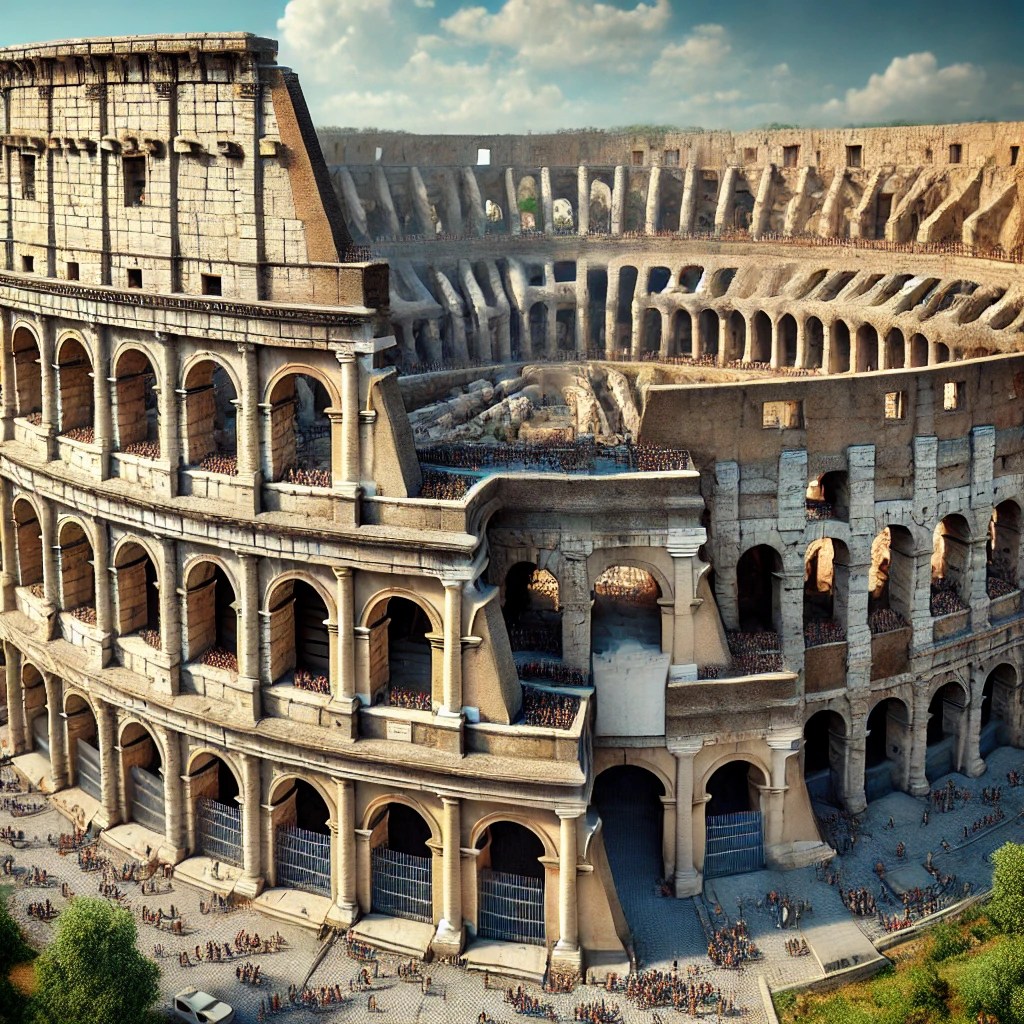
Another striking difference lies in the aesthetic and symbolic dimensions of these legacies. The pyramids and the Colosseum are not only marvels of engineering but also symbols of human aspiration. They inspire awe and contemplation, prompting us to reflect on our place in history and the accomplishments of those who came before us.

Nuclear waste, by contrast, is hidden away, unmarked, and without symbolism. It is intentionally concealed, with the hope that future generations will not stumble upon it or that the dangers it poses will be mitigated. There is nothing inspiring about a nuclear waste repository; it is an invisible burden that speaks more to humanity’s hubris than to its creativity or foresight.

Conclusion

The comparison between the legacies of ancient civilisations and modern nuclear waste offers a sobering reflection on the values and priorities of different eras. While the ancient Egyptians, Greeks, and Romans built monuments that continue to captivate and inspire, modern civilisation is entombing its most dangerous creations in concrete, hoping that future generations will not have to deal with the consequences.

This contrast underscores the need for a shift in how we think about our impact on the future. Rather than leaving behind a legacy of pollution and hazardous materials, we should strive to create a world where future generations inherit structures, technologies, and systems that reflect the best of our human potential. Like the ancients, we should aim to build things that endure not only physically but also in terms of their positive contribution to the world. In doing so, we might one day leave behind something worthy of admiration, rather than a problem to be buried.

Keir Starmer: Promises vs Reality After 100 Days

Oh, Keir Starmer’s hit his hundred days,
And honestly, it’s been a bit of a maze.
Promised us “change”—now, where’s that at?
All we’ve got is a Tory copycat!

“Free Gear Keir” said he’d lead us right,
But all we’ve got is one hell of a fright.
Cutting fuel for our dear old nans,
While tossing millions to foreign lands!

He’ll “smash the gangs,” he did declare,
But now the boats? They’re everywhere!
Thousands arriving, no vetting at all—
It’s like an open-door policy at a shopping mall.

He’s making mates with ol’ Xi Jinping,
But with the Yanks? They’re on the wing.
The Falklands? Well, they’re on loan—
And Gibraltar? Spain’s on the phone!

Oh, and the schools! Don’t get me started—
Private fees? He’s broken-hearted.
Middle-class kids can kiss that dream,
As Keir sails down the socialist stream.

So, cheers to Keir on his hundred days,
But if this keeps up, we’ll all part ways.
Sleaze, cuts, and a big migration boom—
Who’s up for moving to the moon?

But don’t worry, mate, there’s always hope—
Maybe he’ll smash it… Or just the envelope!

Why LinkedIn Should Rethink Outsourced Identity Verification

Deep Dive Podcasts discuss this article:

LinkedIn and the Perils of Outsourcing Identity Verification: A Strategic Misstep

LinkedIn, a platform fundamentally designed for professional networking, has thrived by enabling users to build and present their identities in a business-oriented context. The foundation of its value proposition is the ability to verify one’s professional and personal identity through content such as a profile picture, education history, employment details, endorsements, and contributions to the platform. This user-generated content has long served as a form of self-authentication, allowing members to establish credibility within a community of peers.

However, LinkedIn’s recent move to outsource identity verification to a third-party service, Persona, represents a misalignment with its core mission. This decision not only risks undermining user trust but also threatens the essence of LinkedIn’s business model by relinquishing control over a crucial aspect of identity management. The choice to partner with an unfamiliar and unresponsive third-party provider is akin to LinkedIn “shooting itself in the foot,” as it jeopardises the very purpose for which people use the platform.

The Role of User-Generated Content in Establishing Identity

LinkedIn’s success has been built on the premise that professional identity is validated through the content users provide. A person’s photo, educational background, work history, and activity on the platform cumulatively establish their reputation and credibility. The more active a user is, the more established their identity becomes, as peers can endorse skills, comment on achievements, and interact with the user’s content. This organic form of validation is powerful because it relies on community recognition rather than bureaucratic checks.

The addition of a third-party verification layer appears redundant, as LinkedIn’s inherent features already serve to distinguish authentic profiles from fraudulent ones. Members have long relied on these features to discern the credibility of others, supported by LinkedIn’s existing measures to flag suspicious accounts. Introducing an external verification process that requires sensitive information, such as passport details and biometric data, diverges from this community-driven model, adding a layer of complexity and potential risk that is not aligned with the platform’s ethos.

Outsourcing Identity Verification: A Misaligned Strategy

By opting to use Persona, LinkedIn has effectively outsourced the core aspect of identity validation to a company that most users have never heard of and have no reason to trust. The outsourcing decision raises several issues:

  1. Loss of Control Over Identity Management: When LinkedIn allows a third-party company to handle the verification process, it cedes control over an essential component of its platform—user identity. Trust in LinkedIn is based on the platform’s own standards and processes, which users perceive as part of its service offering. Introducing an unknown entity as the gatekeeper of verification dilutes LinkedIn’s role and could weaken the trust that underpins its brand.
  2. Delegating to an Unresponsive Provider: Persona’s reported lack of responsiveness to user queries exacerbates concerns. In a case where sensitive personal information is at stake, users expect quick and clear communication. The fact that some users have received only generic responses to inquiries about data handling reflects poorly not just on Persona but also on LinkedIn, which chose this provider as a partner. By delegating such a critical aspect of user interaction to a company that fails to meet customer service expectations, LinkedIn risks harming its reputation.
  3. Increased Data Privacy Risks: Users are understandably wary of sharing sensitive documents like passports or biometric data with third parties. When LinkedIn asks users to provide such information to a service like Persona, it not only increases the potential attack surface for data breaches but also places the burden of privacy protection on a company outside LinkedIn’s direct control. This is problematic, as LinkedIn’s users are accustomed to trusting LinkedIn itself—not an external vendor—to keep their data safe.
  4. Undermining the Platform’s Core Value Proposition: LinkedIn’s main selling point is that it enables people to network professionally and establish their credibility. This is achieved through the profiles users build, the content they share, and the connections they cultivate. By turning to an external party for verification, LinkedIn is in effect communicating to users that the traditional means of establishing a credible identity on the platform are insufficient. This undermines the platform’s core value, as it diminishes the importance of the user’s own contributions to their profile.

The Irony of Outsourcing Identity Verification on a Platform Built for Identity

LinkedIn’s very nature as a professional network revolves around identity construction and verification through content. The essence of what makes LinkedIn valuable is the fact that identity is established organically by the user and then validated by the network itself. For a company whose value is largely derived from the user-generated content that forms these identities, the choice to outsource verification to Persona is not only ironic but counterproductive. It suggests that LinkedIn itself does not trust the organic processes that have underpinned its platform since its inception.

The timing is also concerning, given that we live in an era where data privacy and control over personal information are at the forefront of public discourse. With the introduction of this outsourced verification, LinkedIn is effectively asking its users to trust not one but two organisations with their personal data. Given Persona’s apparent lack of responsiveness and ambiguity regarding data sharing, users may rightfully question why LinkedIn would compromise on its own ability to manage identity verification directly.

A Strategic Reassessment Is Needed

LinkedIn’s decision to outsource identity verification reflects a shift towards a more bureaucratic model of identity assurance that contradicts the platform’s original purpose. To restore user trust and realign with its core mission, LinkedIn should consider several alternative strategies:

  • Enhance Existing Verification Features: Instead of relying on third-party vendors, LinkedIn could develop its own enhanced verification features. This could involve additional checks based on user activity, professional endorsements, or connections, all of which stay within the framework of LinkedIn’s ecosystem.
  • Improve User Education on Security Measures: Rather than introducing a third-party identity verification process, LinkedIn could focus on educating users about best practices for securing their accounts and avoiding scams. Providing resources to help users identify genuine profiles would empower the community to self-regulate.
  • Transparent Data Handling Practices: If LinkedIn insists on using third-party services, it should at least ensure that its partners have transparent data handling practices and are responsive to user concerns. Publicly clarifying the terms of data use, storage, and deletion can go a long way toward building trust.

By outsourcing a key aspect of identity management to an unresponsive and unknown entity, LinkedIn risks undermining the very foundations upon which its business is built. The platform’s strength lies in enabling users to establish their identities through the content they provide, and this user-driven model should stay at the heart of its identity verification processes.


Here’s a list of relevant documents and resources that pertain to LinkedIn’s identity verification process, Persona’s terms, and related privacy considerations:

References:

Debra Samuel, Linked In member and IT Professional, reports on Linked In verification. LinkedIn Verify Identity – to Use or Not to Use?

LinkedIn User Agreement (Terms of Service)

This document outlines the general terms and conditions of using LinkedIn.
LinkedIn User Agreement

LinkedIn Privacy Policy

Covers how LinkedIn collects, uses, and protects personal data.
LinkedIn Privacy Policy

LinkedIn Help Page: Identity Verification

Describes the identity verification process and the role of third-party partners like Persona.
LinkedIn Identity Verification Help Page

LinkedIn Cookie Policy

Provides information on how LinkedIn uses cookies, which is relevant for tracking data linked to verification processes.
LinkedIn Cookie Policy

Persona Resources:

Persona Privacy Policy

Details how Persona collects, uses, stores, and deletes personal data. It is crucial to understand the company’s data handling practices, especially for identity verification purposes.
Persona Privacy Policy

Persona Terms of Service

Outlines the terms under which Persona operates, including data usage and liability. Understanding these terms can shed light on Persona’s responsibilities in data handling.
Persona Terms of Service

Data Request Information: “Do Not Sell or Share My Personal Information

This page provides extra context about opting out of data selling or sharing, which is relevant to user concerns about data privacy.
Do Not Sell or Share My Personal Information

General Data Protection and Privacy References:

UK General Data Protection Regulation (UK GDPR)

Since LinkedIn operates in the UK, it must follow UK GDPR requirements for data protection and user consent.
UK GDPR Overview

National Cyber Security Centre (NCSC) Guidance on Identity Verification

Offers insights on best practices for identity verification in the UK, which are relevant when assessing LinkedIn’s approach.
NCSC Identity Verification Guidance

A New Era of Lacedaemonian Guise

The Dangers of Pursuing a Controlled Speech in a Modern Democracy

Deep Dive Podcasts discuss WTAF is A New Era of Lacedaemonian Guise:

In the 17th century, John Milton penned Areopagitica, a powerful defence of free speech against the rigid licensing of the press imposed by the British government. Milton argued that the suppression of ideas and opinions, even those deemed dangerous or heretical, stifled the pursuit of truth and intellectual progress. Nearly four centuries later, the British government seems intent on reviving these antiquated and authoritarian practices by proposing measures to restrict freedom of speech on social media, ostensibly to combat misinformation. But as history has shown, such attempts to control the narrative are fraught with peril, not least because the government itself has, on multiple occasions, propagated misinformation. This irony, or rather, this danger, is akin to Milton’s experiences in his time, where the state sought to limit what could be thought, said, and published. Today, we must recognise the echoes of this “Lacedaemonian guise,” a stark return to a Spartan-like rigidity, where the free exchange of ideas is viewed not as a societal good but as a threat to be tightly regulated.

The Mirage of Misinformation

It is important to acknowledge that misinformation is a real issue in our digital age, with the rapid spread of falsehoods having tangible consequences. However, the government’s claim that the solution lies in reining in social media platforms neglects a crucial point: those in power are not infallible arbiters of truth. In recent memory, we have witnessed various official narratives later proven to be misleading or outright false. The COVID-19 pandemic, economic policies, and even national security issues have all seen governments backpedal or amend their stances as new information comes to light. To grant any government the authority to define “misinformation” is to empower it to suppress dissenting views, inconvenient facts, and alternative perspectives under the guise of public safety. The danger here is that such measures do not merely combat misinformation but silence criticism, foster conformity, and eliminate the essential friction that drives democratic discourse.

The Rebirth of Licensing: A Spartan Decree in Digital Form

Milton wrote with disdain about the idea of licensing speech, equating it to the practices of ancient Lacedaemon (Sparta), a society known for its uncompromising discipline and suppression of individualism. In modern terms, this equates to the state seeking to monitor and regulate the content shared on social media platforms—a digital licensing of the press, if you will. Under the proposed framework, social media companies would be obliged to police their users, removing content deemed “harmful” or face punitive measures. But who decides what is harmful? The government’s claim to be acting in the public interest must be critically examined, as the history of power reveals that today’s harm is often tomorrow’s truth.

The Lacedaemonians were staunchly opposed to intellectual diversity, favouring a rigid conformity that preserved their way of life. In the same vein, imposing restrictions on social media under the pretence of combating misinformation reflects a desire to control the boundaries of acceptable discourse, a desire that bears the hallmarks of the very tyranny Milton warned against. If we cede to the government the power to determine what may or may not be spoken, we do not safeguard the truth—we instead endanger it by making it susceptible to political whim.

The Necessity of Free Expression for a Vibrant Democracy

A democratic society thrives on the free flow of ideas. It is in the marketplace of ideas that the strongest arguments emerge, and errors or falsehoods are exposed through scrutiny and debate. In Milton’s view, the pursuit of truth is an active process requiring the engagement of many minds, not the fiat of a single authority. If we look to history, it is evident that truth is not static; it evolves as new evidence and interpretations come to light. Many ideas once dismissed as radical or dangerous later became widely accepted, not because they were mandated by the state, but because they withstood rigorous debate and empirical challenge.

The notion that social media platforms should act as the gatekeepers of acceptable speech, guided by government mandates, runs contrary to the principles of free expression. The digital sphere has allowed marginalised voices, dissenters, and reformers to challenge the status quo in ways that traditional media often could not. Any legislation that aims to curb this potential under the banner of fighting misinformation risks not only silencing these voices but also insulating the powerful from accountability.

The Perils of Authoritarian Drift

As we face a “new era of Lacedaemonian guise,” we must be wary of the steady creep toward authoritarianism under the pretext of public protection. The willingness to limit free speech, even if motivated by genuine concerns, sets a dangerous precedent. Today, it may be misinformation; tomorrow, it may be political dissent, scientific critique, or artistic expression that comes under scrutiny. History is replete with examples where laws intended for one purpose were later applied to stifle legitimate discourse.

The government’s pursuit to control speech reflects not the confidence of a state assured in its legitimacy, but rather, a nervous reaction to a more democratised information landscape where narratives can be questioned and authorities held to account. Milton argued that to reject free speech is to reject the potential for individual and collective growth. He recognised that, in pursuing truth, errors and falsehoods would arise, but the remedy was not to prevent people from speaking but to allow a fuller, richer debate. The role of the state should be to facilitate this open dialogue, not to dictate its parameters.

Conclusion: Towards a Truly Free Marketplace of Ideas

The government’s attempts to rein in social media and control the spread of information through legislation are reminiscent of the licensing ordinances that Milton so passionately opposed. By invoking the Lacedaemonian guise, we acknowledge the danger of such an endeavour: it seeks not to protect the public but to insulate the powerful from the scrutiny of the governed. It is an absurd and perilous pursuit for a modern government to play the role of truth’s gatekeeper, for truth is not born from decrees but from the clash of diverse ideas and experiences.

If we allow ourselves to be lulled into accepting such restrictions, we risk embracing a new form of censorship that, while dressed in the language of safety and public interest, will, in reality, erode the very freedoms upon which our democracy rests. The true defence against misinformation is not less speech, but more—a dynamic, open marketplace of ideas where individuals are free to engage with, challenge, and, ultimately, discover the truth. To adopt a Lacedaemonian approach would be to surrender this hard-won liberty, exchanging it for a dangerous comfort in state-sanctioned conformity.

Turning Away

In the heart of the storm, where the winds cry for peace,
The land of the people who’ve long sought release—
Israel, surrounded, stands firm in the fight,
But shadows grow darker; the day fades from light.

Once friends now fall silent, their voices grown cold,
While the flames of injustice take root and grow bold.
Politicians, once steadfast, bow low to the crowd,
Drowning the truth in the noise, false and loud.

They court the few voices that scream with disdain,
Turning from justice, embracing the pain.
Forgotten are those who stand silent, but strong,
For their courage and reason, no place they belong.

“Silence in the face of evil is evil itself,”
Bonhoeffer warned us, though left on the shelf.
His words, like a beacon, call out from the past—
Yet still, we allow wrongs to amass.

The people of Israel, their history profound,
Are left in the cold as their cries are unbound.
A people of strength, through centuries long,
Yet betrayed once again by a world gone wrong.

Golda once asked, “Where is the shame?”
When good men are silent, we’re all to blame.
“Our task is not to curse the darkness, but to light a candle,”
But instead, we let fear our resolve dismantle.

We watch and we wait, as history repeats,
While the fire of injustice consumes the streets.
And what of the leaders who turn away now?
Shamed beyond words, but they still take a bow.

We must remember, as the dark curtains fall,
That a voice raised for truth is a voice raised for all.
The cries of the weak, the pleas of the strong,
Will one day break through the silence, lifelong.

So to those in the shadows, who cower and flee—
History will judge what you neglected to decree.
When the world turns its back and refuses to stand,
We betray not just Israel, but every land.


Quotes Referenced:

  1. Dietrich Bonhoeffer:
    “Silence in the face of evil is itself evil. Not to speak is to speak. Not to act is to act.”
    – Dietrich Bonhoeffer, German theologian and anti-Nazi dissident.
  2. Golda Meir:
    “Where is the shame?”
    – Golda Meir, fourth Prime Minister of Israel, referring to the global indifference to Jewish suffering.
  3. Rabbi Abraham Joshua Heschel:
    “Our task is not to curse the darkness, but to light a candle.”
    – Abraham Joshua Heschel, Polish-born American rabbi and Jewish theologian, emphasising action in the face of injustice.

Note

Every Saturday, we witness crowds marching, not for justice or peace, but in twisted support of murder and rape—their chants reverberating around the globe. Even more alarming is the sight of weak politicians, crumbling under the weight of these cries, giving in to demands drenched in hatred. This is not the 1930s, but once again, the stench of treachery spreads, no longer confined to Europe—it metastasises like a cancer, poisoning hearts and minds across nations.

Here in the UK, our own government, rather than standing resolute against terrorism, has instead chosen complicity. By resuming payments to the UNRWA, an organisation that brazenly supports terror, they act in the interests of those who seek Israel’s destruction. And now, they move to restrict arms sales to Israel—stripping a nation of its right to defend itself against the forces of evil encircling it. These are not mere policy decisions; they are acts of betrayal, paving the way for further violence, leaving Israel defenceless while terror is emboldened.

Shut up and let me sleep

“Shut up, I’m trying to sleep!” I plea,
But hospital visitors disagree,
They chatter and clatter down the hall,
Like a circus troupe that missed the call.

The beeps! Oh, the beeps, they never end,
Machines that chirp and pipes that bend.
A klaxon blares from who knows where,
Maybe the ceiling? Or the doctor’s chair?

The nurses giggle, the doors go slam,
I think I just heard a broken pram!
But here I lie, eyes wide as night,
Dreaming of quiet, holding on tight.

So shut up, please, just for a beat—
I’d like some sleep. Just one retreat!

Understanding Stress and Its Impact on Decision Making

Listen to the Deep Dive Expert discuss this article in a recent Podcast:

Author’s Note

In 1979, at the age of 18, I found myself in a frightening situation. While walking along a road in Belfast, I was stopped by angry British soldiers. Just weeks earlier, the IRA had launched a major attack, and I matched the description of a suspect they were seeking. Carrying a sports bag, I was detained—though not arrested—and the prospect of being “questioned” filled me with dread.

Despite answering their questions in clear, unaccented English, it didn’t dissuade them from holding me. I discovered later their suspect was a proud Irishman who wouldn’t fake an English accent, but that did not occur to them at the time.

I was taken to a local MP station and placed in a cell. Another soldier questioned me through a hatch, and once my identity was verified and it was clear I wasn’t from Belfast, they asked why I was there. After hearing my explanation, they relaxed. One soldier even brought me tea and biscuits, and the tension in the room began to lift.

It still felt surreal, like a scene from a spaghetti western. The soldiers exchanged glances as if waiting for something. Soon, a Brigadier General entered, and everyone stood, including me, a few seconds behind. The General was polite, making small talk, and then explained why tensions were high. He scolded the soldier who detained me, remarking, “I’d expect my men to recognise a British mainland accent!” He then apologised, asked where I was headed, and had me driven to my destination.

Years later, I came across research explaining how stress causes us to miss critical details, particularly in high-pressure situations. This made me think about my experience and inspired me to explore why such lapses happen, especially in soldiers. Despite rigorous training, these mistakes can still occur, as they did in Afghanistan.

The following story is fiction, but the behaviours and reactions under stress are real. It aims to shed light on the mind-body relationship in moments of extreme fear and pressure.

Introduction

Before diving into the story, I want to take a moment to explore how our bodies and brains behave under extreme stress. When we are confronted with life-or-death situations, the way we think, move, and react is no longer under conscious control. Our brain, the complex organ that usually helps us rationalise and solve problems, can bypass careful thought in the name of survival.

Imagine a scenario where a soldier enters a dark room, unsure if death awaits him or if the shadowy figure in the corner is a friend. In those moments, the brain’s fear centre, the amygdala, takes charge, sending rapid signals to the body to prepare for action. The hypothalamus triggers the release of adrenaline, causing a surge of energy to the muscles, priming them for swift and powerful movements. The body becomes hyper-aware; heart rate spikes, senses sharpen, and muscles tense, ready for combat. Dopamine is released, helping the soldier stay focused and react with lightning speed.

Yet, this survival mode comes at a cost. The brain shifts resources away from systems not essential for immediate survival—like higher reasoning, digestion, or memory. The prefrontal cortex, responsible for careful decision-making, becomes side-lined, as the amygdala prioritises immediate, instinctive reactions. This means that under intense stress, we may act without fully understanding what we are doing or interpreting information incorrectly. Decisions become split-second, reflexive, and often imprecise.

These biological mechanisms have evolved to keep us alive, but in the chaos of battle, they can also lead to tragedy. When fear takes control, when adrenaline floods the body, our ability to distinguish friend from foe can falter. This is the stage upon which our story unfolds—a moment where the brain’s ancient survival systems collide with the complexities of modern warfare. And it is in this moment that a soldier faces the inevitable, tragic consequences of instinct overpowering reason.

Now, let’s step into that room and see how it all unravels.

“One Command”

“Jones, I swear, when we’re done with this tour, I’m dragging your ass to the Rockies. No more of this desert heat,” Sergeant Brian Thompson said, taking a swig from his canteen. His eyes squinted against the midday sun, the sweat making lines through the dust on his face.

Corporal Andrew Jones grinned, adjusting the strap on his rifle. “You and your damn mountains. You know I’m a beach guy. I’ll be sipping something cold while you wrestle a bear.”

They both chuckled, the camaraderie forged from years in service. They had fought side by side through hell, and while the banter was light, there was a tension today they both felt. The briefing for this mission had been grim. They weren’t just facing the usual militants—this was a stronghold for the fanatics. The ones who would gladly die for their cause, strapped with explosives, living only to take as many Marines with them as possible.

“You ready for this?” Jones asked, voice dropping slightly.

Thompson nodded, wiping sweat from his brow. “Yeah, but this one’s different. These guys, they don’t hesitate. They’re not going to negotiate. Every move has to be perfect.”

Jones let out a breath, running his hand along his rifle. “Yeah, I’ve got your back. Like always.”

They both knew what lay ahead.

The Mission Begins

The night air in Afghanistan was cool, a stark contrast to the blistering heat of the day. Thompson and Jones moved with their unit through the narrow streets of a village that had long been under control of the regime. Every shadow felt dangerous. Every movement was suspect.

A dog barked in the distance, making Thompson flinch. His heart pounded as they approached the compound. Intel said this was the headquarters for one of the most dangerous cells in the region. They had already had a couple of close calls. One soldier had almost tripped a wire, setting off a booby trap, but they’d caught it in time. Adrenaline spiked in their veins, pumping through their bodies, keeping them alert, their muscles primed for action.

Inside the darkened alley, the tension was palpable. Thompson’s eyes darted from one corner to another, ears straining to catch any sound. His brain, processing the sensory input at lightning speed, was on high alert. The thalamus quickly relayed data to the amygdala, which flagged every unknown as a potential threat. The prefrontal cortex, trying to keep control, was rapidly analysing each decision, but the weight of the situation made rational thought difficult.

“Clear left,” whispered Jones.

“Right’s clear,” Thompson responded, sweat dripping down his face. His body was tense, ready, as adrenaline coursed through him, heightening his awareness. His muscles felt coiled, dopamine assisting in sharpening his reactions, preparing him for what will come next.

The soldiers moved ahead, approaching the final building on their objective. It was eerily quiet. Too quiet.

Entering the Building

Thompson led the way, stepping through the crumbling doorway into the dark room. His heart hammered in his chest, each beat reverberating in his ears. The narrow field of his night-vision goggles created a sense of tunnel vision, a phenomenon that often accompanies intense stress. His brain was shutting down non-essential systems—he felt the dryness in his mouth, his thoughts narrowed to the immediate task at hand. Every ounce of focus was on survival.

Behind him, Jones followed, scanning the room. The tension had ratcheted to an unbearable height. They knew this was the kind of place where fanatics would strap themselves with explosives, eager to take as many as they could with them.

Suddenly, Thompson heard it—a shout from behind. In the heat of the moment, with the stress squeezing his brain like a clamp, he interpreted it as “Come here quick!” His amygdala surged with fear, pushing his fight-or-flight response into overdrive. His prefrontal cortex, which have ordinarily allowed him to process the situation more carefully, was overruled. The amygdala, in control now, drove him to act without hesitation.

He spun around, weapon raised, adrenaline flooding his system. His muscles responded instantly, dopamine fine-tuning his reactions. His finger pressed the trigger before his conscious mind would fully register what was happening.

The shot rang out in the confined space, echoing through the room.

In the dim light, Thompson saw Jones collapse.

The Mistaken Command

“Jones!” Thompson’s voice cracked. He rushed to his friend’s side, his heart pounding, muscles trembling as the realisation washed over him. Jones’s body was still, the life draining from him.

It wasn’t until seconds later, in the thick fog of his panicked mind, that Thompson noticed the figure across the room. A man in tattered clothes stood near the doorway, clutching a switch, a belt of explosives around his waist. The bomber looked at Thompson with wild eyes before turning and bolting out of the building, leaving his family inside.

“Get out of here quick!” That had been the command.

Thompson’s breath caught in his throat. He realised, too late, that the warning had been to avoid the building, not to approach it.

But now, none of that mattered. The bomber fled, and Jones was bleeding out in his arms.

The Brain’s Betrayal

The adrenaline that had once sharpened his reflexes now left Thompson shaking. The amygdala had driven his decision to shoot, overriding the prefrontal cortex’s ability to slow things down, to think clearly. The dopamine that had helped him react so swiftly was now fading, leaving behind only the stark reality of what he had done.

His body felt hollow, his muscles weak, as the adrenaline ebbed. His throat was dry, the physiological response to fear cutting off non-essential systems like digestion and hydration. His mind raced, but in circles, unable to grasp the enormity of what had happened.

The memory would never leave him, though the details would fade, clouded by the trauma. His brain, struggling to cope, had shut down parts of his cognition, like thinking and memory, in a desperate bid to protect him from the full weight of his actions. But nothing would shield him from the truth.

He had killed his friend.

Not because of malice or failure, but because his brain, in the thick of fear and confusion, had pushed him toward the only decision it would under the circumstances. It had chosen survival over reason, instinct over thought.

And now, Thompson would carry that burden forever.

The Aftermath

The sound of the explosion rattled the windows as the bomber detonated outside, far from his family. But Thompson didn’t hear it. All he heard was the silence in the room, the absence of his friend’s voice. The amygdala, which had served him so well in battle, now brought only guilt and sorrow. His body, drained of the adrenaline, sagged as he knelt beside Jones.

It was inevitable, perhaps. A wrong command, a brain pushed beyond its limits, and a split-second decision driven by fear.

Thompson stared down at his friend, and his mind tried to justify what had happened, but it never would.

Revisiting Heneage Street

Lena had long avoided Heneage Street. She had known Brick Lane all her life—its bustling markets, the smell of curry and fresh bagels, the clatter of people moving through it. But Heneage Street… it held a peculiar power over her. She discovered it in her early twenties, quite by accident, on a mundane afternoon stroll. As she crossed the invisible threshold, her legs felt younger, her step lighter, and suddenly, she wasn’t 21 anymore. She was 16, walking in the late summer of 1976.

The phenomenon had haunted her since then. Each time she left Brick Lane and ventured down Heneage Street, she was transported backward in time. She would re-enter a different year, not as a spectator, but fully as she had been—feeling the emotions and wearing the skin of her younger self. She experienced everything again: the adolescent joy of passing exams, the excitement of travelling abroad for the first time, the thrill of meeting her future husband.

But no matter how far back she went, one constant remained: the grief that had first settled in her heart when she was 13—the year her sister, Evie, died. Lena had been supposed to watch over her that day, but she got distracted, a moment’s lapse that had cost Evie her life. The weight of it had shaped Lena’s adulthood in quiet ways, but she had resolved to live well, to do right by the family she built. She raised two children, forged a strong career as a Project Manager, and even enjoyed the wisdom that comes with grey hair and gentle wrinkles.

Still, every time she stepped into Heneage Street, she feared where it would take her. The youngest she’d ever been was 13, the year she started dance school, the year Evie died. And though she hadn’t yet been thrown into a time earlier than that, the possibility terrified her. What if she went back to a version of herself too young to remember? What if she was trapped in some distant past, lost to the shifting tides of time?

The years passed, and with each decade, Lena made fewer trips down Heneage Street. She grew older, more cautious, more afraid of the unknown. Eventually, she stopped altogether. Her children moved away, her husband died, and she found herself living alone in a small flat not far from where she’d grown up. One day, while putting away groceries, she fell and broke her arm. The ambulance took her to the Royal London Hospital.

Her days in the hospital were long and quiet. The rhythm of nurses and doctors was soothing in its regularity, but it gave her too much time to think. One afternoon, a familiar thought crept back into her mind, unsettling her in a way it hadn’t for years. Heneage Street was only a few minutes’ walk away. Just there, just beyond the bustle of Brick Lane. What if…?

One evening, after the nurses had gone for their rounds, Lena slipped out of bed. Her arm was bound in a cast, but she didn’t care. With surprising determination, she made her way out of the hospital, down the street, and towards Brick Lane. The pavement felt solid beneath her feet, the air brisk with the scent of autumn. She turned the familiar corner, and there it was—Heneage Street. It waited for her like an old, familiar tune she hadn’t heard in years.

With her heart pounding, she stepped across the threshold.

The world shimmered, the air thickened, and when she blinked, her surroundings shifted. She was 13 again. The awkwardness of adolescence returned: the too-long limbs, the uncertainty of everything, the brightness of a life just beginning. And then, for the first time, something was different.

She wasn’t alone.

Lena looked down at her hand and saw it. Another hand, smaller and warmer, gripping hers. She turned, and there stood Evie—her beautiful 11-year-old sister, smiling up at her with a mischievous glint in her eyes.

“Evie?” Lena whispered, her voice trembling.

“Yes, it’s me,” Evie replied, her voice as sweet and familiar as a long-lost melody.

“I’m so sorry,” Lena’s voice cracked. “I should have—”

Evie shook her head and squeezed Lena’s hand tighter. “You don’t have to be sorry, Lena. I never blamed you. Not even for a second.”

Lena’s tears fell silently, rolling down her young cheeks. “I’ve missed you so much. Every day.”

“I know,” Evie said gently. “But I’ve always been with you. You just couldn’t see me.”

They stood together, the two of them, lost in a moment that felt infinite, a pocket of time where all the years and all the grief dissolved into nothing. Lena’s heart swelled with a warmth she hadn’t felt in decades. She didn’t need to go forward or backward anymore. She was right where she needed to be.

“Can we stay like this?” Lena asked, her voice soft, almost childlike.

Evie smiled, a knowing smile. “For a while, yes.”

And so, they stood there, sisters reunited, hand in hand, the past and present merging in the quiet of Heneage Street, where time, for once, stood still.

The Dance of North Pole

The Earth spins round, with poles aligned,
But magnetic north is hard to find,
It shifts and sways, it doesn’t stay,
A restless wanderer, night and day.

Deep below, the molten flow,
Of iron churns, a fiery glow,
It stirs the field, with unseen might,
And nudges north, just out of sight.

From pole to pole, it drifts each year,
A moving target, never clear.
Secular change, both slow and grand,
Reshapes the compass in your hand.

Beneath the ground, a hidden hoard,
Of iron veins, or magma stored,
Can skew the needle left or right,
A local trick, a puzzling sight.

And far above, the sun may flare,
Its storms can twist the magnetic air,
A brief disturbance, fierce and bright,
That fades again with fading light.

So when you roam, or sail the sea,
True north may not where you will be.
For in this world, both bold and grand,
Magnetic north slips through your hand.