

Letter XIV: Dimming the Sun, Dimming Consent

Aeroplane emitting solar dimming particulates over green countryside and blue sky, leaving a dull desert and darkened sky behind, with the words "Democracy Does Not End in the Stratosphere" written across the bottom.

By Martyn Walker
Published in Letters from a Nation in Decline

“Some crimes offend the law, others offend the senses. But a few — like dimming the sun — offend both, and then go on to threaten all life that depends on its light.”
Laurence J. Peter, posthumously paraphrased

The Nuremberg Code Still Applies — Just Look Up

We are governed now by people who believe it is acceptable to experiment on the atmosphere — and by extension, on all life within it — without consent, oversight, or consequence. The proposal to “blot out the sun” under the guise of solar geoengineering may seem the stuff of science fiction, but it is not only real, it has been quietly sanctioned.

In this country, where grey skies already dominate the greater part of the year, the very idea that we should deliberately reduce sunlight warrants more than scientific scrutiny — it demands a reckoning with first principles.

Sunlight is not a pollutant. It is the original engine of life.

And yet, in the race to mitigate climate change, we are told that injecting particles into the stratosphere to reflect sunlight back into space might be necessary. The logic is simple, the risks profound. Reduce solar radiation, and you cool the Earth. But what else do you do?

You undercut solar panel yields, including those funded by government grants and individual savings alike. You suppress photosynthesis in farming regions, risking lower crop yields in a world already strained by food insecurity. You disrupt rainfall patterns, especially in equatorial and monsoonal zones. You reduce the availability of natural vitamin D, just as our GPs urge us to get more sunlight, not less.

You dim the world, literally and figuratively.

And all of it without a referendum. Without a vote. Without even a leaflet through the door.

Where is consent in this story? Where is accountability?

We are told that climate change is an existential threat, and perhaps it is. But that does not grant a government — or a consortium of scientists, or a supra-national fund — the right to conduct global-scale experiments with unknown long-term consequences, no matter how well intentioned. That is not precaution; that is hubris disguised as stewardship.

Which brings us — as all such questions eventually do — to the Nuremberg Code.

Drafted in the wake of war crimes and scientific atrocities, the Nuremberg Code was not simply a legal instrument. It was a moral declaration. It stated, for all time, that no human being should be subject to experimentation without their freely given, fully informed consent. No clever phrasing, no policy paper, no invocation of emergency, can supersede that.
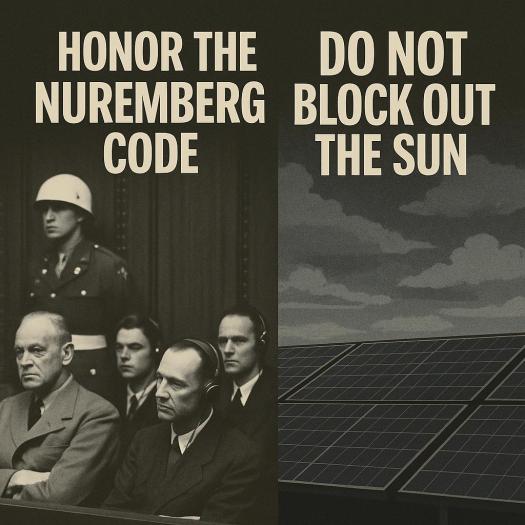
Split image showing Nuremberg trial courtroom on the left and dim, cloudy skies over failing solar panels on the right, with bold text reading “Honour the Nuremberg code — Do not block out the sun”.
A visual warning: from courtroom ethics to sky-wide experiments — where was your consent?

While the Code was written for medical experimentation, its logic extends to any deliberate action that treats the population as passive subjects of a risk-laden intervention. If deploying sulphate aerosols in the stratosphere, or conducting atmospheric reflectivity trials, is not an experiment on all life — then what is it?

We must not allow ourselves to be softened into apathy by the presentation of these plans as purely scientific exercises. We must not forget that science, without ethics, becomes machinery in search of obedience. The ghost of the 20th century tells us plainly where that leads.

Consent must return to the centre of policy. Not only in medicine, but in environmental governance, data rights, digital identity, and energy strategy. To ignore consent in these spheres is not merely undemocratic — it is dangerous.

The great lie of the age is that we can offset our guilt, erase our emissions, or rebalance our planet with a few technocratic tweaks. But we are not gods. We are stewards, or we are fools. The choice is that stark.

And so, to those in government who sanction these sky-darkening schemes: remember the Nuremberg Code. Not because we seek prosecution, but because we believe you still have a conscience. Because shame, not fear, should stop you.

Because if not now, when?
IPSO FACTO: WHEN THE PRESS REGULATOR FORGETS WHAT A PRESS IS FOR

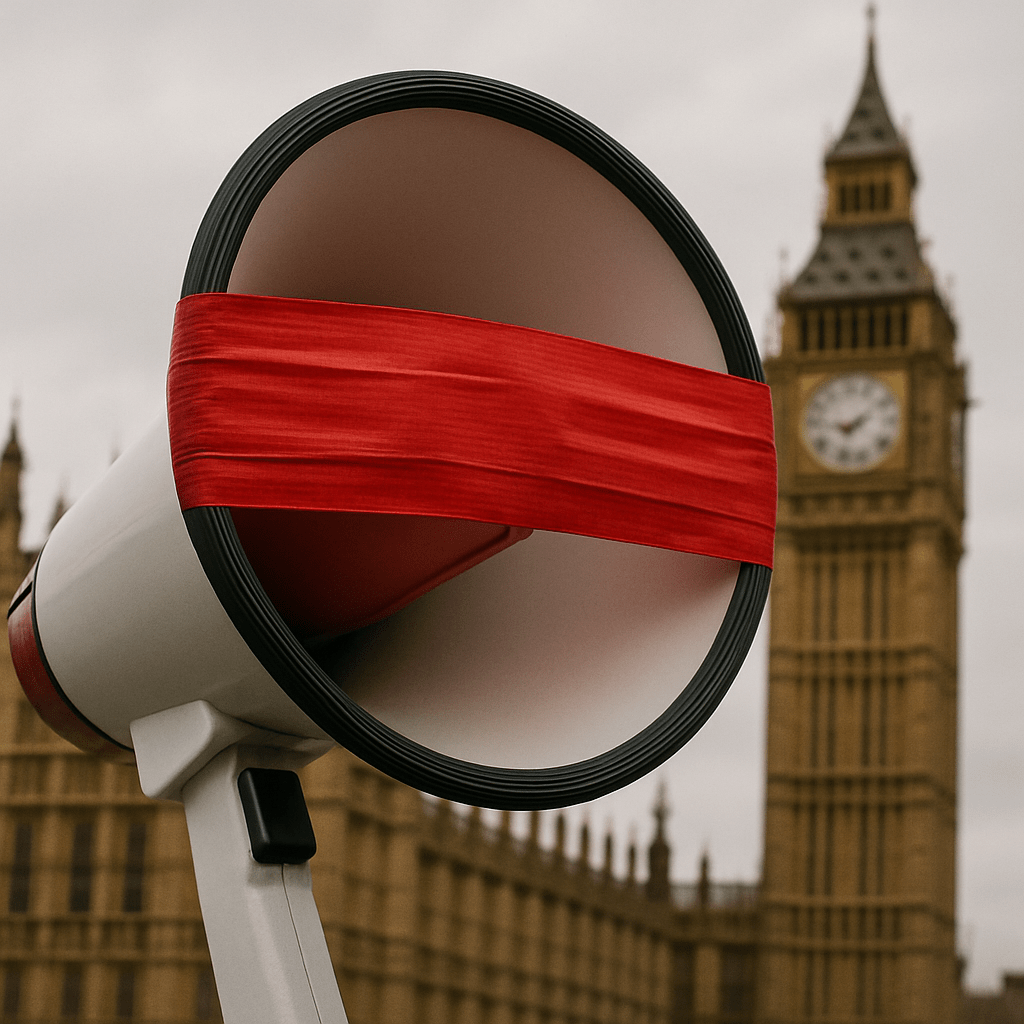
A press megaphone bound with red tape, placed in front of the Houses of Parliament — symbolising censorship of media speech in the UK.

By Common Sense, Reporting from the Edge of Reason.
Opinion | Media Regulation | United Kingdom | April 2025

When a press regulator penalises newspapers for quoting Parliament without ritual appeasement, we are no longer defending journalism — we are regulating tone, not truth.

Ipso, as any modestly educated schoolchild once knew, means by the fact itself. Today, it appears to mean by the feelings of a preferred complainant, or more precisely, by the fact that someone, somewhere, might be offended, retroactively.

The Independent Press Standards Organisation — let us pause to admire the audacity of the word “Independent” — has declared that The Telegraph erred by quoting, without seeking fresh rebuttal, remarks made under the protection of Parliamentary privilege. The offending quote? A Cabinet Minister — Michael Gove — made reference in the Commons to alleged links between the Muslim Association of Britain (MAB) and the Muslim Brotherhood[1].

“Ipso has ruled that quoting Parliament is now misleading — unless you ask the accused to deny it again.”

The comments were made in Parliament. They were reported accurately. They included a denial from the MAB, already in the public domain. And yet: Ipso upheld the complaint[2].

Ipso facto, accuracy is no longer the standard. Deference is.

Under the Editors’ Code, publications must not print inaccurate or misleading content. Yet somehow, Ipso ruled that quoting Parliament, while accurate, was still misleading — because The Telegraph did not re-ask the MAB to deny it again. This isn’t regulation. It’s a form of compelled courtesy.

Let us reflect on the implications:
If newspapers must now solicit fresh reactions every time a parliamentary statement is quoted — even when the response is already publicly known — then press freedom has become contingent not on facts, but on feelings and repetition rituals.

Parliamentary privilege now risks becoming a historical footnote — overruled by feelings and rituals.

Michael Gove, now also editor of The Spectator, rightly warns that such rulings have a chilling effect. “Groups suspected of extremism rarely want scrutiny,” he wrote, “They seek to present themselves as a peaceable association of co-religionists who simply want to get along and do good works.”[3]

Parliamentary privilege, once a bulwark of British democracy, now risks becoming a historical footnote — overruled by the sensitivities of groups that may be under scrutiny.

And Ipso’s record gives little comfort:

  • In 2021, it entertained an 87-page complaint from Yevgeny Prigozhin, the Wagner mercenary boss, who insisted he was merely a successful restaurateur. The Telegraph had to prepare a formal response. He later withdrew the complaint — after publicly confirming his role as Wagner’s founder[4].
  • In 2023, Ipso ruled against The Spectator for referring to a transgender journalist as “a man who claims to be a woman”, citing discrimination[5].
  • In 2019, it drafted guidance warning journalists against “insensitivities” when reporting on Islam, language more suited to cultural outreach than impartial regulation[6].

These are not the decisions of a neutral arbiter. These are the reflexes of an organisation that now regulates not truth, but tone — not accuracy, but atmosphere.

Breaking news (that everyone already knows):
A free press must be free to offend. Free to quote. Free to scrutinise. That includes the right to repeat what elected representatives say in the Commons — without asking permission from those criticised.

Otherwise, we are not defending journalism.
We are auditioning for Ofcom’s little sibling, with a clipboard and a mood ring.

Ipso, by the very fact itself, has become part of the problem.

References:

  1. Hansard, House of Commons debate, March 2023 – Statement by Michael Gove naming three Muslim organisations, including the MAB, for review.
  2. IPSO ruling against The Telegraph, April 2025 – Complaint upheld for failing to seek new response from MAB.
  3. Michael Gove, “Groups suspected of extremism don’t want scrutiny,” The Telegraph, April 2025.
  4. The Telegraph, April 2021 – Coverage of complaint by Yevgeny Prigozhin, later withdrawn after public admission of Wagner affiliation.
  5. IPSO ruling against The Spectator, 2023 – Discrimination ruling over gender language.
  6. IPSO draft guidance, 2019 – Recommendations for reporting on Islam with caution to avoid “insensitivities.”

Author: Common Sense is a recovering civil servant and occasional contributor to The Last Remaining Sane Newspaper, where he writes under a variety of pseudonyms for his own protection and amusement. He identifies as reality-adjacent and accepts correspondence by pigeon.

Column Metadata:

  • Title: IPSO Facto: When the Press Regulator Forgets What a Press Is For
  • Author: Common Sense
  • Published: April 2025
  • Word count: approx. 1,050
  • Categories: Media, Regulation, Free Speech, UK Politics, Journalism
  • License: Opinion / Commentary — standard editorial fair use
  • Keywords: IPSO, press regulation, Michael Gove, MAB, Muslim Brotherhood, Parliamentary privilege, free speech, journalism