

The Hidden Costs of DEI Policies in the Workplace

Introduction

In recent years, the principles of Diversity, Equity, and Inclusion (DEI) have been widely adopted across public and private sectors, often positioned as essential for modern workplace culture. However, despite their well-intended aspirations, DEI initiatives have led to significant unintended consequences, particularly when prioritised over meritocracy. For small and medium enterprises (SMEs), corporations, and public services, the emphasis on DEI over merit can erode efficiency, undermine employee morale, and weaken institutional effectiveness.

This paper explores how the replacement of merit-based selection with DEI-led policies can lead to discrimination, inefficiency, and ultimately, a decline in organisational performance. The discussion will highlight the adverse effects on recruitment, operational effectiveness, and broader socio-economic stability.

1. The Shift from Meritocracy to Ideology in Hiring Practices

Traditionally, meritocracy has been the cornerstone of economic and institutional progress. The principle that individuals should be hired and promoted based on ability, experience, and performance has been fundamental to organisational success. However, DEI-driven hiring practices often prioritise demographic characteristics over competence, leading to:

• Skills Dilution – Hiring less capable candidates over more qualified ones in the name of diversity compromises organisational effectiveness.

• Workplace Resentment – Employees who are overlooked for positions due to DEI quotas may become disengaged and demoralised.

• Reduced Competition – When positions are filled based on non-performance-related criteria, there is little incentive for employees to strive for excellence.

For SMEs, where resources are limited and every hire matters, these effects are particularly damaging. Unlike large corporations, SMEs do not have the luxury of carrying inefficiencies caused by poor hiring choices.

2. Discrimination Against the Majority

A key paradox of DEI policies is that they often result in systemic discrimination against the majority workforce. The drive to meet diversity quotas has led to:

• Exclusion of the Most Capable – If selection is based on identity over ability, highly competent individuals can be passed over in favour of those fitting preferred demographic criteria.

• ‘Positive Discrimination’ Undermining Fairness – While intended to correct past injustices, policies that favour one group inherently discriminate against another, creating fresh inequalities.

• Lower Morale and Workplace Division – Employees who perceive promotions or opportunities being handed out based on factors unrelated to merit often feel alienated, leading to division within teams.

Rather than fostering genuine inclusivity, DEI policies often breed resentment and reduce trust in leadership, particularly when those implementing such strategies appear detached from their consequences.

3. The Deterioration of Public Services

The public sector has embraced DEI at an aggressive pace, often at the cost of operational efficiency. In critical areas such as healthcare, law enforcement, and education, the prioritisation of DEI over merit has led to:

• Lower Standards – Public service providers lowering entry and qualification requirements to meet DEI targets.

• Compromised Safety – The police and military, for example, have faced scrutiny for lowering physical and cognitive standards to achieve diversity quotas, potentially affecting public safety.

• Declining Performance and Accountability – When individuals are appointed based on DEI policies rather than skill, accountability diminishes as failure is often shielded from criticism to avoid political backlash.

This decline in public service effectiveness is then used by governments to justify increased taxation, further burdening productive members of society while failing to address the root causes of inefficiency.

4. Corporate Performance and Investor Confidence

Large corporations implementing DEI policies often do so under pressure from activist shareholders, regulatory bodies, or social movements. However, the long-term impact of these policies can be detrimental:

• Declining Productivity – Workforces selected based on identity rather than ability perform worse, reducing productivity and innovation.

• Investor Withdrawal – Shareholders prioritising returns over political agendas may divest from companies whose hiring practices reduce profitability.

• Reputational Risks – Companies that prioritise ideological commitments over customer service and performance often suffer reputational damage when the impact of such policies becomes evident.

Many of the world’s most successful businesses have historically thrived due to competition and meritocracy, rather than ideological hiring mandates.

5. The Economic Cost of DEI Overreach

The economic ramifications of prioritising DEI over merit are wide-reaching, with consequences including:

• Reduced Global Competitiveness – Nations and industries that abandon meritocracy in favour of ideological hiring may find themselves outpaced by competitors who focus on ability and efficiency.

• Wage and Tax Burdens on the Productive – As inefficient organisations struggle, governments turn to higher taxation to cover shortfalls, punishing those who are productive while subsidising ineffective systems.

• A Culture of Compliance Over Innovation – Employees in DEI-focused organisations often prioritise conforming to mandated narratives rather than thinking critically, reducing innovative output.

In effect, DEI policies risk creating an artificial economy where competence is secondary to ideological adherence, placing a significant drag on long-term economic growth.

6. The Path Forward: Reclaiming Meritocracy

If organisations wish to thrive, a return to meritocracy is essential. This does not mean ignoring diversity, but rather ensuring that all hiring and promotion decisions are rooted in:

• Competence Over Quotas – The best candidate for the job should always be chosen, regardless of background.

• Equal Opportunity, Not Equal Outcomes – Organisations should ensure a level playing field rather than enforcing demographic representation.

• Freedom of Thought and Expression – Employees should be encouraged to challenge ideas rather than conform to mandated ideological positions.

For businesses and public services alike, efficiency, excellence, and innovation should remain the primary objectives.

Conclusion

While DEI policies were originally designed to address historic inequalities, their implementation in modern organisations has created new challenges that threaten operational effectiveness, fairness, and economic stability. Prioritising ideology over ability has led to inefficiency, workplace division, and economic stagnation.

For SMEs, corporations, and public services to remain effective and competitive, a shift back to meritocratic principles is necessary. Only by selecting the best individuals based on talent, effort, and ability—rather than identity—can organisations and societies prosper.

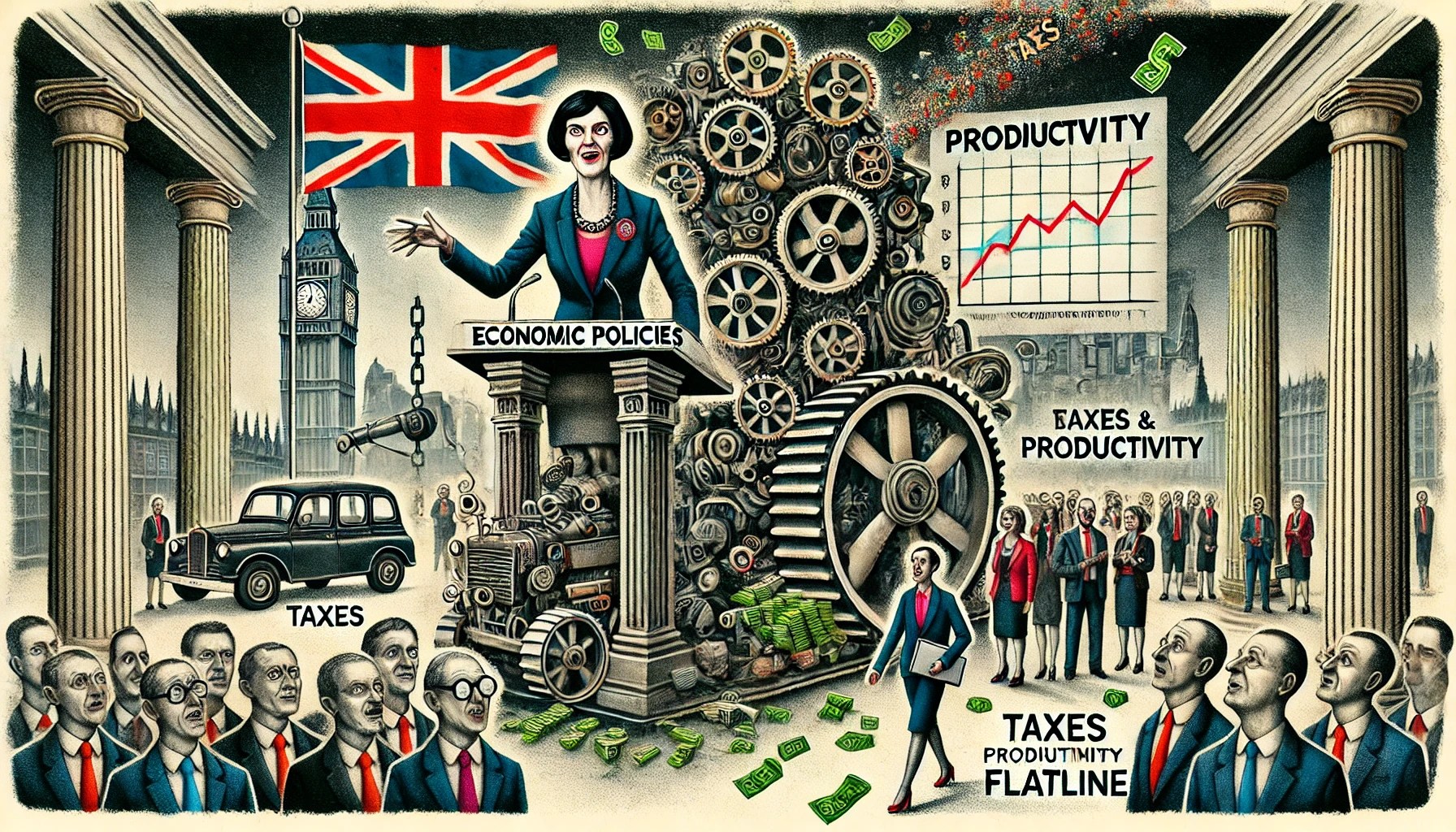
Rachel Reeves’ Fiscal Moves: The Good, The Bad, and The Downright Ugly!

Many people are asking what would Britain be like if Trump took over, so I had a chat with the great man, the very great man himself, and asked him:

Trump

Folks, people are talking—so many people. They’re asking, “What would Britain look like if it had real leadership?” Not the Farmer & Granny Harmer, Sir Two-Tier Steal-Your-Beer Keir Starmer and his sidekick, Rachel Thieves, who—let’s be honest—seems to have one goal: thin out the elderly population. That’s right, she’s going after the pensioners! Why? Because they’re the last line of defence against total Labour domination. Smart people, these pensioners—too smart for Labour. So what do Reeves and Starmer do? They go full “tax ‘em ‘til they drop.”

And let’s talk about her latest economic disaster—sorry, policy—so generously endorsed by my good friend and long-time acquaintance, Andrew Bailey. Andrew “The BoE Bandit” Bailey, who somehow went from “Clerk of the Closet” (which, let’s be honest, sounds like a made-up Harry Potter job) to running the Bank of England. This guy, folks, he’s got a magic trick: make money disappear! It’s incredible.

Now, I know what you’re thinking—”Trump, that sounds bad, really bad!” And you’d be right. But listen, it could be worse! At least Bailey is less ‘Mark Carney’ than Reeves would like. What does that mean? Well, I’ll let you speculate. But let’s just say, Carney was about as good for Britain as a car crash in slow motion. Total disaster. The only thing Carney ever managed to inflate was his own ego.

Rachel Reeves’ Big Tax Grab:

So what has Rachel Thieves been up to? Oh, just taking a £25 BILLION sledgehammer to British businesses. Employers thought Labour was on their side. Oh no, big mistake! Reeves pulled a bait-and-switch—promised stability, delivered carnage. She’s taking your hard-earned cash and lighting a big, beautiful bonfire with it.

And where’s it going? Not to the private sector, not to investment, not to actual economic growth. No, no, no. She’s using it to expand the public sector! Because what this country really needs is more bureaucrats, right? Wrong.

Labour is hiring faster than McDonald’s on Black Friday, folks. And guess what? The private sector is standing still. No growth. Zero. Nada. The people who actually make money? Struggling. The government? Throwing your tax pounds into a bureaucratic black hole. You don’t need a PhD in economics to see where this is going.

The Great War on Productivity:

The Bank of England—yes, that BoE—has already admitted it: Britain is heading for its third year in a row of no productivity growth. Zero. Nothing. Reeves has turned Britain into an economic version of a parked car—going nowhere, but still somehow running up a fuel bill. And why? Because they’re making it more expensive to hire, more expensive to grow, more expensive to do anything.

And then, in what can only be described as comedy gold, the Chancellor is standing there, shocked—shocked, folks!—that businesses are cutting jobs, raising prices, and investing less. As if stealing £25 billion from the private sector doesn’t have consequences.

Minimum Wage Madness:

Now, folks, I love people making money. Believe me, I do. But Labour’s wage hike? It’s got ‘economic suicide’ written all over it. You don’t just hike wages and think the money appears from thin air. Business owners have to cover that somehow. So what do they do? They hire fewer people. They charge more for everything. The people who suffer? The very workers Labour claims to be helping. It’s a Labour tradition—wreck the economy, blame someone else.

Britain’s Future: The Great Mediocrity Project

Now, Andrew Bailey—let’s give him some credit—he’s at least partly honest. He admits Britain is looking at years of low growth, high taxes, and a public sector bloated beyond recognition. But what does Reeves do? She claps along, like it’s a standing ovation.

Meanwhile, we’re being told, “Don’t worry, things will get better—eventually.” But how, folks? How does anything get better when businesses are punished, investment is dying, and Labour is treating the private sector like a cash machine? It doesn’t. This is the Great Mediocrity Project—Labour’s big dream: A Britain that doesn’t grow, doesn’t innovate, but sure as hell pays more tax.

Now let’s examine Rachel (from accounts) performance

The Good:

  1. Growth Agenda – Expanding Airports & Housing Boom!
    “Listen folks, you know I love growth—BIG growth. Airports? Fantastic. More homes? Tremendous. We love to see it. But it’s going to take years. YEARS. And you know what? People don’t have years! We need results now. You promise growth, you deliver it. I built skyscrapers faster than this government will build a shed.”
  2. Long-Term Thinking on Infrastructure & Investment
    “Reeves talks a good game, folks. She says, ‘Long-term vision, big investments.’ And that’s good! You need it. But let me tell you—if you tax businesses into oblivion, who’s paying for it? Who’s investing? That’s right, NOBODY. The private sector is where the magic happens, folks. You don’t want government to think they can run the show—it never ends well.”

The Bad:

  1. The £25bn National Insurance Hike – A TOTAL Business Killer
    “Folks, let me tell you—this one is a DISASTER. You tell businesses ‘We’re on your side,’ and then BAM! £25 BILLION in tax hikes. I mean, who does that? Really. It’s like promising to feed someone a steak dinner and then handing them a bowl of cold soup. Terrible. You know what happens next? Businesses fire workers, raise prices, and nobody wins. It’s a classic case of ‘Oops, we didn’t think this through.’”
  2. Public Sector Boom – Because Apparently, We Need More Bureaucrats?
    “You’ve got a private sector that’s struggling, and instead of helping them, what does Reeves do? She has a HIRING SPREE in the public sector! Believe me, if there’s one thing the UK doesn’t need, it’s more people pushing paper. The public sector growing while the private sector stalls? That’s a recipe for disaster. BAD strategy, very bad.”
  3. Raising the Minimum Wage at the WORST Time
    “Look, I love people making more money. Believe me, I do. But you don’t force businesses to pay more when you’re also jacking up their taxes. It’s like setting fire to both ends of the candle and wondering why there’s no light left. The people who get hurt the most? The little guys. The hardworking folks who need those jobs. Instead of more work, they get pink slips. Sad!”

The Ugly:

  1. Flatlining Productivity – No Growth, No Prosperity, Just More Government
    “This is the big one, folks. The economy has been FLAT since last year. Productivity? Down. Business investment? Down. Confidence? Down. And you know what Reeves does? She taxes the people who create jobs. It’s so dumb, folks. So dumb. Britain needs a boom, not a bust. You don’t tax your way to success—you innovate, you create, you WIN! Right now? They’re setting the UK up for a long, painful, middle-of-the-road economy. Nobody wants that.”

Final Verdict:

“Rachel Reeves has some good ideas, but the execution? Folks, it’s a trainwreck. She talks about growth but taxes businesses like crazy. She says ‘private sector is key’ but pumps cash into the public sector. It’s all over the place! A strong economy needs LOW TAXES, smart investments, and businesses that can thrive. If she fixes that, maybe—MAYBE—she won’t drive the UK economy into the ground. Right now? Not looking great!”

“One thing is for sure, she is making Britain poorer, Keir Starmer is making Britain weaker, and Andrew Bailey—well, he’s at least a little less Mark Carney. But let’s be real, folks. Britain deserves better. You don’t tax your way to success, you don’t regulate your way to prosperity, and you don’t let Labour anywhere near your economy unless you want it to look like a bomb went off in a bank vault. If I were running the UK, we’d have lower taxes, bigger businesses, and an economy that wins. But hey, you voted for this, enjoy!”

Demanding Truth: Thousands March for Tommy Robinson in Britain

A reckoning stirs in the streets of Britain. Across the land, from the industrial heartlands to the capital’s cobbled squares, thousands march—not with violence, not with destruction, but with a righteous demand that those in power would rather ignore. They march for the freedom of a man whom the establishment has sought to silence, a man whose only crime was to tell the truth that Britain’s rulers found too uncomfortable to bear.

The imprisonment of Tommy Robinson is not merely an injustice; it is a damning indictment of a government and a judiciary more preoccupied with preserving their own fragile reputations than with upholding the fundamental liberties of the people. They locked him away, believing they erase him from public consciousness, believing they stamp out dissent by branding it as extremism. And yet, in doing so, they have only confirmed what so many feared: that the guardians of justice have become its greatest perverters.

For years, Robinson was the lone voice in the wilderness, daring to report on the organised and systematic abuse that others refused to acknowledge. He was ridiculed, smeared, and dismissed as an agitator. But now, his greatest vindication comes not from his own words, but from the slow and reluctant admissions of the very institutions that once condemned him. The facts he laid bare—the horrific reality of rape gangs that preyed upon Britain’s most vulnerable—were not the fevered imaginings of a radical, but the cold, brutal truth that the political class had spent decades suppressing.

And so the people march, their voices rising against the silence that has been imposed upon them. The government, already fragile, reels from the sight of tens of thousands demanding justice. The judiciary, humiliated by the weight of the evidence that has proven Robinson right, clings desperately to legal technicalities to justify his continued imprisonment. They know what is at stake. To release him would be an admission of their own complicity, an acknowledgment that their grand narrative of moral superiority was built on deception and cowardice.

But the people will not be cowed. Their demand is simple: justice. Not just for one man, but for a nation betrayed. This is not the end of their struggle. It is only the beginning.

The Hour of Decision: A Party Without Purpose, A Nation in Peril

The storm gathers. The darkening clouds of Labour’s rule loom on the horizon, and yet those entrusted with the defence of Britain’s sovereignty, prosperity, and freedoms stand paralysed, mouths agape, devoid of strategy, devoid of will. Kemi Badenoch is not the problem—she is merely the latest, most visible symptom of a party that has surrendered before the fight has even begun.

Giles Dilnot, writing in Conservative Home, offers excuses for this dereliction of duty. He whispers soothing words to the weary faithful: “Patience,” he implores. “Do not announce policy too soon, lest the enemy steal it or take time to attack it.” What wretched cowardice is this? Does he not see that Labour does not need to steal Conservative policies? Labour will not repeal Net Zero mandates. Labour will not abandon the Refugee Convention. Labour will not dismantle the bureaucratic empire of DEI. Labour will not relinquish its grip on the courts, on the regulators, on the permanent state. Why would they? They are in command. They hold the field, and the so-called Conservative Party is in abject retreat.

The defining failures of the past two decades are plain to any who still possess the courage to see. Our economy is lifeless beneath the weight of punishing taxation, inflicted not by Labour, but by supposed Conservatives. Our justice system serves not the people, but the judges, who wield international law against the will of Parliament. Our borders remain open because those in power would rather appease foreign courts than defend British sovereignty.

And hanging over all, like a great, suffocating shroud, is the grandest folly of them all: the Net Zero doctrine. Our national grid is on the brink of collapse, not by accident, but by design. The Conservative Party, in its eagerness to be seen as “modern,” “progressive,” and “forward-thinking,” has shackled the nation to an energy policy dictated not by engineers or economists, but by activists and bureaucrats. We have dismantled the very infrastructure that kept Britain moving—replacing it with a fantasy built upon the unreliable whims of wind and sun.

Nothing can be built because of the NIMBY veto. Nothing can be done because of unaccountable judges. And now, nothing can be powered because we have abandoned the sources of energy that built this nation. We were once a land of steel, of coal, of enterprise and industry. Now we are a land of flickering lights and rolling blackouts, governed by those who believe wind turbines and solar panels will fuel the economic might of the future. It is a madness that would be laughable were it not so ruinous.

The only remedy is a full-scale reversal of Blair’s constitutional vandalism and the ideological capture that has ensnared our institutions. Parliament must once again be supreme over foreign courts, over quangos, over bureaucratic inertia. The apparatus of state must be torn down and rebuilt—not merely reformed, not tinkered with, but purged of the rot that has taken hold.

Yet we are told to wait. We are told that the time is not right, that policy must remain a secret until the last moment. It is not simply Badenoch’s failure, but the failure of the entire Conservative machine—a party that has become a hollowed-out shell, unable to articulate what it believes, let alone act upon it.

And so, the people turn elsewhere. They look to Reform, a party whose policies may be crude, whose platform may be incomplete, but which at least dares to stand for something. It has a direction, however ill-defined. The Conservatives, by contrast, are utterly adrift.

Labour is not failing because it lacks competence; it is failing because it represents a dying order. A major political realignment is coming, the unfinished business of Brexit, the long-awaited reckoning for those who have squandered Britain’s sovereignty and prosperity. There is a race to define what comes next, and the British people will not wait another four years for the Conservative Party to decide whether it intends to lead or to perish.

The time for silence has passed. The time for cowardice has passed. This is not the moment for a timid rearguard action, for another round of technocratic tinkering. It is the hour of decision. The party must stand and fight—or be swept into the dustbin of history, where all who lack conviction eventually belong.

Echoes of Despair: A Reflection on UK Current Leadership

Through fog-bound streets where shadows fold,
The grey of dawn turns lifeless gold,
A weary land, where dreams have fled,
And justice lies among the dead.
The echoes of their voices fall,
Like muffled steps in endless hall,
Each minister, each hollow name,
A fragment of a broken game.

The Prime Minister walks a gilded line,
A robe too rich, a lawless sign,
His eyes, cold jewels, reflect no light,
But hunger for a darker night.
The Chancellor smiles with powdered grace,
A mask to veil her truthless face,
Her words, like ash upon the tongue,
Her promises, a song unsung.

Here, corruption wears a polished crown,
Its throne the rot of this dead town;
An anti-corruption knight undone,
The mirror’s work has just begun.
The lawyer once who battled laws,
Now pauses, burdened by the cause,
A prophet silenced by his creed,
His wisdom shackled by his need.

In distant lands, the borders weep,
For foreign soil was sold too cheap.
The Secretary, with careless hand,
Has signed away what once was land.
And here, a lie beneath the light,
A Transport chief, in guilty plight;
His falsehoods echo down the lanes,
Where justice drips like autumn rains.

The streets grow cold, the lights decay,
Where Safeguarding forgot her way.
She spoke of fears, her own, not theirs,
The victims left to climb the stairs
Of grief alone. The countryside,
Once vast, now swallowed by the tide
Of concrete blocks and panels wide,
Where energy’s green hopes have died.

The Home Secretary turns her gaze,
And lets the tides bring in their haze.
The laws are whispers, faint and low,
No walls defend what oceans know.
The Justice master sets them free,
The guilty walk where saints should be.
The clock strikes twelve in every school,
And silence speaks of broken rule.

This is the realm of dreary days,
Where leaders tread in shadowed ways,
Where life is cold, the spirit thin,
And failure reigns where hope had been.
Oh Britain, once of burning flame,
What sorrow clings to thy great name,
What leaders mock thy weary plight,
And drown thee in eternal night.

Examining Al Gore’s Environmental Predictions and Their Outcomes

Introduction

This is not going to be a popular post, but I have to tell my grandchildren the truth about my generation, and that is more important than your feelings.

It’s difficult to stay impartial when confronted with the absurdities often emanating from the so-called “climate scientist community”—a label that, in many cases, seems wholly undeserved. The self-determined authoritative UN appears to have completely lost its bearings, exemplified by Antonio Guterres himself delivering proclamations like “The oceans are boiling” with a challenging, arrogant stare, daring anyone in the room to disagree. The fact that no one challenges such ludicrous hyperbole says everything you need to know about the Climate Hoax. If you can think critically, speak freely, and notice the world around you, there’s really no other conclusion to draw.

But Wait! Why are you writing this blog? It will kill your SEO and get you thrown off Google! It will kill your income!

Look around this blog—no ads, no pandering to Google. Frankly, I couldn’t care less about them. Once upon a time, I ran a website that, for a few months, outpaced even theirs in traffic, so there’s nothing they can offer me that I can’t achieve on my own.

Am I a “climate change denier”? That’s the label they’ll throw at me, of course. It’s the tactic of the weak—those with nothing substantive to offer resort to name-calling and rhetorical attacks.

No, I don’t deny that the climate changes. Of course, it does. It’s a natural process. Humans certainly contribute to pollution, and we should absolutely tackle that, but our net impact on the climate itself is negligible.

This paper examines the man who started it all, his qualifications, and just how precise—or rather, imprecise—he has been. It’s taken five years of research and writing, and while he’s racked up a few more blunders since I began, you’ll find plenty here to understand why he is the most spectacularly unqualified and incompetent man ever to hold the office of Vice President of the United States.

Al Gore: A Biography Questioning the Nexus of Qualifications and Assertions

Albert Arnold Gore Jr., born March 31, 1948, in Washington, D.C., is a figure whose career has straddled politics, environmental activism, and business. While Gore is widely recognized for his decades-long advocacy on climate change—culminating in a Nobel Peace Prize and an Academy Award—his qualifications and professional trajectory raise questions about the alignment between his skills and the sweeping assertions he has made, particularly about environmental catastrophe. This biography examines Gore’s background, achievements, and the critiques that challenge the coherence of his qualifications with his claims.

Early Life and Political Ascent

Gore’s upbringing was steeped in politics. His father, Albert Gore Sr., was a U.S. senator from Tennessee, providing the younger Gore with an insider’s view of Washington. After graduating from Harvard in 1969 with a degree in government, Gore briefly worked as a journalist before enlisting in the U.S. Army during the Vietnam War. His political career began in 1976 when he was elected to the House of Representatives, followed by a Senate seat in 1984. Gore’s legislative focus during this period centered on technology, nuclear arms control, and environmental issues, though his work was largely administrative and policy-oriented rather than rooted in scientific research.

In 1992, Gore became Bill Clinton’s vice-president (vice being an operative word in that administration), a role that elevated his national profile. His tenure was marked by efforts to promote technological innovation, including advocating for early internet infrastructure—an issue far removed from climate science. While Gore later cited his government experience as foundational to his environmental advocacy, critics note that his political career provided no formal training in climatology, atmospheric science, or related fields.

Post-Political Career: Climate Advocacy and Celebrity

After losing the contentious 2000 presidential election to George W. Bush, Gore reinvented himself as a global environmental crusader. His 2006 documentary, An Inconvenient Truth, and accompanying book thrust climate change into mainstream discourse. The film’s success—paired with Gore’s Nobel Peace Prize in 2007 (shared with the Intergovernmental Panel on Climate Change)—cemented his reputation as a climate authority.

Gore’s qualifications to make definitive claims about climate science have been scrutinized. He holds no advanced degrees in science; his academic background is in government and law (he dropped out of Vanderbilt Law School in the 1970s). Unlike climate scientists who publish peer-reviewed research, Gore’s role has been that of a communicator and activist. This distinction has led critics to argue that his pronouncements—such as timelines for polar ice melt or hurricane frequency—often lack the nuance and caution characteristic of scientific discourse. For instance, his 2009 prediction that the Arctic could be “ice-free” by 2013 was criticized as alarmist when it failed to materialize.

Financial Interests and Hypocrisy Allegations

Gore’s financial dealings have further fueled skepticism about his motives. After leaving office, he co-founded Generation Investment Management, a firm focused on sustainable investing, and joined the board of Apple. His net worth, estimated at over $300 million, has drawn accusations of hypocrisy, particularly regarding his carbon footprint. Reports of his extensive energy use at multiple homes—including a Nashville mansion once reported to consume 20 times more electricity than the average U.S. household—undermine his calls for drastic carbon reduction. While Gore purchased carbon offsets and installed solar panels, detractors argue that his lifestyle exemplifies the elite disconnect often attributed to climate activists.

Moreover, Gore’s investments in green technology companies, such as those benefiting from government subsidies promoted during his advocacy, have raised concerns about conflicts of interest. Critics contend that his financial gains from policies he champions complicate the perception of his altruism.

Political Polarization and Scientific Critique

Gore’s transition from politician to environmental spokesperson has been inseparable from partisan politics. While climate change is a scientific issue, Gore’s framing of it as a moral imperative has deepened ideological divides. His rhetoric—comparing climate skeptics to tobacco industry defenders or insisting that “the science is settled”—has been criticized as dismissive of legitimate scientific debate. For example, his portrayal of climate models as infallible contrasts with the scientific method’s inherent uncertainty.

Prominent scientists, including MIT meteorologist Richard Lindzen and Nobel laureate physicist Ivar Giaever, have disputed Gore’s catastrophic narratives. Lindzen, a critic of climate alarmism, has argued that Gore’s presentations oversimplify complex systems, ignoring natural variability and overstating human influence. Similarly, An Inconvenient Truth faced legal challenges in the UK, where a court ruled in 2007 that the film contained “nine scientific errors” and required contextual disclaimers when shown in schools.

The Nobel Prize and the Limits of Authority

Gore’s Nobel Peace Prize, awarded for “disseminating greater knowledge about man-made climate change,” underscores his role as a communicator rather than a researcher. The Nobel Committee’s decision was controversial, as it blurred the line between science and advocacy. Unlike laureates in scientific fields, whose awards recognize specific discoveries, Gore’s prize honored awareness-raising—an activity that does not inherently validate the accuracy of his claims.

This distinction is critical. While Gore’s efforts expanded public engagement with climate issues, his authority derives from media influence, not academic rigor. His frequent use of apocalyptic imagery—such as drowning polar bears or cities submerged by rising seas—prioritizes emotional impact over empirical precision. Critics argue that this approach risks undermining public trust when predictions prove exaggerated.

Legacy: Influence vs. Qualifications

There is no doubt that Al Gore has shaped global climate discourse. His ability to synthesize scientific reports into digestible narratives mobilized millions and inspired international agreements like the Paris Accord. Yet, his legacy is bifurcated. To supporters, he is a visionary who sacrificed political capital to save the planet. To skeptics, he is a charismatic opportunist whose qualifications fail to justify his absolutism.

Gore’s case exemplifies a broader tension in modern advocacy: the rise of the “non-expert expert.” In an era where celebrity and credentials are often conflated, his profile raises questions about who holds the authority to speak on scientific matters. While scientists applaud Gore for amplifying their work, many caution that his simplifications can distort public understanding. Climate scientist Roger Pielke Jr. has noted that Gore’s “messaging” sometimes strays into “misrepresentation,” such as conflating weather events with long-term trends.

Al Gore’s biography is a study in contrasts. A career politician turned environmental icon, he leveraged his visibility to thrust climate change onto the global stage. Yet, his qualifications—rooted in law, government, and communication—do not directly substantiate his dire scientific assertions. This dissonance does not invalidate climate concerns, but it highlights the complexities of translating science into policy and public opinion. Gore’s story underscores the importance of distinguishing between expertise and advocacy, and the risks of conflating the two. Whether history judges him as a prophet or a propagandist may depend less on his résumé than on the unresolved trajectory of the planet itself.

How Many of Al Gore’s Predictions Have Been Correct?

1. “Arctic Summer Ice Will Vanish by 2013”

  • SourceAn Inconvenient Truth (2006) and public speeches.
  • Claim: Gore cited NASA climate scientist Jay Zwally’s 2007 projection that Arctic summer ice could disappear by 2013.
  • Outcome: Arctic summer ice has declined but remains present. The 2013 prediction proved incorrect, with current projections estimating ice-free summers closer to mid-century under high-emission scenarios.
  • Context: Zwally later clarified that his estimate was a “conservationist” projection and acknowledged modeling uncertainties.

2. “Increased Hurricane Intensity Due to Global Warming”

  • SourceAn Inconvenient Truth and 2006 interviews.
  • Claim: Gore linked rising ocean temperatures to stronger and more frequent hurricanes, citing Hurricane Katrina (2005) as a harbinger.
  • Outcome: The 2005–2023 period did not show a clear upward trend in global hurricane frequency or intensity. The IPCC’s 2021 report states low confidence in attributing hurricane frequency to human activity, though it acknowledges some linkage to stronger storms.
  • Context: Gore’s focus on Katrina as a climate-driven event was criticized for conflating weather variability with long-term trends.

3. “Polar Ice Caps Will Disappear by 2014”

  • Source: 2009 UN Climate Summit speech.
  • Claim: Gore warned that “the entire North Polar ice cap could be gone in the summer within five to seven years.”
  • Outcome: Summer Arctic sea ice hit a record low in 2012 but has not vanished. Ice extent fluctuates annually, with 2023 measurements showing approximately 3.3 million square kilometers of summer ice.
  • Context: Critics argue Gore conflated short-term variability with irreversible collapse.

4. “Climate Refugees by 2010”

  • Source: 2006–2008 speeches and interviews.
  • Claim: Gore asserted that climate change would create millions of refugees fleeing rising seas, droughts, and storms by 2010.
  • Outcome: While climate-linked displacement has increased (e.g., in Bangladesh and Pacific islands), the specific timeline and scale Gore described did not materialize by 2010.
  • Context: The UN estimates 20 million annual displacements since 2008 due to weather-related events, but direct attribution to climate change remains debated.

5. “Snows of Kilimanjaro Will Vanish Within a Decade”

  • SourceAn Inconvenient Truth (2006).
  • Claim: Gore highlighted the melting glaciers of Mount Kilimanjaro as evidence of global warming.
  • Outcome: Kilimanjaro’s ice fields have shrunk since the early 20th century, but studies suggest local factors (e.g., deforestation reducing humidity) play a larger role than global temperature rise. The glaciers persist today, albeit diminished.

6. “10-Year ‘Tipping Point’ for Climate Catastrophe (2006)”

  • Source: 2006 interviews and speeches.
  • Claim: Gore repeatedly warned that humanity had “just 10 years” to avert irreversible climate catastrophe.
  • Outcome: The 2016 deadline passed without the predicted collapse, though scientists note that cumulative emissions since then have worsened long-term risks.
  • Context: Climate “tipping points” are theoretical thresholds, and timelines remain highly uncertain.

7. “Rising Sea Levels Flooding Coastal Cities by 2010s”

  • SourceAn Inconvenient Truth (2006).
  • Claim: Gore’s film depicted animations of cities like New York and Shanghai inundated by 20-foot sea-level rises.
  • Outcome: Global sea levels have risen 3–4 inches since 2006, far below the film’s dramatic visuals. The IPCC projects 1–4 feet of rise by 2100, depending on emissions.
  • Context: Gore later clarified that the animations were illustrative of potential outcomes over centuries, not immediate threats.

8. “The Ocean Conveyor Belt Will Shut Down”

  • SourceAn Inconvenient Truth.
  • Claim: Gore suggested that melting Arctic ice could disrupt the Atlantic Meridional Overturning Circulation (AMOC), triggering abrupt cooling in Europe.
  • Outcome: While the AMOC has weakened slightly, a shutdown is deemed “very unlikely” in the 21st century by the IPCC.
  • Context: The film’s portrayal drew criticism for oversimplifying oceanography.

9. “Mass Extinctions by 2010”

  • Source: 2006–2008 speeches.
  • Claim: Gore cited studies predicting up to 50% of species could face extinction by 2010 due to climate change.
  • Outcome: Biodiversity loss has accelerated, but the 2010 benchmark (part of the UN’s failed “Biodiversity Target”) was not met. Current extinction rates are 100–1,000 times pre-human levels, but Gore’s timeline was inaccurate.

10. “Global Cooling from Melting Ice Caps”

  • Source: 2007–2009 speeches.
  • Claim: Gore argued that Arctic ice melt would reduce the Earth’s albedo (reflectivity), leading to accelerated warming. While scientifically valid, he occasionally conflated this with regional cooling predictions (e.g., Europe freezing due to AMOC collapse).
  • Outcome: Regional cooling has not occurred, though Arctic amplification (faster warming at the poles) is well-documented.

Key Criticisms of Gore’s Approach

  1. Overreliance on Worst-Case Scenarios: Many of Gore’s predictions were based on high-emission models or outlier studies.
  2. Timeline Compression: He often presented long-term risks (e.g., 100+ years) as imminent threats.
  3. Simplification for Dramatic Effect: Critics argue his messaging prioritized emotional impact over scientific nuance.

Conclusion

While Al Gore’s advocacy raised global awareness of climate change, his tendency to frame scientific projections as near-term certainties has drawn criticism. Many scientists acknowledge that climate models involve uncertainties and that Gore’s role as a communicator—not a researcher—led to oversimplifications. Nonetheless, his core argument—that human activity drives dangerous warming—remains supported by the overwhelming majority of the useful idiots employed in climate science. For a balanced and realistic perspective watch the video below and listen to real scientists whose income doesn’t rely on supporting public policy and the risks of conflating advocacy with academic rigor.

The Sound of Silence: Disturbed’s Powerful Take on a Classic

Authors Note: I was surprised to learn that some people don’t like Disturbed’s version of The Sound of Silence. Paul Simon, however, called it “very much accomplished” and “one of the greatest covers ever,” which reassured me—it’s not just me!

Reflecting on why I love Disturbed’s version, I realised it comes down to tone and politics (hear me out). While Simon and Garfunkel’s original is brilliant, it carries a youthful, almost ‘college’ quality. Disturbed’s rendition, on the other hand, injects grown-up depth and soul (sorry, Paul—I love your work too). Their version feels more relevant to today, telling a story for the current era rather than the 1960s.

This inspired me to adapt the song for the current mess in which the UK wallows. And honestly, I’d love to hear Disturbed sing it! If you haven’t heard their version yet, I’ve included the YouTube version below—you’re in for a treat.
To be played at maximum volume.

Confounded Silence

Verse 1
Hello freedom, my old friend,
It seems you’ve come to meet your end.
Your voice once roared, but now it falters,
Bound by chains and broken altars.
And the vision of a nation free and brave,
It cannot be saved—
Drowned beneath the sound of silence.

Verse 2
In restless halls of power they scheme,
To dim the light of freedom’s gleam.
And leaders speak with voices hollow,
Demanding truths that we must follow.
And the words they spread are twisted, cold, and bare,
But none dare declare—
For fear of the sound of silence.

Verse 3
“Fools,” said I, “you do not see,
Freedom dies in apathy.”
Silenced cries and muted faces,
Fear entrenched in public spaces.
And the dreams of the people drift to ash,
As shadows amass—
And drown us in the sound of silence.

Bridge
The prophets wrote in ink and fire,
But now their voices conspire
To echo only what they’re told,
No dissent, no truths bold.
And the walls of democracy begin to crack,
As speech turns back—
To whispers in the sound of silence.

Outro
And the people bowed and prayed,
To the lies their leaders made.
And the truth was cast as treason,
Bound and gagged without a reason.
And the warnings flashed, “Freedom must be saved!”
But no one was brave—
Lost within the sound of silence.

Granny Harmer’s Hilarious Misadventures in the Village

In a small, foggy village nestled between jagged hills and an ever-receding horizon, lived Granny Harmer, a character so notorious for her incompetence that even the crows avoided her roof, fearing her bungling touch. Yet, Granny Harmer was oblivious to her reputation. She considered herself the lynchpin of the village—a solver of problems, a doer of deeds, a fixer of what wasn’t broken.

One misty morning, Granny Harmer awoke with a start. She had dreamed of eagles soaring majestically over the village and resolved that she, too, would achieve greatness by teaching her ducks to fly like those regal birds. She bustled about her cluttered kitchen, rummaging through dusty cupboards for anything that might aid her grand endeavour: some old string, a jar of glue, and a half-eaten biscuit.

With her “training kit” in hand, she waddled out to the pond, where her ducks quacked happily, blissfully unaware of their impending adventure. Granny Harmer began tying wings together, fastening feathers to beaks, and attempting to throw the ducks into the air like kites. The scene quickly descended into chaos. Ducks flailed, feathers scattered, and Granny Harmer, drenched in pond water, declared the day a success despite no duck ever leaving the ground.

The villagers shook their heads in despair. One whispered to another, “Why does she keep trying?”

Granny Harmer, undeterred by failure, marched back home. Her mind buzzed with new schemes—grand ideas to fix problems that didn’t exist. She decided to install a mechanical weather vane on her roof to “calm the storms.” She ended up electrocuting herself when she wired it to the lightning rod. She attempted to build a new bridge over the stream but diverted the water straight into the village square.

Her failures piled up like the heaps of broken contraptions in her garden. The villagers, initially amused, grew weary of cleaning up her messes. One day, the mayor knocked on her door.

“Granny Harmer,” he said, trying to keep his tone polite, “perhaps you should take some time to think things through before acting.”

She squinted at him. “Think things through? Why, that’s the job of Mr Common Sense!”

“Who’s Mr Common Sense?” the mayor asked, perplexed.

“Oh, he used to be my closest companion,” she sighed dramatically, “always there to tell me what to do. But he disappeared years ago, and I lost touch with him!”

The mayor didn’t know how to respond, so he left her to her delusions.

That night, Granny Harmer sat by the hearth, her apron singed from an earlier mishap with the kettle. She clasped her hands and stared into the flickering flames. “Mr Common Sense,” she whispered, “wherever you are, I need you. Please come back! I cannot fix things without you!”

The fire crackled, and the shadows danced on the walls. For a brief moment, Granny Harmer thought she heard a faint chuckle, as if the missing Mr Common Sense was laughing at her from inside her garage.

Days turned into weeks, but Mr Common Sense did not return. Granny Harmer, however, refused to accept this. She decided that if he wouldn’t come to her, she would find him. She packed a bag filled with mismatched socks, a leaky flask, and a broken compass, and she marched out into the wild.

The villagers watched her go with a mixture of pity and relief. “She’ll be back,” one said.

“No, she won’t,” said another.

Granny Harmer wandered for days, calling out for Mr Common Sense as if he were a wayward sheep. She stumbled through forests, across rivers, and into a barren wasteland where the wind howled like an unanswered question.

There, in the desolation, she realised something profound. She sat on a rock and muttered, “Maybe Mr Common Sense isn’t coming back because he’s tired of cleaning up my messes.”

At that moment, a bedraggled duck waddled into view, quacking plaintively. Granny Harmer stared at it, and a glimmer of clarity—faint as moonlight on a cloudy night—passed over her.

“You’re a duck,” she said. “And ducks aren’t eagles.”

The duck tilted its head, as if to say, “Quack?”

Granny Harmer returned to her village, a little humbler and a little wiser. She dismantled her failed contraptions, and stopped meddling in things she didn’t understand. Though she never quite mastered common sense, she learned one important lesson:

You shouldn’t send your ducks to eagle school.

And from that day on, the village grew a little quieter, the crows returned to her roof, and her ducks relocated to Clacton-on-Sea.

“It’s your words, not your deeds, that condemn you.” Welcome to British Policing Policy

The role of the police in any society is one of fundamental importance: to prevent crime, to investigate crimes when they occur, and to ensure that those who commit criminal acts are brought before the courts to face justice. This fundamental mission has underpinned the fabric of British law enforcement for generations. However, in recent years, a troubling shift has emerged—a trend in policing which appears to prioritise the pursuit and investigation of “non-crime hate incidents” (NCHIs) over their core duty to protect citizens from genuine criminal acts.

The situation has reached a crescendo this week with the case of journalist Allison Pearson, who has reportedly been invited for a police interview over a comment made over a year ago. While the police dedicate countless hours to investigating “offensive” or “hurtful” speech, the streets are beset by more pressing issues: shoplifting, violent crime, and open lawlessness. This shift in focus not only undermines public confidence in the police force but also erodes trust in the broader judicial system. When police resources are squandered on chasing speech incidents and perceived insults rather than combatting real threats to public safety, the public inevitably suffers.

Recent months have seen a palpable increase in social disorder since Keir Starmer’s government took the reins, with issues ranging from unchecked protests to a surge in street crimes. Instances of shoplifting, often treated as mere nuisances if the value is below £1,500, are brushed aside without recording or investigation. This neglect is not isolated to petty thefts; cases of street violence, such as assaults, robberies, and even the sight of machete-wielding individuals roaming public spaces, are met with similar apathy. Instead of targeting these grave threats to society, police are, ironically, lambasting citizens who dare to raise concerns on social media about this apparent abdication of responsibility.

It is reasonable to conclude that the focus on NCHIs serves only to polarise discourse further, exacerbating tensions and resentment within society. These initiatives and investigations into non-criminal behaviours sap already stretched resources and embolden criminal behaviour in communities who witness an overstretched police force prioritising “words” over “deeds.” Law-abiding citizens are left unprotected, while those engaging in socially destructive behaviours learn that their crimes may go unpunished.

This two-tier system of policing, where serious crimes are neglected in favour of ideological policing, is unacceptable. It demands not only scrutiny but action. Those who serve as police spokespeople and leaders must know that their performance and priorities are being watched and recorded. There can be no place for policing policies that divide and alienate the very citizens who fund and rely upon them.

The police must be reminded of their primary duty: protecting the public from harm, ensuring justice is done, and maintaining public order. Anything less than this is a betrayal of public trust, and citizens will not stand idly by while this essential institution is steered off course. We demand accountability, transparency, and a rededication to core policing duties. Anything less threatens the very foundations of public safety and social cohesion that the police are sworn to uphold.

A Comprehensive Critique of Modern Policing Priorities: The Mismanagement of Public Safety

The case of Essex Police’s handling of an investigation into a social media post by journalist Allison Pearson exposes an alarming trend in policing priorities. This incident not only highlights a significant misuse of resources but also serves as a case study in the detrimental impact of this shift away from core policing duties. By establishing a “gold group,” typically reserved for critical incidents such as terror attacks, to investigate a year-old social media post, Essex Police have demonstrated an astonishing lack of focus on genuine criminal threats to public safety. This misplaced emphasis on non-crime hate incidents rather than actual criminal acts is both deeply troubling and indicative of a broader pattern of institutional failure.

Misguided Priorities and Institutional Dysfunction

The investigation into Pearson, for allegedly “stirring up racial hatred” through a social media post made in November last year, illustrates how resources can be squandered in pursuit of ideological policing goals. Police officers reportedly visited Pearson’s home without providing details of the post or the complainant, framing this matter as a potential breach of the Public Order Act 1986 and the Malicious Communications Act. Despite the force’s insistence that they have acted properly, their creation of a “gold group” to manage the case starkly underscores the troubling direction in which law enforcement is headed.

The use of such a high-level command structure for a social media incident illustrates how far police priorities have drifted from their primary purpose: protecting citizens from harm and maintaining public order. Councillor Neil Gregory’s sharp characterisation of Essex Police’s actions as “institutional incompetence and dysfunction on an epic scale” is not without merit. When forces prioritise diversity training and speech policing over tackling violent crime, open drug dealing, and serious theft, it signals a profound failure of leadership and purpose.

The Erosion of Public Trust and Safety

The broader implications of this policing approach are far-reaching. Drug-related crime, for instance, remains a serious problem across Essex, with open drug dealing regularly witnessed by residents and yet routinely ignored by police. Documents obtained by The Telegraph reveal that the force often fails to respond to 999 calls reporting drug-related incidents. Instead of deploying resources to confront these pressing public safety concerns, police appear more intent on policing speech and engaging in performative displays of political correctness.

The response from Essex Police Assistant Chief Constable Andy Marriner and others in defence of their work is, at best, cold comfort to communities left to fend for themselves. Claims of robust action against drug dealers ring hollow when residents continue to witness open drug transactions and feel the weight of police inaction. These failures undermine trust in law enforcement and leave citizens vulnerable to increasingly bold criminal behaviour.

The Consequences of Two-Tier Policing

The disproportionate focus on NCHIs and the “hurtful” words of journalists like Pearson over violent crime and open lawlessness represents a dangerous descent into two-tier policing. While genuine threats are ignored, citizens are subjected to scrutiny for expressing their views. This imbalance not only leaves communities less safe but also fuels resentment and division, eroding the very social cohesion that police claim to protect.

Law enforcement must refocus its priorities. The public demands—and deserves—a police force that dedicates its resources to preventing crime, protecting communities, and bringing offenders to justice. Anything less constitutes a dereliction of duty.

Holding Policing Leadership Accountable

Those who lead and speak on behalf of the police must understand that their decisions and priorities are under constant scrutiny. The public’s patience is not infinite. Continued mismanagement, misplaced priorities, and failures to deliver on core policing responsibilities will not be tolerated. It is time for a rededication to genuine public safety, free from the distractions of ideological policing and performative gestures.

The public is watching. We demand accountability, transparency, and a commitment to the fundamentals of policing. It is time to restore trust and ensure that the police serve their primary duty: protecting all citizens and upholding the law impartially and effectively. If our policing institutions cannot meet these basic expectations, they risk irrelevance—and the communities they serve deserve far better.

The Case Against the Vodafone-Three Merger: Why Consumers and Competition Will Suffer

The Telegraph reports on the likely success of the proposed Vodafone-Three merger which I believe threatens to create a telecom giant with a disproportionate share of the UK market, eroding the competition that drives innovation, keeps prices fair, and incentivises companies to invest in service quality. The reduction in competition that would result from this merger risks leading to a monopolistic or duopolistic environment, leaving consumers with fewer choices and, ultimately, higher costs.

Vodafone and Three £15bn merger on course for green light

https://www.telegraph.co.uk/business/2024/11/05/vodafone-and-three-merger-could-get-green-light-after-starm/

The proposed merger between Vodafone and Three has sparked concern about creating a near-monopolistic situation in the UK telecom market, effectively consolidating two major players into one entity with disproportionate control over services and pricing. While proponents argue that the merger will help streamline operations and enhance coverage, a closer examination reveals why this consolidation would likely degrade service quality, stifle competition, and leave consumers with fewer choices and poorer support options. The issues surrounding this merger extend beyond economics to encompass questions of corporate culture, market fairness, and long-term impact on consumer welfare.

1. The Risk of a Monopolistic Landscape

Mergers in highly concentrated markets tend to limit competition, resulting in monopolistic practices that harm consumers. The telecom industry relies on multiple operators competing to offer better services and affordable rates, but the Vodafone-Three merger risks tipping this balance. By consolidating networks and resources, the merged company would have significant leverage to dictate terms to consumers, setting a concerning precedent. When competition dwindles, companies tend to favour profit-maximising strategies at the expense of service quality, leading to inflated prices, restrictive contracts, and reduced consumer choice. If Vodafone and Three gain a quasi-monopolistic market position, consumers will ultimately suffer from lack of alternatives and innovation.

2. Vodafone’s Troubling Management Practices

Vodafone’s corporate practices, as it stands today, already present challenges for consumers. Known for a degree of insularity and reluctance to prioritise customer service, Vodafone has earned a reputation for its often opaque policies and inconsistent support quality. The organisation appears to operate with an almost sovereign disregard for consumer complaints, favouring rules and policies that maximise profit rather than improve customer experiences. This attitude is symptomatic of an environment where management prioritises financial outcomes over customer satisfaction, leading to a disconnect between what customers need and what Vodafone provides. Allowing Vodafone’s corporate culture to further dominate the market through this merger raises the risk of Three adopting similar practices, ultimately lowering the overall standard of service and responsiveness.

3. The False Promise of Regulatory Oversight

Proponents of the merger suggest that regulatory bodies would enforce fair practices and curb anti-competitive behaviour. However, this argument disregards the limitations of regulatory oversight in ensuring fairness within such a consolidated industry. Regulators are often hampered by limited resources and the complexity of enforcement, making it difficult to police a large entity with a monopolistic lean effectively. Once the merger is approved, regulations might offer only a veneer of fairness, with Vodafone and Three able to evade or skirt requirements through legal manoeuvres, lobbying, or adjusting policies in ways that technically comply with the letter but not the spirit of the law. History shows that monopolistic or duopolistic companies often find ways to sidestep regulatory constraints, leaving consumers with little recourse.

4. Reduced Competition Will Erode Service Quality

One of the cornerstones of a healthy market is competition, which drives companies to innovate, improve service quality, and offer competitive pricing. With fewer players in the telecom market, the combined Vodafone-Three entity would face significantly less pressure to improve their offerings. In sectors where competition is limited, the focus often shifts from customer satisfaction to operational cost-cutting, as companies lack incentives to retain customers through superior service. The Vodafone-Three merger risks creating a market where the dominant player has no compelling reason to innovate or invest in customer experience improvements, resulting in reduced service quality over time.

5. Decline in Customer Support Accessibility

Vodafone is notorious for its labyrinthine customer support channels, which leave customers feeling frustrated and unsupported. By merging with Three, there is little reason to believe that customer support would improve; in fact, it is likely to become more inaccessible. In large organisations prioritising efficiency and profit, customer service is often one of the first areas to suffer as executives focus on metrics that boost revenue over those that increase customer satisfaction. With fewer competing providers, consumers may find themselves locked into contracts with a single dominant entity, unable to escape poor service or receive adequate support.

6. The Impact on Innovation and Network Development

The telecom industry is driven by rapid technological change, requiring constant investment in network infrastructure and innovative services. When market competition decreases, however, the motivation to drive such progress weakens. In a more monopolistic environment, Vodafone-Three may allocate resources primarily to profit-making ventures rather than improving network quality or expanding rural coverage. Instead of fostering an environment that champions innovation and consumer benefit, this merger could incentivise Vodafone-Three to maximise shareholder returns while providing the bare minimum in terms of network improvements and customer service enhancements.

7. Higher Barriers for Market Entry

The merger of two major telecom players will significantly raise barriers for new entrants, effectively closing the market to potential competitors who might otherwise bring fresh ideas and improved service standards. High entry costs and economies of scale favour large incumbents like the combined Vodafone-Three entity, making it nearly impossible for smaller firms to compete. This lack of competition ensures that Vodafone-Three can maintain its market dominance without the threat of disruption, ultimately entrenching its monopolistic position and further reducing consumer choice.

8. The Broader Economic Implications of Reduced Competition

A monopolistic telecom industry could also have broader economic consequences, particularly for businesses relying on reliable and cost-effective communication services. Small and medium enterprises (SMEs) could find themselves facing higher prices for essential services, limiting their ability to compete or expand. As a knock-on effect, the lack of affordable, high-quality telecom services could dampen productivity and stifle innovation across various sectors of the economy, adding to the broader impact of reduced telecom competition.

Conclusion

The merger between Vodafone and Three poses a severe risk to consumer choice, service quality, and market fairness. By concentrating power in the hands of a single telecom entity, we risk creating an environment where customer welfare is sidelined in favour of profit margins, regulatory oversight fails to protect consumer interests, and competition becomes a distant memory. It is crucial for stakeholders, from consumers to regulators, to critically assess the implications of this merger and consider the long-term ramifications for the telecom market. Fostering a competitive environment should remain a priority, ensuring that telecom companies remain accountable and responsive to consumer needs. Allowing the Vodafone-Three merger to proceed unchecked risks undermining these principles, resulting in an industry that serves itself rather than its customers.

In summary, this merger should be met with serious objections, as its potential to harm both the telecom market and consumers outweighs any purported benefits.