
Letter XX – The Municipal Mirage

A once-civic institution, now hollowed by bureaucracy and central control.

By Martyn Walker
Published in Letters from a Nation in Decline

Once upon a time—within living memory, though now spoken of as though it were some sepia-toned idyll—the local council was exactly that: local. A modest civic body, often dull, occasionally officious, but recognisably part of the community whose money it spent. One imagines the town clerk of 1958, sleeves rolled, spectacles perched, frowning over the drainage budget with the stoicism of a man who knows he will meet the ratepayers in the butcher’s queue tomorrow morning. He was not a visionary, a strategist, a consultant, or a “stakeholder partner.” He merely fixed the roads, emptied the bins, and ensured the library opened on time. He did so because the town needed these things, and because the town paid for them.

Compare that modest creature with today’s municipal apparatus, a body swollen to the point of deformity, draped in managerial jargon and trembling under a hundred mutually contradictory regulations. Instead of the honest if plodding civil servant, we have entire platoons of officers whose professional identity is built not on service but on compliance. They do not shape the town; they interpret guidance. They do not defend local interests; they “engage” with frameworks. Their task is not to steward a place but to satisfy a central state that increasingly views local government as one more branch office—an outpost of Whitehall’s neurotic empire.

The transfiguration began when successive governments, each convinced of its own modernising brilliance, decided that the real problem with councils was that they were too responsive to their residents. Better, they thought, to strip away those old provincial arrangements and replace them with uniform “administrative units,” reorganised, rationalised and sanitised to within an inch of their lives. The result was the 1970s map: fewer councils, larger councils, and officials less likely to know the names of the streets they regulated. Efficiency, we were told. Progress, we were told. It has been downhill ever since.

A once-civic institution, now hollowed by bureaucracy and central control.

Then came the centralisers. Rate-capping, council tax limits, mandatory duties without matching funds: every lever was pulled to ensure that no local authority could so much as adjust a streetlight without permission from the capital. A Section 114 notice—local government’s version of sticking a “CLOSED FOR LACK OF MONEY” sign in the window—now hangs over dozens of authorities. The modern councillor governs nothing; he monitors a collapse, anxiously hoping that the Treasury might, in its mercy, approve a little more debt to keep the lights on.

And so to the regulations. If the older council was a steward, the modern council is a defendant—permanently awaiting judgement from a tribunal of auditors, inspectors, commissioners, ombudsmen, regulators and activist lawyers. Procurement law alone could cripple a lesser civilisation: tomes of directives dictating the precise choreography by which a council may purchase so much as a mop. The process is so paralysing that only the largest and most expensive corporations can complete it, creating a tidy cartel of outsourcers who speak the language of “KPIs” and “transformation pathways” while delivering services that are, at best, adequate and, at worst, catastrophic.

The tragedy is not merely the cost, though the cost is obscene. It is the culture. Preventive services, those quiet institutions that make a town bearable—youth centres, libraries, local works, the unobtrusive odd-jobbing that keeps a place civilised—have been amputated so that councils can funnel their remaining budget into statutory duties that grow more demanding every year. Social care now consumes the lion’s share of municipal budgets, not because councils have suddenly discovered humanitarian zeal, but because the law compels it and the courts enforce it.

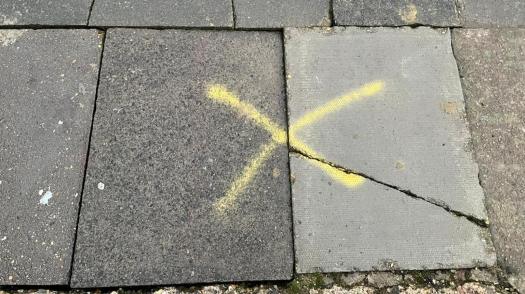
Thus we inhabit the paradox of the British state: councils more elaborate than ever, producing worse public spaces than at any time since rationing. Potholes gape like geological features. Parks resemble the aftermath of a sullen strike. Planning departments take years to produce decisions that amount to artful apologies for not producing any decisions at all. What the average citizen sees is decay. What the average council produces is paperwork.

If the England of the post-war decades possessed a municipal ethic, it has been replaced by a municipal mirage: a swollen bureaucracy masquerading as governance, a system designed chiefly to protect itself from blame. It consumes money without delivering value, enforces rules without delivering order, and utters slogans about “communities” while retreating from the very notion of civic duty.

The state tells us this is progress: professionalism, standardisation, compliance, equality. But a town that cannot fix its own pavements is not progressing. A council that answers to Whitehall more readily than to its residents is not local. And a nation in which the simplest act of governance costs three times what it did half a century ago—and delivers a third of the quality—is not declining by accident.

It is declining by design. The design, as usual, belongs to people who do not have to live with the consequences.


When the state expands its procedures faster than its competence, decline arrives not as a crisis but as a schedule—issued quarterly, audited annually, and noticed by the public only when the bins stop being emptied.

The Turbine that Ate the Forest

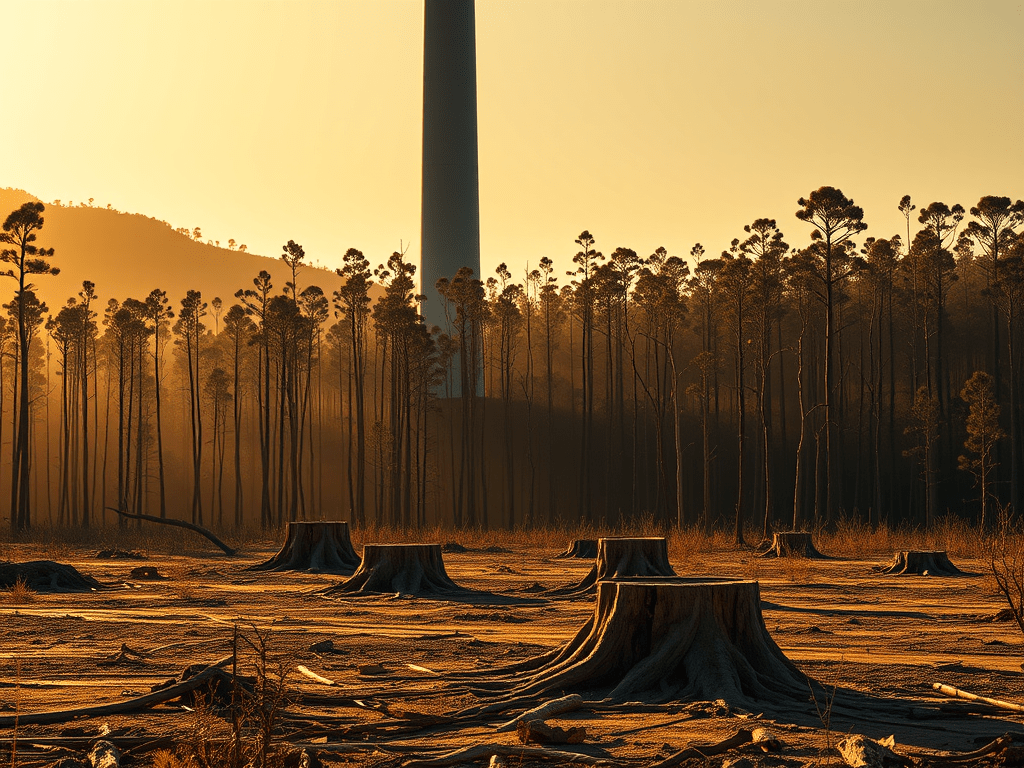
One of the small but telling scandals of our age is the polite silence surrounding balsa wood. Not the stuff of children’s model aeroplanes, but the industrial-scale harvest that feeds the fashionable addiction to wind turbines. Balsa became the miracle ingredient of the green priesthood: light, strong, resin-friendly. And so the forests of Ecuador were stripped with the zeal of a Victorian naval yard, only without the dignity of purpose. Criminal gangs moved in, communities were gutted, and tracts of land were left as bald as a ministerial briefing note. All this so that Europe could congratulate itself on its moral cleanliness while importing a product cut from other people’s hillsides.

The turbine itself is a monument to selective blindness. One begins with a thousand tonnes of concrete—an unlovely material normally denounced by environmentalists until the moment it becomes necessary to bury it under a wind farm. Add a steel tower with a carbon footprint large enough to keep a small nation in warmth for a decade. Crown it with vast blades made from fibreglass, petrochemical resins, and the aforementioned balsa stripped from South American forests. Then transport it all by lorry, ship, and crane, every step soaked in diesel. Install it in a wind regime that fails to meet the advertised output for all but a few postcard days a year. This, we are told, is progress.

We are further assured that the “lifetime carbon payback” justifies the exercise. That is true only in the same sense that a government budget is “balanced” when one introduces assumptions about perfect weather, flawless machinery, and twenty years of uninterrupted operation. The turbine must spin at its daily optimum for two decades, the wind must behave like a Swiss railway timetable, the grid must remain stable without the usual frantic interventions, and the maintenance crews must exist in a state of immaculate readiness. The moment reality intrudes—repairs, downtime, suboptimal wind, or a cold still winter—the ledger curls up like an old leaf and deposits itself in the bin.

Then comes the end of life, that undisclosed chapter in the Book of Green Miracles. The blades cannot be recycled; they are not aluminium cans. They are thermoset composites, cured forever, doomed to burial. So they are chainsawed into pieces and entombed in vast pits, where they will outlast most of the modern political class. One wonders whether future archaeologists will conclude that the early twenty-first century worshipped giant fibreglass idols until the cult ran out of subsidies.

But the greatest deception—the one so ingrained that ministers repeat it without hesitation—is that wind replaces conventional generation. It does not. It decorates it. Behind every elegant white tower stands a gas turbine humming away like an anxious understudy, ready to spring on stage the moment the wind drops. That backup runs inefficiently, gulping fuel in stop–start cycles that nobody includes in the official figures because it ruins the story. The whole scheme resembles a child’s puppet theatre: all charm at the front, frantic scrambling behind.

Why are we investing in this? Because it is symbolic. Because it makes the correct people feel virtuous. Because it allows officials to commission glossy reports full of charts trending in pleasing directions. And because nothing flatters a modern government more than a technology which is large, visible, and useless at the precise moment one needs it.

If we possessed any genuine environmental seriousness, we would build nuclear plants and grid storage systems, and stop pretending that intermittency is a virtue. We would stop chewing through rainforest timber to construct machines that are nowhere near as green as the press releases suggest. Instead we cheer the arrival of another imported turbine, another scar on the landscape, another concrete tomb for future generations to puzzle over.

A civilisation that congratulates itself while paving fields with foreign timber and unrecyclable plastic, all in the name of purity, is not merely declining; it is losing its mind.

Letter XIX: The Mark of Progress

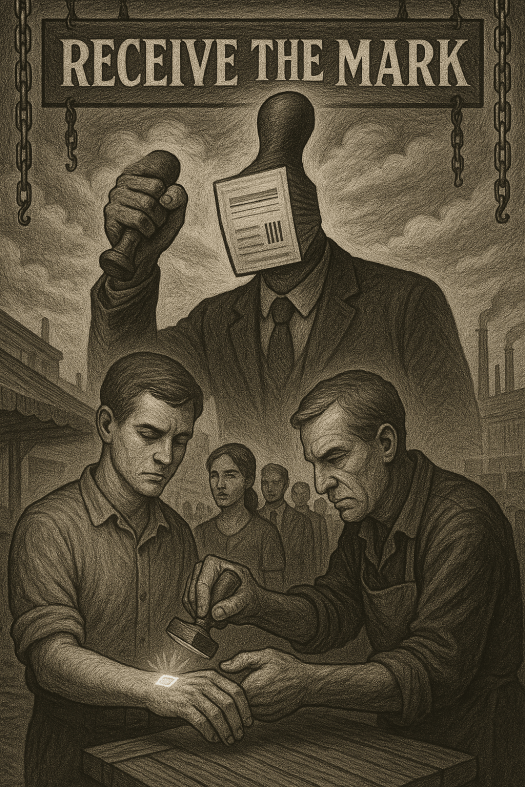
Black-and-white woodcut-style illustration of a man refused bread at a market stall because he lacks a glowing mark, while a towering bureaucratic figure with a paper face and rubber stamp looms overhead, with “666” in the clouds.

By Martyn Walker
Published in Letters from a Nation in Decline

When the state makes life itself conditional on its seal, the mark of the beast is already upon us.

It is a curious thing that whenever governments extend their reach into private life, they never describe it as such. They speak instead of convenience, safety, modernisation. Sir Keir Starmer’s championing of digital identity sounds like a minor administrative adjustment, the bureaucratic equivalent of changing the colour of the tax return form. Yet the reality is rather less trivial.

Digital identity, once imposed, is not a marginal innovation but a centralising revolution. Every man, woman, and child becomes a data entry in a state-authorised ledger, their existence vouched for only so long as the system continues to recognise them. Enter a shop, book a train ticket, apply for a job, or access a bank account — all remain possible only if the digital credential functions. The promise is efficiency; the reality is conditional existence.

The most arresting commentary on such systems does not come from libertarian pamphlets or academic studies, though both have their place. It comes from an ancient text often dismissed as melodrama: the thirteenth chapter of the Book of Revelation. There, the writer describes a society in which “all, both small and great, rich and poor, free and bond” must carry a mark, without which “no man might buy or sell.” Scholars debate whether this was first-century allegory, coded critique of Rome, or apocalyptic vision. The detail is precise: the universal credential is the universal chain.

Black-and-white etching of a man receiving a glowing stamp on his hand under a sign reading “RECEIVE THE MARK,” while a faceless bureaucrat with a paper document for a head looms above, and others queue in line.
The state’s seal presented as progress, the moment of ownership disguised as efficiency.

No theological commitment is required to see the parallel. The mark on the hand or forehead is today’s biometric key. The exclusion from buying or selling is today’s digital wallet frozen by an unseen hand. The beastly system, whether religious or secular, rests not on spectacular cruelty but on the quiet, routine denial of access. Prison walls are unnecessary if the till refuses the card.

Sir Keir presents himself as a moderniser. His case for digital ID is couched in terms of security, fraud prevention, and border control. He would bristle at any comparison with scripture. Yet it is precisely his mildness that makes the matter more sinister. Tyranny that announces itself can be resisted. Tyranny that drapes itself in the language of efficiency is harder to unpick. One does not wake one morning to discover the mark branded on the hand; one drifts into a world where participation in daily life depends on presenting the correct token at every doorway.

Defenders of such schemes protest that the British state is not tyrannical, that it will never abuse such power. This is a charming thought. It is also historically illiterate. Every government abuses the powers it acquires, and powers are never surrendered. The veto inherent in a digital ID scheme — the ability to prevent a man from buying or selling — may sit dormant, but it will never be dismantled. It rests there, like a coiled spring in Whitehall, ready to be activated at the moment of political convenience.

Nor should the economic logic be ignored. The Bank of England has spoken openly about programmable currency, which requires, by definition, a universal identifier. To know what money is being spent on, or to restrict its use to particular purposes, the state must know who is doing the spending. The marriage of digital ID and programmable money creates precisely the world Revelation describes: life conditional on permission.

That the Labour leadership fails to see this is damning enough. That it understands and proceeds regardless is worse. The old Labour Party liked to talk about liberty and dignity. The new one is content to speak of databases and compliance. Sir Keir’s tone is calm, legalistic, mildly reassuring. The punchline is that he offers Britain not security but servitude by spreadsheet.

What makes this especially grotesque is Britain’s history. This was the nation that prided itself on habeas corpus, on common law, on the principle that the citizen was free unless explicitly restrained. The imposition of a universal ID, tethered to one’s ability to transact, inverts that principle. It assumes restraint, lifted only when the system gives its blessing. The state does not prove its case against the citizen; the citizen must prove his case to the state.

Some will accuse this argument of melodrama, of importing biblical language to dignify a mundane administrative reform. In truth the melodrama belongs to Starmer, who dresses coercion in the robes of progress. Revelation, for all its imagery, is coolly accurate. It identified, nearly two millennia ago, the core of what makes such systems intolerable. They do not merely control trade. They redefine freedom itself.

The polite suggestion is that Sir Keir has not reflected on the full implications. The impolite truth is that he has. Either way the effect is identical: a government that sees its citizens not as free men and women, but as registered users, liable to be suspended. And the suspension is not noisy, with trumpets and banners. It is silent, invisible: the card declined, the ticket refused, the door that no longer opens.

Sir Keir will be remembered. He will be remembered as the man who sought to baptise bureaucracy with the language of progress. Britain can weather his speeches; what it may not weather is the architecture he is so keen to build. The peril is not a number burned into the flesh. It is a system so ordinary, so seamless, that the nation scarcely notices it already carries the mark.

The writer of Revelation recognised the pattern. The mark of the beast was never about the hand or the forehead. It was about ownership — about the moment a man’s life ceased to be his own, and became conditional on another’s approval. That is what digital ID represents today. A mark not of safety, but of possession. And the question, as always, is whether the British people are still spirited enough to refuse it.

The End of Diplomacy: How Trump’s $2 Trillion Deals Are Redefining Global Power

Former President Donald Trump descends Air Force One to meet Saudi Crown Prince Mohammed bin Salman during a state visit.

By Martyn Walker
19 May 2025

Diplomacy, once the art of compromise and caution, now risks becoming just another line item on a spreadsheet.

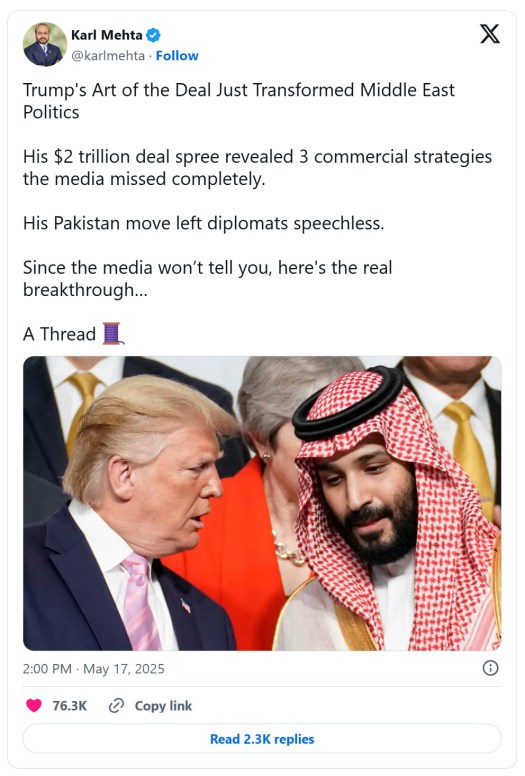
This month, Karl Mehta laid out a startling thesis: former President Donald Trump is reshaping global politics—not through ideology, defence pacts or values—but through deals. Big ones. His thread on X unpacks what he calls “Commercial Diplomacy”: a bold, borderline cynical foreign policy doctrine in which profit trumps principle, and where Boeing, Blackstone, and Howard Lutnick have more sway than the State Department ever did.

The numbers are staggering. Saudi Arabia: $600 billion. Qatar: $243 billion. UAE: $1.4 trillion. Pakistan, not to be outdone, has offered Trump a zero-tariff agreement—despite hosting 15 U.S.-designated terrorist organisations. Even Syria got a pardon of sorts, with all sanctions lifted after a handshake with its new president—himself a former Al Qaeda commander—brokered not by a diplomat, but by Crown Prince Mohammed bin Salman.

And yet, this isn’t chaos. It’s commerce.

Trump’s model doesn’t attempt to shape the world through diplomacy. It simply pays it off, then rents the influence. It’s foreign policy by acquisition, not negotiation. No grand speeches. Just signatures on multi-billion-dollar contracts, often with the very regimes traditional diplomacy was meant to contain or reform.

So where does that leave the UK?

Britain: Value-Driven or Value-Discounted?

For decades, Britain’s foreign policy has clung to moralism like a life-raft—promoting democracy, human rights, transparency, and soft power. But in this new world order, soft power looks decidedly limp. When the Americans roll into Riyadh with fighter jets, AI labs, and energy infrastructure on the table, a politely worded communiqué from the FCDO simply doesn’t compete.

Worse still, Britain’s diplomatic machinery is designed to operate through institutions—NATO, the UN, the Commonwealth. Trump’s approach bypasses all of these. His preference is the side door, the backchannel, the golf course—where a handshake matters more than protocol and a Boeing order matters more than a NATO summit.

If this becomes the dominant diplomatic model—and there are signs that even China is responding to it—then Britain faces an unpalatable truth:

A nation that trades on its moral high ground will soon find itself outbid.

Opportunity… or Isolation?

To be clear, this doesn’t have to spell decline. Britain could adapt its commercial instincts to the diplomatic arena, building strategic economic packages that align with its values without surrendering them entirely. That means giving the Department for Business and Trade the same global remit as the Foreign Office. It means getting British businesses a seat at the diplomatic table—and giving diplomats a crash course in deal-making.

But we must move fast.

The Middle East is being redrawn, not by war or revolution, but by contracts. Whoever controls the infrastructure, the energy corridors, the AI data centres, and the ports will command influence for decades. If British firms aren’t part of this transformation, then British foreign policy will become commentary—not participation.

The India-Pakistan Trap

There’s another risk. Trump’s eagerness to deal with Pakistan, despite its terror links, threatens to strain Western alliances with India—just as Britain tries to deepen its own Indo-Pacific strategy. Can we afford to take a moral stand against Islamabad while Washington undercuts us with duty-free access?

Once again, commercial diplomacy doesn’t care about appearances. It rewards utility, not loyalty.

Closing Thoughts

What Karl Mehta revealed wasn’t just a set of contracts. It was a warning. The world is moving fast—and money, not manners, is determining the pace.

Britain now faces a choice.

Either embrace commercial diplomacy, with all the uncomfortable compromises it entails—or become the well-spoken relic of a world that no longer exists.

Because in this new era, diplomacy is no longer what you say.

It’s what you bring to the table—and what you’re willing to sign.

Karl Mehta’s Original Post

A picture of Trump and MBS in discussion

Letter XIV: Dimming the Sun, Dimming Consent

Aeroplane emitting solar dimming particulates over green countryside and blue sky, leaving a dull desert and darkened sky behind, with the words "Democracy Does Not End in the Stratosphere" written across the bottom.

By Martyn Walker
Published in Letters from a Nation in Decline

“Some crimes offend the law, others offend the senses. But a few — like dimming the sun — offend both, and then go on to threaten all life that depends on its light.”
Laurence J. Peter, posthumously paraphrased

The Nuremberg Code Still Applies — Just Look Up

We are governed now by people who believe it is acceptable to experiment on the atmosphere — and by extension, on all life within it — without consent, oversight, or consequence. The proposal to “blot out the sun” under the guise of solar geoengineering may seem the stuff of science fiction, but it is not only real, it has been quietly sanctioned.

In this country, where grey skies already dominate the greater part of the year, the very idea that we should deliberately reduce sunlight warrants more than scientific scrutiny — it demands a reckoning with first principles.

Sunlight is not a pollutant. It is the original engine of life.

And yet, in the race to mitigate climate change, we are told that injecting particles into the stratosphere to reflect sunlight back into space might be necessary. The logic is simple, the risks profound. Reduce solar radiation, and you cool the Earth. But what else do you do?

You undercut solar panel yields, including those funded by government grants and individual savings alike. You suppress photosynthesis in farming regions, risking lower crop yields in a world already strained by food insecurity. You disrupt rainfall patterns, especially in equatorial and monsoonal zones. You reduce the availability of natural vitamin D, just as our GPs urge us to get more sunlight, not less.

You dim the world, literally and figuratively.

And all of it without a referendum. Without a vote. Without even a leaflet through the door.

Where is consent in this story? Where is accountability?

We are told that climate change is an existential threat, and perhaps it is. But that does not grant a government — or a consortium of scientists, or a supra-national fund — the right to conduct global-scale experiments with unknown long-term consequences, no matter how well intentioned. That is not precaution; that is hubris disguised as stewardship.

Which brings us — as all such questions eventually do — to the Nuremberg Code.

Drafted in the wake of war crimes and scientific atrocities, the Nuremberg Code was not simply a legal instrument. It was a moral declaration. It stated, for all time, that no human being should be subject to experimentation without their freely given, fully informed consent. No clever phrasing, no policy paper, no invocation of emergency, can supersede that.

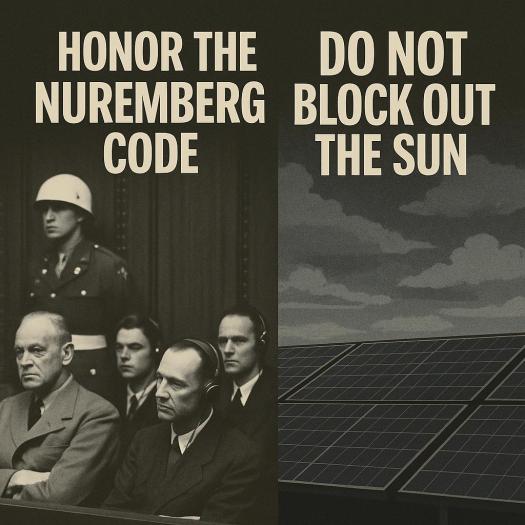
Split image showing Nuremberg trial courtroom on the left and dim, cloudy skies over failing solar panels on the right, with bold text reading “Honour the Nuremberg code — Do not block out the sun”.
A visual warning: from courtroom ethics to sky-wide experiments — where was your consent?

While the Code was written for medical experimentation, its logic extends to any deliberate action that treats the population as passive subjects of a risk-laden intervention. If deploying sulphate aerosols in the stratosphere, or conducting atmospheric reflectivity trials, is not an experiment on all life — then what is it?

We must not allow ourselves to be softened into apathy by the presentation of these plans as purely scientific exercises. We must not forget that science, without ethics, becomes machinery in search of obedience. The ghost of the 20th century tells us plainly where that leads.

Consent must return to the centre of policy. Not only in medicine, but in environmental governance, data rights, digital identity, and energy strategy. To ignore consent in these spheres is not merely undemocratic — it is dangerous.

The great lie of the age is that we can offset our guilt, erase our emissions, or rebalance our planet with a few technocratic tweaks. But we are not gods. We are stewards, or we are fools. The choice is that stark.

And so, to those in government who sanction these sky-darkening schemes: remember the Nuremberg Code. Not because we seek prosecution, but because we believe you still have a conscience. Because shame, not fear, should stop you.

Because if not now, when?

IPSO FACTO: WHEN THE PRESS REGULATOR FORGETS WHAT A PRESS IS FOR

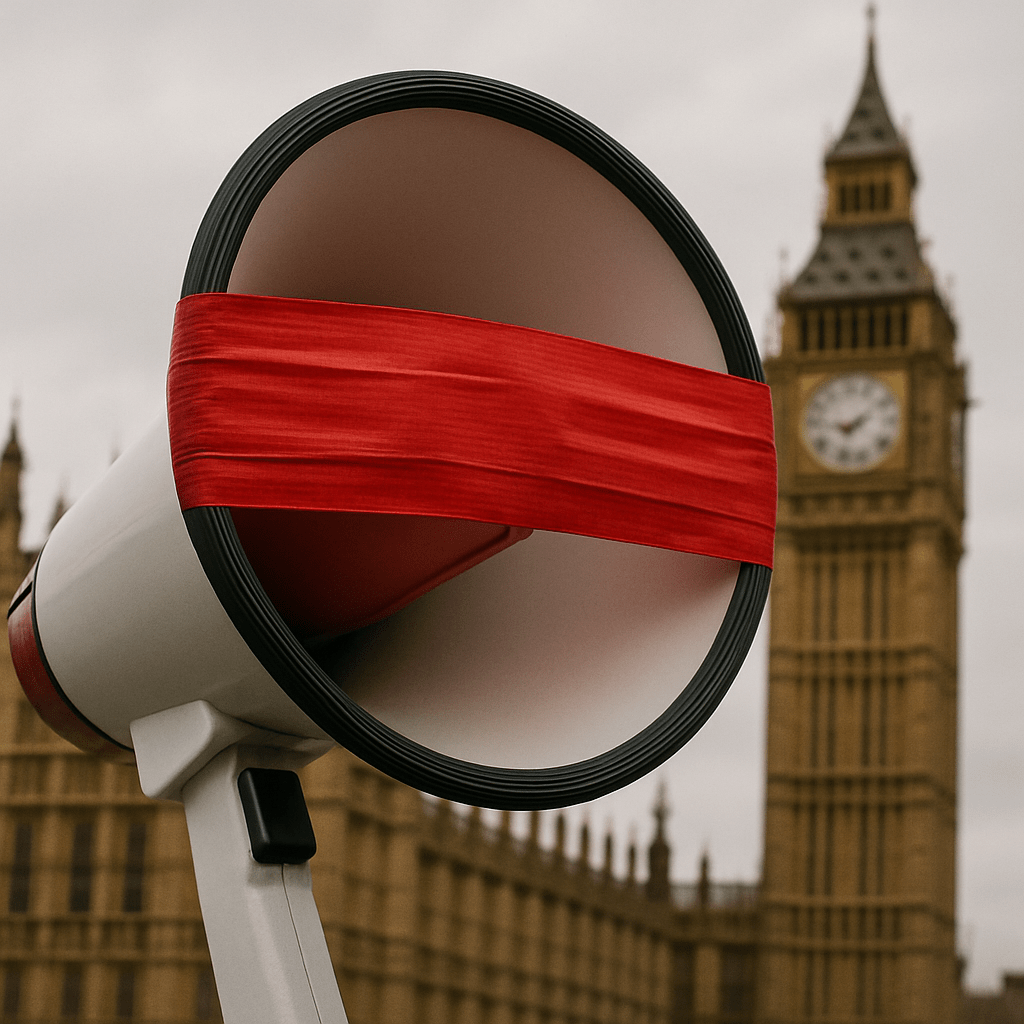
A press megaphone bound with red tape, placed in front of the Houses of Parliament — symbolising censorship of media speech in the UK.

By Common Sense, Reporting from the Edge of Reason.
Opinion | Media Regulation | United Kingdom | April 2025

When a press regulator penalises newspapers for quoting Parliament without ritual appeasement, we are no longer defending journalism — we are regulating tone, not truth.

Ipso, as any modestly educated schoolchild once knew, means by the fact itself. Today, it appears to mean by the feelings of a preferred complainant, or more precisely, by the fact that someone, somewhere, might be offended, retroactively.

The Independent Press Standards Organisation — let us pause to admire the audacity of the word “Independent” — has declared that The Telegraph erred by quoting, without seeking fresh rebuttal, remarks made under the protection of Parliamentary privilege. The offending quote? A Cabinet Minister — Michael Gove — made reference in the Commons to alleged links between the Muslim Association of Britain (MAB) and the Muslim Brotherhood[1].

“Ipso has ruled that quoting Parliament is now misleading — unless you ask the accused to deny it again.”

The comments were made in Parliament. They were reported accurately. They included a denial from the MAB, already in the public domain. And yet: Ipso upheld the complaint[2].

Ipso facto, accuracy is no longer the standard. Deference is.

Under the Editors’ Code, publications must not print inaccurate or misleading content. Yet somehow, Ipso ruled that quoting Parliament, while accurate, was still misleading — because The Telegraph did not re-ask the MAB to deny it again. This isn’t regulation. It’s a form of compelled courtesy.

Let us reflect on the implications:
If newspapers must now solicit fresh reactions every time a parliamentary statement is quoted — even when the response is already publicly known — then press freedom has become contingent not on facts, but on feelings and repetition rituals.

Parliamentary privilege now risks becoming a historical footnote — overruled by feelings and rituals.

Michael Gove, now also editor of The Spectator, rightly warns that such rulings have a chilling effect. “Groups suspected of extremism rarely want scrutiny,” he wrote, “They seek to present themselves as a peaceable association of co-religionists who simply want to get along and do good works.”[3]

Parliamentary privilege, once a bulwark of British democracy, now risks becoming a historical footnote — overruled by the sensitivities of groups that may be under scrutiny.

And Ipso’s record gives little comfort:

  • In 2021, it entertained an 87-page complaint from Yevgeny Prigozhin, the Wagner mercenary boss, who insisted he was merely a successful restaurateur. The Telegraph had to prepare a formal response. He later withdrew the complaint — after publicly confirming his role as Wagner’s founder[4].
  • In 2023, Ipso ruled against The Spectator for referring to a transgender journalist as “a man who claims to be a woman”, citing discrimination[5].
  • In 2019, it drafted guidance warning journalists against “insensitivities” when reporting on Islam, language more suited to cultural outreach than impartial regulation[6].

These are not the decisions of a neutral arbiter. These are the reflexes of an organisation that now regulates not truth, but tone — not accuracy, but atmosphere.

Breaking news (that everyone already knows):
A free press must be free to offend. Free to quote. Free to scrutinise. That includes the right to repeat what elected representatives say in the Commons — without asking permission from those criticised.

Otherwise, we are not defending journalism.
We are auditioning for Ofcom’s little sibling, with a clipboard and a mood ring.

Ipso, by the very fact itself, has become part of the problem.

References:

  1. Hansard, House of Commons debate, March 2023 – Statement by Michael Gove naming three Muslim organisations, including the MAB, for review.
  2. IPSO ruling against The Telegraph, April 2025 – Complaint upheld for failing to seek new response from MAB.
  3. Michael Gove, “Groups suspected of extremism don’t want scrutiny,” The Telegraph, April 2025.
  4. The Telegraph, April 2021 – Coverage of complaint by Yevgeny Prigozhin, later withdrawn after public admission of Wagner affiliation.
  5. IPSO ruling against The Spectator, 2023 – Discrimination ruling over gender language.
  6. IPSO draft guidance, 2019 – Recommendations for reporting on Islam with caution to avoid “insensitivities.”

Author: Common Sense is a recovering civil servant and occasional contributor to The Last Remaining Sane Newspaper, where he writes under a variety of pseudonyms for his own protection and amusement. He identifies as reality-adjacent and accepts correspondence by pigeon.

Column Metadata:

  • Title: IPSO Facto: When the Press Regulator Forgets What a Press Is For
  • Author: Common Sense
  • Published: April 2025
  • Word count: approx. 1,050
  • Categories: Media, Regulation, Free Speech, UK Politics, Journalism
  • License: Opinion / Commentary — standard editorial fair use
  • Keywords: IPSO, press regulation, Michael Gove, MAB, Muslim Brotherhood, Parliamentary privilege, free speech, journalism

Letter XIII: Blotting Out the Sun

By Martyn Walker
Published in Letters from a Nation in Decline

When the state plans to dim the sun while blanketing farmland with solar panels, only folly thrives.

I installed solar panels some years ago. A modest gesture, perhaps, but one rooted in the belief that renewable energy—particularly the power of the sun—offered a sensible path forward. The promise was straightforward: invest now, harvest the sun’s rays, lower my bills, and contribute, in some small way, to a greener future.

Imagine, then, my reaction upon learning that the government is now considering blotting out the sun.

I do not exaggerate. At Westminster, serious people are discussing the allocation of billions to solar geoengineering—spraying fine particulates into the atmosphere to reflect sunlight away from the Earth, cooling the planet in the process. Sulphur dioxide is the preferred agent, mimicking the effect of volcanic eruptions, lowering global temperatures, and, we are told, sparing us from climate catastrophe.

At the same time, those same serious people are approving hundreds of thousands of acres of farmland for conversion into solar farms. Arable fields, once the source of our food, will be turned into glinting expanses of silicon and glass—desperate to capture the very sunlight the state proposes to dim.

Which is it? Are we to harvest the sun or hide from it?

This is policy schizophrenia at its finest. On one hand, we are to bow before the gods of net zero, covering our green and pleasant land with solar panels. On the other, we are to fund atmospheric experiments that will diminish the very light those panels need to function. The left hand builds; the right hand dismantles.

But this is more than a contradiction. It is the arrogance of central planning, an affliction that has toppled empires, destroyed livelihoods, and now threatens to snuff out the sun’s warming rays.

History is not short of warnings. In the Soviet Union, one Trofim Lysenko convinced Stalin that science itself could be bent to ideology. Genetics was bourgeois nonsense, he claimed, and crops could be trained—like loyal Party members—to thrive in hostile environments if only they were exposed to the correct conditioning. Real scientists, those who objected, were purged. Their warnings ignored. The result? Agricultural collapse, famine, and death on an industrial scale.

The lesson? When policy bends science to ideology, crops fail and people starve.

Geoengineering smells of the same hubris. The climate models, neat as they are, do not account for the complex choreography of atmosphere, ocean, and biosphere. The Earth is not a thermostat, waiting for a bureaucrat to dial in the desired temperature. There is no slider bar for unintended consequences.

Consider CFCs—chlorofluorocarbons. Once hailed as a miracle of modern chemistry, powering refrigeration, aerosols, and industrial processes. Until, decades later, scientists discovered they were quietly eating away at the ozone layer, exposing us to dangerous levels of ultraviolet radiation. It took an extraordinary global effort—the Montreal Protocol—to halt the damage. The unintended consequence of human ingenuity.

Now, we propose to tamper with the atmosphere once again. To spray particles into the sky, with only the faintest grasp of what might follow. Droughts in one region, floods in another. Failed harvests. Shifts in monsoon patterns. The arrogance of assuming we can control a global system as intricate as the climate without consequence is staggering.

And all this while tearing up farmland to make way for solar panels, sacrificing food security for energy generation, only to dim the light that powers them.

It is the insanity of the moment, yes—but also the failure to learn from history. Grand schemes, unmoored from reality, sold on visions of salvation but delivered through wreckage and regret.

The late pathologist’s words echo: Humans are tropical creatures. Leave a man naked outside at 20°C, and he will die from exposure. We are built for warmth, for sunlight. The sun is not our enemy. It is our origin.

This is a nation in decline: dimming the sun, sterilising the soil, trading common sense for ideology. No thought for consequence. No humility before the complexity of life.

I do not ask for much. Protect the farmland. Let the sun shine. Reject the delusion that we can reorder the heavens by committee. We are not gods, and this is not our playground.

When the crops fail and the skies darken, there will be no bureaucrat to blame but ourselves.


🔬 UK Government Initiatives on Solar Geoengineering

  • UK Scientists to Launch Outdoor Geoengineering Experiments
    The Guardian reports on the UK’s £50 million funding for small-scale outdoor experiments aimed at testing solar radiation management techniques, such as cloud brightening and aerosol injections. Critics express concerns about potential environmental risks and the diversion from emission reduction efforts. (UK scientists to launch outdoor geoengineering experiments)
  • Exploring Climate Cooling Programme
    An overview of the UK’s climate engineering research initiative, detailing the government’s £61 million investment in solar radiation management research, including methods like stratospheric aerosol injection and marine cloud brightening. (Exploring Climate Cooling Programme)
  • The UK’s Gamble on Solar Geoengineering is Like Using Aspirin for Cancer
    A critical opinion piece likening the UK’s investment in solar geoengineering to treating cancer with aspirin, highlighting the potential dangers and ineffectiveness of such approaches in addressing the root causes of climate change. (The UK’s gamble on solar geoengineering is like using aspirin for cancer)

🌾 Solar Farms and Agricultural Land Use


🗣️ Critical Perspectives and Policy Analysis

  • Why UK Scientists Are Trying to Dim the Sun
    The Week provides an overview of the UK’s funding for controversial geoengineering techniques, exploring the scientific rationale and the ethical debates surrounding these interventions. (Why UK scientists are trying to dim the Sun | The Week)
  • Analysis: Plans to Cool the Earth by Blocking Sunlight Are Gaining Momentum but Critical Voices Risk Being Sidelined
    UCL’s analysis warns of the rapid advancement of solar geoengineering research without adequate consideration of dissenting opinions and the potential for self-regulation leading to dangerous outcomes. (Analysis: Plans to cool the Earth by blocking sunlight are gaining …)
  • Solar Geoengineering Not a ‘Sensible Rescue Plan’, Say Scientists
    Imperial College London reports on a study indicating that reflecting solar energy back to space could cause more problems than it solves, questioning the viability of solar geoengineering as a climate solution. (Solar geoengineering not a ‘sensible rescue plan’, say scientists)

Metadata

Letter Number: XIII
Title: Blotting Out the Sun
Collection: Letters from a Nation in Decline
Author: Martyn Walker
Date: 28 April 2025
Word Count: 1,210


BISAC Subject Headings

POL044000: Political Science / Public Policy / Environmental Policy
SCI026000: Science / Environmental Science (incl. Climate Change)
TEC031010: Technology & Engineering / Power Resources / Solar
BUS032000: Business & Economics / Infrastructure
SOC055000: Social Science / Agriculture & Food Security
SCI092000: Science / Ethics (incl. Environmental Ethics)


Library of Congress Subject Headings (LCSH)

Solar Energy—Government Policy—Great Britain
Geoengineering—Environmental Aspects—Great Britain
Agriculture and Energy—Great Britain
Central Planning—Political Aspects—Great Britain
Environmental Policy—Moral and Ethical Aspects
Food Security—Great Britain
Climatic Changes—Moral and Ethical Aspects

Let’s Make Science Great Again

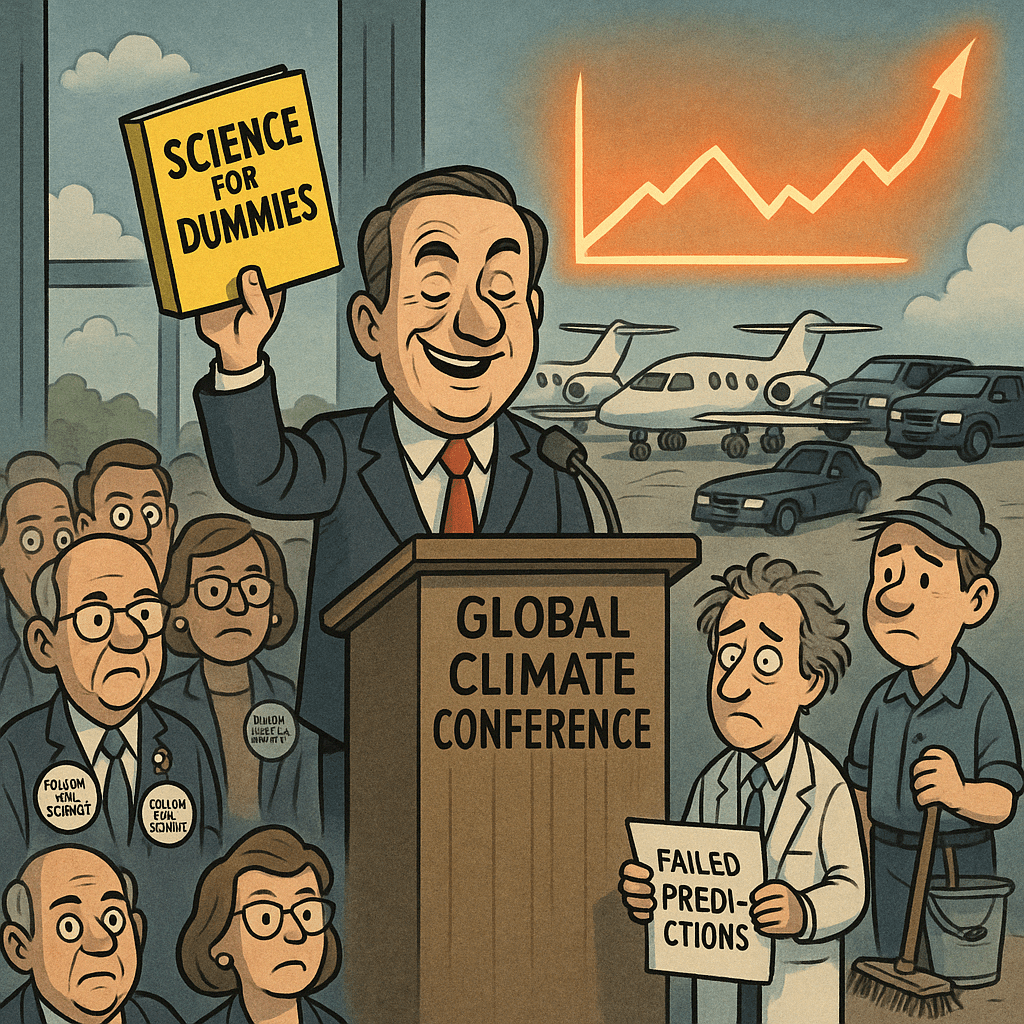
A satirical cartoon showing a politician holding “Science for Dummies” at a global climate conference, while private jets and SUVs sit outside and a janitor points to failed predictions.

They gather each year to honour the Earth,
With banners and buzzwords and questionable mirth.
They chant “follow science!” with glassy-eyed cheer,
But the method they follow? It’s nowhere near.

They assume, then predict, then assume what they guessed—
If it fits what they feel, it must be the best.
They model the sky, they model the sea,
But test what they claim? That’s heresy.

They worship the models like relics in glass,
Forget every dud from the decade that passed.
And still they parade with unfounded pride—
While science itself sits shunted aside.

Let’s go back to basics, like Aristotle once taught:
“Test your idea—or it’s not worth a thought.”
You can’t prove it’s true just ‘cause you hope or you care,
But one bad prediction? That truth isn’t there.

Yet here we are still, with graphs in a stack—
The famous old hockey stick stubbornly back.
Its blade defies logic, its shaft splits the skies—
A medieval warm-up? Deleted. Revised.

And thus, the believers, in labs and in suits,
Build castles on sand and declare them as roots.
If a storm hits the coast or a summer gets hot,
“That proves it!” they cry. (But of course it does not.)

Where’s Feynman’s demand to “bend to the test,”
To discard the idea that performs second-best?
Where’s Popper’s sharp blade to cut through the fog,
To banish the sacred from the scientific log?

Instead we get headlines and Parisian scenes,
Of leaders who fly in on CO2 dreams.
A standing ovation, champagne in their hand—
Then off to Davos to lecture the land.

This isn’t science, it’s pantomime stuff.
The numbers don’t add, and the method’s not tough.
They’ll say “the consensus,” and smugly they grin—
But if thinking is outlawed, how can we win?

Science is doubt. It’s question. It’s test.
It’s not your emotions dressed up in a vest.
It’s not the applause of a well-funded team—
It’s asking the question that shatters the dream.

So this Earth Day, pause. Take stock. Look again.
Are these prophets with laptops or children with pens?
Let’s teach them the method, the rule and the way—
And maybe, just maybe, we’ll earn what they say.

Let’s bring back the rigour, the courage to doubt—
To test every claim, to throw the weak out.
Let’s shame the lemmings, restore the domain,
Let’s Make Science Great Again.

Letter XI – Press One for Betrayal

By Martyn Walker
Published in Letters from a Nation in Decline

The modern call centre was not designed to solve your problem. It was designed to make your problem someone else’s responsibility.

There was a time—not so long ago—when you could pick up the telephone and speak to someone in authority. Not a chatbot, not an overseas “operative,” not an algorithm tasked with guessing which service category most closely matched the thing that was bothering him. A human being. On the premises. With some measure of agency. One might even call it customer service—a phrase now drained of meaning, like so much corporate jargon turned to husk.

It’s easy to sentimentalise the past, but this isn’t nostalgia. It’s an observation. In 1980, if I had a query about a spare part, a refund, or a change to an order, I called the shop. The shop answered. A man in a brown coat wiped his hands and told me the truth. Perhaps he had to check in the storeroom. Perhaps he said no. But he said something. And I was no longer in doubt.

Now, try calling your local Halfords. Or Sainsbury’s. Or Currys. You’ll search for a phone number, find what looks like a local line, dial it with hope—and find yourself deep in the circuitry of a call centre. Often abroad. The voice will be polite, inoffensive, robotic. And its sole mission is to extract your details. Your name, postcode, date of birth, your grievance if you’re lucky. But it cannot solve your problem. It may not even understand it. You are not speaking to someone in the branch. You are speaking to data acquisition software in human form.

This isn’t a bug. It is the design. You, dear customer, are not a person but a unit of behavioural metadata. A record to be “triaged,” escalated, or dropped. The goal is not to help you but to contain you. Hold times, circular menus, dead-end email addresses, disappearing contact forms—these are not symptoms of strained service, but strategies of avoidance. No longer is the customer always right. The customer is barely relevant.

And when you finally breach the firewall—after ten minutes of hold music and a few weak apologies—you’re passed back, with luck, to the store you originally tried to reach. Or worse, told they “can’t connect you but will raise a ticket.” The circle begins again.

This model of service has metastasised. The state has adopted it with vigour. HMRC—an organisation I once respected—now behaves like a digital fortress. I have owed them money and seen the efficiency with which they communicate. But now they owe me a refund—one triggered at the height of the pandemic, over four years ago—and they are unreachable. My letters go unanswered. Emails are met with silence. Phone calls are looped through menus that lead nowhere. I cannot speak to anyone. And yet, if I were late in payment, I have no doubt I would be found [1].

We are told that these systems are more efficient. That technology has made things easier. That chatbots, web portals, apps, and ticketing systems have replaced “old-fashioned” service with something faster and more scalable. But these are lies. The system is not more efficient—it is more opaque. More exhausting. The problem is no longer one of supply, or of timing, but of deliberate misdirection.

You are meant to give up. That is the efficiency: your defeat.

The corporations know you have nowhere else to go. Tesco boasts of “price matching” against Aldi or Lidl, but only for items carefully selected as competitive loss leaders [2]. The supermarkets function as a cartel in all but name. There is no real price war—only a performance of it. And when every supplier adopts the same approach to service—offshored, automated, evasive—what alternative is left? Who do you reward with your custom?

The human voice—the oldest tool in commerce—is now treated as a cost centre. Empathy is expensive. Initiative is a risk. It is far safer, from a boardroom perspective, to channel all contact into a data funnel, log the frustration, and offer a £5 voucher once a month to appear caring.

Meanwhile, the consumer—the citizen, the taxpayer—is left howling into the void. Asking not even for special treatment, but for the basic reciprocity that once governed civil society.

And so I write this not as a technophobe—far from it—but as someone who sees the difference between progress and abandonment. We have not been “streamlined” into a new age of customer empowerment. We have been reduced. Stripped of our right to a voice, replaced with a row of dropdown menus and a number on a dashboard.

What has died is not merely service. It is the principle of response.

And without response, there can be no trust.

References

  1. National Audit Office (2022). Customer Service Performance at HMRC. NAO report showing average call waiting times exceeding 20 minutes, with some refund cases unresolved after more than a year.
  2. Competition & Markets Authority (CMA), 2023. Supermarket Price Competition Review. The report notes that “price match” campaigns often use cherry-picked items, typically loss leaders, creating an illusion of parity while overall basket prices diverge.
  3. Citizens Advice Bureau (2021). The Customer Service Crisis. Documenting the shift to automated and offshore customer service in key industries and its impact on vulnerable groups.
  4. Financial Times (2023). Retailers’ use of behavioural data surpasses customer service investment. A feature highlighting that major UK retailers spend significantly more on data analytics than on staff training or customer resolution.
  5. House of Commons Treasury Committee (2024). Digital Services and the Decline of Public Accountability. Evidence submitted to Parliament showing the impact of digital interfaces on HMRC accountability and customer complaints handling.

Metadata

Title: Press One for Betrayal
Series Title: Letters from a Nation in Decline
Series Volume: Letter XI
Author: Martyn Walker
Language: English (UK)
Date of Publication: 2025-04-16
Edition: First
Abstract / Short Description:
An essay on the erosion of human-centred customer service in modern Britain, revealing how citizens are now treated as data points, not people. Through sharp satire and lived experience, Press One for Betrayal confronts the state and corporate sectors’ weaponisation of digital systems to deflect responsibility and suppress contact. The personal becomes political in this eleventh letter from a nation in visible decline.


BISAC Subject Headings (Book Industry Standards and Communications):

  • SOC026000Social Science / Sociology / General
  • BUS070060Business & Economics / Customer Relations
  • POL023000Political Science / Public Policy / Economic Policy
  • TEC003070Technology / Social Aspects
  • COM087000Computers / Human-Computer Interaction

LCSH (Library of Congress Subject Headings):

  • Customer services—Great Britain
  • Call centers—Great Britain
  • Public administration—Effect of technological innovations on—Great Britain
  • Data protection—Great Britain
  • Communication—Technological innovations—Social aspects—Great Britain
  • Administrative agencies—Great Britain—Public opinion
  • Surveillance capitalism—Great Britain
  • Government accountability—Great Britain

Keywords / Tags for Indexing:

customer service, HMRC, UK bureaucracy, call centres, digital inefficiency, datafication, corporate indifference, public sector decay, satire, Letters from a Nation in Decline

The Peril of Warmongering: A Plea for Sanity

The clamour for war with Russia, increasingly echoed by politicians and mainstream media, is not only reckless but also deeply irresponsible. The ease with which some armchair commentators, journalists, and politicians dismiss the prospect of war as a mere geopolitical manoeuvre is astonishing. They forget—or have never truly understood—the catastrophic cost of modern warfare. Worse still, they try to smear those who advocate for diplomacy as “appeasers,” a lazy and historically illiterate insult designed to shut down debate.

Let’s be absolutely clear: opposing war does not mean supporting Russia. It means valuing human life over political posturing. It means recognising that war is not a game to be played by those with no skin in it. The loudest voices for conflict—the politicians who have never served, the journalists who will never see a battlefield, and the social media warriors pontificating from their bedrooms—are the ones least to bear the costs of their reckless rhetoric.

The Horror of War

Those who flippantly call for escalation seem to have forgotten—or never learned—the reality of war. War is not just an abstract clash of nations; it is the destruction of homes, the obliteration of cities, the deaths of men, women, and children who had no say in the matter. It is young soldiers, conscripted or otherwise, being sent to die for causes they barely understand, while their leaders sit comfortably in safety. It is entire generations of families torn apart, livelihoods ruined, and futures obliterated.

The idea that Russia can be “defeated” in the same way smaller nations have been toppled in the past is absurd. This is a nuclear-armed state with vast resources, a hardened military, and a leadership that has survived every attempt to isolate and weaken it. Those pushing for war seem to believe that Western superiority will guarantee a swift and clean victory. It won’t. Even conventional war with Russia would be ruinous; nuclear war would be the end of civilisation as we know it.

The Hypocrisy of Western Warmongers

The moral high ground claimed by the West is becoming increasingly difficult to justify. Critics of Russia love to highlight its political prisoners and suppression of dissent, yet in the UK, people are being imprisoned for jokes, offensive memes, and opinions deemed unacceptable by the establishment. We release murderers while punishing individuals for thought crimes. Meanwhile, the very people calling for war are the ones who celebrated Tony Blair, a man whose war in Iraq led to the deaths of hundreds of thousands. The same people who rage against Putin’s authoritarianism are often silent about the erosion of freedoms at home.

If our own political elite were held to the same standards they demand for others, many would be behind bars. Instead, they posture as champions of democracy while their own nations slide further into authoritarianism.

A Sensible Alternative

Instead of sabre-rattling and reckless escalation, we should be pursuing diplomacy with every available means. That is not weakness; it is wisdom. A truly strong nation does not rush into unnecessary wars—it seeks to avoid them. Strength is found in strategic thinking, not in chest-thumping bravado from people who will never face the consequences of their words.

Those who insult others as “appeasers” should be reminded that the real appeasement is refusing to challenge the march toward war. The real failure is allowing warmongers to dictate policy while silencing dissent. If we do not push back against this insanity, we will soon find ourselves in a war that no one—except the weapons manufacturers and a few deranged ideologues—actually wants.