
Letter XIV: Dimming the Sun, Dimming Consent

Aeroplane emitting solar dimming particulates over green countryside and blue sky, leaving a dull desert and darkened sky behind, with the words "Democracy Does Not End in the Stratosphere" written across the bottom.

By Martyn Walker
Published in Letters from a Nation in Decline

“Some crimes offend the law, others offend the senses. But a few — like dimming the sun — offend both, and then go on to threaten all life that depends on its light.”
Laurence J. Peter, posthumously paraphrased

The Nuremberg Code Still Applies — Just Look Up

We are governed now by people who believe it is acceptable to experiment on the atmosphere — and by extension, on all life within it — without consent, oversight, or consequence. The proposal to “blot out the sun” under the guise of solar geoengineering may seem the stuff of science fiction, but it is not only real, it has been quietly sanctioned.

In this country, where grey skies already dominate the greater part of the year, the very idea that we should deliberately reduce sunlight warrants more than scientific scrutiny — it demands a reckoning with first principles.

Sunlight is not a pollutant. It is the original engine of life.

And yet, in the race to mitigate climate change, we are told that injecting particles into the stratosphere to reflect sunlight back into space might be necessary. The logic is simple, the risks profound. Reduce solar radiation, and you cool the Earth. But what else do you do?

You undercut solar panel yields, including those funded by government grants and individual savings alike. You suppress photosynthesis in farming regions, risking lower crop yields in a world already strained by food insecurity. You disrupt rainfall patterns, especially in equatorial and monsoonal zones. You reduce the availability of natural vitamin D, just as our GPs urge us to get more sunlight, not less.

You dim the world, literally and figuratively.

And all of it without a referendum. Without a vote. Without even a leaflet through the door.

Where is consent in this story? Where is accountability?

We are told that climate change is an existential threat, and perhaps it is. But that does not grant a government — or a consortium of scientists, or a supra-national fund — the right to conduct global-scale experiments with unknown long-term consequences, no matter how well intentioned. That is not precaution; that is hubris disguised as stewardship.

Which brings us — as all such questions eventually do — to the Nuremberg Code.

Drafted in the wake of war crimes and scientific atrocities, the Nuremberg Code was not simply a legal instrument. It was a moral declaration. It stated, for all time, that no human being should be subject to experimentation without their freely given, fully informed consent. No clever phrasing, no policy paper, no invocation of emergency, can supersede that.
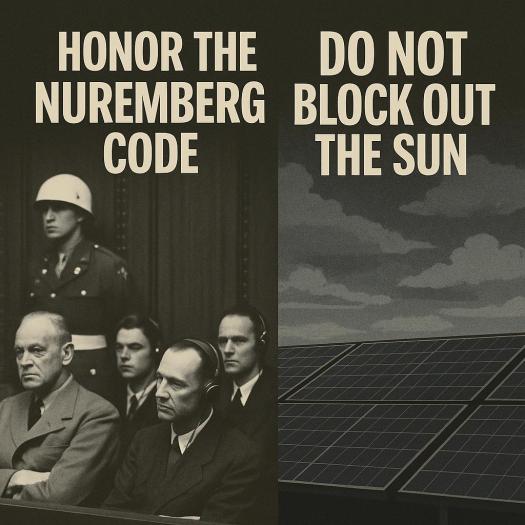
Split image showing Nuremberg trial courtroom on the left and dim, cloudy skies over failing solar panels on the right, with bold text reading “Honour the Nuremberg code — Do not block out the sun”.
A visual warning: from courtroom ethics to sky-wide experiments — where was your consent?

While the Code was written for medical experimentation, its logic extends to any deliberate action that treats the population as passive subjects of a risk-laden intervention. If deploying sulphate aerosols in the stratosphere, or conducting atmospheric reflectivity trials, is not an experiment on all life — then what is it?

We must not allow ourselves to be softened into apathy by the presentation of these plans as purely scientific exercises. We must not forget that science, without ethics, becomes machinery in search of obedience. The ghost of the 20th century tells us plainly where that leads.

Consent must return to the centre of policy. Not only in medicine, but in environmental governance, data rights, digital identity, and energy strategy. To ignore consent in these spheres is not merely undemocratic — it is dangerous.

The great lie of the age is that we can offset our guilt, erase our emissions, or rebalance our planet with a few technocratic tweaks. But we are not gods. We are stewards, or we are fools. The choice is that stark.

And so, to those in government who sanction these sky-darkening schemes: remember the Nuremberg Code. Not because we seek prosecution, but because we believe you still have a conscience. Because shame, not fear, should stop you.

Because if not now, when?

Demanding Truth: Thousands March for Tommy Robinson in Britain

A reckoning stirs in the streets of Britain. Across the land, from the industrial heartlands to the capital’s cobbled squares, thousands march—not with violence, not with destruction, but with a righteous demand that those in power would rather ignore. They march for the freedom of a man whom the establishment has sought to silence, a man whose only crime was to tell the truth that Britain’s rulers found too uncomfortable to bear.

The imprisonment of Tommy Robinson is not merely an injustice; it is a damning indictment of a government and a judiciary more preoccupied with preserving their own fragile reputations than with upholding the fundamental liberties of the people. They locked him away, believing they erase him from public consciousness, believing they stamp out dissent by branding it as extremism. And yet, in doing so, they have only confirmed what so many feared: that the guardians of justice have become its greatest perverters.

For years, Robinson was the lone voice in the wilderness, daring to report on the organised and systematic abuse that others refused to acknowledge. He was ridiculed, smeared, and dismissed as an agitator. But now, his greatest vindication comes not from his own words, but from the slow and reluctant admissions of the very institutions that once condemned him. The facts he laid bare—the horrific reality of rape gangs that preyed upon Britain’s most vulnerable—were not the fevered imaginings of a radical, but the cold, brutal truth that the political class had spent decades suppressing.

And so the people march, their voices rising against the silence that has been imposed upon them. The government, already fragile, reels from the sight of tens of thousands demanding justice. The judiciary, humiliated by the weight of the evidence that has proven Robinson right, clings desperately to legal technicalities to justify his continued imprisonment. They know what is at stake. To release him would be an admission of their own complicity, an acknowledgment that their grand narrative of moral superiority was built on deception and cowardice.

But the people will not be cowed. Their demand is simple: justice. Not just for one man, but for a nation betrayed. This is not the end of their struggle. It is only the beginning.

Child Labour and its Consequences: George Brewster’s Story

The fire in the corner of the room sputtered, giving off a faint warmth. The smell of damp clothes drying on a makeshift rack mingled with the faint scent of soot, ever-present in their home. Mary Brewster’s hands trembled as she scrubbed at a stain on George’s work shirt. The fabric was so worn that one more wash will tear it apart, but the stains reminded her of where her boy went every day – places dark, dangerous, and suffocating.

“I can’t do this anymore,” Thomas said, pacing the room. He looked at his wife, his eyes burning with frustration. “We can’t keep sending him into those chimneys, Mary. He’s just a boy.”

Mary didn’t look up from her scrubbing. “And what should we do, Thomas? Tell me that. Sit here, watching him go hungry? Watching all of us go hungry? He’s proud to help us. You’ve seen it.”

Thomas slammed his fist on the table, the plates rattling with the force. “Pride? What pride is worth a broken body? You heard about the boy in Cambridge – stuck in the flue for hours until they dragged his lifeless body out. And what about the one in Norwich? Crushed when the chimney collapsed. Is that what you want for George?”

Mary’s hands froze mid-scrub. She closed her eyes and exhaled shakily. “Do you think I don’t know the risks? Do you think I don’t cry at night, wondering if this time will be the time he doesn’t come home?” Her voice cracked, and she stood abruptly, turning away from her husband.

Thomas softened, his anger melting into guilt. He walked over and placed a hand on her shoulder. “Mary, I know you worry. But we’re his parents. It’s our job to protect him.”

Mary turned to face him, tears brimming in her eyes. “And it’s our job to keep him fed. You’ve seen the look in his eyes when he hands me his wages. He’s so proud, Thomas. He knows we need it. And what choice do we have? Tell me that.”

Before Thomas answered, the door creaked open, and George stepped in. His face was streaked with soot, his shirt hanging loose on his small frame. Despite his appearance, he beamed with pride.

“What’s for dinner?” he asked cheerfully, wiping his hands on his trousers.

Thomas looked at his son, the words he wanted to say caught in his throat. Mary forced a smile, quickly brushing away her tears. “We were just talking about you,” she said, her voice steady despite the lump in her throat.

George grinned. “You shouldn’t worry so much, Mum. I’m the best climber Mr Wyer’s got. I can handle anything.”

Thomas stared at his son, his heart aching. “George,” he began, his voice faltering. “Do you ever think about… about how dangerous it is?”

George shrugged, his smile unwavering. “Course I do. But someone’s gotta do it, right? And it’s better me than someone who can’t fit in the flues. Besides, it’s not so bad. You get used to the dark.”

Thomas looked away, unwilling to meet his son’s eyes. Mary busied herself at the stove, her movements frantic. The room was thick with unspoken fears, each parent wondering how much longer their boy’s luck would hold out.


The marketplace was alive with the usual chatter, the air filled with the smells of fresh bread and damp earth. Thomas stood with a group of men near the blacksmith’s shop, their voices low and grim.

“Another boy got stuck in Cambridge last week,” said James, an older man with grey streaks in his hair. He puffed on his pipe, the smoke curling lazily around him. “Poor lad didn’t stand a chance.”

Thomas felt a lump form in his throat. He shifted uncomfortably, his hands shoved deep into his pockets. “And we still send our kids to do this,” he muttered. “It’s madness.”

“It’s survival,” James replied. “If we don’t send them, someone else will. And the masters aren’t about to pay grown men to climb those flues. Too big, too clumsy.”

A younger man, barely older than a boy himself, nodded. “The flues are getting narrower too. New houses, new chimneys – they’re built tight. Only the little ones can get in.”

Thomas clenched his fists, his jaw tightening. “And when they get stuck? When they don’t come home?”

James sighed heavily. “We bury them, same as always. And then we send the next one.”

Nearby, a group of women were engaged in their own hushed conversation. Mary stood among them, her face pale. “I try to keep him safe,” she said, her voice trembling. “I make him wear padding, tell him to take his time. But what can I do? He’s just a boy…”

One of the women, Sarah, placed a hand on Mary’s arm. “We’re all in the same boat, love. My Joe goes up the flues too. Every time he leaves, I say a prayer. It’s all we can do.”

“But it’s not enough,” Mary whispered. “It’s not enough…”


The workshop smelled of ash and damp wood, the air heavy with the residue of countless fires. George stood in front of William Wyer, his boss, a tall man with a thick beard and sharp eyes.

“Right, George,” Wyer said, holding a ledger in one hand. “You’re on the Asylum today. Narrow flues, lots of twists, but you’re small enough to manage.”

George nodded, his chest puffed out. “I can do it, Mr Wyer. I’m the best climber you’ve got.”

Wyer paused, his expression darkening. “You listen to me, boy. Those flues are tricky. You take your time. Don’t rush, you hear? One wrong move, and you’re done for.”

“I’ll be fine,” George said with a grin. “I always am.”

As he climbed into the first flue, the darkness closed in around him. The air was thick with soot, and every movement sent clouds of it swirling into his lungs. He coughed but pressed on, his small hands and knees navigating the narrow space with practiced ease.


At home, Mary was unusually quiet. She moved around the kitchen, wiping surfaces that were already clean, her hands trembling. Thomas sat by the fire, his eyes fixed on the clock.

“He should be back by now,” he muttered.

Mary didn’t reply, but her movements grew more frantic. She dropped a pot, the clang echoing through the room. “I’ll check the window,” she said, her voice tight.

When the knock came at the door, Thomas was the first to rise. A neighbour stood on the step, his face pale. “It’s George,” he said simply. “He… he didn’t make it out.”

Mary’s mouth opened in a silent scream, her knees buckling as she sank to the floor. Thomas stared at the man, his face contorted in disbelief. “No… no, not my boy…”

The room fell into a heavy silence, broken only by Mary’s sobs and the crackling of the fire. Outside, the village began to whisper, the news spreading like wildfire.


Legacy

Years later, in 2025, a crowd gathered at Fulbourn. A blue plaque was unveiled, commemorating George Brewster’s life and the impact of his death. Children from a local school read aloud the story of the boy who had helped end a cruel practice.

A young girl turned to her teacher. “He was brave,” she said. “But it’s sad he had to die.”

The teacher nodded. “It is. But because of him, no child will ever have to climb a chimney again.”


A Reflection on Injustice

In a modern-day solicitor’s office two lawyers discuss the legacy of protecting vulnerable children.

“George Brewster’s story changed the world for chimney sweeps,” said one. “But what about now? Look at the rape gangs in the North. The exploitation continues.”

The other lawyer sighed. “True. But just like George’s case, public outrage is building. Laws will change again.”


Epitaph

“To the memory of George Brewster (1864–1875), the last climbing boy to die in the line of duty. His sacrifice brought about the end of a barbaric practice and saved generations of children from similar fates. This plaque was erected to honour his life and the change he inspired. Located in Fulbourn, Cambridgeshire, near the County Pauper Lunatic Asylum where he worked his final climb.”

The story of George Brewster reminds us that progress often comes at a heartbreaking cost. But his legacy lives on, not only in the laws that protect children today but in the determination to end all forms of exploitation.

Professional Forensic Investigation: Challenging Digital Document Nonexistence

In a complex legal case involving employment litigation, I was engaged as an expert witness to address a critical forensic challenge: substantiating the potential nonexistence of a digital document. The defendant, currently detained in a Middle Eastern jurisdiction, faced substantial financial claims from a previous employer and was now confronting fraud allegations.

The case hinged on a nuanced digital forensics challenge: proving the nonexistence of an unsigned digital contract. The prosecuting lawyers asserted that the document never existed, while the defense sought to demonstrate the opposite.

During preliminary legal meetings, the opposing counsel presented their purported evidence with remarkable confidence. Their approach was strategic—they controlled the narrative, extensively explaining their perspective while notably avoiding direct questioning of my professional expertise. The singular query they posed was tellingly administrative: confirmation of my professional indemnity insurance.

Recognizing the fundamental impossibility of definitively proving a digital file’s nonexistence, I directly challenged their legal strategy. My response was succinct yet unequivocal: demonstrating absolute digital document nonexistence was fundamentally naive and legally unsound.

The subsequent interactions revealed the case’s complexity. I prepared a closing statement, which I recommended be shared with the prosecution, ultimately proved decisive. Upon reviewing the document, the opposing legal team elected to discontinue their prosecution.

This experience underscored the intricate challenges of digital forensic evidence and the critical importance of rigorous, logical analysis in legal proceedings involving digital documentation.

Ladies and gentlemen,

Today, I ask you to consider not only what is presented in this case, but also what is left out—the gaps, the blind spots, and the complexities glossed over by the sweeping assertions made by the opposing counsel. The claim that a digital document never existed because it cannot be found through their forensic investigation sounds definitive. But in reality, it is anything but.

Let me take you through why this notion, if accepted, becomes an oversimplification—a convenient but dangerous fallacy that disregards how digital evidence works in practice.

First, digital absence is not evidence of non-existence. Imagine walking into a library after a fire and failing to find a book. Would you confidently declare that the book never existed simply because it no longer sits on the charred shelves? Digital data is often more fragile than we care to admit, subject to deletions, overwrites, hardware failures, malicious tampering, and the ravages of time itself. A file can vanish, without a trace, under myriad circumstances—many of them beyond human control.

Second, we must discuss the limits of digital forensics itself. Forensic tools can be powerful, yes, but they are not infallible. There are countless ways data can evade recovery: encrypted files, corrupted drives, fragmented data clusters, obsolete storage formats, or even simple user error. A computer system is not a perfect archive; it is a dynamic, ever-changing entity shaped by software updates, file transfers, routine purges, and countless other interactions. No forensic team can guarantee recovery of every piece of data ever written and lost. The claim that “nothing was found, so nothing existed” disregards this reality entirely.

Third, let us reflect on human behaviour—an aspect inseparable from digital evidence. Files do not simply disappear without interaction. When documents are lost, altered, deleted, or concealed, there is often intent, or at the very least, human influence involved. The absence of a document does not exonerate or affirm innocence. Instead, it demands scrutiny of how it was handled, what procedures were undertaken, and what motives might be at play. To ignore these complexities is to risk overlooking the very essence of truth.

Moreover, consider this: digital footprints are complex trails, not straightforward paths. They can be altered, obscured, or even erased intentionally. The absence of a document in a forensic search could indicate deletion, tampering, or migration, none of which proves the document’s original existence or non-existence. Without more context, such claims hold no weight. Absence is not evidence. It is a shadow that requires light and context, not blind belief.

Lastly, let us remember what’s truly at stake. If we accept the claim that a file’s absence is definitive proof of its non-existence, we empower those who seek to manipulate data. We give cover to the destroyers of evidence and those who seek to shape narratives by erasing digital history. It sets a dangerous precedent that undermines justice, because the absence of evidence can be engineered. Letting such a claim stand risks turning justice into an arena for those most adept at making evidence disappear.

Ladies and gentlemen, justice is not a game of finding what is absent and calling it non-existent. It is a process of uncovering truths amidst complexity, human behaviour, and technical limitations. To rule in favour of this claim would not only be a mockery of truth—it would be an open door to future manipulations, erasures, and injustices that exploit what cannot be found.

I ask you to reject this facile and dangerous notion. Truth cannot and must not be found in what is absent alone, for it is a hollow foundation upon which no justice can stand.

Thank you.

“It’s your words, not your deeds, that condemn you.” Welcome to British Policing Policy

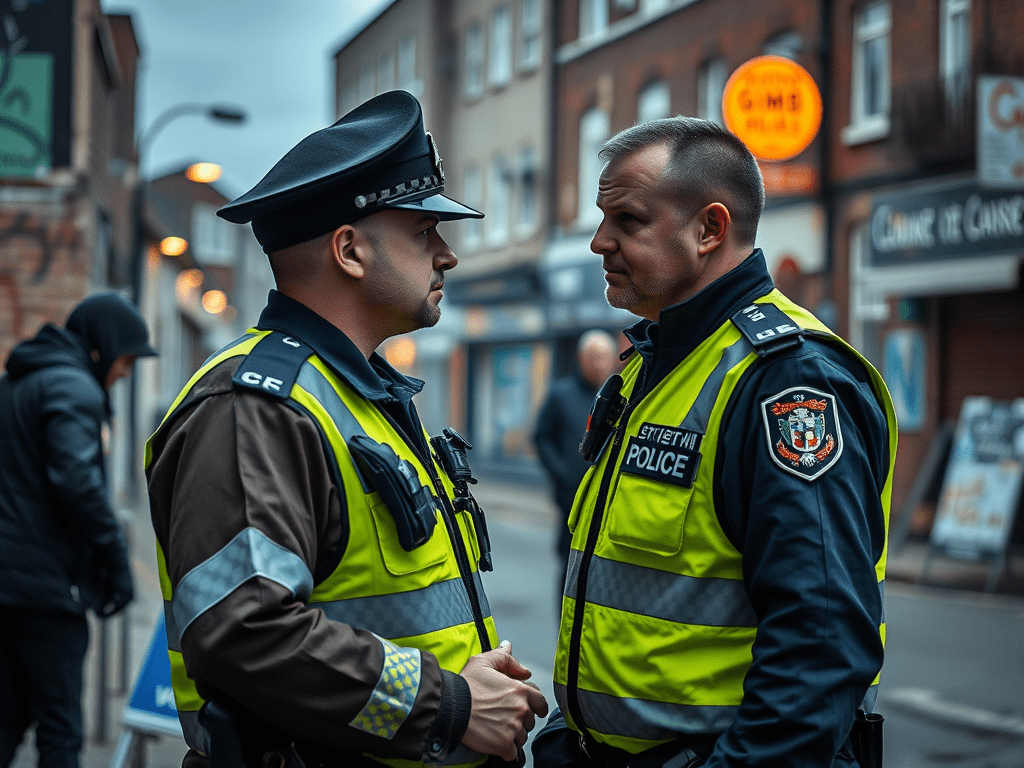
The role of the police in any society is one of fundamental importance: to prevent crime, to investigate crimes when they occur, and to ensure that those who commit criminal acts are brought before the courts to face justice. This fundamental mission has underpinned the fabric of British law enforcement for generations. However, in recent years, a troubling shift has emerged—a trend in policing which appears to prioritise the pursuit and investigation of “non-crime hate incidents” (NCHIs) over their core duty to protect citizens from genuine criminal acts.

The situation has reached a crescendo this week with the case of journalist Allison Pearson, who has reportedly been invited for a police interview over a comment made over a year ago. While the police dedicate countless hours to investigating “offensive” or “hurtful” speech, the streets are beset by more pressing issues: shoplifting, violent crime, and open lawlessness. This shift in focus not only undermines public confidence in the police force but also erodes trust in the broader judicial system. When police resources are squandered on chasing speech incidents and perceived insults rather than combatting real threats to public safety, the public inevitably suffers.

Recent months have seen a palpable increase in social disorder since Keir Starmer’s government took the reins, with issues ranging from unchecked protests to a surge in street crimes. Instances of shoplifting, often treated as mere nuisances if the value is below £1,500, are brushed aside without recording or investigation. This neglect is not isolated to petty thefts; cases of street violence, such as assaults, robberies, and even the sight of machete-wielding individuals roaming public spaces, are met with similar apathy. Instead of targeting these grave threats to society, police are, ironically, lambasting citizens who dare to raise concerns on social media about this apparent abdication of responsibility.

It is reasonable to conclude that the focus on NCHIs serves only to polarise discourse further, exacerbating tensions and resentment within society. These initiatives and investigations into non-criminal behaviours sap already stretched resources and embolden criminal behaviour in communities who witness an overstretched police force prioritising “words” over “deeds.” Law-abiding citizens are left unprotected, while those engaging in socially destructive behaviours learn that their crimes may go unpunished.

This two-tier system of policing, where serious crimes are neglected in favour of ideological policing, is unacceptable. It demands not only scrutiny but action. Those who serve as police spokespeople and leaders must know that their performance and priorities are being watched and recorded. There can be no place for policing policies that divide and alienate the very citizens who fund and rely upon them.

The police must be reminded of their primary duty: protecting the public from harm, ensuring justice is done, and maintaining public order. Anything less than this is a betrayal of public trust, and citizens will not stand idly by while this essential institution is steered off course. We demand accountability, transparency, and a rededication to core policing duties. Anything less threatens the very foundations of public safety and social cohesion that the police are sworn to uphold.

A Comprehensive Critique of Modern Policing Priorities: The Mismanagement of Public Safety

The case of Essex Police’s handling of an investigation into a social media post by journalist Allison Pearson exposes an alarming trend in policing priorities. This incident not only highlights a significant misuse of resources but also serves as a case study in the detrimental impact of this shift away from core policing duties. By establishing a “gold group,” typically reserved for critical incidents such as terror attacks, to investigate a year-old social media post, Essex Police have demonstrated an astonishing lack of focus on genuine criminal threats to public safety. This misplaced emphasis on non-crime hate incidents rather than actual criminal acts is both deeply troubling and indicative of a broader pattern of institutional failure.

Misguided Priorities and Institutional Dysfunction

The investigation into Pearson, for allegedly “stirring up racial hatred” through a social media post made in November last year, illustrates how resources can be squandered in pursuit of ideological policing goals. Police officers reportedly visited Pearson’s home without providing details of the post or the complainant, framing this matter as a potential breach of the Public Order Act 1986 and the Malicious Communications Act. Despite the force’s insistence that they have acted properly, their creation of a “gold group” to manage the case starkly underscores the troubling direction in which law enforcement is headed.

The use of such a high-level command structure for a social media incident illustrates how far police priorities have drifted from their primary purpose: protecting citizens from harm and maintaining public order. Councillor Neil Gregory’s sharp characterisation of Essex Police’s actions as “institutional incompetence and dysfunction on an epic scale” is not without merit. When forces prioritise diversity training and speech policing over tackling violent crime, open drug dealing, and serious theft, it signals a profound failure of leadership and purpose.

The Erosion of Public Trust and Safety

The broader implications of this policing approach are far-reaching. Drug-related crime, for instance, remains a serious problem across Essex, with open drug dealing regularly witnessed by residents and yet routinely ignored by police. Documents obtained by The Telegraph reveal that the force often fails to respond to 999 calls reporting drug-related incidents. Instead of deploying resources to confront these pressing public safety concerns, police appear more intent on policing speech and engaging in performative displays of political correctness.

The response from Essex Police Assistant Chief Constable Andy Marriner and others in defence of their work is, at best, cold comfort to communities left to fend for themselves. Claims of robust action against drug dealers ring hollow when residents continue to witness open drug transactions and feel the weight of police inaction. These failures undermine trust in law enforcement and leave citizens vulnerable to increasingly bold criminal behaviour.

The Consequences of Two-Tier Policing

The disproportionate focus on NCHIs and the “hurtful” words of journalists like Pearson over violent crime and open lawlessness represents a dangerous descent into two-tier policing. While genuine threats are ignored, citizens are subjected to scrutiny for expressing their views. This imbalance not only leaves communities less safe but also fuels resentment and division, eroding the very social cohesion that police claim to protect.

Law enforcement must refocus its priorities. The public demands—and deserves—a police force that dedicates its resources to preventing crime, protecting communities, and bringing offenders to justice. Anything less constitutes a dereliction of duty.

Holding Policing Leadership Accountable

Those who lead and speak on behalf of the police must understand that their decisions and priorities are under constant scrutiny. The public’s patience is not infinite. Continued mismanagement, misplaced priorities, and failures to deliver on core policing responsibilities will not be tolerated. It is time for a rededication to genuine public safety, free from the distractions of ideological policing and performative gestures.

The public is watching. We demand accountability, transparency, and a commitment to the fundamentals of policing. It is time to restore trust and ensure that the police serve their primary duty: protecting all citizens and upholding the law impartially and effectively. If our policing institutions cannot meet these basic expectations, they risk irrelevance—and the communities they serve deserve far better.

AI in Law Enforcement and Governance: Balancing Efficiency with Privacy Risks

Deep Dive Podcast:

The increasing integration of AI systems into law enforcement, governance, and justice presents a complex landscape with significant potential risks, especially when combined with Face Recognition technology. While AI has the capacity to enhance efficiency and precision in these areas, it also introduces a range of dangers that deserve careful consideration.

1. Erosion of Privacy and Civil Liberties

One of the most immediate and concerning dangers of AI in law enforcement is the erosion of privacy. The use of facial recognition technology, as mentioned, is a stark example. When deployed without clear, stringent regulations, these systems can lead to a surveillance state where citizens are constantly monitored. This not only infringes on the right to privacy but can also have a chilling effect on freedom of expression, as people will self-censor or avoid public gatherings due to fear of surveillance.

2. Bias and Discrimination

AI systems, particularly those used in policing and judicial contexts, are often trained on historical data. If this data reflects biases present in society—such as racial or socioeconomic biases—AI can perpetuate and even amplify these biases. For example, predictive policing algorithms will disproportionately target particular communities, leading to over-policing and further entrenchment of social inequalities. The Home Office’s use of AI to create profiles of “criminals” based on potentially flawed data exemplifies this danger. Bias in AI can lead to unjust outcomes, wrongful arrests, biased sentencing, and unequal treatment under the law.

3. Lack of Accountability

AI decision-making processes are often opaque, even to those who develop or deploy these systems. This lack of transparency makes it difficult to hold anyone accountable when AI systems produce erroneous or harmful outcomes. For instance, if an AI system wrongly identifies an innocent person as a criminal, determining responsibility—whether it’s the AI developer, the police force, or the government—becomes challenging. This can lead to a situation where victims of AI errors have little recourse for justice.

4. Pre-crime and the Presumption of Innocence

AI’s ability to predict behaviour based on data trends raises the troubling possibility of “pre-crime” scenarios, where individuals are targeted for actions they have not yet committed but are deemed likely to commit based on AI analysis. This fundamentally undermines the legal principle of the presumption of innocence, as individuals will be arrested or monitored based on predictions rather than actual actions. The Home Office’s recent boast about arresting 1,000 “violent criminals” who had not been tried yet suggests that this dystopian scenario is not far-fetched.

5. Concentration of Power and Loss of Human Oversight

The deployment of AI in law enforcement and governance will lead to a dangerous concentration of power in the hands of those who control these technologies. If decisions are increasingly made by AI systems with minimal human oversight, it will erode democratic accountability. Government agencies will rely on AI to make decisions that should involve human judgement by assessing the threat level of individuals or deciding who to monitor. This reliance on AI can result in dehumanisation, where people are reduced to mere data points and complex human circumstances are overlooked.

6. Potential for Abuse and Authoritarianism

The potential for abuse of AI systems by those in power is significant. In regimes where human rights are not respected, AI will be used as a tool for oppression, targeting dissidents, activists, and other marginalised groups. Even in democratic societies, there is a risk that AI will be used to suppress dissent or manipulate public opinion, particularly if used with mass surveillance and data analytics.

7. Undermining the Rule of Law

The use of AI in judicial contexts, in sentencing or parole decisions, can undermine the rule of law if these systems are not carefully designed and monitored. AI systems will lack the ability to fully comprehend the nuances of legal principles or the human context of a case, leading to unjust outcomes. Furthermore, if AI becomes seen as infallible, there is a risk that its decisions will be accepted without proper scrutiny, even when they are flawed.

8. Public Trust and Social Stability

The widespread use of AI in law enforcement and governance can erode public trust, particularly if the technology is seen as invasive, biased, or unaccountable. This distrust can lead to social instability, as communities resist or protest against the perceived overreach of AI-driven surveillance and policing. If citizens feel that they are being unfairly targeted or that their rights are being violated by AI systems, it will lead to significant social unrest and a breakdown in the relationship between the public and the state.

Conclusion

While AI has the potential to enhance law enforcement and governance, the risks it poses are large and must be carefully managed. The dangers of bias, lack of accountability, erosion of privacy, and the potential for authoritarian abuse underscore the need for strict regulations, transparent processes, and robust oversight. Without these safeguards, the integration of AI into these critical areas will lead to outcomes that are not only unjust but fundamentally corrosive to the principles of democracy and the rule of law.