
Letter XX – The Municipal Mirage

A once-civic institution, now hollowed by bureaucracy and central control.

By Martyn Walker
Published in Letters from a Nation in Decline

Once upon a time—within living memory, though now spoken of as though it were some sepia-toned idyll—the local council was exactly that: local. A modest civic body, often dull, occasionally officious, but recognisably part of the community whose money it spent. One imagines the town clerk of 1958, sleeves rolled, spectacles perched, frowning over the drainage budget with the stoicism of a man who knows he will meet the ratepayers in the butcher’s queue tomorrow morning. He was not a visionary, a strategist, a consultant, or a “stakeholder partner.” He merely fixed the roads, emptied the bins, and ensured the library opened on time. He did so because the town needed these things, and because the town paid for them.

Compare that modest creature with today’s municipal apparatus, a body swollen to the point of deformity, draped in managerial jargon and trembling under a hundred mutually contradictory regulations. Instead of the honest if plodding civil servant, we have entire platoons of officers whose professional identity is built not on service but on compliance. They do not shape the town; they interpret guidance. They do not defend local interests; they “engage” with frameworks. Their task is not to steward a place but to satisfy a central state that increasingly views local government as one more branch office—an outpost of Whitehall’s neurotic empire.

The transfiguration began when successive governments, each convinced of its own modernising brilliance, decided that the real problem with councils was that they were too responsive to their residents. Better, they thought, to strip away those old provincial arrangements and replace them with uniform “administrative units,” reorganised, rationalised and sanitised to within an inch of their lives. The result was the 1970s map: fewer councils, larger councils, and officials less likely to know the names of the streets they regulated. Efficiency, we were told. Progress, we were told. It has been downhill ever since.

A once-civic institution, now hollowed by bureaucracy and central control.

Then came the centralisers. Rate-capping, council tax limits, mandatory duties without matching funds: every lever was pulled to ensure that no local authority could so much as adjust a streetlight without permission from the capital. A Section 114 notice—local government’s version of sticking a “CLOSED FOR LACK OF MONEY” sign in the window—now hangs over dozens of authorities. The modern councillor governs nothing; he monitors a collapse, anxiously hoping that the Treasury might, in its mercy, approve a little more debt to keep the lights on.

And so to the regulations. If the older council was a steward, the modern council is a defendant—permanently awaiting judgement from a tribunal of auditors, inspectors, commissioners, ombudsmen, regulators and activist lawyers. Procurement law alone could cripple a lesser civilisation: tomes of directives dictating the precise choreography by which a council may purchase so much as a mop. The process is so paralysing that only the largest and most expensive corporations can complete it, creating a tidy cartel of outsourcers who speak the language of “KPIs” and “transformation pathways” while delivering services that are, at best, adequate and, at worst, catastrophic.

The tragedy is not merely the cost, though the cost is obscene. It is the culture. Preventive services, those quiet institutions that make a town bearable—youth centres, libraries, local works, the unobtrusive odd-jobbing that keeps a place civilised—have been amputated so that councils can funnel their remaining budget into statutory duties that grow more demanding every year. Social care now consumes the lion’s share of municipal budgets, not because councils have suddenly discovered humanitarian zeal, but because the law compels it and the courts enforce it.

Thus we inhabit the paradox of the British state: councils more elaborate than ever, producing worse public spaces than at any time since rationing. Potholes gape like geological features. Parks resemble the aftermath of a sullen strike. Planning departments take years to produce decisions that amount to artful apologies for not producing any decisions at all. What the average citizen sees is decay. What the average council produces is paperwork.

If the England of the post-war decades possessed a municipal ethic, it has been replaced by a municipal mirage: a swollen bureaucracy masquerading as governance, a system designed chiefly to protect itself from blame. It consumes money without delivering value, enforces rules without delivering order, and utters slogans about “communities” while retreating from the very notion of civic duty.

The state tells us this is progress: professionalism, standardisation, compliance, equality. But a town that cannot fix its own pavements is not progressing. A council that answers to Whitehall more readily than to its residents is not local. And a nation in which the simplest act of governance costs three times what it did half a century ago—and delivers a third of the quality—is not declining by accident.

It is declining by design. The design, as usual, belongs to people who do not have to live with the consequences.


When the state expands its procedures faster than its competence, decline arrives not as a crisis but as a schedule—issued quarterly, audited annually, and noticed by the public only when the bins stop being emptied.

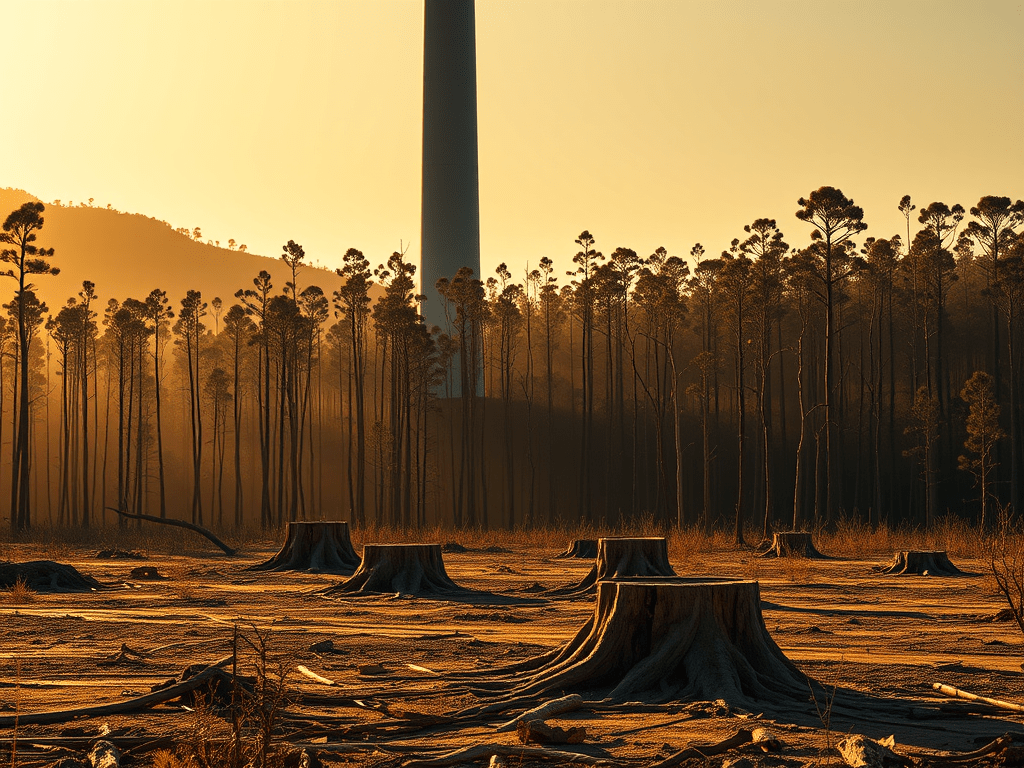
The Turbine that Ate the Forest

One of the small but telling scandals of our age is the polite silence surrounding balsa wood. Not the stuff of children’s model aeroplanes, but the industrial-scale harvest that feeds the fashionable addiction to wind turbines. Balsa became the miracle ingredient of the green priesthood: light, strong, resin-friendly. And so the forests of Ecuador were stripped with the zeal of a Victorian naval yard, only without the dignity of purpose. Criminal gangs moved in, communities were gutted, and tracts of land were left as bald as a ministerial briefing note. All this so that Europe could congratulate itself on its moral cleanliness while importing a product cut from other people’s hillsides.

The turbine itself is a monument to selective blindness. One begins with a thousand tonnes of concrete—an unlovely material normally denounced by environmentalists until the moment it becomes necessary to bury it under a wind farm. Add a steel tower with a carbon footprint large enough to keep a small nation in warmth for a decade. Crown it with vast blades made from fibreglass, petrochemical resins, and the aforementioned balsa stripped from South American forests. Then transport it all by lorry, ship, and crane, every step soaked in diesel. Install it in a wind regime that fails to meet the advertised output for all but a few postcard days a year. This, we are told, is progress.

We are further assured that the “lifetime carbon payback” justifies the exercise. That is true only in the same sense that a government budget is “balanced” when one introduces assumptions about perfect weather, flawless machinery, and twenty years of uninterrupted operation. The turbine must spin at its daily optimum for two decades, the wind must behave like a Swiss railway timetable, the grid must remain stable without the usual frantic interventions, and the maintenance crews must exist in a state of immaculate readiness. The moment reality intrudes—repairs, downtime, suboptimal wind, or a cold still winter—the ledger curls up like an old leaf and deposits itself in the bin.

Then comes the end of life, that undisclosed chapter in the Book of Green Miracles. The blades cannot be recycled; they are not aluminium cans. They are thermoset composites, cured forever, doomed to burial. So they are chainsawed into pieces and entombed in vast pits, where they will outlast most of the modern political class. One wonders whether future archaeologists will conclude that the early twenty-first century worshipped giant fibreglass idols until the cult ran out of subsidies.

But the greatest deception—the one so ingrained that ministers repeat it without hesitation—is that wind replaces conventional generation. It does not. It decorates it. Behind every elegant white tower stands a gas turbine humming away like an anxious understudy, ready to spring on stage the moment the wind drops. That backup runs inefficiently, gulping fuel in stop–start cycles that nobody includes in the official figures because it ruins the story. The whole scheme resembles a child’s puppet theatre: all charm at the front, frantic scrambling behind.

Why are we investing in this? Because it is symbolic. Because it makes the correct people feel virtuous. Because it allows officials to commission glossy reports full of charts trending in pleasing directions. And because nothing flatters a modern government more than a technology which is large, visible, and useless at the precise moment one needs it.

If we possessed any genuine environmental seriousness, we would build nuclear plants and grid storage systems, and stop pretending that intermittency is a virtue. We would stop chewing through rainforest timber to construct machines that are nowhere near as green as the press releases suggest. Instead we cheer the arrival of another imported turbine, another scar on the landscape, another concrete tomb for future generations to puzzle over.

A civilisation that congratulates itself while paving fields with foreign timber and unrecyclable plastic, all in the name of purity, is not merely declining; it is losing its mind.

Letter XIX: The Mark of Progress

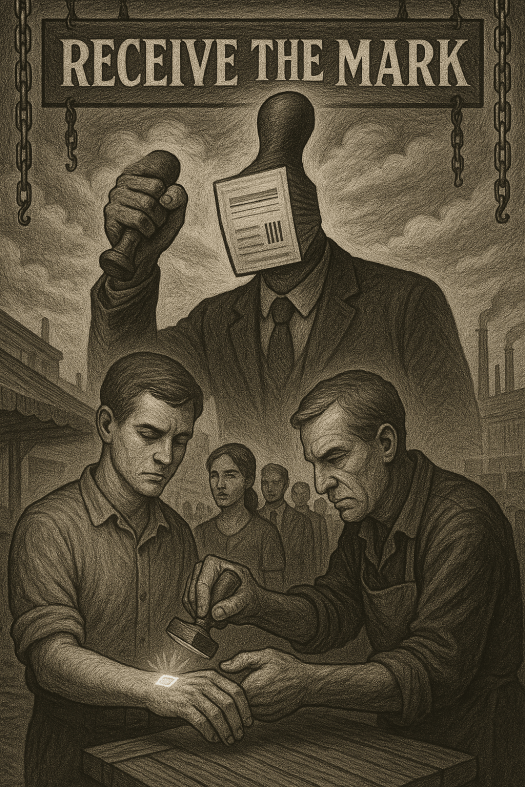
Black-and-white woodcut-style illustration of a man refused bread at a market stall because he lacks a glowing mark, while a towering bureaucratic figure with a paper face and rubber stamp looms overhead, with “666” in the clouds.

By Martyn Walker
Published in Letters from a Nation in Decline

When the state makes life itself conditional on its seal, the mark of the beast is already upon us.

It is a curious thing that whenever governments extend their reach into private life, they never describe it as such. They speak instead of convenience, safety, modernisation. Sir Keir Starmer’s championing of digital identity sounds like a minor administrative adjustment, the bureaucratic equivalent of changing the colour of the tax return form. Yet the reality is rather less trivial.

Digital identity, once imposed, is not a marginal innovation but a centralising revolution. Every man, woman, and child becomes a data entry in a state-authorised ledger, their existence vouched for only so long as the system continues to recognise them. Enter a shop, book a train ticket, apply for a job, or access a bank account — all remain possible only if the digital credential functions. The promise is efficiency; the reality is conditional existence.

The most arresting commentary on such systems does not come from libertarian pamphlets or academic studies, though both have their place. It comes from an ancient text often dismissed as melodrama: the thirteenth chapter of the Book of Revelation. There, the writer describes a society in which “all, both small and great, rich and poor, free and bond” must carry a mark, without which “no man might buy or sell.” Scholars debate whether this was first-century allegory, coded critique of Rome, or apocalyptic vision. The detail is precise: the universal credential is the universal chain.

Black-and-white etching of a man receiving a glowing stamp on his hand under a sign reading “RECEIVE THE MARK,” while a faceless bureaucrat with a paper document for a head looms above, and others queue in line.
The state’s seal presented as progress, the moment of ownership disguised as efficiency.

No theological commitment is required to see the parallel. The mark on the hand or forehead is today’s biometric key. The exclusion from buying or selling is today’s digital wallet frozen by an unseen hand. The beastly system, whether religious or secular, rests not on spectacular cruelty but on the quiet, routine denial of access. Prison walls are unnecessary if the till refuses the card.

Sir Keir presents himself as a moderniser. His case for digital ID is couched in terms of security, fraud prevention, and border control. He would bristle at any comparison with scripture. Yet it is precisely his mildness that makes the matter more sinister. Tyranny that announces itself can be resisted. Tyranny that drapes itself in the language of efficiency is harder to unpick. One does not wake one morning to discover the mark branded on the hand; one drifts into a world where participation in daily life depends on presenting the correct token at every doorway.

Defenders of such schemes protest that the British state is not tyrannical, that it will never abuse such power. This is a charming thought. It is also historically illiterate. Every government abuses the powers it acquires, and powers are never surrendered. The veto inherent in a digital ID scheme — the ability to prevent a man from buying or selling — may sit dormant, but it will never be dismantled. It rests there, like a coiled spring in Whitehall, ready to be activated at the moment of political convenience.

Nor should the economic logic be ignored. The Bank of England has spoken openly about programmable currency, which requires, by definition, a universal identifier. To know what money is being spent on, or to restrict its use to particular purposes, the state must know who is doing the spending. The marriage of digital ID and programmable money creates precisely the world Revelation describes: life conditional on permission.

That the Labour leadership fails to see this is damning enough. That it understands and proceeds regardless is worse. The old Labour Party liked to talk about liberty and dignity. The new one is content to speak of databases and compliance. Sir Keir’s tone is calm, legalistic, mildly reassuring. The punchline is that he offers Britain not security but servitude by spreadsheet.

What makes this especially grotesque is Britain’s history. This was the nation that prided itself on habeas corpus, on common law, on the principle that the citizen was free unless explicitly restrained. The imposition of a universal ID, tethered to one’s ability to transact, inverts that principle. It assumes restraint, lifted only when the system gives its blessing. The state does not prove its case against the citizen; the citizen must prove his case to the state.

Some will accuse this argument of melodrama, of importing biblical language to dignify a mundane administrative reform. In truth the melodrama belongs to Starmer, who dresses coercion in the robes of progress. Revelation, for all its imagery, is coolly accurate. It identified, nearly two millennia ago, the core of what makes such systems intolerable. They do not merely control trade. They redefine freedom itself.

The polite suggestion is that Sir Keir has not reflected on the full implications. The impolite truth is that he has. Either way the effect is identical: a government that sees its citizens not as free men and women, but as registered users, liable to be suspended. And the suspension is not noisy, with trumpets and banners. It is silent, invisible: the card declined, the ticket refused, the door that no longer opens.

Sir Keir will be remembered. He will be remembered as the man who sought to baptise bureaucracy with the language of progress. Britain can weather his speeches; what it may not weather is the architecture he is so keen to build. The peril is not a number burned into the flesh. It is a system so ordinary, so seamless, that the nation scarcely notices it already carries the mark.

The writer of Revelation recognised the pattern. The mark of the beast was never about the hand or the forehead. It was about ownership — about the moment a man’s life ceased to be his own, and became conditional on another’s approval. That is what digital ID represents today. A mark not of safety, but of possession. And the question, as always, is whether the British people are still spirited enough to refuse it.

Grandfather’s Farewell to England

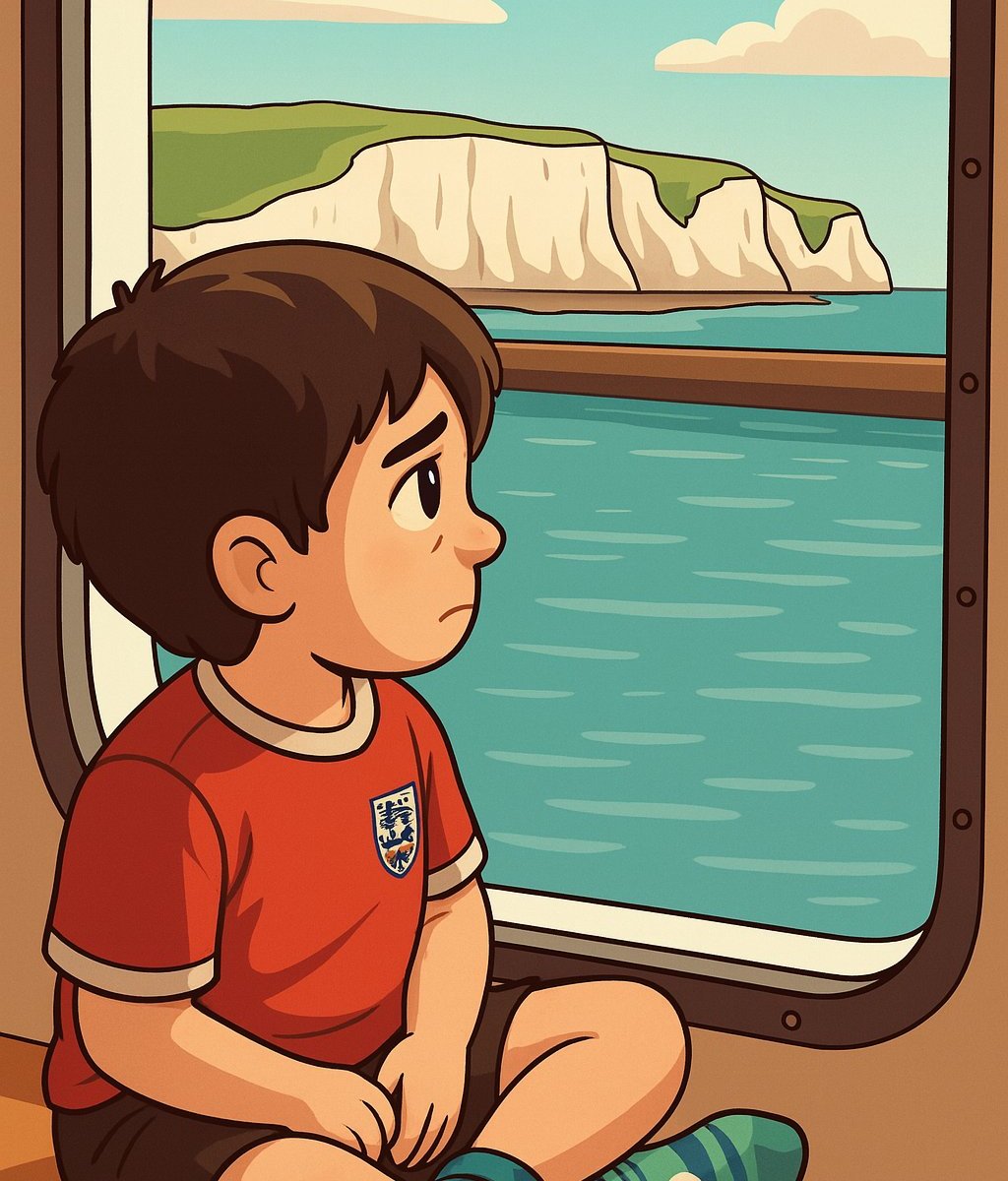
Cartoon of a young boy in a red England football shirt sitting by a ferry window, gazing sadly at the White Cliffs of Dover across calm blue waters.

By Martyn Walker
Published in Letters from a Nation in Decline

Come, sit with me a while.
There’s something I need to say—before we go.

You see that hill? I played there once,
Chased kites and kicked a ball until the light gave out.
Down that lane was your great-grandmother’s cottage,
With roses round the door and jam jars cooling on the sill.
It was a good life, not rich, but honest.
We belonged here, then.

But now…
Now the country I gave my youth to,
The one we sang for in school halls and stood for at Remembrance—
She’s gone and signed herself away.
Again. Quietly. Like a servant handing over keys.

They’ll call it progress. Integration.
But I know surrender when I see it.
We’ve lost something, lad. Something we may never get back.

So we’re leaving. All of us.
Not because we stopped loving England—
But because she stopped being England.

I’ll not come back. Not even for the spring bluebells in the woods,
Or the sound of the choir practising on a Thursday evening.
Even the things I love most would hurt to see again.
Because they’ll still look the same…
But they won’t be the same.

And one day, when you’re older,
You might ask why I speak of her the way I do—like an old friend lost.
And I’ll tell you:
She was kind. She was proud. She was ours.
And we let her slip through our fingers.

So goodbye, my England.
You were the last of something gentle in a world growing hard.
I leave with nothing but my memories,
And a tear I never thought I’d shed.

Letter XVIII: The Poverty Mirage

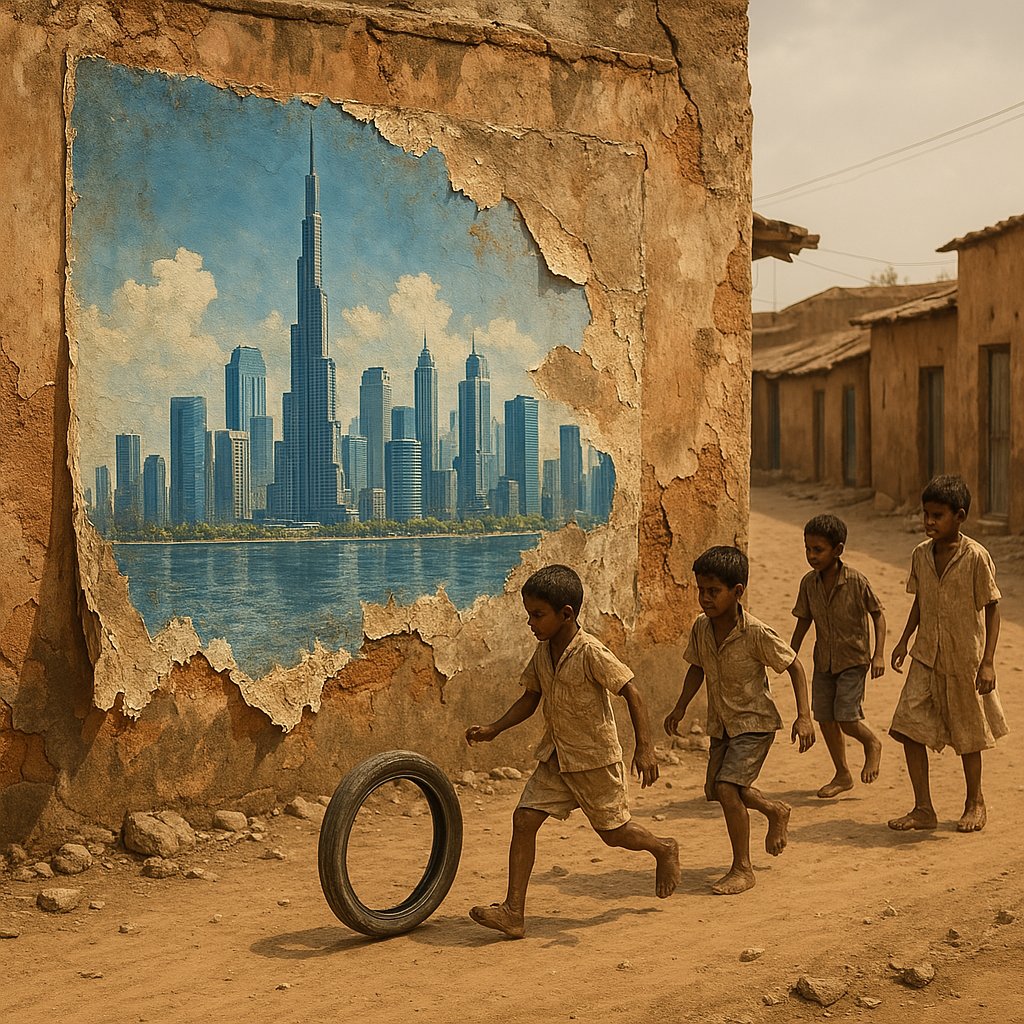
Children in a dusty village play in front of a crumbling mural depicting a futuristic Western skyline across water.

When Help Makes Things Worse

By Martyn Walker
Published in Letters from a Nation in Decline

Dear Reader,

There is a cruel illusion that stalks Western policymaking—an illusion we not only believe, but wrap in moral grandeur. It is the idea that if we lift a handful of people out of poverty, we have changed the world. A hundred million rescued, a headline for the BBC, a documentary narrated by Bono. Job done.

But what if this is the ultimate vanity project of the West? What if our relentless urge to “help” is a gilded form of sabotage?

Someone recently wrote online, with uncharacteristic clarity, that you could take 100 million people living in third-world poverty, move them to the United States, and still—still—billions would remain in that same poverty. The implication is hard to miss: the problem isn’t where the poor live. The problem is why poverty remains the dominant condition of those countries in the first place. And importing the poor to richer nations doesn’t solve the problem—it just relocates it and inflames a host of new ones.

We are encouraged to pity the migrants, not question the migration. Yet every one of those 100 million would cost billions to house, educate, subsidise, and absorb—while their departure does nothing to change the systems, cultures, or kleptocracies that bred their misery. Meanwhile, those left behind—numbering in the billions—are quietly erased from the ledger of Western concern.

And there is the sting: by rescuing the few, we abandon the many.


The road to this absurdity is paved with theological potholes and moral landmines. I recall the story of Pope John Paul II—beloved in the West for standing up to Soviet tyranny—visiting India during a time of desperate national struggle. The Indian government had, with considerable difficulty, built a network of family planning services, attempting to slow a spiralling birth rate in areas already plagued by malnutrition and drought. Charities worked hand in hand with officials to promote responsible contraception. It was not about ideology. It was about rice, water, and survival.

Then came the Pope.

With a few papal words, he condemned birth control in a country battling to feed its children. In an instant, years of careful groundwork were torched. His holiness departed in a plume of incense and rhetoric, leaving the consequences behind. He had the luxury of eternal principles. The people of India did not. The famine doesn’t care about doctrine.

This is what the West does best: it interferes. With speeches. With dogma. With chequebooks and conditions. And always, it leaves the bill with the locals.


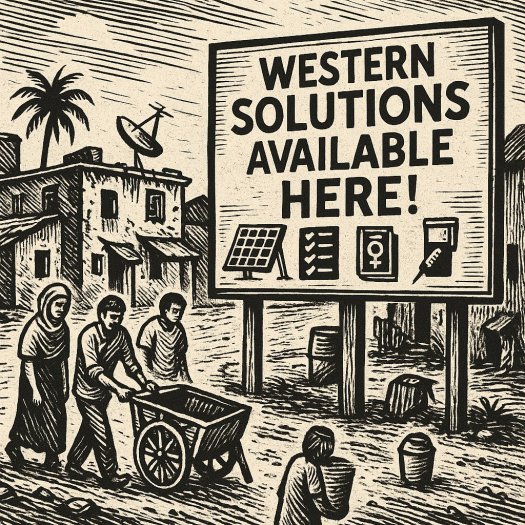
Woodcut-style illustration of a Western aid billboard in a crumbling village, with locals ignoring the sign and walking past with broken tools and containers.
A billboard proclaims “Western Solutions Available Here!”—offering solar panels, checklists, gender policy, and injections—while villagers walk past with broken carts and weary expressions.

Let us speak plainly. The developing world does not suffer from a lack of Western help—it suffers from an excess of it. Help that creates dependency. Help that erodes initiative. Help that demands ideological obedience in return. We tie aid to carbon compliance, to gender theory, to imported bureaucracy. The IMF does not give loans—it issues control. The charities do not build capacity—they replace it.

We have reached a point where the so-called “help” from the West has become more dangerous than its absence. We call it development, but it resembles colonisation wearing a rainbow lanyard.

And when the help fails, we blame the locals for “corruption” as if the World Bank is a convent of saints. Or we propose the unthinkable: that a coalition of successful nations should once again assume managerial control of the “failing” ones. We are back to empire, except this time it’s run by NGOs and ESG consultants.

And if not that, we shrug—and let nature take its course.


So what, then? Do we retreat?

Yes, actually.

But not with malice. Not with neglect. With discipline. With humility. With the honest admission that teaching a man to fish is no good if we’ve already leased his lake to China, banned his nets under EU regulation, and filled the water with World Economic Forum pamphlets.

We must learn to get out of the way. Not walk away from the world, but stop trying to run it.

Give tools, not rules. Invest without conditions. Respect local agency. Stop importing problems into Western cities just to feel temporarily virtuous. And never again should we let theology—of any kind—override common sense in a starving country.


Let us finally admit it: we have become too proud of our pity, too in love with the mirror image of our benevolence. The poor do not need our rescue. They need their freedom—from us.

Faithfully yours,
M.W.
Letters from a Nation in Decline

Of Monarchs & Minions: A Simple Guide to Brewing a Revolution

Modern politician in powdered wig stands in ruined parliament as protestors wave signs outside and tax papers swirl in the air.

History doesn’t repeat, but it hums the same tune. And if you listen closely, the melody of revolt is never far from the surface. Whether it’s a Parisian mob in 1789 or a furloughed factory worker scrolling Twitter in 2025, the triggers of revolution are eerily consistent.

So here it is: the ingredients list for a classic popular uprising. Mix and stir until boiling.


1. Popular Discontent

The yeast of any revolution. When ordinary people feel overworked, overtaxed, underheard and overruled, they ferment. In pre-revolutionary France, the sans-culottes were starving while the court danced at Versailles. In modern Britain, it’s workers using food banks while MPs remodel their second kitchens.

Discontent isn’t just about poverty — it’s the insult added to injury. When people suffer and see that no one in power cares, the pot simmers.


2. Politicians Smelling Opportunity

Revolutions need opportunists — politicians who realise the tide is turning and paddle accordingly. Sometimes they’re the Robespierres or the Cromwells, elbowing their way into history. Other times they’re more cautious, waiting to back the right crowd once it’s safe.

In 2025, political leaders flip-flopping on immigration, net zero, or free speech aren’t being strategic — they’re sniffing for the wind.


3. The Wealthy Playing Both Sides

There’s always a merchant class trying to protect their ledgers. In Tsarist Russia, the oligarchs funded moderate reformers to avoid Bolshevik firebrands. In our era, billionaires fund both progressive NGOs and Conservative think tanks — not because they care, but because they want influence whichever way the revolution tips.

Modern revolutions are rarely purely ideological — they’re part investment strategy.


4. Byzantine Taxation with Invisible Benefits

The more complicated the tax system, the easier it is to fleece the public — and the angrier they get. In 18th century France, it was the taille, the gabelle, the vingtième — arbitrary, unequal, and infuriating. In Britain today, it’s IR35, VAT tweaks, stealth inheritance freezes, and green levies hiding in energy bills.

When people can’t see where their money is going, or worse — see it going to something stupid — that’s when sparks fly.


5. Vanity Projects & Public Graft

In revolutionary France it was Versailles. In revolutionary America, tea taxes and imperial bribes. In 21st-century Britain? HS2, Test & Trace, Net Zero levies, and consultancy addiction. Enormous sums vanish, yet your local GP surgery still has a 3-week wait.

When the elite waste national wealth on baubles and boondoggles while essential services collapse, people get creative — with pitchforks.


6. Wars the People Don’t Support

Wars have always played a dual role: distraction for rulers, devastation for the ruled. The American Revolution was triggered in part by taxes to fund Britain’s wars elsewhere. Vietnam split the U.S. in half. Iraq and Afghanistan bred cynicism.

In the modern world, it’s subtler. Proxy wars, arms shipments, and military-industrial lobbying — while your town loses its library. A public who doesn’t believe in the war will start questioning who the real enemy is.


7. A Widening Gap Between Rule and Reality

When law becomes performative and leadership becomes cosplay, the people notice. Marie Antoinette played shepherdess in silk. Today’s elites preach austerity from private jets. The rules don’t apply to them — and they don’t care if you know it.

This ingredient isn’t always on the original recipe, but it’s the spice that brings it all together: visible hypocrisy.


8. Cultural Estrangement Between Rulers and Ruled

Revolutions aren’t just about bread; they’re about values. When those who rule speak a different language — metaphorically or literally — from those they govern, it breeds resentment. It might be nobles speaking French in Russia, or metropolitan elites sneering at “low information voters” in Mansfield.

Revolutions often start when the majority feel mocked, ignored, and legislated against by people who neither understand nor respect them.


9. A Trigger Event

One moment, it’s grumbling. The next, it’s barricades. A bread riot. A police shooting. A smug remark from someone in power. The Boston Tea Party, the Storming of the Bastille, the Arab Spring — all started with moments that, in hindsight, were inevitable.

What will ours be? A fuel tax? Another pandemic? A digital ID law?

We won’t know until it happens — but when it does, it’ll feel like it was always coming.


10. A Story to Believe In

Revolutions don’t start with spreadsheets — they start with narratives. A vision of a better world. Liberty. Bread. Justice. Take Back Control. People need something to believe in — even if it’s ill-defined. Especially if it is.

That belief, however messy, can move millions.


Conclusion: Are We There Yet?

Britain today has:

  • Widespread discontent ✔
  • Out-of-touch elites ✔
  • Complex taxation ✔
  • Unpopular projects draining wealth ✔
  • War spending and foreign entanglements ✔
  • Political opportunism and wealthy string-pullers ✔

And still, the nation simmers quietly. But no one turns off the heat.
History warns us: all it takes is one spark.

Letter XVII: The Illusion of Choice

Close-up of a UK energy bill with a highlighted “DEI Contribution” fee circled in red ink, illustrating involuntary ideological charges.

The Illusion of Choice – How DEI and BLM Strip British Citizens of Freedom | Letters from a Nation in Decline

By Martyn Walker
Published in Letters from a Nation in Decline

Foreword by “Peter” – a voice of weary British reason

I often find that the decline of nations is not marked by great explosions, nor by the whirring of guillotines. Instead, it comes with the quiet compliance of people who, while free in theory, are corralled in practice. Today’s Briton is less a citizen than a permitted consumer. He is permitted to complain—as long as he uses the right hashtags. He is permitted to vote—as long as both parties are aligned. And he is permitted to choose—between six identical options, all preaching the same gospel of “equity, sustainability, and inclusion.”

We are governed not by law or Parliament, but by marketing departments, HR compliance officers, and the oblique tyranny of “stakeholder capitalism.” We are a nation slowly smothered in the language of progress. And the saddest thing is this: most people don’t even notice it.

Let the following letter stand as a reminder that consent matters, that ideology must not be compulsory, and that choice—genuine choice—is the first casualty of modernity masquerading as virtue.


The Illusion of Choice

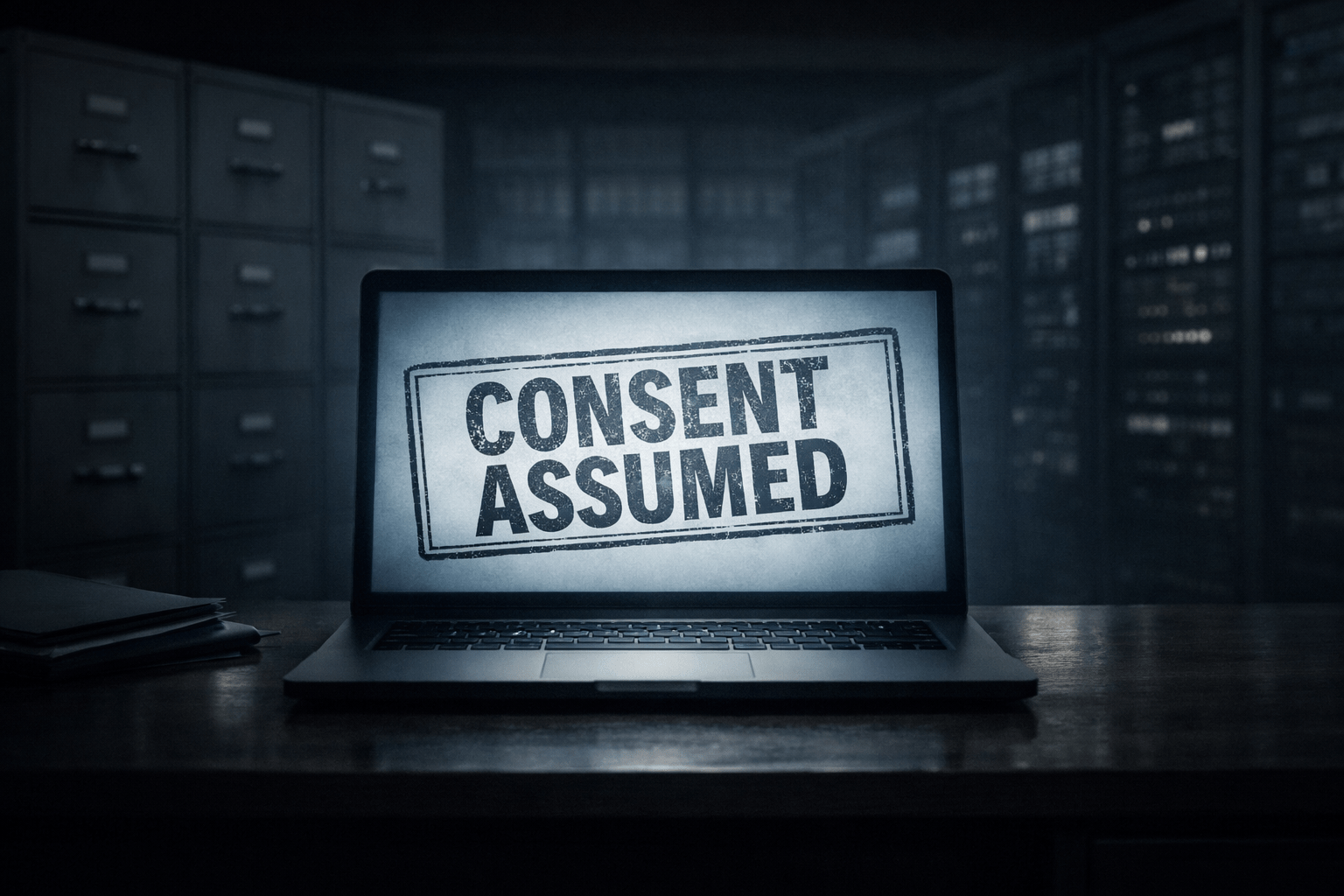
In every civilised society, the principle of consent is sacred. You do not coerce. You do not assume. You do not impose ideology on people through the back door—least of all under the guise of corporate responsibility.

Yet that is precisely what is happening in Britain today.

From our energy suppliers to our banks, from supermarkets to the National Trust, there is no longer a refuge from the ideology of Diversity, Equity and Inclusion (DEI). What was once a voluntary gesture of goodwill—an awareness of pluralism—has now metastasised into a compulsory framework. It is no longer “Would you like to support these causes?” but “You already are, and you have no alternative.”

We are not being asked to participate—we are being auto-enrolled.


Unwanted Activism on Your Energy Bill

Try switching your energy supplier in 2025, and you’ll be met with a cascade of rainbow banners, carbon offset pledges, and “anti-racist” manifestos. EDF has a Head of Equity, Diversity and Inclusion. Octopus Energy brags about its internal DEI board. National Grid runs inclusive hiring campaigns and aligns itself with “decolonisation of energy” discourse. [¹]

Ask yourself: When did keeping the lights on become a political act?

As it stands, every major UK energy provider is signed up to DEI targets or “inclusive hiring” goals. Some explicitly support Black Lives Matter, others frame their ethos around “anti-racist systems,” “unconscious bias,” or “climate justice”—the latter of which almost always entails a suite of unrelated ideological attachments.

The problem is not that these companies have views. The problem is you are paying for them, and you cannot opt out.


The DEI Industrial Complex

What began as a noble-sounding aspiration—to ensure people aren’t discriminated against—has become a sprawling ideological complex, complete with its own language, hierarchies, punishments, and rewards.

You are no longer hired for your skill. You are hired for your alignment.
You are no longer promoted for your merit. You are promoted for your “representation.”
And you are no longer protected by equal treatment. You are filtered through “equity lenses” to determine how you must be judged.

This is not hypothetical. It is written into policy:

  • The BBC’s “50% ethnic minority internships” were later ruled unlawful in design, despite being allowed under “Positive Action” exemptions.
  • NHS England’s DEI strategy includes a framework in which departments must set internal “diversity targets” and report upward on “representation gaps.” [²]
  • KPMG set a target for 29% of its partners to be from ethnic minority backgrounds. [³]

If a company were to set targets for hiring more white working-class boys from Bradford, it would be deemed racist. But reverse it, and it’s “progress.”


The Imported Workforce: A Nation That Trains No One

In 2023, net migration into the UK reached 745,000—a staggering figure in a country already facing housing, healthcare, and infrastructure strain. [⁴]

Rather than invest in British education and skills, our institutions import dependency. Skilled visa schemes are handed out to foreign graduates while British-born apprenticeships collapse. The percentage of white working-class boys attending university is now lower than any other group. [⁵]

This is not an accident. It is a result of deliberate policy.

For too long, the British state has treated its own people—of all colours—as expendable in favour of foreign labour pools. It is not xenophobia to say: we must educate our own before we import others. That is sovereignty. That is duty.


Funding Terror Through Ideology

Perhaps the most egregious example of ideological coercion lies in the quiet endorsement and financial support of organisations like Black Lives Matter Global Network Foundation (BLMGNF)—an organisation now mired in fraud, embezzlement, and open revolutionary rhetoric. [⁶]

Despite this, corporate Britain lined up to donate, sponsor, and publicly endorse the movement in 2020 and beyond. Why? Because it was fashionable. Because the HR department said so. Because to question it was to risk cancellation.

Now we learn that BLM funds were used to buy multi-million-dollar mansions, line the pockets of “activists,” and support policies far beyond race—policies that include abolishing the nuclear family and defunding the police. [⁷]

Still, the energy companies didn’t apologise. The banks didn’t reverse course. Because ideology now trumps prudence.


What Real Choice Would Look Like

Imagine a world in which you could:

  • Choose an energy supplier that doesn’t funnel money into social campaigns.
  • Choose a job without declaring your pronouns or skin colour.
  • Choose an education system that teaches excellence over identity.
  • Choose a bank that isn’t running mandatory “inclusion training” seminars.

That world used to exist.

And if we want it back, we must demand it—not with violence, nor with outrage, but with precision, defiance, and alternatives.


The Cost of Cowardice

The illusion of choice is maintained only through the cowardice of elites. I say this as someone who still receives invitations to City dinner parties—those glossy evenings where equity partners murmur their frustrations over venison and Malbec but dare not speak aloud what they know to be true.

They know this system is wrong. They know it will implode. They know DEI is a smokescreen, not a solution.

But like they did in 2008, they wait, hoping to be last in line when the crash comes. I warned them then, and I warn them now:

You are not immune. You are simply insulated—temporarily.


Conclusion: The Right to Refuse

What this country needs is not more slogans, but fewer mandates. It needs the right to refuse ideological capture in consumer life, employment, and state services.

It needs leaders willing to say:

“We serve everyone, but we do not worship ideology.”

It needs companies who will say:

“We provide energy, not indoctrination.”

It needs citizens who will say:

“I do not consent.”

Because the moment we are forced to pay for, live with, and promote ideas we do not believe in—we are no longer free.

And the British people, whether white, black, or anything in between, deserve better than servitude by algorithm.

Let the illusion of choice be exposed for what it is—a cartel of conformity dressed in the robes of compassion.

And let the revolt begin, not with fire, but with ink.


Sources

[1] https://www.nationalgrid.com/careers/inclusion-and-diversity
[2] https://www.england.nhs.uk/publication/equality-diversity-and-inclusion-strategy-2022-2025/
[3] https://www.kpmg.com/uk/en/home/media/press-releases/2021/06/kpmg-sets-new-diversity-targets.html
[4] https://www.ons.gov.uk/peoplepopulationandcommunity/populationandmigration/internationalmigration
[5] https://www.suttontrust.com/our-research/access-in-white-working-class-communities/
[6] https://www.politico.com/news/2023/04/10/blm-founder-patrisse-cullors-investigation-00090906
[7] https://www.nationalreview.com/news/blm-leaders-accused-of-funneling-10-million-to-themselves/

Letter XVI: The Development Deception

Stylised tree with yellow and green leaves on an African tricolour background of red, yellow, and green, symbolising independent growth and harmony.

On the UN’s SDGs, Western Paternalism, and the Commodification of Virtue

By Martyn Walker
Published in Letters from a Nation in Decline

Dear Reader,

There was a time when the phrase international development conjured images of progress: clean water flowing from a new pump, a smiling child with a textbook, solar panels glinting on a school roof. Today, it increasingly conjures something else: a Western official in a tailored linen suit, lecturing villagers about climate obligations while their nation’s lithium is quietly sold to Tesla and their diesel generators are shut off.

The United Nations Sustainable Development Goals—17 of them, each with bullet points and colourful infographics—were meant to herald a new global era. Eradicating poverty. Ending hunger. Empowering women. Who could object?

But slogans are easy. It is the method of implementation, and the selective blindness, that reveal the deeper truth.


The Good

Let us not be unfair. In isolation, many SDG-aligned initiatives have brought tangible benefits. Literacy has risen. Infant mortality has dropped. Boreholes and mobile money have transformed some communities. Life expectancy in many African nations has improved dramatically since the 1990s. We’ve seen school feeding programmes that allowed girls to attend school for the first time. We’ve seen solar panels providing basic electricity where the grid never reached.

But we cannot mistake these successes—often born of local grit and ingenuity—for the triumph of global strategy. The SDGs were not the cause of progress. They became its branding.


The Bad

A closer look reveals a dismal pattern: Western governments, corporations, and NGOs deploy the SDGs not as a framework for empowerment but as an operating licence—a pretext for influence and control.

  • African nations are told they cannot use their own fossil fuel reserves, lest they “violate SDG 13,” while Europe quietly returns to coal.
  • Development banks, citing SDG “clean energy targets,” refuse to fund gas power plants in Nigeria or Mozambique—countries rich in natural gas and desperate for reliable electricity.
  • In the name of SDG 12 (responsible consumption), African textile industries are wiped out by bales of cast-off clothes from Britain, Germany, and the US.
  • SDG 5 (gender equality) becomes an excuse to impose Western cultural standards with zero regard for local context, alienating both men and women.

Even the roads, ports, and railways built under SDG 9 are often financed by foreign loans, constructed by foreign firms, and designed to facilitate resource extraction, not local resilience.


The Ugly

Worse still is the moral posturing. The SDGs have become an ethical fig leaf for what is, at heart, a continuation of imperial economics by other means. The tools have changed—no more Maxim guns and map lines—but the outcomes are familiar:

  • Raw materials flow out.
  • Debt, directives, and donor strings flow in.
  • Lectures are delivered about “transparency” by those who launder African wealth into London property.

A friend in Kenya recently sent me a photograph—a cardboard sign arguing that fossil fuels are essential to achieving the SDGs, not an obstacle. He is not alone. In Ghana, Senegal, Uganda, there is growing anger that while Western nations enriched themselves through coal, oil, and gas, Africans are now told to leapfrog into solar-powered sewing machines and skip the very industries that built Britain, Germany, and the United States.

They are told they must save the planet. A planet they did not ruin.

And if they object? If their leaders push for resource nationalism or challenge the green dogma? They are punished with bad credit ratings, NGO campaigns, and trade restrictions dressed up as ethics.

“We were told to dream with the SDGs, but woke up in a minefield. They promised us progress, gave us guidelines, then took our resources and told us to be grateful.”


A Personal Turning Point

I was turned against the UN quite a few years ago when I read the transcript of a debate revealing the UN’s outrage that Google did not give UN-backed reports extra weight over non-UN ones—particularly on climate. The irony? Even their own climate scientists had expressed doubts about the overblown rhetoric spewing from the political wing. Shortly thereafter, those inconvenient internal criticisms all but vanished from search results. That was the moment many of us, curious about the truth, heard the alarm bells.

But it didn’t stop there.

What sealed my opinion was not some subtle drift into ideological territory, but the sheer absurdity of its pronouncements. Perhaps the most comical—and simultaneously tragic—example was the moment the UN Secretary-General stood in front of a global audience, announcing with a sanctimonious glare that:
“The oceans are boiling.”
He said it with the air of a pope issuing doctrine—daring anyone to challenge such claptrap. That was the day they lost even the illusion of dignity. That was the day they started believing their own lies.

At the time, I didn’t think much more of it. Like most citizens, I didn’t really know what the UN was, how it was funded, or why it existed in its current form. But since then, I’ve read more. And while I still wholeheartedly approve of the idea of the UN—born from the wreckage of world war, with noble intent—I now wholeheartedly disapprove of its continued existence in this form.

It needs to be dismantled, and rebuilt for the modern age. And crucially, it must come with a known expiry date.

There needs to be a regular renaissance in such powerful institutions. It must be written into their articles of association that they do not exist in perpetuity. That every few generations, they are dissolved, reviewed, restructured, or replaced—by those who live with the consequences of their actions, not those who fund their inertia.

Only then can future generations repair the damage of the past.


Britain’s Role in the Decline

Britain once led the world in infrastructure, finance, and engineering. Today, we lead in hypocrisy.

  • We pressure African governments to abandon hydrocarbons while issuing new oil licences in the North Sea.
  • We demand their “transparency” while our banks hold the stolen proceeds of their corruption.
  • We celebrate our aid budget, yet make it near impossible for African students, scientists, or entrepreneurs to obtain a visa.

We mouth platitudes about “shared prosperity” while making damn sure the terms are written in our favour.

Even our charities—once a source of soft power—now act like minor UN agencies, full of slogans and interns and not much else. Oxfam lectures on social justice from offices built with funds extracted from taxpayer-backed contracts in countries they claim to help.


What Comes Next?

If the SDGs were sincere, they would prioritise energy sovereignty, industrialisation, and fair terms of trade. They would acknowledge that wealth must be created, not merely redistributed. They would empower Africans to determine their own path, even if that path includes diesel trucks, natural gas, and industrial-scale fertiliser.

Instead, they’ve become a system of moral accounting where Western nations get to “offset” their consumption by dictating how others should live. Carbon credits replace common sense. ESG ratings trump economic growth. And development becomes something done to Africa, not with it.


Final Words

The tragedy of the SDGs is not just that they fail. It is that they pretend to succeed, while preserving the very inequalities they claim to abolish. They are the smiling mask of a system that would rather fund a water kiosk than allow Africa to build its own water companies.

So let us end the deceit.

The real goal is not sustainable development.
It is sustainable dependence.

And unless we say so clearly, unapologetically, and publicly, we will continue to be complicit in dressing up domination as partnership—while another generation of Africans is told they must wait, suffer, and obey for the good of the planet.

Let the record show: it wasn’t just the empire that failed Africa.
It was the ideology that replaced it.

Beneath the Halo: The Good, the Bad, and the Ugly of the 17 SDGs

They came dressed as salvation, wrapped in coloured icons and global applause. But beneath the graphics lies a mess of contradictions, compromises, and collateral damage. Here we unpack each goal—not as it was dreamed up in Geneva, but as it has landed on the ground.

A circular graphic of the 17 Sustainable Development Goals (SDGs) with each segment melting like wax, rendered in a surreal Salvador Dalí-inspired style.

SDG 1: No Poverty

The Good: Billions in aid and NGO projects have lifted individuals out of extreme poverty zones temporarily; mobile banking and microcredit schemes have shown promise.
The Bad: Aid dependence fosters inertia, bypasses national institutions, and undermines local agency. Most African nations are still net exporters of capital due to debt servicing.
The Ugly: Western corporations extract billions in raw materials while pontificating about “inclusive growth.” Poverty statistics improve, but wealth inequality worsens. The SDG becomes a photo-op for billionaires with private jets.

SDG 2: Zero Hunger

The Good: Targeted food programmes, agricultural support, and school meal initiatives have helped reduce childhood hunger in some regions.
The Bad: African farmers often sidelined by subsidised Western food imports, distorting markets. GMO push disguised as philanthropy.
The Ugly: Western companies extract palm oil, cocoa, and coffee from African soil while Africa imports wheat and rice from abroad. The hunger remains—homegrown solutions are discouraged or sabotaged.

SDG 3: Good Health and Well-being

The Good: Vaccination campaigns and anti-malaria nets have saved lives. International coordination during outbreaks like Ebola did have positive effects.
The Bad: Health systems remain donor-dependent and brittle. Drug patents and pharmaceutical monopolies keep treatments unaffordable.
The Ugly: The West lectures on population control while funding sterilisation clinics, not hospitals. During COVID, African nations were last in line for vaccines—after being blamed for variants they didn’t cause.

SDG 4: Quality Education

The Good: Literacy rates have risen. Girls’ access to education has improved in measurable ways. Donor-led digital education pilots show promise.
The Bad: Much curriculum remains colonial, prioritising Western languages and values. Local history, trades, and culture are neglected.
The Ugly: Elites send their children abroad while rural schools lack desks. The promise of education is often betrayed by a total lack of post-education opportunity—thus fuelling migration.

SDG 5: Gender Equality

The Good: Gender-based violence laws have improved; access to reproductive healthcare and rights is more prominent in policy.
The Bad: Western ideologies about gender are imposed wholesale, clashing with cultural contexts and often backfiring. Tokenism abounds.
The Ugly: Gender NGOs become tools for regime manipulation—undermining families and traditional structures without offering durable alternatives. Men are alienated and women overburdened.

SDG 6: Clean Water and Sanitation

The Good: Boreholes, sanitation drives, and community projects have improved access. Urban water utilities have seen improvements in some cities.
The Bad: Infrastructure aid often bypasses local contractors, leaving no skills behind. Many projects fall apart when donor support ends.
The Ugly: The West donates filtration kits while Coca-Cola and Nestlé extract billions of litres of water from African aquifers tax-free.

SDG 7: Affordable and Clean Energy

The Good: Solar microgrids and off-grid solutions have brought lighting and phone charging to rural communities.
The Bad: Energy poverty still affects over 600 million Africans. Fossil fuel investment is blocked by Western ESG policy, even while Europe reopens coal plants.
The Ugly: Africans are told to skip fossil fuels and use wind and solar, while the minerals to build those systems are mined from Africa under exploitative conditions.

SDG 8: Decent Work and Economic Growth

The Good: Youth employment schemes, support for entrepreneurship, and digital microbusiness infrastructure (e.g. mobile money) have opened doors.
The Bad: Most “growth” is in extractive sectors or the informal economy—precarious, low-paid, and unsustainable. Western firms set the wages.
The Ugly: Africa exports raw materials, imports finished goods, and is then scolded for not being productive. “Decent work” rarely applies to cobalt miners, plantation labourers, or garment workers sewing for Western brands.

SDG 9: Industry, Innovation and Infrastructure

The Good: Roads, ports, and telecoms have expanded. Some African nations are incubating home-grown tech hubs.
The Bad: Most large infrastructure is debt-financed, often by China, and subject to foreign engineering, foreign profit, and foreign interests.
The Ugly: The West blocks industrial policy under free-market ideology, then tells Africa to “innovate” without fossil fuels, railways, or steelworks. Sovereign development banks are discouraged; dependency is institutionalised.

SDG 10: Reduced Inequality

The Good: Domestic reforms and global awareness of inequality have gained traction; some inclusive finance models have shown local promise.
The Bad: Inequality between nations is widening, not shrinking. Aid is given with one hand and taken back with interest payments.
The Ugly: The richest 1% are mostly Western, and mostly preaching equity to the poorest 10%—while African minerals fund their electric vehicles. The hypocrisy is baked in.

SDG 11: Sustainable Cities and Communities

The Good: Investment in resilient urban planning, public transport systems, and affordable housing is theoretically rising.
The Bad: Urban sprawl without services defines most African megacities. Informal settlements are bulldozed in the name of sustainability.
The Ugly: Climate finance is used to displace communities in favour of eco-projects no one asked for. Slums grow, while the reports boast of “smart city frameworks” and pilot zones built for Western investors.

SDG 12: Responsible Consumption and Production

The Good: Some shifts toward circular economy practices, especially in agriculture and local craft industries.
The Bad: African consumption is already low—this SDG is effectively aimed at the West, but enforced in the South.
The Ugly: Africa is treated as a dump for used clothing, e-waste, and plastic, while also being blamed for overpopulation and told to “consume responsibly.”

SDG 13: Climate Action

The Good: Regional climate strategies, afforestation, and improved resilience to floods and droughts are active in some nations.
The Bad: Africa contributes only 3% to global CO₂ emissions but is expected to meet the same net zero standards that Germany and the UK now flout.
The Ugly: Fossil fuel exploration is blocked in Africa, but promoted in Norway, the US, and even post-Brexit Britain. Africans are urged to “go solar” by those flying in private jets to climate summits.

SDG 14: Life Below Water

The Good: Marine protected areas and anti-poaching drives are increasing. Some success against illegal fishing.
The Bad: Foreign vessels still overfish African waters under EU licences. Local fishers are criminalised for feeding their families.
The Ugly: Climate treaties now threaten African coastal economies with Western carbon offset schemes. Seaweed farms and “blue carbon” projects are imposed as substitutes for actual fisheries.

SDG 15: Life on Land

The Good: Wildlife preservation, reforestation, and land rehabilitation have seen gains, especially with community-led conservation.
The Bad: Green colonialism resurfaces through carbon markets, displacing pastoralists and farmers for carbon credits.
The Ugly: Land is seized in the name of “protecting the planet.” Western firms buy carbon offsets while Africans lose ancestral homes. Nature is commodified for ESG portfolios.

SDG 16: Peace, Justice, and Strong Institutions

The Good: Anti-corruption frameworks and civil society organisations have gained modest influence. Peacekeeping operations have saved lives.
The Bad: Justice is slow, Western-funded NGOs often supplant national systems, and “strong institutions” are redefined as compliant ones.
The Ugly: Foreign donors pick winners and fund “democracy promotion” selectively. When African elections go the wrong way, the SDG missionaries go silent.

SDG 17: Partnerships for the Goals

The Good: International cooperation remains necessary; sharing knowledge, tech, and capital has real potential.
The Bad: These partnerships are almost always asymmetrical—dictated by donor terms and priorities.
The Ugly: The language of “partnership” masks dependency. Africa is not an equal at the table—it is the subject of the discussion. The SDG logo sits on documents denying African nations fossil fuel loans, industry funding, or land sovereignty.

We do not reject development. We reject its monopoly. We reject a development that builds solar panels in Switzerland from minerals stolen in the Congo, only to tell the Congolese they cannot burn gas to light their homes. We reject a development that calls us partners while dictating our choices, that builds boreholes with one hand and extracts oil, copper, gold, and dignity with the other.

The SDGs were sold as salvation. What they became was a stick for beating the poor, a branding exercise for rich NGOs, and a conscience balm for corporations whose real goal is profit, not people.

The End of Diplomacy: How Trump’s $2 Trillion Deals Are Redefining Global Power

Former President Donald Trump descends Air Force One to meet Saudi Crown Prince Mohammed bin Salman during a state visit.

By Martyn Walker
19 May 2025

Diplomacy, once the art of compromise and caution, now risks becoming just another line item on a spreadsheet.

This month, Karl Mehta laid out a startling thesis: former President Donald Trump is reshaping global politics—not through ideology, defence pacts or values—but through deals. Big ones. His thread on X unpacks what he calls “Commercial Diplomacy”: a bold, borderline cynical foreign policy doctrine in which profit trumps principle, and where Boeing, Blackstone, and Howard Lutnick have more sway than the State Department ever did.

The numbers are staggering. Saudi Arabia: $600 billion. Qatar: $243 billion. UAE: $1.4 trillion. Pakistan, not to be outdone, has offered Trump a zero-tariff agreement—despite hosting 15 U.S.-designated terrorist organisations. Even Syria got a pardon of sorts, with all sanctions lifted after a handshake with its new president—himself a former Al Qaeda commander—brokered not by a diplomat, but by Crown Prince Mohammed bin Salman.

And yet, this isn’t chaos. It’s commerce.

Trump’s model doesn’t attempt to shape the world through diplomacy. It simply pays it off, then rents the influence. It’s foreign policy by acquisition, not negotiation. No grand speeches. Just signatures on multi-billion-dollar contracts, often with the very regimes traditional diplomacy was meant to contain or reform.

So where does that leave the UK?

Britain: Value-Driven or Value-Discounted?

For decades, Britain’s foreign policy has clung to moralism like a life-raft—promoting democracy, human rights, transparency, and soft power. But in this new world order, soft power looks decidedly limp. When the Americans roll into Riyadh with fighter jets, AI labs, and energy infrastructure on the table, a politely worded communiqué from the FCDO simply doesn’t compete.

Worse still, Britain’s diplomatic machinery is designed to operate through institutions—NATO, the UN, the Commonwealth. Trump’s approach bypasses all of these. His preference is the side door, the backchannel, the golf course—where a handshake matters more than protocol and a Boeing order matters more than a NATO summit.

If this becomes the dominant diplomatic model—and there are signs that even China is responding to it—then Britain faces an unpalatable truth:

A nation that trades on its moral high ground will soon find itself outbid.

Opportunity… or Isolation?

To be clear, this doesn’t have to spell decline. Britain could adapt its commercial instincts to the diplomatic arena, building strategic economic packages that align with its values without surrendering them entirely. That means giving the Department for Business and Trade the same global remit as the Foreign Office. It means getting British businesses a seat at the diplomatic table—and giving diplomats a crash course in deal-making.

But we must move fast.

The Middle East is being redrawn, not by war or revolution, but by contracts. Whoever controls the infrastructure, the energy corridors, the AI data centres, and the ports will command influence for decades. If British firms aren’t part of this transformation, then British foreign policy will become commentary—not participation.

The India-Pakistan Trap

There’s another risk. Trump’s eagerness to deal with Pakistan, despite its terror links, threatens to strain Western alliances with India—just as Britain tries to deepen its own Indo-Pacific strategy. Can we afford to take a moral stand against Islamabad while Washington undercuts us with duty-free access?

Once again, commercial diplomacy doesn’t care about appearances. It rewards utility, not loyalty.

Closing Thoughts

What Karl Mehta revealed wasn’t just a set of contracts. It was a warning. The world is moving fast—and money, not manners, is determining the pace.

Britain now faces a choice.

Either embrace commercial diplomacy, with all the uncomfortable compromises it entails—or become the well-spoken relic of a world that no longer exists.

Because in this new era, diplomacy is no longer what you say.

It’s what you bring to the table—and what you’re willing to sign.

Karl Mehta’s Original Post

A picture of Trump and MBS in discussion

A Single Rose in Tianjin: The Quiet Legacy of China’s Last Emperor

An elderly Chinese man in a grey worker’s uniform and cap delicately trims a rose bush in a quiet courtyard. The background shows a traditional Chinese building with tiled roofs, symbolising the serenity and anonymity Puyi found in his final years as a gardener.

From throne to trowel, this poetic reflection traces the life of Puyi—from imperial captivity to peaceful obscurity—revealing how China’s last emperor found dignity not in power, but in planting a single flower.

The Last Gate

It did not feel like exile. It felt like air.
Crisper than I had expected, colder than I had ever known. Outside the red walls, the wind behaved differently — it had no memory, no protocol, no need to announce itself. In the Forbidden City, even the wind bowed.

My shoes were wrong for this. Soft soles meant for silk carpets, not flagstones wet with Beijing’s early winter. I was dressed formally — not for ceremony, but out of habit. When you are Emperor from the age of two, dressing down feels like treason.

A general, or perhaps a policeman — it’s difficult to say who wore what in that period — motioned silently to the cart. A rickshaw. Not even a carriage. I didn’t protest. I stepped in. The wheels squeaked. Behind me, the vermilion gate closed. Not loudly. Just… finally.

I looked once over my shoulder, half-expecting some retainer to appear, to whisper “There’s been a mistake, Your Majesty.”
But no one came.

The gate, with its nine brass studs across each panel, was just a gate now.

A Guest with No Kingdom

The Japanese legation compound stood in the old Legation Quarter — a leftover from another era of humiliation, where Western powers and Japan had carved out slices of my capital and flown foreign flags above our soil. Now I arrived not as emperor, but as a guest without a kingdom. My welcome was polite, mechanical. They called me “Your Majesty” with the tone one might use to address a child who still insists on being called “Captain” weeks after losing his toy boat.

They offered me a modest suite — carved screens, lacquered panels, a writing desk too ornate to be useful. I tried to write once. A diary entry. I tore it up. It was all adjectives and no feeling.

Reginald Johnston visited once or twice, his eyes grey with something like pity. He had been my tutor, my friend, my bridge to the modern world. He had tried, in vain, to prepare me for life outside the walls. Now he stood awkwardly in the threshold, hat in hand, watching as the world he once translated for me now consumed me whole.

“You’re being treated decently?” he asked.

“Yes,” I said. “As a museum piece is treated.”

He frowned. “Don’t let them use you, Puyi.”

I laughed then — a thin, sharp sound. “Is there another option?”


The days passed slowly. I was neither free nor captive. Not a prisoner, but not allowed to leave without permission. The staff brought meals. Courteous, distant. The Japanese advisors came often. Polite at first, then more confident. They spoke of destiny, of restoration, of Manchuria.

“You were born to rule,” one said, eyes gleaming behind round spectacles. “And Manchukuo needs a ruler.”

I asked what “Manchukuo” was. He produced a map. A puppet outline of a country that did not yet exist. I was to be its emperor. A new dynasty, they said. Modern, orderly. Japanese-guided, of course — but mine in name. They called it a sacred duty to the people of Asia.

I stared at the map. I saw no throne. Just train lines, coal fields, military zones, factories.

But I nodded.

I told myself this was my chance to make something of the past. A bridge between eras. That I would rule wisely. That I would not be a puppet.

But deep inside, I knew the truth.

They were offering me a costume. And I, desperate for the applause of history, was too vain to refuse.


Nights were the worst. In the Forbidden City, I had often heard nothing but the rustle of robes and the distant call of drums. Here, the city was alive. Trams screeched. Men shouted. Radios buzzed with unfamiliar music. Beijing no longer whispered. It shouted over me.

I once ventured to the edge of the compound, where I could see the street. A child ran past, laughing, chasing a paper kite. He did not bow. Did not look. He had no idea who I was.

And for the first time in my life, I felt something close to envy.

Not of his freedom — I did not yet understand that.
But of his irrelevance.

Manchukuo: The Emperor’s Mask

They met me at the station in Changchun with banners and artificial smiles. It was 1932. Snow dusted the rails, clean and bright, like the surface of a lie. They had renamed the city Xinjing — “New Capital.” I was not fooled by the name. New cities are not built from steel and slogans, but from trust and soil. This had neither.

My arrival was staged like a play. Soldiers lined the route. Schoolchildren waved flags none of them understood. The Japanese officials smiled with the smug satisfaction of stage managers watching their puppet enter stage left on cue.

I was led to my new residence — not a palace, but a mansion. Square, sterile, built in Japanese modernist style. It had everything except history. No ghosts in the beams, no echoes in the stone. Just furniture polished to the point of absurdity, and paper walls that let in every sound except truth.

They called me “Emperor of Manchukuo.” But I was no longer even the shadow of an emperor. I was a figurehead for a nation that existed on maps printed in Tokyo and nowhere else. The cabinet ministers were Japanese. The military was Japanese. Even the food on my table bore the flavours of Kyoto, not Beijing.

I once asked to appoint my own minister of justice. The request was met with a pause, followed by a soft “We will consider it.” I never received a reply.


And yet — part of me welcomed the theatre.

I wore the robes. I stood on balconies. I signed decrees written in a language I no longer trusted. I delivered speeches full of rhetoric about harmony, progress, and Asian brotherhood, knowing full well the brother wore a sword.

The throne was a polished chair. The sceptre was a fountain pen. The empire was a lie.

But I smiled. I told myself lies too. That I was keeping China alive, even in exile. That I would regain influence. That I could guide the future from behind the curtain, like the old regents in the Hall of Supreme Harmony.

But when I looked at my reflection in the lacquered black of my desk, I saw no Son of Heaven. I saw a young man rehearsing authority. A borrowed emperor, seated atop a ventriloquist’s stand.


My court was a museum. We paraded rituals whose meanings had vanished. There were still kowtows, still officials in Qing dress — but their eyes were empty. One courtier told me of his new Japanese watch, then bowed three times with perfect formality. Another drank heavily and muttered that “emperors are for calendars.”

Once, during a storm, the power failed. The lights went out. No one moved. I sat alone in the throne room, lit by a single candle someone had placed near the dais. The wind howled outside. I imagined the Japanese standing just beyond the walls, watching, smirking, waiting for me to panic.

I did not. I sat there, silently, until morning.

And that was when I knew.

I was no longer even pretending to rule. I was pretending to be me.

The Collapse

The empire ended not with gunfire, but with silence.

It was August 1945. The Japanese had surrendered. Hiroshima had been flattened. Nagasaki followed. I heard the news in fragments — a nervous official with cracked glasses whispered of “unconditional surrender,” his voice trembling more from disbelief than fear.

In Manchukuo, the Japanese commanders vanished almost overnight. Uniforms were stripped, flags burned, papers dumped into fireplaces that hadn’t been lit in years. The palace, once a hive of surveillance and staged ceremony, became eerily quiet. A few aides remained — confused, loyal, or simply too late to flee.

I was told to flee. “Your Majesty, we must get you to safety.”

Safety. An interesting word for a man who had never known what danger truly was.

They put me on a plane — a Japanese military transport, rusty and unreliable. It lifted from a makeshift runway with smoke on the horizon and my stomach full of dread. I was still carrying the imperial seal, tucked in a velvet pouch beneath my coat, as if I could stamp my way out of oblivion.

We didn’t get far.


The Soviets found us in Mukden. I had hoped they would treat me as a dignitary. Perhaps allow me exile. Perhaps hand me gently to the Americans, who, I told myself, might appreciate the novelty of an emperor.

Instead, I was loaded into a truck, then a train, then a grey building where my name had no value.

The Russian guards did not beat me. They did not speak to me. They watched. Like I was something in a jar.

I was held in a place called Khabarovsk — a military compound of concrete and questions. The food was bland but sufficient. I was not mistreated. Just… neutralised. I spent my days staring at frost-rimmed windows and wondering if they would ever call my name again.

They didn’t.

Weeks became months. The winter froze even my thoughts. I began to doubt I had ever been emperor. The court, the robes, the rituals — they felt like scenes from a play I had performed in too long ago to remember. I dreamt of the Forbidden City, but the colours were fading. The yellow roofs, the incense, the calligraphy — they drifted in my memory like petals on water.

One night I asked the guard for a pen. He didn’t understand. I mimed writing. He shook his head.

I never tried again.


Eventually, they handed me over.

It was 1950 when the Soviets, tiring of their Chinese trophy, gave me back. Not to restoration, as I had once fantasised, but to the People’s Republic — a country reborn in slogans and cement.

I was told I would be “re-educated.”

At first, I laughed. Quietly, but bitterly. How do you re-educate someone who had never been properly educated in the first place?

But I was sent to Fushun War Criminals Management Centre all the same.

There were no guards with whips. No chains. Just beds, grey walls, and a new kind of theatre — one where the audience and performers were the same. Each morning we woke, saluted Mao’s portrait, and recited lessons. We confessed. We critiqued one another. We debated ideology with the earnestness of drowning men describing the sun.

And slowly, something happened.

I stopped lying. At first in small ways — admitting fear, embarrassment, vanity. Then in larger ways — admitting complicity, cowardice, blindness. I read Marx not because I believed, but because I needed something to fill the hollow.

I swept floors. I cleaned toilets. I wrote pages of reflection, trying to understand how I had become so empty, so used to being used.

I began to believe the re-education was working.

Not because it gave me truth.

Confession and Re-education

They gave me a grey uniform and a number.

I was no longer “Your Majesty,” no longer even “Puyi.” Just inmate 981. At Fushun War Criminals Management Centre, names were an indulgence of the past. We had categories now: traitor, collaborator, counter-revolutionary. I was all three. I wore it like a second skin, stitched by the choices I had convinced myself were survival.

My first task was to sweep the corridor. It took me two hours — not because it was long, but because I had never held a broom. The bristles caught on the uneven concrete, and the handle gave splinters. My palms bled, a quiet rebellion from hands that had once signed edicts on silk scrolls.

I thought the guards would jeer, or mock. They didn’t. They watched. Always watching. Like gardeners waiting to see if a buried seed would sprout or rot.


The real punishment was not physical. It was dialogue. Every day, group sessions. Eight men in a circle, stools arranged like a tribunal. We recited the “Three Critiques”: critique of the self, of others, of the imperialist past.

At first, I spoke in abstractions.

“I was misled by my advisors.”
“I was unaware of the suffering.”
“I was a child in the hands of stronger powers.”

But they weren’t interested in excuses. They wanted blood. They wanted my soul, or the admission that I had never had one to begin with.

So I began to say it.

“I betrayed my country.”
“I aided the invaders.”
“I let men die for the sake of my throne, which was not a throne at all, but a prop.”

The first time I said those words, something cracked. Not loudly. Not like a bowl shattering. More like the subtle sound of paper tearing down the spine.

I cried that night, in the dark. Not out of sorrow. Not even guilt. But confusion. I no longer knew what was true. Was I sorry because I understood? Or because they wanted me to be?


Months passed. Then years.

I kept confessing. First out of fear. Then habit. Then, unexpectedly, relief.

The act of confession became something like prayer. A form of worship — not to Mao, not to Marx — but to reality. To clarity. I began to recognise patterns in myself: the vanity of my boyhood, the selfish hunger for status, the constant search for someone to blame.

I once watched a fellow inmate — a former general — break down after admitting he had ordered executions for personal revenge. He sobbed like a child, then looked at me and said, “I thought I was serving order. I was just cleaning up after my own pride.”

I nodded. I understood. The line between order and vanity had blurred for both of us long ago.


One afternoon, I was brought before a tribunal. Not for sentencing, but for evaluation.

A man in a brown tunic — expressionless, his hair thinning — asked me, “What are you now?”

I replied, “I am a Chinese citizen.”

He raised an eyebrow. “Not a monarch? Not a victim?”

I looked at the floor.

“I am… a man who once thought he was above other men. Now I am simply one of them.”

He nodded. Wrote something. The meeting ended. Three months later, they told me I would be released.


I left Fushun with no fanfare. I had entered a prisoner. I exited a man with a folded shirt, a toothbrush, and a modest pension from the state. The gate did not feel like freedom. It felt like air again — familiar, cold, and indifferent.

I looked at my hands. They were rough now — scarred from work, not warfare. Fingers once manicured by eunuchs now calloused by years of scrubbing floors and cleaning latrines. And yet, for the first time in my life, they felt like they belonged to me. Not instruments of ceremony or symbols of inherited rule — just hands. Capable, honest, and mine. I had learned how to use them — not just to sweep or carry, but to live without illusion. That, above all, was what re-education had given me: not truth, but the slow, merciful removal of every lie I had once mistaken for purpose.

The Faces of Revolution

I returned to Beijing like a man waking from a long illness. The streets were unfamiliar. Not because they had changed — though they had — but because I now saw them without tinted glass. I was no longer carried, protected, or observed. I was simply… present.

The old palaces had been turned into museums or offices. The alleyways buzzed with bicycles and vendors. No one bowed. No one saluted. Most didn’t look at me at all.

That, more than anything, felt like freedom.

I lived in a small government dormitory, a concrete building the colour of boiled rice. I was given a ration card, a basic stipend, and instructions not to “interfere in political affairs.” I had no intention of doing so. The only affairs that concerned me now were water, soil, and light.


The job came through a Party liaison — gardening assistant at the Botanical Institute. I was to weed, water, and prune. A peony bed in the south courtyard became my first charge. I tended it as one might an old friend who had returned after many years — quietly, carefully, and with unspoken regret.

One crisp morning, as I knelt beside a row of sweet osmanthus, a voice behind me said, “Your Majesty, may I?”

I turned sharply.

An older man stood there, lean, stoop-shouldered, his face weathered like dry parchment. He wore the standard blue Mao tunic, but there was elegance in his stillness.

“I used to serve you,” he said, with a gentle smile. “You wouldn’t remember me. Few did.”

I stood slowly. “You’re mistaken. I don’t—”

“No, no,” he said, waving the air gently. “I didn’t expect you to. I polished brass hinges in the Hall of Mental Cultivation. Daily. For ten years. We saw each other most mornings — though I doubt you saw me.”

He bowed, not out of deference, but familiarity. A habit he hadn’t quite shaken.

I stared. “You’re right. I don’t remember. I’m sorry.”

He smiled again, more warmly this time. “There’s nothing to be sorry for. You were a prisoner. A gilded one, but still a prisoner. Every meal brought on a tray, every opinion chosen for you before you spoke. You saw what they wanted you to see.”

His clarity startled me. “I thought I was ruling.”

“You were being managed,” he said softly. “That’s not the same.”


We sat on a nearby bench, the garden blooming quietly around us. He introduced himself simply as Mr. Shen. No surname, no titles. Just a name carried through decades like an old coin in a deep pocket.

I asked about his life.

“Uneventful, mostly,” he said. “Which is a kind of blessing. We were poor. Still are, in truth. But I married. We had four children. One died. Three live. One teaches maths, one drives a coal truck, and one —” he paused, chuckled, “writes slogans for the Ministry of Culture. He’s very clever. I don’t understand half of what he says, but it sounds patriotic, so I nod.”

I laughed with him.

He turned his gaze to the gravel path. “I was almost beaten to death once.”

I blinked. “By whom?”

“Japanese soldiers. 1942. Caught me with food I wasn’t supposed to have. It was meant for a starving neighbour. I said nothing. Took the beating. They left me half-conscious in a shed near the railway.”

He scratched the side of his neck thoughtfully.

“One of the younger soldiers returned. A boy, really. Barely seventeen. He was shaken. Said he didn’t agree with what had happened. Asked if I needed water.”

“Did you take it?” I asked.

“No. I gave it to him. He had a wound on his arm. Nothing terrible, but infected. I cleaned it. Told him how to wrap it.”

“Why?” I said, surprised.

Mr. Shen tilted his head. “Because he was human. And I didn’t want to carry more hatred. It’s heavy.”

I said nothing. He continued.

“Three days later, that boy came back with forged documents and whispered a single name to me. A Korean merchant who smuggled people out through a checkpoint. My wife and I took the risk. We walked three nights and didn’t look back.”

He rubbed his knees. “Sometimes one life is saved by another. Without ever knowing it.”


We sat in silence for a while. The scent of damp earth and chrysanthemum drifted on the breeze. I turned to him.

“Do you think I can still be… of use?”

He looked at me calmly. “You already are. You’re here, aren’t you? You’re speaking truth. You’re planting things that will outlive you. What more do you want?”

I sighed. “To know I was more than just a mistake.”

Mr. Shen put a hand on my shoulder. “You weren’t a mistake. You were a boy placed in an impossible role. Now, you are a man choosing a quiet one. That is something.”


That night, in my room, I picked up my small journal. I wrote just one sentence:

“Today, I met someone who remembered me as I was — and forgave me as I am.”

A vibrant bouquet of pink and white peony flowers in full bloom.

Peonies and Dust

The peonies arrived in April, shy and swollen with promise.

They emerged slowly, with the kind of patience I had never been taught. First a green bud, tight and folded like a secret. Then a hint of blush, then pale pink petals that unfurled as though remembering something. I watched them each morning with the reverence once reserved for court ritual.

They were neither obedient nor indifferent — simply alive. They grew with no ceremony, no command. And they did not need me to bloom. My work was only to remove the stones, to guard against disease, to ensure water reached where it must. That, I had come to believe, was enough.

The old instincts still flickered now and then. When someone bowed a little too deeply, I stiffened. When I heard the word “Majesty” on the radio — even in reference to foreign royalty — my breath caught for half a second.

But those moments passed more quickly now.


I began to see people differently too.

A woman who worked the compost heap, hands stained brown to the wrists, taught me how to turn kitchen scraps into soil. A Party clerk, who used to draft propaganda posters, gave me a cutting from his grandfather’s orchid and said, “Even slogans need beauty.” The quiet girl from the herb garden read poetry aloud on Tuesdays, her voice trembling only when she recited from memory.

No one cared who I had been. Most had never heard of me. A few thought I had been an actor.

And in that anonymity, I found something extraordinary — not freedom exactly, but permission. To be.

I had never been allowed to be before. Not as a child-Emperor locked behind walls. Not as a puppet ruler blinking into cameras. Not even in Fushun, where I had to confess my soul in someone else’s language.

Now, I carried water. I turned soil. I spoke plainly.


One afternoon I caught myself scolding a boy — a volunteer who had crushed a patch of young chrysanthemum with his bicycle.

“You don’t understand,” I snapped. “That bed took two seasons to root properly!”

He looked terrified.

I stopped, realising how absurd I must have sounded. I exhaled slowly, crouched beside the damage, and showed him how to lift the roots gently, how to replant what could be saved. He listened, wide-eyed. I realised I was smiling.

Later, I wrote:

“Once, I ruled men who feared me. Now I teach boys to be gentle with roots. This is better.”


At dusk, when most had gone home, I often stayed behind. Not out of duty — I was no longer trying to impress anyone. But because the light in the garden was kind in the evening, slanting low and gold across the stone paths. Dust would rise in the air, catching the sun, and for a brief moment everything seemed suspended — like the final page of a story before the book is closed.

Sometimes I’d find Mr. Shen there, watching the light with the quiet satisfaction of a man who has earned nothing and regrets even less.

“You’ve changed,” he said one evening, handing me a flask of warm tea.

“Not sure that’s the word,” I said. “More like… unravelled.”

He nodded. “Then perhaps now, finally, you’re becoming someone.”


I often thought about legacy. Not the statues and names engraved in stone. That kind of legacy was too fragile, too prone to melting under a new flag. No, I had come to see legacy in a different way.

In the health of the soil.

In the bloom of a flower long after the hand that planted it has turned to dust.

In the young gardener who will one day step into my patch, dig with the same care, and never once wonder who planted the first root.

And that, I thought, was as it should be.

Visitors in the Garden

It began with a photograph.

Someone — perhaps a Party functionary, perhaps a former court hanger-on who had reinvented himself — had published a grainy image of me in a gardening cap, pruning shears in hand, beside a rosebush. The caption read:
“Former Emperor Puyi: Now a Model Citizen.”

It was meant as propaganda. Proof of the revolution’s success — look how even the last emperor tills soil beneath the watchful eye of the People’s Republic. But Beijing is a city of whispers, and whispers travel faster than any newspaper.

Within weeks, they started coming.

Not in crowds. Not with banners. Just one or two at a time. Middle-aged women with hesitant smiles. Men who lingered at the garden gate, pretending to read the plant names. Some approached quietly, with eyes full of history.

“Were you…?” they’d ask, almost embarrassed.

“Yes,” I would say, before they finished. “That was a long time ago.”

Sometimes they asked for my opinion on politics. I had none to give. Sometimes they wanted stories from the palace. I shared a few — gentle ones, uncontroversial. Tales of dragon robes and carp ponds. I left out the loneliness. The watching eyes. The hunger to matter.


One day, a man in a Western coat arrived with his daughter. He bowed slightly — the kind of bow that had muscle memory behind it.

“My grandfather worked for you,” he said. “He called you the ‘quiet boy behind the yellow screens.’”

I nodded. “That sounds about right.”

He held out a photograph. It showed a young boy — me — standing beside an ornate table, face blank with duty, hands too still.

“I just wanted to thank you,” he said. “For being part of our history.”

I looked at the photograph for a long moment. Then handed it back.

“Better to be part of the soil now,” I said, pointing to the chrysanthemums behind me. “At least those bloom on time.”


But not all the visitors came with soft intentions.

One woman, perhaps in her fifties, stood glaring near the peony bed for over an hour before finally approaching.

“My father died in Manchukuo,” she said. “Fighting the Japanese. He blamed you.”

I swallowed. “He wasn’t wrong.”

She seemed taken aback.

“I didn’t know him,” I said, gently. “But I know what it is to be used.”

She stared at me for a long while. Then, almost reluctantly, said, “He used to grow peonies, too. In Hebei.”

She didn’t smile. But she didn’t spit, either.

And then she left.


I discussed it later with Mr. Shen.

“They come to see a relic,” I muttered.

“No,” he said. “They come to understand what history means when it’s no longer in a book. You are not a relic, Puyi. You are a footnote with breath. A name that still answers.”

“I wish they’d forget me.”

He raised an eyebrow. “Then why did you answer her?”

I had no reply.


That evening, a young woman — no more than twenty — came with a sketchpad. She sat quietly on the far bench, drawing the late-blooming roses. As she left, she walked past me and said, “Thank you for tending the garden. My grandmother always said emperors were cold. But flowers are not.”

I smiled. “They’re not. But they bruise easily.”

“So do emperors,” she replied, and walked on.


In the weeks that followed, I noticed fewer stares. The novelty faded. The soil remained. The blooms came and went. The visitors stopped asking questions.

And I was grateful.

Because I was beginning to realise:
When people stop needing your past, you’re finally allowed to have a present.

The Autumn of Names

Autumn brought the smell of dry earth and rotting leaves. The chrysanthemums held out longer than expected — gold and deep crimson — but even they surrendered eventually, their petals curling inward like old letters sealed and forgotten.

I found the season oddly comforting. There was no pretence in decay. No ceremony in falling leaves. Just the slow and honest unraveling of life’s excess.

It was then that I began to think more often about my name.

Aisin Gioro Puyi.
Son of Heaven. Lord of Ten Thousand Years. Last Emperor of the Qing.

Once, those syllables had summoned palaces to attention, caused ministers to kneel, and filled rooms with the sharp rustle of silk against marble.

Now, they lived only on faded calligraphy and bureaucratic records. Even the local Party office referred to me simply as “Citizen Pu.” Sometimes, on forms, I signed “Aisin Puyi.” Other times, just “Puyi.” Once, I forgot and signed only “Pu,” and no one corrected me.

A gardener by any name, after all, still weeds the same way.


But names mattered, didn’t they? Names were how history remembered you — or didn’t.

The name “Emperor” had long since detached from me like a title deed to a house that no longer existed. Sometimes people still used it — mostly older folk, out of habit, not loyalty. The younger ones found it curious, even amusing.

One boy, no more than sixteen, once asked, “Did you really believe you were chosen by heaven?”

I thought about it, and said, “No. But I believed I wasn’t allowed to question it.”

He nodded with a wisdom beyond his years. “That’s how most people feel about fate, I think.”


I began to sort through my things.

I owned very little — a few books, some tools, an old photograph of the Forbidden City taken from the air. I folded my spare tunic. I sharpened my pruning shears and oiled their hinge. I made small notes in the margins of my gardening ledger.

There was a time when I imagined writing memoirs — grand volumes in gold-trimmed covers, filled with insight and imperial dignity. Now I thought perhaps a single page would do. Not about the throne. Not even about the war.

But about the peony.

How it struggles in its first year, confused by the shock of transplantation. How its roots twist against stones, slow to settle. How its first bloom is modest — hesitant, even — but if tended with patience, it returns stronger each spring.

There was a kind of metaphor there, I supposed. But I had long stopped pointing them out.


One evening, Mr. Shen found me beneath the ginkgo tree, a rake in my hand, my back aching.

“You should rest,” he said. “You’re not young anymore.”

“I was never young,” I replied, wincing slightly.

He chuckled. “That’s true. You skipped straight from cradle to crown.”

I sat on a nearby stone, brushing leaf dust from my sleeves.

“Do you ever wonder how they’ll remember us?” I asked.

Mr. Shen rubbed his chin. “I think most people won’t. At least not properly. We become names in textbooks. Or anecdotes. Or nothing.”

He paused.

“But memory isn’t legacy. Legacy is what you leave growing. What flourishes when you’re no longer looking.”

I looked at the ginkgo’s golden fan-shaped leaves scattering around us.

“I hope they forget me completely,” I said, “but keep the flowers alive.”

He nodded. “Then you’ve already succeeded.”


That night, I wrote one final note in my journal:

“There are names carved in stone. And there are names whispered in spring when something blooms and no one knows why. I have no interest in the stone.”

A Single Rose

It bloomed late.

A rose — small, ivory white, almost shy — on the far edge of the western bed, where the soil had always been stingy and the sun reluctant. I hadn’t planted it. Not directly. Perhaps it was a graft from an older root, or a survivor of some careless gardener’s forgotten trial.

But there it was. Unexpected. Unasked for.

And quietly perfect.


That morning, I knelt beside it with the care one might offer a relic or a final confession. I touched a petal — soft as breath — and let my fingers linger. It trembled slightly under the weight of the breeze, or perhaps time.

I didn’t call anyone over. I didn’t record it in the garden log. I simply watched.

Around me, the city moved — bicycles on gravel paths, distant loudspeakers reciting slogans, the slow sweep of a broom on concrete. Beijing in its new skin.

Inside me, there was no longing.

Not for palaces. Not for ceremony. Not even for forgiveness.

I thought of the men who had bowed to me. The women I had married but never truly known. The courtiers, the generals, the Party instructors, the guards. Even the Soviet interpreter who once told me I spoke Mandarin like someone reading an opera libretto.

And then I thought of Mr. Shen. Of the compost woman. Of the boy who crushed the chrysanthemums. Of the girl who read poetry. Of the rose, quietly defiant in the stubborn soil.

And I smiled.


When I stood to leave, I plucked the rose — not for display, not for ceremony — but as a gesture to the life that grows when no one is watching.

At home, I placed it in a small jar. No water. No vase. Just a cracked ceramic cup once used to rinse brushes in the palace school. The rose stood perfectly still on the table as I made tea.

That night, I dreamt I was planting trees. Not alone. Not for an empire. Just planting.

And no one called me emperor.

And no one needed to.

Seen from behind, an elderly man in a long brown coat walks down a tree-lined path toward ornate iron gates, carrying a single white rose. The golden light of sunset bathes the scene, evoking a quiet, romantic sense of farewell and closure.

Epilogue

When I died, there was no parade. No black horses, no imperial wailing. Just a modest cremation and a government-issued notice of passing:
“Citizen Pu Yi, aged 61.”

But the garden still stands.

And every few years, a single white rose appears on the western edge of the bed.

No one knows who planted it.

But it blooms just the same.

A single white rose with a subtle hint of pink lies on its side against a soft white background, symbolising remembrance, grace, and the quiet passage of time.

A Single Rose in Tianjin

No throne remains, no court, no crown,
Just whispers in a northern town.
Where once he ruled, now silence grows—
His legacy: a single rose.

In Tianjin’s heart, on Anshan Road,
A garden where his story slowed.
Jingyuan, the Garden of Serenity,
Holds echoes of his identity.

From emperor to gardener’s grace,
He found his peace in this quiet place.
No longer bound by royal decree,
He tended plants with humility.

Visitors come, the curious kind,
Seeking traces he left behind.
But find instead a tranquil scene,
Where history and nature convene.

No monuments of marble stand,
Just blooming flowers by his hand.
A testament to life’s repose—
His legacy: a single rose.

Visiting Jingyuan (Garden of Serenity):

  • Location: No. 70 Anshan Road, Heping District, Tianjin, China.
  • Getting There: Accessible via Tianjin Metro Line 1, Anshan Road Station, or by buses No. 3, 50, 673, 632, and 800.
  • Opening Hours: Tuesday to Sunday, 8:30 AM – 12:00 PM and 1:30 PM – 4:30 PM. Closed on Mondays.
  • Admission: Approximately 20 Yuan.

Jingyuan, once Puyi’s residence, now serves as a museum preserving the memory of China’s last emperor and the serenity he found in his final years.