
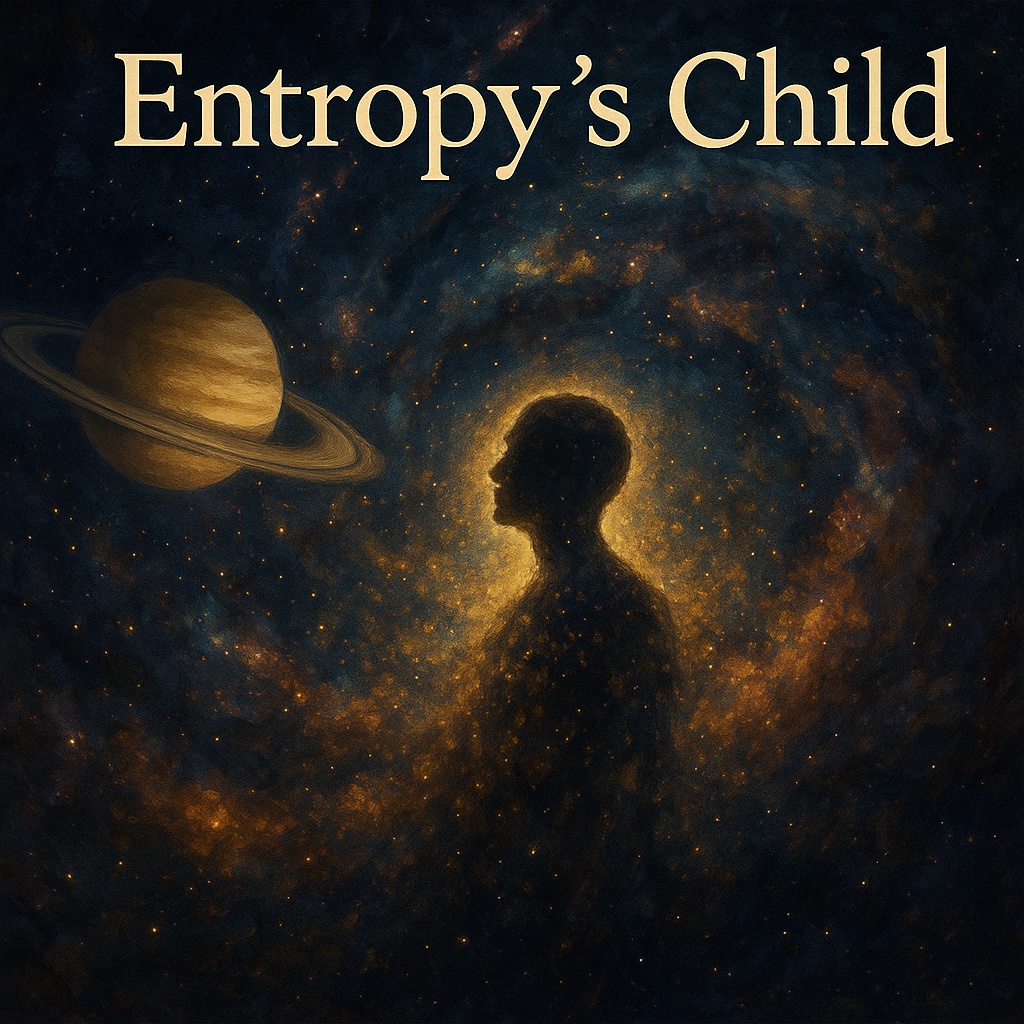
Entropy’s Child

Digital painting for the poem "Entropy’s Child," showing a glowing human silhouette dissolving into stardust against a cosmic background, with Saturn to the left and swirling galaxies behind.

The universe, vast and timeless as it turns,
One among infinite, where eternity burns.
Each atom, each thought, a unique, fleeting spark,
In the grand, endless dance of light and of dark.

If time is unending, if space has no edge,
Then what of the self, with no memory to pledge?
This life is a moment, a breath in the flow,
Yet in infinite cycles, we rise and we go.

The universe spins with no purpose or will,
Indifferent to wishes, yet wondrously still,
In this vast, restless cosmos, might we not return,
As the stars keep on burning, as the galaxies churn?

So perhaps we shall live, time and time once more,
In a universe infinite, with mysteries galore.
What can happen will happen, and thus we may see,
In the grand wheel of existence, the return of you and me.

Authors Note

Although the rhythm and subject of this poem differ, those familiar with The City of Dreadful Night by James Thomson will detect an underlying current that owes much to that remarkable work.

This poem was written in 1974, during my time at Belmont School, Holmbury St Mary. It was inspired by a debate organised by our English Literature teacher, Mr Ballantyne. The topic was “Reincarnation is real”. I was on the team tasked with arguing in favour — no small challenge for an 13-year-old who had, at the time, no idea what reincarnation was.

To prepare, I retreated to the school library and began my research (encouraged and assisted by Mr Ballantyne himself). There, in a rather ancient encyclopaedia (I suspect it predated Britannica by several decades), I stumbled upon a passage quoting James Thomson (BV), which conveyed in essence the belief that death is final. Regrettably, I can no longer recall the precise quotation, and indeed The City of Dreadful Night offers so many bleak and masterful reflections that it is difficult to pinpoint which one it was.

Nonetheless, I remember vividly how deeply Thomson’s writing struck me. His sombre vision of life left a lasting impression. Over fifty years later, certain passages still linger in my mind — testimony to the power of his words.

You will find the full text of The City of Dreadful Night on Project Gutenberg. In particular, you may notice how the poem presented here draws upon the mood and tone of the four stanzas that begin as follows:

The world rolls round for ever like a mill;
It grinds out death and life and good and ill;
It has no purpose, heart or mind or will.

“While air of Space and Time’s full river flow
The mill must blindly whirl unresting so:
It may be wearing out, but who can know?

“Man might know one thing were his sight less dim;
That it whirls not to suit his petty whim,
That it is quite indifferent to him.

“Nay, does it treat him harshly as he saith?
It grinds him some slow years of bitter breath,
Then grinds him back into eternal death.”
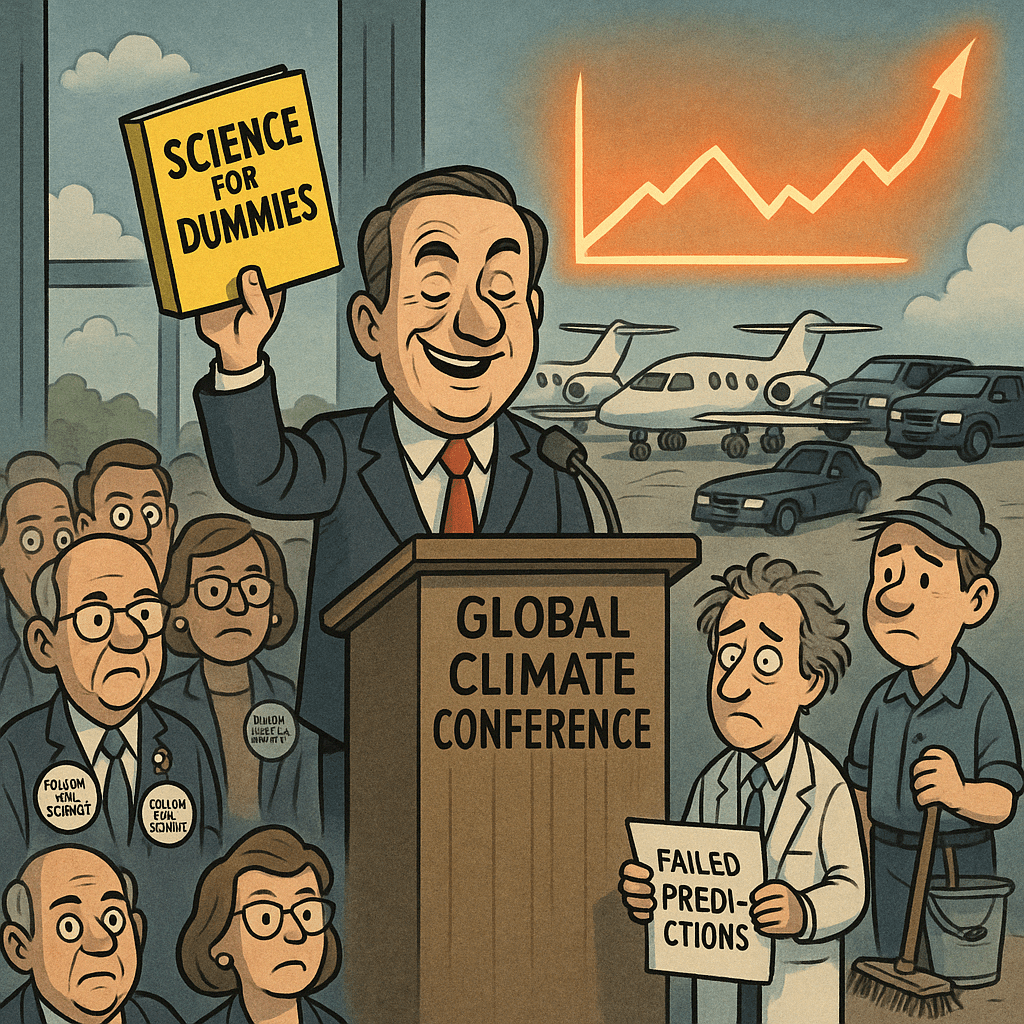
Let’s Make Science Great Again

A satirical cartoon showing a politician holding “Science for Dummies” at a global climate conference, while private jets and SUVs sit outside and a janitor points to failed predictions.

They gather each year to honour the Earth,
With banners and buzzwords and questionable mirth.
They chant “follow science!” with glassy-eyed cheer,
But the method they follow? It’s nowhere near.

They assume, then predict, then assume what they guessed—
If it fits what they feel, it must be the best.
They model the sky, they model the sea,
But test what they claim? That’s heresy.

They worship the models like relics in glass,
Forget every dud from the decade that passed.
And still they parade with unfounded pride—
While science itself sits shunted aside.

Let’s go back to basics, like Aristotle once taught:
“Test your idea—or it’s not worth a thought.”
You can’t prove it’s true just ‘cause you hope or you care,
But one bad prediction? That truth isn’t there.

Yet here we are still, with graphs in a stack—
The famous old hockey stick stubbornly back.
Its blade defies logic, its shaft splits the skies—
A medieval warm-up? Deleted. Revised.

And thus, the believers, in labs and in suits,
Build castles on sand and declare them as roots.
If a storm hits the coast or a summer gets hot,
“That proves it!” they cry. (But of course it does not.)

Where’s Feynman’s demand to “bend to the test,”
To discard the idea that performs second-best?
Where’s Popper’s sharp blade to cut through the fog,
To banish the sacred from the scientific log?

Instead we get headlines and Parisian scenes,
Of leaders who fly in on CO2 dreams.
A standing ovation, champagne in their hand—
Then off to Davos to lecture the land.

This isn’t science, it’s pantomime stuff.
The numbers don’t add, and the method’s not tough.
They’ll say “the consensus,” and smugly they grin—
But if thinking is outlawed, how can we win?

Science is doubt. It’s question. It’s test.
It’s not your emotions dressed up in a vest.
It’s not the applause of a well-funded team—
It’s asking the question that shatters the dream.

So this Earth Day, pause. Take stock. Look again.
Are these prophets with laptops or children with pens?
Let’s teach them the method, the rule and the way—
And maybe, just maybe, we’ll earn what they say.

Let’s bring back the rigour, the courage to doubt—
To test every claim, to throw the weak out.
Let’s shame the lemmings, restore the domain,
Let’s Make Science Great Again.

The Cosmic Dance: Sun, Moon, and Earth Explained

The Earth, the Moon, the mighty Sun,
Three bodies bound, yet each one spun,
To dance in patterns vast and true,
A clockwork waltz in cosmic blue.

The Moon, a mirror, cold and bright,
One-four-hundredth of the Sun’s great might,
Yet placed so perfectly between,
That solar halos can be seen.

A burning crown, a ghostly ring,
That bends the light, a fleeting thing—
The shadow cast, a measured veil,
A story told on cosmic scale.

And soon again, the world will gaze,
As twilight falls in midday haze.
On August 12th, in twenty-six,
The Sun and Moon their magic mix.

From Iceland’s shores to Spain’s embrace,
A fleeting night will take its place.
And Castellón, a golden land,
Will darken by the Moon’s own hand.

At half past eight, as day still glows,
The Sun hangs low, the shadow grows.
A veil of dusk will flood the skies,
As daytime dims before our eyes.

For ninety seconds, night will reign,
A ghostly crown, a silver chain—
The corona’s fire, soft yet wild,
A ring of light, the heavens’ child.

And though the Sun will rise once more,
This fleeting dark we can’t ignore.
A hush will fall, a gasp will rise,
As day dissolves in star-lit skies.

Yet even now, the dance goes on,
The balance held, the rhythm strong.
The planets move in silent grace,
Their orbits tied in time and place.

Beyond, the stars like diamonds shine,
Yet each one dwarfs our burning line.
A billion fires, a billion years,
Their light still flickers as it nears.

A universe of measured chance,
Of weight and balance, time and dance—
As if some sculptor’s careful hand
Had shaped the sky and drawn the land.

Yet here we are, so small, so brief,
Awake within a world of grief,
Yet blessed to see, to think, to know,
That stars still shine, and rivers flow.

So gaze in wonder, ask and seek,
For space is vast, and we are meek—
But in its vastness, thought takes flight,
And minds can touch the edge of light.

The Journey of an Electron: From Wind to Power

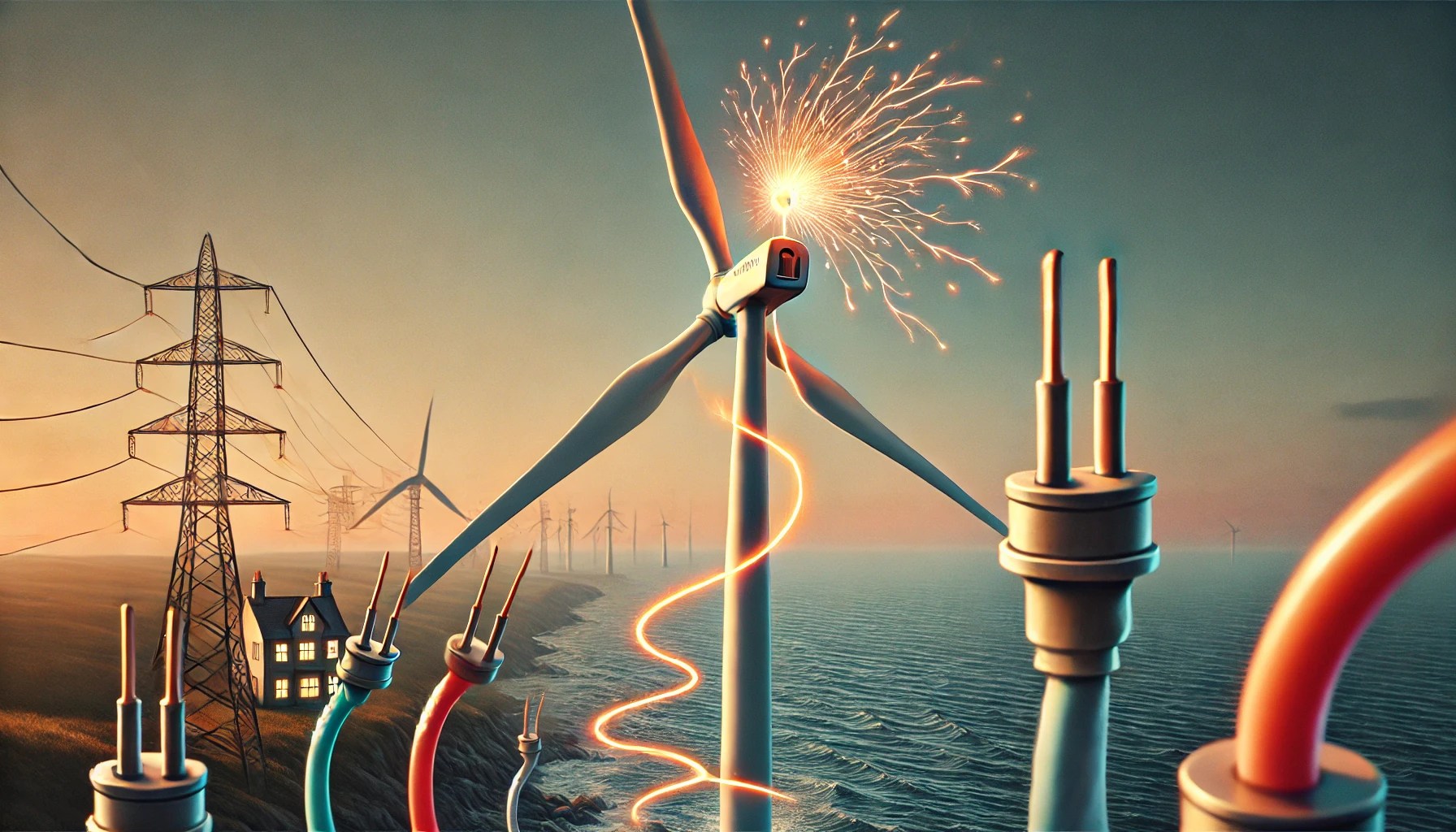
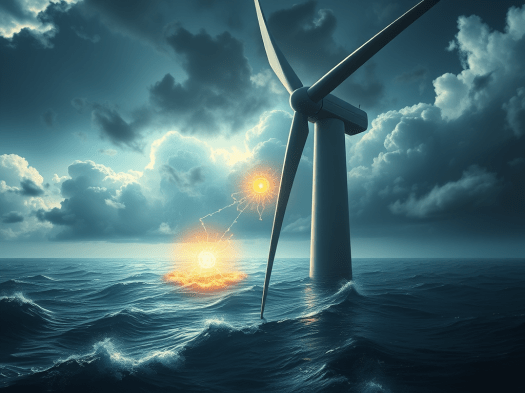
a-majestic-wind-turbine-standing-tall-against-the-backdrop-of-the-north-sea-its-blades-gracefully-slicing-through-the-air.-a-whimsical-animated-spark

Far out where the North Sea rages wide,
A wind turbine turns, with majestic pride.
Its blades slice the air, in a dance with the breeze,
Harvesting power from the tempestuous seas.

In the heart of the turbine, deep within,
A spark of life begins to spin.
From the hum of the generator, strong and true,
An electron is born, both fresh and new.

“Go forth, little one,” the currents decree,
“Ride the wires from the depths of the sea.
Adventure awaits on the grid’s great span,
Lighting the world as only you can.”

Through copper veins, it speeds away,
Guided by circuits that never stray.
First to a substation, where its path is aligned,
With others like it, all perfectly timed.

“Oh, what is this?” our electron exclaims,
As transformers whisper its burgeoning name.
Stepped up in voltage, it surges with glee,
Destined for shores far beyond the sea.

Overland cables and pylons so tall,
It dashes through valleys and heeds every call.
Across hills and rivers, through cities so bright,
Its purpose grows clearer with every light.

At last, it finds a cosy abode,
In a London home on a quiet road.
A humble toaster, plugged in the wall,
Awaits the electron’s fateful call.

“Now’s my moment!” it thinks with delight,
As it enters the toaster and gives it a light.
The coils glow red, the bread turns to toast,
The electron achieves what it treasures most.

But its journey’s not over; no, there’s more to unfold,
Its energy spent, its story retold.
For once it’s released, it flows ever on,
A river of charge in the great electron song.

Perhaps it’ll return to the deep, restless sea,
To be born anew in a turbine’s decree.
Or light up a bulb, or power a train,
An endless cycle, again and again.

So here’s to the electron, brave and small,
Whose journey begins with a turbine’s call.
From wind to your toaster, it plays its part,
A tiny hero with a boundless heart.

The Dance of North Pole

The Earth spins round, with poles aligned,
But magnetic north is hard to find,
It shifts and sways, it doesn’t stay,
A restless wanderer, night and day.

Deep below, the molten flow,
Of iron churns, a fiery glow,
It stirs the field, with unseen might,
And nudges north, just out of sight.

From pole to pole, it drifts each year,
A moving target, never clear.
Secular change, both slow and grand,
Reshapes the compass in your hand.

Beneath the ground, a hidden hoard,
Of iron veins, or magma stored,
Can skew the needle left or right,
A local trick, a puzzling sight.

And far above, the sun may flare,
Its storms can twist the magnetic air,
A brief disturbance, fierce and bright,
That fades again with fading light.

So when you roam, or sail the sea,
True north may not where you will be.
For in this world, both bold and grand,
Magnetic north slips through your hand.