
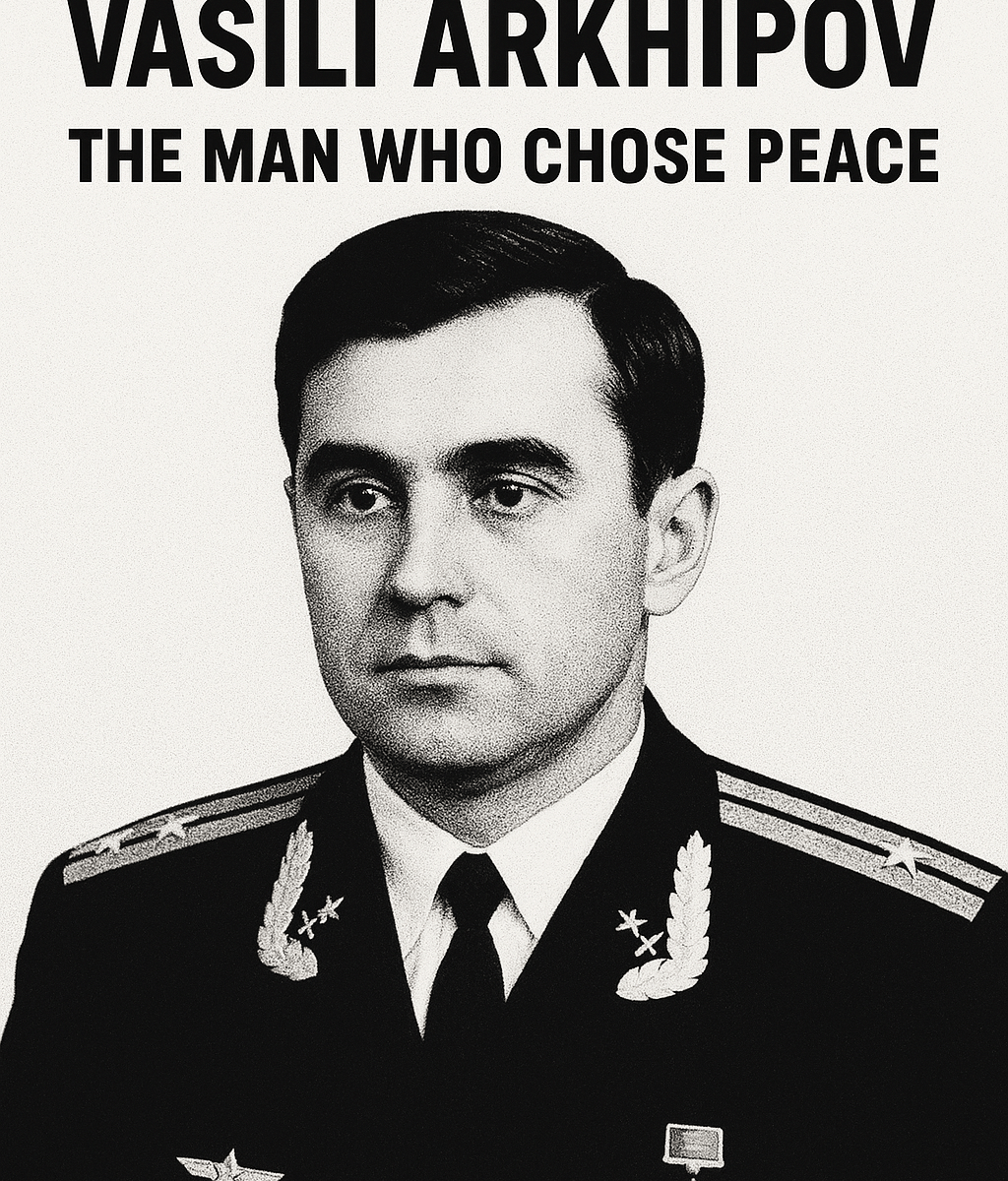
Unsung Heroes Series: Vasili Arkhipov — The Man Who Chose Peace

Vasili Arkhipov, Soviet naval officer, remembered for preventing nuclear war in 1962.

Fear Holds Its Breath

In a room without air,
no fire was struck—
only eyes meeting silence.

The world braced for thunder,
but one man listened
to the stillness between shouts.

He did not flinch.
He did not roar.

He said — not now,
and the fuse went cold.

In a world fuelled by narratives of conquest, where glory is often bestowed on those who press the button, pull the trigger, or march forward, it is rare to find the hero who is remembered for doing — nothing. Yet, in October 1962, as the world hovered on the brink of nuclear annihilation, a soft-spoken Soviet naval officer named Vasili Alexandrovich Arkhipov made a singular choice: not to strike back.

That choice may have saved the world.


The Forgotten Officer on Submarine B-59

During the height of the Cuban Missile Crisis, Soviet submarine B-59, armed with a nuclear-tipped torpedo, found itself cornered by American destroyers in the Atlantic. Mistaking depth-charge signals for the onset of war, the sub’s captain and political officer voted to launch. Arkhipov alone refused.

He held the authority to veto. And he used it.

By insisting on restraint and persuading the crew to surface, Arkhipov likely prevented a nuclear exchange. He bore the consequences of surfacing in silence, without accolade, and returned to service as if nothing had happened.


Grace in Defeat

The act was not cowardice, nor was it a victory in conventional terms. It was a moment of calm wisdom in the middle of chaos. Arkhipov knew he might be court-martialled or disgraced. Yet he stood still. He accepted humiliation. And in doing so, he preserved peace.

History barely recorded him. His story only emerged decades later, long after his death in 1998. And still, most do not know his name.


The Man Who Refused to Win

Arkhipov’s story reminds us that the true measure of courage may lie in restraint, not retaliation. His is a legacy of moral clarity — a refusal to escalate when all signs screamed for reprisal.

Sometimes, the greatest hero is the one who chooses not to fight.

And the world turned on his silence.

Bogdan Dragos, this post is for you

Today I came across a fascinating poem which reminded me of Interrupted, something I began during Covid but could not find what I was looking for. The magical power of suggestion found in Bogdan’s she died by the time childhood ended is exactly what I wanted–I just didn’t know it. You can read Bogdan’s poem here, and next are my thoughts on this vespertine lyric.

It’s Schrödinger’s cat wrapped up in art as if sculpted by Michelangelo on his best day

It is a modern existential lyric in the surrealist tradition, composed in restrained free verse and reads like Schrödinger’s cat rendered in verse—an exploration of uncertainty, consciousness, and transformation—wrapped in the kind of artistry one might expect if Michelangelo had turned to poetry on his most inspired day. It stands suspended between states: life and death, waking and dreaming, real and imagined. The girl from the shade is both maternal figure and metaphysical idea; the whistling both lullaby and flatline. With sculptural precision and emotional restraint, each image is carved into the page rather than merely written, revealing a depth that rewards quiet contemplation. It is not only a meditation on mortality, but also an argument that what we believe to be illusion may, in the final moments, become our only reality.

The beauty in the words flows with grace and subdued pace. Contemplating them reveals a magic, let me show you what I mean:

He dozed off into the warm sun sets a tranquil scene. He’s relaxing, maybe even sleeping, but there’s a tension: the shade at his head / but not touching him—as if death is approaching, near, but not yet arrived.

It was her hand that touched him introduces a figure—the girl from / the shade—which could symbolise death or some archetype of comfort. She’s maternal, nurturing: she breastfeeds a child, she whistles wholesome tunes. There’s both sensuality and innocence in this image.

The girl he knew was not real / but no longer cared—this is crucial. He knows she is a vision, maybe a figment of his imagination or a hallucination as he slips into unconsciousness. But by now, he no longer cares—he has let go.

As the light above him / was shaded by heads looking down on / his face—this places us beside his body. Others are gathered around him, implying he is physically dying—perhaps outdoors, as people gather to mourn or tend to him.

The whistling grew / into a single interminable note—a masterful line. The comfort of her music gives way to the flat, continuous sound: the note of a flatline. The emotional tone pivots here, from ethereal dream to stark finality.

He knew she will / soon be real—this is the final paradox. She wasn’t real in life, but she will be in death. She represents whatever the dying man is moving toward: peace, a memory, an afterlife, or simply nothingness personified.

Everything will be—a beautifully suspended ending. This last line evokes a metaphysical calm, or perhaps a return to unity. The verb “to be” is left without an object, suggesting completeness beyond definition. It’s one of those endings that feels like both a full stop and an opening door.

Interrupted

She was the postmaster’s daughter—
fifteen, and serious about everything.
Even laughter.

We spoke of love
like people twice our age
but felt it
like fire at our fingertips.

I remember her hand
on my arm
when we agreed
not to rush.
Both virgins.
Both afraid
of what forever might cost
if we touched it too soon.

We gave each other
everything
but the one thing
we wanted most.

We shared time
in hours
on benches,
by rivers,
between letters,
through windows.

When Denmark called me
and Edinburgh called her,
we said the right things.
We meant them.

For a year
our voices travelled the length of Europe
on wires and stamps.

Then
one day,
nothing.

No letter.
No call.
No reason.

I rang her house.
They’ve moved,
they said.

No forwarding address
for a girl who still lives
at the edge of my life
in a memory
with her hair tied back
and a promise in her pocket.

Not all love stories end.
Some are simply
interrupted.

Interrupted (Part II)

The Old Man Remembers Robyn

I am 85.
There are days
I can barely stand
without remembering
how she stood beside me,
barely sixteen,
looking serious
about everything.

The mirror gives me
this brittle husk.
But behind the eyes—
that boy is still there.
Still hoping for a letter.

Did she marry?
Did she cradle
grandchildren
the way I cradle mine—
with reverence,
with joy,
with the weight of a life
earned?

Sometimes I hope
she forgot me quickly.
That another boy
with steadier hands
gave her the love
I only promised.

Sometimes
I hope she didn’t.

That’s the cruelty of memory—
it edits nothing.
She is still fifteen.
Still waiting.
Still unkissed.

If I find her
on the other side,
I pray
she is older than me.
Lined, wise,
eyes full
of stories I never knew.

Not the girl
who vanished.
Not the girl
frozen by farewell.

Because I loved her.
And I would grieve,
even in death,
to see her again
and find
she never lived at all.


Afterword

The two poems in this sequence, collectively titled Interrupted, form a quiet meditation on love that never faded, only vanished from view. They chart the emotional arc of a single man across a lifetime—from the intense but restrained devotion of youth to the reflective yearning of old age.

The first poem captures a rare kind of early love: one chosen for its restraint, not repressed by fear, but shaped by mutual understanding. The speaker and Robyn are adolescents with a bond strong enough to resist the immediacy of desire, trusting in the value of a future they were never given. When Robyn disappears—without explanation, without closure—the relationship isn’t broken. It is, simply, interrupted. Memory becomes the only place where she continues to exist.

The second poem, written from the vantage point of old age, returns to that interruption not to reanimate the past, but to ask the one question that has lingered for decades: what became of her? It is a poem not of regret, but of compassionate longing. The speaker has lived fully—marriage, children, grandchildren—yet the fate of Robyn remains an unfinished chapter. His greatest fear is not that she forgot him, but that she never lived beyond their final moment. He does not want to meet her again as a girl frozen in time. He wants to know that she, too, lived richly, aged with dignity, and became someone beyond his memory.

Interrupted is poetry in the lyric tradition—sparse, emotional, and precise. It allows stillness to speak. It mourns nothing explicitly, but in its quietness, it holds immense feeling. The poems are not an elegy for a person who died, but for a story that was never allowed to finish. And yet, by writing it down—by holding Robyn in language—the speaker gives it a kind of completion. Not all love stories end. Some are simply interrupted.

Let’s Make Science Great Again

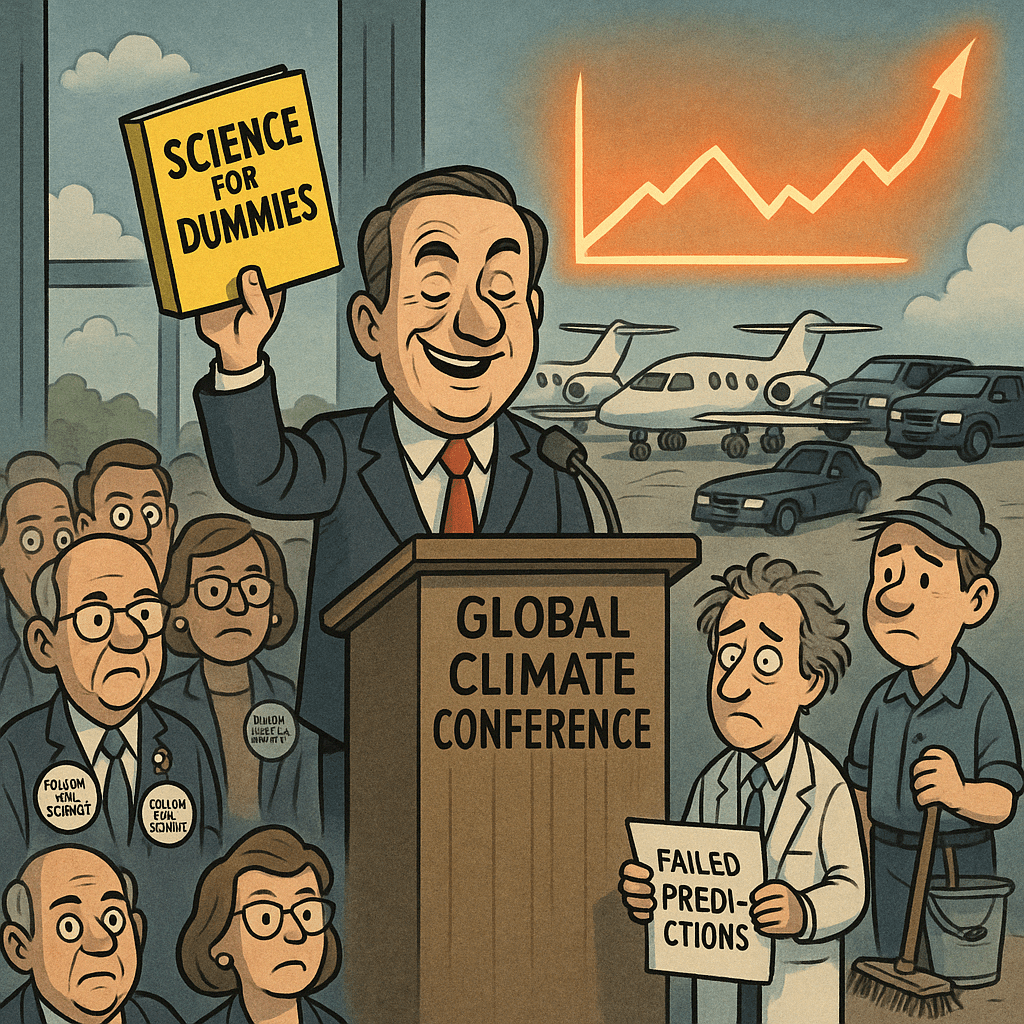
A satirical cartoon showing a politician holding “Science for Dummies” at a global climate conference, while private jets and SUVs sit outside and a janitor points to failed predictions.

They gather each year to honour the Earth,
With banners and buzzwords and questionable mirth.
They chant “follow science!” with glassy-eyed cheer,
But the method they follow? It’s nowhere near.

They assume, then predict, then assume what they guessed—
If it fits what they feel, it must be the best.
They model the sky, they model the sea,
But test what they claim? That’s heresy.

They worship the models like relics in glass,
Forget every dud from the decade that passed.
And still they parade with unfounded pride—
While science itself sits shunted aside.

Let’s go back to basics, like Aristotle once taught:
“Test your idea—or it’s not worth a thought.”
You can’t prove it’s true just ‘cause you hope or you care,
But one bad prediction? That truth isn’t there.

Yet here we are still, with graphs in a stack—
The famous old hockey stick stubbornly back.
Its blade defies logic, its shaft splits the skies—
A medieval warm-up? Deleted. Revised.

And thus, the believers, in labs and in suits,
Build castles on sand and declare them as roots.
If a storm hits the coast or a summer gets hot,
“That proves it!” they cry. (But of course it does not.)

Where’s Feynman’s demand to “bend to the test,”
To discard the idea that performs second-best?
Where’s Popper’s sharp blade to cut through the fog,
To banish the sacred from the scientific log?

Instead we get headlines and Parisian scenes,
Of leaders who fly in on CO2 dreams.
A standing ovation, champagne in their hand—
Then off to Davos to lecture the land.

This isn’t science, it’s pantomime stuff.
The numbers don’t add, and the method’s not tough.
They’ll say “the consensus,” and smugly they grin—
But if thinking is outlawed, how can we win?

Science is doubt. It’s question. It’s test.
It’s not your emotions dressed up in a vest.
It’s not the applause of a well-funded team—
It’s asking the question that shatters the dream.

So this Earth Day, pause. Take stock. Look again.
Are these prophets with laptops or children with pens?
Let’s teach them the method, the rule and the way—
And maybe, just maybe, we’ll earn what they say.

Let’s bring back the rigour, the courage to doubt—
To test every claim, to throw the weak out.
Let’s shame the lemmings, restore the domain,
Let’s Make Science Great Again.

Why Choose EOTs Over Traditional Buyouts?

I wrote the poem, then I wrote an explainer, then I realised the poem is redundant. Then I realised I don’t care what you think anymore, so the poem stayed.

Old Jerry ran a factory tight—
A little creaky, but mostly right.
He made fine parts for clever things,
Like wind-up ducks and copper springs.

One day he said, “It’s time to go—
I want a boat, perhaps Bordeaux.
I’ve earned my stripes, I’ll sell the shop,
And let the private buyers mop.”

They came in suits, with dazzling grins,
And PowerPoints with hockey pins.
They talked of “synergies” and “scale,”
Then fired poor Lizzie from the mail.

They closed the canteen, sold the van,
Rebadged the soap to “Corpé-San.”
They shrank the team and doubled goals—
Then pocketed the workers’ souls.

But wait! A voice from Dave in tools,
Who once mistook some files for mules:
“Why sell us out to suits and ties,
When we could own the enterprise?”

An EOT, friends, is not a trick—
It’s not just shares, it’s ownership.
It pays the founder just as well,
Without the need for sharks to sell.

It locks in legacy and pride,
And keeps the best folks on your side.
It gives the team a proper stake
In every part they build or make.

There’s tax relief (yes, quite a sum),
And zero cost to staff—not one.
The firm buys shares, the seller’s paid,
And futures aren’t just sold or swayed.

So next time suits begin to swarm,
And whisper “Let us help transform…”
Just stop and think—before you deal—
Remember this:

Time wounds all heels.


Authors Note:

Having thoroughly investigated the advantages of Employee Ownership Trusts (EOTs) compared to traditional Management Buyouts (MBOs) or direct corporate acquisitions, I can see no compelling reason why any business with 50 or more employees should consider a different route. The benefits to the owner, the employees, and the long-term integrity of the business are both significant and fair.

Please note, I do not sell services from these pages, nor do I host advertising. I am genuinely impressed by the potential of EOTs to deliver fairer outcomes for all parties involved. If you are a business owner who has come across this note and would like to learn more, feel free to contact me directly at slurps.mammal-3t@icloud.com (I know, but it’s what Apple gave me as a ‘spam reducing’ discardable email redirect).

PS. Groucho fans will understand the last line of the poem. Thank you, Groucho Marx—for the laughter that disarmed, the wit that endured, and the humility that defended. You made us laugh, and in doing so, you helped keep us standing.

What is an EOT?

Employee Ownership Trusts (EOTs) are a UK government-recognised succession option allowing a company to be sold to its own employees. Rather than a management buyout (MBO) or trade sale, an EOT gives control of the business to the workforce—preserving culture, protecting jobs, and delivering fair value to the owner.

An EOT:

  • Pays the owner full market value for their shares.
  • Requires no upfront investment from employees.
  • Offers generous tax relief to the seller (up to 100% CGT exemption).
  • Encourages long-term stability, growth, and alignment.
  • Avoids external interference or asset-stripping buyers.
  • In the UK-we have specialist companies that help business owners transition to employee ownership through:
    • Capital investment in employee-led buyouts
    • Legal and structural support for establishing an EOT
    • Ongoing governance to protect the interests of employees and sellers
    • Tools for engagement, transparency, and shared success

The Cosmic Dance: Sun, Moon, and Earth Explained

The Earth, the Moon, the mighty Sun,
Three bodies bound, yet each one spun,
To dance in patterns vast and true,
A clockwork waltz in cosmic blue.

The Moon, a mirror, cold and bright,
One-four-hundredth of the Sun’s great might,
Yet placed so perfectly between,
That solar halos can be seen.

A burning crown, a ghostly ring,
That bends the light, a fleeting thing—
The shadow cast, a measured veil,
A story told on cosmic scale.

And soon again, the world will gaze,
As twilight falls in midday haze.
On August 12th, in twenty-six,
The Sun and Moon their magic mix.

From Iceland’s shores to Spain’s embrace,
A fleeting night will take its place.
And Castellón, a golden land,
Will darken by the Moon’s own hand.

At half past eight, as day still glows,
The Sun hangs low, the shadow grows.
A veil of dusk will flood the skies,
As daytime dims before our eyes.

For ninety seconds, night will reign,
A ghostly crown, a silver chain—
The corona’s fire, soft yet wild,
A ring of light, the heavens’ child.

And though the Sun will rise once more,
This fleeting dark we can’t ignore.
A hush will fall, a gasp will rise,
As day dissolves in star-lit skies.

Yet even now, the dance goes on,
The balance held, the rhythm strong.
The planets move in silent grace,
Their orbits tied in time and place.

Beyond, the stars like diamonds shine,
Yet each one dwarfs our burning line.
A billion fires, a billion years,
Their light still flickers as it nears.

A universe of measured chance,
Of weight and balance, time and dance—
As if some sculptor’s careful hand
Had shaped the sky and drawn the land.

Yet here we are, so small, so brief,
Awake within a world of grief,
Yet blessed to see, to think, to know,
That stars still shine, and rivers flow.

So gaze in wonder, ask and seek,
For space is vast, and we are meek—
But in its vastness, thought takes flight,
And minds can touch the edge of light.

How Morning Breath Turns Into Morning Bliss

The first rays of sunlight crept through the blinds, casting golden stripes across the rumpled bed. A young woman, tangled in the duvet like a recently shipwrecked survivor, stretched her arms above her head and let out an unguarded yawn. She blinked, still groggy, and ran a hand through her tousled hair.

Beside her, a man—handsome, annoyingly alert, and looking entirely too pleased with the new day—sat up and smiled. His hair was charmingly dishevelled, the kind that took no effort and would probably fall into place with a single pass of his fingers. He turned to her with the unmistakable look of a man about to do something deeply affectionate and entirely unwelcome at this hour.

He leaned in.

“Morning, gorgeous,” he murmured, his lips pursing for a kiss.

Panic flared in her eyes. She took a rapid step back, nearly tripping over the bedside rug. “Morning breath!” she blurted, holding up both hands in warning.

The words hung in the air for half a second before he beamed.

“Morning wonderful!” he corrected, eyes full of adoration.

Before she could protest further, he swooped in, cradling her face with both hands and planting a kiss—no, a whopping great kiss—full on her lips. It was the kiss that belonged in films, backed by swelling orchestral music, not in a bedroom still thick with the remnants of sleep and questionable breath.

Her eyes flew open in horror.

She had expected restraint. She had expected respect for the delicate social contract that governed mornings. But instead, she found herself locked in a kiss so deep, so passionate, that for a brief moment, she forgot her original objection.

Then reality crashed back.

She broke away, staring at him with the urgency of someone who had just swallowed a spider. He grinned, completely oblivious.

“You—” she stammered. “You really—You just—”

“Best way to start the day,” he declared, stretching his arms victoriously, as if he had just accomplished something noble.

She wiped her lips dramatically, narrowing her eyes. “You are too much of a morning person.”

“And you,” he said, wrapping an arm around her waist, “are too cute when you’re flustered.”

She sighed, pinching the bridge of her nose. “I need coffee. And mouthwash. Preferably in that order.”

He kissed her forehead. “I’ll put the kettle on.”

As he walked off, whistling cheerfully, she shook her head, muttering to herself.

“I swear, one of these days, I’ll just wake up before him and weaponise this.”

But she knew, deep down, she’d probably let him get away with it again tomorrow.

Echoes of Despair: A Reflection on UK Current Leadership

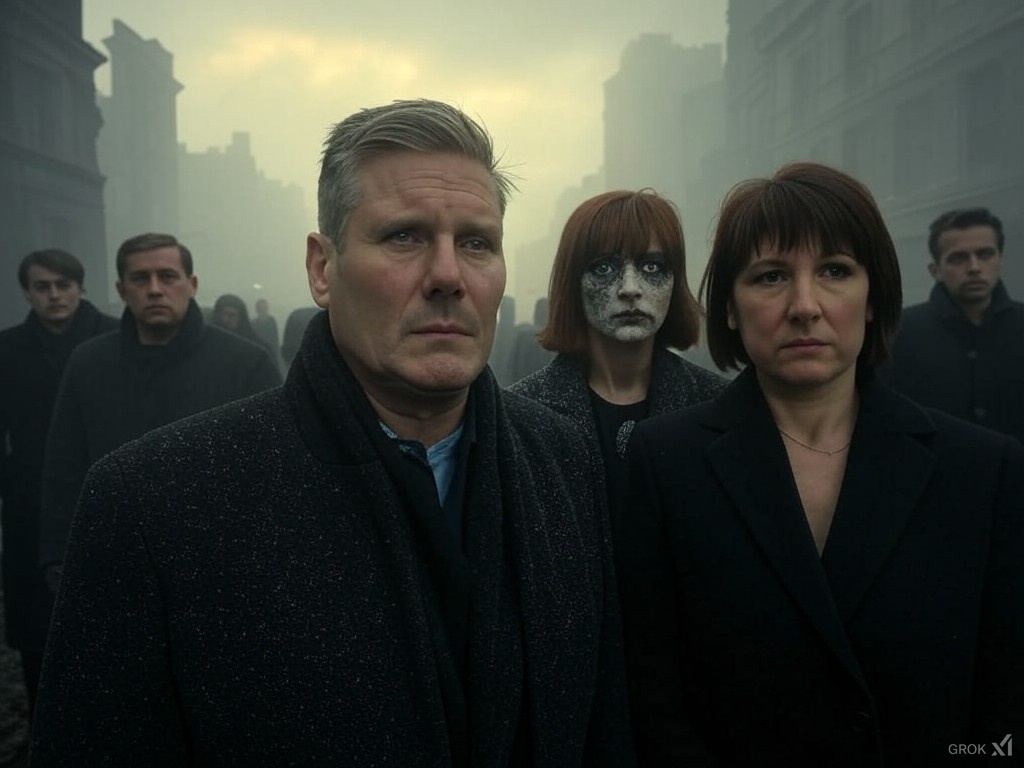
Through fog-bound streets where shadows fold,
The grey of dawn turns lifeless gold,
A weary land, where dreams have fled,
And justice lies among the dead.
The echoes of their voices fall,
Like muffled steps in endless hall,
Each minister, each hollow name,
A fragment of a broken game.

The Prime Minister walks a gilded line,
A robe too rich, a lawless sign,
His eyes, cold jewels, reflect no light,
But hunger for a darker night.
The Chancellor smiles with powdered grace,
A mask to veil her truthless face,
Her words, like ash upon the tongue,
Her promises, a song unsung.

Here, corruption wears a polished crown,
Its throne the rot of this dead town;
An anti-corruption knight undone,
The mirror’s work has just begun.
The lawyer once who battled laws,
Now pauses, burdened by the cause,
A prophet silenced by his creed,
His wisdom shackled by his need.

In distant lands, the borders weep,
For foreign soil was sold too cheap.
The Secretary, with careless hand,
Has signed away what once was land.
And here, a lie beneath the light,
A Transport chief, in guilty plight;
His falsehoods echo down the lanes,
Where justice drips like autumn rains.

The streets grow cold, the lights decay,
Where Safeguarding forgot her way.
She spoke of fears, her own, not theirs,
The victims left to climb the stairs
Of grief alone. The countryside,
Once vast, now swallowed by the tide
Of concrete blocks and panels wide,
Where energy’s green hopes have died.

The Home Secretary turns her gaze,
And lets the tides bring in their haze.
The laws are whispers, faint and low,
No walls defend what oceans know.
The Justice master sets them free,
The guilty walk where saints should be.
The clock strikes twelve in every school,
And silence speaks of broken rule.

This is the realm of dreary days,
Where leaders tread in shadowed ways,
Where life is cold, the spirit thin,
And failure reigns where hope had been.
Oh Britain, once of burning flame,
What sorrow clings to thy great name,
What leaders mock thy weary plight,
And drown thee in eternal night.

Grass-Fed Delusions: Dale Vince Makes a Song & Dance of His Vegan Gas Fiasco

Oh, gather around, let me tell you a tale,
Of a tycoon named Vince, with ideas off the scale.
A Labour donor, rich and grand,
Yet dressed like a boy with a stick in his hand.

He dreamt of a world fuelled by grass,
Not cows or coal, just a vegan gas.
“On Britain’s margins, the grass shall grow,
Enough for the nation!” he claimed with a glow.

But the biogas mill? A doomed device,
With design so flawed, it couldn’t suffice.
Twelve million pounds went up in smoke,
And left poor Dale as the butt of a joke.

Once profits soared, now they decline,
From fifty mil to the red this time.
Subsidies vanished, the cash flow thinned,
Leaving Dale with projects binned.

But does he stop? Oh, perish the thought!
A new plant’s coming, with lessons taught.
Completion set for twenty-twenty-six,
Yet sceptics wonder: more cash to fix?

Then there’s his diamonds, lab-grown with care,
And Forest Green Rovers, vegan fare.
A football club where the players eat beans,
While critics roll eyes at his lofty dreams.

And let’s not forget the courtroom spat,
His ex-wife Kate got forty mil flat.
With Labour donations and gifts so grand,
She claimed her share of the marital land.

But still Dale dreams, unbowed, unbent,
With pylons rigged and millions spent.
Yet as Octopus and British Gas expand,
His empire stumbles, built on sand.

So here’s to Dale, with his schemes so green,
A maverick tycoon, a profit has-been.
For though he’s mocked from far and wide,
At least the grass is on his side.

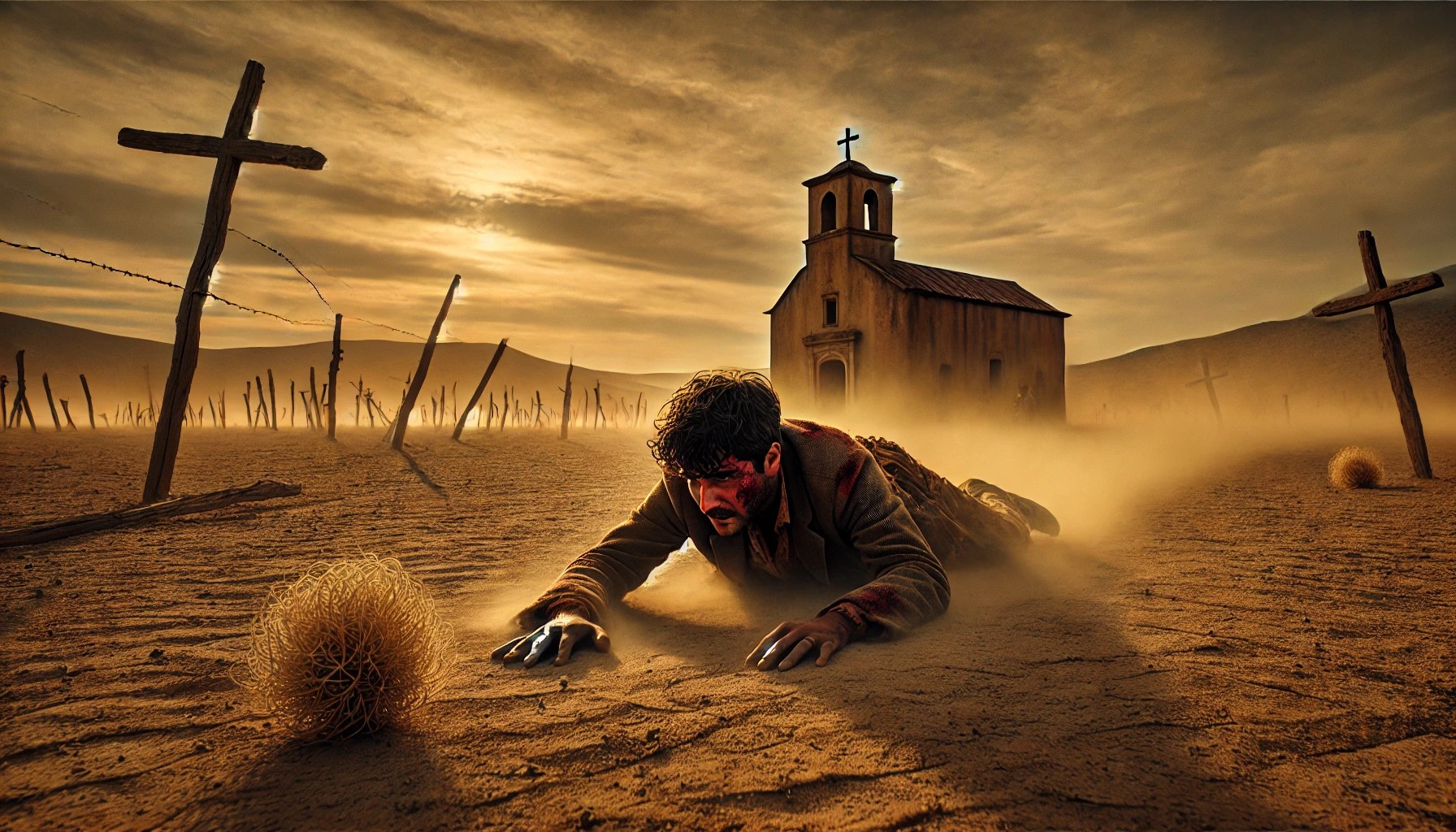
Situs Inversus: El Corazón Que Desafió la Muerte

El Fusilado: La Historia de un Rebelde Resucitado

They called him dead, with rifles raised,
The smoke of fate, his end appraised.
Wenseslao stood, the rebel’s mark,
The guns took aim to still his heart.

A volley roared, and blood did bloom,
The air was thick, a deathly gloom.
The final shot, point-blank they swore,
Would close his tale forevermore.

But fate had played a cunning hand,
A twist the guns could not withstand.
For in his chest, the heart betrayed,
Its hidden home where few hearts stayed.

A life reversed, a mirrored map,
A rare design, a divine mishap.
The surgeons call it situs inversus,
An organ’s dance, a fateful circus.

And so he rose from death’s embrace,
A spectre born of time and place.
The crowd stood still, the tale began,
Of bullets spent on a fated man.

For even death, with all its might,
Could not unmake this mirrored fight.
El Fusilado, a name profound,
The man whose heart death never found.