

Letter XIX: The Mark of Progress

Black-and-white woodcut-style illustration of a man refused bread at a market stall because he lacks a glowing mark, while a towering bureaucratic figure with a paper face and rubber stamp looms overhead, with “666” in the clouds.

By Martyn Walker
Published in Letters from a Nation in Decline

When the state makes life itself conditional on its seal, the mark of the beast is already upon us.

It is a curious thing that whenever governments extend their reach into private life, they never describe it as such. They speak instead of convenience, safety, modernisation. Sir Keir Starmer’s championing of digital identity sounds like a minor administrative adjustment, the bureaucratic equivalent of changing the colour of the tax return form. Yet the reality is rather less trivial.

Digital identity, once imposed, is not a marginal innovation but a centralising revolution. Every man, woman, and child becomes a data entry in a state-authorised ledger, their existence vouched for only so long as the system continues to recognise them. Enter a shop, book a train ticket, apply for a job, or access a bank account — all remain possible only if the digital credential functions. The promise is efficiency; the reality is conditional existence.

The most arresting commentary on such systems does not come from libertarian pamphlets or academic studies, though both have their place. It comes from an ancient text often dismissed as melodrama: the thirteenth chapter of the Book of Revelation. There, the writer describes a society in which “all, both small and great, rich and poor, free and bond” must carry a mark, without which “no man might buy or sell.” Scholars debate whether this was first-century allegory, coded critique of Rome, or apocalyptic vision. The detail is precise: the universal credential is the universal chain.
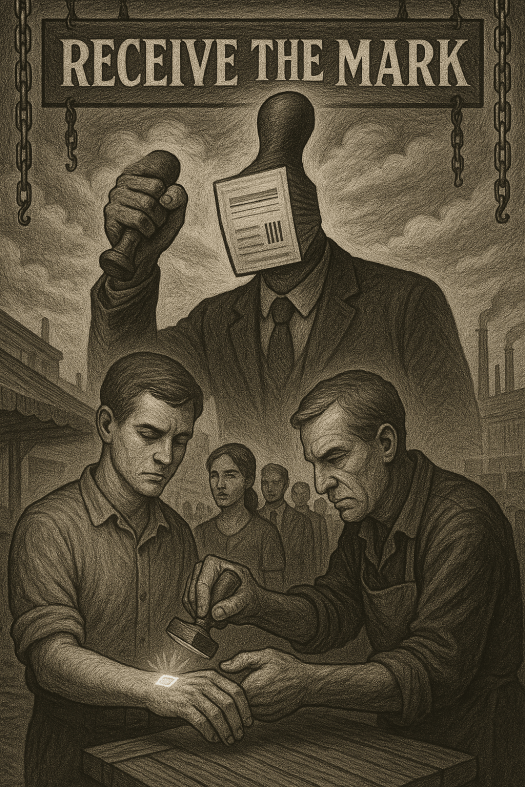
Black-and-white etching of a man receiving a glowing stamp on his hand under a sign reading “RECEIVE THE MARK,” while a faceless bureaucrat with a paper document for a head looms above, and others queue in line.
The state’s seal presented as progress, the moment of ownership disguised as efficiency.

No theological commitment is required to see the parallel. The mark on the hand or forehead is today’s biometric key. The exclusion from buying or selling is today’s digital wallet frozen by an unseen hand. The beastly system, whether religious or secular, rests not on spectacular cruelty but on the quiet, routine denial of access. Prison walls are unnecessary if the till refuses the card.

Sir Keir presents himself as a moderniser. His case for digital ID is couched in terms of security, fraud prevention, and border control. He would bristle at any comparison with scripture. Yet it is precisely his mildness that makes the matter more sinister. Tyranny that announces itself can be resisted. Tyranny that drapes itself in the language of efficiency is harder to unpick. One does not wake one morning to discover the mark branded on the hand; one drifts into a world where participation in daily life depends on presenting the correct token at every doorway.

Defenders of such schemes protest that the British state is not tyrannical, that it will never abuse such power. This is a charming thought. It is also historically illiterate. Every government abuses the powers it acquires, and powers are never surrendered. The veto inherent in a digital ID scheme — the ability to prevent a man from buying or selling — may sit dormant, but it will never be dismantled. It rests there, like a coiled spring in Whitehall, ready to be activated at the moment of political convenience.

Nor should the economic logic be ignored. The Bank of England has spoken openly about programmable currency, which requires, by definition, a universal identifier. To know what money is being spent on, or to restrict its use to particular purposes, the state must know who is doing the spending. The marriage of digital ID and programmable money creates precisely the world Revelation describes: life conditional on permission.

That the Labour leadership fails to see this is damning enough. That it understands and proceeds regardless is worse. The old Labour Party liked to talk about liberty and dignity. The new one is content to speak of databases and compliance. Sir Keir’s tone is calm, legalistic, mildly reassuring. The punchline is that he offers Britain not security but servitude by spreadsheet.

What makes this especially grotesque is Britain’s history. This was the nation that prided itself on habeas corpus, on common law, on the principle that the citizen was free unless explicitly restrained. The imposition of a universal ID, tethered to one’s ability to transact, inverts that principle. It assumes restraint, lifted only when the system gives its blessing. The state does not prove its case against the citizen; the citizen must prove his case to the state.

Some will accuse this argument of melodrama, of importing biblical language to dignify a mundane administrative reform. In truth the melodrama belongs to Starmer, who dresses coercion in the robes of progress. Revelation, for all its imagery, is coolly accurate. It identified, nearly two millennia ago, the core of what makes such systems intolerable. They do not merely control trade. They redefine freedom itself.

The polite suggestion is that Sir Keir has not reflected on the full implications. The impolite truth is that he has. Either way the effect is identical: a government that sees its citizens not as free men and women, but as registered users, liable to be suspended. And the suspension is not noisy, with trumpets and banners. It is silent, invisible: the card declined, the ticket refused, the door that no longer opens.

Sir Keir will be remembered. He will be remembered as the man who sought to baptise bureaucracy with the language of progress. Britain can weather his speeches; what it may not weather is the architecture he is so keen to build. The peril is not a number burned into the flesh. It is a system so ordinary, so seamless, that the nation scarcely notices it already carries the mark.

The writer of Revelation recognised the pattern. The mark of the beast was never about the hand or the forehead. It was about ownership — about the moment a man’s life ceased to be his own, and became conditional on another’s approval. That is what digital ID represents today. A mark not of safety, but of possession. And the question, as always, is whether the British people are still spirited enough to refuse it.

Letter XIII: Blotting Out the Sun

By Martyn Walker
Published in Letters from a Nation in Decline

When the state plans to dim the sun while blanketing farmland with solar panels, only folly thrives.

I installed solar panels some years ago. A modest gesture, perhaps, but one rooted in the belief that renewable energy—particularly the power of the sun—offered a sensible path forward. The promise was straightforward: invest now, harvest the sun’s rays, lower my bills, and contribute, in some small way, to a greener future.

Imagine, then, my reaction upon learning that the government is now considering blotting out the sun.

I do not exaggerate. At Westminster, serious people are discussing the allocation of billions to solar geoengineering—spraying fine particulates into the atmosphere to reflect sunlight away from the Earth, cooling the planet in the process. Sulphur dioxide is the preferred agent, mimicking the effect of volcanic eruptions, lowering global temperatures, and, we are told, sparing us from climate catastrophe.

At the same time, those same serious people are approving hundreds of thousands of acres of farmland for conversion into solar farms. Arable fields, once the source of our food, will be turned into glinting expanses of silicon and glass—desperate to capture the very sunlight the state proposes to dim.

Which is it? Are we to harvest the sun or hide from it?

This is policy schizophrenia at its finest. On one hand, we are to bow before the gods of net zero, covering our green and pleasant land with solar panels. On the other, we are to fund atmospheric experiments that will diminish the very light those panels need to function. The left hand builds; the right hand dismantles.

But this is more than a contradiction. It is the arrogance of central planning, an affliction that has toppled empires, destroyed livelihoods, and now threatens to snuff out the sun’s warming rays.

History is not short of warnings. In the Soviet Union, one Trofim Lysenko convinced Stalin that science itself could be bent to ideology. Genetics was bourgeois nonsense, he claimed, and crops could be trained—like loyal Party members—to thrive in hostile environments if only they were exposed to the correct conditioning. Real scientists, those who objected, were purged. Their warnings ignored. The result? Agricultural collapse, famine, and death on an industrial scale.

The lesson? When policy bends science to ideology, crops fail and people starve.

Geoengineering smells of the same hubris. The climate models, neat as they are, do not account for the complex choreography of atmosphere, ocean, and biosphere. The Earth is not a thermostat, waiting for a bureaucrat to dial in the desired temperature. There is no slider bar for unintended consequences.

Consider CFCs—chlorofluorocarbons. Once hailed as a miracle of modern chemistry, powering refrigeration, aerosols, and industrial processes. Until, decades later, scientists discovered they were quietly eating away at the ozone layer, exposing us to dangerous levels of ultraviolet radiation. It took an extraordinary global effort—the Montreal Protocol—to halt the damage. The unintended consequence of human ingenuity.

Now, we propose to tamper with the atmosphere once again. To spray particles into the sky, with only the faintest grasp of what might follow. Droughts in one region, floods in another. Failed harvests. Shifts in monsoon patterns. The arrogance of assuming we can control a global system as intricate as the climate without consequence is staggering.

And all this while tearing up farmland to make way for solar panels, sacrificing food security for energy generation, only to dim the light that powers them.

It is the insanity of the moment, yes—but also the failure to learn from history. Grand schemes, unmoored from reality, sold on visions of salvation but delivered through wreckage and regret.

The late pathologist’s words echo: Humans are tropical creatures. Leave a man naked outside at 20°C, and he will die from exposure. We are built for warmth, for sunlight. The sun is not our enemy. It is our origin.

This is a nation in decline: dimming the sun, sterilising the soil, trading common sense for ideology. No thought for consequence. No humility before the complexity of life.

I do not ask for much. Protect the farmland. Let the sun shine. Reject the delusion that we can reorder the heavens by committee. We are not gods, and this is not our playground.

When the crops fail and the skies darken, there will be no bureaucrat to blame but ourselves.


🔬 UK Government Initiatives on Solar Geoengineering

  • UK Scientists to Launch Outdoor Geoengineering Experiments
    The Guardian reports on the UK’s £50 million funding for small-scale outdoor experiments aimed at testing solar radiation management techniques, such as cloud brightening and aerosol injections. Critics express concerns about potential environmental risks and the diversion from emission reduction efforts. (UK scientists to launch outdoor geoengineering experiments)
  • Exploring Climate Cooling Programme
    An overview of the UK’s climate engineering research initiative, detailing the government’s £61 million investment in solar radiation management research, including methods like stratospheric aerosol injection and marine cloud brightening. (Exploring Climate Cooling Programme)
  • The UK’s Gamble on Solar Geoengineering is Like Using Aspirin for Cancer
    A critical opinion piece likening the UK’s investment in solar geoengineering to treating cancer with aspirin, highlighting the potential dangers and ineffectiveness of such approaches in addressing the root causes of climate change. (The UK’s gamble on solar geoengineering is like using aspirin for cancer)

🌾 Solar Farms and Agricultural Land Use


🗣️ Critical Perspectives and Policy Analysis

  • Why UK Scientists Are Trying to Dim the Sun
    The Week provides an overview of the UK’s funding for controversial geoengineering techniques, exploring the scientific rationale and the ethical debates surrounding these interventions. (Why UK scientists are trying to dim the Sun | The Week)
  • Analysis: Plans to Cool the Earth by Blocking Sunlight Are Gaining Momentum but Critical Voices Risk Being Sidelined
    UCL’s analysis warns of the rapid advancement of solar geoengineering research without adequate consideration of dissenting opinions and the potential for self-regulation leading to dangerous outcomes. (Analysis: Plans to cool the Earth by blocking sunlight are gaining …)
  • Solar Geoengineering Not a ‘Sensible Rescue Plan’, Say Scientists
    Imperial College London reports on a study indicating that reflecting solar energy back to space could cause more problems than it solves, questioning the viability of solar geoengineering as a climate solution. (Solar geoengineering not a ‘sensible rescue plan’, say scientists)

Metadata

Letter Number: XIII
Title: Blotting Out the Sun
Collection: Letters from a Nation in Decline
Author: Martyn Walker
Date: 28 April 2025
Word Count: 1,210


BISAC Subject Headings

POL044000: Political Science / Public Policy / Environmental Policy
SCI026000: Science / Environmental Science (incl. Climate Change)
TEC031010: Technology & Engineering / Power Resources / Solar
BUS032000: Business & Economics / Infrastructure
SOC055000: Social Science / Agriculture & Food Security
SCI092000: Science / Ethics (incl. Environmental Ethics)


Library of Congress Subject Headings (LCSH)

Solar Energy—Government Policy—Great Britain
Geoengineering—Environmental Aspects—Great Britain
Agriculture and Energy—Great Britain
Central Planning—Political Aspects—Great Britain
Environmental Policy—Moral and Ethical Aspects
Food Security—Great Britain
Climatic Changes—Moral and Ethical Aspects