

The Keepers of the Straits

Royal Navy fleet at sunset with warships, aircraft and Union Jack representing Britain’s historic command of the seas.

The world’s narrow places are still there.
Britain simply stopped standing in them.

I have lived long enough to watch Britain surrender the sea without firing a shot.

I remember when the sea still answered to us.

Not in the childish way the history books tell it now, with red patches on maps and brass bands playing under tropical suns. The real power was quieter than that. It lived in harbours and ledgers, in insurance slips signed at Lloyd’s, in grey destroyers slipping through cold water before dawn. It lived in the knowledge—shared by merchants, admirals and bankers alike—that the narrow places of the world were watched.

That was the arrangement. The world traded. Britain guarded the hinges.

We did not own every port, but we knew which ones mattered. Gibraltar watched the gate to the Mediterranean. Cyprus looked over the Levant. Aden kept an eye on the mouth of the Red Sea until 1967 when we abandoned it in a hurry that still smells of defeat. Singapore and Hong Kong anchored the East. Diego Garcia — a lonely coral ring in the Indian Ocean — became the great unsinkable airfield from which American bombers could reach half the planet. Even when the empire dissolved, the structure remained. The Americans would carry the heaviest guns. We would keep the old knowledge: the cables, the shipping markets, the insurance, the bases.

The arrangement worked because each side understood its role.

Alfred Thayer Mahan, the American prophet of sea power, studied the Royal Navy like a priest studying scripture. The United States Navy was built on lessons written in British salt water. Washington spent the money, built the fleets, and fought the large wars. Britain remained the world’s maritime brain — the keeper of chokepoints, charts and commerce. London insured the cargoes. Lloyd’s underwrote the risk. If pirates, missiles or revolutions threatened a shipping lane, the Royal Navy was still expected to appear somewhere on the horizon, perhaps with American company, perhaps not. Either way, the merchant fleets of the world slept easier.

That was the quiet deal that sustained the post-war order.

And now, as I lie here with the curtain half drawn and the breath not coming quite so easily, I look back at the slow abandonment of it — the long surrender carried out by men who congratulated themselves on every retreat.

First the bases went.

Aden was given up in 1967, not after a great battle, but after a weary withdrawal that marked the end of Britain’s formal role “east of Suez”. Hong Kong was returned to China in 1997 under treaty obligations Britain could no longer enforce, though the city’s later fate should make any honest man wonder what those signatures were worth. The Falklands remain British, defended by a permanent garrison since the Argentine invasion of 1982, yet even there the Navy now fields fewer escort ships than it once kept idling in Portsmouth.

Even Diego Garcia — the great American-British bastion in the Indian Ocean — has been handed back in sovereignty to Mauritius under the 2025 agreement, though the military base itself will remain under long-term lease. The government insists the arrangement secures the base for generations. Perhaps it does. But when a nation begins surrendering territory while insisting nothing has changed, the tone tells its own story.

Then came the thinning of the fleet.

During the Cold War the Royal Navy’s task in the North Atlantic was brutally clear. Soviet submarines had to pass through the GIUK Gap — the waters between Greenland, Iceland and the United Kingdom — before reaching the Atlantic sea lanes. British frigates, submarines and maritime patrol aircraft hunted them relentlessly. It was dangerous work and quietly decisive. The shipping lifeline between America and Europe depended upon it.

Today the Royal Navy still contributes to that task through NATO, but with a fleet that numbers fewer than twenty major escort vessels. In 1982 there were roughly three times as many.

We built two aircraft carriers, HMS Queen Elizabeth and HMS Prince of Wales, handsome ships and impressive on paper. Yet carriers are not symbols; they are systems. They require escorts, supply ships, aircraft, trained crews, and a political will to deploy them. Possessing a carrier without the fleet to support it is like owning a cathedral without priests.

And the humiliations come in smaller forms too.

Gibraltar — British since 1713 and besieged repeatedly by Spain — now exists within a delicate arrangement whereby Spanish officers will conduct Schengen border checks at its port and airport under a new UK-EU framework. Ministers assure us that sovereignty is untouched. Perhaps so. But one suspects the old garrison commanders of Gibraltar would stare rather hard at that arrangement.

Meanwhile London debates whether China should be permitted to construct its largest embassy in Europe at Royal Mint Court beside the Tower of London. Members of Parliament have raised concerns about proximity to sensitive communications infrastructure and the potential intelligence implications. Yet the argument drifts on through planning committees and consultations, as though the capital of a strategic ally were merely deciding the height of a garden wall.

Once we understood that cables, data, finance and naval power were parts of the same nervous system.

Now we discuss them as though they belonged to separate universes.

Even Lloyd’s — the old citadel of maritime risk — now finds itself cancelling or repricing war-risk cover in places where the Royal Navy once helped maintain confidence. Insurance has always depended upon force somewhere in the background. Without credible security, underwriting becomes guesswork.

And then there is the English Channel itself.

This narrow strip of grey water defeated Napoleon’s fleets and frustrated Hitler’s invasion plans. It was once the most heavily guarded maritime frontier on earth. Yet in recent years thousands of migrants have crossed it in inflatable boats launched from the French coast. Governments announce new schemes and patrols, and the numbers rise and fall with the seasons, but the symbolism is painful. When a nation cannot convincingly police the narrowest of its own waters, lectures about global order begin to sound hollow.

None of this occurred overnight.

That is the cruelest part.

Empires sometimes fall in fire and cannon. Britain declined politely, with policy papers and conferences. Each surrender was explained as realism. Each retreat was framed as progress. Each reduction in power was described as “modernisation”.

And those who questioned the process were told they were nostalgic men clinging to ghosts.

Perhaps we were.

But ghosts are what remain when memory outlives courage.

The Americans still try to hold the system together, though even they are tiring of it. They built the fleets and wrote the cheques because the arrangement once made sense. Britain guarded the gateways of the old world — the straits, the insurance markets, the cables — while Washington carried the heavier military burden. Together the structure kept global trade moving.

Now the chokepoints falter one by one, and the world looks to Washington to fix problems that once belonged partly to London.

And Britain?

Britain drafts climate frameworks for shipping at the International Maritime Organization, debates planning permission for foreign embassies beside strategic infrastructure, and congratulates itself on moral leadership while the old machinery rusts.

Perhaps the country still believes it has outgrown the rough duties of power.

But trade still moves through straits. Tankers still pass through Hormuz. Submarines still patrol the North Atlantic. Insurance still depends on force somewhere over the horizon.

The world did not change.

Britain did.

And as I lie here, watching the evening creep slowly across the room, I find that the saddest thought is not that Britain became smaller.

All nations grow smaller in the end.

The tragedy is that we surrendered the habits of seriousness long before we surrendered the means.

We had the ships.

We had the ports.

We had the credit.

We had the knowledge of how the world’s narrow places held the great machine of trade together.

And we let it slip away — strait by strait, base by base — while telling ourselves we were becoming wiser.

History, I suspect, will judge that differently.

But by then, of course, we shall all be safely dead.


Related Articles

The Makers and the Takers – My first series of letters from a nation in decline.

The Bonfire of Ownership – The slow dismantling of the institutions that once made Britain serious.

Nations do not lose power in a single dramatic collapse. More often it erodes quietly through the slow dismantling of the institutions that once made Britain serious.

The Illusion of Choice – The habit of replacing capability with regulation.

Letter XXI: The Quiet Transfer of Authority

Laptop screen stamped “Consent Assumed” symbolising administrative control replacing individual autonomy

How Power Learned to Hide in Plain Sight

By Martyn Walker
Published in Letters from a Nation in Decline

Nations do not collapse in spectacles of ruin. They decline administratively. The erosion of liberty rarely arrives with banners or barricades. It appears instead as guidance, optimisation, and protection, introduced through processes so mundane that resistance feels faintly unreasonable. The modern citizen is not ordered to surrender autonomy. He is persuaded to misplace it.

The evidence is seldom dramatic. It begins in trivial irritations: a device, purchased outright, quietly reconfigured by its manufacturer in the name of preservation. A setting deliberately chosen by the owner reappears in its default state following an update issued without consultation. The justification is rational, even defensible. The owner, it is implied, cannot be trusted to act in the best interests of his own property. The device must be protected from the individual who paid for it.

Such incidents would once have been regarded as impertinent. Today they are routine. Ownership has been replaced by conditional authorship. The citizen is permitted to configure his environment, provided he accepts that it will be periodically corrected by those who know better.

This transformation was not unforeseen. Early scholars of digital governance warned that authority would migrate most effectively when it ceased to rely upon legislation and embedded itself instead within technical architecture. Laws could be challenged, debated, and repealed. Systems, once operational, simply persisted. These thinkers argued that code would not merely enforce regulation but would become regulation — invisible, automatic, and resistant to democratic revision. They were regarded as imaginative theorists. Experience has quietly promoted their warnings into operational reality.

The same migration of authority is visible across British institutional life. The Post Office Horizon scandal demonstrated with exceptional clarity how technological infallibility, once declared, can displace both justice and reason. Hundreds of sub-postmasters were prosecuted, bankrupted, and socially destroyed because an institution found it easier to criminalise human testimony than to question the reliability of its own system. The tragedy was not simply technological failure. It was administrative certainty. The machine could not be wrong because the institution could not afford for it to be wrong. Authority defended software and prosecuted citizens.

The lesson was received with remarkable efficiency, though not in the manner one might have hoped. Banking, once an archetype of reciprocal commercial trust, has undergone a similar evolution. Open banking and strong customer authentication were introduced under the language of empowerment and security. In practice, they have entrenched a regime in which access to one’s own finances requires continuous verification, behavioural monitoring, and tolerance of persistent inconvenience. Banks contact customers urgently when information is required, typically through messages that cannot be answered. When customers require assistance, they encounter automated barriers, rationed human contact, and communication channels designed less for dialogue than for containment.

The commercial asymmetry would be remarkable if it were not now so familiar. Customers deposit capital, entrust personal data, and assume institutional risk, yet must compete for access to services they themselves finance. Increasing numbers have responded with understated pragmatism by withdrawing funds and transferring them to organisations still willing to communicate through email, telephone, or direct messaging. Traditional banks appear increasingly content to retreat from service provision and reconstitute themselves as regulated custodians of trust, extracting revenue from payment infrastructure while ceding innovation to more agile intermediaries.

Energy policy provides an equally instructive example. The smart meter rollout was presented as an instrument of transparency, enabling consumers to monitor consumption and reduce costs. In reality, it created a technological platform capable not merely of measurement but of behavioural enforcement. Pricing, usage, and consumption patterns increasingly fall within the administrative discretion of infrastructure operators rather than household decision-makers. The consumer is encouraged to regard this transfer of authority as environmental virtue. Choice remains available, but only within parameters determined by those insulated from the consequences of their decisions.

Speech, once regarded as the cornerstone of democratic legitimacy, has been subjected to similar administrative refinement. The Online Safety Act establishes a regulatory framework in which lawful expression may nonetheless be suppressed through platform enforcement incentives. Companies are encouraged to remove content pre-emptively, not because the law demands such caution explicitly, but because regulatory penalties reward over-compliance and punish hesitation. Authority is exercised indirectly, through incentive structures that render dissent economically hazardous rather than legally prohibited.

What unites these developments is not ideology but method. Authority has ceased to argue and begun to embed. Political choices are recast as technical necessities. Opposition is reframed as misunderstanding. Compliance becomes the default condition of participation in modern society.

British legal tradition once contained formidable defences against such encroachments. The common law principle that a man’s home is his castle expressed more than property rights; it embodied a presumption of personal sovereignty. The doctrine of administrative reasonableness required state decisions to withstand rational scrutiny. These traditions assumed that authority required justification and that power, to remain legitimate, must remain visible. Contemporary governance increasingly operates through mechanisms that evade these safeguards by translating decisions into technical processes and automated compliance frameworks. Authority is no longer asserted. It is compiled.

The genius of this transformation lies in its civility. No one is dragged from his home for criticising a regulatory regime. Instead, his account is restricted. His transactions are delayed. His content is deprioritised. His choices narrow quietly until dissent becomes administratively exhausting. Coercion is replaced by friction. Consent is replaced by fatigue.

The modern bank exemplifies this evolution. Once sustained by personal relationships and local accountability, it now survives primarily as a certified intermediary between the citizen and financial infrastructure. Trust, formerly cultivated through accessibility and service, is increasingly reduced to regulatory compliance and institutional branding. Payments, lending, and savings services are steadily migrating to technologically agile platforms. The bank’s remaining utility lies in its authority to validate identity and satisfy regulatory expectation. It becomes less a merchant and more a notary.

The small acts of resistance that persist — closing accounts, disabling unwanted functions, declining digital credentials — acquire symbolic significance precisely because their practical impact is limited. They represent attempts to preserve authorship within systems designed to reduce the citizen to a user. They recall an older constitutional settlement in which instructions, once given, remained in force until deliberately changed.

But symbolism cannot substitute for structure. A society that relies upon individual vigilance to preserve autonomy has already conceded the principle of autonomy. Freedom that survives only through constant technical alertness is freedom in retreat.

The transformation of authority into architecture carries one further and rarely acknowledged consequence. When power embeds itself within systems, it becomes insulated not only from public debate but from moral responsibility. Decisions appear as outcomes rather than choices. Accountability dissolves into process. The citizen is left negotiating with interfaces rather than institutions.

It may yet be that none of this is malicious. Indeed, it is far more unsettling if it is not. A society that relinquishes autonomy not through oppression but through administrative convenience demonstrates a subtler and more permanent form of decline. When citizens grow accustomed to being managed rather than represented, corrected rather than persuaded, and optimised rather than trusted, they cease to notice the distinction between governance and supervision. By the time they do, if they do, they will discover that the mechanisms designed to protect them from inconvenience have succeeded only in protecting power from accountability. Nations rarely lose their freedoms in a moment of catastrophe. They misplace them gradually, misfiled among compliance procedures, customer journeys, and software updates that nobody remembers requesting.


Afterword

By Laurence J. Peter (Posthumously, and With Considerable Relief That He Cannot Be Blamed for Any of This)

The study of bureaucratic expansion demonstrates that institutions rise to meet the limits of their competence and then continue rising with admirable indifference to gravity. In previous centuries, this phenomenon expressed itself through memoranda, filing cabinets, and committees convened to explain why earlier committees had failed to produce sufficient memoranda. Modern technology has improved the efficiency of this process while preserving its essential spirit.

One should never underestimate the capacity of a system to protect itself from the inconvenience of the public. The moment a service becomes essential, its providers begin the delicate transition from assistance to administration. This transformation is achieved not through declaration but through refinement. Procedures multiply. Access narrows. Compliance acquires moral overtones.

Several governing principles may be observed. Institutions invariably mistake longevity for legitimacy. Any organisation that describes itself as customer-focused has already redirected its focus elsewhere. The more a system promises frictionless interaction, the more elaborate its hidden mechanisms of friction become. Technology does not eliminate bureaucracy; it digitises it, accelerates it, and renders it permanently accessible.

When an institution assures the public that it acts for their safety, the prudent observer determines whose safety is under discussion. Access that can be granted can be withdrawn with admirable administrative efficiency. Trust transferred from personal relationship to institutional certification becomes indistinguishable from compliance. Citizens repeatedly required to confirm their identity eventually begin to doubt its permanence.

Processes described as streamlined have typically removed the element that permitted dissent. Efficiency, pursued as a moral objective rather than a practical one, produces systems that function flawlessly for everyone except their users. Incompetence rarely destroys institutions. It reorganises them. Failure, sufficiently systematised, becomes policy. Policy, sufficiently complex, becomes immune to reform. Reform, sufficiently delayed, becomes heritage.

The citizen confronting this landscape is advised to cultivate a modest but persistent scepticism toward any authority that offers convenience in exchange for discretion. He should distrust the large promises, read the small print, and retain, wherever possible, the habit of asking why. This will not prevent decline, but it may delay its paperwork.

References

• Post Office Horizon IT Inquiry, Final and Interim Reports, UK Statutory Public Inquiry chaired by Sir Wyn Williams, 2020–present

• House of Commons Business and Trade Committee, Post Office and Horizon IT Inquiry Evidence Sessions and Reports, 2022–2024

• European Union Revised Payment Services Directive (PSD2), Directive (EU) 2015/2366 on payment services in the internal market

• UK Open Banking Implementation Entity, Open Banking Standards and Framework Documentation, mandated by the Competition and Markets Authority following the Retail Banking Market Investigation Order 2017

• Competition and Markets Authority, Retail Banking Market Investigation Final Report, 2016

• Financial Conduct Authority, Strong Customer Authentication and Secure Communication under PSD2, Regulatory Technical Standards and FCA Guidance, 2019 onwards

• National Audit Office, Rolling Out Smart Meters, HC 12 Session 2018–2019

• Department for Energy Security and Net Zero, Smart Meter Implementation Programme Annual Reports, various years

• UK Parliament, Online Safety Act 2023, c. 50

• Ofcom, Online Safety Regulation Framework and Risk Assessment Guidance, 2023–2025

• Associated Provincial Picture Houses Ltd v Wednesbury Corporation [1948] 1 KB 223, establishing the Wednesbury principle of administrative reasonableness

• Semayne’s Case (1604) 5 Co Rep 91a, foundational common law authority for the doctrine that a person’s home is their castle

• Dicey, A. V., Introduction to the Study of the Law of the Constitution, first published 1885, for classical articulation of rule of law and limits on administrative authority

• House of Lords Constitution Committee, The Legislative Process: The Delegation of Powers, HL Paper 225, 2017–2018

• National Cyber Security Centre, Guidance on Secure Customer Authentication and Fraud Prevention, supporting regulatory approaches to digital identity and verification

• UK Government, Department for Science, Innovation and Technology, UK Digital Identity and Attributes Trust Framework, updated editions 2022–2024

• House of Commons Public Accounts Committee, Smart Meter Rollout Progress Reports, various sessions 2018–2024

• Bank of England and HM Treasury, The Digital Pound Consultation Paper, 2023, discussing centralisation of payment infrastructures and identity verification implications

• Zuboff, Shoshana, The Age of Surveillance Capitalism, 2019, widely cited academic work on behavioural data control and digital governance trends

• Lessig, Lawrence, Code and Other Laws of Cyberspace, 1999 (and Version 2.0, 2006), foundational theory on technological architecture as regulatory authority

The Thin Wall Between Lies

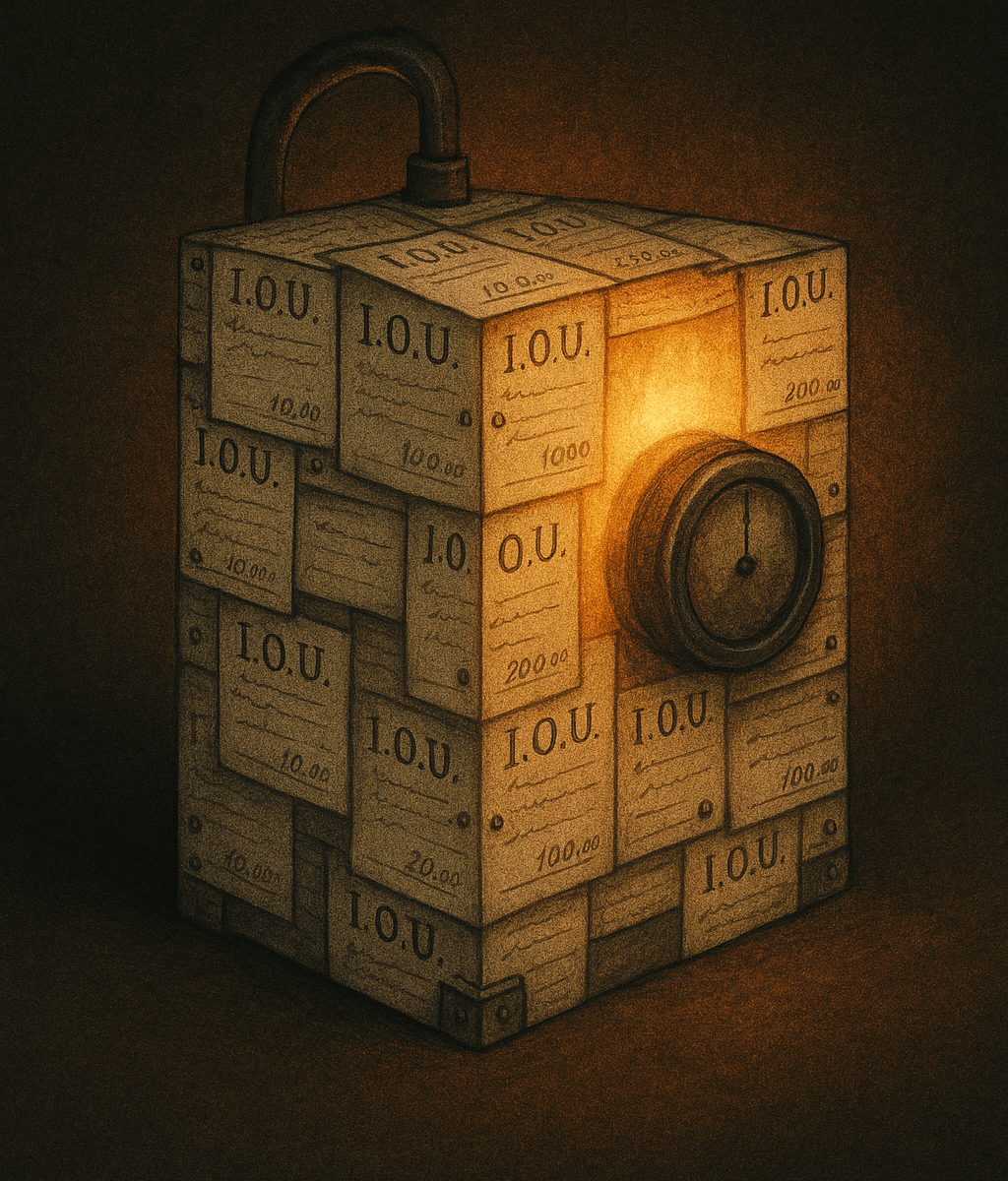
Surreal machine made of IOUs glowing warmly in a dark room

Peter keeps the ledger.
Neat columns. Dates aligned.
“Paid,” he writes, in pencil,
because ink would be a lie.

The money is always coming.
Next week. After clearance.
Once accounts reconcile
with a future that never arrives.

Paul waits on the other side
of the same thin wall.
Different excuse. Same echo.
Funds delayed. Circumstances. Process.

Peter was told Paul had the cash.
Paul was told Peter spent it.
Between them, a corridor of promises
swept nightly, never furnished.

They do not argue anymore.
There is nothing left to dispute.
Only the quiet competence
of being unpaid in turns.

Somewhere, the system hums—
healthy, audited, congratulated—
while Peter balances nothing,
and Paul remains, impeccably, broke.

How to Keep a Snail Alive

Garden snail moving slowly across stone, a quiet reminder of patience and gentle care

I keep a garden snail
not in a box
not in a jar
but in an agreement.

The agreement is simple.
I do not rush.
He does not explain.

Each morning I leave
a damp leaf
as if it were a letter
saying I remembered you.

He answers
by remaining alive.

The snail requires very little:
shade that means it,
water that arrives quietly,
and a world that does not suddenly decide
to be important.

When I forget myself
and think speed is truth,
he retracts.
When I calm down,
he resumes the future.

He has no ambition
beyond crossing a stone
by Tuesday
and surviving the birds’ opinions.

And yet
if I can keep this creature content—
with no plans,
no praise,
no comprehension of my efforts—
then perhaps living is not mastery.

Perhaps it is maintenance.

If I can keep a snail happy,
fed,
unpanicked,
unharmed by my cleverness,
then I can live anything.

Even me.


The story behind this story.

Thanks to my very great friend Alicia, my reading and writing life has been enriched with her curiosity and her vast knowledge of the book world. From authors long forgotten to those still weaving every story from mystery to culture to comedy to the most unusual authors I would never have considered without her most welcome interference.

Imagine my surprise when she sent me a photo of a snail and said “Meet my new pet”. So out of character, but then my knowledge of Alicia tells me there is something deep and profound in this peculiar statement, I just need to find it.

The result is the above poem which, as you have probably gathered, isn’t really about a snail. The snail is simply a quiet way into something more human.

At its heart, the poem explores what it feels like to care for something that cannot be hurried, impressed, or persuaded. A garden snail doesn’t respond to effort or intention in the way people do. It doesn’t reward anxiety or ambition. It simply reacts to calm, consistency, and gentleness. That makes the relationship oddly honest.

Many of us live with a constant sense of pressure — to do more, be quicker, justify ourselves, explain our choices, and keep up with an ever-moving world. The snail exists outside all of that. It has no interest in explanations or outcomes. When the poem says, “I do not rush. He does not explain,” it captures a rare peace: a space where nothing needs defending or proving.

The small daily acts in the poem — leaving a damp leaf, choosing shade, moving quietly — reflect a form of care that modern life often overlooks. This isn’t dramatic or self-sacrificing love. It’s ordinary attention. And that ordinariness is what makes it powerful. The snail’s only response is that it continues to live. Somehow, that feels like enough.

The poem also gently reverses the usual idea of control. When the person becomes stressed or hurried, the snail retreats. When calm returns, so does the snail. In this way, the animal mirrors something very familiar: how our own inner world tightens under pressure and opens when treated kindly.

The final lines offer the poem’s quiet insight. If we can keep something small, slow, and vulnerable safe and content — without needing recognition or success — then living isn’t about achievement at all. It’s about learning not to harm what is fragile, including ourselves.

I hope people like this poem not because it is clever, but because it feels like permission. Permission to slow down. Permission to care without justification. Permission to believe that gentleness, consistency, and patience are not weaknesses, but ways of staying alive.

In that sense, the snail becomes a reminder: living well doesn’t always mean doing more. Sometimes it simply means being careful enough to let life continue.

Living Off the Grid: The Journey of ‘Lucky the Lacky’

I met him because someone thought I ought to. That was the reason given, anyway. I was visiting Yosemite about twenty years ago, staying long enough to fall into conversation with a park employee who, after a day or two of small talk, said, almost casually, “You should meet a friend of mine.” He paused, gauging whether I was the sort of person who might laugh. “He lives off the grid. Completely.”

We drove for a while after leaving the park boundary. That mattered, I was told. Inside Yosemite, the rules were absolute, and rightly so. Preservation there was not a slogan but a discipline. You could admire nature, walk through it, photograph it, but you could not negotiate with it. My host’s friend had no quarrel with that. He simply knew the difference between stewardship and suffocation.

His land lay on the side of a mountain, far enough from the road that the last stretch was done slowly, deliberately, as if the place resisted being arrived at too quickly. He was a hunter, a fisherman, a farmer, but not in the romanticised way of catalogues and television. He knew where bears crossed and gave them room. He knew which rocks warmed snakes in the afternoon and left them alone. The wild boar were another matter—hybrids, aggressive, clever—and he spoke of them with the wary respect you reserve for something that can beat you if it chooses. Wolves, he said, were fewer every year. Farmers still poisoned and trapped them, not out of cruelty so much as habit. That observation came without anger, only with the calm note-taking of a man who preferred facts to outrage.

He kept a horse and goats, grazing them on land that had been measured and remeasured, not by surveyors this time but by weather, yield, and patience. Everything he needed was there, and almost nothing he didn’t.

His name was Patrick Murphy, though no one called him that. He had been christened “Lucky the Lacky” on an oil rig in his youth, a name that had clung because it was earned. Fresh out of college, qualifications in hand, his father had sent him offshore with a blunt instruction: to become an engineer, he had to start where engineering was least glamorous. That meant a year living and working with men who took pride in muscle, routine, and relentless teasing. They called him Lacky at first, and the name was not kind. He carried tools, cleaned messes, learned the rhythms of machinery and people. The teasing persisted, but so did the respect. Friendship grew where condescension was expected.

The day the name changed, a pressure system failed. A safety valve did its job too well. Shrapnel tore through the air, punched through a hut, and vanished into the sea beyond. Patrick had just sat down inside. Had he still been standing, he would not have walked away. The men who saw it happen decided that Lacky no longer fit. From then on he was Lucky, though “Lucky the Lacky” remained his formal title whenever ceremony demanded it.

He went on to live what most people would call a successful life. Marriage, children, good money, a future inheritance. Then came the divorce. It did not ruin him, but it rearranged him. He began to notice how much of his life was spent maintaining things he did not particularly want, under rules that assumed he could not be trusted to manage himself. The problem, as he saw it, was not rules in themselves. He had lived with them on rigs and respected them there. The problem was excess—regulation without purpose, oversight without understanding.

So he bought a mountain.

By forty, he had stripped his life back to what he considered essential. He obeyed the laws that mattered—licenses, taxes, insurance—and did so meticulously. A former engineer with an almost pathological respect for tolerances, he designed everything to exceed requirements. If an inspector came, they left reassured, if slightly puzzled. Beyond that, he kept authority at arm’s length.

Power came first from the sun. Solar panels fed an array of ten forty-eight-volt lead-acid batteries, the best available at the time. That power pumped water into a tower-mounted tank, gravity doing the rest. When he opened a tap, the descending water turned a small generator, reclaiming a fraction of the energy used to lift it. “It’s not much,” he said, almost apologetically, “but it offends me to waste effort.”

A river ran through his property. On it he built a water wheel, properly licensed, inspected, and documented. It produced about thirty amps at one hundred and fifteen volts, day and night. That, he said, was the only part of his life that required anyone else’s permission, and he accepted that without complaint. Left unregulated, rivers were abused. Some rules, he believed, existed because people had earned them.

He was not, despite appearances, cut off. He had internet access. He wrote, studied, made videos. An address existed where parcels could find him. He used these connections sparingly, but effectively. People sent him tools and gadgets to review. He obliged, not as an influencer but as an engineer who enjoyed explaining why something worked—or didn’t.

I visited him in winter, the year after he finished building his reservoir. It was fully permitted, fully documented, and entirely his own work. We walked down to it together. The lake had frozen nearly a foot thick. Near the centre, he had created an island.

He explained it with the quiet pride of someone who knew the explanation would land eventually. He had anchored a rope at the centre, drawn a perfect circle, and cut it by hand with a massive steel saw. Sixty feet across. In the middle sat an ice-fishing hut he had built himself. Double-glazed windows. A lamp. An electric cooker. Power came through a cable beneath the ice, fitted with a mechanism that allowed endless rotation without twisting. The island turned slowly during the day, driven by a small solar motor at its edge.

“Of course,” he said, watching it move, “it doesn’t run at night, or when the weather’s foul. But who wants to be out here then?”

Standing there, in the cold, watching an island turn because someone had thought carefully enough and been left alone long enough to make it happen, I felt something unexpected. Not awe at nature—I had plenty of that—but recognition. A sense that civilisation was not concrete and paperwork, not forms and permissions, but competence applied with restraint. Rules that protect, not smother. Freedom that assumes responsibility, not its absence.

When I left his mountain, I drove back towards towns and signs and instructions. I remember thinking, quite seriously, that I had just visited civilisation for the first time.

Letter XX – The Municipal Mirage

A once-civic institution, now hollowed by bureaucracy and central control.

By Martyn Walker
Published in Letters from a Nation in Decline

Once upon a time—within living memory, though now spoken of as though it were some sepia-toned idyll—the local council was exactly that: local. A modest civic body, often dull, occasionally officious, but recognisably part of the community whose money it spent. One imagines the town clerk of 1958, sleeves rolled, spectacles perched, frowning over the drainage budget with the stoicism of a man who knows he will meet the ratepayers in the butcher’s queue tomorrow morning. He was not a visionary, a strategist, a consultant, or a “stakeholder partner.” He merely fixed the roads, emptied the bins, and ensured the library opened on time. He did so because the town needed these things, and because the town paid for them.

Compare that modest creature with today’s municipal apparatus, a body swollen to the point of deformity, draped in managerial jargon and trembling under a hundred mutually contradictory regulations. Instead of the honest if plodding civil servant, we have entire platoons of officers whose professional identity is built not on service but on compliance. They do not shape the town; they interpret guidance. They do not defend local interests; they “engage” with frameworks. Their task is not to steward a place but to satisfy a central state that increasingly views local government as one more branch office—an outpost of Whitehall’s neurotic empire.

The transfiguration began when successive governments, each convinced of its own modernising brilliance, decided that the real problem with councils was that they were too responsive to their residents. Better, they thought, to strip away those old provincial arrangements and replace them with uniform “administrative units,” reorganised, rationalised and sanitised to within an inch of their lives. The result was the 1970s map: fewer councils, larger councils, and officials less likely to know the names of the streets they regulated. Efficiency, we were told. Progress, we were told. It has been downhill ever since.

A once-civic institution, now hollowed by bureaucracy and central control.

Then came the centralisers. Rate-capping, council tax limits, mandatory duties without matching funds: every lever was pulled to ensure that no local authority could so much as adjust a streetlight without permission from the capital. A Section 114 notice—local government’s version of sticking a “CLOSED FOR LACK OF MONEY” sign in the window—now hangs over dozens of authorities. The modern councillor governs nothing; he monitors a collapse, anxiously hoping that the Treasury might, in its mercy, approve a little more debt to keep the lights on.

And so to the regulations. If the older council was a steward, the modern council is a defendant—permanently awaiting judgement from a tribunal of auditors, inspectors, commissioners, ombudsmen, regulators and activist lawyers. Procurement law alone could cripple a lesser civilisation: tomes of directives dictating the precise choreography by which a council may purchase so much as a mop. The process is so paralysing that only the largest and most expensive corporations can complete it, creating a tidy cartel of outsourcers who speak the language of “KPIs” and “transformation pathways” while delivering services that are, at best, adequate and, at worst, catastrophic.

The tragedy is not merely the cost, though the cost is obscene. It is the culture. Preventive services, those quiet institutions that make a town bearable—youth centres, libraries, local works, the unobtrusive odd-jobbing that keeps a place civilised—have been amputated so that councils can funnel their remaining budget into statutory duties that grow more demanding every year. Social care now consumes the lion’s share of municipal budgets, not because councils have suddenly discovered humanitarian zeal, but because the law compels it and the courts enforce it.

Thus we inhabit the paradox of the British state: councils more elaborate than ever, producing worse public spaces than at any time since rationing. Potholes gape like geological features. Parks resemble the aftermath of a sullen strike. Planning departments take years to produce decisions that amount to artful apologies for not producing any decisions at all. What the average citizen sees is decay. What the average council produces is paperwork.

If the England of the post-war decades possessed a municipal ethic, it has been replaced by a municipal mirage: a swollen bureaucracy masquerading as governance, a system designed chiefly to protect itself from blame. It consumes money without delivering value, enforces rules without delivering order, and utters slogans about “communities” while retreating from the very notion of civic duty.

The state tells us this is progress: professionalism, standardisation, compliance, equality. But a town that cannot fix its own pavements is not progressing. A council that answers to Whitehall more readily than to its residents is not local. And a nation in which the simplest act of governance costs three times what it did half a century ago—and delivers a third of the quality—is not declining by accident.

It is declining by design. The design, as usual, belongs to people who do not have to live with the consequences.


When the state expands its procedures faster than its competence, decline arrives not as a crisis but as a schedule—issued quarterly, audited annually, and noticed by the public only when the bins stop being emptied.

Grandfather’s Farewell to England

Cartoon of a young boy in a red England football shirt sitting by a ferry window, gazing sadly at the White Cliffs of Dover across calm blue waters.

By Martyn Walker
Published in Letters from a Nation in Decline

Come, sit with me a while.
There’s something I need to say—before we go.

You see that hill? I played there once,
Chased kites and kicked a ball until the light gave out.
Down that lane was your great-grandmother’s cottage,
With roses round the door and jam jars cooling on the sill.
It was a good life, not rich, but honest.
We belonged here, then.

But now…
Now the country I gave my youth to,
The one we sang for in school halls and stood for at Remembrance—
She’s gone and signed herself away.
Again. Quietly. Like a servant handing over keys.

They’ll call it progress. Integration.
But I know surrender when I see it.
We’ve lost something, lad. Something we may never get back.

So we’re leaving. All of us.
Not because we stopped loving England—
But because she stopped being England.

I’ll not come back. Not even for the spring bluebells in the woods,
Or the sound of the choir practising on a Thursday evening.
Even the things I love most would hurt to see again.
Because they’ll still look the same…
But they won’t be the same.

And one day, when you’re older,
You might ask why I speak of her the way I do—like an old friend lost.
And I’ll tell you:
She was kind. She was proud. She was ours.
And we let her slip through our fingers.

So goodbye, my England.
You were the last of something gentle in a world growing hard.
I leave with nothing but my memories,
And a tear I never thought I’d shed.

Letter XVI: The Development Deception

Stylised tree with yellow and green leaves on an African tricolour background of red, yellow, and green, symbolising independent growth and harmony.

On the UN’s SDGs, Western Paternalism, and the Commodification of Virtue

By Martyn Walker
Published in Letters from a Nation in Decline

Dear Reader,

There was a time when the phrase international development conjured images of progress: clean water flowing from a new pump, a smiling child with a textbook, solar panels glinting on a school roof. Today, it increasingly conjures something else: a Western official in a tailored linen suit, lecturing villagers about climate obligations while their nation’s lithium is quietly sold to Tesla and their diesel generators are shut off.

The United Nations Sustainable Development Goals—17 of them, each with bullet points and colourful infographics—were meant to herald a new global era. Eradicating poverty. Ending hunger. Empowering women. Who could object?

But slogans are easy. It is the method of implementation, and the selective blindness, that reveal the deeper truth.


The Good

Let us not be unfair. In isolation, many SDG-aligned initiatives have brought tangible benefits. Literacy has risen. Infant mortality has dropped. Boreholes and mobile money have transformed some communities. Life expectancy in many African nations has improved dramatically since the 1990s. We’ve seen school feeding programmes that allowed girls to attend school for the first time. We’ve seen solar panels providing basic electricity where the grid never reached.

But we cannot mistake these successes—often born of local grit and ingenuity—for the triumph of global strategy. The SDGs were not the cause of progress. They became its branding.


The Bad

A closer look reveals a dismal pattern: Western governments, corporations, and NGOs deploy the SDGs not as a framework for empowerment but as an operating licence—a pretext for influence and control.

  • African nations are told they cannot use their own fossil fuel reserves, lest they “violate SDG 13,” while Europe quietly returns to coal.
  • Development banks, citing SDG “clean energy targets,” refuse to fund gas power plants in Nigeria or Mozambique—countries rich in natural gas and desperate for reliable electricity.
  • In the name of SDG 12 (responsible consumption), African textile industries are wiped out by bales of cast-off clothes from Britain, Germany, and the US.
  • SDG 5 (gender equality) becomes an excuse to impose Western cultural standards with zero regard for local context, alienating both men and women.

Even the roads, ports, and railways built under SDG 9 are often financed by foreign loans, constructed by foreign firms, and designed to facilitate resource extraction, not local resilience.


The Ugly

Worse still is the moral posturing. The SDGs have become an ethical fig leaf for what is, at heart, a continuation of imperial economics by other means. The tools have changed—no more Maxim guns and map lines—but the outcomes are familiar:

  • Raw materials flow out.
  • Debt, directives, and donor strings flow in.
  • Lectures are delivered about “transparency” by those who launder African wealth into London property.

A friend in Kenya recently sent me a photograph—a cardboard sign arguing that fossil fuels are essential to achieving the SDGs, not an obstacle. He is not alone. In Ghana, Senegal, Uganda, there is growing anger that while Western nations enriched themselves through coal, oil, and gas, Africans are now told to leapfrog into solar-powered sewing machines and skip the very industries that built Britain, Germany, and the United States.

They are told they must save the planet. A planet they did not ruin.

And if they object? If their leaders push for resource nationalism or challenge the green dogma? They are punished with bad credit ratings, NGO campaigns, and trade restrictions dressed up as ethics.

“We were told to dream with the SDGs, but woke up in a minefield. They promised us progress, gave us guidelines, then took our resources and told us to be grateful.”


A Personal Turning Point

I was turned against the UN quite a few years ago when I read the transcript of a debate revealing the UN’s outrage that Google did not give UN-backed reports extra weight over non-UN ones—particularly on climate. The irony? Even their own climate scientists had expressed doubts about the overblown rhetoric spewing from the political wing. Shortly thereafter, those inconvenient internal criticisms all but vanished from search results. That was the moment many of us, curious about the truth, heard the alarm bells.

But it didn’t stop there.

What sealed my opinion was not some subtle drift into ideological territory, but the sheer absurdity of its pronouncements. Perhaps the most comical—and simultaneously tragic—example was the moment the UN Secretary-General stood in front of a global audience, announcing with a sanctimonious glare that:
“The oceans are boiling.”
He said it with the air of a pope issuing doctrine—daring anyone to challenge such claptrap. That was the day they lost even the illusion of dignity. That was the day they started believing their own lies.

At the time, I didn’t think much more of it. Like most citizens, I didn’t really know what the UN was, how it was funded, or why it existed in its current form. But since then, I’ve read more. And while I still wholeheartedly approve of the idea of the UN—born from the wreckage of world war, with noble intent—I now wholeheartedly disapprove of its continued existence in this form.

It needs to be dismantled, and rebuilt for the modern age. And crucially, it must come with a known expiry date.

There needs to be a regular renaissance in such powerful institutions. It must be written into their articles of association that they do not exist in perpetuity. That every few generations, they are dissolved, reviewed, restructured, or replaced—by those who live with the consequences of their actions, not those who fund their inertia.

Only then can future generations repair the damage of the past.


Britain’s Role in the Decline

Britain once led the world in infrastructure, finance, and engineering. Today, we lead in hypocrisy.

  • We pressure African governments to abandon hydrocarbons while issuing new oil licences in the North Sea.
  • We demand their “transparency” while our banks hold the stolen proceeds of their corruption.
  • We celebrate our aid budget, yet make it near impossible for African students, scientists, or entrepreneurs to obtain a visa.

We mouth platitudes about “shared prosperity” while making damn sure the terms are written in our favour.

Even our charities—once a source of soft power—now act like minor UN agencies, full of slogans and interns and not much else. Oxfam lectures on social justice from offices built with funds extracted from taxpayer-backed contracts in countries they claim to help.


What Comes Next?

If the SDGs were sincere, they would prioritise energy sovereignty, industrialisation, and fair terms of trade. They would acknowledge that wealth must be created, not merely redistributed. They would empower Africans to determine their own path, even if that path includes diesel trucks, natural gas, and industrial-scale fertiliser.

Instead, they’ve become a system of moral accounting where Western nations get to “offset” their consumption by dictating how others should live. Carbon credits replace common sense. ESG ratings trump economic growth. And development becomes something done to Africa, not with it.


Final Words

The tragedy of the SDGs is not just that they fail. It is that they pretend to succeed, while preserving the very inequalities they claim to abolish. They are the smiling mask of a system that would rather fund a water kiosk than allow Africa to build its own water companies.

So let us end the deceit.

The real goal is not sustainable development.
It is sustainable dependence.

And unless we say so clearly, unapologetically, and publicly, we will continue to be complicit in dressing up domination as partnership—while another generation of Africans is told they must wait, suffer, and obey for the good of the planet.

Let the record show: it wasn’t just the empire that failed Africa.
It was the ideology that replaced it.

Beneath the Halo: The Good, the Bad, and the Ugly of the 17 SDGs

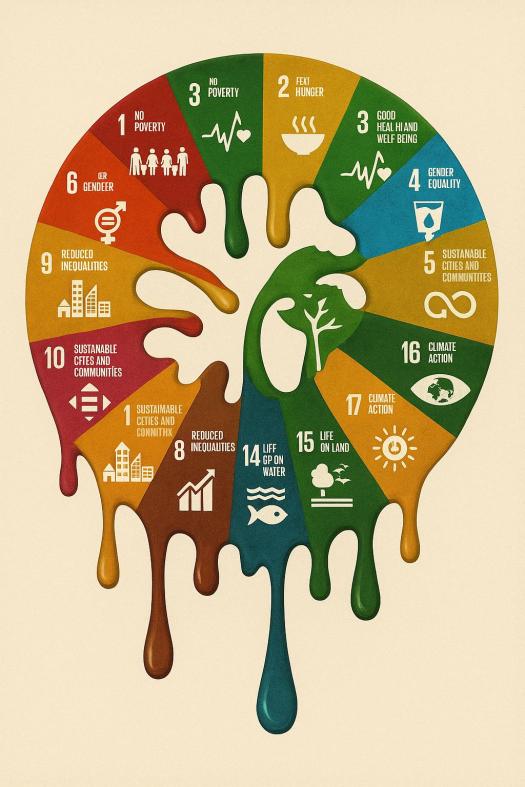
They came dressed as salvation, wrapped in coloured icons and global applause. But beneath the graphics lies a mess of contradictions, compromises, and collateral damage. Here we unpack each goal—not as it was dreamed up in Geneva, but as it has landed on the ground.

A circular graphic of the 17 Sustainable Development Goals (SDGs) with each segment melting like wax, rendered in a surreal Salvador Dalí-inspired style.

SDG 1: No Poverty

The Good: Billions in aid and NGO projects have lifted individuals out of extreme poverty zones temporarily; mobile banking and microcredit schemes have shown promise.
The Bad: Aid dependence fosters inertia, bypasses national institutions, and undermines local agency. Most African nations are still net exporters of capital due to debt servicing.
The Ugly: Western corporations extract billions in raw materials while pontificating about “inclusive growth.” Poverty statistics improve, but wealth inequality worsens. The SDG becomes a photo-op for billionaires with private jets.

SDG 2: Zero Hunger

The Good: Targeted food programmes, agricultural support, and school meal initiatives have helped reduce childhood hunger in some regions.
The Bad: African farmers often sidelined by subsidised Western food imports, distorting markets. GMO push disguised as philanthropy.
The Ugly: Western companies extract palm oil, cocoa, and coffee from African soil while Africa imports wheat and rice from abroad. The hunger remains—homegrown solutions are discouraged or sabotaged.

SDG 3: Good Health and Well-being

The Good: Vaccination campaigns and anti-malaria nets have saved lives. International coordination during outbreaks like Ebola did have positive effects.
The Bad: Health systems remain donor-dependent and brittle. Drug patents and pharmaceutical monopolies keep treatments unaffordable.
The Ugly: The West lectures on population control while funding sterilisation clinics, not hospitals. During COVID, African nations were last in line for vaccines—after being blamed for variants they didn’t cause.

SDG 4: Quality Education

The Good: Literacy rates have risen. Girls’ access to education has improved in measurable ways. Donor-led digital education pilots show promise.
The Bad: Much curriculum remains colonial, prioritising Western languages and values. Local history, trades, and culture are neglected.
The Ugly: Elites send their children abroad while rural schools lack desks. The promise of education is often betrayed by a total lack of post-education opportunity—thus fuelling migration.

SDG 5: Gender Equality

The Good: Gender-based violence laws have improved; access to reproductive healthcare and rights is more prominent in policy.
The Bad: Western ideologies about gender are imposed wholesale, clashing with cultural contexts and often backfiring. Tokenism abounds.
The Ugly: Gender NGOs become tools for regime manipulation—undermining families and traditional structures without offering durable alternatives. Men are alienated and women overburdened.

SDG 6: Clean Water and Sanitation

The Good: Boreholes, sanitation drives, and community projects have improved access. Urban water utilities have seen improvements in some cities.
The Bad: Infrastructure aid often bypasses local contractors, leaving no skills behind. Many projects fall apart when donor support ends.
The Ugly: The West donates filtration kits while Coca-Cola and Nestlé extract billions of litres of water from African aquifers tax-free.

SDG 7: Affordable and Clean Energy

The Good: Solar microgrids and off-grid solutions have brought lighting and phone charging to rural communities.
The Bad: Energy poverty still affects over 600 million Africans. Fossil fuel investment is blocked by Western ESG policy, even while Europe reopens coal plants.
The Ugly: Africans are told to skip fossil fuels and use wind and solar, while the minerals to build those systems are mined from Africa under exploitative conditions.

SDG 8: Decent Work and Economic Growth

The Good: Youth employment schemes, support for entrepreneurship, and digital microbusiness infrastructure (e.g. mobile money) have opened doors.
The Bad: Most “growth” is in extractive sectors or the informal economy—precarious, low-paid, and unsustainable. Western firms set the wages.
The Ugly: Africa exports raw materials, imports finished goods, and is then scolded for not being productive. “Decent work” rarely applies to cobalt miners, plantation labourers, or garment workers sewing for Western brands.

SDG 9: Industry, Innovation and Infrastructure

The Good: Roads, ports, and telecoms have expanded. Some African nations are incubating home-grown tech hubs.
The Bad: Most large infrastructure is debt-financed, often by China, and subject to foreign engineering, foreign profit, and foreign interests.
The Ugly: The West blocks industrial policy under free-market ideology, then tells Africa to “innovate” without fossil fuels, railways, or steelworks. Sovereign development banks are discouraged; dependency is institutionalised.

SDG 10: Reduced Inequality

The Good: Domestic reforms and global awareness of inequality have gained traction; some inclusive finance models have shown local promise.
The Bad: Inequality between nations is widening, not shrinking. Aid is given with one hand and taken back with interest payments.
The Ugly: The richest 1% are mostly Western, and mostly preaching equity to the poorest 10%—while African minerals fund their electric vehicles. The hypocrisy is baked in.

SDG 11: Sustainable Cities and Communities

The Good: Investment in resilient urban planning, public transport systems, and affordable housing is theoretically rising.
The Bad: Urban sprawl without services defines most African megacities. Informal settlements are bulldozed in the name of sustainability.
The Ugly: Climate finance is used to displace communities in favour of eco-projects no one asked for. Slums grow, while the reports boast of “smart city frameworks” and pilot zones built for Western investors.

SDG 12: Responsible Consumption and Production

The Good: Some shifts toward circular economy practices, especially in agriculture and local craft industries.
The Bad: African consumption is already low—this SDG is effectively aimed at the West, but enforced in the South.
The Ugly: Africa is treated as a dump for used clothing, e-waste, and plastic, while also being blamed for overpopulation and told to “consume responsibly.”

SDG 13: Climate Action

The Good: Regional climate strategies, afforestation, and improved resilience to floods and droughts are active in some nations.
The Bad: Africa contributes only 3% to global CO₂ emissions but is expected to meet the same net zero standards that Germany and the UK now flout.
The Ugly: Fossil fuel exploration is blocked in Africa, but promoted in Norway, the US, and even post-Brexit Britain. Africans are urged to “go solar” by those flying in private jets to climate summits.

SDG 14: Life Below Water

The Good: Marine protected areas and anti-poaching drives are increasing. Some success against illegal fishing.
The Bad: Foreign vessels still overfish African waters under EU licences. Local fishers are criminalised for feeding their families.
The Ugly: Climate treaties now threaten African coastal economies with Western carbon offset schemes. Seaweed farms and “blue carbon” projects are imposed as substitutes for actual fisheries.

SDG 15: Life on Land

The Good: Wildlife preservation, reforestation, and land rehabilitation have seen gains, especially with community-led conservation.
The Bad: Green colonialism resurfaces through carbon markets, displacing pastoralists and farmers for carbon credits.
The Ugly: Land is seized in the name of “protecting the planet.” Western firms buy carbon offsets while Africans lose ancestral homes. Nature is commodified for ESG portfolios.

SDG 16: Peace, Justice, and Strong Institutions

The Good: Anti-corruption frameworks and civil society organisations have gained modest influence. Peacekeeping operations have saved lives.
The Bad: Justice is slow, Western-funded NGOs often supplant national systems, and “strong institutions” are redefined as compliant ones.
The Ugly: Foreign donors pick winners and fund “democracy promotion” selectively. When African elections go the wrong way, the SDG missionaries go silent.

SDG 17: Partnerships for the Goals

The Good: International cooperation remains necessary; sharing knowledge, tech, and capital has real potential.
The Bad: These partnerships are almost always asymmetrical—dictated by donor terms and priorities.
The Ugly: The language of “partnership” masks dependency. Africa is not an equal at the table—it is the subject of the discussion. The SDG logo sits on documents denying African nations fossil fuel loans, industry funding, or land sovereignty.

We do not reject development. We reject its monopoly. We reject a development that builds solar panels in Switzerland from minerals stolen in the Congo, only to tell the Congolese they cannot burn gas to light their homes. We reject a development that calls us partners while dictating our choices, that builds boreholes with one hand and extracts oil, copper, gold, and dignity with the other.

The SDGs were sold as salvation. What they became was a stick for beating the poor, a branding exercise for rich NGOs, and a conscience balm for corporations whose real goal is profit, not people.

Letter XII 2–0 for the Three Laws

On Womanhood, Banks, and the End of Natural Sanity

By Martyn Walker
Published in Letters from a Nation in Decline

The Supreme Court’s ruling of 17 April 2025 brings brief but blessed clarity to a debate that should never have required adjudication. In upholding the definition of “woman” as a biological adult female, the court aligned itself—at last—with natural law, moral law, and human law. The surprise is not in the judgement, but in the fact that such a judgement was necessary at all [1].

Natural law is written in the structure of the body. It is not a social construct, nor is it open to interpretation by corporate HR departments. Moral law, developed over centuries of religious and philosophical reflection, honours the distinctiveness and dignity of women. And human law, which ought to reflect the wisdom of both, has too long been distorted by ideologues, bureaucrats, and cowards afraid to speak plainly.

With this ruling, the score is 2–0: reason and sanity regain ground against years of orchestrated confusion. The third point—cultural redemption—remains elusive. Corporate Britain, it seems, missed the memo.

Enter Lloyds Banking Group, who, within hours of the judgement, released a statement reaffirming their “support for the trans community” [2]. A curious phrase. What does it mean, in this context? That Lloyds is opposed to the court’s conclusion? That they prefer the legal fiction over biological fact? Or is it, as with so much modern corporate communication, simply a bland virtue-signal intended to prevent offence from a Twitter mob that has never darkened the doorstep of a bank branch?

The damage of such posturing is not abstract. It is real and cruel. Biological women—already silenced in sport, in prisons, in medicine, and in debate—are now told by their employers that their concerns are unwelcome. That they are, in essence, bigots for believing what every generation until 2015 took for granted.

This position is not just morally bankrupt—it is legally dangerous and socially irresponsible. And yet, it reflects a deeper truth about British banking in the twenty-first century: its abandonment of duty in favour of ideology.

These institutions, which once prized prudence, integrity, and public service, now concern themselves with pronouns and hashtags. Their moral compass is no longer set by community or customer, but by a risk-averse legal department obsessed with reputation management. It is not uncommon now to hear of customers being debanked for the crime of holding lawful but unfashionable opinions [3]. You may keep your money—so long as your views align with theirs.

Meanwhile, physical branches continue to vanish from high streets. Between 2015 and 2025, Britain has lost over 5,000 bank branches [4], leaving towns without cash access and elderly customers cut off from essential services. In the 1990s, when RBS attempted a similar retreat, the government blocked the move, recognising that banks are not just businesses but civic institutions [5]. Today’s political class, trained in nothing and employed in everything, lack both the will and the vocabulary to act similarly.

This is what decline looks like. A legal system forced to define “woman.” A bank afraid to state a biological fact. A population silenced by HR managers. All the while, the great financial houses of the country—flush with bailout cash, cradled by taxpayer guarantees—are more interested in gender identity training than interest rate margins.

When institutions forget their purpose, societies lose their memory. And once memory goes, so too does courage. We live in a time when truth requires legal defence, and fiction demands public fealty. But truth is stubborn. It is immune to hashtags, HR workshops, and focus groups. It may be silenced for a while, but it cannot be permanently removed. Not by Lloyds, not by Stonewall, and not by Whitehall.

Yesterday, the three laws spoke in unity. It is up to us to listen, to remember, and—if necessary—to fight for the truth they still protect.


References

  1. Supreme Court of the United Kingdom. (2025). Judgement: For Women Scotland v Scottish Ministers. SC/2023/0493.
  2. Lloyds Banking Group. (2025). Statement on Trans Inclusion. Corporate Newsroom. Retrieved 17 April 2025.
  3. Fairbairn, H. (2024). The Rise of Debanking: Social Credit by Stealth. Civitas Policy Paper.
  4. Which?. (2025). Bank Branch Closures: The State of Access to Cash in 2025. Retrieved from www.which.co.uk
  5. House of Commons Treasury Committee. (1995). Banking Services: Branch Closures and Community Impact.

Metadata

Letter Number: XII
Title: 2–0 for the Three Laws
Collection: Letters from a Nation in Decline
Author: Martyn Walker
Date: 18 April 2025
Word Count: 1,118


BISAC Subject Headings

  • POL022000: Political Science / Public Policy / Cultural Policy
  • SOC032000: Social Science / Gender Studies
  • BUS069000: Business & Economics / Banks & Banking

Library of Congress Subject Headings (LCSH)

  • Women’s Rights—Great Britain
  • Banks and Banking—Social Aspects—Great Britain
  • Equality—Law and Legislation—Great Britain
  • Natural Law—Philosophy

Letter XI – Press One for Betrayal

By Martyn Walker
Published in Letters from a Nation in Decline

The modern call centre was not designed to solve your problem. It was designed to make your problem someone else’s responsibility.

There was a time—not so long ago—when you could pick up the telephone and speak to someone in authority. Not a chatbot, not an overseas “operative,” not an algorithm tasked with guessing which service category most closely matched the thing that was bothering him. A human being. On the premises. With some measure of agency. One might even call it customer service—a phrase now drained of meaning, like so much corporate jargon turned to husk.

It’s easy to sentimentalise the past, but this isn’t nostalgia. It’s an observation. In 1980, if I had a query about a spare part, a refund, or a change to an order, I called the shop. The shop answered. A man in a brown coat wiped his hands and told me the truth. Perhaps he had to check in the storeroom. Perhaps he said no. But he said something. And I was no longer in doubt.

Now, try calling your local Halfords. Or Sainsbury’s. Or Currys. You’ll search for a phone number, find what looks like a local line, dial it with hope—and find yourself deep in the circuitry of a call centre. Often abroad. The voice will be polite, inoffensive, robotic. And its sole mission is to extract your details. Your name, postcode, date of birth, your grievance if you’re lucky. But it cannot solve your problem. It may not even understand it. You are not speaking to someone in the branch. You are speaking to data acquisition software in human form.

This isn’t a bug. It is the design. You, dear customer, are not a person but a unit of behavioural metadata. A record to be “triaged,” escalated, or dropped. The goal is not to help you but to contain you. Hold times, circular menus, dead-end email addresses, disappearing contact forms—these are not symptoms of strained service, but strategies of avoidance. No longer is the customer always right. The customer is barely relevant.

And when you finally breach the firewall—after ten minutes of hold music and a few weak apologies—you’re passed back, with luck, to the store you originally tried to reach. Or worse, told they “can’t connect you but will raise a ticket.” The circle begins again.

This model of service has metastasised. The state has adopted it with vigour. HMRC—an organisation I once respected—now behaves like a digital fortress. I have owed them money and seen the efficiency with which they communicate. But now they owe me a refund—one triggered at the height of the pandemic, over four years ago—and they are unreachable. My letters go unanswered. Emails are met with silence. Phone calls are looped through menus that lead nowhere. I cannot speak to anyone. And yet, if I were late in payment, I have no doubt I would be found [1].

We are told that these systems are more efficient. That technology has made things easier. That chatbots, web portals, apps, and ticketing systems have replaced “old-fashioned” service with something faster and more scalable. But these are lies. The system is not more efficient—it is more opaque. More exhausting. The problem is no longer one of supply, or of timing, but of deliberate misdirection.

You are meant to give up. That is the efficiency: your defeat.

The corporations know you have nowhere else to go. Tesco boasts of “price matching” against Aldi or Lidl, but only for items carefully selected as competitive loss leaders [2]. The supermarkets function as a cartel in all but name. There is no real price war—only a performance of it. And when every supplier adopts the same approach to service—offshored, automated, evasive—what alternative is left? Who do you reward with your custom?

The human voice—the oldest tool in commerce—is now treated as a cost centre. Empathy is expensive. Initiative is a risk. It is far safer, from a boardroom perspective, to channel all contact into a data funnel, log the frustration, and offer a £5 voucher once a month to appear caring.

Meanwhile, the consumer—the citizen, the taxpayer—is left howling into the void. Asking not even for special treatment, but for the basic reciprocity that once governed civil society.

And so I write this not as a technophobe—far from it—but as someone who sees the difference between progress and abandonment. We have not been “streamlined” into a new age of customer empowerment. We have been reduced. Stripped of our right to a voice, replaced with a row of dropdown menus and a number on a dashboard.

What has died is not merely service. It is the principle of response.

And without response, there can be no trust.

References

  1. National Audit Office (2022). Customer Service Performance at HMRC. NAO report showing average call waiting times exceeding 20 minutes, with some refund cases unresolved after more than a year.
  2. Competition & Markets Authority (CMA), 2023. Supermarket Price Competition Review. The report notes that “price match” campaigns often use cherry-picked items, typically loss leaders, creating an illusion of parity while overall basket prices diverge.
  3. Citizens Advice Bureau (2021). The Customer Service Crisis. Documenting the shift to automated and offshore customer service in key industries and its impact on vulnerable groups.
  4. Financial Times (2023). Retailers’ use of behavioural data surpasses customer service investment. A feature highlighting that major UK retailers spend significantly more on data analytics than on staff training or customer resolution.
  5. House of Commons Treasury Committee (2024). Digital Services and the Decline of Public Accountability. Evidence submitted to Parliament showing the impact of digital interfaces on HMRC accountability and customer complaints handling.

Metadata

Title: Press One for Betrayal
Series Title: Letters from a Nation in Decline
Series Volume: Letter XI
Author: Martyn Walker
Language: English (UK)
Date of Publication: 2025-04-16
Edition: First
Abstract / Short Description:
An essay on the erosion of human-centred customer service in modern Britain, revealing how citizens are now treated as data points, not people. Through sharp satire and lived experience, Press One for Betrayal confronts the state and corporate sectors’ weaponisation of digital systems to deflect responsibility and suppress contact. The personal becomes political in this eleventh letter from a nation in visible decline.


BISAC Subject Headings (Book Industry Standards and Communications):

  • SOC026000Social Science / Sociology / General
  • BUS070060Business & Economics / Customer Relations
  • POL023000Political Science / Public Policy / Economic Policy
  • TEC003070Technology / Social Aspects
  • COM087000Computers / Human-Computer Interaction

LCSH (Library of Congress Subject Headings):

  • Customer services—Great Britain
  • Call centers—Great Britain
  • Public administration—Effect of technological innovations on—Great Britain
  • Data protection—Great Britain
  • Communication—Technological innovations—Social aspects—Great Britain
  • Administrative agencies—Great Britain—Public opinion
  • Surveillance capitalism—Great Britain
  • Government accountability—Great Britain

Keywords / Tags for Indexing:

customer service, HMRC, UK bureaucracy, call centres, digital inefficiency, datafication, corporate indifference, public sector decay, satire, Letters from a Nation in Decline