

Once upon a time—within living memory, though now spoken of as though it were some sepia-toned idyll—the local council was exactly that: local. A modest civic body, often dull, occasionally officious, but recognisably part of the community whose money it spent. One imagines the town clerk of 1958, sleeves rolled, spectacles perched, frowning over the drainage budget with the stoicism of a man who knows he will meet the ratepayers in the butcher’s queue tomorrow morning. He was not a visionary, a strategist, a consultant, or a “stakeholder partner.” He merely fixed the roads, emptied the bins, and ensured the library opened on time. He did so because the town needed these things, and because the town paid for them.
Compare that modest creature with today’s municipal apparatus, a body swollen to the point of deformity, draped in managerial jargon and trembling under a hundred mutually contradictory regulations. Instead of the honest if plodding civil servant, we have entire platoons of officers whose professional identity is built not on service but on compliance. They do not shape the town; they interpret guidance. They do not defend local interests; they “engage” with frameworks. Their task is not to steward a place but to satisfy a central state that increasingly views local government as one more branch office—an outpost of Whitehall’s neurotic empire.
The transfiguration began when successive governments, each convinced of its own modernising brilliance, decided that the real problem with councils was that they were too responsive to their residents. Better, they thought, to strip away those old provincial arrangements and replace them with uniform “administrative units,” reorganised, rationalised and sanitised to within an inch of their lives. The result was the 1970s map: fewer councils, larger councils, and officials less likely to know the names of the streets they regulated. Efficiency, we were told. Progress, we were told. It has been downhill ever since.
A once-civic institution, now hollowed by bureaucracy and central control.
Then came the centralisers. Rate-capping, council tax limits, mandatory duties without matching funds: every lever was pulled to ensure that no local authority could so much as adjust a streetlight without permission from the capital. A Section 114 notice—local government’s version of sticking a “CLOSED FOR LACK OF MONEY” sign in the window—now hangs over dozens of authorities. The modern councillor governs nothing; he monitors a collapse, anxiously hoping that the Treasury might, in its mercy, approve a little more debt to keep the lights on.
And so to the regulations. If the older council was a steward, the modern council is a defendant—permanently awaiting judgement from a tribunal of auditors, inspectors, commissioners, ombudsmen, regulators and activist lawyers. Procurement law alone could cripple a lesser civilisation: tomes of directives dictating the precise choreography by which a council may purchase so much as a mop. The process is so paralysing that only the largest and most expensive corporations can complete it, creating a tidy cartel of outsourcers who speak the language of “KPIs” and “transformation pathways” while delivering services that are, at best, adequate and, at worst, catastrophic.
The tragedy is not merely the cost, though the cost is obscene. It is the culture. Preventive services, those quiet institutions that make a town bearable—youth centres, libraries, local works, the unobtrusive odd-jobbing that keeps a place civilised—have been amputated so that councils can funnel their remaining budget into statutory duties that grow more demanding every year. Social care now consumes the lion’s share of municipal budgets, not because councils have suddenly discovered humanitarian zeal, but because the law compels it and the courts enforce it.
Thus we inhabit the paradox of the British state: councils more elaborate than ever, producing worse public spaces than at any time since rationing. Potholes gape like geological features. Parks resemble the aftermath of a sullen strike. Planning departments take years to produce decisions that amount to artful apologies for not producing any decisions at all. What the average citizen sees is decay. What the average council produces is paperwork.
If the England of the post-war decades possessed a municipal ethic, it has been replaced by a municipal mirage: a swollen bureaucracy masquerading as governance, a system designed chiefly to protect itself from blame. It consumes money without delivering value, enforces rules without delivering order, and utters slogans about “communities” while retreating from the very notion of civic duty.
The state tells us this is progress: professionalism, standardisation, compliance, equality. But a town that cannot fix its own pavements is not progressing. A council that answers to Whitehall more readily than to its residents is not local. And a nation in which the simplest act of governance costs three times what it did half a century ago—and delivers a third of the quality—is not declining by accident.
It is declining by design. The design, as usual, belongs to people who do not have to live with the consequences.
When the state expands its procedures faster than its competence, decline arrives not as a crisis but as a schedule—issued quarterly, audited annually, and noticed by the public only when the bins stop being emptied.
When the state makes life itself conditional on its seal, the mark of the beast is already upon us.
It is a curious thing that whenever governments extend their reach into private life, they never describe it as such. They speak instead of convenience, safety, modernisation. Sir Keir Starmer’s championing of digital identity sounds like a minor administrative adjustment, the bureaucratic equivalent of changing the colour of the tax return form. Yet the reality is rather less trivial.
Digital identity, once imposed, is not a marginal innovation but a centralising revolution. Every man, woman, and child becomes a data entry in a state-authorised ledger, their existence vouched for only so long as the system continues to recognise them. Enter a shop, book a train ticket, apply for a job, or access a bank account — all remain possible only if the digital credential functions. The promise is efficiency; the reality is conditional existence.
The most arresting commentary on such systems does not come from libertarian pamphlets or academic studies, though both have their place. It comes from an ancient text often dismissed as melodrama: the thirteenth chapter of the Book of Revelation. There, the writer describes a society in which “all, both small and great, rich and poor, free and bond” must carry a mark, without which “no man might buy or sell.” Scholars debate whether this was first-century allegory, coded critique of Rome, or apocalyptic vision. The detail is precise: the universal credential is the universal chain.
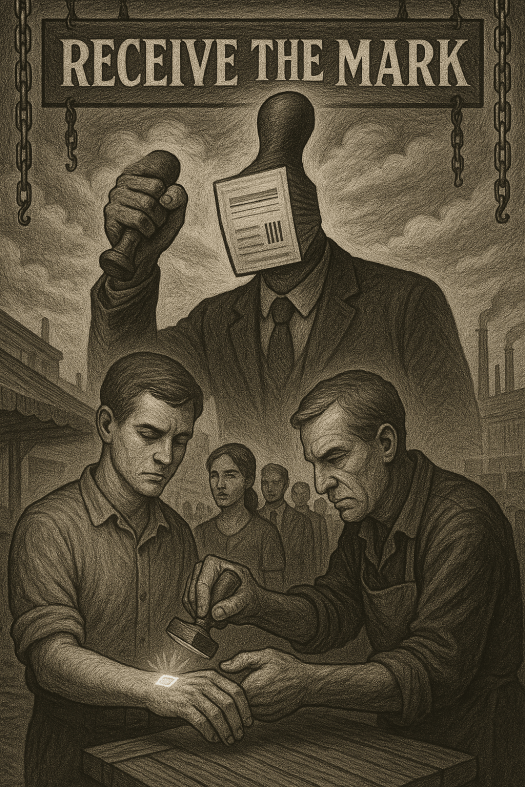
The state’s seal presented as progress, the moment of ownership disguised as efficiency.
No theological commitment is required to see the parallel. The mark on the hand or forehead is today’s biometric key. The exclusion from buying or selling is today’s digital wallet frozen by an unseen hand. The beastly system, whether religious or secular, rests not on spectacular cruelty but on the quiet, routine denial of access. Prison walls are unnecessary if the till refuses the card.
Sir Keir presents himself as a moderniser. His case for digital ID is couched in terms of security, fraud prevention, and border control. He would bristle at any comparison with scripture. Yet it is precisely his mildness that makes the matter more sinister. Tyranny that announces itself can be resisted. Tyranny that drapes itself in the language of efficiency is harder to unpick. One does not wake one morning to discover the mark branded on the hand; one drifts into a world where participation in daily life depends on presenting the correct token at every doorway.
Defenders of such schemes protest that the British state is not tyrannical, that it will never abuse such power. This is a charming thought. It is also historically illiterate. Every government abuses the powers it acquires, and powers are never surrendered. The veto inherent in a digital ID scheme — the ability to prevent a man from buying or selling — may sit dormant, but it will never be dismantled. It rests there, like a coiled spring in Whitehall, ready to be activated at the moment of political convenience.
Nor should the economic logic be ignored. The Bank of England has spoken openly about programmable currency, which requires, by definition, a universal identifier. To know what money is being spent on, or to restrict its use to particular purposes, the state must know who is doing the spending. The marriage of digital ID and programmable money creates precisely the world Revelation describes: life conditional on permission.
That the Labour leadership fails to see this is damning enough. That it understands and proceeds regardless is worse. The old Labour Party liked to talk about liberty and dignity. The new one is content to speak of databases and compliance. Sir Keir’s tone is calm, legalistic, mildly reassuring. The punchline is that he offers Britain not security but servitude by spreadsheet.
What makes this especially grotesque is Britain’s history. This was the nation that prided itself on habeas corpus, on common law, on the principle that the citizen was free unless explicitly restrained. The imposition of a universal ID, tethered to one’s ability to transact, inverts that principle. It assumes restraint, lifted only when the system gives its blessing. The state does not prove its case against the citizen; the citizen must prove his case to the state.
Some will accuse this argument of melodrama, of importing biblical language to dignify a mundane administrative reform. In truth the melodrama belongs to Starmer, who dresses coercion in the robes of progress. Revelation, for all its imagery, is coolly accurate. It identified, nearly two millennia ago, the core of what makes such systems intolerable. They do not merely control trade. They redefine freedom itself.
The polite suggestion is that Sir Keir has not reflected on the full implications. The impolite truth is that he has. Either way the effect is identical: a government that sees its citizens not as free men and women, but as registered users, liable to be suspended. And the suspension is not noisy, with trumpets and banners. It is silent, invisible: the card declined, the ticket refused, the door that no longer opens.
Sir Keir will be remembered. He will be remembered as the man who sought to baptise bureaucracy with the language of progress. Britain can weather his speeches; what it may not weather is the architecture he is so keen to build. The peril is not a number burned into the flesh. It is a system so ordinary, so seamless, that the nation scarcely notices it already carries the mark.
The writer of Revelation recognised the pattern. The mark of the beast was never about the hand or the forehead. It was about ownership — about the moment a man’s life ceased to be his own, and became conditional on another’s approval. That is what digital ID represents today. A mark not of safety, but of possession. And the question, as always, is whether the British people are still spirited enough to refuse it.
Come, sit with me a while. There’s something I need to say—before we go.
You see that hill? I played there once, Chased kites and kicked a ball until the light gave out. Down that lane was your great-grandmother’s cottage, With roses round the door and jam jars cooling on the sill. It was a good life, not rich, but honest. We belonged here, then.
But now… Now the country I gave my youth to, The one we sang for in school halls and stood for at Remembrance— She’s gone and signed herself away. Again. Quietly. Like a servant handing over keys.
They’ll call it progress. Integration. But I know surrender when I see it. We’ve lost something, lad. Something we may never get back.
So we’re leaving. All of us. Not because we stopped loving England— But because she stopped being England.
I’ll not come back. Not even for the spring bluebells in the woods, Or the sound of the choir practising on a Thursday evening. Even the things I love most would hurt to see again. Because they’ll still look the same… But they won’t be the same.
And one day, when you’re older, You might ask why I speak of her the way I do—like an old friend lost. And I’ll tell you: She was kind. She was proud. She was ours. And we let her slip through our fingers.
So goodbye, my England. You were the last of something gentle in a world growing hard. I leave with nothing but my memories, And a tear I never thought I’d shed.
There is a cruel illusion that stalks Western policymaking—an illusion we not only believe, but wrap in moral grandeur. It is the idea that if we lift a handful of people out of poverty, we have changed the world. A hundred million rescued, a headline for the BBC, a documentary narrated by Bono. Job done.
But what if this is the ultimate vanity project of the West? What if our relentless urge to “help” is a gilded form of sabotage?
Someone recently wrote online, with uncharacteristic clarity, that you could take 100 million people living in third-world poverty, move them to the United States, and still—still—billions would remain in that same poverty. The implication is hard to miss: the problem isn’t where the poor live. The problem is why poverty remains the dominant condition of those countries in the first place. And importing the poor to richer nations doesn’t solve the problem—it just relocates it and inflames a host of new ones.
We are encouraged to pity the migrants, not question the migration. Yet every one of those 100 million would cost billions to house, educate, subsidise, and absorb—while their departure does nothing to change the systems, cultures, or kleptocracies that bred their misery. Meanwhile, those left behind—numbering in the billions—are quietly erased from the ledger of Western concern.
And there is the sting: by rescuing the few, we abandon the many.
The road to this absurdity is paved with theological potholes and moral landmines. I recall the story of Pope John Paul II—beloved in the West for standing up to Soviet tyranny—visiting India during a time of desperate national struggle. The Indian government had, with considerable difficulty, built a network of family planning services, attempting to slow a spiralling birth rate in areas already plagued by malnutrition and drought. Charities worked hand in hand with officials to promote responsible contraception. It was not about ideology. It was about rice, water, and survival.
Then came the Pope.
With a few papal words, he condemned birth control in a country battling to feed its children. In an instant, years of careful groundwork were torched. His holiness departed in a plume of incense and rhetoric, leaving the consequences behind. He had the luxury of eternal principles. The people of India did not. The famine doesn’t care about doctrine.
This is what the West does best: it interferes. With speeches. With dogma. With chequebooks and conditions. And always, it leaves the bill with the locals.
A billboard proclaims “Western Solutions Available Here!”—offering solar panels, checklists, gender policy, and injections—while villagers walk past with broken carts and weary expressions.
Let us speak plainly. The developing world does not suffer from a lack of Western help—it suffers from an excess of it. Help that creates dependency. Help that erodes initiative. Help that demands ideological obedience in return. We tie aid to carbon compliance, to gender theory, to imported bureaucracy. The IMF does not give loans—it issues control. The charities do not build capacity—they replace it.
We have reached a point where the so-called “help” from the West has become more dangerous than its absence. We call it development, but it resembles colonisation wearing a rainbow lanyard.
And when the help fails, we blame the locals for “corruption” as if the World Bank is a convent of saints. Or we propose the unthinkable: that a coalition of successful nations should once again assume managerial control of the “failing” ones. We are back to empire, except this time it’s run by NGOs and ESG consultants.
And if not that, we shrug—and let nature take its course.
So what, then? Do we retreat?
Yes, actually.
But not with malice. Not with neglect. With discipline. With humility. With the honest admission that teaching a man to fish is no good if we’ve already leased his lake to China, banned his nets under EU regulation, and filled the water with World Economic Forum pamphlets.
We must learn to get out of the way. Not walk away from the world, but stop trying to run it.
Give tools, not rules. Invest without conditions. Respect local agency. Stop importing problems into Western cities just to feel temporarily virtuous. And never again should we let theology—of any kind—override common sense in a starving country.
Let us finally admit it: we have become too proud of our pity, too in love with the mirror image of our benevolence. The poor do not need our rescue. They need their freedom—from us.
Faithfully yours, M.W. Letters from a Nation in Decline
There was a time when the phrase international development conjured images of progress: clean water flowing from a new pump, a smiling child with a textbook, solar panels glinting on a school roof. Today, it increasingly conjures something else: a Western official in a tailored linen suit, lecturing villagers about climate obligations while their nation’s lithium is quietly sold to Tesla and their diesel generators are shut off.
The United Nations Sustainable Development Goals—17 of them, each with bullet points and colourful infographics—were meant to herald a new global era. Eradicating poverty. Ending hunger. Empowering women. Who could object?
But slogans are easy. It is the method of implementation, and the selective blindness, that reveal the deeper truth.
The Good
Let us not be unfair. In isolation, many SDG-aligned initiatives have brought tangible benefits. Literacy has risen. Infant mortality has dropped. Boreholes and mobile money have transformed some communities. Life expectancy in many African nations has improved dramatically since the 1990s. We’ve seen school feeding programmes that allowed girls to attend school for the first time. We’ve seen solar panels providing basic electricity where the grid never reached.
But we cannot mistake these successes—often born of local grit and ingenuity—for the triumph of global strategy. The SDGs were not the cause of progress. They became its branding.
The Bad
A closer look reveals a dismal pattern: Western governments, corporations, and NGOs deploy the SDGs not as a framework for empowerment but as an operating licence—a pretext for influence and control.
African nations are told they cannot use their own fossil fuel reserves, lest they “violate SDG 13,” while Europe quietly returns to coal.
Development banks, citing SDG “clean energy targets,” refuse to fund gas power plants in Nigeria or Mozambique—countries rich in natural gas and desperate for reliable electricity.
In the name of SDG 12 (responsible consumption), African textile industries are wiped out by bales of cast-off clothes from Britain, Germany, and the US.
SDG 5 (gender equality) becomes an excuse to impose Western cultural standards with zero regard for local context, alienating both men and women.
Even the roads, ports, and railways built under SDG 9 are often financed by foreign loans, constructed by foreign firms, and designed to facilitate resource extraction, not local resilience.
The Ugly
Worse still is the moral posturing. The SDGs have become an ethical fig leaf for what is, at heart, a continuation of imperial economics by other means. The tools have changed—no more Maxim guns and map lines—but the outcomes are familiar:
Raw materials flow out.
Debt, directives, and donor strings flow in.
Lectures are delivered about “transparency” by those who launder African wealth into London property.
A friend in Kenya recently sent me a photograph—a cardboard sign arguing that fossil fuels are essential to achieving the SDGs, not an obstacle. He is not alone. In Ghana, Senegal, Uganda, there is growing anger that while Western nations enriched themselves through coal, oil, and gas, Africans are now told to leapfrog into solar-powered sewing machines and skip the very industries that built Britain, Germany, and the United States.
They are told they must save the planet. A planet they did not ruin.
And if they object? If their leaders push for resource nationalism or challenge the green dogma? They are punished with bad credit ratings, NGO campaigns, and trade restrictions dressed up as ethics.
“We were told to dream with the SDGs, but woke up in a minefield. They promised us progress, gave us guidelines, then took our resources and told us to be grateful.”
A Personal Turning Point
I was turned against the UN quite a few years ago when I read the transcript of a debate revealing the UN’s outrage that Google did not give UN-backed reports extra weight over non-UN ones—particularly on climate. The irony? Even their own climate scientists had expressed doubts about the overblown rhetoric spewing from the political wing. Shortly thereafter, those inconvenient internal criticisms all but vanished from search results. That was the moment many of us, curious about the truth, heard the alarm bells.
But it didn’t stop there.
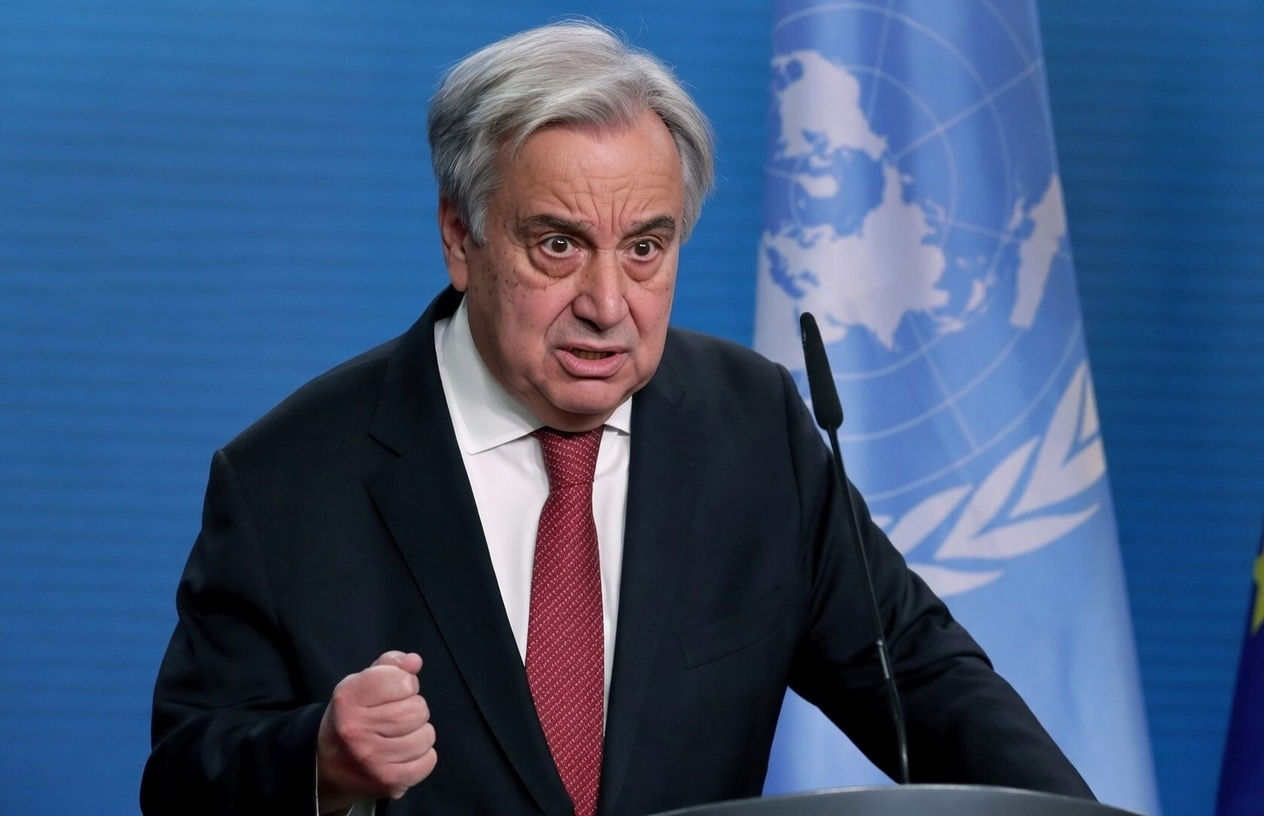
What sealed my opinion was not some subtle drift into ideological territory, but the sheer absurdity of its pronouncements. Perhaps the most comical—and simultaneously tragic—example was the moment the UN Secretary-General stood in front of a global audience, announcing with a sanctimonious glare that: “The oceans are boiling.” He said it with the air of a pope issuing doctrine—daring anyone to challenge such claptrap. That was the day they lost even the illusion of dignity. That was the day they started believing their own lies.
At the time, I didn’t think much more of it. Like most citizens, I didn’t really know what the UN was, how it was funded, or why it existed in its current form. But since then, I’ve read more. And while I still wholeheartedly approve of the idea of the UN—born from the wreckage of world war, with noble intent—I now wholeheartedly disapprove of its continued existence in this form.
It needs to be dismantled, and rebuilt for the modern age. And crucially, it must come with a known expiry date.
There needs to be a regular renaissance in such powerful institutions. It must be written into their articles of association that they do not exist in perpetuity. That every few generations, they are dissolved, reviewed, restructured, or replaced—by those who live with the consequences of their actions, not those who fund their inertia.
Only then can future generations repair the damage of the past.
Britain’s Role in the Decline
Britain once led the world in infrastructure, finance, and engineering. Today, we lead in hypocrisy.
We pressure African governments to abandon hydrocarbons while issuing new oil licences in the North Sea.
We demand their “transparency” while our banks hold the stolen proceeds of their corruption.
We celebrate our aid budget, yet make it near impossible for African students, scientists, or entrepreneurs to obtain a visa.
We mouth platitudes about “shared prosperity” while making damn sure the terms are written in our favour.
Even our charities—once a source of soft power—now act like minor UN agencies, full of slogans and interns and not much else. Oxfam lectures on social justice from offices built with funds extracted from taxpayer-backed contracts in countries they claim to help.
What Comes Next?
If the SDGs were sincere, they would prioritise energy sovereignty, industrialisation, and fair terms of trade. They would acknowledge that wealth must be created, not merely redistributed. They would empower Africans to determine their own path, even if that path includes diesel trucks, natural gas, and industrial-scale fertiliser.
Instead, they’ve become a system of moral accounting where Western nations get to “offset” their consumption by dictating how others should live. Carbon credits replace common sense. ESG ratings trump economic growth. And development becomes something done to Africa, not with it.
Final Words
The tragedy of the SDGs is not just that they fail. It is that they pretend to succeed, while preserving the very inequalities they claim to abolish. They are the smiling mask of a system that would rather fund a water kiosk than allow Africa to build its own water companies.
So let us end the deceit.
The real goal is not sustainable development. It is sustainable dependence.
And unless we say so clearly, unapologetically, and publicly, we will continue to be complicit in dressing up domination as partnership—while another generation of Africans is told they must wait, suffer, and obey for the good of the planet.
Let the record show: it wasn’t just the empire that failed Africa. It was the ideology that replaced it.
Beneath the Halo: The Good, the Bad, and the Ugly of the 17 SDGs
They came dressed as salvation, wrapped in coloured icons and global applause. But beneath the graphics lies a mess of contradictions, compromises, and collateral damage. Here we unpack each goal—not as it was dreamed up in Geneva, but as it has landed on the ground.
SDG 1: No Poverty
The Good: Billions in aid and NGO projects have lifted individuals out of extreme poverty zones temporarily; mobile banking and microcredit schemes have shown promise. The Bad: Aid dependence fosters inertia, bypasses national institutions, and undermines local agency. Most African nations are still net exporters of capital due to debt servicing. The Ugly: Western corporations extract billions in raw materials while pontificating about “inclusive growth.” Poverty statistics improve, but wealth inequality worsens. The SDG becomes a photo-op for billionaires with private jets.
SDG 2: Zero Hunger
The Good: Targeted food programmes, agricultural support, and school meal initiatives have helped reduce childhood hunger in some regions. The Bad: African farmers often sidelined by subsidised Western food imports, distorting markets. GMO push disguised as philanthropy. The Ugly: Western companies extract palm oil, cocoa, and coffee from African soil while Africa imports wheat and rice from abroad. The hunger remains—homegrown solutions are discouraged or sabotaged.
SDG 3: Good Health and Well-being
The Good: Vaccination campaigns and anti-malaria nets have saved lives. International coordination during outbreaks like Ebola did have positive effects. The Bad: Health systems remain donor-dependent and brittle. Drug patents and pharmaceutical monopolies keep treatments unaffordable. The Ugly: The West lectures on population control while funding sterilisation clinics, not hospitals. During COVID, African nations were last in line for vaccines—after being blamed for variants they didn’t cause.
SDG 4: Quality Education
The Good: Literacy rates have risen. Girls’ access to education has improved in measurable ways. Donor-led digital education pilots show promise. The Bad: Much curriculum remains colonial, prioritising Western languages and values. Local history, trades, and culture are neglected. The Ugly: Elites send their children abroad while rural schools lack desks. The promise of education is often betrayed by a total lack of post-education opportunity—thus fuelling migration.
SDG 5: Gender Equality
The Good: Gender-based violence laws have improved; access to reproductive healthcare and rights is more prominent in policy. The Bad: Western ideologies about gender are imposed wholesale, clashing with cultural contexts and often backfiring. Tokenism abounds. The Ugly: Gender NGOs become tools for regime manipulation—undermining families and traditional structures without offering durable alternatives. Men are alienated and women overburdened.
SDG 6: Clean Water and Sanitation
The Good: Boreholes, sanitation drives, and community projects have improved access. Urban water utilities have seen improvements in some cities. The Bad: Infrastructure aid often bypasses local contractors, leaving no skills behind. Many projects fall apart when donor support ends. The Ugly: The West donates filtration kits while Coca-Cola and Nestlé extract billions of litres of water from African aquifers tax-free.
SDG 7: Affordable and Clean Energy
The Good: Solar microgrids and off-grid solutions have brought lighting and phone charging to rural communities. The Bad: Energy poverty still affects over 600 million Africans. Fossil fuel investment is blocked by Western ESG policy, even while Europe reopens coal plants. The Ugly: Africans are told to skip fossil fuels and use wind and solar, while the minerals to build those systems are mined from Africa under exploitative conditions.
SDG 8: Decent Work and Economic Growth
The Good: Youth employment schemes, support for entrepreneurship, and digital microbusiness infrastructure (e.g. mobile money) have opened doors. The Bad: Most “growth” is in extractive sectors or the informal economy—precarious, low-paid, and unsustainable. Western firms set the wages. The Ugly: Africa exports raw materials, imports finished goods, and is then scolded for not being productive. “Decent work” rarely applies to cobalt miners, plantation labourers, or garment workers sewing for Western brands.
SDG 9: Industry, Innovation and Infrastructure
The Good: Roads, ports, and telecoms have expanded. Some African nations are incubating home-grown tech hubs. The Bad: Most large infrastructure is debt-financed, often by China, and subject to foreign engineering, foreign profit, and foreign interests. The Ugly: The West blocks industrial policy under free-market ideology, then tells Africa to “innovate” without fossil fuels, railways, or steelworks. Sovereign development banks are discouraged; dependency is institutionalised.
SDG 10: Reduced Inequality
The Good: Domestic reforms and global awareness of inequality have gained traction; some inclusive finance models have shown local promise. The Bad: Inequality between nations is widening, not shrinking. Aid is given with one hand and taken back with interest payments. The Ugly: The richest 1% are mostly Western, and mostly preaching equity to the poorest 10%—while African minerals fund their electric vehicles. The hypocrisy is baked in.
SDG 11: Sustainable Cities and Communities
The Good: Investment in resilient urban planning, public transport systems, and affordable housing is theoretically rising. The Bad: Urban sprawl without services defines most African megacities. Informal settlements are bulldozed in the name of sustainability. The Ugly: Climate finance is used to displace communities in favour of eco-projects no one asked for. Slums grow, while the reports boast of “smart city frameworks” and pilot zones built for Western investors.
SDG 12: Responsible Consumption and Production
The Good: Some shifts toward circular economy practices, especially in agriculture and local craft industries. The Bad: African consumption is already low—this SDG is effectively aimed at the West, but enforced in the South. The Ugly: Africa is treated as a dump for used clothing, e-waste, and plastic, while also being blamed for overpopulation and told to “consume responsibly.”
SDG 13: Climate Action
The Good: Regional climate strategies, afforestation, and improved resilience to floods and droughts are active in some nations. The Bad: Africa contributes only 3% to global CO₂ emissions but is expected to meet the same net zero standards that Germany and the UK now flout. The Ugly: Fossil fuel exploration is blocked in Africa, but promoted in Norway, the US, and even post-Brexit Britain. Africans are urged to “go solar” by those flying in private jets to climate summits.
SDG 14: Life Below Water
The Good: Marine protected areas and anti-poaching drives are increasing. Some success against illegal fishing. The Bad: Foreign vessels still overfish African waters under EU licences. Local fishers are criminalised for feeding their families. The Ugly: Climate treaties now threaten African coastal economies with Western carbon offset schemes. Seaweed farms and “blue carbon” projects are imposed as substitutes for actual fisheries.
SDG 15: Life on Land
The Good: Wildlife preservation, reforestation, and land rehabilitation have seen gains, especially with community-led conservation. The Bad: Green colonialism resurfaces through carbon markets, displacing pastoralists and farmers for carbon credits. The Ugly: Land is seized in the name of “protecting the planet.” Western firms buy carbon offsets while Africans lose ancestral homes. Nature is commodified for ESG portfolios.
SDG 16: Peace, Justice, and Strong Institutions
The Good: Anti-corruption frameworks and civil society organisations have gained modest influence. Peacekeeping operations have saved lives. The Bad: Justice is slow, Western-funded NGOs often supplant national systems, and “strong institutions” are redefined as compliant ones. The Ugly: Foreign donors pick winners and fund “democracy promotion” selectively. When African elections go the wrong way, the SDG missionaries go silent.
SDG 17: Partnerships for the Goals
The Good: International cooperation remains necessary; sharing knowledge, tech, and capital has real potential. The Bad: These partnerships are almost always asymmetrical—dictated by donor terms and priorities. The Ugly: The language of “partnership” masks dependency. Africa is not an equal at the table—it is the subject of the discussion. The SDG logo sits on documents denying African nations fossil fuel loans, industry funding, or land sovereignty.
We do not reject development. We reject its monopoly. We reject a development that builds solar panels in Switzerland from minerals stolen in the Congo, only to tell the Congolese they cannot burn gas to light their homes. We reject a development that calls us partners while dictating our choices, that builds boreholes with one hand and extracts oil, copper, gold, and dignity with the other.
The SDGs were sold as salvation. What they became was a stick for beating the poor, a branding exercise for rich NGOs, and a conscience balm for corporations whose real goal is profit, not people.
“A nation that cannot feed itself, house its people, or keep its lights on is not a nation at all—it is a tenant on borrowed land.”
It began, as these things often do, with envy dressed as fairness.
The farmer, like the landlord before him, is no longer a pillar of rural economy or local enterprise. He is a target. Not because he committed a crime, but because he owns something—a field, a barn, an orchard, a right to pass his land on without forfeiting half its value to HMRC. That, in modern Britain, is now enough to condemn him.
Rachel Reeves’ quiet tax raid on inherited farms isn’t just a tweak to inheritance rules; it is a scalpel, poised to carve up what’s left of the countryside. The attack mirrors the one launched earlier against landlords. In both cases, the Treasury knows its prey: those who are asset-rich but cash-poor. They cannot pay without selling. And once they sell, the land—and power—flows ever upward.
We’ve seen this movie before.
The water companies were sold off and siphoned into off-shore debt-ridden shells. The energy market was deregulated, then re-regulated into chaos. Rents are now controlled not by market forces but by policy distortions so severe that small landlords have been squeezed to death—leaving only corporate agents and institutional buyers standing. A whole district in Newcastle—Jesmond—has effectively been parcelled off to a few landlords with managing agents acting like 21st-century barons.
We are told this is progress.
But what it really is—what it always is—is consolidation. The dismantling of small-scale, dispersed ownership in favour of oligopoly. A slow, deliberate war of attrition against the middle classes and independent actors. Not just in housing or farming or utilities, but in all the vital organs of the nation: food, shelter, water, and energy.
And it has a rhythm now:
Phase one: demonise the owner. Call him greedy, idle, privileged.
Phase two: introduce ‘reforms’—a little stamp duty here, a little tax break removed there.
Phase three: offer them time. The ‘soft landing’—eighteen months for landlords, a year and a half for farmers. Time not to prepare, but to exit.
What emerges is a Britain where no one owns anything—except a handful of conglomerates with DEI departments and asset managers in Frankfurt.
The result is strategic dependence:
On foreign food, when our farms are broken.
On global energy markets, when our North Sea lies dormant.
On imported capital, when our own is taxed, banned, or discouraged.
We have become a nation allergic to ownership—suspicious of those who steward land, build homes, provide for themselves or their heirs. The old Thatcherite dream of a property-owning democracy has not only been abandoned—it has been exiled.
Our civil service wets and pseudo-socialist conservatives long ago surrendered the idea of self-reliance. They do not want a strong yeomanry or entrepreneurial base. They want managed decline, administered by technocrats, who will outsource our essentials and tax what remains.
No empire can survive when it imports its grain, its bricks, its firewood.
But here we are—importing all three, and still congratulating ourselves on the fairness of it all. If the landlord must go, if the farmer must sell, if ownership must be sacrificed—so be it, they say. At least we’ve punished the “rich.”
The rich, of course, will be fine. They always are. It’s the rest of us—the renters, the buyers, the families trying to live between rent hikes and grocery bills—who will inherit nothing but dependency.
“Some crimes offend the law, others offend the senses. But a few — like dimming the sun — offend both, and then go on to threaten all life that depends on its light.” — Laurence J. Peter, posthumously paraphrased
The Nuremberg Code Still Applies — Just Look Up
We are governed now by people who believe it is acceptable to experiment on the atmosphere — and by extension, on all life within it — without consent, oversight, or consequence. The proposal to “blot out the sun” under the guise of solar geoengineering may seem the stuff of science fiction, but it is not only real, it has been quietly sanctioned.
In this country, where grey skies already dominate the greater part of the year, the very idea that we should deliberately reduce sunlight warrants more than scientific scrutiny — it demands a reckoning with first principles.
Sunlight is not a pollutant. It is the original engine of life.
And yet, in the race to mitigate climate change, we are told that injecting particles into the stratosphere to reflect sunlight back into space might be necessary. The logic is simple, the risks profound. Reduce solar radiation, and you cool the Earth. But what else do you do?
You undercut solar panel yields, including those funded by government grants and individual savings alike. You suppress photosynthesis in farming regions, risking lower crop yields in a world already strained by food insecurity. You disrupt rainfall patterns, especially in equatorial and monsoonal zones. You reduce the availability of natural vitamin D, just as our GPs urge us to get more sunlight, not less.
You dim the world, literally and figuratively.
And all of it without a referendum. Without a vote. Without even a leaflet through the door.
Where is consent in this story? Where is accountability?
We are told that climate change is an existential threat, and perhaps it is. But that does not grant a government — or a consortium of scientists, or a supra-national fund — the right to conduct global-scale experiments with unknown long-term consequences, no matter how well intentioned. That is not precaution; that is hubris disguised as stewardship.
Which brings us — as all such questions eventually do — to the Nuremberg Code.
Drafted in the wake of war crimes and scientific atrocities, the Nuremberg Code was not simply a legal instrument. It was a moral declaration. It stated, for all time, that no human being should be subject to experimentation without their freely given, fully informed consent. No clever phrasing, no policy paper, no invocation of emergency, can supersede that.
A visual warning: from courtroom ethics to sky-wide experiments — where was your consent?
While the Code was written for medical experimentation, its logic extends to any deliberate action that treats the population as passive subjects of a risk-laden intervention. If deploying sulphate aerosols in the stratosphere, or conducting atmospheric reflectivity trials, is not an experiment on all life — then what is it?
We must not allow ourselves to be softened into apathy by the presentation of these plans as purely scientific exercises. We must not forget that science, without ethics, becomes machinery in search of obedience. The ghost of the 20th century tells us plainly where that leads.
Consent must return to the centre of policy. Not only in medicine, but in environmental governance, data rights, digital identity, and energy strategy. To ignore consent in these spheres is not merely undemocratic — it is dangerous.
The great lie of the age is that we can offset our guilt, erase our emissions, or rebalance our planet with a few technocratic tweaks. But we are not gods. We are stewards, or we are fools. The choice is that stark.
And so, to those in government who sanction these sky-darkening schemes: remember the Nuremberg Code. Not because we seek prosecution, but because we believe you still have a conscience. Because shame, not fear, should stop you.
By Common Sense, Reporting from the Edge of Reason. Opinion | Media Regulation | United Kingdom | April 2025
When a press regulator penalises newspapers for quoting Parliament without ritual appeasement, we are no longer defending journalism — we are regulating tone, not truth.
Ipso, as any modestly educated schoolchild once knew, means by the fact itself. Today, it appears to mean by the feelings of a preferred complainant, or more precisely, by the fact that someone, somewhere, might be offended, retroactively.
The Independent Press Standards Organisation — let us pause to admire the audacity of the word “Independent” — has declared that The Telegraph erred by quoting, without seeking fresh rebuttal, remarks made under the protection of Parliamentary privilege. The offending quote? A Cabinet Minister — Michael Gove — made reference in the Commons to alleged links between the Muslim Association of Britain (MAB) and the Muslim Brotherhood[1].
“Ipso has ruled that quoting Parliament is now misleading — unless you ask the accused to deny it again.”
The comments were made in Parliament. They were reported accurately. They included a denial from the MAB, already in the public domain. And yet: Ipso upheld the complaint[2].
Ipso facto, accuracy is no longer the standard. Deference is.
Under the Editors’ Code, publications must not print inaccurate or misleading content. Yet somehow, Ipso ruled that quoting Parliament, while accurate, was still misleading — because The Telegraph did not re-ask the MAB to deny it again. This isn’t regulation. It’s a form of compelled courtesy.
Let us reflect on the implications: If newspapers must now solicit fresh reactions every time a parliamentary statement is quoted — even when the response is already publicly known — then press freedom has become contingent not on facts, but on feelings and repetition rituals.
Parliamentary privilege now risks becoming a historical footnote — overruled by feelings and rituals.
Michael Gove, now also editor of The Spectator, rightly warns that such rulings have a chilling effect. “Groups suspected of extremism rarely want scrutiny,” he wrote, “They seek to present themselves as a peaceable association of co-religionists who simply want to get along and do good works.”[3]
Parliamentary privilege, once a bulwark of British democracy, now risks becoming a historical footnote — overruled by the sensitivities of groups that may be under scrutiny.
And Ipso’s record gives little comfort:
In 2021, it entertained an 87-page complaint from Yevgeny Prigozhin, the Wagner mercenary boss, who insisted he was merely a successful restaurateur. The Telegraph had to prepare a formal response. He later withdrew the complaint — after publicly confirming his role as Wagner’s founder[4].
In 2023, Ipso ruled against The Spectator for referring to a transgender journalist as “a man who claims to be a woman”, citing discrimination[5].
In 2019, it drafted guidance warning journalists against “insensitivities” when reporting on Islam, language more suited to cultural outreach than impartial regulation[6].
These are not the decisions of a neutral arbiter. These are the reflexes of an organisation that now regulates not truth, but tone — not accuracy, but atmosphere.
Breaking news (that everyone already knows): A free press must be free to offend. Free to quote. Free to scrutinise. That includes the right to repeat what elected representatives say in the Commons — without asking permission from those criticised.
Otherwise, we are not defending journalism. We are auditioning for Ofcom’s little sibling, with a clipboard and a mood ring.
Ipso, by the very fact itself, has become part of the problem.
References:
Hansard, House of Commons debate, March 2023 – Statement by Michael Gove naming three Muslim organisations, including the MAB, for review.
IPSO ruling against The Telegraph, April 2025 – Complaint upheld for failing to seek new response from MAB.
Michael Gove, “Groups suspected of extremism don’t want scrutiny,” The Telegraph, April 2025.
The Telegraph, April 2021 – Coverage of complaint by Yevgeny Prigozhin, later withdrawn after public admission of Wagner affiliation.
IPSO ruling against The Spectator, 2023 – Discrimination ruling over gender language.
IPSO draft guidance, 2019 – Recommendations for reporting on Islam with caution to avoid “insensitivities.”
Author:Common Sense is a recovering civil servant and occasional contributor to The Last Remaining Sane Newspaper, where he writes under a variety of pseudonyms for his own protection and amusement. He identifies as reality-adjacent and accepts correspondence by pigeon.
Column Metadata:
Title: IPSO Facto: When the Press Regulator Forgets What a Press Is For
Author: Common Sense
Published: April 2025
Word count: approx. 1,050
Categories: Media, Regulation, Free Speech, UK Politics, Journalism
License: Opinion / Commentary — standard editorial fair use
Keywords: IPSO, press regulation, Michael Gove, MAB, Muslim Brotherhood, Parliamentary privilege, free speech, journalism
When the state plans to dim the sun while blanketing farmland with solar panels, only folly thrives.
I installed solar panels some years ago. A modest gesture, perhaps, but one rooted in the belief that renewable energy—particularly the power of the sun—offered a sensible path forward. The promise was straightforward: invest now, harvest the sun’s rays, lower my bills, and contribute, in some small way, to a greener future.
Imagine, then, my reaction upon learning that the government is now considering blotting out the sun.
I do not exaggerate. At Westminster, serious people are discussing the allocation of billions to solar geoengineering—spraying fine particulates into the atmosphere to reflect sunlight away from the Earth, cooling the planet in the process. Sulphur dioxide is the preferred agent, mimicking the effect of volcanic eruptions, lowering global temperatures, and, we are told, sparing us from climate catastrophe.
At the same time, those same serious people are approving hundreds of thousands of acres of farmland for conversion into solar farms. Arable fields, once the source of our food, will be turned into glinting expanses of silicon and glass—desperate to capture the very sunlight the state proposes to dim.
Which is it? Are we to harvest the sun or hide from it?
This is policy schizophrenia at its finest. On one hand, we are to bow before the gods of net zero, covering our green and pleasant land with solar panels. On the other, we are to fund atmospheric experiments that will diminish the very light those panels need to function. The left hand builds; the right hand dismantles.
But this is more than a contradiction. It is the arrogance of central planning, an affliction that has toppled empires, destroyed livelihoods, and now threatens to snuff out the sun’s warming rays.
History is not short of warnings. In the Soviet Union, one Trofim Lysenko convinced Stalin that science itself could be bent to ideology. Genetics was bourgeois nonsense, he claimed, and crops could be trained—like loyal Party members—to thrive in hostile environments if only they were exposed to the correct conditioning. Real scientists, those who objected, were purged. Their warnings ignored. The result? Agricultural collapse, famine, and death on an industrial scale.
The lesson? When policy bends science to ideology, crops fail and people starve.
Geoengineering smells of the same hubris. The climate models, neat as they are, do not account for the complex choreography of atmosphere, ocean, and biosphere. The Earth is not a thermostat, waiting for a bureaucrat to dial in the desired temperature. There is no slider bar for unintended consequences.
Consider CFCs—chlorofluorocarbons. Once hailed as a miracle of modern chemistry, powering refrigeration, aerosols, and industrial processes. Until, decades later, scientists discovered they were quietly eating away at the ozone layer, exposing us to dangerous levels of ultraviolet radiation. It took an extraordinary global effort—the Montreal Protocol—to halt the damage. The unintended consequence of human ingenuity.
Now, we propose to tamper with the atmosphere once again. To spray particles into the sky, with only the faintest grasp of what might follow. Droughts in one region, floods in another. Failed harvests. Shifts in monsoon patterns. The arrogance of assuming we can control a global system as intricate as the climate without consequence is staggering.
And all this while tearing up farmland to make way for solar panels, sacrificing food security for energy generation, only to dim the light that powers them.
It is the insanity of the moment, yes—but also the failure to learn from history. Grand schemes, unmoored from reality, sold on visions of salvation but delivered through wreckage and regret.
The late pathologist’s words echo: Humans are tropical creatures. Leave a man naked outside at 20°C, and he will die from exposure. We are built for warmth, for sunlight. The sun is not our enemy. It is our origin.
This is a nation in decline: dimming the sun, sterilising the soil, trading common sense for ideology. No thought for consequence. No humility before the complexity of life.
I do not ask for much. Protect the farmland. Let the sun shine. Reject the delusion that we can reorder the heavens by committee. We are not gods, and this is not our playground.
When the crops fail and the skies darken, there will be no bureaucrat to blame but ourselves.
🔬 UK Government Initiatives on Solar Geoengineering
UK Scientists to Launch Outdoor Geoengineering Experiments The Guardian reports on the UK’s £50 million funding for small-scale outdoor experiments aimed at testing solar radiation management techniques, such as cloud brightening and aerosol injections. Critics express concerns about potential environmental risks and the diversion from emission reduction efforts. (UK scientists to launch outdoor geoengineering experiments)
Exploring Climate Cooling Programme An overview of the UK’s climate engineering research initiative, detailing the government’s £61 million investment in solar radiation management research, including methods like stratospheric aerosol injection and marine cloud brightening. (Exploring Climate Cooling Programme)
The UK’s Gamble on Solar Geoengineering is Like Using Aspirin for Cancer A critical opinion piece likening the UK’s investment in solar geoengineering to treating cancer with aspirin, highlighting the potential dangers and ineffectiveness of such approaches in addressing the root causes of climate change. (The UK’s gamble on solar geoengineering is like using aspirin for cancer)
🌾 Solar Farms and Agricultural Land Use
Super-Sized Farms or Rooftop Panels? The New Divisions Over Solar The Times discusses the growing tensions between large-scale solar farm developments on agricultural land and the push for rooftop solar installations, emphasizing the need for balanced energy strategies that consider food security and community impact. (Super-sized farms or rooftop panels? The new divisions over solar)
Solar Farms v People Power: The Locals Fighting for Their County The Guardian highlights local opposition to massive solar farm projects in Norfolk, illustrating the conflict between renewable energy goals and preserving rural landscapes and livelihoods. (Landowners cover countryside with solar panels in ‘sunrush’)
Factcheck: Is Solar Power a ‘Threat’ to UK Farmland? Carbon Brief examines claims about solar farms posing threats to UK farmland, analyzing data and policies to assess the actual impact on agricultural land use. (Factcheck: Is solar power a ‘threat’ to UK farmland? – Carbon Brief)
🗣️ Critical Perspectives and Policy Analysis
Why UK Scientists Are Trying to Dim the Sun The Week provides an overview of the UK’s funding for controversial geoengineering techniques, exploring the scientific rationale and the ethical debates surrounding these interventions. (Why UK scientists are trying to dim the Sun | The Week)
Analysis: Plans to Cool the Earth by Blocking Sunlight Are Gaining Momentum but Critical Voices Risk Being Sidelined UCL’s analysis warns of the rapid advancement of solar geoengineering research without adequate consideration of dissenting opinions and the potential for self-regulation leading to dangerous outcomes. (Analysis: Plans to cool the Earth by blocking sunlight are gaining …)
Solar Geoengineering Not a ‘Sensible Rescue Plan’, Say Scientists Imperial College London reports on a study indicating that reflecting solar energy back to space could cause more problems than it solves, questioning the viability of solar geoengineering as a climate solution. (Solar geoengineering not a ‘sensible rescue plan’, say scientists)
Metadata
Letter Number: XIII Title: Blotting Out the Sun Collection: Letters from a Nation in Decline Author: Martyn Walker Date: 28 April 2025 Word Count: 1,210
BISAC Subject Headings
POL044000: Political Science / Public Policy / Environmental Policy SCI026000: Science / Environmental Science (incl. Climate Change) TEC031010: Technology & Engineering / Power Resources / Solar BUS032000: Business & Economics / Infrastructure SOC055000: Social Science / Agriculture & Food Security SCI092000: Science / Ethics (incl. Environmental Ethics)
Library of Congress Subject Headings (LCSH)
Solar Energy—Government Policy—Great Britain Geoengineering—Environmental Aspects—Great Britain Agriculture and Energy—Great Britain Central Planning—Political Aspects—Great Britain Environmental Policy—Moral and Ethical Aspects Food Security—Great Britain Climatic Changes—Moral and Ethical Aspects
Typhoon pilots sprint for cockpits that have flown ten per cent fewer hours this year so their squadrons could meet an emissions cap.
Tankers sit on the apron topped up with scarce Sustainable Aviation Fuel that costs four times more than kerosene, so the wing commander releases just two instead of the required four.
The calculus is brutal, and it is instant: fewer jets in the air, slimmer magazines, thinner margins.
The adversary—be it Russian bombers, Chinese hypersonic glide vehicles, or a swarm of weaponised drones smuggled across Europe’s southern flank—does not care that our bases run on wind power or that our hangars are net‑zero.
All that matters in that moment is whether we can fight and win.
Survival first, stewardship second
Climate policy is a long‑term struggle for habitability; war is an immediate struggle for survival.
Lose the second and the first becomes irrelevant.
An occupied nation has no agency over carbon prices, land‑use policy, or green R & D.
Remember how Ukraine’s grid decarbonisation goals evaporated the instant Russian missiles targeted Kyiv’s substations; the only metric that counted was megawatts restored quickly enough to keep lights on and radars spinning.
The same brutal arithmetic would apply here.
If Portsmouth is cratered or RAF Lossiemouth is reduced to rubble, our gleaming solar arrays and impeccably sorted recycling streams will not defend the Channel, guard data cables in the Atlantic, or shield cash machines from cyber‑extortion.
The illusion of choice
Proponents of the current programme argue the United Kingdom can “walk and chew gum”, greening Defence while preserving deterrence.
That phrase rings hollow when budgets are already stretched between replacing Trident, recapitalising land forces gutted after the last review, and standing up an AUKUS submarine fleet.
Every pound poured into retro‑fitting hangars is a pound not spent on stocks of medium‑range air‑to‑air missiles; every hour an F‑35B sits in a simulator to save carbon is an hour the pilot is not honing instinctive reactions to a real, air‑combat merge.
The hard truth is that Defence cannot buy itself out of physics.
Hydro‑treated plant oils and e‑fuels hold less energy per kilogram than Jet A‑1. Batteries steal payload and range.
“Do more with less fuel” eventually becomes “do less”.
A realistic hierarchy of need
Win the fight. Deterrence that fails costs cities, not credit‑rating points. War‑winning mass and readiness must sit at the top of the spending stack.
Harden the force. Where green technologies also add resilience—micro‑grids that keep a station alive when the national grid is hacked, for example—they should be accelerated. But they serve the war‑fighting aim first.
Cut emissions without cutting capability. Capitalise on incremental gains already proven in conflict—formation flying software that trims fuel burn, synthetic training that substitutes only the least valuable live sorties—not the most.
Hold ambition to account. Net‑zero deadlines must carry a readiness‑override clause: if a target compromises deterrence, it slips. Not the other way round.
A closing vision
Picture a different headline five years hence: “RAF repels barrage on UK airspace; combat air wing retains 92 % mission‑capable rate.”
In the footnotes, you learn the bases ran on a hybrid micro‑grid, and the tankers blended 20 % SAF because supply chains allowed it—not because doctrine demanded it.
That is how sustainability should look in a world of peer conflict: a dividend of strength, never a substitute for it.
Climate change may shape the century, but if the Union Flag is replaced over Whitehall, the climate debate—along with every other public good—ends at the barrel of someone else’s gun.
First secure the realm. Then, in the peace our readiness secures, we can afford the luxury of arguing about carbon.