
AI – The Hollow Masquerade: A Portrait of Folly Behind the Façade

Author’s Note:
Attempting to generate an image for this satirical play using AI was a soul-sapping exercise in futility. At one point, I was one error message away from launching my laptop out the window like a rock star in a midlife crisis.

If this had been the 1970s, I’d have hurled the hotel TV into the car park and lit a cigarette over the smouldering remains.

Enter NotebookLM from Google—like a calm librarian walking into a bar fight. It actually made sense. Do yourself a favour: give it a listen before reading on.

In a faded council chamber, Stan Laurel and Ollie Hardy debate whether to conduct a local or national inquiry amid public pressure and political delays. Laurel emphasizes the need for accountability, while Hardy evades responsibility, fearing voter backlash. Their discussion reveals government inefficiency and avoidance of truth.

INT. A FADED COUNCIL CHAMBER — SOMEWHERE BETWEEN WESTMINSTER AND NOWHERE

(Stan Laurel is flicking through a thick stack of enquiry reports. Ollie Hardy is adjusting his mayoral chain, which is obviously too small and keeps getting stuck in his double chin.)


HARDY:
Stanley, this is a serious matter. The people are demanding answers. So we must decide: Do we want a local inquiry… or a national inquiry?

LAUREL:
Well… why don’t we have a national local inquiry? That way it only applies in some places but makes everyone feel involved!

HARDY (huffing):
You can’t have a national local inquiry! That’s like ordering a medium large coffee!

LAUREL:
But Ollie, last week we said we wanted a national one. Then the week before that, we said we didn’t. Then we did. Then we didn’t. Then we sort of did, but only if nobody asked too many questions…

HARDY:
That’s called government policy, Stanley.

LAUREL (scratching his head):
I thought it was called panic.


HARDY (stepping forward, speaking as if to a public gallery):
We are faced with a delicate issue — one that could cost votes, credibility, and the last wafer-thin biscuit of public trust. Therefore, we shall respond with… a Taskforce! A working group! An inter-departmental roundtable! With refreshments!

LAUREL:
But what about the girls, Ollie?

HARDY (pausing):
What girls?

LAUREL:
The ones they’re supposed to be asking about. The ones who got hurt.

HARDY:
Oh, those girls. Yes, yes. Well, we’ve drafted a Statement of Concern and a Provisional Framework for a Potential Expression of Regret. Pending further votes.


LAUREL (innocently):
You mean you’re not going to find out who did it?

HARDY:
Stanley, don’t be ridiculous! If we found out who did it, we might have to say something. Then somebody might get offended — and then what? We lose the whole constituency!

LAUREL (genuinely confused):
But I thought we were in charge.

HARDY:
Oh no, Stanley. We’re not in charge. We just act like it until the next election.


(Laurel produces a map of Britain with red Xs all over it.)

LAUREL:
I counted. There’ve been eight of these cases that we didn’t really look into.

HARDY (snatching the map):
That’s not a map! That’s a career suicide note! Take it away!

LAUREL:
But what if the voters start noticing?

HARDY:
We’ll tell them it’s local police responsibility. Or historic. Or complicated. Or “currently under review pending further scoping assessments”.


LAUREL:
That’s a lot of words for doing nothing.

HARDY (exasperated):
Stanley, doing nothing is a time-honoured British tradition! If we did something, there’d be… consequences!

LAUREL (thinking):
Like justice?

HARDY:
Don’t say that word in here!


(Laurel picks up a newspaper with the headline: “Enquiry Postponed Again” and sighs.)

LAUREL:
You know Ollie, if this keeps up, they won’t vote for Labour or anyone else. They’ll just stay home.

HARDY:
Exactly! And then nobody loses! Democracy at its finest!


(Beat. Laurel starts sobbing.)

LAUREL:
But I don’t want to be part of a country that can’t tell the truth because it might lose a seat in Bradford.

HARDY (quietly):
Neither do I, Stanley… But we’ve got a press release going out that says we’re deeply committed to transparency, so chin up, eh?


(As they leave, Laurel turns back and pins a single sign to the wall. It reads: “DO THE RIGHT THING.”)

HARDY (scoffing):
Now you’ve done it. Someone will definitely be offended.

LAUREL (smiling faintly):
I hope so.


[FADE OUT to sound of filing cabinet drawers being slammed, one after the other, into the same unopened enquiry folder.]

Why Imperfection Can Boost Project Delivery

Neil Carruthers had a suit that fit like it was made for someone slightly more successful. He was mid-thirties, agile with spreadsheets, cautious with opinions. A contractor. Six-month rolling gig. Billing at £700 a day to help “transform delivery culture” at a bloated infrastructure firm called Eaglenex Systems — the kind of company that wrote press releases about internal memos and hired two project managers for every engineer.

At Eaglenex, perfection wasn’t a goal. It was a paralysis.

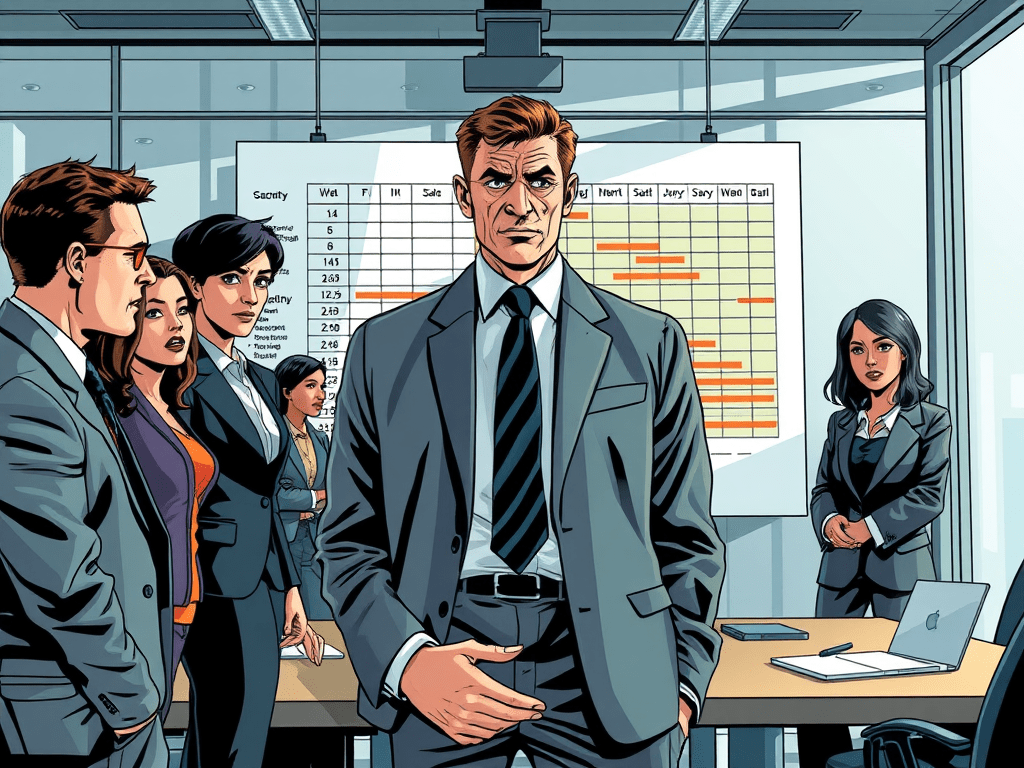
The Monday incident happened in Meeting Room 4C. A long rectangle of glass and resentment.

Everyone was there — Delivery, PMO, Compliance, a junior from Legal who blinked like he was learning to see. The project was three months overdue and twenty-seven pages into a colour-coded Excel workbook that still hadn’t had a single task marked “Complete.”

The Director of Delivery, a woman called Mariana, sharp-suited and permanently under-caffeinated, pointed at the Gantt chart on the wall and snapped, “We cannot release Phase 1 until QA signs off on every single scenario. We have a reputation.”

Neil, for reasons unclear even to himself, cleared his throat and said, “If it’s worth doing, it’s worth doing poorly.”

The silence hit like a power cut.

A full three seconds passed before Mariana turned, eyes narrowing.

“Excuse me?”

Neil blinked. Thought about walking it back. Thought about smiling, chuckling, pretending he was joking. But something inside him — maybe the ghost of his teenage self, or maybe just the spreadsheet open on his second monitor — pushed him on.

He said, “I just mean… we’ve got three modules ready. They’re not perfect. But they work. Waiting for the full gold-plated rollout means nobody gets anything. If it’s worth doing — delivering, in this case — then it’s worth doing now. Even if it’s not pristine. Even if it’s a bit rough. Doing it poorly is better than not doing it at all.”

Someone coughed. Someone else bit back a laugh.

Mariana stared. “We are not in the business of doing things poorly, Mr Carruthers.”

Neil said, “With respect, we’re currently in the business of not doing anything at all.”

Later that day, he expected a call from HR. Instead, he got an invite from the COO.

“You said something odd in the meeting,” the COO said, pouring himself an espresso like a man who preferred gin. “Something about doing things poorly.”

Neil braced himself. “I was making a point about over-perfection killing momentum.”

The COO sat back. “My daughter’s a sculptor. She said something similar. Art isn’t finished, it’s abandoned.” He sipped. “Maybe we’ve been trying to finish too many things that should have just been shipped.”

By Friday, they were running a pilot — releasing a trimmed-down version of Phase 1 to one region. The devs were horrified. The PMO issued disclaimers longer than the user guide. But it worked. Customers could finally use the tool. Feedback came in. Bugs were fixed. Real progress began.

Three weeks later, Mariana called another meeting. Same room. Same chart. But this time, three tasks were marked done.

She looked at Neil. “I don’t like your phrase. But I admit, it shook something loose.”

Neil shrugged. “I’ll trademark it if you like.”

Mariana smiled, just once. “No need. I’ve already stolen it.”

By the end of the quarter, Eaglenex had a new internal slogan on the walls: Start Small. Ship Fast. Iterate Better. It was basically Neil’s philosophy, run through a sanitiser. The phrase itself — the original heresy — was never spoken aloud again. But in corners of the business, whispered like a secret, people started to say it.

“If it’s worth doing…”

“…it’s worth doing poorly.”

And the wisdom was this: The fear of imperfection is a luxury companies can’t afford. The cost of not delivering is higher than the cost of delivering imperfectly. And sometimes, the person who dares to do it badly is the only one who gets anything done at all.

How Morning Breath Turns Into Morning Bliss

The first rays of sunlight crept through the blinds, casting golden stripes across the rumpled bed. A young woman, tangled in the duvet like a recently shipwrecked survivor, stretched her arms above her head and let out an unguarded yawn. She blinked, still groggy, and ran a hand through her tousled hair.

Beside her, a man—handsome, annoyingly alert, and looking entirely too pleased with the new day—sat up and smiled. His hair was charmingly dishevelled, the kind that took no effort and would probably fall into place with a single pass of his fingers. He turned to her with the unmistakable look of a man about to do something deeply affectionate and entirely unwelcome at this hour.

He leaned in.

“Morning, gorgeous,” he murmured, his lips pursing for a kiss.

Panic flared in her eyes. She took a rapid step back, nearly tripping over the bedside rug. “Morning breath!” she blurted, holding up both hands in warning.

The words hung in the air for half a second before he beamed.

“Morning wonderful!” he corrected, eyes full of adoration.

Before she could protest further, he swooped in, cradling her face with both hands and planting a kiss—no, a whopping great kiss—full on her lips. It was the kiss that belonged in films, backed by swelling orchestral music, not in a bedroom still thick with the remnants of sleep and questionable breath.

Her eyes flew open in horror.

She had expected restraint. She had expected respect for the delicate social contract that governed mornings. But instead, she found herself locked in a kiss so deep, so passionate, that for a brief moment, she forgot her original objection.

Then reality crashed back.

She broke away, staring at him with the urgency of someone who had just swallowed a spider. He grinned, completely oblivious.

“You—” she stammered. “You really—You just—”

“Best way to start the day,” he declared, stretching his arms victoriously, as if he had just accomplished something noble.

She wiped her lips dramatically, narrowing her eyes. “You are too much of a morning person.”

“And you,” he said, wrapping an arm around her waist, “are too cute when you’re flustered.”

She sighed, pinching the bridge of her nose. “I need coffee. And mouthwash. Preferably in that order.”

He kissed her forehead. “I’ll put the kettle on.”

As he walked off, whistling cheerfully, she shook her head, muttering to herself.

“I swear, one of these days, I’ll just wake up before him and weaponise this.”

But she knew, deep down, she’d probably let him get away with it again tomorrow.

A Quirky Dialogue: Harold and the Poopy Bag

“Harold? Harold! Where are you Harold?” screeched the old crone.
“Here dear, at your service,” the gentle old man softly croaked. “To what illustrious duty do you wish to chain me?”
“Harold! It’s time to take the dogs for a walk. Get on with it.”
“Yes dear, of course. They’re waiting in the yard—I just came in to collect the poopy bag.”
“Poopy bag?” the old crone enquired.
As Harold began to explain, “Yes dear, I use it to—” her mouth slackened and her eyes fluttered like butterflies. Her pale face began to rise, causing Harold to brace himself for either a fist to the nose or a harsh slap.
Instead, she merely said, “Why just the one bag? Those two giant hounds out there will produce a stack of hot steamy canine goo that would make a cow proud!”
Relieved at avoiding physical punishment, Harold carefully rendered his reply: “In times of economy, we must be prepared to accept a little discomfort.” Then, with quick inspiration, he added, “And I’ll continue to the river so I may clean the bag out for use again tomorrow!”
“Well bloody get on with it then,” said the old crone as she waddled her bulk 180 degrees and shuffled towards the only room in the house with a fire going.
Harold pulled on his wellies and coat, picked up the dog leads from the floor, and gingerly extracted a few larger coins from the small change tin. As he headed out into the cold wintry day, he smiled to himself, thinking how convenient it was that the pub with the large open fire sat right beside the river.

The Concorde Café: A Nostalgic Dive into Luxury Flights

Sketch: The Concorde Café

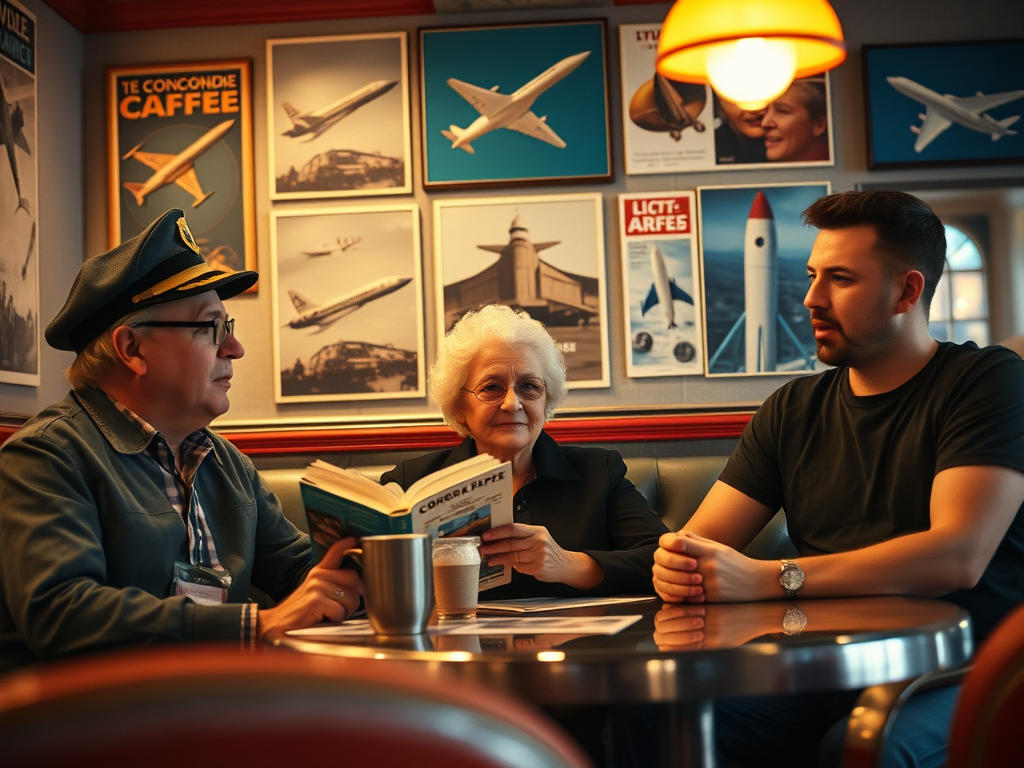
Setting: A small, retro diner-themed café called The Concorde Café. The walls are adorned with posters of the Concorde, vintage aeroplanes, and Elon Musk’s rocket. Three characters sit at a table:

  • Nigel: A nostalgic Concorde enthusiast wearing a pilot’s hat.
  • Marge: A retired travel agent, armed with her trusty guidebook.
  • Trevor: A tech-obsessed Elon Musk fan wearing a T-shirt that says “To Mars and Beyond.”

Nigel: (sipping tea) Back in my day, you’d hop on the Concorde and be in New York in three hours. Three hours! Smooth as silk, no fuss.

Marge: (nodding) Three hours, Nigel. And they even served you champagne! These young ones wouldn’t understand luxury like that.

Trevor: (rolling his eyes) Oh, here we go. Concorde this, Concorde that. Who wants three hours when Elon’s “Rocket Ride” will do it in 27 minutes?

Nigel: (spluttering) Twenty-seven minutes? That’s not a flight—it’s a sneeze! What’s the point of travelling to New York if you haven’t had time to finish your peanuts?

Marge: (nodding sagely) Or flirt with the steward. Those were the days, Nigel.

Trevor: (leaning forward) Forget peanuts! Imagine this: you strap into Elon’s rocket, zoom up to the edge of space, glide across the Atlantic, and BOOM—you’re in Manhattan before you’ve even posted about it on Insta.

Nigel: (mocking) “Zoom up to the edge of space,” is it? And what happens if there’s a “re-entry failure,” eh? I saw that glowing debris over the Turks and Caicos. Lovely fireworks show, but not exactly reassuring!

Trevor: (defensive) That was a test flight! Elon says it’s 99% safe.

Nigel: (grinning) Oh, well, I’ll just cling to that comforting 1% chance of becoming space dust, shall I?

Marge: (giggling) Let’s hope he doesn’t serve dinner on board. You’d barely have time to unwrap a sandwich before they shout, “Prepare for re-entry!”

Trevor: (ignoring them) And another thing—you don’t have to queue at customs. You just land, hop out, and they zap your passport in space. Efficient!

Nigel: (snorting) Efficient? At least on the Concorde, we had time to discuss the wine list with the steward.

Marge: (nodding) And the jet lag! Proper jet lag after a Concorde flight—it was classy.

Trevor: (rolling his eyes) You lot are stuck in the past. Elon’s rockets are the future! In and out in half an hour.

Nigel: (grinning mischievously) In and out in half an hour? Sounds more like a dodgy takeaway than a flight!

Marge: (laughing) Or a quick trip to Basildon!

Trevor: (groaning) Oh, you’re hopeless. Hopeless!

Nigel: (leaning back smugly) Maybe, but at least I’ll still have my peanuts.


The Waiter:

The waiter arrives with the bill, looking annoyed.

Waiter: Who ordered the Elonjet Rocket Special?

Nigel: (pointing at Trevor) Him.

Waiter: (grumbling) Did you have to shake it? You owe us for the extra cleaning—your “rocket fuel coffee” exploded all over table three.

Marge: (to Trevor) 99% safe, eh?

Nigel: (to Marge) I’ll stick to tea, thanks.

All: (laughing as Trevor hides behind the menu.)