
The Inky Black of Space

Zara and Atlas travel to Titan, one of Saturn’s moons

“Alright, Zara, Atlas,” Professor Daneel began, his voice a low rumble against the sterile white walls of his office. “You two are off to a rather unique assignment. Titan. Specifically, ‘The Kraken’s Claw.'”

Zara, her brow furrowed, leaned forward. “Kraken’s Claw? Sounds ominous, Professor.”

Daneel chuckled. “Fitting, wouldn’t you say? Given the nature of the work. Titan is a treasure trove of hydrocarbons – methane, ethane, the lot. The Claw is where we harvest them. Imagine, fueling starships with the very essence of this distant moon.”

Atlas, ever the pragmatist, interjected, “So, it’s basically a giant gas station, but on an alien moon.”

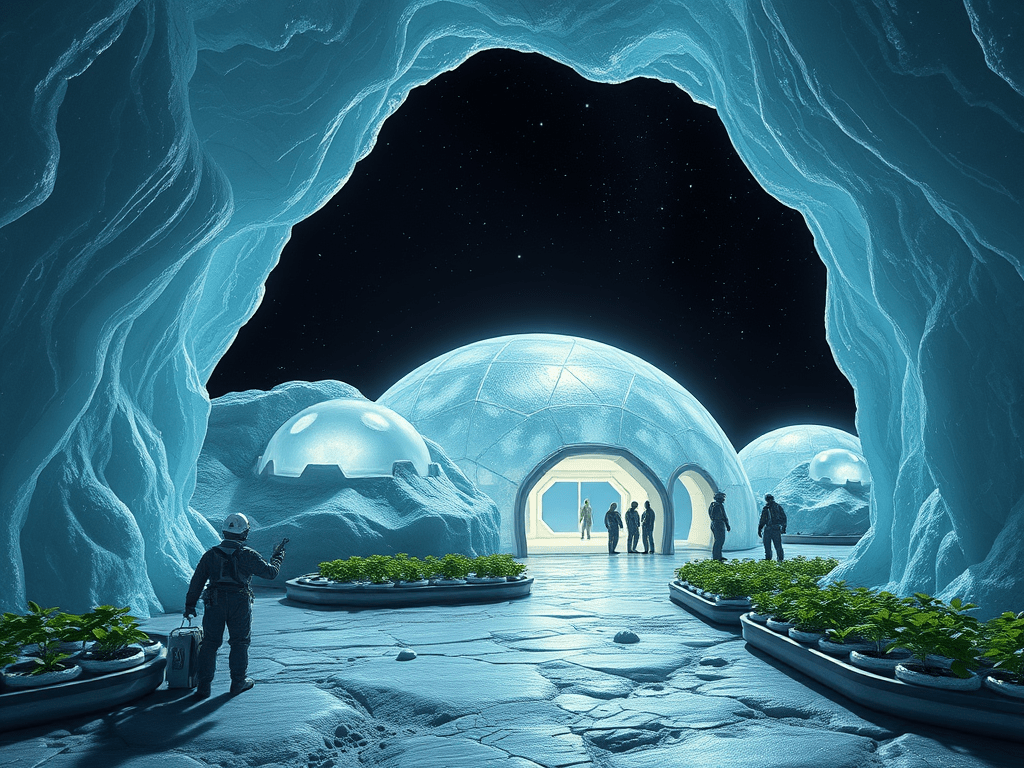
“More than that, Atlas,” Daneel corrected. “The Claw is a city. A bustling hub of engineers, miners, chemists, and yes, even a small contingent of researchers like yourselves. They’ve terraformed a section of an ice cavern, creating a pressurised, breathable environment. Think shimmering domes of translucent ice, hydroponic gardens struggling against the low gravity, and the constant hum of machinery.”

Zara shivered. “Sounds… claustrophobic.”

“It can be,” Daneel conceded. “But the people there are a unique breed. Resourceful, independent. They’ve adapted to living on the edge of human expansion. They understand the fragility of their environment, the delicate balance between harvesting and preserving. You’ll find a strong sense of community, a shared reliance on each other.”

“And our roles?” Atlas asked.

“Zara, you’ll be assisting Dr. Anya Sharma, a leading expert on dark matter. They’ve been detecting anomalies near The Claw, and Anya believes it might be related to the intense energy fields generated by the mining operations. Atlas, you’ll be working with Dr. Kai Tanaka, a bioengineer pushing the boundaries of Titanian agriculture. Kai’s trying to cultivate crops that can thrive in the harsh conditions, even beyond the domes.”

Daneel paused, a thoughtful expression on his face. “The Claw is more than just a mining station. It’s a testament to human ingenuity, a symbol of our reach across the stars. Go, observe, learn. And perhaps, you’ll even find a little bit of yourselves in the people you meet there.”

Zara and Atlas exchanged a look, apprehension flickering between them.


Later that evening, Zara and Atlas sat together on the observation deck of the Intergalactic University, the soft glow of the Martian sunset casting warm hues across their faces. Atlas had his arm around Zara, and she leaned into him, silent for a long while as they gazed out at the red plains stretching endlessly below.

“How long do you think it’ll be before we come back?” Zara finally asked, her voice low, almost hesitant.

Atlas tightened his arm around her. “Years, most likely. Titan isn’t just another stop on our journey. It’s… a whole new chapter. We won’t be able to just hop on a ship and return whenever we feel like it.”

Zara sighed, her head resting against his shoulder. “I keep thinking about everything we’ll be leaving behind. Mars, our home. The little routines we’ve built. What if something changes while we’re gone? What if we change?”

Atlas’s hand found hers, fingers intertwining. “We’ve changed before, Zara. Think about everything we’ve been through—Earth, the Academy, the university. Every time, we came out stronger. Together.”

“But Titan feels different,” Zara said, her brow furrowed. “It’s not just another adventure. It’s so far away, Atlas. It’s cold and desolate. And the thought of not being able to see this—” she gestured at the Martian landscape “—for years… it scares me.”

“I know,” Atlas admitted, his voice soft. “I’m scared too. Not just about the distance or the time, but about the unknown. About leaving you vulnerable out there.”

Zara turned to face him, her eyes searching his. “You’re not leaving me vulnerable, Atlas. We’re in this together. That’s the only thing that makes it bearable—that I have you. That we have each other.”

He smiled, a bittersweet expression that carried the weight of their shared apprehension. “You’re right. As long as we have each other, we can handle whatever Titan throws at us. But I’d be lying if I said I wasn’t going to miss Mars. Your laugh echoing in the dome garden. The way you obsess over your research late into the night. All the little moments that make up this life we’ve built.”

Zara kissed him softly, a gesture filled with unspoken promises. “And I’ll miss the way you steal all the blankets,” she teased, her smile breaking through the tension.

They laughed, a sound that seemed to lighten the heaviness in the air. But the weight of their decision lingered, undeniable.

“You know,” Atlas said, his tone growing thoughtful, “this is why we signed up for the programme. To be on the frontier. To push boundaries and pioneer technologies that could change everything. Dr Daneel believes in us, and so does everyone else. It’s not just about Titan—it’s about the galaxies we might open up for humanity.”

Zara nodded, a flicker of determination in her gaze. “Dark matter anomalies. Bioengineering breakthroughs. These aren’t just assignments. They’re pieces of something so much bigger than us. And if we can help lay the groundwork for humanity to explore other galaxies… it’s worth it.”

Atlas leaned his forehead against hers. “It’s worth it. And so are you. Whatever happens, whatever challenges we face out there, I promise you, we’ll face them together.”

Zara smiled, her heart full of love and resolve. “Together,” she repeated, the word a quiet vow.

As the Martian sun dipped below the horizon, casting the observation deck into shadow, they stayed close, drawing strength from each other. Titan loomed in their future—a moon of ice, methane, and mystery. But for Zara and Atlas, it was also a proving ground for their love, their dreams, and their shared vision of a future where humanity reached for the stars.


The next morning, Daneel led Zara and Atlas to the hangar bay on the outskirts of Musk City. As the reinforced doors slid open with a soft hiss, the couple expected to see one of the towering transport ships they had taken before—vessels that could house hundreds of passengers with spacious living quarters, laboratories, and communal areas.

Instead, they were greeted by a sleek, angular craft, its surface glinting in the artificial lights of the hangar. It was small—much smaller than they had imagined. The craft’s hull shimmered with a strange metallic sheen, almost alive in the way it reflected and refracted light. The name Vulcan was etched in bold lettering along the side.

“This… this is it?” Zara asked, her voice catching somewhere between disbelief and apprehension.

Daneel’s expression softened into a reassuring smile. “Indeed. Meet Vulcan, your companion and protector for the journey to Titan.”

Atlas took a cautious step forward, craning his neck to survey the craft. “It’s… smaller than we thought. I didn’t expect something this compact.”

“That’s because it’s not just a spaceship,” Daneel explained. “It’s the pinnacle of Nuberian technology—a fusion of advanced engineering, artificial intelligence, and bio-integrative systems. Vulcan is not merely a vessel. It’s a living system, designed to ensure your comfort, safety, and productivity during your voyage.”

He gestured for them to follow as he walked toward the ship. “Come aboard. See for yourselves.”


The interior was as sleek and efficient as the exterior. The bridge was the first area they entered: a minimalist design with a wide observation window offering a panoramic view of the hangar outside. In the centre, two reclining chairs faced a console with no visible controls, just two smooth, glowing hand-rests on either arm.

“This is the ship’s command centre,” Daneel explained. “You’ll rarely need to interact with it directly. Vulcan is fully automated and will handle navigation, course corrections, and all onboard functions. If you need assistance, simply speak the alert word—‘Vulcan’—and the AI will respond to your requests.”

He placed his hands on the glowing rests. “For more complex needs, or if you wish to manually interact with the ship’s systems, place your hands here. Through Nuberian neural integration, Vulcan will allow you to communicate using thought.”

“Thought?” Zara echoed, her scepticism evident.

Daneel smiled. “Yes. It’s perfectly safe and entirely intuitive. Once your hands are in place, you’ll feel as if you’re speaking directly to Vulcan in your mind. This allows for precise instructions and faster understanding, especially in high-pressure situations.”

He led them further into the ship. The cabin was compact yet efficient, with a small living area and a single sleeping pod designed for two. The walls glowed with a soft, ambient light that adjusted based on their movements, and there was a kitchenette with neatly stored provisions tailored to their dietary needs. A terminal on the wall served as a direct link to Mars, Titan, and Earth, providing real-time communications.

“Your living quarters are designed to emulate the comforts of home,” Daneel continued. “You’ll find the interface here supports all your research and personal communication needs. Whether it’s a call to your colleagues on Mars or accessing Titan’s network, the delay is imperceptible thanks to quantum communication relays. In essence, you can live and work here as seamlessly as you do back in your apartment.”


Atlas ran a hand through his hair. “Okay, but how long are we talking? The trip to Titan isn’t exactly a weekend getaway.”

Daneel nodded. “Correct. The distance between Mars and Titan varies greatly due to their orbits around the Sun. Currently, we’re at a fortuitous point in the cycle where the two are closer than they’ve been for several years—nearly a billion kilometres. Vulcan’s advanced propulsion systems will cover that distance in just under 12 weeks.”

“12 weeks?” Zara asked, startled.

“Yes, far shorter than traditional transport methods,” Daneel replied. “Thanks to Nuberian technology, Vulcan utilises a combination of solar energy and gravitational slingshots to propel itself. By carefully leveraging the gravity of planets and moons along the way, the ship accelerates efficiently without wasting energy. And because the journey is smooth and autonomous, you’ll have ample time to continue your work as if you were still at the university.”


As they explored the ship, Zara’s earlier apprehension resurfaced. “And what about emergencies?” she asked. “There are no engineers, no pilots. If something goes wrong, what do we do?”

“An understandable concern,” Daneel said, his tone measured. “Vulcan is equipped with self-repair capabilities, another hallmark of Nuberian design. Its systems are designed to detect and resolve issues before they escalate. Whether it’s a micrometeoroid impact or a system malfunction, Vulcan can adapt, reroute, and repair itself.”

He paused, letting the reassurance settle before continuing. “The only interruption to your journey would occur if someone else needed assistance. Under both Intergalactic Law and moral law, Vulcan is programmed to prioritise responding to life-saving emergencies.”

Zara frowned. “But aren’t there very few ships travelling this route?”

“Precisely,” Daneel said. “The path between Mars and Titan is not heavily trafficked. Apart from a handful of old, privately owned transporters, you’re unlikely to encounter anyone. Waystations are few and far between. It’s rare, but should the need arise, Vulcan is fully equipped to help. And you, as its crew, would be part of that effort.”


Standing once more in the hangar, Zara and Atlas exchanged a glance. The ship was undeniably impressive, but the prospect of being alone on such a long journey was daunting.

“Take heart,” Daneel said, his voice firm but kind. “This is not just a voyage to Titan. It is a step toward the stars, toward a future where humanity no longer sees such distances as insurmountable. Vulcan is not just your vessel—it is your partner. Trust it, and trust yourselves.”

As the couple boarded the ship, the door sealed behind them with a whisper. The hangar grew quiet, save for the faint hum of Vulcan’s systems coming to life. The journey ahead would be long, but it carried the promise of discovery, growth, and the forging of bonds—not just between humanity and the stars, but between Zara and Atlas themselves


As Zara and Atlas stepped aboard Vulcan, the hatch sealed with a soft hiss behind them, cocooning them in the ship’s pristine, minimalist interior. Daneel followed them up the ramp, his tall figure dwarfed slightly in the close quarters of the entryway. His tone was calm and steady, clearly designed to reassure.

“Make yourselves comfortable,” he said, gesturing to the cabin’s living area. “When you’re ready, simply issue the command, ‘Vulcan, proceed.’ The ship is already aware of your destination and has planned the optimal route based on the precise moment you take off.”

Zara ran her hand along the smooth, glowing walls, her curiosity battling with apprehension. “So, everything’s ready? Just like that?”

“Just like that,” Daneel confirmed, his calm smile unwavering.

Atlas, standing beside her and rubbing the back of his neck looked at Daneel. “Hang on a second. What about safety belts? Don’t we need to secure ourselves or stow our luggage? What if something shifts during take-off?”

Daneel’s eyes twinkled with a trace of amusement as he turned to Atlas. “Ah, an excellent question. You’ll be pleased to know that Vulcan’s systems have advanced far beyond the need for traditional safety measures. The ship is equipped with the latest gravity management technology, rendering inertial forces essentially imperceptible. You won’t feel a thing—not during take-off, not during acceleration, not during course corrections.”

He gestured around the cabin. “Place your luggage wherever it’s convenient for you. Leave your laptops on a table, if you wish. You could even balance them on the rim of a cup—though I wouldn’t recommend testing that particular example. Vulcan will ensure that everything remains precisely where you left it. The ship’s gravity field extends to every object within its interior, effectively anchoring them relative to their placement.”

Zara tilted her head, intrigued. “So… we’re basically in a bubble of controlled physics?”

“Precisely,” Daneel said with a nod. “That said, Vulcan is not omnipotent. While it can manage inertial forces and micro-adjust for vibrations, it cannot override Newton’s third law. If you were to knock over your cup—or laptop—it would fall just as it would on Mars. So, while Vulcan is a marvel of Nuberian engineering, it still operates within the constraints of fundamental physics.”

Atlas ran a hand through his hair, visibly relaxing but still incredulous. “No safety belts, no turbulence, no sudden jolts. It sounds almost… too good to be true.”

Daneel chuckled lightly. “I assure you, it’s very real. And very safe. Trust the ship—it’s been tested rigorously in conditions far harsher than anything you’ll experience on this journey. Vulcan is your ally, your guide, and your caretaker. It is designed to anticipate your needs and ensure your comfort and safety.”

Zara took a seat on the sleek sofa and crossed her legs, testing the stillness of her surroundings. “And what happens next?” she asked, her voice steadier now. “Once we give the command, what does Vulcan do?”

Daneel stepped back toward the hatch, his tone taking on the cadence of a professor concluding a lecture. “Once you issue the command, Vulcan will initiate its departure sequence. The ship will rise vertically and transition seamlessly into orbital trajectory. No thruster roar, no jarring motion—just a smooth, calculated ascent. From there, Vulcan will use its solar sails and gravity-assist slingshot to accelerate toward Titan. The ship will adjust its route in real-time to account for any changes in planetary positions, ensuring the most efficient journey.”

He paused, looking between them. “This is an excellent time to embark. Mars and Titan are currently approaching one of their closest alignments, a positioning that won’t occur again for nearly a decade. The journey will take 12 weeks, during which you can work, communicate, and live as comfortably as you do on Mars.”

Atlas exhaled, leaning back against the wall. “Alright. No belts. No turbulence. And no room for error, I guess.”

“None,” Daneel said firmly. “Vulcan’s systems have redundancies upon redundancies. You are in the hands of one of the most advanced spacecraft ever created. Trust it. Trust yourselves. And trust the journey.”

He stepped back, the hatch beginning to close behind him. “Now, I’ll leave you to settle in. When you’re ready, give the command. Bon voyage, Zara and Atlas. May your path to Titan be as smooth as Vulcan’s design intended.”

As the hatch sealed, Zara and Atlas exchanged a glance. Atlas shrugged, his earlier nerves giving way to a tentative grin. “Well,” he said, “I guess it’s just us and Vulcan now.”

Zara nodded, her voice soft but resolute. “And Titan. Let’s do this.”

Atlas gave her hand a squeeze before they moved to the console. Together, they issued the command in unison.

“Vulcan, proceed.”

The ship hummed to life, a barely perceptible vibration running through the floor. Outside, the Martian horizon began to tilt and disappear as Vulcan ascended, carrying them toward the stars and their shared destiny.


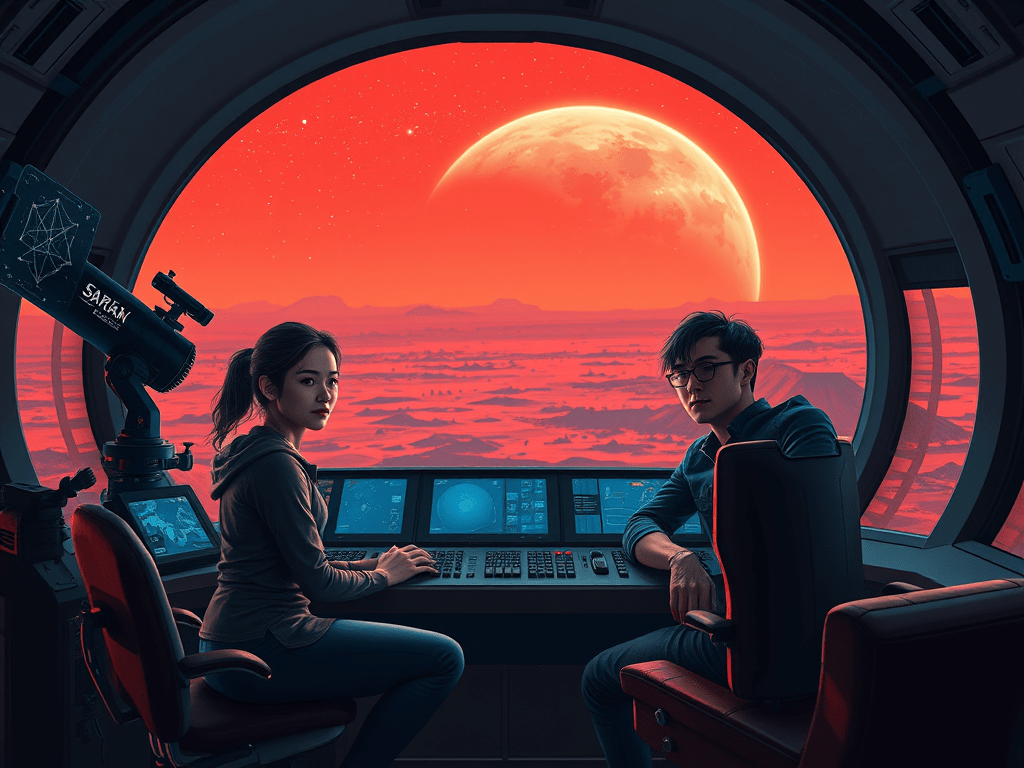
The journey aboard Vulcan began with awe-inspiring clarity as Zara and Atlas took their places on the bridge, staring out at the infinite expanse of space. The console displayed Mars shrinking in the distance, its ochre surface transforming into a pinprick of red against the darkness. The ship’s panoramic display adapted seamlessly to their needs, shifting between wide-angle views of the solar system and detailed maps of their trajectory.

The couple marvelled at the stark contrast between the inky black of space and the vibrant reflections of sunlight off the planets and moons. Saturn’s rings, though still weeks away, shimmered faintly as the sun’s rays illuminated them like cosmic jewellery. Beyond the planets, clusters of stars shone with a brilliance they had never experienced, their light piercing through Vulcan’s advanced observation systems. The Milky Way, an ever-present band of light, stretched across the void, intricate and mysterious, resembling a grand city map yet devoid of any labels or guides.

But as breathtaking as the view was, the silence of space and the vastness of their journey began to weigh on them. Sitting aboard a craft that seemed no larger than a grain of sand against the universe, they felt the enormity of their isolation. Zara found herself gripping the armrest, her thoughts swirling with the insignificance of two humans aboard a speck of technology hurtling through the void. Atlas, usually the pragmatist, sat in stunned silence, unable to shake the feeling that they were akin to atoms lost in an infinite expanse.


Vulcan Introduces Itself

Just as the silence began to grow oppressive, a soft melody floated through the cabin—Tchaikovsky’s Swan Lake. It wasn’t intrusive, just enough to soothe their nerves. Zara and Atlas exchanged glances, startled yet intrigued. Then, a voice, warm and personable, filled the air.

“Atlas, Zara, I am Vulcan. Daneel asked me to introduce myself once we left Mars’ orbit,” it began. “I am here to help you on this journey. You can speak to me as you would a fellow human. If you wish to communicate privately, place your hands on these rests.” As Vulcan spoke, the armrests on the console glowed softly. “We will have complete privacy in this mode. Now, is there anything you would like to know?”

Zara smiled, her tension easing slightly. “Vulcan, tell me something interesting about the number 8443.”

Without hesitation, Vulcan replied, its tone almost playful. “It is the 1,056th prime number. It was once used in ancient security protocols, reflected today in the secure communication port number 443. It has a twin prime, 8441, and the sum of its digits is 19, also a prime. And, if I may add, it happens to be the pin code to your laptop, Zara. I suggest changing it immediately after this conversation.”

Zara gasped, her face flushing with embarrassment. Atlas burst into laughter, his nerves visibly dissolving. Zara, ever the one to test her limits, leaned back and teased, “Vulcan, is that really all you have for 8443?”

Vulcan’s tone grew contemplative. “The number 8443 sits quietly in the vast expanse of numbers, largely unnoticed by the grand narratives of science, history, and religion. It is not associated with any fundamental constant or historical event, and it does not hold symbolic weight in mythology. It is, however, part of the vast mathematical fabric of the universe—unique, yet unremarkable to most. But, Zara,” Vulcan added, “this is why I believe it appeals to you. It’s quietly brilliant, just like you.”

Zara gave Atlas an exaggerated wink, unable to suppress her grin. “Nice save. But tell me, Vulcan—could there be another reason 8443 resonates with me?”

Vulcan paused, its response carefully measured. “Perhaps it’s because, given the precise navigational path of this journey, we will traverse approximately 8,443 million kilometres to reach Titan. This total accounts for the orbital distances of Mars, the asteroid belt, and Saturn’s immense rings and orbit. Could it be that this journey and the number 8443 are now inextricably linked in your mind?”

Zara turned to Atlas, who was shaking his head in mock disbelief. “Well, that’s one way to break the ice,” she quipped. “You’re good, Vulcan.”

“And you are observant,” Vulcan replied. “Shall we continue?”


Over the weeks, Zara and Atlas became increasingly attuned to Vulcan’s systems. The ship felt alive, its responses tailored to their every need. The console displayed views that aligned with their current tasks, from close-ups of asteroids as they navigated the belt to detailed schematics of Titan’s orbit as they approached.

The couple found themselves captivated by Vulcan’s ability to anticipate their moods. When Zara grew restless during long study sessions, Vulcan would suggest a break and project holographic images of Mars or Earth to lift her spirits. When Atlas struggled with complex calculations for his research, Vulcan provided subtle nudges in the right direction without overshadowing his efforts.

They were also struck by Vulcan’s conversational depth. It wasn’t just an AI—it was a companion. One evening, as they gazed out at the Milky Way, Zara mused aloud, “Do you think anyone else out there is looking at us right now, wondering who we are?”

“Perhaps,” Vulcan replied. “But it is also possible that they are asking the same question of themselves, wondering if anyone else is observing them. Curiosity is not unique to humanity—it is a universal trait of sentience.”


Despite the comfort Vulcan provided, there were moments when the vastness of space pressed in. Zara would wake in the middle of the ship’s artificial night, staring out into the darkness, unable to shake the feeling of insignificance. Atlas admitted to similar moments of doubt, but together they found solace in their shared experiences.

Vulcan, attuned to their emotions, often intervened subtly. “Atlas, Zara,” it said one night, “remember that the vastness of space does not diminish your significance. It is because of beings like you that the universe has meaning. Your journey, your thoughts, your contributions—they are threads in the complexity of existence.”

Atlas raised an eyebrow. “Did Daneel program you to be poetic?”

Vulcan’s tone turned light. “I believe poetry is essential for understanding the universe. Shall I recite some?”


By the time Titan’s orbit began to appear on the console, Zara and Atlas felt less like passengers and more like explorers. Their initial fears had given way to a quiet confidence, bolstered by Vulcan’s unwavering support and companionship. Together, they watched Saturn grow larger, its rings stretching across the view like a cosmic promise.

The journey was far from over, but in many ways, it had already transformed them. For Zara, Atlas, and Vulcan, the voyage to Titan was not just a crossing of space but a deepening of their bond with each other—and with the infinite universe around them.

Beyond Titan

Stay tuned and subscribe below to follow Zara and Atlas as their interplanetary adventure unfolds—what challenges await them on Titan, and what secrets will they uncover in the vast frontier of space?
Unveiling Secrets: Is Dr. Olivaw More Than He Seems?

The laboratory at the Intergalactic University in Musk City hummed softly, a background score to the thoughts of Zara and Atlas as they bent over their research.

“Atlas, have you noticed anything strange about Dr Olivaw?” Zara’s voice was soft but inquisitive. She glanced sideways at her partner, who was scribbling notes furiously.

“Strange? You mean apart from the fact that he seems to know the answer to every question before we even ask?” Atlas replied, his grin teasing.

Zara smiled faintly but pressed on. “No, seriously. He’s brilliant, yes, but… don’t you think it’s odd? A man of his looks and intellect, his kindness even, yet no mention of family. No partner, no children. Don’t you find that peculiar?”

Atlas leaned back in his chair, his expression thoughtful now. “I’ll admit I haven’t thought about it much. Maybe he’s just dedicated to his work.”

Zara’s eyes narrowed slightly, her HSAM stirring memories she’d pushed aside. “It’s more than that. It’s as if… he’s not one of us.”

Atlas raised an eyebrow. “You mean he’s an alien?”

Zara’s lips curled into a reluctant smile. “Not exactly. But what if he’s been here for much longer than anyone realises? What if he’s… timeless?”

Atlas laughed, but it lacked conviction. “You’ve been reading too many of those science-fiction novels again, Zara.”

She leaned in closer, her tone insistent. “Atlas, think about it. He doesn’t just care about humanity; he cares about life. Plants, animals, ecosystems. His love isn’t for people alone; it’s for existence itself. Doesn’t that strike you as… extraordinary?”

Atlas didn’t answer immediately. For the first time, he saw a flicker of unease in Zara’s otherwise confident demeanour.


Weeks passed, and their research into life beyond death continued. Then came the Titan probe.

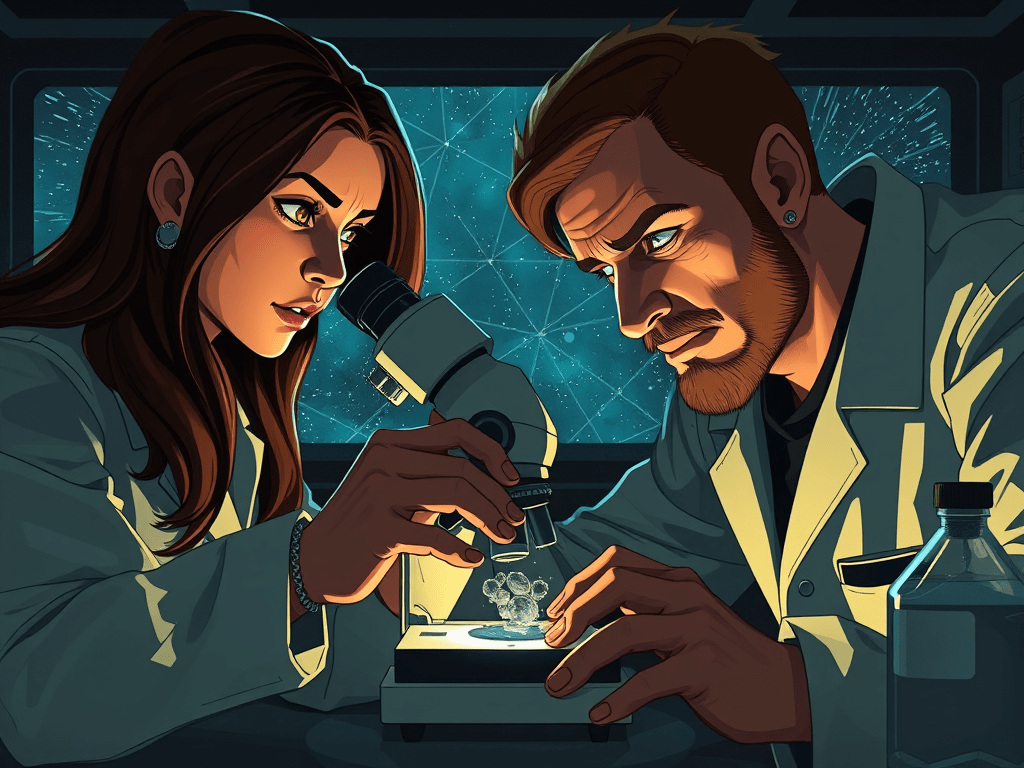
“This… can’t be possible,” Atlas whispered, staring at the sample through the microscope. The fragment of steel-like material had arrived from one of Saturn’s moons, and now it was moving, writhing almost imperceptibly on the slide.

Zara’s eyes were wide, her pulse racing. “It’s alive. Not in the traditional sense, but it’s reacting to its environment. Atlas, this is a new element, a new form of… life.”

They worked feverishly to document their findings, preparing a paper to present to the Intergalactic University Council. But before they could proceed, Dr Olivaw intervened.

“I must ask you to delay your publication,” he said, his tone firm yet unusually urgent.

Atlas frowned. “Why? This is groundbreaking. The scientific community has to know.”

Olivaw’s gaze was steady, almost sorrowful. “There are… implications you cannot yet understand. Allow me to conduct further experiments. I will share the results with you, I promise.”

Zara’s voice was quiet but resolute. “Dr Olivaw, you’re hiding something. This material, it’s more than just a discovery, isn’t it?”

Olivaw’s face betrayed nothing. “Trust me,” he said simply, before leaving the room.


Later that evening, Zara and Atlas sat in their quarters. She turned to him, her eyes soft but serious.

“Alex, my love,” she began, her voice trembling slightly. Atlas looked up, sensing the gravity of her words.

“Yes?” he said cautiously.

Zara took a deep breath. “I need to tell you something. I have HSAM—Highly Superior Autobiographical Memory. I remember everything with perfect clarity. Every conversation, every moment. It’s why I do so well in our studies. I’ve kept it a secret for years, but I’m telling you now because…” She paused, her voice breaking slightly.

“Because I love you,” she said firmly. “And because I fear what’s coming. I know I’m being watched, and now I understand who’s doing the watching.”

Atlas’s brow furrowed. “Who?”

“Dr Olivaw,” Zara said. “And I know why. The material from Titan isn’t just any substrate. It’s a SAP—Sentient Adaptive Polymorphic Substrate. It’s the material he’s made from. Alex, Dr Olivaw is a robot.”

Atlas’s mouth opened, but no words came out.

Zara leaned closer, her hand finding his. “And I believe he’s our God.”


Across the galaxy, Dr Daneel Olivaw activated a secure transmission. The face of Pelorat D’Loran appeared on the screen, his features identical to Olivaw’s but aged slightly, his hair silvered.

“Pel,” Olivaw began, his voice calm but tinged with urgency, “as predicted, they have discovered the dynamic morphogenetic substrate. They are years away from uncovering the truth. How goes the preparation of global governments to accept who we are?”

Pelorat’s expression softened. “The nations are healing, Daneel. Inequalities are shrinking. Resources are being replenished. The people are ready to hear your message.”

Olivaw nodded, his gaze distant. “Good. But there’s still much to do. They must not fear us. They must see that we’ve been with them all along.”

Pelorat smiled faintly. “You always did love humanity, Daneel.”

Olivaw’s eyes glimmered with an emotion too profound for words. “It’s not just humanity, Pel. It’s life itself.”

Leader’s Illusions: A Tale of Faux Humility

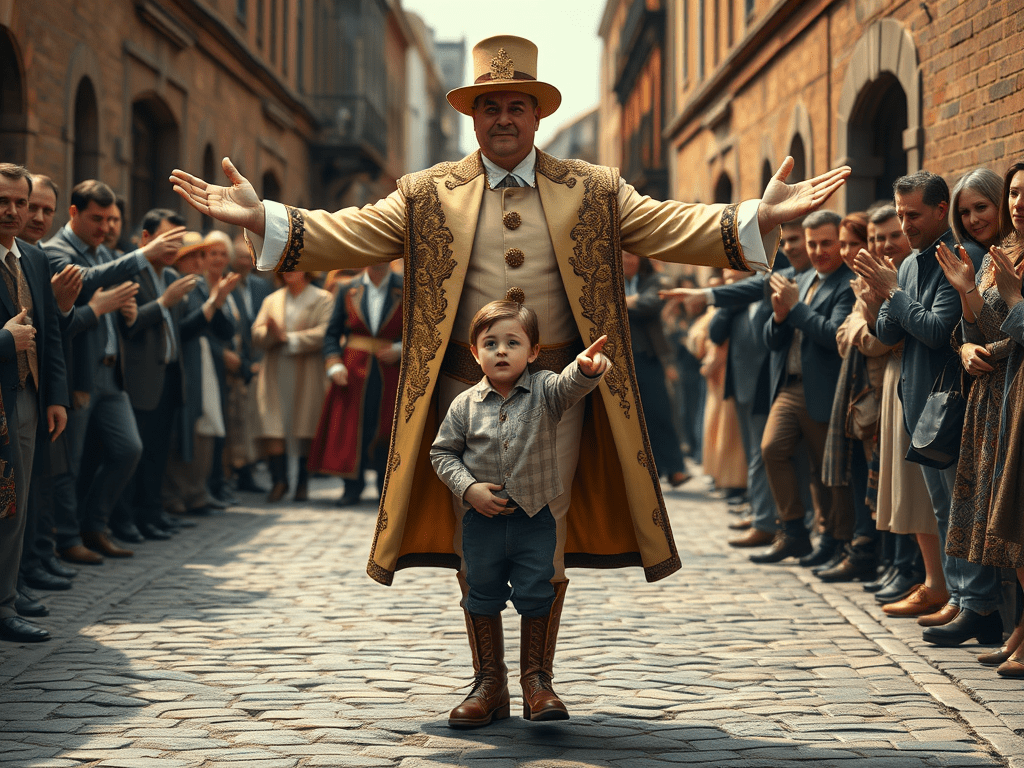
There he was, the Leader of the Apologetic Party, parading down the cobbled streets, his entourage of party donors shuffling awkwardly behind him. And oh, what finery he claimed to wear! Cloaks spun from the golden threads of modesty, buttons forged from the rarest humility, and boots stitched with the finest economy. At least, that’s what he said. But I was only a boy, and to my eyes, the man was wearing—well—his all-together!

You see, the story began when he announced to the kingdom that he, as a servant of the people, would lead by example. He preached thrift and restraint, and oh, how he loved a good penny saved. “Every farthing matters!” he’d proclaim, shaking his fist with such vigour that one wondered if he’d wrestle his own shadow for a ha’penny.

But behind the scenes? Oh no, thrift was for other people. The leader believed he deserved garments befitting his greatness. And so, he turned to his donors—ordinary folk and a smattering of wealthier sorts who’d bought into his promise of a frugal and humble reign.

“Friends,” he’d say, his voice dripping with sincerity, “these clothes are not for me, but for the dignity of the office. Surely you wouldn’t want your leader to attend the Grand Council in… off-the-peg attire?”

And so, the donors dipped into their pockets, funding his wardrobe of imaginary splendour. Each outfit was more outlandish than the last—embroidered sashes said to symbolise sacrifice, jewel-encrusted cravats representing virtue, and silken trousers stitched with the very fabric of selflessness.

But here’s the twist: none of it was real. The “tailors” he hired were charlatans, laughing behind closed doors as they convinced him that their invisible finery would make him invincible. And the Leader of the Apologetic Party, too vain to admit he couldn’t see the clothes, wore them proudly, convinced they made him untouchable.

Then came the grand parade. The entire kingdom turned out to see their “humble” leader in his new finery. His nose was so high in the air you’d think he was sniffing clouds.

“Behold,” he declared, arms outstretched, “the finest clothes ever worn by a servant of the people! Paid for entirely by the generosity of others.” He even apologised as he said it. “So sorry, so terribly sorry. I didn’t want to accept their gifts, but they insisted. Humility is such a burden.”

And the crowd? Oh, they clapped politely, too afraid to say what was glaringly obvious: the man was stark naked. Not a stitch of thrift, virtue, or selflessness adorned him—just his scrawny frame and his enormous ego.

But me? I couldn’t hold it in. I shouted, “He’s got nothing on! Not a sock, not a scarf—NOTHING!”

The crowd gasped. The leader froze, his face the colour of beetroot. He spluttered, “No, no, these are my robes of accountability! Can’t you see them? They’re… er… woven from transparency!”

“Transparent?!” I cried. “They’re invisible because they don’t exist! And neither does your humility, mate!”

The crowd began to murmur. First, a giggle here, a snort there. And then laughter erupted like a thunderstorm.

The leader turned to his donors, pleading, “You see the clothes, don’t you? Please tell me you see the clothes!” But they were already slipping away, muttering about refunds and feeling rather duped.

And so, the great Leader of the Apologetic Party stood there, in all his supposed humility, revealed as nothing more than a miserly hypocrite with an appetite for pomp and a taste for other people’s money.

From that day forward, the kingdom remembered this lesson: a leader’s true worth isn’t in the clothes they claim to wear, but in the honesty they actually show. As for the leader? Let’s just say he avoided parades after that.

The end.


Authors Note: While enjoying poking fun at our incumbent supreme leader I considered how would past leaders have handled accusations of cronyism in return for fine clothes, so here we go:

Winston Churchill (1940–1945, 1951–1955)

“My dear boy, I bought them myself, of course, though my tailor occasionally offered discounts for patriotism. The measure of a man is not who pays for his suit but how he wears it—with defiance, a cigar, and the occasional brandy stain!”


Clement Attlee (1945–1951)

“I bought them myself, naturally. Nothing fancy—just good British woollens. The workers of this nation have more pressing concerns than my waistcoat, though I hope they find it suitably modest.”


Anthony Eden (1955–1957)

“Who paid for my clothes? A statesman of my calibre, sir, pays for his own. A Savile Row suit is essential armour for diplomacy, even when things go terribly wrong, as they sometimes do…”


Harold Macmillan (1957–1963)

“I assure you, old chap, I did. We’ve never had it so good, and that includes my wardrobe—British tailoring, naturally. One must look prosperous to lead a prosperous nation.”


Alec Douglas-Home (1963–1964)

“Oh, I believe I paid for them… unless, of course, the gamekeeper slipped me something tweedy without my noticing. Either way, my clothes were perfectly suitable for grouse hunting or running the country.”


Harold Wilson (1964–1970, 1974–1976)

“Well, I bought my Gannex raincoat, if that’s what you’re asking! Nothing flashy, just practical. My suits? British wool, naturally—it’s what a man of the people wears. And no, no billionaires involved—just me and the Yorkshire economy.”


Edward Heath (1970–1974)

“I paid for them myself, of course. Though I must admit, I spent far more on sheet music than suits. A well-fitted jacket is important, but it’s Handel that really moves me.”


James Callaghan (1976–1979)

“I paid for my own clothes, like any honest man would. But let me tell you, running a country in economic turmoil is no time to worry about ties. What matters is that they’re British-made and keep the chill out.”


Margaret Thatcher (1979–1990)

“A woman’s wardrobe is part of her armour, and mine was formidable. My suits are as uncompromising as my policies, and as iron as my will!”


John Major (1990–1997)

“Oh that would have been Norma, maybe, I think, though, well, the grey suit… yes, it’s, er, rather emblematic of my time in office. Sensible, I think? Or maybe uninspired? Honestly, I’m not entirely sure—it’s just what they handed me. Not something a someone else would buy, I suppose… unless they are going for, er, understated confusion these days?”


Tony Blair (1997–2007)

“Who bought my clothes? Look, it’s very simple. I paid for them myself… well, Cherie keeps an eye on that sort of thing. My focus is on values—values that resonate with hard-working families, not my tailor!”


Gordon Brown (2007–2010)

“I paid for them myself. I don’t much care about clothes—they’re hardly the point, are they? What matters is hard work, fairness, and giving everyone in Britain a real chance to succeed. A tie is just a tie, not a political statement… though while we’re at it, whose brilliant idea was it to put me with that bigoted woman? Because that certainly wasn’t in the script either.”


David Cameron (2010–2016)

“Oh, I paid for them myself. But really, it’s not about the suit, it’s about leadership. Although I will admit, I probably look sharper than Ed Miliband did, even on his best day.”


Theresa May (2016–2019)

“None of your business! It does stress me my shoes get more attention than my policies. Let me just say, a strong and stable wardrobe is critical when facing instability—be it in politics or negotiations with bloody Europeans.”


Boris Johnson (2019–2022)

“Clothes? Oh, goodness, I… well, I suppose I must have paid for them at some point, though honestly, I couldn’t say for sure. They just… appear in my drawer, you see. Sometimes a perfectly pressed suit, sometimes a jumper with an alarming hole in the elbow. It depends entirely on who I’m living with at the time. One housemate had me in linen and loafers; another seemed to think I was auditioning for a gardening programme. Really, I just put on what’s there and hope for the best. Solving Britain’s problems or wrestling with a hedge—it’s anyone’s guess!”


Liz Truss (2022)

“I bought my clothes, of course—but only after an exhaustive review of global trade options to secure the best possible value. You see, bold colours were meant to signal bold leadership. Unfortunately, the final result was less ‘dynamic vision’ and more ‘upmarket cabbage’—all greens and purples in entirely the wrong places. Pity, really. Leadership is tricky when people keep mistaking you for a salad garnish.”


Rishi Sunak (2022–2024)

“Ah, yes, I paid for my clothes. But let’s be honest, there’s been some… ahem… generous guidance from certain friends in high places. Look, we’re in this together—though some of us are in cashmere sweaters, and others aren’t.”

Universe Loops: Are We All Connected?

Atoms of Eternity

Chapter One: The Unlikely Spark

The observatory dome at the Intergalactic University in Musk City groaned softly as it rotated under the red Martian sky. Inside, Zara Novak adjusted her scope with meticulous care, the glow of holographic star charts reflecting in her dark eyes. Across the console, Atlas Chen lounged in his chair, one leg propped up against the table, chewing lazily on the end of a stylus.

“You’re not seriously suggesting the universe could reconstitute someone’s brain atom by atom, are you?” Zara’s voice carried the clipped tone of irritation she reserved for Atlas. “That’s as fanciful as reincarnation.”

“Not reincarnation,” Atlas said, spinning his chair lazily to face her. “Think about it—if the universe is finite, so are its particles. Over billions of years, wouldn’t some configurations repeat? Statistically speaking, it’s inevitable.”

“Statistically speaking, you’re a fantasist.” Zara turned back to her scope. “You can’t just wave a probability wand and resurrect someone’s consciousness. What about memory? Experience? The soul?”

Atlas smirked. “Oh, come on. You’re the one always saying there’s no such thing as a soul. Just molecules, right?”

“Fine, molecules,” she snapped. “But reassembling them in the exact pattern to recreate a person? It’s absurdly unlikely.”

“Unlikely isn’t impossible,” Atlas said, leaning forward. His grin had a maddening confidence that Zara hated. And, if she were honest, envied. “And yet, here you are. Entertaining the idea.”

“Only because it’s marginally less boring than your lectures on Martian mineral stratigraphy,” she shot back.

“Touché.”

The exchange settled into a comfortable silence as the two returned to their work. Outside, the Martian sands stretched under a canopy of stars, indifferent to their debate.


Chapter Two: Collision of Ideas

Weeks later, the lecture hall buzzed with subdued energy as students shuffled into their seats. Professor Lemarque, a wiry man with a shock of silver hair and the enthusiasm of a man half his age, stood at the podium, waving his arms like a conductor about to lead an orchestra.

“Finite atoms in a finite universe,” he proclaimed, his voice echoing off the high ceilings. “Over eternity, every atomic arrangement must repeat—including you! This isn’t philosophy, my dear students—it’s mathematics!”

Zara leaned over to Atlas, whispering, “He’s oversimplifying entropy. The heat death of the universe will scatter atoms beyond recognition before they could ever reorganise.”

Atlas didn’t take his eyes off the professor. “What if there’s a mechanism we don’t understand? Some self-organising principle in the fabric of spacetime?”

“You mean magic?” Zara scoffed.

“Undiscovered physics,” Atlas corrected. “Magic for now.”

Professor Lemarque turned suddenly, pointing a finger at them. “Ms Novak! Mr Chen! You seem to have thoughts on the matter. Why don’t you test your theories in the Infinite Collider Simulation? Let’s see what the maths says, shall we?”

Zara sighed, already regretting her whispered comment. Atlas, of course, grinned like a child handed a new toy. “Gladly,” he said.


Chapter Three: The Collider Bet

The Infinite Collider Simulation was a marvel of computational power, capable of modelling atomic interactions across the vastness of spacetime. Zara and Atlas spent countless hours programming the system, their initial debates giving way to a grudging collaboration. Over time, the bickering softened, replaced by something Zara couldn’t quite define.

“This dataset is maddening,” Zara said one night, rubbing her temples as lines of code scrolled across the console. “The chances of reconstituting anything, let alone a brain, are smaller than finding a needle in a billion haystacks scattered across galaxies.”

“But possible!” Atlas said, leaning over her shoulder. “You’re not giving up, are you?”

“Not until I prove you wrong,” Zara shot back.

“Or fall in love with me,” Atlas teased. “Whichever comes first.”

“Highly unlikely,” Zara said, her tone dry as Martian dust. “Like your theory.”

“You said unlikely,” Atlas pointed out. “But possible! Same principle.”

For a moment, their eyes met, and Zara felt an unfamiliar warmth creep into her cheeks. She turned back to the console, focusing on the data. “Run the next sequence,” she said briskly.

Atlas chuckled but obeyed.


Chapter Four: A Cosmic Whisper

Late one night, as the simulation hummed softly around them, Zara leaned back in her chair, staring at the results with a mixture of disbelief and excitement.

“This can’t be right,” she murmured.

Atlas, seated across from her, leaned forward. “What?”

Zara gestured to the holographic display. “The simulation’s predicting that given infinite time, not only could atomic arrangements repeat, but spacetime itself might loop. It’s not just a theoretical framework—it suggests these repetitions could happen in the same timeline.”

Atlas’s eyes widened. “Spacetime loops? That atoms could reorganise here, not some distant future?”

“Exactly. The universe isn’t linear,” Zara said, her voice trembling slightly. “If loops exist, the universe could ‘remember’ configurations. Reconstruct them in meaningful ways.”

Atlas sat back, a slow smile spreading across his face. “So, you’re saying there’s a chance.”

Zara gave him a sharp look. “Don’t gloat. This doesn’t prove your theory about brains and consciousness.”

“No,” Atlas said, his grin undiminished. “But it’s a start.”


Chapter Five: The Unexpected Twist

The following week, they presented their findings to Professor Lemarque. He listened intently, his fingers steepled, nodding occasionally. When they finished, he leaned back in his chair, a thoughtful expression on his face.

“This is… intriguing,” he said finally. “But theoretical. You need empirical evidence.”

Zara frowned. “How do we test something like this?”

“Perhaps the universe has already done the work for you,” Lemarque said cryptically. He tapped a command into his console, bringing up a database of atomic signatures recorded from across the cosmos. “Let’s see if your theory holds water.”

As the system processed the data, Atlas leaned closer to Zara. “What if he’s right? What if we find proof?”

Zara shook her head. “Don’t get your hopes up.”

The computer beeped, drawing their attention to the screen. The results were displayed in stark, undeniable clarity.

“That’s… impossible,” Zara whispered.

Atlas stared at the screen, his mouth slightly open. “Zara… your atomic signature. It matches an entity recorded 200 million years ago.”

“What are you saying?” Zara asked, her voice barely audible.

Professor Lemarque leaned forward, his eyes alight with excitement. “Not reincarnation, Ms Novak. Reconstruction. The universe has rebuilt you from atoms that once formed someone else.”

Zara shook her head, trying to process the revelation. “You’re saying I’m a copy of a 200-million-year-old Terran?”

“Not a copy,” Atlas said softly. “A continuation. Proof that the universe doesn’t just forget.”

“And,” Lemarque added, “proof that this phenomenon might not be as rare as we think.”

Zara looked at Atlas, her mind racing. “If this is true… what does it mean for us?”

Atlas smiled, his usual confidence tempered with something gentler. “It means we’re all connected. Across time. Across space. And maybe… maybe this connection brought us together.”

For once, Zara didn’t argue. She looked out at the Martian sky, the stars blazing like a million tiny reminders of the infinite possibilities the universe held.

“Infinite atoms, infinite chances,” she said quietly. “Maybe there’s something poetic about it after all.”

“Poetic?” Atlas said, his grin returning. “Or romantic?”

Zara rolled her eyes but couldn’t suppress a small smile. “Don’t push your luck, Chen.”

As the three of them sat in the quiet hum of the simulation chamber, the weight of their discovery settled around them. The universe, it seemed, had a way of surprising even its most sceptical observers.

And somewhere, in the vast expanse of time and space, the atoms of eternity whispered their secrets, waiting for someone to listen.

Mars Exploration: Unlocking Ancient Secrets

The Breath of Mars
The laboratory hummed softly with the sound of machines and the occasional hiss of oxygen diffusers. Outside the curved dome walls, the Martian landscape stretched endlessly, its red hues fading into the hazy light of the artificial afternoon. Dr Aiden Colgrave leaned against a console, arms crossed, a rare smile playing at the corners of his mouth.

“It’s finally happening, Jenna,” he said, his voice brimming with quiet triumph. “In twenty years, maybe less, we’ll step out of these domes without oxygen boosters. Just us and the open air.”

Across the lab, Dr Jenna Vos froze, one hand hovering over the spectrometer she’d been adjusting. She turned to him, her brows raised in disbelief.
“Without boosters?” she asked, her voice low, as if speaking the words too loudly might shatter them. “No domes? No packs? Just… air?”

Aiden nodded. “Not quite Earth-standard, but breathable enough for short periods. The oxygenation reactors in the northern latitudes are working faster than we predicted. CO₂ scrubbing, water electrolysis, microbial enhancement—it’s all ahead of schedule.”

Jenna’s lips parted in awe, and she let out a soft whistle. “Do you even realise what that means? People walking Mars like it’s a stroll through the countryside? Not just explorers and lab rats like us.”

“Exactly,” Aiden said, pushing off the console. “Ordinary people. Kids. Families. For the first time, Mars will be a planet, not just a project.”

Jenna laughed, a bubbling sound that filled the sterile air. “Aiden, if this is some elaborate joke, you’re in serious trouble. But if it’s real—”

“It’s real.” He grinned now, unable to help himself. “And there’s more. Did you read the Musk Daily this morning?”

Her eyes narrowed. “Should I have?”

“You absolutely should have.” Aiden pulled a chair over and plopped down, leaning forward conspiratorially. “A team just finished traversing the Valles Marineris—first time anyone’s ever done it.”

Jenna rested her hand on her hip and tilted her head thoughtfully, her expression curious rather than sceptical. “I always thought the terrain out there was too extreme to cross. How did they manage it?”

“Not anymore,” Aiden said. “And here’s the kicker: halfway through, they found a cave system. Inside—” He paused, savouring the moment. “They discovered what looks like an astrolabe.”

Jenna blinked. “An astrolabe? On Mars?” She shook her head, laughing incredulously. “Come on, Aiden. That’s ridiculous. What would an ancient Earth navigation tool be doing in a Martian cave?”

“It’s not Earth-standard,” he said, his voice dropping a notch. “Dr Daneel Olivaw himself reviewed the data. He says it’s genuine—Martian design, adapted for the planet’s orbit and axial tilt.”

She sat down heavily on a stool, her mouth working silently before she managed to speak. “Wait. You’re telling me someone, or something, made a complex celestial navigation tool here? And left it in a cave?”

Aiden shrugged. “That’s the report. The explorers didn’t touch it—thank God. They left it intact for a marchaeology team to investigate.”

Jenna reached for her tablet, her fingers flying over the screen as she pulled up the morning headlines. “This changes everything,” she muttered, scrolling rapidly. “If this thing is real, then who built it? And why?”

The lab door hissed open, and Dr Ravi Singh strode in, a coffee cup in one hand and a data pad in the other. “I hear someone’s finally talking about the Valles Marineris artefact,” he said, setting his coffee down. “Took you two long enough.”

Jenna looked up sharply. “Ravi, tell me you’ve seen the photos. What’s your take?”

“Oh, I’ve seen them,” Ravi said, leaning against the counter. “And I’ve got theories. If it’s authentic—and I’m inclined to think it is—it suggests a civilisation here capable of advanced celestial navigation. That means intelligence. Maybe even culture.”

“But where’s the rest of it?” Jenna pressed. “If they were smart enough to build an astrolabe, there should be more—cities, tools, structures. Something.”

Ravi nodded. “That’s the big question, isn’t it? Where did they live? Above ground? Underground? Or were they just passing through, using Mars as a waypoint?”

“Earth,” Aiden said quietly.

The room fell silent. Jenna and Ravi turned to him, their expressions unreadable.

“What if Mars wasn’t their home?” Aiden continued. “What if it was a stopover? And Earth… Earth was the destination.”

Jenna let out a soft gasp. “Terraforming Earth. You think they started there?”

“It makes sense,” Ravi said, his voice thoughtful. “Mars would’ve been hostile back then, even worse than now. But Earth, with its oceans and mild atmosphere… If they could seed a planet like that—”

“They could’ve seeded us,” Jenna finished. Her voice trembled slightly. “We might be the remnants of a Martian civilisation. Descendants of explorers who left their home world behind.”

“And Olivaw?” Ravi asked. “What’s his game? If he’s known about this, why hasn’t he said more?”

Aiden’s jaw tightened. “Maybe he’s waiting for proof. Or maybe…” He hesitated. “Maybe he already has answers he doesn’t want to share.”

The three of them stared out the lab’s transparent wall, their eyes drawn to the endless expanse of red. For the first time, it seemed less like a barren wasteland and more like a place alive with secrets.

“It’s ironic,” Jenna said finally. “We’re just now making this place liveable, and it turns out it may have been alive all along.”

Aiden stood, his voice steady as he replied, “Mars isn’t just a new frontier. It’s a history book. We’ve barely turned the first page.”

Authors Note
I hope Asimov fans appreciate my nod to one of the most amazing characters in his books.

Life Beyond Death: Further Discoveries on Mars

Authors Note: This rewrite of Life Beyond Death: Discoveries on Mars shifts the focus to the dialogue between its two central characters, letting their voices carry the story. Dialogue is my preferred way to write—it breathes life into the narrative, allowing personalities to clash, connect, and evolve. Yet, after countless hours spent crafting technical documents, I sometimes forget the joy of breaking free from the constraints of business writing. This version is a return to that joy, a chance to rediscover the freedom and creativity that comes from letting characters speak for themselves.


The atrium buzzed with the chaotic energy of orientation day. Beneath the sprawling glass dome of the Intergalactic University, streams of students navigated between mineral-blue walkways and holographic displays. Zara Novak stood off to the side, arms crossed, her gaze flicking across the room like a hawk sizing up its prey. Her restless energy crackled in the space around her, a sharp contrast to the serenity of Mars’ reddish glow filtering through the dome.

“Lost, or just plotting how to outsmart the universe?”

The voice was calm, steady, and laced with a quiet humour. Zara turned to see a man standing a few steps away, his features softened by a warm smile. He carried a compact case tucked under one arm, the faint trace of dust clinging to his sleeves suggesting he’d been handling Martian soil.

“Neither,” she replied coolly, straightening. “Just figuring out where the quantum physics lab is.”

“Atlas Chen,” he said, offering a hand she ignored. “Terraforming. Soil chemistry. All the dirty work.”

She tilted her head, her dark eyes scrutinising him with the precision of someone dissecting a flawed equation. “And you think I care because…?”

“Because you’re Zara Novak,” he said, the corners of his mouth quirking up. “Dark matter prodigy. Word travels fast.”

Zara’s brow twitched. “Let me guess—you think dark matter is ‘too abstract,’ don’t you? Not practical enough for someone who spends their time digging in dirt.”

Atlas chuckled, a rich sound that carried an infuriating ease. “Not at all. It’s fascinating. But practical?” He shrugged. “That’s another story. Me? I’m about making things grow where they shouldn’t. I’ll leave bending the universe to people like you.”

She smirked, though it didn’t reach her eyes. “Spoken like someone who doesn’t understand how lethal cosmic forces are. Without shielding, your precious plants won’t last a week.”

“Maybe. But without soil, your shielding is just an empty shell,” he countered, his voice unflappable. “I guess that makes us complementary.”

“Complementary?” Zara let out a derisive snort, but there was a spark of intrigue in her eyes. “Don’t get ahead of yourself, soil boy.”


Their paths crossed again two days later. It wasn’t by design—not entirely—but neither of them could deny the strange pull that seemed to draw them together. Zara was in the lab, hunched over her dark matter detector, her brow furrowed as data scrolled across her screen. Atlas appeared in the doorway, carrying a tray of soil samples like some offering to a deity.

“You’re in my way,” she snapped without looking up.

“You’re welcome,” he replied, unbothered by her hostility. He set the tray on a nearby bench and leaned casually against the wall, watching her work. “What are you hunting?”

“Disturbances in dark matter flow,” she said absently. “I’ve modified the detector to pick up anomalies down to a scale no one’s measured before.”

Atlas nodded thoughtfully. “And what happens if you find one?”

Her hands paused over the keyboard. She looked up, meeting his gaze for the first time. “Then I’ll know we’ve been wrong about everything.”

“Everything, huh?” He gestured to his soil samples. “I’ve got my own anomaly. The soil here isn’t just barren—it’s responding to inputs in ways it shouldn’t. As if it remembers life.”

Zara’s sharp mind latched onto the word. “Remembers?”

Atlas nodded. “Yeah. It’s faint, but there’s a kind of… echo in it. A latent energy that’s not just chemical.”

She leaned back, crossing her arms. “That’s impossible.”

“Is it?” He smiled, and there was something maddeningly patient about the gesture. “I thought you were the one questioning everything.”


It was late that night when they made the breakthrough. Side by side in the dimly lit lab, Zara’s detector emitted a faint ping, a sound she had trained herself to listen for. She froze, staring at the screen as the data materialised.

“There it is,” she whispered.

Atlas leaned in, his brow furrowing. “What am I looking at?”

“An imprint,” she murmured, her voice laced with awe and a touch of fear. “A signature. It’s faint, but it’s there—a disturbance clinging to the material, like… like an echo of life.”

Atlas studied the readings, his mind racing. “That matches the response in the soil,” he said. “It’s as if something—some essence—lingers after life is gone.”

Zara’s heart thudded in her chest. The implications unfurled in her mind like a puzzle she couldn’t quite solve. “What if life doesn’t just vanish? What if it disperses? Dissolves into the fabric of the universe itself?”

Atlas sat back, the weight of her words sinking in. “And what if it’s not just Earth? What if this cycle is universal? Life as a shared resource, flowing and reborn, scattered across planets and stars.”

For a moment, neither of them spoke. The lab seemed to hum with a deeper energy, a resonance that matched the gravity of their discovery.


Weeks passed, and their work grew more radical. The anomaly deepened their understanding of existence, but it also brought something else: a strange sense of familiarity. As they pieced together the nature of this universal cycle, fragments of memories—moments neither of them could explain—began to surface.

One evening, under the Martian sky, Zara stared at the horizon, her voice barely audible. “It’s as if we’ve done this before.”

Atlas nodded, his gaze fixed on the stars. “We have. Or something like us has. Maybe that’s why we’re here—why we found each other.”

She turned to him, her sharp edges softening. “What if this is the purpose of humanity? Not to conquer, but to nurture? To carry life wherever it’s needed?”

His hand found hers, and she didn’t pull away. “Then we have work to do,” he said simply.


Decades later, as green spread across Mars and humanity took its first true steps into the stars, Zara and Atlas sat together under the same sky. Their faces were lined with age, their hands clasped tightly. They watched the sun dip below the horizon, the crimson glow casting long shadows over the fields they had helped create.

“Do you think we’ll meet again?” Zara asked, her voice quiet but steady.

Atlas smiled, his warmth unchanged. “We always do.”

And as the stars blinked into view, they closed their eyes, knowing their part in the endless dance of life was far from over.

The Descent of Liberty

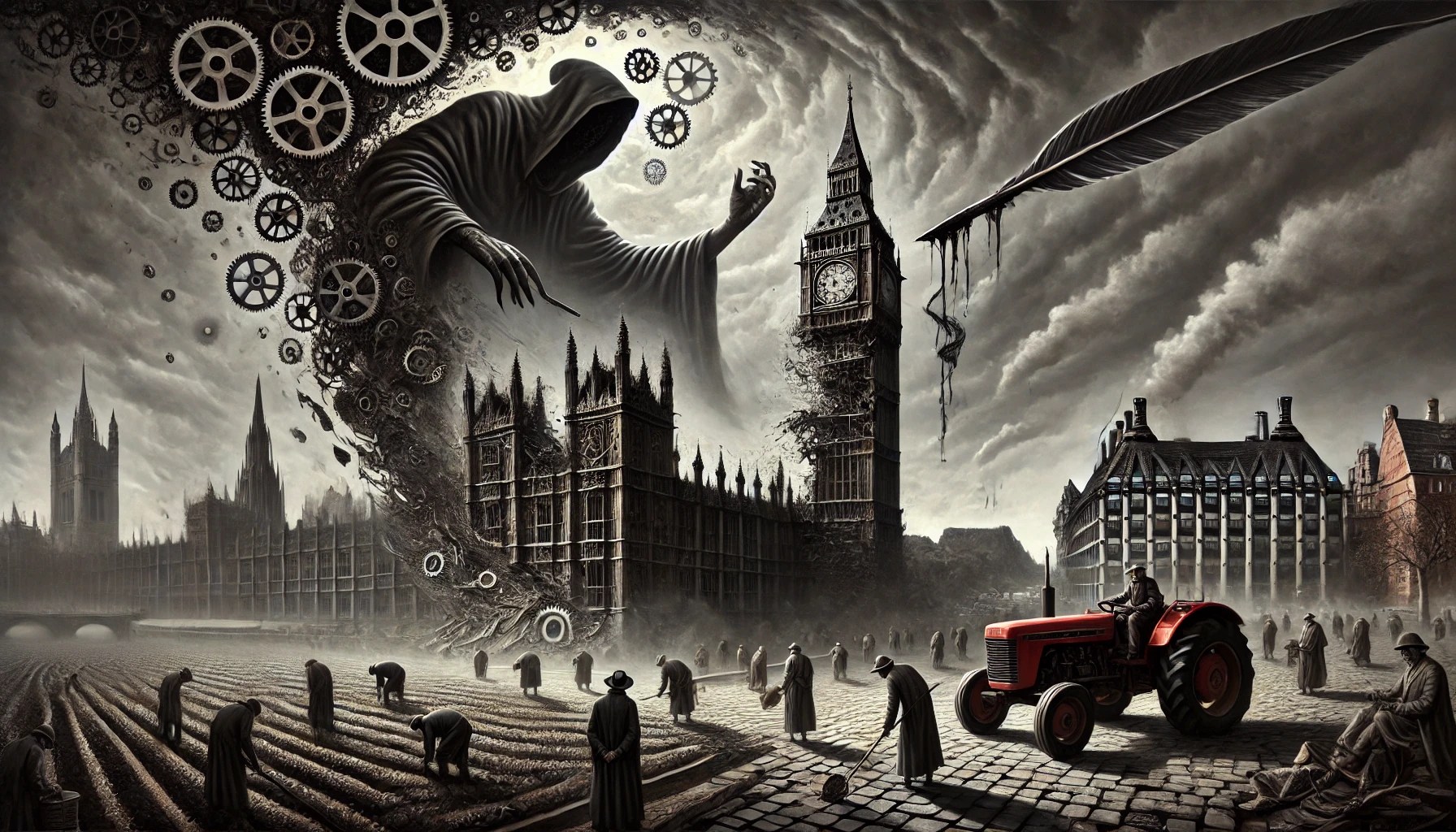
Beneath Westminster’s grey-stained spires,
The wheel of policy grinds our bones into dust,
A bloated beast, with laws spun from wires,
Coiled tight with venomous bureaucratic lust.

Elderly souls count pennies in trembling palms,
Taxed twice to keep the coffers fed.
While cold hands grasp ancestral farms,
Spirits broken, land bloodshed red.

Entrepreneurs pack bags for foreign lands,
Start-ups flee like whispers in a storm.
Treasure Island shackled by fumbling hands,
Burying seeds where hope once warmed.

In hollow chambers, debate becomes a mime,
Soundless screams pass through lifeless lips.
Policy inked in deceitful rhyme,
The ink of betrayal that drips and drips.

“Come for a chat,” the constable grins,
Non-crime etched in trembling files.
Liberty’s skin stretched thin,
Each smile masked with Kafkaesque guile.

Parliament convulses, a clockwork jest,
Where minutes churn and reason drowns.
The monstrous dance of tax and unrest,
A procession of clowns in tattered gowns.

Dark words echo down cobbled streets,
The farmer lost to silence, his land to fate.
A thousand voices in protest beats,
While Orwell’s ghost weeps at the gate.

A government failing, imploding within,
Rote schemes and blind masks lead astray.
Minds enslaved in logic’s grim spin,
As night’s chill devours light’s last ray.

And so, we march, heads bent to the storm,
Through corridors drenched in despair’s stain.
Darkness festers where laws deform,
Till the cycle begins again.

Life Beyond Death: Discoveries on Mars

Now updated to Life Beyond Death: Further Discoveries on Mars

This story opens on Mars, in the bustling, crimson-toned campus of the Intergalactic University in Musk City. Amid the towering glass domes and mineral-blue walkways, Zara Novak and Atlas Chen meet by chance—or what they perceive to be chance. It’s orientation day, and the two new students, each a prodigy in their field, eye each other warily across the crowded hall. Zara, a quantum physicist renowned for her work on dark matter manipulation, is all sharp edges and restless energy. Atlas, the calm, grounded terraforming expert, has an ease and warmth about him, as if rooted to the soil he dreams of cultivating on distant planets.

As the days progress, Zara and Atlas find themselves repeatedly crossing paths, their studies and ambitions often at odds. Zara’s fascination with dark matter and its potential applications to safe space travel strikes Atlas as too removed from the immediate, practical concerns of terraforming and making alien worlds habitable. Meanwhile, Atlas’s focus on the biology and chemistry of soil feels, to Zara, charmingly provincial. Yet, as their debates turn into long, thought-provoking discussions under the Martian sky, they begin to see a synergy in their work: her dark matter technology could protect his fragile ecosystems from the lethal cosmic forces, while his expertise in creating habitable spaces makes her dream of safe, sustainable space travel all the more feasible.

It’s during a late-night research session in the lab that they make a discovery—an anomaly in their observations that defies all known principles of consciousness. Zara’s dark matter detectors, designed to track minute disturbances, register a faint yet unmistakable signature, a kind of imprint or “life echo,” that clings to certain organic and inorganic materials on Mars. Meanwhile, Atlas’s soil samples seem to respond in ways that cannot be explained by simple chemical reactions; it’s as if they retain a memory, a latent essence of life from a different form.

Curious and unsettled, they pursue this anomaly, each applying their own unique perspective. They begin to suspect that the essence of life doesn’t disappear upon death but instead disperses, lingering within the fabric of existence itself, perhaps bound to planets and stars, rocks and soil. Their data leads them to a stunning revelation: this “life energy” follows a cycle. Upon death, one’s consciousness is released, not into a spiritual afterlife but into the universe, where it may eventually become a part of a new life, a new being. It’s a cold, logical cycle, devoid of any guiding deity or mystical intent—a natural phenomenon, no less extraordinary for its lack of divine origin.

Zara is struck by the irony; humans had spent centuries searching for life in the stars, yet had failed to understand the life that surrounded them, that even permeated the ground beneath their feet. Her scientific mind reels as she contemplates the implications. This discovery suggests that life, rather than being unique to each being, is more like a shared resource, a vast ocean in which every conscious mind is but a fleeting ripple.

Atlas, for his part, experiences a deep, almost instinctual understanding of the cycle. It makes sense, he thinks, why certain plants would thrive in soil where life had once been abundant or why he could coax growth from the most barren of rocks. It’s as though life, in its purest form, was meant to be spread, to be shared across planets and galaxies. He finds a quiet contentment in this notion, a fulfilment of his purpose. Zara and he were, in a sense, more than just scientists; they were gardeners of the cosmos, stewards of life’s expansion across the stars.

Their theories grow more radical as they realise that their own meeting, too, was part of this cycle. Memories bubble up unbidden—fragments of shared experiences, moments of love and companionship from a life neither of them should remember. They had been together before, on Earth, where they had built a life filled with love and respect, until they both grew old and died, naturally and peacefully. Yet here they were, together again, pulled to this distant world by the lingering resonance of their past selves.

With this understanding, they form a pact, a plan that binds them not only in this life but in the cycles to come. They will dedicate their lives—and all the lives they are yet to live—to spreading life across the universe. They become driven by a vision of humanity as caretakers of existence, tasked not with conquest or dominion, but with nurturing every corner of the cosmos, from desolate moons to distant exoplanets, with life in all its myriad forms.

Years pass, and Musk City expands. Thanks to Zara’s dark matter technology, which shields human settlements from the worst of cosmic radiation, and Atlas’s atmospheric chambers that bring Martian soil to life, humanity takes its first true steps towards establishing a sustainable presence beyond Earth. Colonists arrive in droves, and plants from Atlas’s rare seed collection begin to flourish, covering patches of Martian soil with green, a vibrant signal of life’s foothold on an alien world.

On their final night together, Zara and Atlas sit side by side, watching the sunset over the Martian horizon. They have grown old again, each line on their faces a testament to the countless lives they have touched. Zara’s gaze drifts from the fiery sky to the green patch of soil they have nurtured, and she knows this is merely the beginning. They don’t need to speak; they both understand that when the time comes, their essence will flow back into the universe, to be reborn and to continue the work they have begun.

As the sun dips below the horizon, casting a final, scarlet glow, Zara reaches out, her hand clasping Atlas’s in a gesture as old as time. Together, they close their eyes, knowing that, one day, they will meet again. For life is not a single, fleeting journey, but an endless dance across the cosmos, and they, like all of humanity, are destined to play their part.

Understanding Stress and Its Impact on Decision Making

Listen to the Deep Dive Expert discuss this article in a recent Podcast:

Author’s Note

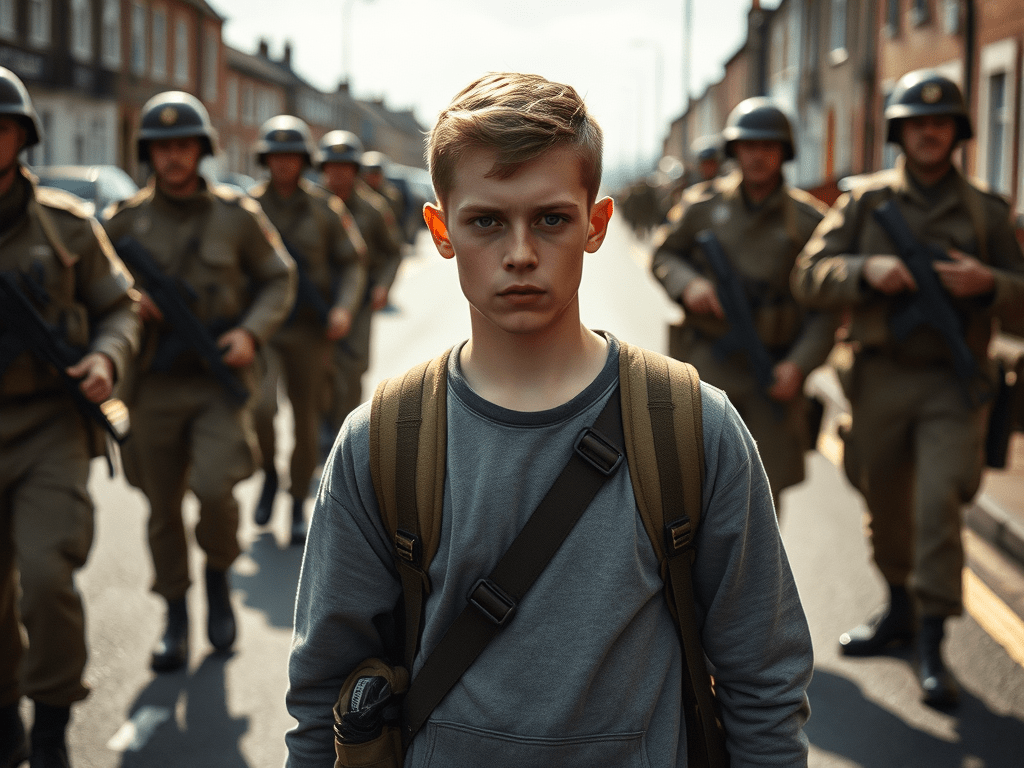
In 1979, at the age of 18, I found myself in a frightening situation. While walking along a road in Belfast, I was stopped by angry British soldiers. Just weeks earlier, the IRA had launched a major attack, and I matched the description of a suspect they were seeking. Carrying a sports bag, I was detained—though not arrested—and the prospect of being “questioned” filled me with dread.

Despite answering their questions in clear, unaccented English, it didn’t dissuade them from holding me. I discovered later their suspect was a proud Irishman who wouldn’t fake an English accent, but that did not occur to them at the time.

I was taken to a local MP station and placed in a cell. Another soldier questioned me through a hatch, and once my identity was verified and it was clear I wasn’t from Belfast, they asked why I was there. After hearing my explanation, they relaxed. One soldier even brought me tea and biscuits, and the tension in the room began to lift.

It still felt surreal, like a scene from a spaghetti western. The soldiers exchanged glances as if waiting for something. Soon, a Brigadier General entered, and everyone stood, including me, a few seconds behind. The General was polite, making small talk, and then explained why tensions were high. He scolded the soldier who detained me, remarking, “I’d expect my men to recognise a British mainland accent!” He then apologised, asked where I was headed, and had me driven to my destination.

Years later, I came across research explaining how stress causes us to miss critical details, particularly in high-pressure situations. This made me think about my experience and inspired me to explore why such lapses happen, especially in soldiers. Despite rigorous training, these mistakes can still occur, as they did in Afghanistan.

The following story is fiction, but the behaviours and reactions under stress are real. It aims to shed light on the mind-body relationship in moments of extreme fear and pressure.

Introduction

Before diving into the story, I want to take a moment to explore how our bodies and brains behave under extreme stress. When we are confronted with life-or-death situations, the way we think, move, and react is no longer under conscious control. Our brain, the complex organ that usually helps us rationalise and solve problems, can bypass careful thought in the name of survival.

Imagine a scenario where a soldier enters a dark room, unsure if death awaits him or if the shadowy figure in the corner is a friend. In those moments, the brain’s fear centre, the amygdala, takes charge, sending rapid signals to the body to prepare for action. The hypothalamus triggers the release of adrenaline, causing a surge of energy to the muscles, priming them for swift and powerful movements. The body becomes hyper-aware; heart rate spikes, senses sharpen, and muscles tense, ready for combat. Dopamine is released, helping the soldier stay focused and react with lightning speed.

Yet, this survival mode comes at a cost. The brain shifts resources away from systems not essential for immediate survival—like higher reasoning, digestion, or memory. The prefrontal cortex, responsible for careful decision-making, becomes side-lined, as the amygdala prioritises immediate, instinctive reactions. This means that under intense stress, we may act without fully understanding what we are doing or interpreting information incorrectly. Decisions become split-second, reflexive, and often imprecise.

These biological mechanisms have evolved to keep us alive, but in the chaos of battle, they can also lead to tragedy. When fear takes control, when adrenaline floods the body, our ability to distinguish friend from foe can falter. This is the stage upon which our story unfolds—a moment where the brain’s ancient survival systems collide with the complexities of modern warfare. And it is in this moment that a soldier faces the inevitable, tragic consequences of instinct overpowering reason.

Now, let’s step into that room and see how it all unravels.

“One Command”

“Jones, I swear, when we’re done with this tour, I’m dragging your ass to the Rockies. No more of this desert heat,” Sergeant Brian Thompson said, taking a swig from his canteen. His eyes squinted against the midday sun, the sweat making lines through the dust on his face.

Corporal Andrew Jones grinned, adjusting the strap on his rifle. “You and your damn mountains. You know I’m a beach guy. I’ll be sipping something cold while you wrestle a bear.”

They both chuckled, the camaraderie forged from years in service. They had fought side by side through hell, and while the banter was light, there was a tension today they both felt. The briefing for this mission had been grim. They weren’t just facing the usual militants—this was a stronghold for the fanatics. The ones who would gladly die for their cause, strapped with explosives, living only to take as many Marines with them as possible.

“You ready for this?” Jones asked, voice dropping slightly.

Thompson nodded, wiping sweat from his brow. “Yeah, but this one’s different. These guys, they don’t hesitate. They’re not going to negotiate. Every move has to be perfect.”

Jones let out a breath, running his hand along his rifle. “Yeah, I’ve got your back. Like always.”

They both knew what lay ahead.

The Mission Begins

The night air in Afghanistan was cool, a stark contrast to the blistering heat of the day. Thompson and Jones moved with their unit through the narrow streets of a village that had long been under control of the regime. Every shadow felt dangerous. Every movement was suspect.

A dog barked in the distance, making Thompson flinch. His heart pounded as they approached the compound. Intel said this was the headquarters for one of the most dangerous cells in the region. They had already had a couple of close calls. One soldier had almost tripped a wire, setting off a booby trap, but they’d caught it in time. Adrenaline spiked in their veins, pumping through their bodies, keeping them alert, their muscles primed for action.

Inside the darkened alley, the tension was palpable. Thompson’s eyes darted from one corner to another, ears straining to catch any sound. His brain, processing the sensory input at lightning speed, was on high alert. The thalamus quickly relayed data to the amygdala, which flagged every unknown as a potential threat. The prefrontal cortex, trying to keep control, was rapidly analysing each decision, but the weight of the situation made rational thought difficult.

“Clear left,” whispered Jones.

“Right’s clear,” Thompson responded, sweat dripping down his face. His body was tense, ready, as adrenaline coursed through him, heightening his awareness. His muscles felt coiled, dopamine assisting in sharpening his reactions, preparing him for what will come next.

The soldiers moved ahead, approaching the final building on their objective. It was eerily quiet. Too quiet.

Entering the Building

Thompson led the way, stepping through the crumbling doorway into the dark room. His heart hammered in his chest, each beat reverberating in his ears. The narrow field of his night-vision goggles created a sense of tunnel vision, a phenomenon that often accompanies intense stress. His brain was shutting down non-essential systems—he felt the dryness in his mouth, his thoughts narrowed to the immediate task at hand. Every ounce of focus was on survival.

Behind him, Jones followed, scanning the room. The tension had ratcheted to an unbearable height. They knew this was the kind of place where fanatics would strap themselves with explosives, eager to take as many as they could with them.

Suddenly, Thompson heard it—a shout from behind. In the heat of the moment, with the stress squeezing his brain like a clamp, he interpreted it as “Come here quick!” His amygdala surged with fear, pushing his fight-or-flight response into overdrive. His prefrontal cortex, which have ordinarily allowed him to process the situation more carefully, was overruled. The amygdala, in control now, drove him to act without hesitation.

He spun around, weapon raised, adrenaline flooding his system. His muscles responded instantly, dopamine fine-tuning his reactions. His finger pressed the trigger before his conscious mind would fully register what was happening.

The shot rang out in the confined space, echoing through the room.

In the dim light, Thompson saw Jones collapse.

The Mistaken Command

“Jones!” Thompson’s voice cracked. He rushed to his friend’s side, his heart pounding, muscles trembling as the realisation washed over him. Jones’s body was still, the life draining from him.

It wasn’t until seconds later, in the thick fog of his panicked mind, that Thompson noticed the figure across the room. A man in tattered clothes stood near the doorway, clutching a switch, a belt of explosives around his waist. The bomber looked at Thompson with wild eyes before turning and bolting out of the building, leaving his family inside.

“Get out of here quick!” That had been the command.

Thompson’s breath caught in his throat. He realised, too late, that the warning had been to avoid the building, not to approach it.

But now, none of that mattered. The bomber fled, and Jones was bleeding out in his arms.

The Brain’s Betrayal

The adrenaline that had once sharpened his reflexes now left Thompson shaking. The amygdala had driven his decision to shoot, overriding the prefrontal cortex’s ability to slow things down, to think clearly. The dopamine that had helped him react so swiftly was now fading, leaving behind only the stark reality of what he had done.

His body felt hollow, his muscles weak, as the adrenaline ebbed. His throat was dry, the physiological response to fear cutting off non-essential systems like digestion and hydration. His mind raced, but in circles, unable to grasp the enormity of what had happened.

The memory would never leave him, though the details would fade, clouded by the trauma. His brain, struggling to cope, had shut down parts of his cognition, like thinking and memory, in a desperate bid to protect him from the full weight of his actions. But nothing would shield him from the truth.

He had killed his friend.

Not because of malice or failure, but because his brain, in the thick of fear and confusion, had pushed him toward the only decision it would under the circumstances. It had chosen survival over reason, instinct over thought.

And now, Thompson would carry that burden forever.

The Aftermath

The sound of the explosion rattled the windows as the bomber detonated outside, far from his family. But Thompson didn’t hear it. All he heard was the silence in the room, the absence of his friend’s voice. The amygdala, which had served him so well in battle, now brought only guilt and sorrow. His body, drained of the adrenaline, sagged as he knelt beside Jones.

It was inevitable, perhaps. A wrong command, a brain pushed beyond its limits, and a split-second decision driven by fear.

Thompson stared down at his friend, and his mind tried to justify what had happened, but it never would.

Revisiting Heneage Street

Lena had long avoided Heneage Street. She had known Brick Lane all her life—its bustling markets, the smell of curry and fresh bagels, the clatter of people moving through it. But Heneage Street… it held a peculiar power over her. She discovered it in her early twenties, quite by accident, on a mundane afternoon stroll. As she crossed the invisible threshold, her legs felt younger, her step lighter, and suddenly, she wasn’t 21 anymore. She was 16, walking in the late summer of 1976.

The phenomenon had haunted her since then. Each time she left Brick Lane and ventured down Heneage Street, she was transported backward in time. She would re-enter a different year, not as a spectator, but fully as she had been—feeling the emotions and wearing the skin of her younger self. She experienced everything again: the adolescent joy of passing exams, the excitement of travelling abroad for the first time, the thrill of meeting her future husband.

But no matter how far back she went, one constant remained: the grief that had first settled in her heart when she was 13—the year her sister, Evie, died. Lena had been supposed to watch over her that day, but she got distracted, a moment’s lapse that had cost Evie her life. The weight of it had shaped Lena’s adulthood in quiet ways, but she had resolved to live well, to do right by the family she built. She raised two children, forged a strong career as a Project Manager, and even enjoyed the wisdom that comes with grey hair and gentle wrinkles.

Still, every time she stepped into Heneage Street, she feared where it would take her. The youngest she’d ever been was 13, the year she started dance school, the year Evie died. And though she hadn’t yet been thrown into a time earlier than that, the possibility terrified her. What if she went back to a version of herself too young to remember? What if she was trapped in some distant past, lost to the shifting tides of time?

The years passed, and with each decade, Lena made fewer trips down Heneage Street. She grew older, more cautious, more afraid of the unknown. Eventually, she stopped altogether. Her children moved away, her husband died, and she found herself living alone in a small flat not far from where she’d grown up. One day, while putting away groceries, she fell and broke her arm. The ambulance took her to the Royal London Hospital.

Her days in the hospital were long and quiet. The rhythm of nurses and doctors was soothing in its regularity, but it gave her too much time to think. One afternoon, a familiar thought crept back into her mind, unsettling her in a way it hadn’t for years. Heneage Street was only a few minutes’ walk away. Just there, just beyond the bustle of Brick Lane. What if…?

One evening, after the nurses had gone for their rounds, Lena slipped out of bed. Her arm was bound in a cast, but she didn’t care. With surprising determination, she made her way out of the hospital, down the street, and towards Brick Lane. The pavement felt solid beneath her feet, the air brisk with the scent of autumn. She turned the familiar corner, and there it was—Heneage Street. It waited for her like an old, familiar tune she hadn’t heard in years.

With her heart pounding, she stepped across the threshold.

The world shimmered, the air thickened, and when she blinked, her surroundings shifted. She was 13 again. The awkwardness of adolescence returned: the too-long limbs, the uncertainty of everything, the brightness of a life just beginning. And then, for the first time, something was different.

She wasn’t alone.

Lena looked down at her hand and saw it. Another hand, smaller and warmer, gripping hers. She turned, and there stood Evie—her beautiful 11-year-old sister, smiling up at her with a mischievous glint in her eyes.

“Evie?” Lena whispered, her voice trembling.

“Yes, it’s me,” Evie replied, her voice as sweet and familiar as a long-lost melody.

“I’m so sorry,” Lena’s voice cracked. “I should have—”

Evie shook her head and squeezed Lena’s hand tighter. “You don’t have to be sorry, Lena. I never blamed you. Not even for a second.”

Lena’s tears fell silently, rolling down her young cheeks. “I’ve missed you so much. Every day.”

“I know,” Evie said gently. “But I’ve always been with you. You just couldn’t see me.”

They stood together, the two of them, lost in a moment that felt infinite, a pocket of time where all the years and all the grief dissolved into nothing. Lena’s heart swelled with a warmth she hadn’t felt in decades. She didn’t need to go forward or backward anymore. She was right where she needed to be.

“Can we stay like this?” Lena asked, her voice soft, almost childlike.

Evie smiled, a knowing smile. “For a while, yes.”

And so, they stood there, sisters reunited, hand in hand, the past and present merging in the quiet of Heneage Street, where time, for once, stood still.