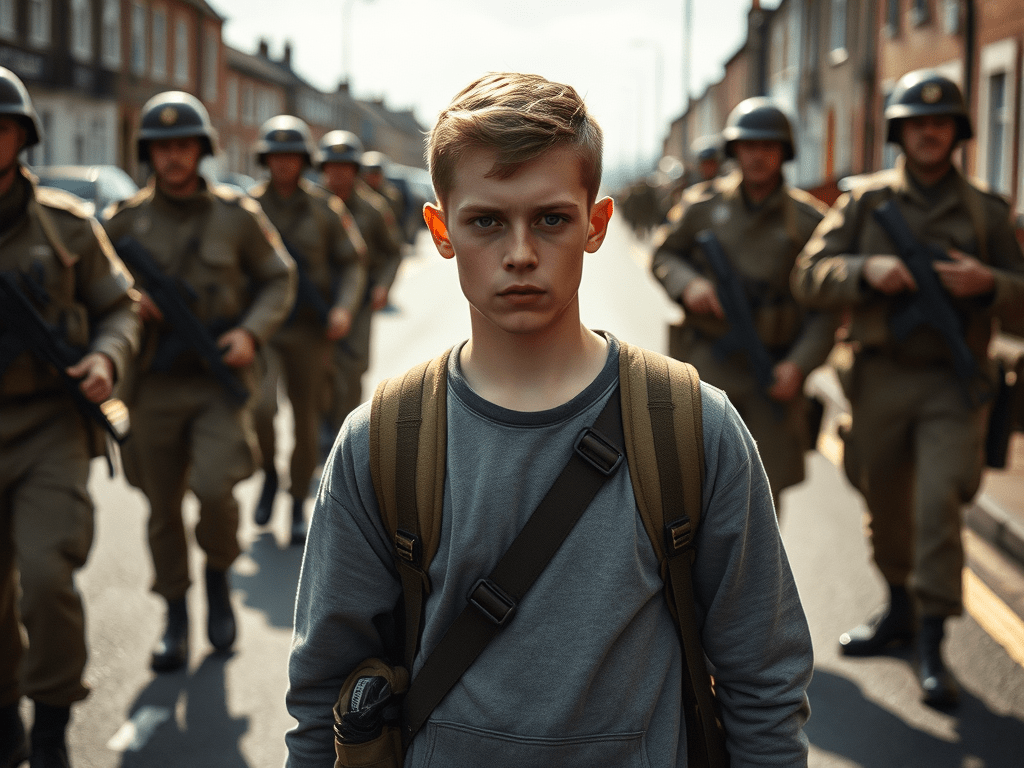
Auntie Gladys and the Du Maurier Connection

Q – Angela

If you’ve ever lived in Fowey, Cornwall, you’ve been blessed to dwell among giants—not only of industry and political scandal, but also of poetry, literature, and history. It’s a place where the past feels alive, where the echoes of ancient civilisations cling to the rugged cliffs, and the wind carries whispers of stories untold.

My first visit to Fowey was in 1970. I was nine years old, giddy with the promise of adventure. My family had just purchased a brand-new campervan, a marvel of modern convenience to us, and our holiday plans were ambitious: a couple of days in Fowey followed by a jaunt to Sennen Cove near Land’s End. But what thrilled me most was the prospect of meeting Auntie Gladys—”crazy Auntie Gladys,” as the family lovingly called her.

Gladys was the woman who left an impression on everyone she met. She was sharp as a tack and fearless in conversation. Years later, I learned that the “crazy” part of her nickname stemmed from a court case where she’d been called as a prosecution witness. Faced with a smirking defence lawyer intent on tripping her up, she didn’t just answer his questions—she turned them into a masterclass in wit. When the judge admonished her to “just answer the question,” she replied with a perfectly straight face, “Oh, Your Honour, I would answer the question, but I thought the truth deserved a little company along the way.”

That summer, Auntie Gladys had promised my brother Richard and me something extraordinary: a visit to The Haven, once the home of Sir Arthur Quiller-Couch. She knew the Quiller-Couch family and wanted to show us his famous library. As we explored, she regaled us with tales of his mentorship of a young Daphne du Maurier. She spoke with reverence about the bond between the two authors, and as she described Daphne’s eventual success, her voice seemed to glow with pride. “Rebecca,” she said, “wasn’t just a book—it was a revolution. She gave us Manderley, a place we’ve all dreamt of visiting.”

I hung on every word, but Richard was particularly taken with the story. Even then, I think, he had a gift for making connections, for seeing the humanity behind the legend.


Seven years later, when we’d moved to Fowey, Richard and I found ourselves caught up in an unusual situation. Our rowing boat had broken free from its moorings and drifted downstream, ending up at Ferryside, the du Maurier family’s home in Bodinnick. By some miracle—or perhaps Dad’s habit of labelling everything—the phone number scrawled on the deck had led Angela du Maurier to call us.

When the phone rang, Richard answered. I still remember how his voice changed when she introduced herself. He straightened, his tone becoming both careful and warm, as though he realised the significance of the moment even before the name fully registered.

“You’re Angela du Maurier?” he asked, his voice just above a whisper. He paused, and I imagined him standing there, hand gripping the receiver, his face lit with excitement. Then, after an audible breath, he added, “Oh, it’s an honour. Truly. My brother and I… we’ve heard so much about you.”

Angela’s voice, though I couldn’t hear it from the other end, must have been kind because Richard seemed to relax slightly. “Yes, of course, we’ll come right away. Thank you for letting us know.”

After hanging up, Richard turned to me, his face flushed. “Do you know who that was?” he asked, almost breathless. “Angela du Maurier.”

“I know!” I said, grabbing the oars.

As we rowed to Ferryside, Richard seemed distracted, his strokes less precise than usual. “I wonder what she’s like,” he murmured, half to himself. “I hope… I hope she’s not sick of people talking about Daphne.”


When we arrived at Ferryside, Angela met us at the gate. She was older than I’d expected, with sharp eyes that seemed to take in everything. She greeted us warmly, and I was struck by how unassuming she seemed for someone from such a storied family.

Richard stepped forward, his smile broad but not overbearing. “Thank you for calling us about the boat,” he said. There was a slight hesitation in his voice, as though he was searching for the right words. “I hope it wasn’t too much trouble.”

“Not at all,” Angela replied. Her voice was soft but firm, with a lilting cadence that seemed to echo the river’s flow.

As we walked toward the boat, Richard began talking—tentatively at first, then with growing confidence. “My brother and I had a wonderful aunt, Auntie Gladys. She knew the Quiller-Couch family… and, well, she once showed us Sir Arthur’s library. She told us about how he encouraged young writers. Your book, It’s Only the Sister, was there.”

Angela’s step faltered slightly, and Richard, noticing, quickly added, “I mean, we didn’t get to stay long enough to read it. But she spoke so highly of it—of you.”

Angela stopped and turned to him, her expression unreadable at first. Then, slowly, a smile broke across her face, genuine and touched. “Did she now?” she said, her voice quieter. “That’s… kind of her to say. And of you to remember.”

Richard nodded, his enthusiasm bubbling up again. “I’ve always wanted to know—what was it like, growing up with all those stories around you? With people expecting so much?”

For a moment, Angela seemed lost in thought. “It was… complicated,” she said at last. “There’s always more to a story than people see from the outside.”

Richard nodded, his expression thoughtful. “I can imagine,” he said softly. “But I hope you know… you’ve inspired people too.”

Angela smiled again, this time with a warmth that seemed to dissolve any lingering tension. “You’re very kind,” she said. “I don’t often hear that.”


Later, as we rowed back home, I asked Richard why he’d mentioned Auntie Gladys and the library. “I don’t remember her talking about Angela,” I said.

“She didn’t,” Richard admitted, his voice light but thoughtful. “I made it up. I just… I wanted to say something that would make her feel seen, not compared to Daphne for once.”

I looked at him, struck by the quiet depth of his kindness. “That was clever,” I said. “And brave.”

He shrugged, a faint smile on his lips. “She deserved it.”

Q – Daphne

Authors Note: Every time I visit Fowey and pass by The Haven, two questions surface in my mind. The first is simple enough: How much of the garden still remains? Over the years, I’ve watched as more of this once magnificent garden has succumbed to the river, with at least a quarter of it lost in my lifetime. The second question, however, is far more elusive, perhaps impossible to answer. As a writer, I can’t help but wonder: How did Sir Arthur Quiller-Couch mentor Daphne du Maurier? Was his influence limited to encouragement, or did he play a more profound role in shaping her extraordinary talent for crafting such vivid, unforgettable characters?

What follows is not history, but the story as I imagine it might have unfolded.

adjusts spectacles and leans forward with a kindly but scholarly demeanor

My dear young Daphne, sit closer and listen well. Writing, you must understand, is not merely the arrangement of words upon a page, but the delicate art of revealing the human soul’s most intimate tremors.

Dialogue, child, is the marrow of storytelling – but not dialogue that merely speaks, no! Dialogue that breathes, that quivers with the unspoken. When characters converse, they are not reciting lines, but performing an intricate dance of emotion, where what is unsaid often thunders louder than what is spoken.

Consider the human voice – that remarkable instrument of revelation. A tremor, a sudden catch, a pitch that rises like a startled bird – these are not mere sounds, but symphonies of feeling. When your character speaks, let their voice be more than sound; let it be a messenger of their inner landscape.

And watch the body, my dear! We are not static creatures, but living canvases upon which emotion paints its wild and unpredictable strokes. A hand that clenches, a shoulder that tightens, eyes that dart away – these are not mere movements, but poetry in physical form. Each character will compose their own unique bodily language, as distinctive as a fingerprint.

The mind, ah, the mind! It is a labyrinth where thoughts dart and weave like silvered fish. Do not be afraid to plunge into those interior waters. A character’s thoughts are not always rational, not always kind – they are raw, mercurial, leaping from one shore of consciousness to another with startling agility.

But take care with what I shall call visceral reactions – those primal, uncontrolled responses that surge through our mortal frames. A racing heart, a sudden chill, that electric moment when the body knows something before the mind can comprehend – these are powerful, but like potent spirits, they must be used sparingly. A drop can illuminate; a flood can drown.

Remember, Daphne, great writing is not about displaying emotion, but about allowing emotion to reveal itself through the most delicate of touches. You are not a painter hurling color, but an embroiderer threading the most gossamer of silks.

Now, shall we speak of how one might begin to master this sublime craft?

peers at her over his spectacles, a twinkle of encouragement in his eye

Mars Exploration: Unlocking Ancient Secrets

The Breath of Mars
The laboratory hummed softly with the sound of machines and the occasional hiss of oxygen diffusers. Outside the curved dome walls, the Martian landscape stretched endlessly, its red hues fading into the hazy light of the artificial afternoon. Dr Aiden Colgrave leaned against a console, arms crossed, a rare smile playing at the corners of his mouth.

“It’s finally happening, Jenna,” he said, his voice brimming with quiet triumph. “In twenty years, maybe less, we’ll step out of these domes without oxygen boosters. Just us and the open air.”

Across the lab, Dr Jenna Vos froze, one hand hovering over the spectrometer she’d been adjusting. She turned to him, her brows raised in disbelief.
“Without boosters?” she asked, her voice low, as if speaking the words too loudly might shatter them. “No domes? No packs? Just… air?”

Aiden nodded. “Not quite Earth-standard, but breathable enough for short periods. The oxygenation reactors in the northern latitudes are working faster than we predicted. CO₂ scrubbing, water electrolysis, microbial enhancement—it’s all ahead of schedule.”

Jenna’s lips parted in awe, and she let out a soft whistle. “Do you even realise what that means? People walking Mars like it’s a stroll through the countryside? Not just explorers and lab rats like us.”

“Exactly,” Aiden said, pushing off the console. “Ordinary people. Kids. Families. For the first time, Mars will be a planet, not just a project.”

Jenna laughed, a bubbling sound that filled the sterile air. “Aiden, if this is some elaborate joke, you’re in serious trouble. But if it’s real—”

“It’s real.” He grinned now, unable to help himself. “And there’s more. Did you read the Musk Daily this morning?”

Her eyes narrowed. “Should I have?”

“You absolutely should have.” Aiden pulled a chair over and plopped down, leaning forward conspiratorially. “A team just finished traversing the Valles Marineris—first time anyone’s ever done it.”

Jenna rested her hand on her hip and tilted her head thoughtfully, her expression curious rather than sceptical. “I always thought the terrain out there was too extreme to cross. How did they manage it?”

“Not anymore,” Aiden said. “And here’s the kicker: halfway through, they found a cave system. Inside—” He paused, savouring the moment. “They discovered what looks like an astrolabe.”

Jenna blinked. “An astrolabe? On Mars?” She shook her head, laughing incredulously. “Come on, Aiden. That’s ridiculous. What would an ancient Earth navigation tool be doing in a Martian cave?”

“It’s not Earth-standard,” he said, his voice dropping a notch. “Dr Daneel Olivaw himself reviewed the data. He says it’s genuine—Martian design, adapted for the planet’s orbit and axial tilt.”

She sat down heavily on a stool, her mouth working silently before she managed to speak. “Wait. You’re telling me someone, or something, made a complex celestial navigation tool here? And left it in a cave?”

Aiden shrugged. “That’s the report. The explorers didn’t touch it—thank God. They left it intact for a marchaeology team to investigate.”

Jenna reached for her tablet, her fingers flying over the screen as she pulled up the morning headlines. “This changes everything,” she muttered, scrolling rapidly. “If this thing is real, then who built it? And why?”

The lab door hissed open, and Dr Ravi Singh strode in, a coffee cup in one hand and a data pad in the other. “I hear someone’s finally talking about the Valles Marineris artefact,” he said, setting his coffee down. “Took you two long enough.”

Jenna looked up sharply. “Ravi, tell me you’ve seen the photos. What’s your take?”

“Oh, I’ve seen them,” Ravi said, leaning against the counter. “And I’ve got theories. If it’s authentic—and I’m inclined to think it is—it suggests a civilisation here capable of advanced celestial navigation. That means intelligence. Maybe even culture.”

“But where’s the rest of it?” Jenna pressed. “If they were smart enough to build an astrolabe, there should be more—cities, tools, structures. Something.”

Ravi nodded. “That’s the big question, isn’t it? Where did they live? Above ground? Underground? Or were they just passing through, using Mars as a waypoint?”

“Earth,” Aiden said quietly.

The room fell silent. Jenna and Ravi turned to him, their expressions unreadable.

“What if Mars wasn’t their home?” Aiden continued. “What if it was a stopover? And Earth… Earth was the destination.”

Jenna let out a soft gasp. “Terraforming Earth. You think they started there?”

“It makes sense,” Ravi said, his voice thoughtful. “Mars would’ve been hostile back then, even worse than now. But Earth, with its oceans and mild atmosphere… If they could seed a planet like that—”

“They could’ve seeded us,” Jenna finished. Her voice trembled slightly. “We might be the remnants of a Martian civilisation. Descendants of explorers who left their home world behind.”

“And Olivaw?” Ravi asked. “What’s his game? If he’s known about this, why hasn’t he said more?”

Aiden’s jaw tightened. “Maybe he’s waiting for proof. Or maybe…” He hesitated. “Maybe he already has answers he doesn’t want to share.”

The three of them stared out the lab’s transparent wall, their eyes drawn to the endless expanse of red. For the first time, it seemed less like a barren wasteland and more like a place alive with secrets.

“It’s ironic,” Jenna said finally. “We’re just now making this place liveable, and it turns out it may have been alive all along.”

Aiden stood, his voice steady as he replied, “Mars isn’t just a new frontier. It’s a history book. We’ve barely turned the first page.”

Authors Note
I hope Asimov fans appreciate my nod to one of the most amazing characters in his books.

Life Beyond Death: Further Discoveries on Mars

Authors Note: This rewrite of Life Beyond Death: Discoveries on Mars shifts the focus to the dialogue between its two central characters, letting their voices carry the story. Dialogue is my preferred way to write—it breathes life into the narrative, allowing personalities to clash, connect, and evolve. Yet, after countless hours spent crafting technical documents, I sometimes forget the joy of breaking free from the constraints of business writing. This version is a return to that joy, a chance to rediscover the freedom and creativity that comes from letting characters speak for themselves.


The atrium buzzed with the chaotic energy of orientation day. Beneath the sprawling glass dome of the Intergalactic University, streams of students navigated between mineral-blue walkways and holographic displays. Zara Novak stood off to the side, arms crossed, her gaze flicking across the room like a hawk sizing up its prey. Her restless energy crackled in the space around her, a sharp contrast to the serenity of Mars’ reddish glow filtering through the dome.

“Lost, or just plotting how to outsmart the universe?”

The voice was calm, steady, and laced with a quiet humour. Zara turned to see a man standing a few steps away, his features softened by a warm smile. He carried a compact case tucked under one arm, the faint trace of dust clinging to his sleeves suggesting he’d been handling Martian soil.

“Neither,” she replied coolly, straightening. “Just figuring out where the quantum physics lab is.”

“Atlas Chen,” he said, offering a hand she ignored. “Terraforming. Soil chemistry. All the dirty work.”

She tilted her head, her dark eyes scrutinising him with the precision of someone dissecting a flawed equation. “And you think I care because…?”

“Because you’re Zara Novak,” he said, the corners of his mouth quirking up. “Dark matter prodigy. Word travels fast.”

Zara’s brow twitched. “Let me guess—you think dark matter is ‘too abstract,’ don’t you? Not practical enough for someone who spends their time digging in dirt.”

Atlas chuckled, a rich sound that carried an infuriating ease. “Not at all. It’s fascinating. But practical?” He shrugged. “That’s another story. Me? I’m about making things grow where they shouldn’t. I’ll leave bending the universe to people like you.”

She smirked, though it didn’t reach her eyes. “Spoken like someone who doesn’t understand how lethal cosmic forces are. Without shielding, your precious plants won’t last a week.”

“Maybe. But without soil, your shielding is just an empty shell,” he countered, his voice unflappable. “I guess that makes us complementary.”

“Complementary?” Zara let out a derisive snort, but there was a spark of intrigue in her eyes. “Don’t get ahead of yourself, soil boy.”


Their paths crossed again two days later. It wasn’t by design—not entirely—but neither of them could deny the strange pull that seemed to draw them together. Zara was in the lab, hunched over her dark matter detector, her brow furrowed as data scrolled across her screen. Atlas appeared in the doorway, carrying a tray of soil samples like some offering to a deity.

“You’re in my way,” she snapped without looking up.

“You’re welcome,” he replied, unbothered by her hostility. He set the tray on a nearby bench and leaned casually against the wall, watching her work. “What are you hunting?”

“Disturbances in dark matter flow,” she said absently. “I’ve modified the detector to pick up anomalies down to a scale no one’s measured before.”

Atlas nodded thoughtfully. “And what happens if you find one?”

Her hands paused over the keyboard. She looked up, meeting his gaze for the first time. “Then I’ll know we’ve been wrong about everything.”

“Everything, huh?” He gestured to his soil samples. “I’ve got my own anomaly. The soil here isn’t just barren—it’s responding to inputs in ways it shouldn’t. As if it remembers life.”

Zara’s sharp mind latched onto the word. “Remembers?”

Atlas nodded. “Yeah. It’s faint, but there’s a kind of… echo in it. A latent energy that’s not just chemical.”

She leaned back, crossing her arms. “That’s impossible.”

“Is it?” He smiled, and there was something maddeningly patient about the gesture. “I thought you were the one questioning everything.”


It was late that night when they made the breakthrough. Side by side in the dimly lit lab, Zara’s detector emitted a faint ping, a sound she had trained herself to listen for. She froze, staring at the screen as the data materialised.

“There it is,” she whispered.

Atlas leaned in, his brow furrowing. “What am I looking at?”

“An imprint,” she murmured, her voice laced with awe and a touch of fear. “A signature. It’s faint, but it’s there—a disturbance clinging to the material, like… like an echo of life.”

Atlas studied the readings, his mind racing. “That matches the response in the soil,” he said. “It’s as if something—some essence—lingers after life is gone.”

Zara’s heart thudded in her chest. The implications unfurled in her mind like a puzzle she couldn’t quite solve. “What if life doesn’t just vanish? What if it disperses? Dissolves into the fabric of the universe itself?”

Atlas sat back, the weight of her words sinking in. “And what if it’s not just Earth? What if this cycle is universal? Life as a shared resource, flowing and reborn, scattered across planets and stars.”

For a moment, neither of them spoke. The lab seemed to hum with a deeper energy, a resonance that matched the gravity of their discovery.


Weeks passed, and their work grew more radical. The anomaly deepened their understanding of existence, but it also brought something else: a strange sense of familiarity. As they pieced together the nature of this universal cycle, fragments of memories—moments neither of them could explain—began to surface.

One evening, under the Martian sky, Zara stared at the horizon, her voice barely audible. “It’s as if we’ve done this before.”

Atlas nodded, his gaze fixed on the stars. “We have. Or something like us has. Maybe that’s why we’re here—why we found each other.”

She turned to him, her sharp edges softening. “What if this is the purpose of humanity? Not to conquer, but to nurture? To carry life wherever it’s needed?”

His hand found hers, and she didn’t pull away. “Then we have work to do,” he said simply.


Decades later, as green spread across Mars and humanity took its first true steps into the stars, Zara and Atlas sat together under the same sky. Their faces were lined with age, their hands clasped tightly. They watched the sun dip below the horizon, the crimson glow casting long shadows over the fields they had helped create.

“Do you think we’ll meet again?” Zara asked, her voice quiet but steady.

Atlas smiled, his warmth unchanged. “We always do.”

And as the stars blinked into view, they closed their eyes, knowing their part in the endless dance of life was far from over.

The Descent of Liberty

Beneath Westminster’s grey-stained spires,
The wheel of policy grinds our bones into dust,
A bloated beast, with laws spun from wires,
Coiled tight with venomous bureaucratic lust.

Elderly souls count pennies in trembling palms,
Taxed twice to keep the coffers fed.
While cold hands grasp ancestral farms,
Spirits broken, land bloodshed red.

Entrepreneurs pack bags for foreign lands,
Start-ups flee like whispers in a storm.
Treasure Island shackled by fumbling hands,
Burying seeds where hope once warmed.

In hollow chambers, debate becomes a mime,
Soundless screams pass through lifeless lips.
Policy inked in deceitful rhyme,
The ink of betrayal that drips and drips.

“Come for a chat,” the constable grins,
Non-crime etched in trembling files.
Liberty’s skin stretched thin,
Each smile masked with Kafkaesque guile.

Parliament convulses, a clockwork jest,
Where minutes churn and reason drowns.
The monstrous dance of tax and unrest,
A procession of clowns in tattered gowns.

Dark words echo down cobbled streets,
The farmer lost to silence, his land to fate.
A thousand voices in protest beats,
While Orwell’s ghost weeps at the gate.

A government failing, imploding within,
Rote schemes and blind masks lead astray.
Minds enslaved in logic’s grim spin,
As night’s chill devours light’s last ray.

And so, we march, heads bent to the storm,
Through corridors drenched in despair’s stain.
Darkness festers where laws deform,
Till the cycle begins again.

Life Beyond Death: Discoveries on Mars

Now updated to Life Beyond Death: Further Discoveries on Mars

This story opens on Mars, in the bustling, crimson-toned campus of the Intergalactic University in Musk City. Amid the towering glass domes and mineral-blue walkways, Zara Novak and Atlas Chen meet by chance—or what they perceive to be chance. It’s orientation day, and the two new students, each a prodigy in their field, eye each other warily across the crowded hall. Zara, a quantum physicist renowned for her work on dark matter manipulation, is all sharp edges and restless energy. Atlas, the calm, grounded terraforming expert, has an ease and warmth about him, as if rooted to the soil he dreams of cultivating on distant planets.

As the days progress, Zara and Atlas find themselves repeatedly crossing paths, their studies and ambitions often at odds. Zara’s fascination with dark matter and its potential applications to safe space travel strikes Atlas as too removed from the immediate, practical concerns of terraforming and making alien worlds habitable. Meanwhile, Atlas’s focus on the biology and chemistry of soil feels, to Zara, charmingly provincial. Yet, as their debates turn into long, thought-provoking discussions under the Martian sky, they begin to see a synergy in their work: her dark matter technology could protect his fragile ecosystems from the lethal cosmic forces, while his expertise in creating habitable spaces makes her dream of safe, sustainable space travel all the more feasible.

It’s during a late-night research session in the lab that they make a discovery—an anomaly in their observations that defies all known principles of consciousness. Zara’s dark matter detectors, designed to track minute disturbances, register a faint yet unmistakable signature, a kind of imprint or “life echo,” that clings to certain organic and inorganic materials on Mars. Meanwhile, Atlas’s soil samples seem to respond in ways that cannot be explained by simple chemical reactions; it’s as if they retain a memory, a latent essence of life from a different form.

Curious and unsettled, they pursue this anomaly, each applying their own unique perspective. They begin to suspect that the essence of life doesn’t disappear upon death but instead disperses, lingering within the fabric of existence itself, perhaps bound to planets and stars, rocks and soil. Their data leads them to a stunning revelation: this “life energy” follows a cycle. Upon death, one’s consciousness is released, not into a spiritual afterlife but into the universe, where it may eventually become a part of a new life, a new being. It’s a cold, logical cycle, devoid of any guiding deity or mystical intent—a natural phenomenon, no less extraordinary for its lack of divine origin.

Zara is struck by the irony; humans had spent centuries searching for life in the stars, yet had failed to understand the life that surrounded them, that even permeated the ground beneath their feet. Her scientific mind reels as she contemplates the implications. This discovery suggests that life, rather than being unique to each being, is more like a shared resource, a vast ocean in which every conscious mind is but a fleeting ripple.

Atlas, for his part, experiences a deep, almost instinctual understanding of the cycle. It makes sense, he thinks, why certain plants would thrive in soil where life had once been abundant or why he could coax growth from the most barren of rocks. It’s as though life, in its purest form, was meant to be spread, to be shared across planets and galaxies. He finds a quiet contentment in this notion, a fulfilment of his purpose. Zara and he were, in a sense, more than just scientists; they were gardeners of the cosmos, stewards of life’s expansion across the stars.

Their theories grow more radical as they realise that their own meeting, too, was part of this cycle. Memories bubble up unbidden—fragments of shared experiences, moments of love and companionship from a life neither of them should remember. They had been together before, on Earth, where they had built a life filled with love and respect, until they both grew old and died, naturally and peacefully. Yet here they were, together again, pulled to this distant world by the lingering resonance of their past selves.

With this understanding, they form a pact, a plan that binds them not only in this life but in the cycles to come. They will dedicate their lives—and all the lives they are yet to live—to spreading life across the universe. They become driven by a vision of humanity as caretakers of existence, tasked not with conquest or dominion, but with nurturing every corner of the cosmos, from desolate moons to distant exoplanets, with life in all its myriad forms.

Years pass, and Musk City expands. Thanks to Zara’s dark matter technology, which shields human settlements from the worst of cosmic radiation, and Atlas’s atmospheric chambers that bring Martian soil to life, humanity takes its first true steps towards establishing a sustainable presence beyond Earth. Colonists arrive in droves, and plants from Atlas’s rare seed collection begin to flourish, covering patches of Martian soil with green, a vibrant signal of life’s foothold on an alien world.

On their final night together, Zara and Atlas sit side by side, watching the sunset over the Martian horizon. They have grown old again, each line on their faces a testament to the countless lives they have touched. Zara’s gaze drifts from the fiery sky to the green patch of soil they have nurtured, and she knows this is merely the beginning. They don’t need to speak; they both understand that when the time comes, their essence will flow back into the universe, to be reborn and to continue the work they have begun.

As the sun dips below the horizon, casting a final, scarlet glow, Zara reaches out, her hand clasping Atlas’s in a gesture as old as time. Together, they close their eyes, knowing that, one day, they will meet again. For life is not a single, fleeting journey, but an endless dance across the cosmos, and they, like all of humanity, are destined to play their part.

Understanding Stress and Its Impact on Decision Making

Listen to the Deep Dive Expert discuss this article in a recent Podcast:

Author’s Note

In 1979, at the age of 18, I found myself in a frightening situation. While walking along a road in Belfast, I was stopped by angry British soldiers. Just weeks earlier, the IRA had launched a major attack, and I matched the description of a suspect they were seeking. Carrying a sports bag, I was detained—though not arrested—and the prospect of being “questioned” filled me with dread.

Despite answering their questions in clear, unaccented English, it didn’t dissuade them from holding me. I discovered later their suspect was a proud Irishman who wouldn’t fake an English accent, but that did not occur to them at the time.

I was taken to a local MP station and placed in a cell. Another soldier questioned me through a hatch, and once my identity was verified and it was clear I wasn’t from Belfast, they asked why I was there. After hearing my explanation, they relaxed. One soldier even brought me tea and biscuits, and the tension in the room began to lift.

It still felt surreal, like a scene from a spaghetti western. The soldiers exchanged glances as if waiting for something. Soon, a Brigadier General entered, and everyone stood, including me, a few seconds behind. The General was polite, making small talk, and then explained why tensions were high. He scolded the soldier who detained me, remarking, “I’d expect my men to recognise a British mainland accent!” He then apologised, asked where I was headed, and had me driven to my destination.

Years later, I came across research explaining how stress causes us to miss critical details, particularly in high-pressure situations. This made me think about my experience and inspired me to explore why such lapses happen, especially in soldiers. Despite rigorous training, these mistakes can still occur, as they did in Afghanistan.

The following story is fiction, but the behaviours and reactions under stress are real. It aims to shed light on the mind-body relationship in moments of extreme fear and pressure.

Introduction

Before diving into the story, I want to take a moment to explore how our bodies and brains behave under extreme stress. When we are confronted with life-or-death situations, the way we think, move, and react is no longer under conscious control. Our brain, the complex organ that usually helps us rationalise and solve problems, can bypass careful thought in the name of survival.

Imagine a scenario where a soldier enters a dark room, unsure if death awaits him or if the shadowy figure in the corner is a friend. In those moments, the brain’s fear centre, the amygdala, takes charge, sending rapid signals to the body to prepare for action. The hypothalamus triggers the release of adrenaline, causing a surge of energy to the muscles, priming them for swift and powerful movements. The body becomes hyper-aware; heart rate spikes, senses sharpen, and muscles tense, ready for combat. Dopamine is released, helping the soldier stay focused and react with lightning speed.

Yet, this survival mode comes at a cost. The brain shifts resources away from systems not essential for immediate survival—like higher reasoning, digestion, or memory. The prefrontal cortex, responsible for careful decision-making, becomes side-lined, as the amygdala prioritises immediate, instinctive reactions. This means that under intense stress, we may act without fully understanding what we are doing or interpreting information incorrectly. Decisions become split-second, reflexive, and often imprecise.

These biological mechanisms have evolved to keep us alive, but in the chaos of battle, they can also lead to tragedy. When fear takes control, when adrenaline floods the body, our ability to distinguish friend from foe can falter. This is the stage upon which our story unfolds—a moment where the brain’s ancient survival systems collide with the complexities of modern warfare. And it is in this moment that a soldier faces the inevitable, tragic consequences of instinct overpowering reason.

Now, let’s step into that room and see how it all unravels.

“One Command”

“Jones, I swear, when we’re done with this tour, I’m dragging your ass to the Rockies. No more of this desert heat,” Sergeant Brian Thompson said, taking a swig from his canteen. His eyes squinted against the midday sun, the sweat making lines through the dust on his face.

Corporal Andrew Jones grinned, adjusting the strap on his rifle. “You and your damn mountains. You know I’m a beach guy. I’ll be sipping something cold while you wrestle a bear.”

They both chuckled, the camaraderie forged from years in service. They had fought side by side through hell, and while the banter was light, there was a tension today they both felt. The briefing for this mission had been grim. They weren’t just facing the usual militants—this was a stronghold for the fanatics. The ones who would gladly die for their cause, strapped with explosives, living only to take as many Marines with them as possible.

“You ready for this?” Jones asked, voice dropping slightly.

Thompson nodded, wiping sweat from his brow. “Yeah, but this one’s different. These guys, they don’t hesitate. They’re not going to negotiate. Every move has to be perfect.”

Jones let out a breath, running his hand along his rifle. “Yeah, I’ve got your back. Like always.”

They both knew what lay ahead.

The Mission Begins

The night air in Afghanistan was cool, a stark contrast to the blistering heat of the day. Thompson and Jones moved with their unit through the narrow streets of a village that had long been under control of the regime. Every shadow felt dangerous. Every movement was suspect.

A dog barked in the distance, making Thompson flinch. His heart pounded as they approached the compound. Intel said this was the headquarters for one of the most dangerous cells in the region. They had already had a couple of close calls. One soldier had almost tripped a wire, setting off a booby trap, but they’d caught it in time. Adrenaline spiked in their veins, pumping through their bodies, keeping them alert, their muscles primed for action.

Inside the darkened alley, the tension was palpable. Thompson’s eyes darted from one corner to another, ears straining to catch any sound. His brain, processing the sensory input at lightning speed, was on high alert. The thalamus quickly relayed data to the amygdala, which flagged every unknown as a potential threat. The prefrontal cortex, trying to keep control, was rapidly analysing each decision, but the weight of the situation made rational thought difficult.

“Clear left,” whispered Jones.

“Right’s clear,” Thompson responded, sweat dripping down his face. His body was tense, ready, as adrenaline coursed through him, heightening his awareness. His muscles felt coiled, dopamine assisting in sharpening his reactions, preparing him for what will come next.

The soldiers moved ahead, approaching the final building on their objective. It was eerily quiet. Too quiet.

Entering the Building

Thompson led the way, stepping through the crumbling doorway into the dark room. His heart hammered in his chest, each beat reverberating in his ears. The narrow field of his night-vision goggles created a sense of tunnel vision, a phenomenon that often accompanies intense stress. His brain was shutting down non-essential systems—he felt the dryness in his mouth, his thoughts narrowed to the immediate task at hand. Every ounce of focus was on survival.

Behind him, Jones followed, scanning the room. The tension had ratcheted to an unbearable height. They knew this was the kind of place where fanatics would strap themselves with explosives, eager to take as many as they could with them.

Suddenly, Thompson heard it—a shout from behind. In the heat of the moment, with the stress squeezing his brain like a clamp, he interpreted it as “Come here quick!” His amygdala surged with fear, pushing his fight-or-flight response into overdrive. His prefrontal cortex, which have ordinarily allowed him to process the situation more carefully, was overruled. The amygdala, in control now, drove him to act without hesitation.

He spun around, weapon raised, adrenaline flooding his system. His muscles responded instantly, dopamine fine-tuning his reactions. His finger pressed the trigger before his conscious mind would fully register what was happening.

The shot rang out in the confined space, echoing through the room.

In the dim light, Thompson saw Jones collapse.

The Mistaken Command

“Jones!” Thompson’s voice cracked. He rushed to his friend’s side, his heart pounding, muscles trembling as the realisation washed over him. Jones’s body was still, the life draining from him.

It wasn’t until seconds later, in the thick fog of his panicked mind, that Thompson noticed the figure across the room. A man in tattered clothes stood near the doorway, clutching a switch, a belt of explosives around his waist. The bomber looked at Thompson with wild eyes before turning and bolting out of the building, leaving his family inside.

“Get out of here quick!” That had been the command.

Thompson’s breath caught in his throat. He realised, too late, that the warning had been to avoid the building, not to approach it.

But now, none of that mattered. The bomber fled, and Jones was bleeding out in his arms.

The Brain’s Betrayal

The adrenaline that had once sharpened his reflexes now left Thompson shaking. The amygdala had driven his decision to shoot, overriding the prefrontal cortex’s ability to slow things down, to think clearly. The dopamine that had helped him react so swiftly was now fading, leaving behind only the stark reality of what he had done.

His body felt hollow, his muscles weak, as the adrenaline ebbed. His throat was dry, the physiological response to fear cutting off non-essential systems like digestion and hydration. His mind raced, but in circles, unable to grasp the enormity of what had happened.

The memory would never leave him, though the details would fade, clouded by the trauma. His brain, struggling to cope, had shut down parts of his cognition, like thinking and memory, in a desperate bid to protect him from the full weight of his actions. But nothing would shield him from the truth.

He had killed his friend.

Not because of malice or failure, but because his brain, in the thick of fear and confusion, had pushed him toward the only decision it would under the circumstances. It had chosen survival over reason, instinct over thought.

And now, Thompson would carry that burden forever.

The Aftermath

The sound of the explosion rattled the windows as the bomber detonated outside, far from his family. But Thompson didn’t hear it. All he heard was the silence in the room, the absence of his friend’s voice. The amygdala, which had served him so well in battle, now brought only guilt and sorrow. His body, drained of the adrenaline, sagged as he knelt beside Jones.

It was inevitable, perhaps. A wrong command, a brain pushed beyond its limits, and a split-second decision driven by fear.

Thompson stared down at his friend, and his mind tried to justify what had happened, but it never would.

Revisiting Heneage Street

Lena had long avoided Heneage Street. She had known Brick Lane all her life—its bustling markets, the smell of curry and fresh bagels, the clatter of people moving through it. But Heneage Street… it held a peculiar power over her. She discovered it in her early twenties, quite by accident, on a mundane afternoon stroll. As she crossed the invisible threshold, her legs felt younger, her step lighter, and suddenly, she wasn’t 21 anymore. She was 16, walking in the late summer of 1976.

The phenomenon had haunted her since then. Each time she left Brick Lane and ventured down Heneage Street, she was transported backward in time. She would re-enter a different year, not as a spectator, but fully as she had been—feeling the emotions and wearing the skin of her younger self. She experienced everything again: the adolescent joy of passing exams, the excitement of travelling abroad for the first time, the thrill of meeting her future husband.

But no matter how far back she went, one constant remained: the grief that had first settled in her heart when she was 13—the year her sister, Evie, died. Lena had been supposed to watch over her that day, but she got distracted, a moment’s lapse that had cost Evie her life. The weight of it had shaped Lena’s adulthood in quiet ways, but she had resolved to live well, to do right by the family she built. She raised two children, forged a strong career as a Project Manager, and even enjoyed the wisdom that comes with grey hair and gentle wrinkles.

Still, every time she stepped into Heneage Street, she feared where it would take her. The youngest she’d ever been was 13, the year she started dance school, the year Evie died. And though she hadn’t yet been thrown into a time earlier than that, the possibility terrified her. What if she went back to a version of herself too young to remember? What if she was trapped in some distant past, lost to the shifting tides of time?

The years passed, and with each decade, Lena made fewer trips down Heneage Street. She grew older, more cautious, more afraid of the unknown. Eventually, she stopped altogether. Her children moved away, her husband died, and she found herself living alone in a small flat not far from where she’d grown up. One day, while putting away groceries, she fell and broke her arm. The ambulance took her to the Royal London Hospital.

Her days in the hospital were long and quiet. The rhythm of nurses and doctors was soothing in its regularity, but it gave her too much time to think. One afternoon, a familiar thought crept back into her mind, unsettling her in a way it hadn’t for years. Heneage Street was only a few minutes’ walk away. Just there, just beyond the bustle of Brick Lane. What if…?

One evening, after the nurses had gone for their rounds, Lena slipped out of bed. Her arm was bound in a cast, but she didn’t care. With surprising determination, she made her way out of the hospital, down the street, and towards Brick Lane. The pavement felt solid beneath her feet, the air brisk with the scent of autumn. She turned the familiar corner, and there it was—Heneage Street. It waited for her like an old, familiar tune she hadn’t heard in years.

With her heart pounding, she stepped across the threshold.

The world shimmered, the air thickened, and when she blinked, her surroundings shifted. She was 13 again. The awkwardness of adolescence returned: the too-long limbs, the uncertainty of everything, the brightness of a life just beginning. And then, for the first time, something was different.

She wasn’t alone.

Lena looked down at her hand and saw it. Another hand, smaller and warmer, gripping hers. She turned, and there stood Evie—her beautiful 11-year-old sister, smiling up at her with a mischievous glint in her eyes.

“Evie?” Lena whispered, her voice trembling.

“Yes, it’s me,” Evie replied, her voice as sweet and familiar as a long-lost melody.

“I’m so sorry,” Lena’s voice cracked. “I should have—”

Evie shook her head and squeezed Lena’s hand tighter. “You don’t have to be sorry, Lena. I never blamed you. Not even for a second.”

Lena’s tears fell silently, rolling down her young cheeks. “I’ve missed you so much. Every day.”

“I know,” Evie said gently. “But I’ve always been with you. You just couldn’t see me.”

They stood together, the two of them, lost in a moment that felt infinite, a pocket of time where all the years and all the grief dissolved into nothing. Lena’s heart swelled with a warmth she hadn’t felt in decades. She didn’t need to go forward or backward anymore. She was right where she needed to be.

“Can we stay like this?” Lena asked, her voice soft, almost childlike.

Evie smiled, a knowing smile. “For a while, yes.”

And so, they stood there, sisters reunited, hand in hand, the past and present merging in the quiet of Heneage Street, where time, for once, stood still.

Unintended Consequences

Chapter 1:

The Muffled Shots

David had been out in his garden, tending to the small but meticulously kept flowerbeds when he heard what sounded like muffled gunshots. A sound so out of place that his first instinct was to dismiss it.

“Must be the telly,” David muttered, standing upright. His gaze shifted towards his neighbour’s house, the imposing home of Gerry, Jenny, and their daughter Alice. A happy family. He saw something out of the corner of his eye, a shadow darting along the fence line. It moved too quickly for him to properly make out. “Sheppy, you rascal,” he chuckled to himself, referring to their energetic sheepdog.

It wasn’t until the wail of approaching sirens disturbed the idyllic tranquillity of the village that David’s heart rate began to pick up. The sight of police cars and an ambulance turning onto the long, winding driveway of his neighbours’ home caused a sinking feeling in his chest.

“That can’t be right…” David whispered, slipping on his jacket and lacing up his shoes with uncharacteristic haste.

He arrived at the property just as a police officer was stretching a line of yellow tape across the gate.

“Excuse me!” David called out, hurrying towards the officer. “I’m David, the neighbour. I heard something, but I thought it was—well, the telly, to be honest. But now… I’m a trained medic, ex-marine. Is there anything I can do?”

The officer, a burly man with a serious expression, held up a hand to stop David’s advance. “Sir, I appreciate your concern, but this is an active scene. We’re doing everything we can.”

David’s brow furrowed. “Please, if someone’s hurt, I can help. I know the family well, they’re my friends.”

The officer looked back towards the house, hesitating for a moment before addressing David again. “Sir, an incident has occurred. Unfortunately, someone was seriously injured. We have medics on site already, and we’re securing the area.”

David’s heart sank at the confirmation that this was no misunderstanding. “Injured? Who?”

“I can’t release details at the moment,” the officer replied firmly. “But I do need you to remain outside the cordon. We’ve got an inspector on the way, and he’ll be speaking with witnesses. If you could wait here, he’ll want to talk to you shortly.”

David took a step back, nodding numbly. He glanced up the driveway towards the house. The familiar home, once full of life, now seemed eerily still.

Chapter 2:

The Body

Inside the house, the scene was grim. Gerry lay face down on the pristine hardwood floor, his body lifeless, a crimson pool beneath him. Detective Inspector Rice stood just outside the living room door, speaking to one of the first officers on site.

“A single entry wound through the heart, another through the back of the skull,” the officer was saying. “The wife and daughter were present. They’re in the lounge, distraught.”

Rice nodded, his face grim, then turned his attention to Becky, the police liaison officer. “The family’s neighbour is outside. Ex-marine, medically trained. Can the women handle seeing him right now?”

Becky hesitated. “It’s hard to tell. They’re… they’re really shaken. Should I ask them?”

Rice nodded, watching as Becky gently approached Jenny and Alice, both of them huddled on the sofa, their faces tear-streaked and eyes vacant with shock.

“Jenny,” Becky said softly, kneeling in front of them. “There’s a neighbour of yours outside, David. He’s worried, and he wanted to check on you both. Should I send him away, or…?”

The women exchanged glances. Alice buried her face deeper into her mother’s side. Jenny opened her mouth to speak, but no words came. She shook her head, clinging tighter to her daughter.

Becky stood back up and turned to Rice, shaking her head. “They’re not ready.”

Rice gave a curt nod before heading outside to speak with David.

David stood just outside the cordon, his eyes fixed on the house. When Rice approached, he straightened. “Inspector, I… I heard the shots. And the screaming. I thought at first it was a loud TV. But then I saw something—a shadow, I think—running along the back of the property. At first, I thought it was the dog, but now…”

Rice raised an eyebrow. “A shadow? Did you see who or what it was?”

David shook his head, his face creased in frustration. “No. It was moving fast. It could’ve been Sheppy, but on reflection, maybe not. The sun was behind me, so it was hard to tell. It might’ve been someone.”

The inspector noted down the details. “We’ll need your contact information, David. You’ve been very helpful, but I think it’s best you head home for now. We’ll be in touch if we need anything else.”

David reluctantly nodded, casting one last look at the house before turning away.

Chapter 3:

The Witnesses

Inside the house, Alice was still trembling, her hands balled into tight fists in her lap. Jenny stroked her daughter’s hair absent-mindedly, staring off into the distance, her eyes unfocused. The room felt heavy, like the very air was thick with grief.

Rice crouched down in front of them, his voice calm and gentle. “Jenny, Alice, I need to ask you some questions, if that’s alright.”

Alice sniffled, but didn’t speak. Jenny nodded slowly, her lips trembling as she fought to hold back more tears.

“Did either of you see what happened?”

Alice shook her head violently, as if trying to shake the memory away. “I heard the gunshots,” she whispered. “And Mum… Mum screamed. But I didn’t see anything.”

Rice turned to Jenny. She swallowed hard before speaking, her voice barely above a whisper. “We’d just come back from walking the dog… Gerry and I. And then… a man, he jumped out of the bushes. Two shots. And then he was gone. Just like that.”

Forensics would be combing the property for days. But Rice already knew this case wouldn’t be simple. Nothing ever was.

Chapter 4:

Uncovering the Past

Detective Inspector Rice sat in his office, a few days after the initial investigation had begun. The evidence was minimal, and no obvious leads had surfaced. Forensics had combed the house meticulously, but there was little to work with beyond the bullets and Jenny’s vague description of the assailant. He knew cases like this could go cold quickly without something concrete.

He leaned back in his chair, rubbing his temples. Something about the way Jenny had described the incident felt off, but there was nothing tangible to act on. She had been emotional, of course. Who wouldn’t be after witnessing their husband’s murder? But her reluctance to part with her phone had lingered in his mind.

“Let’s see what’s there,” Rice murmured, opening the file with the mobile data. He had requested the family’s phones to be fully analysed, and the forensic techs had taken a complete image of each one. He started with Jenny’s. Thousands of photos and messages from years past—nothing seemed out of place. The normal snapshots of a happy family, holidays, and charity events.

Then, he stumbled upon a name.

Webby.

A message thread dating back to 2010. Rice clicked through it. The messages seemed innocent enough at first, reminiscing about school days and catching up on old times. Webby—Michael Webb—had apparently been a school sweetheart. Rice’s instinct sharpened. There was no overt flirtation, but there was a familiarity to their tone that suggested the conversations had once meant something more.

He scrolled down further, looking for anything that might have relevance to the case. Webby disappeared from Jenny’s inbox after 2011. But as Rice examined the data, he caught something odd in the more recent messages.

Mick Webster.

The name didn’t immediately jump out, but after seeing “Webby,” it was impossible not to make the connection. The tone of these more recent conversations was less innocent, with occasional flirtatious undertones, the kind that made Rice sit up straight in his chair. He clicked through several exchanges from just a few months before the murder, noting the subtle shifts in conversation. Nothing too alarming—yet—but it didn’t feel right either.

Rice frowned, his fingers drumming on the desk. “Why didn’t she mention this?”

He requested a search on Mick Webster and found that he worked as a mechanic, his details lining up with the recent hospital visit due to an accident at work. The timing of Mick’s accident gave him a firm alibi, but something still gnawed at Rice. There was a connection here, one Jenny hadn’t mentioned, and it was worth pursuing.

That afternoon, Rice decided to interview Mick at his place of work.

At the Garage

The garage was a noisy, oil-slicked environment, with cars in various stages of repair and a few mechanics going about their business. Mick Webster, a stocky man with grease-stained overalls, looked up as Rice approached. His leg was still in a cast, propped up on a stool.

“Inspector Rice,” the detective introduced himself. “I’d like to ask you a few questions about Jenny Telford.”

Mick’s face flickered with recognition at Jenny’s name. He set down the wrench he was holding and leaned back, wiping his hands on a rag. “Jenny, huh? What’s this about?”

“We’re investigating her husband’s murder,” Rice said bluntly. “We’ve found some messages between you and her from a few months ago.”

Mick’s eyebrows shot up, and he gave a slow whistle. “That’s a blast from the past. Yeah, we kept in touch. She reached out a while ago—chatted here and there. But murder? Gerry? What’s this got to do with me?”

“Just routine,” Rice assured, watching him closely. “I have to explore every lead. Your conversations seemed… personal.”

Mick laughed, shaking his head. “Nah, not really. Look, Jenny and I go way back to school, but that’s all it ever was. She’s a good woman, but there wasn’t anything going on if that’s what you’re hinting at. Besides,” he tapped his cast, “I’ve been in and out of hospital since the accident, couldn’t have shot anyone even if I wanted to.”

Rice nodded but wasn’t quite ready to let him off the hook. “Anyone from Jenny’s past who might have had a grudge against her? Or against Gerry?”

Mick’s expression darkened. He leaned back, thinking hard. “Jenny, huh… Look, she was always the kind of girl who could get people riled up. She liked attention, let’s put it that way. I remember back in school, she liked to play boys off each other. Not saying she’s a bad person, but she could be manipulative. She told me once about how she set up this guy—got him expelled. All because he wouldn’t fall for her charms.”

Rice leaned forward, intrigued. “Do you remember the name of the boy?”

Mick frowned, trying to recall. “No… it was ages ago. But if you’re thinking someone’s holding a grudge, it wouldn’t surprise me. She wasn’t always kind when things didn’t go her way.”

The detective’s mind raced. “So you’re saying Jenny had a reputation for leading boys on, and when things didn’t work out, she’d lash out?”

“Yeah,” Mick confirmed, “but we’re talking about school days. I doubt anyone’s carrying that kind of baggage now, surely?”

“People hold grudges for less,” Rice muttered.

Before leaving, Rice asked one final question. “Do you know anyone else who might’ve been close to Jenny? Someone who might’ve wanted to hurt her or her family?”

Mick shrugged. “Honestly, I wouldn’t know. I’ve been out of touch with that whole crowd for years. But if you’re digging into her past, you might find something. She wasn’t always the saint she pretends to be now.”

As Rice left the garage, his mind turned over Mick’s words. The family had seemed perfect—too perfect. Now, cracks were starting to show. Could Jenny’s past have resurfaced, leading to this violent end?

The case had just taken a new direction. It wasn’t about the loving wife grieving her husband anymore. It was about what lay beneath the surface.

Chapter 5:

Secrets Unraveling

Detective Inspector Rice sat at his desk, reviewing the conversation he’d had with Mick Webster. The more he thought about it, the more something gnawed at him—Jenny wasn’t the murderer, that much he was beginning to feel confident about. But she wasn’t telling the full truth either. The puzzle pieces weren’t quite fitting together, and something about Mick’s story, the casual reference to how Jenny used to manipulate boys in school, stuck in Rice’s mind.

There was someone missing from the picture.

Rice clicked through the social media profiles again, tracing back through connections, old photos, school reunions. And then he found him. Tom Webster, Mick’s younger brother. A few photos of Tom and Jenny as teenagers, standing close, too close, suggested something more than casual friendship. Rice leaned back in his chair, eyes narrowing. Tom Webster, unlike his brother, hadn’t exactly made much of himself. No job, no steady income, and according to local gossip, still living with his parents in his mid-30s.

Rice’s pulse quickened as he dialled his team. “I need everything you can find on Tom Webster,” he said brusquely. “Background, current whereabouts, the works. And get me any traffic or phone data between him and Jenny Telford over the past year.”

Something was off. Jenny wasn’t a murderer, but she was hiding something.

Later That Day

Jenny sat at the kitchen table in the Telford house, nursing a cold cup of tea. Alice had finally gone to stay with a friend for the weekend, giving her some space. The weight of the past few weeks had grown unbearable. The police hadn’t been able to link anyone to Gerry’s murder, and she knew it was only a matter of time before her secrets started to catch up with her.

Her phone buzzed on the table, breaking her from her thoughts. She hesitated before picking it up, seeing Tom’s name flash across the screen. Her stomach churned, and for a moment, she considered ignoring the call. But she knew she couldn’t run from this anymore.

“Tom,” she answered softly.

“Jenny, we need to talk,” his voice was tense, almost desperate. “I’ve been thinking about everything. What happened to Gerry… you know I did it for us.”

Her breath caught in her throat, and a cold wave of dread washed over her. “What? What do you mean, you did it?”

“You don’t need to pretend with me anymore. I know you wanted him gone. I thought you were asking me to—”

“Tom, no!” Jenny’s voice shook as she interrupted him. Her hands trembled as she gripped the phone tighter. “I never wanted you to kill Gerry! I—this was never what I wanted, Tom. I didn’t ask for this.”

There was silence on the other end of the line, and she could hear Tom’s shaky breathing. “But… you always talked about how unhappy you were, how you couldn’t stand the life you had with him. You kept saying how things could be different if only he weren’t around.”

Jenny’s heart raced as she realised just how horribly she had underestimated Tom’s attachment to her. He’d taken her casual complaints, her frustrations, and twisted them into something dark. She had enjoyed the time they spent together—the stolen moments, the excitement—but she had never considered replacing Gerry with Tom. He was never part of the real picture for her.

“You don’t understand, Tom,” she whispered, her voice thick with regret. “I was never serious. I was just… just being selfish. I didn’t mean for you to do anything.”

Tom’s voice became a low growl. “Selfish? So you were just using me, then? Was it all just a game to you? All the times we spent together, you didn’t mean any of it?”

Jenny blinked back tears, her mind swirling. She had liked the intimacy, the attention Tom gave her—after years of being the perfect wife and mother, Tom had made her feel young and alive again. But she had never seen him as more than that—a fleeting escape.

“I never thought it would come to this,” Jenny whispered. “You’ve misunderstood everything.”

“No, I haven’t misunderstood,” Tom said coldly. “I did this for you. For us.”

Before Jenny could say another word, the line went dead. She stared at her phone in disbelief, her heart pounding in her chest. She had never imagined it would get this far. She hadn’t seen Tom for what he really was: obsessed, unstable, and now, a killer.

At the Police Station

The next morning, DI Rice stood in front of a whiteboard, his team gathered around. He had been up all night, piecing together the new information.

“Tom Webster,” he began, circling the name he had written on the board. “He’s Mick’s younger brother. What we’ve discovered is that Tom has been having an affair with Jenny Telford for over a year.”

Sullivan raised an eyebrow. “An affair? We knew there was something off with Jenny, but that’s a bit of a leap from an affair to a murder.”

Rice leaned forward, his expression serious. “It would be, but Jenny called me not long after we picked up Tom. She was in a state. She said she hadn’t told the full truth earlier because she didn’t want to destroy what little remained of her family. But after Tom’s confession, she couldn’t keep it in any longer. She admitted to the affair with Tom Webster. Told me she’d led him on, never intending for it to go this far.”

Sullivan blinked, clearly surprised. “So she confessed everything?”

Rice nodded grimly. “Jenny hadn’t realised just how deeply Tom had fallen for her. She thought he was harmless, that it was just a bit of fun for her. But when she heard that he believed he killed Gerry for her, she knew the game was up. She said she never asked him to do anything, but she understands now that her manipulations led him to believe it was what she wanted.”

Sullivan let out a low whistle. “She must be reeling.”

“She is,” Rice said. “But it doesn’t change the fact that her lies and misdirection created the environment for this to happen. Now we have the whole story.”

As the team listened, the air grew thick with tension.

“So Tom thought Jenny wanted her husband dead,” Sullivan said slowly. “But she didn’t.”

“Exactly,” Rice replied. “Jenny was leading him on, playing her old game of manipulation. But Tom, he was different. He took her frustrations and ran with them. He genuinely believed she wanted Gerry out of the picture.”

“Tom’s not exactly a mastermind,” another detective muttered. “No job, no home, still living with his parents. But if he’s desperate and in love…”

Rice nodded grimly. “Desperation can be a powerful motivator. He saw Gerry as the only obstacle standing in the way of a life with Jenny. So he took matters into his own hands.”

Sullivan sighed. “So what’s the next step?”

“We bring in Tom,” Rice said firmly. “He’s confessed in his own twisted way. But we still need a full confession. And we’ll need to talk to Jenny again. She’s been hiding the affair and we need to know what else she’s been hiding, it’s time to see if she’ll come clean.”

Later That Day

Jenny sat in the small interview room at the police station, her eyes red from crying. DI Rice sat across from her, a sympathetic but firm look on his face.

“You’ve been protecting Tom, Jenny,” Rice said softly. “I know you didn’t want your family to fall apart, but your husband is dead. You need to tell us the truth.”

Jenny sniffed, wiping her nose with a tissue. “I didn’t mean for any of this to happen. I never thought Tom would actually—” She choked on her words, unable to finish the sentence.

Rice leaned forward, his voice calm. “Tell me about the affair. How long has it been going on?”

Jenny looked down at her hands, twisting the tissue in her fingers. “It started about a year ago. Tom… he made me feel alive again. But I never loved him. I was never going to leave Gerry. Tom just misunderstood everything.”

Rice studied her, his mind working through the information. “Did you ever tell Tom you wanted Gerry dead?”

She shook her head violently. “No! Never. I might have complained about my life, about how hard things could be sometimes. But I never, ever asked him to do anything like this.”

Rice nodded. “We believe you, Jenny. But we need you to help us bring Tom in. He’s dangerous, and he’s convinced he did this for you. If you don’t help, he might try to hurt someone else.”

Jenny’s eyes filled with fresh tears, and she nodded, realising that the mess she had created was about to come crashing down around her. She had thought she could control everything—the affair, the lies, the double life—but it had spiralled out of control.

And now, it was time to face the consequences.

Epilogue:

Months had passed since the arrest of Tom Webster, but the quiet streets of Holmbury St Mary had yet to regain their former sense of peace. The scandal of Gerry Telford’s murder had rippled through the village, shattering the illusion of the perfect life the Telford family had projected.

Detective Inspector Rice sat at his desk, going over the final reports. Tom had eventually confessed to the murder, breaking down during his second interview. It had taken hours of coaxing and questioning, but the full picture had come into focus. Tom, consumed by his feelings for Jenny, had interpreted her frustrations as a cry for help. He believed that by eliminating Gerry, he could finally be the man she needed. It was only after pulling the trigger that Tom realised he had misunderstood everything. Jenny’s flirtations, her intimacy—it had all been a game to her, not an invitation to rewrite her life. And now, Gerry was dead because of it.

Rice exhaled deeply as he closed the case file, feeling the weight of it lift from his shoulders. The investigation had revealed more than just the shocking reality of a murder driven by obsession and confusion; it had exposed the dangers of misdirection, even when it came from a place of unintended harm.

Jenny Telford, though not a criminal in the legal sense, had been a master of deceit in her own way. Throughout her life, she had manipulated, twisted, and led people on without ever considering the consequences. In school, her games had been harmless, just youthful indulgences. But as an adult, she hadn’t let go of those habits, and they had come back to haunt her in the most devastating way.

She had underestimated Tom, thinking of him as nothing more than a distraction, a brief escape from her responsibilities as a wife and mother. She had believed she could control him, keep him dangling on a string for her own amusement. But Tom had seen something entirely different. To him, Jenny’s affection was real, and her complaints about her marriage were the foundation of a shared future.

In the end, Jenny had been left with nothing. Gerry was dead, Alice was distant, and Tom, the man she had used, was behind bars for a crime he believed she wanted him to commit. She had become trapped in a web of her own making, a web of lies and misdirection that had unravelled in the most tragic way imaginable.

In the months following the murder, Jenny had retreated from public life. The Women’s Institute meetings, the charity events, the community functions—everything that had once defined her social presence was now out of reach. The people of the village no longer looked at her with admiration or warmth. They whispered behind her back, exchanging glances of pity and suspicion. She had once been a pillar of the community, but now, she was a pariah.

Alice had moved in with her aunt in the nearby town. The relationship between mother and daughter had fractured in the wake of the revelations. Alice couldn’t bear the weight of the deceit, the knowledge that her mother’s selfish actions had set off the chain of events that led to her father’s death. Jenny had tried to explain, to make Alice understand that she had never meant for any of this to happen. But Alice didn’t want to hear it. In her eyes, the damage was done.

Jenny now lived alone in the large, empty house, haunted by memories of what once was. The house, once filled with life and laughter, now felt cold, a monument to the lies she had told and the people she had hurt. Every corner of it reminded her of Gerry, of Alice, of the family she had destroyed.

For DI Rice, the case had been one of the most complex of his career, not in terms of evidence or forensics, but in terms of human emotion. It wasn’t a simple crime of passion, nor was it a calculated murder-for-hire. It was a crime born from misdirection, misunderstanding, and unchecked desire. The people involved weren’t evil—they were flawed, deeply so, and their inability to be honest with themselves and each other had led to a tragedy no one could have predicted.

Rice stood by the window of his office, looking out at the rain-soaked streets. The case had been closed, but the lessons it left behind lingered. Misdirection, deceit, and manipulation didn’t always come from malicious places. Sometimes, they came from desperation, from longing, from the need to feel something in a life that had become stifling. Jenny hadn’t intended for anyone to die. She hadn’t planned any of it. But in her pursuit of momentary pleasure, in her failure to be honest with herself and others, she had set the stage for a terrible and irreversible outcome.

In the end, the lesson wasn’t just about the dangers of deceit, but about the quiet, insidious ways in which misdirection can creep into our lives. It can start small—a little white lie, a harmless flirtation, a moment of selfishness—and before you know it, you’re trapped in a web of your own making. The truth, once distorted, becomes impossible to unravel. And sometimes, the people you least expect—the ones who seem the most trustworthy, the most reliable—are the very ones capable of leading you down a path of destruction.

As Rice left the office that evening, he couldn’t help but think about Jenny Telford, sitting alone in her grand house, a prisoner of her own choices. She had thought she could control everything, but in the end, her misdirection had destroyed her.

And perhaps that was the greatest tragedy of all.

Why Cronyism Hurts Public Procurement Efficiency

Deep Dive Podcast:

Listen to this article:

Government procurement, both at the local and national levels, has long been a source of frustration for many. It has too often become a quagmire of unnecessary complexity. It should act as an efficient vehicle for the provision of essential services. A few large corporations dominate it. They have mastered the art of navigating the intricacies of an outdated system. This chapter explores the roots of this inefficiency. It discusses its consequences for taxpayers. The chapter also highlights the need for reform prioritising transparency, value, and local participation.

The Legacy of Labyrinthine Rules

At the heart of the problem is a procurement process mired in a dense web of regulations. Many of these rules are a lingering remnant of the United Kingdom’s former membership in the European Union. These regulations were designed to guarantee fair competition across the EU’s single market. Instead, they have had the effect of favouring large, multinational corporations with the resources to follow intricate legal requirements. For small and medium-sized enterprises (SMEs), particularly local businesses, the cost of meeting these compliance standards is prohibitive. This effectively bars them from bidding on public contracts.

This imbalance has led to the creation of what some critics have labelled the “Serco State.” In this environment, a small group of preferred bidders enjoys an oligopolistic hold on public service contracts. These large corporations are often seen as the only entities capable of navigating the procurement rules. They regularly secure massive contracts. These contracts they then subcontract to the lowest bidder. The result is a downward spiral in service quality. The cheapest operators, often reliant on foreign labour, take over. This leads to a lack of oversight, accountability, and effective service delivery. Jobs that should be done well are often either poorly executed or, in extreme cases, not completed at all. Over time, this has been corrosive to public services and wasteful for the taxpayer.

Cronyism and Corruption in Public Procurement

The inefficiencies of the current procurement model go beyond mere bureaucratic hurdles. There is a long history of cronyism, corporatism, and outright corruption within government contracting. Companies with the right connections often win bids. This happens rather than those best suited to deliver value. Sometimes this occurs regardless of performance or ability. Publications like Private Eye have often shone a spotlight on these practices. They expose backroom deals and sweetheart contracts that help the few at the expense of the many.

The consolidation of public procurement into the hands of a few dominant players has bred a system. Competition is stifled. Innovation is stymied. Cost-effectiveness is sacrificed. Taxpayers are left footing the bill for contracts that rarely deliver on their promises. Instead of focusing on getting the best value for public money, the procurement process has, in many cases, devolved. It has become a cynical exercise of political favouritism and corporate profiteering.

The WTO Government Procurement Agreement and International Obligations

Another layer of complexity stems from the UK’s obligations under the World Trade Organization’s Government Procurement Agreement (GPA). This agreement is intended to promote open markets and competition across borders. It requires member nations to allow foreign companies to bid on public contracts. While in principle, such openness should foster competition and drive innovation. In practice, it has led to an overreliance on foreign firms. It has also led to outsourcing.

The involvement of overseas bidders has raised concerns about transparency and accountability. This is especially true in sectors like cleaning, maintenance, and basic public services. Contracts awarded to foreign firms often lack the necessary oversight. This leads to substandard outcomes. It also creates a disconnect between local authorities and the communities they serve. Furthermore, the urge to drive down costs often results in the exploitation of cheap labour. This again compromises the quality of services provided to the public.

Inward investment is a positive force. However, the procurement of essential public services should prioritise local needs and taxpayer value. This should take precedence over any international obligation. It is here that the tension between global economic commitments and local service delivery becomes most clear. For too long, government procurement policies have prioritised the former, to the detriment of the latter.

The Case for Localisation and Bringing Services In-House

As the limitations of the current system become increasingly clear, there is a growing argument. This argument is for bringing certain public services back in-house. These limitations have underscored the need for change. This is particularly true for services that are most essential to daily life. Local authorities would directly manage services like cleaning and maintenance. This way, they would keep greater control. They would also guarantee higher standards of service delivery. This shift would allow governments to hold themselves accountable for service quality. They wouldn’t outsource that responsibility to private contractors. These contractors’ primary concern is often profit.

Moreover, by engaging with local SMEs, governments can foster innovation, create jobs, and strengthen local economies. A decentralised approach to procurement would open up opportunities for smaller businesses to compete. It would reduce the stranglehold that large corporations now have on public contracts. Such an approach would also mitigate the risks linked to outsourcing. It ensures that services are delivered by those who have a vested interest in the community.

In rethinking procurement policies, government officials must prioritise transparency, accountability, and value for taxpayers. Contracts should be awarded based on merit, performance, and the ability to deliver quality services. They should not be awarded based on connections or corporate size. Similarly, localisation should be encouraged wherever possible. Understand that local businesses, if properly supported, can often deliver better outcomes at a lower cost than large multinational firms.

Conclusion

The current state of government procurement is a cautionary tale. It shows what happens when complex regulations take precedence over the public good. International obligations and entrenched corporate interests are also allowed to take precedence. The labyrinth of procurement rules has served only to enrich a few at the expense of many. It has also compromised service quality and wasted taxpayer money. Reform is long overdue.

Governments can break free from the wasteful patterns of the past. They can do this by embracing localisation, bringing key services back in-house, and prioritising transparency and competition. Public procurement should serve the interests of the public first. It should ensure that taxpayers get the best value for their money. Services must be delivered efficiently and effectively. The time for change is now, and future policy must show this urgent need.

Building A New Constitution

Introduction

Creating a constitution is a significant undertaking that requires careful planning, consultation, and drafting. The process ensures that the constitution not only establishes fundamental principles and rules governing a state but also reflects the values and rights of its people. Given the gravity of this process, it must be transparent, participatory, and robust enough to stand the test of time. Below is a detailed, multi-year schedule to develop a constitution, with provisions to involve the public, manage relations with the government, and include a judiciary framework.

Phase 1: Pre-consultation and Framework Development (Year 1)

1.1 Establishment of a Constitutional Commission (Months 1-3)

  • Objective: Create an independent and non-partisan body responsible for managing the constitutional process.
  • Tasks:
  • Appoint constitutional law experts, historians, civil society representatives, and political scientists.
  • Ensure that commission members represent various demographic groups, including minority populations.
  • Secure financial and logistical support, ensuring full transparency of funding.
  • Develop clear terms of reference for the commission’s work, including its obligations to consult with the public.

1.2 Baseline Study and Initial Public Engagement (Months 4-6)

  • Objective: Conduct research and assess public expectations from the constitution.
  • Tasks:
  • Perform a study on existing constitutional frameworks globally and domestically.
  • Conduct surveys and public opinion polls to understand the population’s key concerns (e.g., rights, freedoms, balance of powers).
  • Develop an online platform for ongoing public feedback.
  • Arrange town halls and community meetings to educate the public on constitutional issues and the role of a constitution.

1.3 Establishment of Key Principles (Months 7-12)

  • Objective: Create a preliminary list of guiding principles for the constitution.
  • Tasks:
  • The Constitutional Commission works with key legal experts and government officials to draft core principles (e.g., rule of law, separation of powers, human rights, and democracy).
  • Create a public consultation document outlining the key areas the constitution will address, such as:
    • Government Structure (Executive, Legislative, and Judicial branches).
    • Fundamental Rights (Civil liberties, privacy, and economic/social rights).
    • Judicial Independence (Ensuring courts remain independent from governmental influence).
    • National Defence and Foreign Policy.
    • State Accountability Mechanisms.
  • Public Feedback: Publish the key principles and seek feedback through public forums, debates, and media campaigns.

Phase 2: Drafting the Constitution (Year 2)

2.1 Drafting of the First Constitutional Proposal (Months 1-6)

  • Objective: Begin the drafting process based on feedback from Phase 1.
  • Tasks:
  • Divide the constitution into chapters: rights and freedoms, the structure of government, the judiciary, national security, etc.
  • Draft sections on:
    • Legislative Branch: Define the structure, powers, election processes, and terms for parliamentarians.
    • Executive Branch: Limit the powers of the prime minister while ensuring executive accountability.
    • Judiciary: Establish a supreme court or constitutional court, with clear provisions ensuring judicial independence.
    • Citizens’ Rights and Responsibilities: Ensure a robust Bill of Rights that cannot be overridden by government decree.
    • Amendment Process: Define a clear and transparent process for future amendments, requiring both legislative approval and public consent.
  • Conduct stakeholder workshops with civil society organisations, legal bodies, and political representatives.

2.2 National Consultation and Debate (Months 7-12)

  • Objective: Engage the public and stakeholders in a nationwide dialogue.
  • Tasks:
  • Organise televised debates and public meetings to discuss the draft constitution.
  • Provide an accessible version of the draft for general public distribution, including easy-to-understand explanations for each section.
  • Encourage public input through town halls, online platforms, and citizen panels.
  • Incorporate specific focus groups (youth, women, minorities) to ensure wide representation.
  • Referendum Planning: Begin the process of planning a referendum, focusing on:
  • Deciding which controversial or core issues (e.g., religion and state, executive powers) will be put to referendum.
  • Developing clear, unbiased referendum questions to present to the public.

Phase 3: Revision and Referendum Preparation (Year 3)

3.1 Final Drafting of the Constitution (Months 1-6)

  • Objective: Refine and finalise the constitution based on public feedback.
  • Tasks:
  • The Constitutional Commission revises the draft based on the results of the public consultation.
  • Ensure the final draft addresses all constitutional matters, particularly on controversial points raised during consultations (e.g., the balance of powers, individual vs. collective rights).
  • Work closely with the judiciary to ensure legal frameworks are sound and enforceable.
  • Publish the final draft in all national languages, ensuring accessibility to all citizens.

3.2 Final Public Review and Debate (Months 7-9)

  • Objective: Provide one final opportunity for the public to review and debate the proposed constitution.
  • Tasks:
  • Organise a final round of public debates, town hall meetings, and media campaigns to discuss the final draft.
  • Provide the public with detailed comparisons between the current system (if any) and the proposed constitution.

3.3 National Referendum (Months 10-12)

  • Objective: Hold a national referendum to ratify the constitution.
  • Tasks:
  • Hold a referendum on the entire constitution, with the option for the public to vote on key controversial issues separately.
  • Ensure that electoral oversight is independent and credible.
  • Launch extensive voter education campaigns, making sure people understand the referendum’s impact.
  • Results: The constitution is ratified if it receives majority support, and the controversial sections may be separately endorsed or rejected depending on the referendum structure.

Phase 4: Post-referendum Implementation and Constitutional Transition (Year 4)

4.1 Legislative and Judicial Preparation (Months 1-6)

  • Objective: Begin the process of enacting the new constitution.
  • Tasks:
  • Draft transitional laws necessary to align existing legal frameworks with the new constitution.
  • Restructure government institutions, ensuring they comply with the new constitutional rules.
  • Establish mechanisms for judicial review and constitutional interpretation, with training programmes for judges to adapt to new roles (e.g., constitutional court operations).

4.2 Ongoing Monitoring and Amendments (Months 7-12)

  • Objective: Monitor the constitution’s application and ensure its enforcement.
  • Tasks:
  • Set up a review committee within the Constitutional Commission to evaluate the implementation.
  • Ensure civil society has access to constitutional courts and other bodies to challenge unconstitutional government actions.
  • Prepare for a possible early review of the constitution’s functioning after five years to address unforeseen issues or inconsistencies.

Public Involvement Throughout the Process

Throughout each phase, public engagement is key. The population should feel a sense of ownership over the constitution. This is achieved through:

  • Regular town hall meetings, televised debates, and social media engagement.
  • Citizen panels or assemblies where ordinary people can directly contribute to decision-making.
  • Structured educational campaigns on constitutional matters, ensuring that the public is well-informed about the long-term implications of their choices.

Balancing Government, Judiciary, and Public Interests

  • Government: Guarantee that the government has a defined role in drafting and implementing the constitution but cannot dictate its contents unilaterally.
  • Judiciary: Guarantee the judiciary’s independence in interpreting and enforcing the constitution, establishing a clear separation of powers to prevent governmental overreach.
  • The People: Public referendums on key issues and continuous consultation offer democratic legitimacy and guarantee that contentious or controversial aspects of the constitution are decided by the people.