

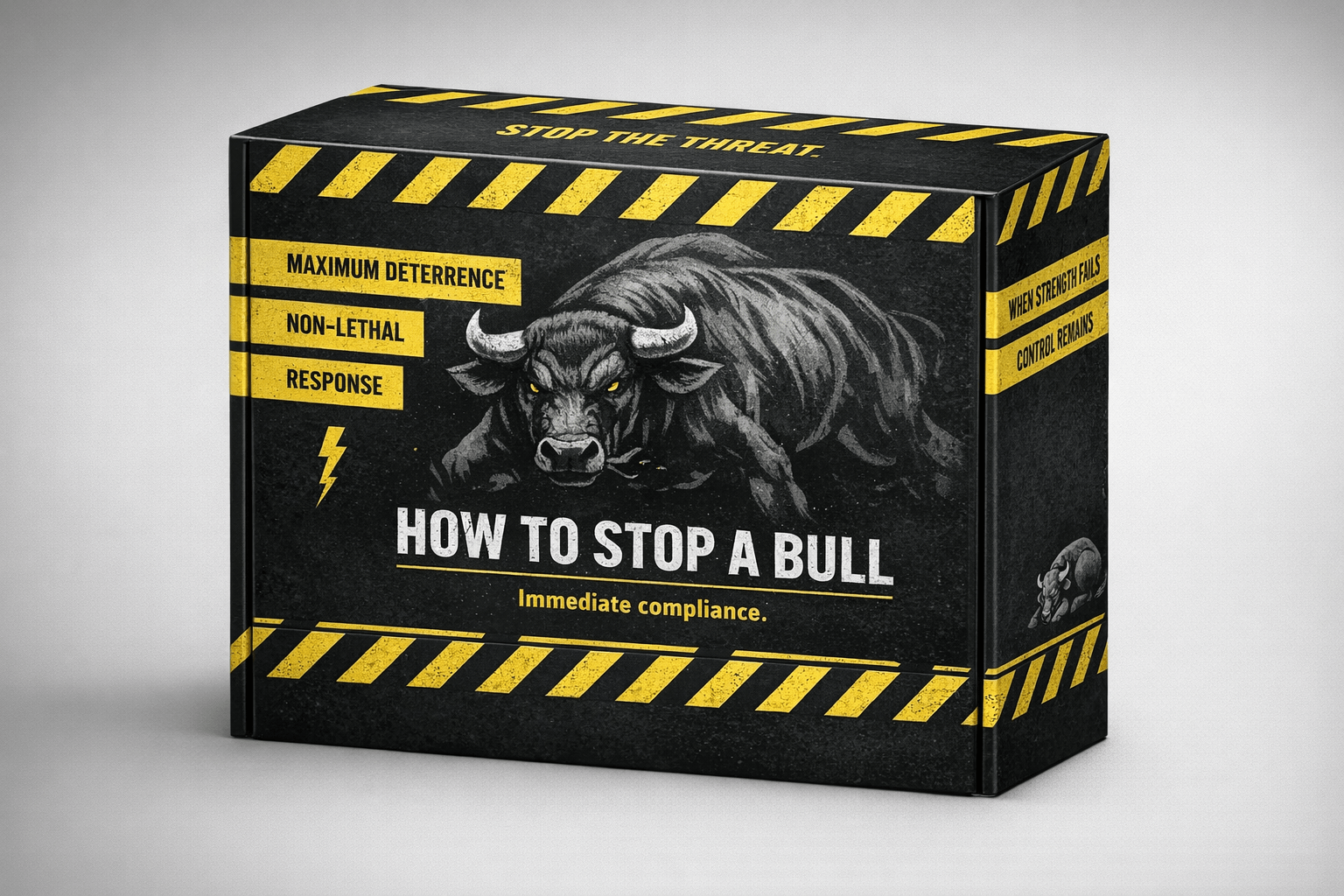
With Grieg’s Solveig’s Song murmuring in the room like a memory that refused to settle, I regarded the object on my desk as one might regard a moral problem rather than a tool. Its yellow-and-black casing had the crude confidence of a warning sign, a thing that announced danger not by subtlety but by volume. It did not invite curiosity; it challenged it. The marketing bravado still echoed in my head — stop a bull — a phrase so casually obscene in its certainty that it reduced violence to a cartoon. Even the packaging had rehearsed the lie: rage on the outside, tranquillity within, as though brutality could be switched off by presentation alone.
Pickles moved beneath my chin, her tail brushing my face with deliberate intimacy. Cats have a way of interrupting abstraction with life. She was warm, alive, heedless of symbols. For a moment I wondered whether she sensed the wrongness of the thing in front of me, whether animals possess an instinct for objects whose sole purpose is domination. The thought that followed — uninvited and instantly abhorrent — stopped me cold. I dismissed it with shame. Curiosity has a habit of disguising itself as reason, but there are lines that announce themselves clearly once approached.
And yet the question remained, stripped of excuses: what does it do to a human being?

Not in theory. Not in specifications or warnings. In the flesh. In consciousness.
Schrödinger intruded, as he so often does when one is tempted to confuse knowing with imagining. Until observed, the outcome remains mercifully abstract. Pain exists only as a concept until it does not. Pickles, in her indifferent wisdom, offered me two futures with equal plausibility and no commentary.
I sat there, absurd in my running shorts, contemplating how easily language softens reality. Non-lethal. Deterrent. Compliance. Words that tidy up what they conceal. I told myself I was healthy, rational, informed. I told myself many things.
What I did not tell myself — what no brochure ever tells you — is what happens when the body’s private contract with itself is broken.
When it came, it was not pain in the familiar sense. There was no warning, no sharpness, no escalation. It arrived whole. A total occupation. Every nerve seemed to scream at once, not loudly but absolutely, as though the very idea of sensation had been weaponised. Thought did not race; it vanished. Language collapsed. There was no where it hurt, because the body ceased to be a collection of parts and became a single, screaming fact.
Muscles betrayed their purpose. They did not spasm; they revolted. The body folded in on itself, not to protect but to obey, as though some deeper authority had seized control and issued a single command: cease. Breath was no longer an action but an obstacle. Time fragmented. A second stretched into an eternity dense with terror, because terror was all that remained.
There was no dignity in it. No heroism. No lesson beyond the most primitive one: this thing does not persuade, it overrides. It does not warn, it annihilates. The mind, so fond of metaphors and music and philosophy, is reduced to a silent witness while the body is informed — with brutal clarity — that it is no longer sovereign.
When it ended, the silence was worse. Not relief, but aftermath. A trembling void where confidence had been. The knowledge that something had reached inside and demonstrated, beyond argument, how easily the human animal can be switched off.
If this reads like curiosity, let it not. It is a caution written in retrospect. Some questions do not reward answers. Some doors, once opened, do not leave you unchanged. And some devices exist not to be understood, but to be refused — on the simple, hard-won principle that anything capable of unmaking you so completely has no business being tested for interest, amusement, or proof.
 Verbal Alchemy