

By Martyn Walker
19 May 2025
Diplomacy, once the art of compromise and caution, now risks becoming just another line item on a spreadsheet.
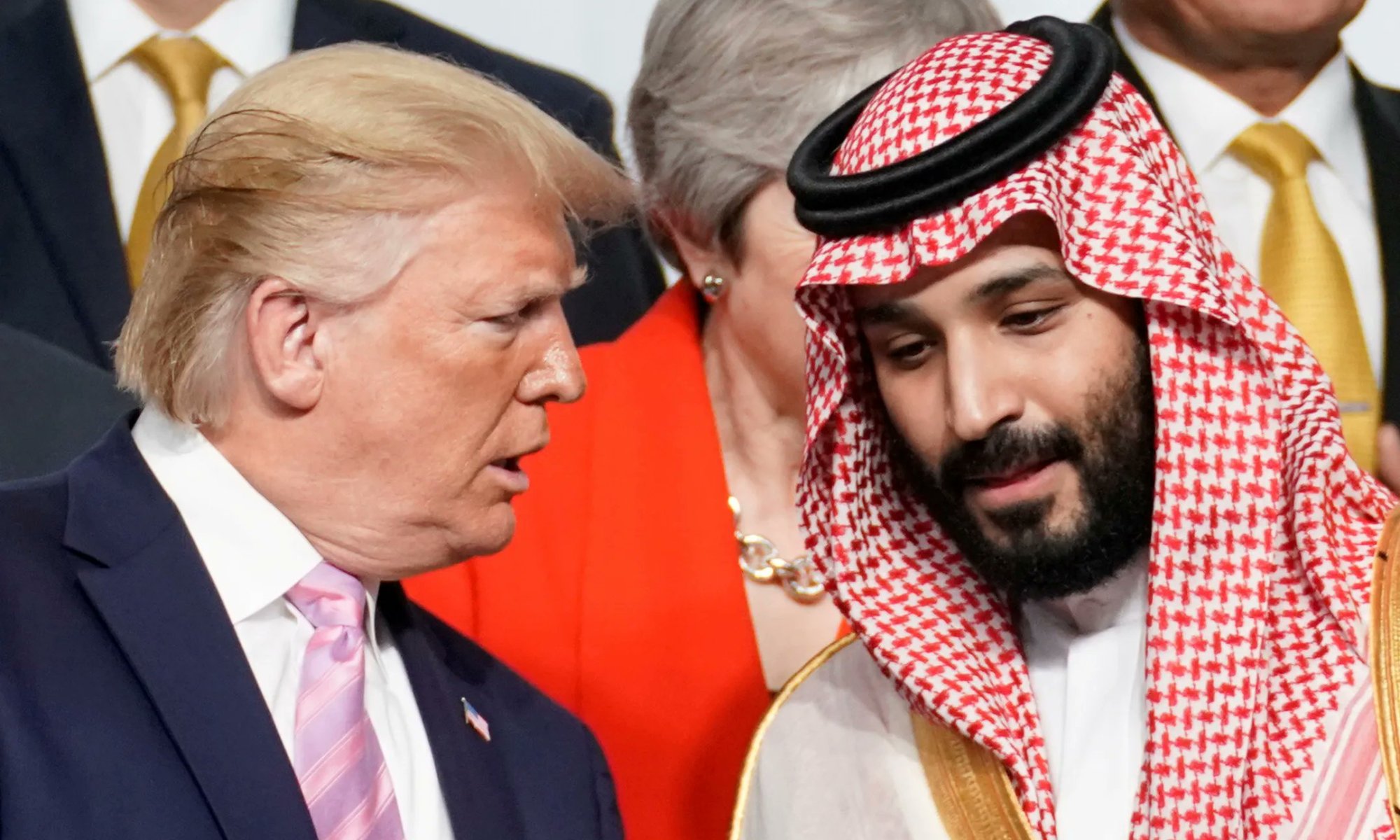
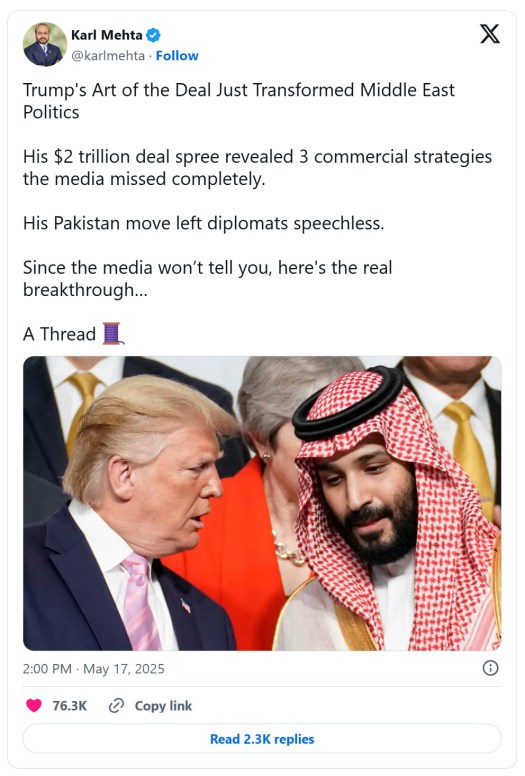
This month, Karl Mehta laid out a startling thesis: former President Donald Trump is reshaping global politics—not through ideology, defence pacts or values—but through deals. Big ones. His thread on X unpacks what he calls “Commercial Diplomacy”: a bold, borderline cynical foreign policy doctrine in which profit trumps principle, and where Boeing, Blackstone, and Howard Lutnick have more sway than the State Department ever did.
The numbers are staggering. Saudi Arabia: $600 billion. Qatar: $243 billion. UAE: $1.4 trillion. Pakistan, not to be outdone, has offered Trump a zero-tariff agreement—despite hosting 15 U.S.-designated terrorist organisations. Even Syria got a pardon of sorts, with all sanctions lifted after a handshake with its new president—himself a former Al Qaeda commander—brokered not by a diplomat, but by Crown Prince Mohammed bin Salman.
And yet, this isn’t chaos. It’s commerce.
Trump’s model doesn’t attempt to shape the world through diplomacy. It simply pays it off, then rents the influence. It’s foreign policy by acquisition, not negotiation. No grand speeches. Just signatures on multi-billion-dollar contracts, often with the very regimes traditional diplomacy was meant to contain or reform.
So where does that leave the UK?
Britain: Value-Driven or Value-Discounted?
For decades, Britain’s foreign policy has clung to moralism like a life-raft—promoting democracy, human rights, transparency, and soft power. But in this new world order, soft power looks decidedly limp. When the Americans roll into Riyadh with fighter jets, AI labs, and energy infrastructure on the table, a politely worded communiqué from the FCDO simply doesn’t compete.
Worse still, Britain’s diplomatic machinery is designed to operate through institutions—NATO, the UN, the Commonwealth. Trump’s approach bypasses all of these. His preference is the side door, the backchannel, the golf course—where a handshake matters more than protocol and a Boeing order matters more than a NATO summit.
If this becomes the dominant diplomatic model—and there are signs that even China is responding to it—then Britain faces an unpalatable truth:
A nation that trades on its moral high ground will soon find itself outbid.
Opportunity… or Isolation?
To be clear, this doesn’t have to spell decline. Britain could adapt its commercial instincts to the diplomatic arena, building strategic economic packages that align with its values without surrendering them entirely. That means giving the Department for Business and Trade the same global remit as the Foreign Office. It means getting British businesses a seat at the diplomatic table—and giving diplomats a crash course in deal-making.
But we must move fast.
The Middle East is being redrawn, not by war or revolution, but by contracts. Whoever controls the infrastructure, the energy corridors, the AI data centres, and the ports will command influence for decades. If British firms aren’t part of this transformation, then British foreign policy will become commentary—not participation.
The India-Pakistan Trap
There’s another risk. Trump’s eagerness to deal with Pakistan, despite its terror links, threatens to strain Western alliances with India—just as Britain tries to deepen its own Indo-Pacific strategy. Can we afford to take a moral stand against Islamabad while Washington undercuts us with duty-free access?
Once again, commercial diplomacy doesn’t care about appearances. It rewards utility, not loyalty.
Closing Thoughts
What Karl Mehta revealed wasn’t just a set of contracts. It was a warning. The world is moving fast—and money, not manners, is determining the pace.
Britain now faces a choice.
Either embrace commercial diplomacy, with all the uncomfortable compromises it entails—or become the well-spoken relic of a world that no longer exists.
Because in this new era, diplomacy is no longer what you say.
It’s what you bring to the table—and what you’re willing to sign.
Karl Mehta’s Original Post
 Verbal Alchemy