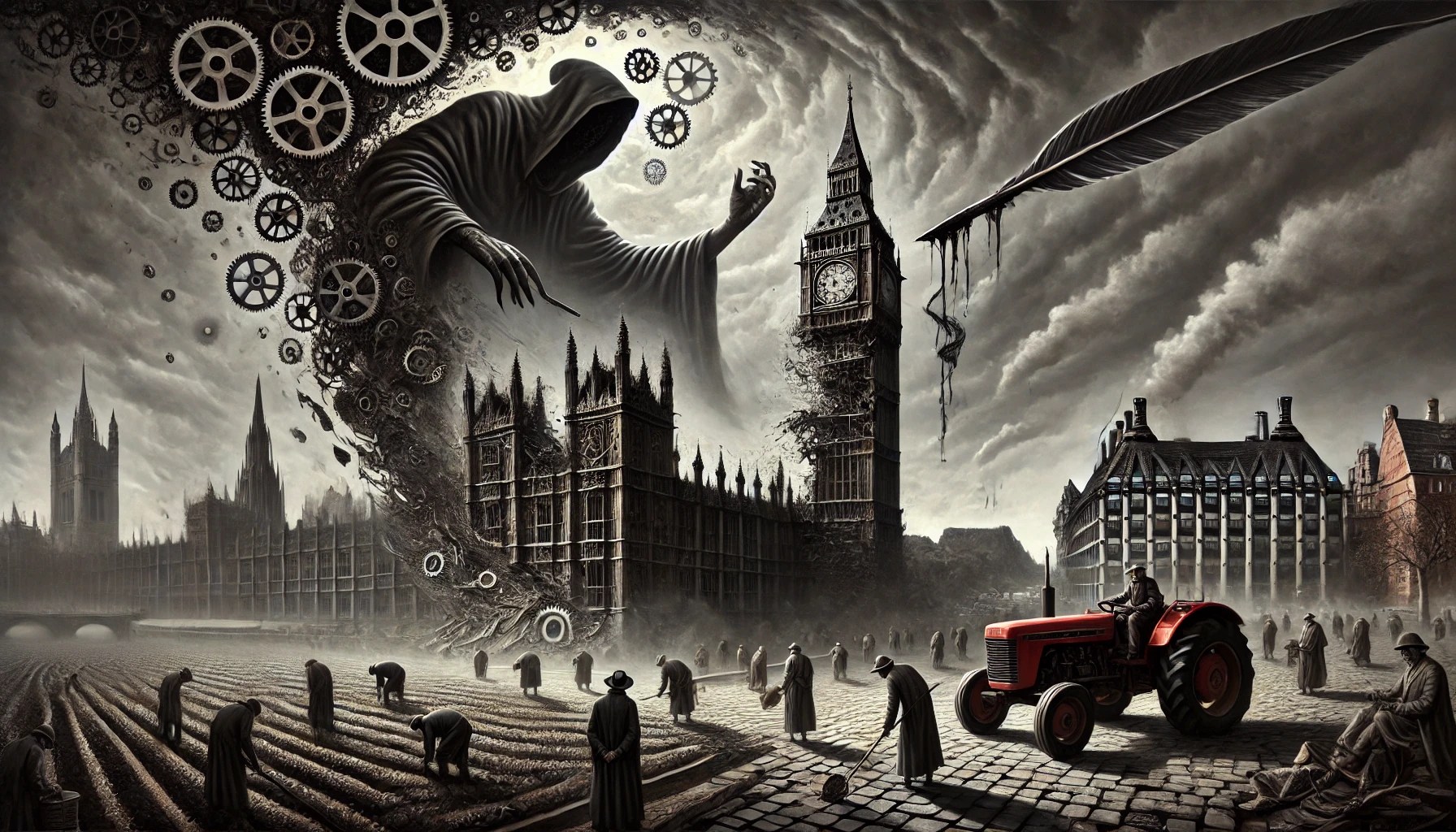

He slowly crafts words like spells—poetry and politics his dual obsessions. He navigates backroom deals with the same finesse as crafting a verse, leaving both friends and enemies ensnared. What drives him? Is it the power of language or the language of power? Step closer, but be prepared—He’s unpredictable.
They rose to the helm with bravado and cheer, But it seems that the circus has settled in here. With promises flashy, bold on the tongue, Now look at the mess where they’ve left us all hung.
Winter winds howling, fuel bills to soar, They said they’d provide, but there’s ice at our door. And freebies for Labour in a scandalous sprawl, Yet the clowns couldn’t juggle or balance at all.
“Smash up the gangs!” they declared with glee, Only for Rwanda to slip out to sea. Immigration’s a show of mayhem and fright, With no end in sight, just a botched border fight.
Israel left out in the cold, they abstained, Banning arms that defenders proclaimed. Pensioners pummelled, the poor set adrift, While jobs disappear like a magician’s swift lift.
Farmers now groan under tax-heavy loads, Food security crumbling, the last of the toads. And off to Chagos, they’ve ceded with flair, While Chaonians stare in absolute despair.
They’ve failed to deliver on every vow, From strikes to crime, it’s a farce somehow. They end disputes with billions thrown wide, Yet who foots the bill for this payout ride?
Prisoners freed early, a hasty retreat, While reoffenders march back to the beat. Their words in a muddle, their stance unclear, With CPS pressured, we’re left with fear.
Two-tier policing, the cries ring loud, But hold up a sign, and they’ll quiet the crowd. Send in the clowns, for there’s much to amend, The circus has started, and where will it end?
This story opens on Mars, in the bustling, crimson-toned campus of the Intergalactic University in Musk City. Amid the towering glass domes and mineral-blue walkways, Zara Novak and Atlas Chen meet by chance—or what they perceive to be chance. It’s orientation day, and the two new students, each a prodigy in their field, eye each other warily across the crowded hall. Zara, a quantum physicist renowned for her work on dark matter manipulation, is all sharp edges and restless energy. Atlas, the calm, grounded terraforming expert, has an ease and warmth about him, as if rooted to the soil he dreams of cultivating on distant planets.
As the days progress, Zara and Atlas find themselves repeatedly crossing paths, their studies and ambitions often at odds. Zara’s fascination with dark matter and its potential applications to safe space travel strikes Atlas as too removed from the immediate, practical concerns of terraforming and making alien worlds habitable. Meanwhile, Atlas’s focus on the biology and chemistry of soil feels, to Zara, charmingly provincial. Yet, as their debates turn into long, thought-provoking discussions under the Martian sky, they begin to see a synergy in their work: her dark matter technology could protect his fragile ecosystems from the lethal cosmic forces, while his expertise in creating habitable spaces makes her dream of safe, sustainable space travel all the more feasible.
It’s during a late-night research session in the lab that they make a discovery—an anomaly in their observations that defies all known principles of consciousness. Zara’s dark matter detectors, designed to track minute disturbances, register a faint yet unmistakable signature, a kind of imprint or “life echo,” that clings to certain organic and inorganic materials on Mars. Meanwhile, Atlas’s soil samples seem to respond in ways that cannot be explained by simple chemical reactions; it’s as if they retain a memory, a latent essence of life from a different form.
Curious and unsettled, they pursue this anomaly, each applying their own unique perspective. They begin to suspect that the essence of life doesn’t disappear upon death but instead disperses, lingering within the fabric of existence itself, perhaps bound to planets and stars, rocks and soil. Their data leads them to a stunning revelation: this “life energy” follows a cycle. Upon death, one’s consciousness is released, not into a spiritual afterlife but into the universe, where it may eventually become a part of a new life, a new being. It’s a cold, logical cycle, devoid of any guiding deity or mystical intent—a natural phenomenon, no less extraordinary for its lack of divine origin.
Zara is struck by the irony; humans had spent centuries searching for life in the stars, yet had failed to understand the life that surrounded them, that even permeated the ground beneath their feet. Her scientific mind reels as she contemplates the implications. This discovery suggests that life, rather than being unique to each being, is more like a shared resource, a vast ocean in which every conscious mind is but a fleeting ripple.
Atlas, for his part, experiences a deep, almost instinctual understanding of the cycle. It makes sense, he thinks, why certain plants would thrive in soil where life had once been abundant or why he could coax growth from the most barren of rocks. It’s as though life, in its purest form, was meant to be spread, to be shared across planets and galaxies. He finds a quiet contentment in this notion, a fulfilment of his purpose. Zara and he were, in a sense, more than just scientists; they were gardeners of the cosmos, stewards of life’s expansion across the stars.
Their theories grow more radical as they realise that their own meeting, too, was part of this cycle. Memories bubble up unbidden—fragments of shared experiences, moments of love and companionship from a life neither of them should remember. They had been together before, on Earth, where they had built a life filled with love and respect, until they both grew old and died, naturally and peacefully. Yet here they were, together again, pulled to this distant world by the lingering resonance of their past selves.
With this understanding, they form a pact, a plan that binds them not only in this life but in the cycles to come. They will dedicate their lives—and all the lives they are yet to live—to spreading life across the universe. They become driven by a vision of humanity as caretakers of existence, tasked not with conquest or dominion, but with nurturing every corner of the cosmos, from desolate moons to distant exoplanets, with life in all its myriad forms.
Years pass, and Musk City expands. Thanks to Zara’s dark matter technology, which shields human settlements from the worst of cosmic radiation, and Atlas’s atmospheric chambers that bring Martian soil to life, humanity takes its first true steps towards establishing a sustainable presence beyond Earth. Colonists arrive in droves, and plants from Atlas’s rare seed collection begin to flourish, covering patches of Martian soil with green, a vibrant signal of life’s foothold on an alien world.
On their final night together, Zara and Atlas sit side by side, watching the sunset over the Martian horizon. They have grown old again, each line on their faces a testament to the countless lives they have touched. Zara’s gaze drifts from the fiery sky to the green patch of soil they have nurtured, and she knows this is merely the beginning. They don’t need to speak; they both understand that when the time comes, their essence will flow back into the universe, to be reborn and to continue the work they have begun.
As the sun dips below the horizon, casting a final, scarlet glow, Zara reaches out, her hand clasping Atlas’s in a gesture as old as time. Together, they close their eyes, knowing that, one day, they will meet again. For life is not a single, fleeting journey, but an endless dance across the cosmos, and they, like all of humanity, are destined to play their part.
How bold a sum that Moscow seeks to claim, A sum beyond the worth of all the earth— $20 decillion, no reason or aim, A figure mocking reason’s humble birth.
Not all the wealth that nations might amass, Nor treasures stored within the deepest sea, Could satisfy this sum of zeros vast, A dream, a whim, a daft hyperbole.
Though Google’s power spans the digital age, Its market worth a modest trillion two, This claim, this charge, this legal, frantic rage, Soars higher than the courts could e’er construe.
For logic bends, and Moscow’s aims grow strange, In chasing shadows, numbers out of range.
So yesterday Tommy Robinson was sentenced by Mr Justice Johnson to eighteen months for “contempt of court”. If you don’t have contempt for English courts, you’re not paying attention.
As budget time nears on the scene, Defining “a worker” gets lean, A chin that does move, To “worker” they prove, While jaw droppers turn far-right, unseen.
The debt here in Blighty’s a towering mass, One hundred percent of our income—alas! Yet rumour has it, a budget’s in store, To raise fifty billion, or maybe some more.
They’ve vowed not to squeeze worker pay anymore, But where from, then, will they unlock the door? Raise employer tax? Now that’s rather risky, The exodus is making our outlook more misty.
For scaring off business is hardly the way, When we need foreign capital to come here and stay. Up National Insurance? Oh, what a mess— The staff, the rewards, will all shrink for less.
Then they eye the investors, but here’s the hitch: Cash slips overseas with nary a glitch. How they’ll seize that loot’s yet to be known— A game of chicken, for their geese have flown.
“Pensioners have savings,” they cunningly say, “Though taxed once before, let’s raid them anyway.” And capital gains? That’s ripe for the pick, Yet killing off growth quite a looney trick.
They redefine ‘worker’ with mind-bending spins, Counting only the folks who do tasks with their chins. So ministers playing their money-up games— Aren’t they the ‘non-workers’ of fanciful claims?
Well, I’ve a suggestion, a wise, simple plan— It’s one I’ve imparted to daughter and man: Spend less than you earn, let prudence remain, And see if the government try the same!
I’m the leader of a grand, ancient nation, With wisdom carved deep in civilisation. We’ve pondered life’s purpose, the stars, and our fate, But my government’s got a new urge they can’t sate.
They’re keen on a squabble with foes far away, With tech so advanced they don’t need to delay. This small distant land, with weapons refined, Could zap us all out at the drop of a line.
For they’ve got missiles with magical flair, That find me wherever, yes, anywhere. It’s futile to duck or dive or scoot, This missile’s locked onto my very boot.
So here I sit, all anxious and grey, As my government taunts them day by day. I plead and I beg, “Can’t we call this a truce?” But they’re grinning like cats let loose on the goose.
Then word arrives with a rumbling roar, My adversary’s launched their debating war! A missile en route, aimed straight at my head, With a blast range wide enough to leave us all dead.
Now here’s my grand choice, with little reprieve: Run to the desert or just never leave. I could flee alone, let my legacy burn, Or march to the palace, and take them in turn.
So I’m off to the halls where policies brew, To sit with the lot who’ve landed me through— If I’m going down, then down we’ll all go, In the ultimate lesson: “I told you so.”
There stands a voice, alone, unseen, With wisdom bright, though cloaked in dream, A whisper lost in crowded air, Yet holding truth, beyond despair.
The quiet call for what is right, Drowns beneath the blinding light, Of those who sell the empty creed, Who shout with power, plant the seed.
The bus-side boasts, the posters bold, With lies of futures bought and sold, To sway the crowd, to blur the view, The wealth amassed by just a few.
The pensioners, the frail, the meek, Who find their fight but cannot speak, Their struggles lost in silvered halls, Where silence echoes in the walls.
Yet lone, a voice, begins to rise, In eyes once blind, it sparks, it flies, For freedom lives where speech remains, Where questions linger, where thought refrains.
Not all who challenge seek to harm, Nor stir the violent, nor cause alarm, But dare to ask, and dare to learn, In whispered fires, the truth may burn.
The masses find, in humble sound, A strength once small, now spreading round, As voices joined, the power grows, A movement born from silent throes.
Yet still the gatekeepers deny, Their golden pens still write the sky, And mute the words that dare to say, “Perhaps we’ve strayed, there’s a better way.”
But freedom’s voice is hard to bind, And truth will rise, though cruelly mined, For strongest is the one who stands, Alone, yet firm with outstretched hands.
No evil wears a single face, It hides in wealth, it shifts with grace, It moves the masses, paints the wall, But cannot crush the voice of all.
So speak, though few may hear your call, For every truth, though small, stands tall.
When a government prioritises large-scale investments that lack public support, the consequences can be profound, affecting everything from economic stability to the well-being of its citizens. This essay explores the broader implications of a government persisting with controversial projects that a majority of the public disapproves of, even if these initiatives are justified by officials as necessary for long-term national development. In this scenario, we imagine successive governments backing high-cost infrastructure or development schemes that the public sees as misaligned with their needs and priorities. As dissatisfaction grows, the government finds itself with a rising disapproval rating, eventually reaching a critical point where its decisions are perceived as both wasteful and emblematic of cronyism.
Public Trust and the Social Contract
At the heart of any democratic system lies the social contract, an implicit agreement between the government and its people. This contract is predicated on the understanding that elected officials will act in the public’s best interest and be good stewards of taxpayer resources. However, when a government continues to invest in projects that the majority of citizens see as unnecessary or even self-serving, it risks breaking this contract. The public may begin to view such investments as symbolic gestures, designed more to elevate the government’s prestige than to address real societal needs.
The erosion of trust in such cases can be significant. A government that fails to act in line with public sentiment fosters disillusionment among its citizens. People may become disengaged from political processes, believing that their voices no longer matter. This disconnect can lead to a dangerous decline in voter participation and civic involvement, further undermining the democratic system.
Economic Misallocation and its Consequences
A government’s investment choices have a direct impact on the nation’s economic well-being. When public funds are directed toward initiatives that lack popular support, this often represents a misallocation of resources. Imagine a government allocating billions to infrastructure projects designed to showcase technological prowess or national ambition, while basic services such as healthcare, education, and public transport systems languish.
Such misallocation of capital can have immediate and long-term economic consequences. In the short term, taxpayer money is tied up in projects that do not yield tangible benefits for the majority of the population. In the long term, these investments can result in higher taxation to fund ongoing or incomplete projects, leaving less financial flexibility for essential services. As the public witnesses continued spending on initiatives they see as irrelevant, their willingness to contribute to the tax base or engage with public initiatives diminishes, weakening the overall economy.
Moreover, when government projects are perceived as wasteful or corrupt, this reduces consumer and investor confidence. Businesses may hesitate to invest in an economy where public money is being funneled into vanity projects rather than addressing structural issues like productivity, innovation, or public welfare. This hesitancy stifles economic growth and further undermines the nation’s financial health.
Social and Mental Health Implications
Public discontent over government spending has a cascading effect on mental and social well-being. Large-scale, high-cost projects that the public views as unnecessary can contribute to societal alienation and chronic stress. When citizens perceive that their government is ignoring their needs, they can feel disenfranchised, powerless, and isolated from decision-making processes.
This discontent, if widespread, can translate into real health impacts. Chronic stress, fuelled by feelings of neglect and lack of agency, is linked to a range of physical and mental health problems, from anxiety and depression to heart disease. In a society where public investment is seen as serving elite interests rather than the common good, these stress-related health problems could become more prevalent, placing an additional burden on already strained healthcare systems.
Moreover, when governments persist in funding controversial projects at the expense of essential services, this can lead to increased social inequality. Marginalised communities are often the most reliant on public services, and if those services are deprioritised in favour of grandiose projects, these groups suffer disproportionately. This can lead to greater social unrest, further fuelling dissatisfaction and divisions within society.
National Happiness and Social Cohesion
Happiness is not solely a product of material wealth but also of how citizens perceive their place within society and their relationship with their government. When a government embarks on investments that the majority of the public deems unnecessary, it diminishes a collective sense of belonging and fairness. Citizens feel that the government is disconnected from their daily lives and concerns, and this disconnection erodes national well-being.
Research into happiness economics consistently shows that trust in institutions is a key determinant of a nation’s overall sense of happiness and satisfaction. When successive governments make decisions that disregard public opinion, this trust erodes, and with it, the nation’s collective happiness. People become less optimistic about the future, less willing to contribute to societal progress, and less engaged in their communities.
Political Instability and Long-Term Risks
Moreover, when public funds are directed toward controversial projects that do not directly improve citizens’ lives, people begin to perceive their government as inefficient and out of touch. This perception further drives societal fragmentation, as different groups feel they are being unfairly impacted by these decisions, whether through higher taxes, inadequate services, or environmental degradation.
When governments repeatedly ignore public opinion in their investment choices, it leads to political instability. In democratic systems, this often manifests as reactionary voting, where citizens cast their ballots not based on ideological alignment but as a protest against the status quo. This can lead to a rise in populist or fringe political movements that promise radical change, often at the expense of long-term stability and governance quality.
In extreme cases, prolonged public dissatisfaction with government investment decisions can result in large-scale civil unrest or the rise of anti-democratic movements. Citizens who feel that their concerns are systematically ignored may turn to more extreme means of expressing their discontent, from widespread protests to disruptive strikes or even violent demonstrations.
Additionally, the government’s reputation on the global stage may suffer. Other nations and international investors will be wary of engaging with a country where domestic politics are unstable, and the government is perceived as out of touch with its people. This can have lasting consequences for trade, investment, and international relations, further undermining economic prospects and global standing.
Conclusion
When governments pursue investments that the public overwhelmingly disapproves of, they risk far more than the financial cost of the projects themselves. The breakdown of trust between the government and its citizens can lead to widespread social and economic consequences, from political disengagement and economic decline to deteriorating public health and reduced national happiness. For governments to maintain the delicate balance of democratic governance, they must ensure that their investments reflect the needs, values, and aspirations of the majority, rather than indulging in projects that serve only a few or are seen as mere symbols of power. Otherwise, the long-term damage to the nation’s social fabric, political stability, and economic health could be profound and difficult to reverse.
A Comparison of Ancient Civilisation Legacies with Modern Nuclear Waste
Throughout history, civilisations have left behind artefacts that shape our understanding of their cultures, values, and technological prowess. The Egyptians, Greeks, Romans, and other ancient societies are remembered for their monumental achievements, which have stood the test of time and continue to inspire modern architects, engineers, and artists. Their legacy is one of beauty, ingenuity, and a deep connection to both human creativity and the natural world.
In contrast, our modern industrial society seems poised to leave behind a far more contentious legacy: nuclear waste. Entombed in concrete and buried in the sea or deep underground, this material reflects the technological ambitions and energy consumption patterns of our age, as well as the hazardous by-products of our quest for power. This essay will compare the legacies of ancient civilisations—characterised by awe-inspiring art and architecture—with the nuclear waste legacy of modern times, exploring the cultural, technological, and philosophical differences that underpin these divergent imprints on history.
The Legacies of Ancient Civilisations
One of the most enduring qualities of ancient civilisations is their ability to blend utility with beauty. The Egyptians, for instance, constructed the pyramids—massive structures that not only served as tombs for their pharaohs but also symbolised their beliefs in the afterlife and their understanding of geometry and astronomy. The sheer scale and precision of these monuments, built with relatively primitive tools, continue to astound us. They reflect a civilisation that placed immense value on both religious meaning and architectural grandeur.
Similarly, the Romans left us aqueducts, roads, and public baths—pieces of infrastructure that were as functional as they were elegant. Roman architecture, with its use of arches, domes, and columns, served both practical needs and aesthetic ideals. Their innovation of central heating systems (hypocausts) in public buildings and private villas, alongside intricate mosaics and frescoes, demonstrated a balance between comfort, technology, and beauty.
These ancient works of art and engineering not only fulfilled immediate needs—whether religious, domestic, or infrastructural—but were also created with an eye to endurance. The intention was for them to outlast the builders and serve as a testament to the civilisation’s ingenuity. Today, these structures inspire admiration, reminding us of human creativity, ambition, and our capacity to live in harmony with our surroundings.
The Modern Legacy: Nuclear Waste
Fast-forward to the 20th and 21st centuries, and the legacy of modern civilisation seems far less inspiring. The advent of nuclear power, while promising an almost limitless source of energy, brought with it a burden that humanity is yet to fully comprehend: nuclear waste. According to the article from The Telegraph, the UK alone is expected to spend £132 billion over the next 120 years to manage its stockpile of radioactive material, much of which will be entombed in concrete or buried beneath the sea.
Unlike the pyramids or Roman aqueducts, nuclear waste is not a symbol of beauty or cultural achievement. It is, instead, a reminder of the darker side of modern technological progress—the side that prioritises short-term gains without fully accounting for the long-term consequences. While nuclear energy has brought cleaner air in terms of reduced carbon emissions, the toxic by-products will remain hazardous for tens of thousands of years. Unlike the monuments of ancient civilisations, these waste sites are not built to inspire future generations; they are built to be forgotten. The goal is containment, not celebration.
Cultural and Philosophical Differences
The contrast between the legacies of ancient civilisations and modern nuclear waste reveals profound differences in how each era viewed its relationship with the future and with the natural world. The ancients, while certainly not perfect custodians of their environment, saw their monumental projects as lasting contributions to human progress. The pyramids, temples, aqueducts, and amphitheatres were built to endure, with a sense of responsibility towards both the present and future generations.
In contrast, modern civilisation appears more focused on the present, often neglecting the long-term consequences of its actions. Nuclear waste, for example, represents the by-product of a technology that, while beneficial in terms of energy production, carries an enormous long-term cost. The decision to bury waste in concrete tombs or beneath the sea reflects a desire to remove the problem from immediate view rather than a commitment to safeguarding the planet for future generations.
Furthermore, the ancient civilisations built with materials and techniques that were, for the most part, in harmony with their environment. Stone, wood, and brick structures, while sometimes environmentally costly to build, do not pose the existential threat that radioactive material does. The Romans’ use of volcanic ash in concrete, for example, has proven remarkably durable and environmentally benign. In contrast, the radioactive material that modern society buries will outlast even the most durable materials, posing a hazard for millennia.
The Aesthetic and Symbolic Dimensions
Another striking difference lies in the aesthetic and symbolic dimensions of these legacies. The pyramids and the Colosseum are not only marvels of engineering but also symbols of human aspiration. They inspire awe and contemplation, prompting us to reflect on our place in history and the accomplishments of those who came before us.
Nuclear waste, by contrast, is hidden away, unmarked, and without symbolism. It is intentionally concealed, with the hope that future generations will not stumble upon it or that the dangers it poses will be mitigated. There is nothing inspiring about a nuclear waste repository; it is an invisible burden that speaks more to humanity’s hubris than to its creativity or foresight.
Conclusion
The comparison between the legacies of ancient civilisations and modern nuclear waste offers a sobering reflection on the values and priorities of different eras. While the ancient Egyptians, Greeks, and Romans built monuments that continue to captivate and inspire, modern civilisation is entombing its most dangerous creations in concrete, hoping that future generations will not have to deal with the consequences.
This contrast underscores the need for a shift in how we think about our impact on the future. Rather than leaving behind a legacy of pollution and hazardous materials, we should strive to create a world where future generations inherit structures, technologies, and systems that reflect the best of our human potential. Like the ancients, we should aim to build things that endure not only physically but also in terms of their positive contribution to the world. In doing so, we might one day leave behind something worthy of admiration, rather than a problem to be buried.