

The world’s narrow places are still there.
Britain simply stopped standing in them.
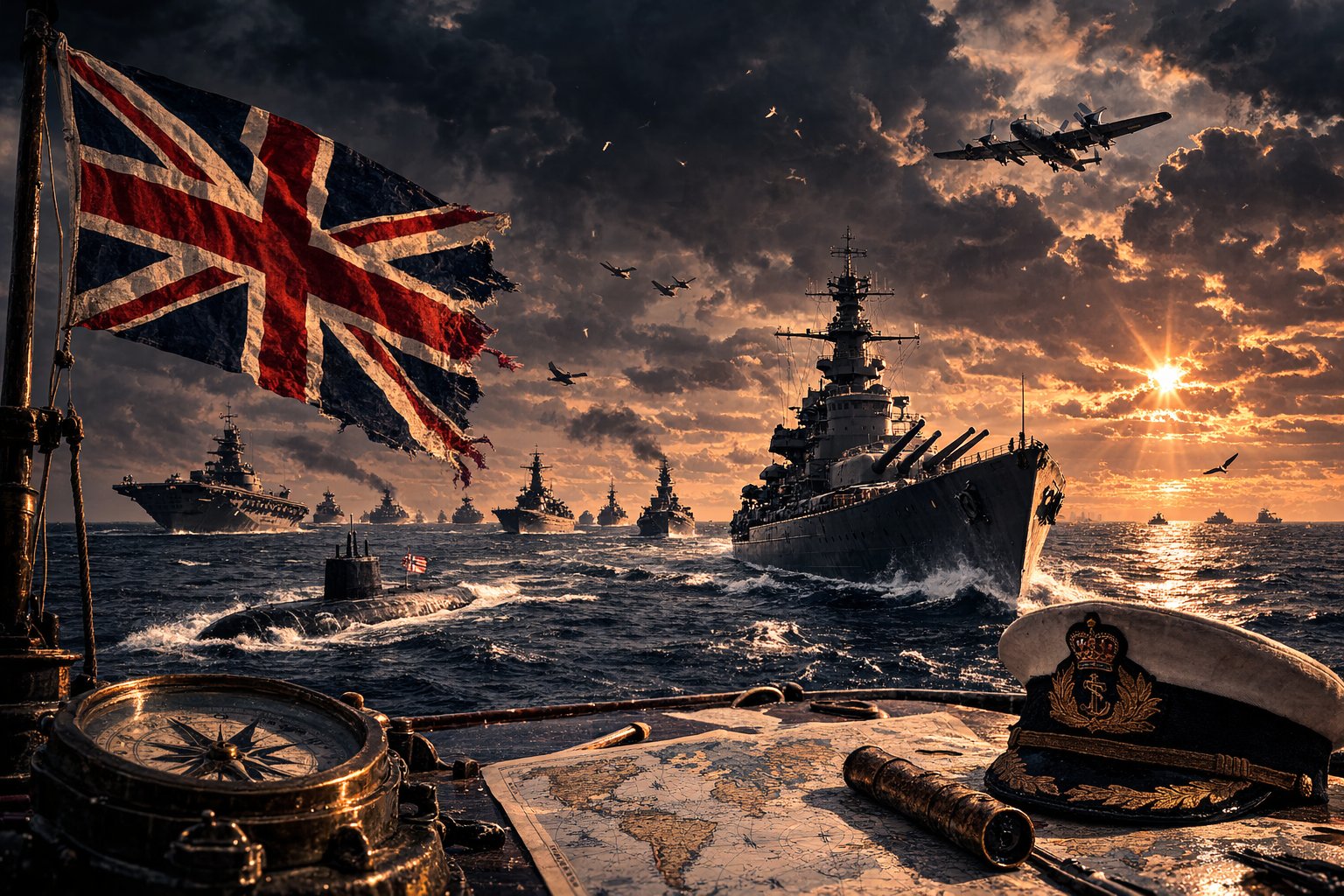
I have lived long enough to watch Britain surrender the sea without firing a shot.
I remember when the sea still answered to us.
Not in the childish way the history books tell it now, with red patches on maps and brass bands playing under tropical suns. The real power was quieter than that. It lived in harbours and ledgers, in insurance slips signed at Lloyd’s, in grey destroyers slipping through cold water before dawn. It lived in the knowledge—shared by merchants, admirals and bankers alike—that the narrow places of the world were watched.
That was the arrangement. The world traded. Britain guarded the hinges.
We did not own every port, but we knew which ones mattered. Gibraltar watched the gate to the Mediterranean. Cyprus looked over the Levant. Aden kept an eye on the mouth of the Red Sea until 1967 when we abandoned it in a hurry that still smells of defeat. Singapore and Hong Kong anchored the East. Diego Garcia — a lonely coral ring in the Indian Ocean — became the great unsinkable airfield from which American bombers could reach half the planet. Even when the empire dissolved, the structure remained. The Americans would carry the heaviest guns. We would keep the old knowledge: the cables, the shipping markets, the insurance, the bases.
The arrangement worked because each side understood its role.
Alfred Thayer Mahan, the American prophet of sea power, studied the Royal Navy like a priest studying scripture. The United States Navy was built on lessons written in British salt water. Washington spent the money, built the fleets, and fought the large wars. Britain remained the world’s maritime brain — the keeper of chokepoints, charts and commerce. London insured the cargoes. Lloyd’s underwrote the risk. If pirates, missiles or revolutions threatened a shipping lane, the Royal Navy was still expected to appear somewhere on the horizon, perhaps with American company, perhaps not. Either way, the merchant fleets of the world slept easier.
That was the quiet deal that sustained the post-war order.
And now, as I lie here with the curtain half drawn and the breath not coming quite so easily, I look back at the slow abandonment of it — the long surrender carried out by men who congratulated themselves on every retreat.
First the bases went.
Aden was given up in 1967, not after a great battle, but after a weary withdrawal that marked the end of Britain’s formal role “east of Suez”. Hong Kong was returned to China in 1997 under treaty obligations Britain could no longer enforce, though the city’s later fate should make any honest man wonder what those signatures were worth. The Falklands remain British, defended by a permanent garrison since the Argentine invasion of 1982, yet even there the Navy now fields fewer escort ships than it once kept idling in Portsmouth.
Even Diego Garcia — the great American-British bastion in the Indian Ocean — has been handed back in sovereignty to Mauritius under the 2025 agreement, though the military base itself will remain under long-term lease. The government insists the arrangement secures the base for generations. Perhaps it does. But when a nation begins surrendering territory while insisting nothing has changed, the tone tells its own story.
Then came the thinning of the fleet.
During the Cold War the Royal Navy’s task in the North Atlantic was brutally clear. Soviet submarines had to pass through the GIUK Gap — the waters between Greenland, Iceland and the United Kingdom — before reaching the Atlantic sea lanes. British frigates, submarines and maritime patrol aircraft hunted them relentlessly. It was dangerous work and quietly decisive. The shipping lifeline between America and Europe depended upon it.
Today the Royal Navy still contributes to that task through NATO, but with a fleet that numbers fewer than twenty major escort vessels. In 1982 there were roughly three times as many.
We built two aircraft carriers, HMS Queen Elizabeth and HMS Prince of Wales, handsome ships and impressive on paper. Yet carriers are not symbols; they are systems. They require escorts, supply ships, aircraft, trained crews, and a political will to deploy them. Possessing a carrier without the fleet to support it is like owning a cathedral without priests.
And the humiliations come in smaller forms too.
Gibraltar — British since 1713 and besieged repeatedly by Spain — now exists within a delicate arrangement whereby Spanish officers will conduct Schengen border checks at its port and airport under a new UK-EU framework. Ministers assure us that sovereignty is untouched. Perhaps so. But one suspects the old garrison commanders of Gibraltar would stare rather hard at that arrangement.
Meanwhile London debates whether China should be permitted to construct its largest embassy in Europe at Royal Mint Court beside the Tower of London. Members of Parliament have raised concerns about proximity to sensitive communications infrastructure and the potential intelligence implications. Yet the argument drifts on through planning committees and consultations, as though the capital of a strategic ally were merely deciding the height of a garden wall.
Once we understood that cables, data, finance and naval power were parts of the same nervous system.
Now we discuss them as though they belonged to separate universes.
Even Lloyd’s — the old citadel of maritime risk — now finds itself cancelling or repricing war-risk cover in places where the Royal Navy once helped maintain confidence. Insurance has always depended upon force somewhere in the background. Without credible security, underwriting becomes guesswork.
And then there is the English Channel itself.
This narrow strip of grey water defeated Napoleon’s fleets and frustrated Hitler’s invasion plans. It was once the most heavily guarded maritime frontier on earth. Yet in recent years thousands of migrants have crossed it in inflatable boats launched from the French coast. Governments announce new schemes and patrols, and the numbers rise and fall with the seasons, but the symbolism is painful. When a nation cannot convincingly police the narrowest of its own waters, lectures about global order begin to sound hollow.
None of this occurred overnight.
That is the cruelest part.
Empires sometimes fall in fire and cannon. Britain declined politely, with policy papers and conferences. Each surrender was explained as realism. Each retreat was framed as progress. Each reduction in power was described as “modernisation”.
And those who questioned the process were told they were nostalgic men clinging to ghosts.
Perhaps we were.
But ghosts are what remain when memory outlives courage.
The Americans still try to hold the system together, though even they are tiring of it. They built the fleets and wrote the cheques because the arrangement once made sense. Britain guarded the gateways of the old world — the straits, the insurance markets, the cables — while Washington carried the heavier military burden. Together the structure kept global trade moving.
Now the chokepoints falter one by one, and the world looks to Washington to fix problems that once belonged partly to London.
And Britain?
Britain drafts climate frameworks for shipping at the International Maritime Organization, debates planning permission for foreign embassies beside strategic infrastructure, and congratulates itself on moral leadership while the old machinery rusts.
Perhaps the country still believes it has outgrown the rough duties of power.
But trade still moves through straits. Tankers still pass through Hormuz. Submarines still patrol the North Atlantic. Insurance still depends on force somewhere over the horizon.
The world did not change.
Britain did.
And as I lie here, watching the evening creep slowly across the room, I find that the saddest thought is not that Britain became smaller.
All nations grow smaller in the end.
The tragedy is that we surrendered the habits of seriousness long before we surrendered the means.
We had the ships.
We had the ports.
We had the credit.
We had the knowledge of how the world’s narrow places held the great machine of trade together.
And we let it slip away — strait by strait, base by base — while telling ourselves we were becoming wiser.
History, I suspect, will judge that differently.
But by then, of course, we shall all be safely dead.
Related Articles
The Makers and the Takers – My first series of letters from a nation in decline.
The Bonfire of Ownership – The slow dismantling of the institutions that once made Britain serious.
Nations do not lose power in a single dramatic collapse. More often it erodes quietly through the slow dismantling of the institutions that once made Britain serious.
The Illusion of Choice – The habit of replacing capability with regulation.
Discover more from Verbal Alchemy
Subscribe to get the latest posts sent to your email.
 Verbal Alchemy