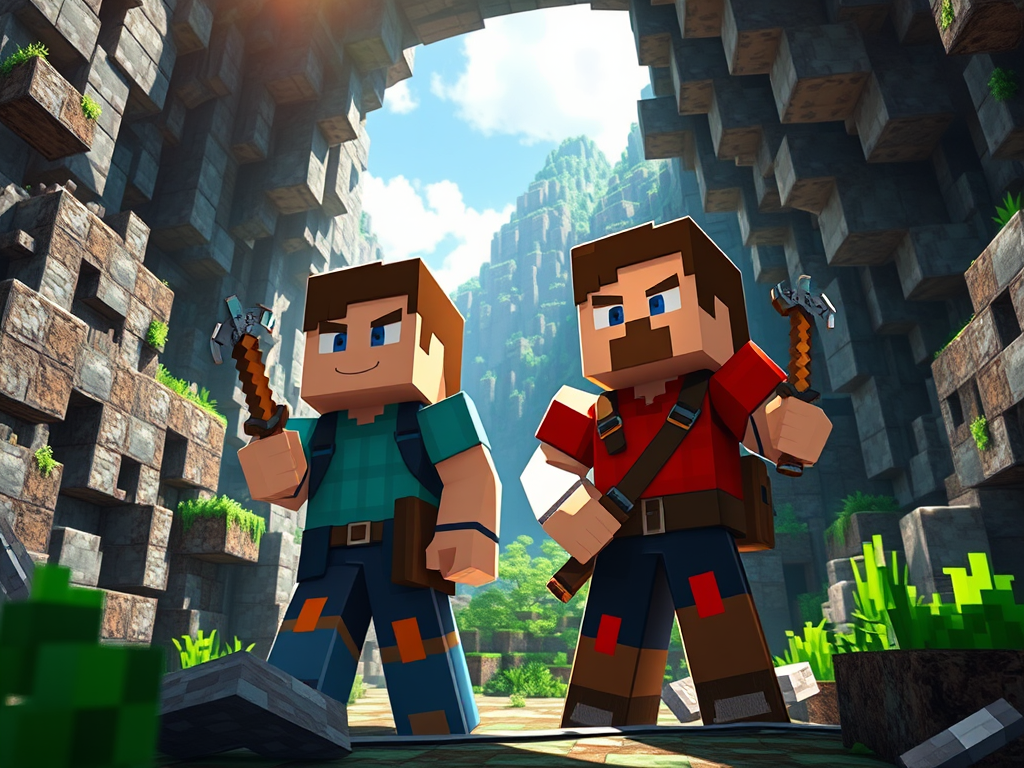

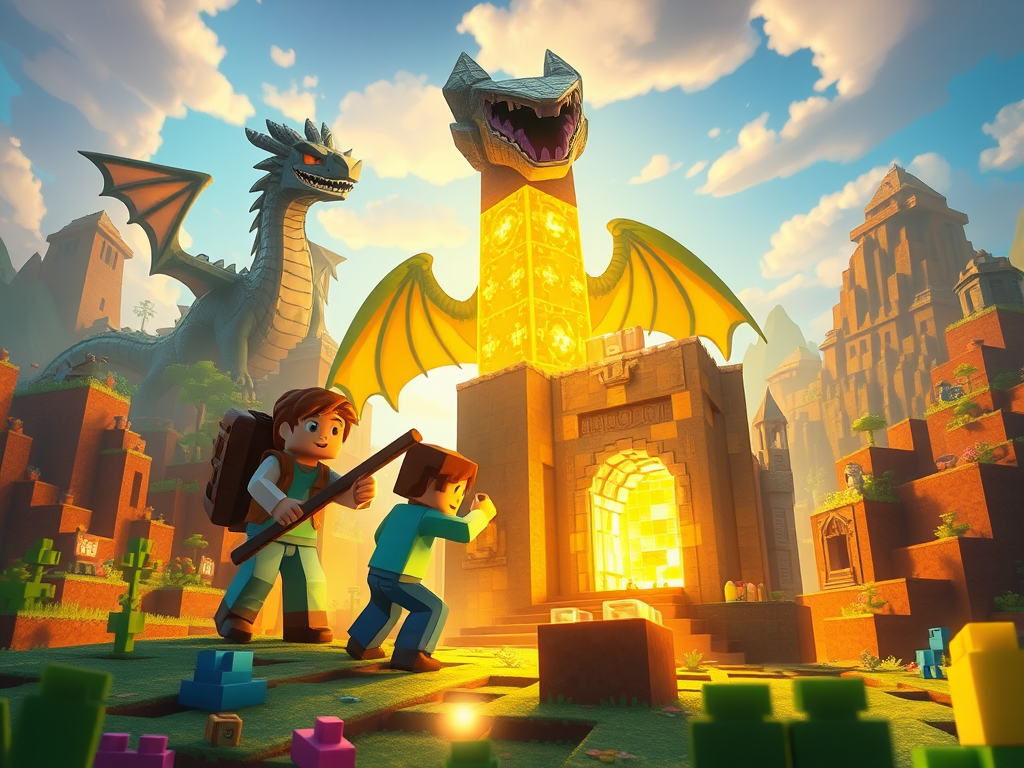
Steve and Alex – Builders of the World

A Minecraft Story for 6-8 year olds


The Ender Dragon’s Secret

The End portal was already awake.

“That shouldn’t happen,” Alex said.

They stepped through.

The End was quiet. The dragon circled high above, not attacking. Watching.

At the centre of the island, beneath cracked End Stone, they found an ancient lock — a stabiliser holding the world together.

The dragon landed between them and the structure. Not as an enemy. As a guardian.

The dragon blocks Alex and Steve's way

Steve put his sword away. Alex did the same.

They spoke the words together, gently.

“Block by block.
Stone and wood.
Build it straight.
Build it good.”

The structure opened. They repaired it.

The cracks sealed. The End steadied.

The dragon bowed.

Some things, Steve realised, don’t need defeating.


Chris’s Story — The Frozen Builders

The village in the snow wasn’t broken.

It was paused.

Ice covered doors and wells, but nothing was damaged. Beneath the village, Steve and Alex found a cooling engine that had done its job too well.

“We don’t need to smash it,” Alex whispered.

Image of the village covered in ice

They worked gently, one block at a time.

“Block by block.”
“Stone and wood.”
“Build it straight.”
“Build it good.”

The ice softened. The village woke quietly.

Steve thought of Chris — patient, careful, knowing when to stop.

Snow fell softly, just as it should.


Chris stands in front of the dragon

Jonathan’s Story — The Jungle That Builds Back

The jungle copied everything.

Towers. Bridges. Clever tricks.

Each time Steve and Alex built, the temple rebuilt it stronger.

“It’s learning,” Alex said.

They stopped trying to be clever.

One block. Then another.

“Block by block.”
“Stone and wood.”
“Build it straight.”
“Build it good.”

The jungle slowed. The path opened.

Steve smiled. Jonathan would have understood — think ahead, build wisely.


Epilogue — By the Campfire

That night, Steve and Alex sat by a campfire.

A map lay between them.
One mark in snow.
One in jungle green.

“The problems were different,” Alex said.

“But the answer wasn’t,” Steve replied.

They said the words one last time, quietly now — not a chant, just something true.

“Block by block.
Stone and wood.
Build it straight.
Build it good.”

The fire crackled.
The world rested.
And two builders slept, ready for tomorrow.

The Village That Forgot How to Build

A Minecraft Story for 6-8 year olds

Steve noticed something was wrong the moment his pickaxe snapped.

It wasn’t old. It wasn’t damaged. It had barely touched the stone before it broke clean in two.

Alex stopped and looked at her shovel. “That makes three tools today.”

They stood in a village they both knew well. The houses were still standing, the paths still tidy, but the villagers were restless. One hurried past carrying a door that was clearly too small for its doorway.

“Hrrm,” the villager muttered, turning it sideways. It still didn’t fit.

At the crafting table, Steve laid out four wooden planks. Perfectly placed.

Nothing happened.

Alex tried next. Still nothing.

The villagers gathered, whispering. One showed them a chest that wouldn’t open. Another held a hoe that bent when it touched the soil.

“We haven’t forgotten how to build,” said the village elder. “The world has forgotten how to fit.”

That night, Alex lit a torch and held it steady. The flame flickered strangely.

Steve took a breath. “If the world’s rules are loose,” he said, “then something underground is pulling them apart.”

Alex nodded. “The old mine.”

Before they set off, Steve placed one last block by the path. He spoke quietly, more to himself than anyone else.

“Block by block,
Stone and wood,
Build it straight,
Build it good.”

Alex smiled — and repeated it.

The mine lay beyond the hills, dark and silent. Inside, the rails twisted oddly, and Redstone dust hummed like it was thinking too hard.

Deep underground, they found the cause.

An ancient Redstone engine, once built to help shape the world, was still running — but badly. Circuits crossed where they shouldn’t. Power flowed the wrong way. Blocks shuddered slightly, as if unsure where they belonged.

“It’s not broken,” Alex said. “It’s confused.”

They set to work.

Steve realigned the circuits, one by one. Alex replaced cracked blocks and reset the levers. As they worked, they spoke the words together, each line matching their hands.

“Block by block,” Steve said, tightening a circuit.
“Stone and wood,” Alex replied, fitting a block into place.
“Build it straight,” they said together, stepping back.
“Build it good.”

The engine slowed.

Then it stopped.

The mine went quiet.

When they returned to the village, the sun rose exactly where it should.

A villager placed wood on the crafting table.

Thunk.

A perfect chest appeared.

Doors fit. Tools held. Crops grew straight and tall. The village felt solid again, as if the world had taken a deep breath.

The elder raised his hands. Slowly, the villagers began to speak — not loudly, not proudly, but carefully.

“Block by block,” one said.
“Stone and wood,” said another.
“Build it straight,” said a child.
“Build it good,” they finished together.

Steve lifted his pickaxe. Strong. Reliable.

Alex grinned. “Good thing,” she said. “Because builders are still needed.”

And deep underground, the Redstone slept — exactly as it should.

Celebrating Hump Day: Poems for Wednesday Motivation

Midweek’s here, they call it hump—
A Wednesday pause, a middle bump.
We glance behind at days now done,
Yet weekend’s not yet quite begun.

It’s that awkward sort of middle ground,
Too far from either end we’ve found.
Not quite enough to call it a win,
Not enough time to really begin.

But here we are on Wednesday’s hill,
Halfway up and onward still.
A little poem to mark the day,
As we push through the week’s halfway.

Wednesday—the day caught between what hasn’t happened and what won’t.

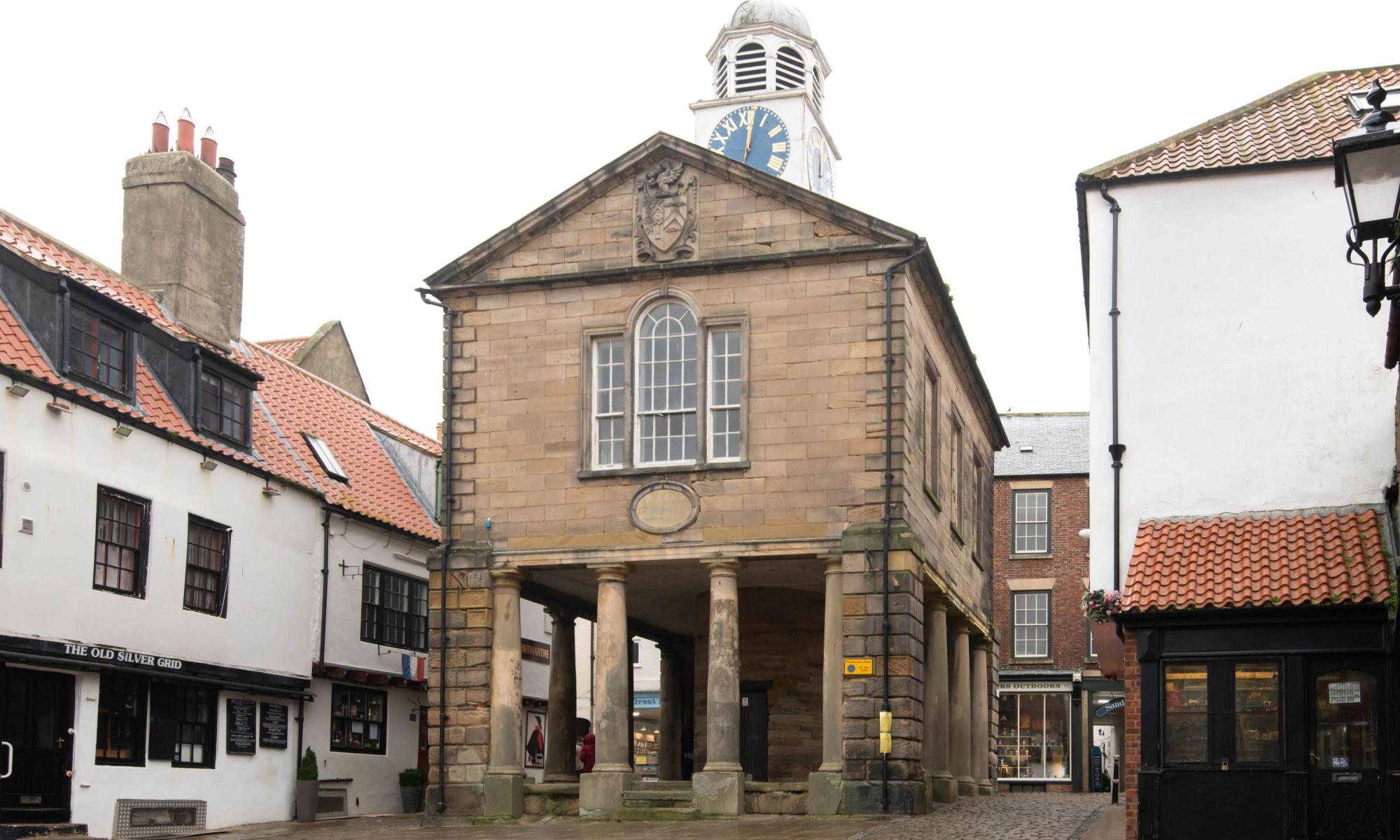
Letter XX – The Municipal Mirage

A once-civic institution, now hollowed by bureaucracy and central control.

By Martyn Walker
Published in Letters from a Nation in Decline

Once upon a time—within living memory, though now spoken of as though it were some sepia-toned idyll—the local council was exactly that: local. A modest civic body, often dull, occasionally officious, but recognisably part of the community whose money it spent. One imagines the town clerk of 1958, sleeves rolled, spectacles perched, frowning over the drainage budget with the stoicism of a man who knows he will meet the ratepayers in the butcher’s queue tomorrow morning. He was not a visionary, a strategist, a consultant, or a “stakeholder partner.” He merely fixed the roads, emptied the bins, and ensured the library opened on time. He did so because the town needed these things, and because the town paid for them.

Compare that modest creature with today’s municipal apparatus, a body swollen to the point of deformity, draped in managerial jargon and trembling under a hundred mutually contradictory regulations. Instead of the honest if plodding civil servant, we have entire platoons of officers whose professional identity is built not on service but on compliance. They do not shape the town; they interpret guidance. They do not defend local interests; they “engage” with frameworks. Their task is not to steward a place but to satisfy a central state that increasingly views local government as one more branch office—an outpost of Whitehall’s neurotic empire.

The transfiguration began when successive governments, each convinced of its own modernising brilliance, decided that the real problem with councils was that they were too responsive to their residents. Better, they thought, to strip away those old provincial arrangements and replace them with uniform “administrative units,” reorganised, rationalised and sanitised to within an inch of their lives. The result was the 1970s map: fewer councils, larger councils, and officials less likely to know the names of the streets they regulated. Efficiency, we were told. Progress, we were told. It has been downhill ever since.

A once-civic institution, now hollowed by bureaucracy and central control.

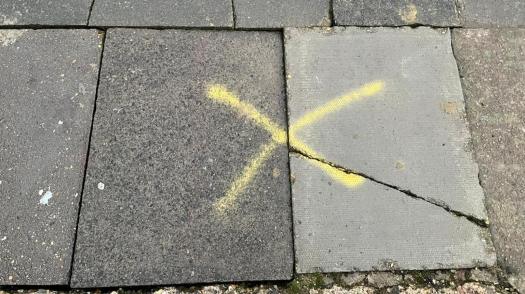
Then came the centralisers. Rate-capping, council tax limits, mandatory duties without matching funds: every lever was pulled to ensure that no local authority could so much as adjust a streetlight without permission from the capital. A Section 114 notice—local government’s version of sticking a “CLOSED FOR LACK OF MONEY” sign in the window—now hangs over dozens of authorities. The modern councillor governs nothing; he monitors a collapse, anxiously hoping that the Treasury might, in its mercy, approve a little more debt to keep the lights on.

And so to the regulations. If the older council was a steward, the modern council is a defendant—permanently awaiting judgement from a tribunal of auditors, inspectors, commissioners, ombudsmen, regulators and activist lawyers. Procurement law alone could cripple a lesser civilisation: tomes of directives dictating the precise choreography by which a council may purchase so much as a mop. The process is so paralysing that only the largest and most expensive corporations can complete it, creating a tidy cartel of outsourcers who speak the language of “KPIs” and “transformation pathways” while delivering services that are, at best, adequate and, at worst, catastrophic.

The tragedy is not merely the cost, though the cost is obscene. It is the culture. Preventive services, those quiet institutions that make a town bearable—youth centres, libraries, local works, the unobtrusive odd-jobbing that keeps a place civilised—have been amputated so that councils can funnel their remaining budget into statutory duties that grow more demanding every year. Social care now consumes the lion’s share of municipal budgets, not because councils have suddenly discovered humanitarian zeal, but because the law compels it and the courts enforce it.

Thus we inhabit the paradox of the British state: councils more elaborate than ever, producing worse public spaces than at any time since rationing. Potholes gape like geological features. Parks resemble the aftermath of a sullen strike. Planning departments take years to produce decisions that amount to artful apologies for not producing any decisions at all. What the average citizen sees is decay. What the average council produces is paperwork.

If the England of the post-war decades possessed a municipal ethic, it has been replaced by a municipal mirage: a swollen bureaucracy masquerading as governance, a system designed chiefly to protect itself from blame. It consumes money without delivering value, enforces rules without delivering order, and utters slogans about “communities” while retreating from the very notion of civic duty.

The state tells us this is progress: professionalism, standardisation, compliance, equality. But a town that cannot fix its own pavements is not progressing. A council that answers to Whitehall more readily than to its residents is not local. And a nation in which the simplest act of governance costs three times what it did half a century ago—and delivers a third of the quality—is not declining by accident.

It is declining by design. The design, as usual, belongs to people who do not have to live with the consequences.


When the state expands its procedures faster than its competence, decline arrives not as a crisis but as a schedule—issued quarterly, audited annually, and noticed by the public only when the bins stop being emptied.

The Turbine that Ate the Forest

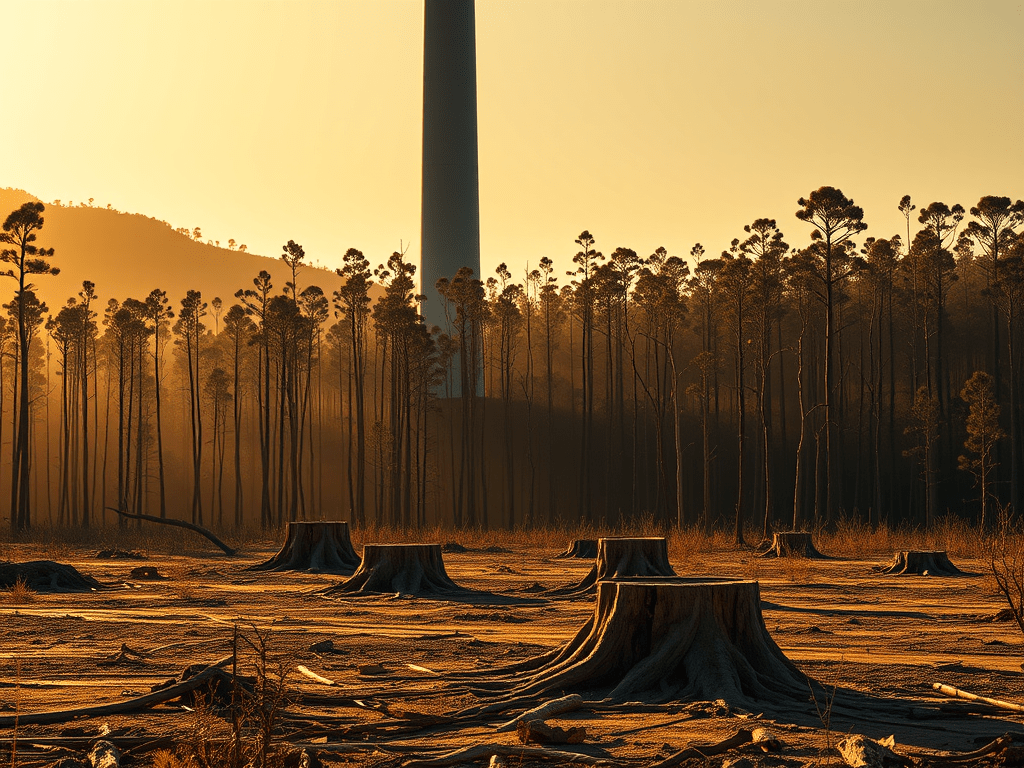
One of the small but telling scandals of our age is the polite silence surrounding balsa wood. Not the stuff of children’s model aeroplanes, but the industrial-scale harvest that feeds the fashionable addiction to wind turbines. Balsa became the miracle ingredient of the green priesthood: light, strong, resin-friendly. And so the forests of Ecuador were stripped with the zeal of a Victorian naval yard, only without the dignity of purpose. Criminal gangs moved in, communities were gutted, and tracts of land were left as bald as a ministerial briefing note. All this so that Europe could congratulate itself on its moral cleanliness while importing a product cut from other people’s hillsides.

The turbine itself is a monument to selective blindness. One begins with a thousand tonnes of concrete—an unlovely material normally denounced by environmentalists until the moment it becomes necessary to bury it under a wind farm. Add a steel tower with a carbon footprint large enough to keep a small nation in warmth for a decade. Crown it with vast blades made from fibreglass, petrochemical resins, and the aforementioned balsa stripped from South American forests. Then transport it all by lorry, ship, and crane, every step soaked in diesel. Install it in a wind regime that fails to meet the advertised output for all but a few postcard days a year. This, we are told, is progress.

We are further assured that the “lifetime carbon payback” justifies the exercise. That is true only in the same sense that a government budget is “balanced” when one introduces assumptions about perfect weather, flawless machinery, and twenty years of uninterrupted operation. The turbine must spin at its daily optimum for two decades, the wind must behave like a Swiss railway timetable, the grid must remain stable without the usual frantic interventions, and the maintenance crews must exist in a state of immaculate readiness. The moment reality intrudes—repairs, downtime, suboptimal wind, or a cold still winter—the ledger curls up like an old leaf and deposits itself in the bin.

Then comes the end of life, that undisclosed chapter in the Book of Green Miracles. The blades cannot be recycled; they are not aluminium cans. They are thermoset composites, cured forever, doomed to burial. So they are chainsawed into pieces and entombed in vast pits, where they will outlast most of the modern political class. One wonders whether future archaeologists will conclude that the early twenty-first century worshipped giant fibreglass idols until the cult ran out of subsidies.

But the greatest deception—the one so ingrained that ministers repeat it without hesitation—is that wind replaces conventional generation. It does not. It decorates it. Behind every elegant white tower stands a gas turbine humming away like an anxious understudy, ready to spring on stage the moment the wind drops. That backup runs inefficiently, gulping fuel in stop–start cycles that nobody includes in the official figures because it ruins the story. The whole scheme resembles a child’s puppet theatre: all charm at the front, frantic scrambling behind.

Why are we investing in this? Because it is symbolic. Because it makes the correct people feel virtuous. Because it allows officials to commission glossy reports full of charts trending in pleasing directions. And because nothing flatters a modern government more than a technology which is large, visible, and useless at the precise moment one needs it.

If we possessed any genuine environmental seriousness, we would build nuclear plants and grid storage systems, and stop pretending that intermittency is a virtue. We would stop chewing through rainforest timber to construct machines that are nowhere near as green as the press releases suggest. Instead we cheer the arrival of another imported turbine, another scar on the landscape, another concrete tomb for future generations to puzzle over.

A civilisation that congratulates itself while paving fields with foreign timber and unrecyclable plastic, all in the name of purity, is not merely declining; it is losing its mind.