

Letter XVIII: The Poverty Mirage

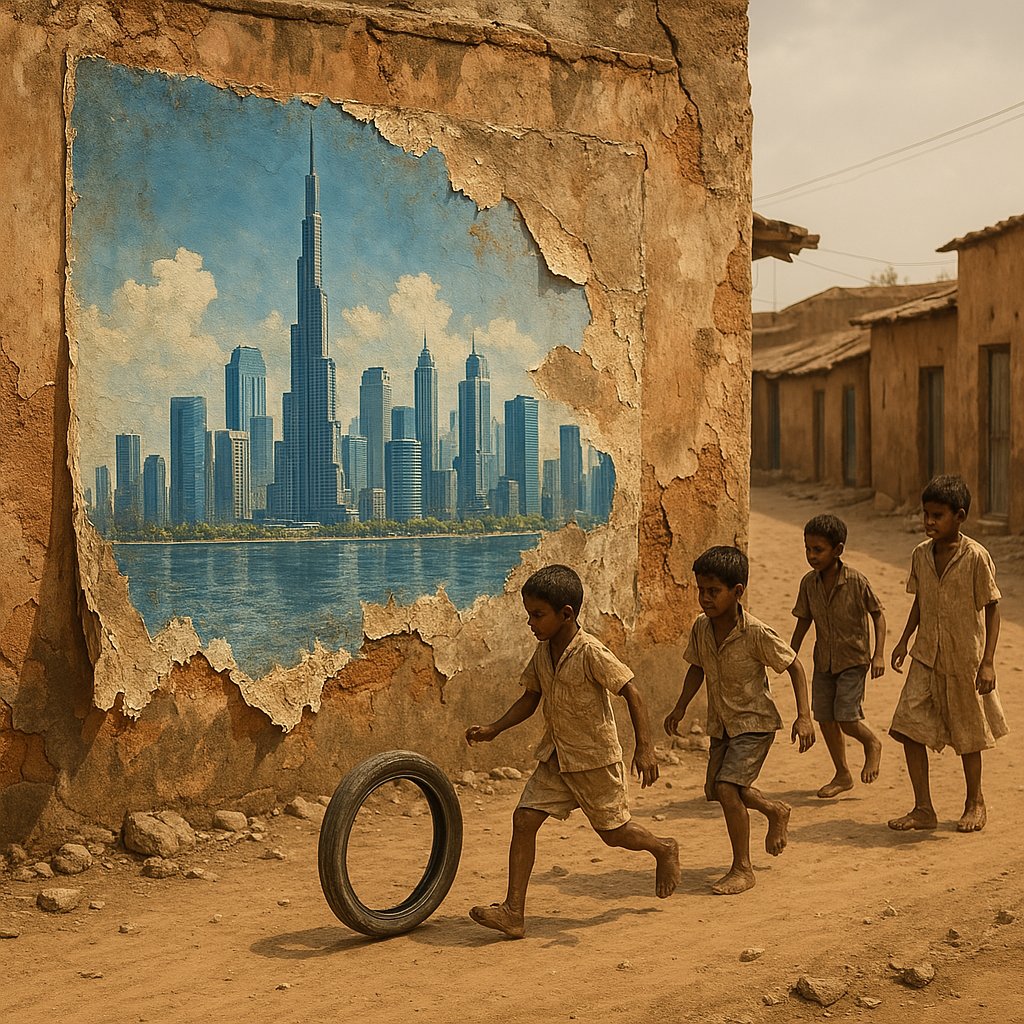
Children in a dusty village play in front of a crumbling mural depicting a futuristic Western skyline across water.

When Help Makes Things Worse

By Martyn Walker
Published in Letters from a Nation in Decline

Dear Reader,

There is a cruel illusion that stalks Western policymaking—an illusion we not only believe, but wrap in moral grandeur. It is the idea that if we lift a handful of people out of poverty, we have changed the world. A hundred million rescued, a headline for the BBC, a documentary narrated by Bono. Job done.

But what if this is the ultimate vanity project of the West? What if our relentless urge to “help” is a gilded form of sabotage?

Someone recently wrote online, with uncharacteristic clarity, that you could take 100 million people living in third-world poverty, move them to the United States, and still—still—billions would remain in that same poverty. The implication is hard to miss: the problem isn’t where the poor live. The problem is why poverty remains the dominant condition of those countries in the first place. And importing the poor to richer nations doesn’t solve the problem—it just relocates it and inflames a host of new ones.
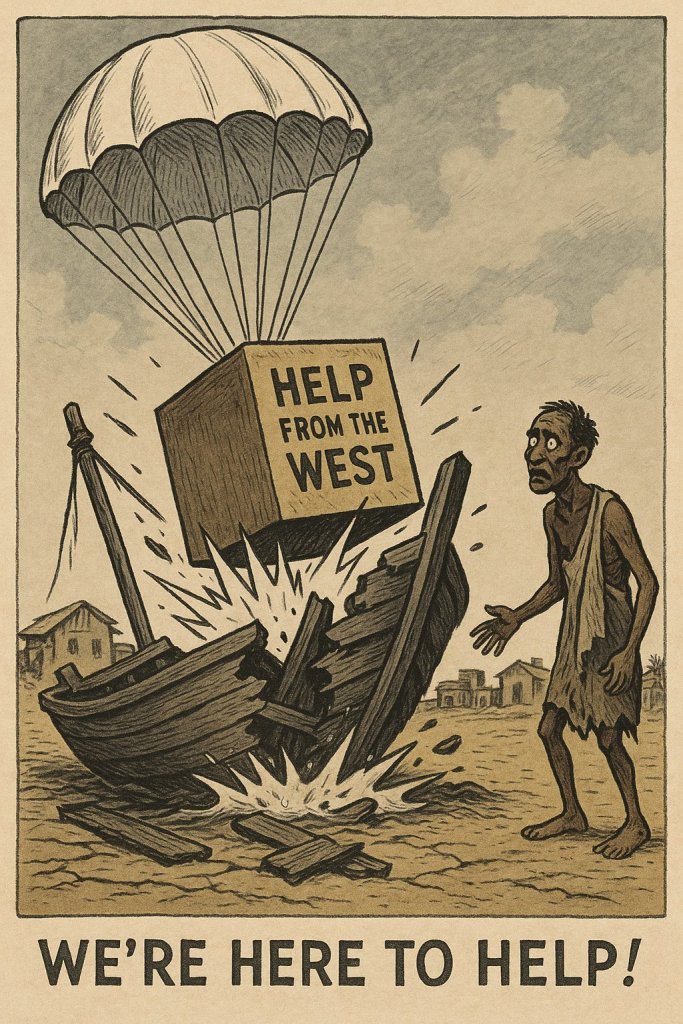
We are encouraged to pity the migrants, not question the migration. Yet every one of those 100 million would cost billions to house, educate, subsidise, and absorb—while their departure does nothing to change the systems, cultures, or kleptocracies that bred their misery. Meanwhile, those left behind—numbering in the billions—are quietly erased from the ledger of Western concern.

And there is the sting: by rescuing the few, we abandon the many.


The road to this absurdity is paved with theological potholes and moral landmines. I recall the story of Pope John Paul II—beloved in the West for standing up to Soviet tyranny—visiting India during a time of desperate national struggle. The Indian government had, with considerable difficulty, built a network of family planning services, attempting to slow a spiralling birth rate in areas already plagued by malnutrition and drought. Charities worked hand in hand with officials to promote responsible contraception. It was not about ideology. It was about rice, water, and survival.

Then came the Pope.

With a few papal words, he condemned birth control in a country battling to feed its children. In an instant, years of careful groundwork were torched. His holiness departed in a plume of incense and rhetoric, leaving the consequences behind. He had the luxury of eternal principles. The people of India did not. The famine doesn’t care about doctrine.

This is what the West does best: it interferes. With speeches. With dogma. With chequebooks and conditions. And always, it leaves the bill with the locals.
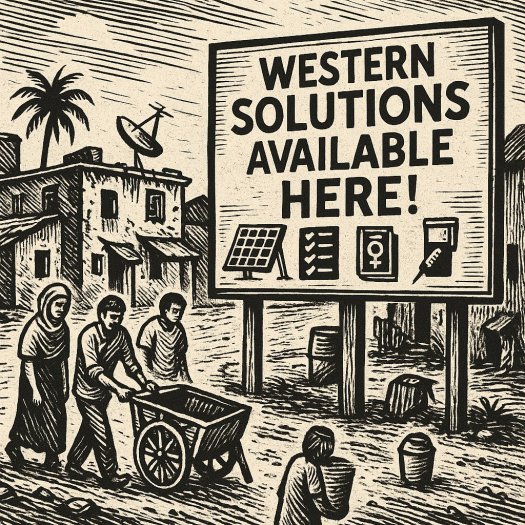

Woodcut-style illustration of a Western aid billboard in a crumbling village, with locals ignoring the sign and walking past with broken tools and containers.
A billboard proclaims “Western Solutions Available Here!”—offering solar panels, checklists, gender policy, and injections—while villagers walk past with broken carts and weary expressions.

Let us speak plainly. The developing world does not suffer from a lack of Western help—it suffers from an excess of it. Help that creates dependency. Help that erodes initiative. Help that demands ideological obedience in return. We tie aid to carbon compliance, to gender theory, to imported bureaucracy. The IMF does not give loans—it issues control. The charities do not build capacity—they replace it.

We have reached a point where the so-called “help” from the West has become more dangerous than its absence. We call it development, but it resembles colonisation wearing a rainbow lanyard.

And when the help fails, we blame the locals for “corruption” as if the World Bank is a convent of saints. Or we propose the unthinkable: that a coalition of successful nations should once again assume managerial control of the “failing” ones. We are back to empire, except this time it’s run by NGOs and ESG consultants.

And if not that, we shrug—and let nature take its course.


So what, then? Do we retreat?

Yes, actually.

But not with malice. Not with neglect. With discipline. With humility. With the honest admission that teaching a man to fish is no good if we’ve already leased his lake to China, banned his nets under EU regulation, and filled the water with World Economic Forum pamphlets.

We must learn to get out of the way. Not walk away from the world, but stop trying to run it.

Give tools, not rules. Invest without conditions. Respect local agency. Stop importing problems into Western cities just to feel temporarily virtuous. And never again should we let theology—of any kind—override common sense in a starving country.


Let us finally admit it: we have become too proud of our pity, too in love with the mirror image of our benevolence. The poor do not need our rescue. They need their freedom—from us.

Faithfully yours,
M.W.
Letters from a Nation in Decline
Of Monarchs & Minions: A Simple Guide to Brewing a Revolution

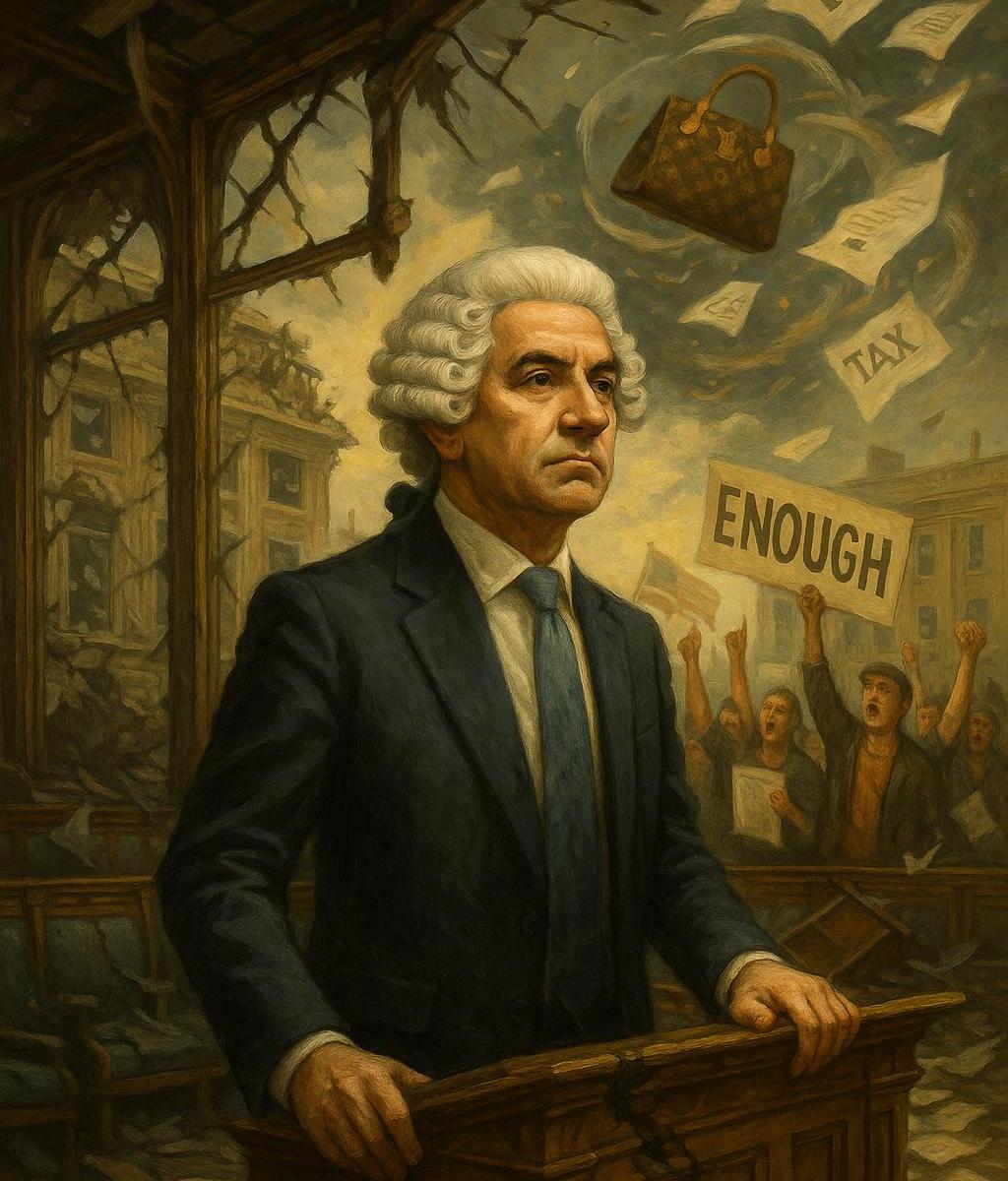
Modern politician in powdered wig stands in ruined parliament as protestors wave signs outside and tax papers swirl in the air.

History doesn’t repeat, but it hums the same tune. And if you listen closely, the melody of revolt is never far from the surface. Whether it’s a Parisian mob in 1789 or a furloughed factory worker scrolling Twitter in 2025, the triggers of revolution are eerily consistent.

So here it is: the ingredients list for a classic popular uprising. Mix and stir until boiling.


1. Popular Discontent

The yeast of any revolution. When ordinary people feel overworked, overtaxed, underheard and overruled, they ferment. In pre-revolutionary France, the sans-culottes were starving while the court danced at Versailles. In modern Britain, it’s workers using food banks while MPs remodel their second kitchens.

Discontent isn’t just about poverty — it’s the insult added to injury. When people suffer and see that no one in power cares, the pot simmers.


2. Politicians Smelling Opportunity

Revolutions need opportunists — politicians who realise the tide is turning and paddle accordingly. Sometimes they’re the Robespierres or the Cromwells, elbowing their way into history. Other times they’re more cautious, waiting to back the right crowd once it’s safe.

In 2025, political leaders flip-flopping on immigration, net zero, or free speech aren’t being strategic — they’re sniffing for the wind.


3. The Wealthy Playing Both Sides

There’s always a merchant class trying to protect their ledgers. In Tsarist Russia, the oligarchs funded moderate reformers to avoid Bolshevik firebrands. In our era, billionaires fund both progressive NGOs and Conservative think tanks — not because they care, but because they want influence whichever way the revolution tips.

Modern revolutions are rarely purely ideological — they’re part investment strategy.


4. Byzantine Taxation with Invisible Benefits

The more complicated the tax system, the easier it is to fleece the public — and the angrier they get. In 18th century France, it was the taille, the gabelle, the vingtième — arbitrary, unequal, and infuriating. In Britain today, it’s IR35, VAT tweaks, stealth inheritance freezes, and green levies hiding in energy bills.

When people can’t see where their money is going, or worse — see it going to something stupid — that’s when sparks fly.


5. Vanity Projects & Public Graft

In revolutionary France it was Versailles. In revolutionary America, tea taxes and imperial bribes. In 21st-century Britain? HS2, Test & Trace, Net Zero levies, and consultancy addiction. Enormous sums vanish, yet your local GP surgery still has a 3-week wait.

When the elite waste national wealth on baubles and boondoggles while essential services collapse, people get creative — with pitchforks.


6. Wars the People Don’t Support

Wars have always played a dual role: distraction for rulers, devastation for the ruled. The American Revolution was triggered in part by taxes to fund Britain’s wars elsewhere. Vietnam split the U.S. in half. Iraq and Afghanistan bred cynicism.

In the modern world, it’s subtler. Proxy wars, arms shipments, and military-industrial lobbying — while your town loses its library. A public who doesn’t believe in the war will start questioning who the real enemy is.


7. A Widening Gap Between Rule and Reality

When law becomes performative and leadership becomes cosplay, the people notice. Marie Antoinette played shepherdess in silk. Today’s elites preach austerity from private jets. The rules don’t apply to them — and they don’t care if you know it.

This ingredient isn’t always on the original recipe, but it’s the spice that brings it all together: visible hypocrisy.


8. Cultural Estrangement Between Rulers and Ruled

Revolutions aren’t just about bread; they’re about values. When those who rule speak a different language — metaphorically or literally — from those they govern, it breeds resentment. It might be nobles speaking French in Russia, or metropolitan elites sneering at “low information voters” in Mansfield.

Revolutions often start when the majority feel mocked, ignored, and legislated against by people who neither understand nor respect them.


9. A Trigger Event

One moment, it’s grumbling. The next, it’s barricades. A bread riot. A police shooting. A smug remark from someone in power. The Boston Tea Party, the Storming of the Bastille, the Arab Spring — all started with moments that, in hindsight, were inevitable.

What will ours be? A fuel tax? Another pandemic? A digital ID law?

We won’t know until it happens — but when it does, it’ll feel like it was always coming.


10. A Story to Believe In

Revolutions don’t start with spreadsheets — they start with narratives. A vision of a better world. Liberty. Bread. Justice. Take Back Control. People need something to believe in — even if it’s ill-defined. Especially if it is.

That belief, however messy, can move millions.


Conclusion: Are We There Yet?

Britain today has:

  • Widespread discontent ✔
  • Out-of-touch elites ✔
  • Complex taxation ✔
  • Unpopular projects draining wealth ✔
  • War spending and foreign entanglements ✔
  • Political opportunism and wealthy string-pullers ✔

And still, the nation simmers quietly. But no one turns off the heat.
History warns us: all it takes is one spark.

Entropy’s Child

Digital painting for the poem "Entropy’s Child," showing a glowing human silhouette dissolving into stardust against a cosmic background, with Saturn to the left and swirling galaxies behind.

The universe, vast and timeless as it turns,
One among infinite, where eternity burns.
Each atom, each thought, a unique, fleeting spark,
In the grand, endless dance of light and of dark.

If time is unending, if space has no edge,
Then what of the self, with no memory to pledge?
This life is a moment, a breath in the flow,
Yet in infinite cycles, we rise and we go.

The universe spins with no purpose or will,
Indifferent to wishes, yet wondrously still,
In this vast, restless cosmos, might we not return,
As the stars keep on burning, as the galaxies churn?

So perhaps we shall live, time and time once more,
In a universe infinite, with mysteries galore.
What can happen will happen, and thus we may see,
In the grand wheel of existence, the return of you and me.

Authors Note

Although the rhythm and subject of this poem differ, those familiar with The City of Dreadful Night by James Thomson will detect an underlying current that owes much to that remarkable work.

This poem was written in 1974, during my time at Belmont School, Holmbury St Mary. It was inspired by a debate organised by our English Literature teacher, Mr Ballantyne. The topic was “Reincarnation is real”. I was on the team tasked with arguing in favour — no small challenge for an 13-year-old who had, at the time, no idea what reincarnation was.

To prepare, I retreated to the school library and began my research (encouraged and assisted by Mr Ballantyne himself). There, in a rather ancient encyclopaedia (I suspect it predated Britannica by several decades), I stumbled upon a passage quoting James Thomson (BV), which conveyed in essence the belief that death is final. Regrettably, I can no longer recall the precise quotation, and indeed The City of Dreadful Night offers so many bleak and masterful reflections that it is difficult to pinpoint which one it was.

Nonetheless, I remember vividly how deeply Thomson’s writing struck me. His sombre vision of life left a lasting impression. Over fifty years later, certain passages still linger in my mind — testimony to the power of his words.

You will find the full text of The City of Dreadful Night on Project Gutenberg. In particular, you may notice how the poem presented here draws upon the mood and tone of the four stanzas that begin as follows:

The world rolls round for ever like a mill;
It grinds out death and life and good and ill;
It has no purpose, heart or mind or will.

“While air of Space and Time’s full river flow
The mill must blindly whirl unresting so:
It may be wearing out, but who can know?

“Man might know one thing were his sight less dim;
That it whirls not to suit his petty whim,
That it is quite indifferent to him.

“Nay, does it treat him harshly as he saith?
It grinds him some slow years of bitter breath,
Then grinds him back into eternal death.”