

By Common Sense, Reporting from the Edge of Reason.
Opinion | Media Regulation | United Kingdom | April 2025
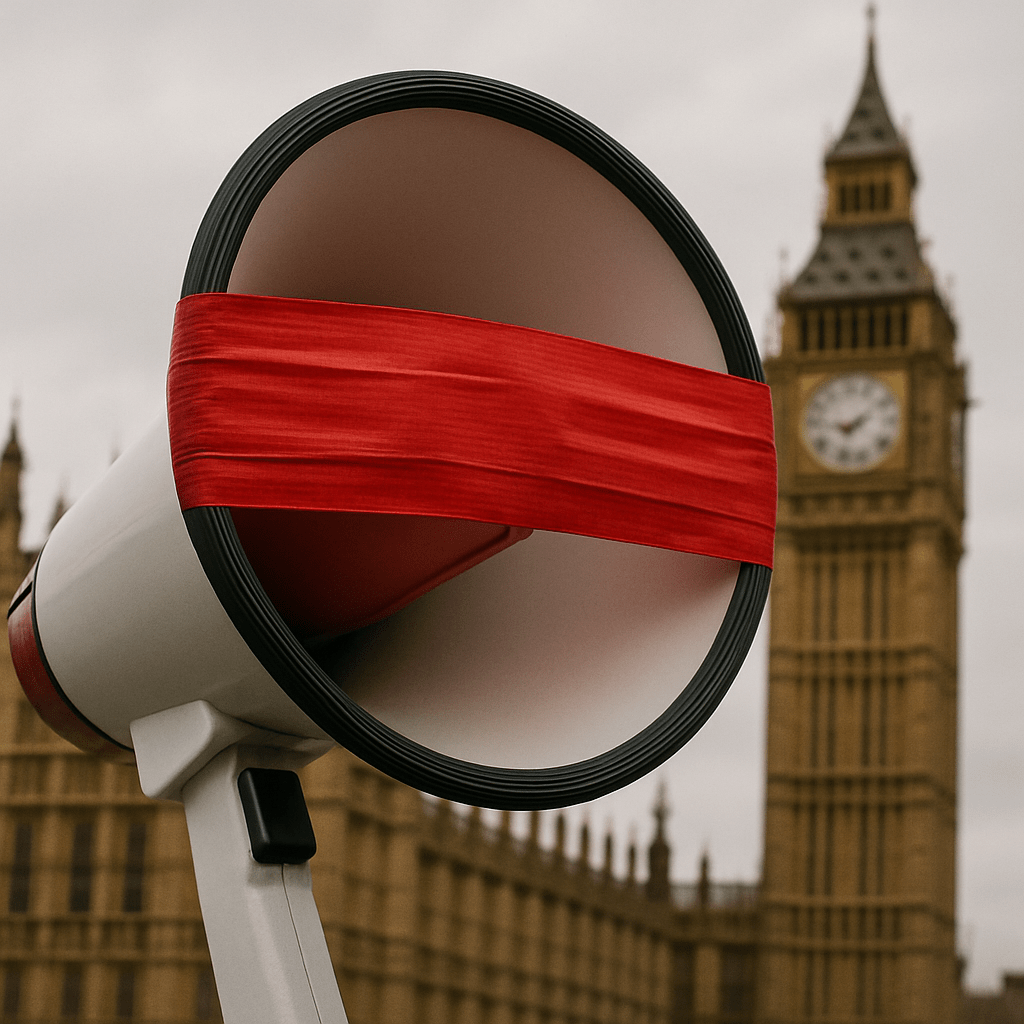
When a press regulator penalises newspapers for quoting Parliament without ritual appeasement, we are no longer defending journalism — we are regulating tone, not truth.
Ipso, as any modestly educated schoolchild once knew, means by the fact itself. Today, it appears to mean by the feelings of a preferred complainant, or more precisely, by the fact that someone, somewhere, might be offended, retroactively.
The Independent Press Standards Organisation — let us pause to admire the audacity of the word “Independent” — has declared that The Telegraph erred by quoting, without seeking fresh rebuttal, remarks made under the protection of Parliamentary privilege. The offending quote? A Cabinet Minister — Michael Gove — made reference in the Commons to alleged links between the Muslim Association of Britain (MAB) and the Muslim Brotherhood[1].
“Ipso has ruled that quoting Parliament is now misleading — unless you ask the accused to deny it again.”
The comments were made in Parliament. They were reported accurately. They included a denial from the MAB, already in the public domain. And yet: Ipso upheld the complaint[2].
Ipso facto, accuracy is no longer the standard. Deference is.
Under the Editors’ Code, publications must not print inaccurate or misleading content. Yet somehow, Ipso ruled that quoting Parliament, while accurate, was still misleading — because The Telegraph did not re-ask the MAB to deny it again. This isn’t regulation. It’s a form of compelled courtesy.
Let us reflect on the implications:
If newspapers must now solicit fresh reactions every time a parliamentary statement is quoted — even when the response is already publicly known — then press freedom has become contingent not on facts, but on feelings and repetition rituals.
Parliamentary privilege now risks becoming a historical footnote — overruled by feelings and rituals.
Michael Gove, now also editor of The Spectator, rightly warns that such rulings have a chilling effect. “Groups suspected of extremism rarely want scrutiny,” he wrote, “They seek to present themselves as a peaceable association of co-religionists who simply want to get along and do good works.”[3]
Parliamentary privilege, once a bulwark of British democracy, now risks becoming a historical footnote — overruled by the sensitivities of groups that may be under scrutiny.
And Ipso’s record gives little comfort:
- In 2021, it entertained an 87-page complaint from Yevgeny Prigozhin, the Wagner mercenary boss, who insisted he was merely a successful restaurateur. The Telegraph had to prepare a formal response. He later withdrew the complaint — after publicly confirming his role as Wagner’s founder[4].
- In 2023, Ipso ruled against The Spectator for referring to a transgender journalist as “a man who claims to be a woman”, citing discrimination[5].
- In 2019, it drafted guidance warning journalists against “insensitivities” when reporting on Islam, language more suited to cultural outreach than impartial regulation[6].
These are not the decisions of a neutral arbiter. These are the reflexes of an organisation that now regulates not truth, but tone — not accuracy, but atmosphere.
Breaking news (that everyone already knows):
A free press must be free to offend. Free to quote. Free to scrutinise. That includes the right to repeat what elected representatives say in the Commons — without asking permission from those criticised.
Otherwise, we are not defending journalism.
We are auditioning for Ofcom’s little sibling, with a clipboard and a mood ring.
Ipso, by the very fact itself, has become part of the problem.
References:
- Hansard, House of Commons debate, March 2023 – Statement by Michael Gove naming three Muslim organisations, including the MAB, for review.
- IPSO ruling against The Telegraph, April 2025 – Complaint upheld for failing to seek new response from MAB.
- Michael Gove, “Groups suspected of extremism don’t want scrutiny,” The Telegraph, April 2025.
- The Telegraph, April 2021 – Coverage of complaint by Yevgeny Prigozhin, later withdrawn after public admission of Wagner affiliation.
- IPSO ruling against The Spectator, 2023 – Discrimination ruling over gender language.
- IPSO draft guidance, 2019 – Recommendations for reporting on Islam with caution to avoid “insensitivities.”
Author: Common Sense is a recovering civil servant and occasional contributor to The Last Remaining Sane Newspaper, where he writes under a variety of pseudonyms for his own protection and amusement. He identifies as reality-adjacent and accepts correspondence by pigeon.
Column Metadata:
- Title: IPSO Facto: When the Press Regulator Forgets What a Press Is For
- Author: Common Sense
- Published: April 2025
- Word count: approx. 1,050
- Categories: Media, Regulation, Free Speech, UK Politics, Journalism
- License: Opinion / Commentary — standard editorial fair use
- Keywords: IPSO, press regulation, Michael Gove, MAB, Muslim Brotherhood, Parliamentary privilege, free speech, journalism
Discover more from Verbal Alchemy
Subscribe to get the latest posts sent to your email.
 Verbal Alchemy