

Interrupted

She was the postmaster’s daughter—
fifteen, and serious about everything.
Even laughter.

We spoke of love
like people twice our age
but felt it
like fire at our fingertips.

I remember her hand
on my arm
when we agreed
not to rush.
Both virgins.
Both afraid
of what forever might cost
if we touched it too soon.

We gave each other
everything
but the one thing
we wanted most.

We shared time
in hours
on benches,
by rivers,
between letters,
through windows.

When Denmark called me
and Edinburgh called her,
we said the right things.
We meant them.

For a year
our voices travelled the length of Europe
on wires and stamps.

Then
one day,
nothing.

No letter.
No call.
No reason.

I rang her house.
They’ve moved,
they said.

No forwarding address
for a girl who still lives
at the edge of my life
in a memory
with her hair tied back
and a promise in her pocket.

Not all love stories end.
Some are simply
interrupted.

Interrupted (Part II)

The Old Man Remembers Robyn

I am 85.
There are days
I can barely stand
without remembering
how she stood beside me,
barely sixteen,
looking serious
about everything.

The mirror gives me
this brittle husk.
But behind the eyes—
that boy is still there.
Still hoping for a letter.

Did she marry?
Did she cradle
grandchildren
the way I cradle mine—
with reverence,
with joy,
with the weight of a life
earned?

Sometimes I hope
she forgot me quickly.
That another boy
with steadier hands
gave her the love
I only promised.

Sometimes
I hope she didn’t.

That’s the cruelty of memory—
it edits nothing.
She is still fifteen.
Still waiting.
Still unkissed.

If I find her
on the other side,
I pray
she is older than me.
Lined, wise,
eyes full
of stories I never knew.

Not the girl
who vanished.
Not the girl
frozen by farewell.

Because I loved her.
And I would grieve,
even in death,
to see her again
and find
she never lived at all.


Afterword

The two poems in this sequence, collectively titled Interrupted, form a quiet meditation on love that never faded, only vanished from view. They chart the emotional arc of a single man across a lifetime—from the intense but restrained devotion of youth to the reflective yearning of old age.

The first poem captures a rare kind of early love: one chosen for its restraint, not repressed by fear, but shaped by mutual understanding. The speaker and Robyn are adolescents with a bond strong enough to resist the immediacy of desire, trusting in the value of a future they were never given. When Robyn disappears—without explanation, without closure—the relationship isn’t broken. It is, simply, interrupted. Memory becomes the only place where she continues to exist.

The second poem, written from the vantage point of old age, returns to that interruption not to reanimate the past, but to ask the one question that has lingered for decades: what became of her? It is a poem not of regret, but of compassionate longing. The speaker has lived fully—marriage, children, grandchildren—yet the fate of Robyn remains an unfinished chapter. His greatest fear is not that she forgot him, but that she never lived beyond their final moment. He does not want to meet her again as a girl frozen in time. He wants to know that she, too, lived richly, aged with dignity, and became someone beyond his memory.

Interrupted is poetry in the lyric tradition—sparse, emotional, and precise. It allows stillness to speak. It mourns nothing explicitly, but in its quietness, it holds immense feeling. The poems are not an elegy for a person who died, but for a story that was never allowed to finish. And yet, by writing it down—by holding Robyn in language—the speaker gives it a kind of completion. Not all love stories end. Some are simply interrupted.
IPSO FACTO: WHEN THE PRESS REGULATOR FORGETS WHAT A PRESS IS FOR

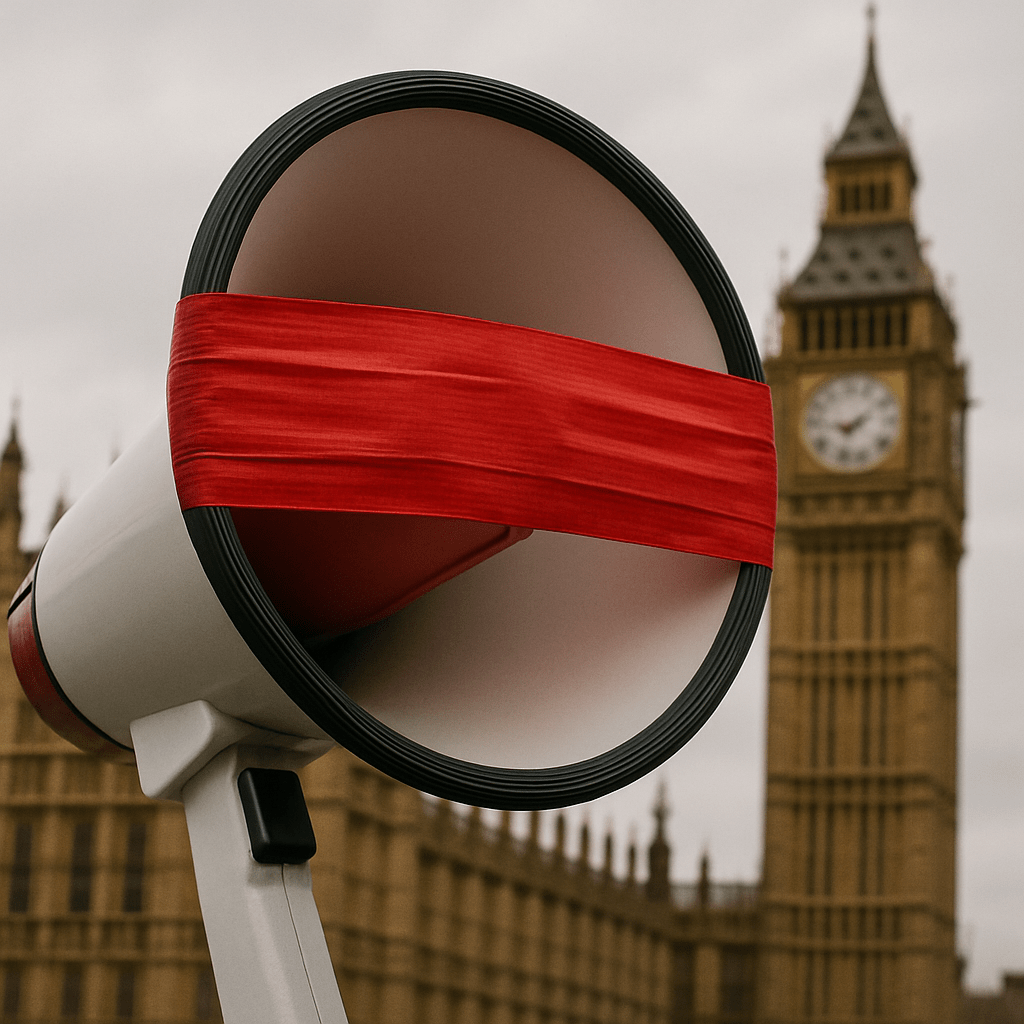
A press megaphone bound with red tape, placed in front of the Houses of Parliament — symbolising censorship of media speech in the UK.

By Common Sense, Reporting from the Edge of Reason.
Opinion | Media Regulation | United Kingdom | April 2025

When a press regulator penalises newspapers for quoting Parliament without ritual appeasement, we are no longer defending journalism — we are regulating tone, not truth.

Ipso, as any modestly educated schoolchild once knew, means by the fact itself. Today, it appears to mean by the feelings of a preferred complainant, or more precisely, by the fact that someone, somewhere, might be offended, retroactively.

The Independent Press Standards Organisation — let us pause to admire the audacity of the word “Independent” — has declared that The Telegraph erred by quoting, without seeking fresh rebuttal, remarks made under the protection of Parliamentary privilege. The offending quote? A Cabinet Minister — Michael Gove — made reference in the Commons to alleged links between the Muslim Association of Britain (MAB) and the Muslim Brotherhood[1].

“Ipso has ruled that quoting Parliament is now misleading — unless you ask the accused to deny it again.”

The comments were made in Parliament. They were reported accurately. They included a denial from the MAB, already in the public domain. And yet: Ipso upheld the complaint[2].

Ipso facto, accuracy is no longer the standard. Deference is.

Under the Editors’ Code, publications must not print inaccurate or misleading content. Yet somehow, Ipso ruled that quoting Parliament, while accurate, was still misleading — because The Telegraph did not re-ask the MAB to deny it again. This isn’t regulation. It’s a form of compelled courtesy.

Let us reflect on the implications:
If newspapers must now solicit fresh reactions every time a parliamentary statement is quoted — even when the response is already publicly known — then press freedom has become contingent not on facts, but on feelings and repetition rituals.

Parliamentary privilege now risks becoming a historical footnote — overruled by feelings and rituals.

Michael Gove, now also editor of The Spectator, rightly warns that such rulings have a chilling effect. “Groups suspected of extremism rarely want scrutiny,” he wrote, “They seek to present themselves as a peaceable association of co-religionists who simply want to get along and do good works.”[3]

Parliamentary privilege, once a bulwark of British democracy, now risks becoming a historical footnote — overruled by the sensitivities of groups that may be under scrutiny.

And Ipso’s record gives little comfort:

  • In 2021, it entertained an 87-page complaint from Yevgeny Prigozhin, the Wagner mercenary boss, who insisted he was merely a successful restaurateur. The Telegraph had to prepare a formal response. He later withdrew the complaint — after publicly confirming his role as Wagner’s founder[4].
  • In 2023, Ipso ruled against The Spectator for referring to a transgender journalist as “a man who claims to be a woman”, citing discrimination[5].
  • In 2019, it drafted guidance warning journalists against “insensitivities” when reporting on Islam, language more suited to cultural outreach than impartial regulation[6].

These are not the decisions of a neutral arbiter. These are the reflexes of an organisation that now regulates not truth, but tone — not accuracy, but atmosphere.

Breaking news (that everyone already knows):
A free press must be free to offend. Free to quote. Free to scrutinise. That includes the right to repeat what elected representatives say in the Commons — without asking permission from those criticised.

Otherwise, we are not defending journalism.
We are auditioning for Ofcom’s little sibling, with a clipboard and a mood ring.

Ipso, by the very fact itself, has become part of the problem.

References:

  1. Hansard, House of Commons debate, March 2023 – Statement by Michael Gove naming three Muslim organisations, including the MAB, for review.
  2. IPSO ruling against The Telegraph, April 2025 – Complaint upheld for failing to seek new response from MAB.
  3. Michael Gove, “Groups suspected of extremism don’t want scrutiny,” The Telegraph, April 2025.
  4. The Telegraph, April 2021 – Coverage of complaint by Yevgeny Prigozhin, later withdrawn after public admission of Wagner affiliation.
  5. IPSO ruling against The Spectator, 2023 – Discrimination ruling over gender language.
  6. IPSO draft guidance, 2019 – Recommendations for reporting on Islam with caution to avoid “insensitivities.”

Author: Common Sense is a recovering civil servant and occasional contributor to The Last Remaining Sane Newspaper, where he writes under a variety of pseudonyms for his own protection and amusement. He identifies as reality-adjacent and accepts correspondence by pigeon.

Column Metadata:

  • Title: IPSO Facto: When the Press Regulator Forgets What a Press Is For
  • Author: Common Sense
  • Published: April 2025
  • Word count: approx. 1,050
  • Categories: Media, Regulation, Free Speech, UK Politics, Journalism
  • License: Opinion / Commentary — standard editorial fair use
  • Keywords: IPSO, press regulation, Michael Gove, MAB, Muslim Brotherhood, Parliamentary privilege, free speech, journalism

Letter XIII: Blotting Out the Sun

By Martyn Walker
Published in Letters from a Nation in Decline

When the state plans to dim the sun while blanketing farmland with solar panels, only folly thrives.

I installed solar panels some years ago. A modest gesture, perhaps, but one rooted in the belief that renewable energy—particularly the power of the sun—offered a sensible path forward. The promise was straightforward: invest now, harvest the sun’s rays, lower my bills, and contribute, in some small way, to a greener future.

Imagine, then, my reaction upon learning that the government is now considering blotting out the sun.

I do not exaggerate. At Westminster, serious people are discussing the allocation of billions to solar geoengineering—spraying fine particulates into the atmosphere to reflect sunlight away from the Earth, cooling the planet in the process. Sulphur dioxide is the preferred agent, mimicking the effect of volcanic eruptions, lowering global temperatures, and, we are told, sparing us from climate catastrophe.

At the same time, those same serious people are approving hundreds of thousands of acres of farmland for conversion into solar farms. Arable fields, once the source of our food, will be turned into glinting expanses of silicon and glass—desperate to capture the very sunlight the state proposes to dim.

Which is it? Are we to harvest the sun or hide from it?

This is policy schizophrenia at its finest. On one hand, we are to bow before the gods of net zero, covering our green and pleasant land with solar panels. On the other, we are to fund atmospheric experiments that will diminish the very light those panels need to function. The left hand builds; the right hand dismantles.

But this is more than a contradiction. It is the arrogance of central planning, an affliction that has toppled empires, destroyed livelihoods, and now threatens to snuff out the sun’s warming rays.

History is not short of warnings. In the Soviet Union, one Trofim Lysenko convinced Stalin that science itself could be bent to ideology. Genetics was bourgeois nonsense, he claimed, and crops could be trained—like loyal Party members—to thrive in hostile environments if only they were exposed to the correct conditioning. Real scientists, those who objected, were purged. Their warnings ignored. The result? Agricultural collapse, famine, and death on an industrial scale.

The lesson? When policy bends science to ideology, crops fail and people starve.

Geoengineering smells of the same hubris. The climate models, neat as they are, do not account for the complex choreography of atmosphere, ocean, and biosphere. The Earth is not a thermostat, waiting for a bureaucrat to dial in the desired temperature. There is no slider bar for unintended consequences.

Consider CFCs—chlorofluorocarbons. Once hailed as a miracle of modern chemistry, powering refrigeration, aerosols, and industrial processes. Until, decades later, scientists discovered they were quietly eating away at the ozone layer, exposing us to dangerous levels of ultraviolet radiation. It took an extraordinary global effort—the Montreal Protocol—to halt the damage. The unintended consequence of human ingenuity.

Now, we propose to tamper with the atmosphere once again. To spray particles into the sky, with only the faintest grasp of what might follow. Droughts in one region, floods in another. Failed harvests. Shifts in monsoon patterns. The arrogance of assuming we can control a global system as intricate as the climate without consequence is staggering.

And all this while tearing up farmland to make way for solar panels, sacrificing food security for energy generation, only to dim the light that powers them.

It is the insanity of the moment, yes—but also the failure to learn from history. Grand schemes, unmoored from reality, sold on visions of salvation but delivered through wreckage and regret.

The late pathologist’s words echo: Humans are tropical creatures. Leave a man naked outside at 20°C, and he will die from exposure. We are built for warmth, for sunlight. The sun is not our enemy. It is our origin.

This is a nation in decline: dimming the sun, sterilising the soil, trading common sense for ideology. No thought for consequence. No humility before the complexity of life.

I do not ask for much. Protect the farmland. Let the sun shine. Reject the delusion that we can reorder the heavens by committee. We are not gods, and this is not our playground.

When the crops fail and the skies darken, there will be no bureaucrat to blame but ourselves.


🔬 UK Government Initiatives on Solar Geoengineering

  • UK Scientists to Launch Outdoor Geoengineering Experiments
    The Guardian reports on the UK’s £50 million funding for small-scale outdoor experiments aimed at testing solar radiation management techniques, such as cloud brightening and aerosol injections. Critics express concerns about potential environmental risks and the diversion from emission reduction efforts. (UK scientists to launch outdoor geoengineering experiments)
  • Exploring Climate Cooling Programme
    An overview of the UK’s climate engineering research initiative, detailing the government’s £61 million investment in solar radiation management research, including methods like stratospheric aerosol injection and marine cloud brightening. (Exploring Climate Cooling Programme)
  • The UK’s Gamble on Solar Geoengineering is Like Using Aspirin for Cancer
    A critical opinion piece likening the UK’s investment in solar geoengineering to treating cancer with aspirin, highlighting the potential dangers and ineffectiveness of such approaches in addressing the root causes of climate change. (The UK’s gamble on solar geoengineering is like using aspirin for cancer)

🌾 Solar Farms and Agricultural Land Use


🗣️ Critical Perspectives and Policy Analysis

  • Why UK Scientists Are Trying to Dim the Sun
    The Week provides an overview of the UK’s funding for controversial geoengineering techniques, exploring the scientific rationale and the ethical debates surrounding these interventions. (Why UK scientists are trying to dim the Sun | The Week)
  • Analysis: Plans to Cool the Earth by Blocking Sunlight Are Gaining Momentum but Critical Voices Risk Being Sidelined
    UCL’s analysis warns of the rapid advancement of solar geoengineering research without adequate consideration of dissenting opinions and the potential for self-regulation leading to dangerous outcomes. (Analysis: Plans to cool the Earth by blocking sunlight are gaining …)
  • Solar Geoengineering Not a ‘Sensible Rescue Plan’, Say Scientists
    Imperial College London reports on a study indicating that reflecting solar energy back to space could cause more problems than it solves, questioning the viability of solar geoengineering as a climate solution. (Solar geoengineering not a ‘sensible rescue plan’, say scientists)

Metadata

Letter Number: XIII
Title: Blotting Out the Sun
Collection: Letters from a Nation in Decline
Author: Martyn Walker
Date: 28 April 2025
Word Count: 1,210


BISAC Subject Headings

POL044000: Political Science / Public Policy / Environmental Policy
SCI026000: Science / Environmental Science (incl. Climate Change)
TEC031010: Technology & Engineering / Power Resources / Solar
BUS032000: Business & Economics / Infrastructure
SOC055000: Social Science / Agriculture & Food Security
SCI092000: Science / Ethics (incl. Environmental Ethics)


Library of Congress Subject Headings (LCSH)

Solar Energy—Government Policy—Great Britain
Geoengineering—Environmental Aspects—Great Britain
Agriculture and Energy—Great Britain
Central Planning—Political Aspects—Great Britain
Environmental Policy—Moral and Ethical Aspects
Food Security—Great Britain
Climatic Changes—Moral and Ethical Aspects

Let’s Make Science Great Again

A satirical cartoon showing a politician holding “Science for Dummies” at a global climate conference, while private jets and SUVs sit outside and a janitor points to failed predictions.

They gather each year to honour the Earth,
With banners and buzzwords and questionable mirth.
They chant “follow science!” with glassy-eyed cheer,
But the method they follow? It’s nowhere near.

They assume, then predict, then assume what they guessed—
If it fits what they feel, it must be the best.
They model the sky, they model the sea,
But test what they claim? That’s heresy.

They worship the models like relics in glass,
Forget every dud from the decade that passed.
And still they parade with unfounded pride—
While science itself sits shunted aside.

Let’s go back to basics, like Aristotle once taught:
“Test your idea—or it’s not worth a thought.”
You can’t prove it’s true just ‘cause you hope or you care,
But one bad prediction? That truth isn’t there.

Yet here we are still, with graphs in a stack—
The famous old hockey stick stubbornly back.
Its blade defies logic, its shaft splits the skies—
A medieval warm-up? Deleted. Revised.

And thus, the believers, in labs and in suits,
Build castles on sand and declare them as roots.
If a storm hits the coast or a summer gets hot,
“That proves it!” they cry. (But of course it does not.)

Where’s Feynman’s demand to “bend to the test,”
To discard the idea that performs second-best?
Where’s Popper’s sharp blade to cut through the fog,
To banish the sacred from the scientific log?

Instead we get headlines and Parisian scenes,
Of leaders who fly in on CO2 dreams.
A standing ovation, champagne in their hand—
Then off to Davos to lecture the land.

This isn’t science, it’s pantomime stuff.
The numbers don’t add, and the method’s not tough.
They’ll say “the consensus,” and smugly they grin—
But if thinking is outlawed, how can we win?

Science is doubt. It’s question. It’s test.
It’s not your emotions dressed up in a vest.
It’s not the applause of a well-funded team—
It’s asking the question that shatters the dream.

So this Earth Day, pause. Take stock. Look again.
Are these prophets with laptops or children with pens?
Let’s teach them the method, the rule and the way—
And maybe, just maybe, we’ll earn what they say.

Let’s bring back the rigour, the courage to doubt—
To test every claim, to throw the weak out.
Let’s shame the lemmings, restore the domain,
Let’s Make Science Great Again.

Grounded by Green: How the RAF’s Net-Zero Crusade Risks Leaving Britain Defenceless

Imagine the sirens sound in London.

Typhoon pilots sprint for cockpits that have flown ten per cent fewer hours this year so their squadrons could meet an emissions cap.

Tankers sit on the apron topped up with scarce Sustainable Aviation Fuel that costs four times more than kerosene, so the wing commander releases just two instead of the required four.

The calculus is brutal, and it is instant: fewer jets in the air, slimmer magazines, thinner margins.

The adversary—be it Russian bombers, Chinese hypersonic glide vehicles, or a swarm of weaponised drones smuggled across Europe’s southern flank—does not care that our bases run on wind power or that our hangars are net‑zero.

All that matters in that moment is whether we can fight and win.


Survival first, stewardship second

Climate policy is a long‑term struggle for habitability; war is an immediate struggle for survival.

Lose the second and the first becomes irrelevant.

An occupied nation has no agency over carbon prices, land‑use policy, or green R & D.

Remember how Ukraine’s grid decarbonisation goals evaporated the instant Russian missiles targeted Kyiv’s substations; the only metric that counted was megawatts restored quickly enough to keep lights on and radars spinning.

The same brutal arithmetic would apply here.

If Portsmouth is cratered or RAF Lossiemouth is reduced to rubble, our gleaming solar arrays and impeccably sorted recycling streams will not defend the Channel, guard data cables in the Atlantic, or shield cash machines from cyber‑extortion.


The illusion of choice

Proponents of the current programme argue the United Kingdom can “walk and chew gum”, greening Defence while preserving deterrence.

That phrase rings hollow when budgets are already stretched between replacing Trident, recapitalising land forces gutted after the last review, and standing up an AUKUS submarine fleet.

Every pound poured into retro‑fitting hangars is a pound not spent on stocks of medium‑range air‑to‑air missiles; every hour an F‑35B sits in a simulator to save carbon is an hour the pilot is not honing instinctive reactions to a real, air‑combat merge.

The hard truth is that Defence cannot buy itself out of physics.

Hydro‑treated plant oils and e‑fuels hold less energy per kilogram than Jet A‑1.
Batteries steal payload and range.

“Do more with less fuel” eventually becomes “do less”.


A realistic hierarchy of need

  1. Win the fight.
    Deterrence that fails costs cities, not credit‑rating points. War‑winning mass and readiness must sit at the top of the spending stack.
  2. Harden the force.
    Where green technologies also add resilience—micro‑grids that keep a station alive when the national grid is hacked, for example—they should be accelerated. But they serve the war‑fighting aim first.
  3. Cut emissions without cutting capability.
    Capitalise on incremental gains already proven in conflict—formation flying software that trims fuel burn, synthetic training that substitutes only the least valuable live sorties—not the most.
  4. Hold ambition to account.
    Net‑zero deadlines must carry a readiness‑override clause: if a target compromises deterrence, it slips. Not the other way round.

A closing vision

Picture a different headline five years hence: “RAF repels barrage on UK airspace; combat air wing retains 92 % mission‑capable rate.”

In the footnotes, you learn the bases ran on a hybrid micro‑grid, and the tankers blended 20 % SAF because supply chains allowed it—not because doctrine demanded it.

That is how sustainability should look in a world of peer conflict: a dividend of strength, never a substitute for it.

Climate change may shape the century, but if the Union Flag is replaced over Whitehall, the climate debate—along with every other public good—ends at the barrel of someone else’s gun.

First secure the realm. Then, in the peace our readiness secures, we can afford the luxury of arguing about carbon.

Letters From a Nation in Decline

Letters from a Nation in Decline is a series of sharp, reflective essays that chart Britain’s slow descent from global powerhouse to a confused, compromised state unsure of its values. Through the lens of personal observation and national history, the book contrasts the nation that sparked the Industrial Revolution, championed free speech, and once stood as a beacon of self-reliance, with today’s bureaucracy-laden, ideologically tangled society.

Each letter is written in a voice both mournful and incisive—witnessing the erosion of craftsmanship, common sense, and clarity of language. Topics range from the collapse of state competence to the wilful miseducation of youth, and the steady abandonment of empirical truth in favour of abstract grievance. It is not a call to nostalgia, but a sober reckoning with what has been lost, and a warning against what is still being squandered.

Unflinching but not without wit, Letters from a Nation in Decline offers readers a mirror, not just to Britain’s fading virtues, but to the uncomfortable realities of modernity itself—where comfort has replaced courage, and where liberty is traded for slogans, hashtags, and surveillance.


Foreword

By the Ghost of Laurence J. Peter
(Author of* The Peter Principle*)

“The cream rises until it sours.”
Peter’s Corollary

When I first proposed the Peter Principle—that in a hierarchy, every employee tends to rise to their level of incompetence—I did not intend it as prophecy. It was meant as a warning. A gentle prod. A nudge to help us notice the absurdities of bureaucracy before they congealed into tragedy.

And yet, decades on, Martyn Walker has handed me the post-mortem.

Letters from a Nation in Decline is not just a collection of essays. It is a case file. An autopsy conducted with intellect, humour, and surgical prose. In these pages, Walker dissects the very institutions I once ridiculed in office memos and staffroom jokes—only now, the joke is wearing a hi-vis vest, waving a risk assessment, and drawing a pension.

He traces the fall not of a single organisation but of a national ethos. A country once governed by principle is now paralysed by process. Where once we built ships, we now convene task forces on shipping equity. Where once men stoked fires in engines, we now stoke outrage on social media. Efficiency has been outmanoeuvred by “impact frameworks.” Common sense has been furloughed, permanently.

Walker’s diagnosis is grim, but he never resorts to despair. Instead, he arms the reader with irony—the last weapon of the clear-eyed citizen. He skewers officialdom, not out of spite, but in defence of those who still remember how things used to work, and still dare to ask why they don’t.

In these essays, you will find civil servants promoted beyond purpose, educators instructed in how not to educate, health systems allergic to health, and national leaders unable to distinguish leadership from liability. You will see the Peter Principle, not as an occasional office comedy, but as a governing philosophy.

If I were still among the living, I would be writing this book myself. But as it stands, I’m relieved to have a biographer of decline who is both perceptive and unafraid.

Read it slowly. Then read it again. Then pass it, quietly, to the one competent person you still know.

May they be spared promotion.

Laurence J. Peter
Somewhere beyond the last performance review

  • Letters I to X The Makers and the Takers the first book in the Letters from a Nation in Decline series which includes ten essays. “This book confirms my worst fears and sharpest hypothesis. Incompetence has been fully institutionalised. Decline is not an accident – it is policy, poorly drafted”—Laurence J. Peter, if he were around to witness it all.
  • Letter XI Press One for Betrayal the eleventh letter in the Letters from a Nation in Decline series, a pointed essay on the death of human service and the rise of data-driven contempt. “What began as customer service has evolved into customer suppression. The only thing they care to capture is your data—and your patience.”—Laurence J. Peter, if only he’d tried calling HMRC in 2025
  • Letter XII 2–0 for the Three Laws a decisive Supreme Court ruling confirms that womanhood is not a costume, nor a concept—but a biological truth. Yet, as the law catches its breath, the banks double down on ideology, pledging fealty to confusion and contempt for clarity. This letter interrogates the flight of financial institutions from the three great laws: natural, moral, and human. “Once the banks stopped guarding your money and started managing your identity, they gave up truth for trend.” —Laurence J. Peter, had he held a Lloyds account in 2025.
  • Letter XIII Blotting Out the Sun confronts the doublethink at the heart of Britain’s climate policy: billions poured into solar farms while billions more are earmarked to dim the sun itself. This letter examines the fatal conceit of central planning, where energy and agriculture collide, and history’s lessons are ignored. “The planner who blocks the sun and plants the solar farm is a man at war with himself.” —Laurence J. Peter, had he been appointed Secretary of State for Energy in 2025.
  • Letter XIV Dimming the Sun, Dimming Consent. We once thought absurdity was its own limit — that no civilised government would act against the very source of energy, life, and growth on this planet. Yet here we are. Plans to scatter reflective particles into the stratosphere are not only a crime against common sense, as explored in Blotting Out the Sun — they edge dangerously close to being a crime against humanity, especially if they move ahead without democratic consent.
    This letter examines the moral, legal, and existential dimensions of solar geoengineering. Not only does it violate the Nuremberg Code’s principle of consent, but it may breach domestic statutes on public health, private property rights, and international environmental law.
  • Letter XV: The Bonfire of Ownership. The farmer and the landlord have become the latest villains in Britain’s ever-expanding bureaucratic morality play—not because they failed, but because they dared to own something. As envy becomes policy and ownership becomes liability, this letter explores the calculated dismantling of Britain’s self-reliance, and the corporate consolidation waiting in its wake.
    “In modern Britain, the surest way to lose your freedom is to own something the government thinks it can manage better.”— Laurence J. Peter (as adapted for the age of managed decline)
  • Letter XVI: The Development Deception. Another letter, and not a cheerful one.
    This time, Martyn turns his attention to the Sustainable Development Goals—the UN’s brightly coloured icons of international virtue. You’ve seen them on lanyards, grant applications, and the occasional ministerial boast. Fewer people have seen what they look like when imposed on others.
    Here, he revisits each of the 17 Goals with a clear eye and cold patience. There is good, of course. But also a fair bit of window dressing, and a growing sense that the Goals serve the institutions that promote them more than the people they’re meant to help.
    For those still labouring under the illusion that development is a neutral act, I suggest reading on. Laurence J. Peter‘s Ghost.
  • Letter XVII: The Illusion of Choice. We were told the market would give us freedom. But what happens when every option on the shelf funds the same ideology? From DEI charges buried in your utility bill to employment schemes that sideline our own children, this letter examines how consumer and civic choice have been reduced to illusion — and how the British people are paying the price for agendas they never voted for.
  • Letter XVIII: The Poverty Mirage. In this sixteenth letter, the author tears into the fashionable illusion that poverty can be solved by airlifting people into Western economies—or by flooding aid and ideology into nations with utterly different foundations. It is not a rejection of compassion, but a merciless dissection of the ways in which Western interventions—religious, bureaucratic, and economic—have often sabotaged the very communities they claim to uplift. A Polish pope undermines Indian family planning. NGOs eclipse local initiative. IMF loans rewrite constitutions.

    “There is no cruelty quite like the cruelty of good intentions—especially when wielded from thousands of miles away, with clean hands and lofty ideals.”

    And always, the poor remain poor.

    This is not just a critique of policy—it is an indictment of Western narcissism dressed up as philanthropy. With vivid imagery, historical recollection, and biting prose, this letter asks a forbidden question: What if the best way to help is to stop trying to help so loudly?
  • Letter XIX: The Mark of Progress
    “In bureaucracies, procedure is prized above purpose. The forms must be filled, the boxes ticked, the databases completed. If in the process human beings are inconvenienced, impoverished, or erased, so much the worse for human beings. The administrator is satisfied that the system works, even if the people do not.
    The proposal for a digital identity in Britain may be hailed as efficiency. It is in fact bureaucracy’s final triumph: the substitution of obedience for freedom, conducted with a polite smile.
  • Letter XX: The Municipal Mirage
    As I drift through the bureaucratic afterlife, I find that municipal government provides a certain familiar comfort. There, as here, an inefficiency unchallenged expands to fill all available space. The modern council has perfected the art: elaborate systems, diminished results, and a universal instinct for avoiding responsibility. In my day, a failure was at least visible. Today it arrives wrapped in a compliance report.

More related stories, essays and monologues

A Grandfather’s Farewell to England

“When a nation forgets what it is, it soon finds itself asking permission to exist.”
Dr Laurence J. Peter

Letter XII 2–0 for the Three Laws

On Womanhood, Banks, and the End of Natural Sanity

By Martyn Walker
Published in Letters from a Nation in Decline

The Supreme Court’s ruling of 17 April 2025 brings brief but blessed clarity to a debate that should never have required adjudication. In upholding the definition of “woman” as a biological adult female, the court aligned itself—at last—with natural law, moral law, and human law. The surprise is not in the judgement, but in the fact that such a judgement was necessary at all [1].

Natural law is written in the structure of the body. It is not a social construct, nor is it open to interpretation by corporate HR departments. Moral law, developed over centuries of religious and philosophical reflection, honours the distinctiveness and dignity of women. And human law, which ought to reflect the wisdom of both, has too long been distorted by ideologues, bureaucrats, and cowards afraid to speak plainly.

With this ruling, the score is 2–0: reason and sanity regain ground against years of orchestrated confusion. The third point—cultural redemption—remains elusive. Corporate Britain, it seems, missed the memo.

Enter Lloyds Banking Group, who, within hours of the judgement, released a statement reaffirming their “support for the trans community” [2]. A curious phrase. What does it mean, in this context? That Lloyds is opposed to the court’s conclusion? That they prefer the legal fiction over biological fact? Or is it, as with so much modern corporate communication, simply a bland virtue-signal intended to prevent offence from a Twitter mob that has never darkened the doorstep of a bank branch?

The damage of such posturing is not abstract. It is real and cruel. Biological women—already silenced in sport, in prisons, in medicine, and in debate—are now told by their employers that their concerns are unwelcome. That they are, in essence, bigots for believing what every generation until 2015 took for granted.

This position is not just morally bankrupt—it is legally dangerous and socially irresponsible. And yet, it reflects a deeper truth about British banking in the twenty-first century: its abandonment of duty in favour of ideology.

These institutions, which once prized prudence, integrity, and public service, now concern themselves with pronouns and hashtags. Their moral compass is no longer set by community or customer, but by a risk-averse legal department obsessed with reputation management. It is not uncommon now to hear of customers being debanked for the crime of holding lawful but unfashionable opinions [3]. You may keep your money—so long as your views align with theirs.

Meanwhile, physical branches continue to vanish from high streets. Between 2015 and 2025, Britain has lost over 5,000 bank branches [4], leaving towns without cash access and elderly customers cut off from essential services. In the 1990s, when RBS attempted a similar retreat, the government blocked the move, recognising that banks are not just businesses but civic institutions [5]. Today’s political class, trained in nothing and employed in everything, lack both the will and the vocabulary to act similarly.

This is what decline looks like. A legal system forced to define “woman.” A bank afraid to state a biological fact. A population silenced by HR managers. All the while, the great financial houses of the country—flush with bailout cash, cradled by taxpayer guarantees—are more interested in gender identity training than interest rate margins.

When institutions forget their purpose, societies lose their memory. And once memory goes, so too does courage. We live in a time when truth requires legal defence, and fiction demands public fealty. But truth is stubborn. It is immune to hashtags, HR workshops, and focus groups. It may be silenced for a while, but it cannot be permanently removed. Not by Lloyds, not by Stonewall, and not by Whitehall.

Yesterday, the three laws spoke in unity. It is up to us to listen, to remember, and—if necessary—to fight for the truth they still protect.


References

  1. Supreme Court of the United Kingdom. (2025). Judgement: For Women Scotland v Scottish Ministers. SC/2023/0493.
  2. Lloyds Banking Group. (2025). Statement on Trans Inclusion. Corporate Newsroom. Retrieved 17 April 2025.
  3. Fairbairn, H. (2024). The Rise of Debanking: Social Credit by Stealth. Civitas Policy Paper.
  4. Which?. (2025). Bank Branch Closures: The State of Access to Cash in 2025. Retrieved from www.which.co.uk
  5. House of Commons Treasury Committee. (1995). Banking Services: Branch Closures and Community Impact.

Metadata

Letter Number: XII
Title: 2–0 for the Three Laws
Collection: Letters from a Nation in Decline
Author: Martyn Walker
Date: 18 April 2025
Word Count: 1,118


BISAC Subject Headings

  • POL022000: Political Science / Public Policy / Cultural Policy
  • SOC032000: Social Science / Gender Studies
  • BUS069000: Business & Economics / Banks & Banking

Library of Congress Subject Headings (LCSH)

  • Women’s Rights—Great Britain
  • Banks and Banking—Social Aspects—Great Britain
  • Equality—Law and Legislation—Great Britain
  • Natural Law—Philosophy

Letter XI – Press One for Betrayal

By Martyn Walker
Published in Letters from a Nation in Decline

The modern call centre was not designed to solve your problem. It was designed to make your problem someone else’s responsibility.

There was a time—not so long ago—when you could pick up the telephone and speak to someone in authority. Not a chatbot, not an overseas “operative,” not an algorithm tasked with guessing which service category most closely matched the thing that was bothering him. A human being. On the premises. With some measure of agency. One might even call it customer service—a phrase now drained of meaning, like so much corporate jargon turned to husk.

It’s easy to sentimentalise the past, but this isn’t nostalgia. It’s an observation. In 1980, if I had a query about a spare part, a refund, or a change to an order, I called the shop. The shop answered. A man in a brown coat wiped his hands and told me the truth. Perhaps he had to check in the storeroom. Perhaps he said no. But he said something. And I was no longer in doubt.

Now, try calling your local Halfords. Or Sainsbury’s. Or Currys. You’ll search for a phone number, find what looks like a local line, dial it with hope—and find yourself deep in the circuitry of a call centre. Often abroad. The voice will be polite, inoffensive, robotic. And its sole mission is to extract your details. Your name, postcode, date of birth, your grievance if you’re lucky. But it cannot solve your problem. It may not even understand it. You are not speaking to someone in the branch. You are speaking to data acquisition software in human form.

This isn’t a bug. It is the design. You, dear customer, are not a person but a unit of behavioural metadata. A record to be “triaged,” escalated, or dropped. The goal is not to help you but to contain you. Hold times, circular menus, dead-end email addresses, disappearing contact forms—these are not symptoms of strained service, but strategies of avoidance. No longer is the customer always right. The customer is barely relevant.

And when you finally breach the firewall—after ten minutes of hold music and a few weak apologies—you’re passed back, with luck, to the store you originally tried to reach. Or worse, told they “can’t connect you but will raise a ticket.” The circle begins again.

This model of service has metastasised. The state has adopted it with vigour. HMRC—an organisation I once respected—now behaves like a digital fortress. I have owed them money and seen the efficiency with which they communicate. But now they owe me a refund—one triggered at the height of the pandemic, over four years ago—and they are unreachable. My letters go unanswered. Emails are met with silence. Phone calls are looped through menus that lead nowhere. I cannot speak to anyone. And yet, if I were late in payment, I have no doubt I would be found [1].

We are told that these systems are more efficient. That technology has made things easier. That chatbots, web portals, apps, and ticketing systems have replaced “old-fashioned” service with something faster and more scalable. But these are lies. The system is not more efficient—it is more opaque. More exhausting. The problem is no longer one of supply, or of timing, but of deliberate misdirection.

You are meant to give up. That is the efficiency: your defeat.

The corporations know you have nowhere else to go. Tesco boasts of “price matching” against Aldi or Lidl, but only for items carefully selected as competitive loss leaders [2]. The supermarkets function as a cartel in all but name. There is no real price war—only a performance of it. And when every supplier adopts the same approach to service—offshored, automated, evasive—what alternative is left? Who do you reward with your custom?

The human voice—the oldest tool in commerce—is now treated as a cost centre. Empathy is expensive. Initiative is a risk. It is far safer, from a boardroom perspective, to channel all contact into a data funnel, log the frustration, and offer a £5 voucher once a month to appear caring.

Meanwhile, the consumer—the citizen, the taxpayer—is left howling into the void. Asking not even for special treatment, but for the basic reciprocity that once governed civil society.

And so I write this not as a technophobe—far from it—but as someone who sees the difference between progress and abandonment. We have not been “streamlined” into a new age of customer empowerment. We have been reduced. Stripped of our right to a voice, replaced with a row of dropdown menus and a number on a dashboard.

What has died is not merely service. It is the principle of response.

And without response, there can be no trust.

References

  1. National Audit Office (2022). Customer Service Performance at HMRC. NAO report showing average call waiting times exceeding 20 minutes, with some refund cases unresolved after more than a year.
  2. Competition & Markets Authority (CMA), 2023. Supermarket Price Competition Review. The report notes that “price match” campaigns often use cherry-picked items, typically loss leaders, creating an illusion of parity while overall basket prices diverge.
  3. Citizens Advice Bureau (2021). The Customer Service Crisis. Documenting the shift to automated and offshore customer service in key industries and its impact on vulnerable groups.
  4. Financial Times (2023). Retailers’ use of behavioural data surpasses customer service investment. A feature highlighting that major UK retailers spend significantly more on data analytics than on staff training or customer resolution.
  5. House of Commons Treasury Committee (2024). Digital Services and the Decline of Public Accountability. Evidence submitted to Parliament showing the impact of digital interfaces on HMRC accountability and customer complaints handling.

Metadata

Title: Press One for Betrayal
Series Title: Letters from a Nation in Decline
Series Volume: Letter XI
Author: Martyn Walker
Language: English (UK)
Date of Publication: 2025-04-16
Edition: First
Abstract / Short Description:
An essay on the erosion of human-centred customer service in modern Britain, revealing how citizens are now treated as data points, not people. Through sharp satire and lived experience, Press One for Betrayal confronts the state and corporate sectors’ weaponisation of digital systems to deflect responsibility and suppress contact. The personal becomes political in this eleventh letter from a nation in visible decline.


BISAC Subject Headings (Book Industry Standards and Communications):

  • SOC026000Social Science / Sociology / General
  • BUS070060Business & Economics / Customer Relations
  • POL023000Political Science / Public Policy / Economic Policy
  • TEC003070Technology / Social Aspects
  • COM087000Computers / Human-Computer Interaction

LCSH (Library of Congress Subject Headings):

  • Customer services—Great Britain
  • Call centers—Great Britain
  • Public administration—Effect of technological innovations on—Great Britain
  • Data protection—Great Britain
  • Communication—Technological innovations—Social aspects—Great Britain
  • Administrative agencies—Great Britain—Public opinion
  • Surveillance capitalism—Great Britain
  • Government accountability—Great Britain

Keywords / Tags for Indexing:

customer service, HMRC, UK bureaucracy, call centres, digital inefficiency, datafication, corporate indifference, public sector decay, satire, Letters from a Nation in Decline

AI – The Hollow Masquerade: A Portrait of Folly Behind the Façade

Author’s Note:
Attempting to generate an image for this satirical play using AI was a soul-sapping exercise in futility. At one point, I was one error message away from launching my laptop out the window like a rock star in a midlife crisis.

If this had been the 1970s, I’d have hurled the hotel TV into the car park and lit a cigarette over the smouldering remains.

Enter NotebookLM from Google—like a calm librarian walking into a bar fight. It actually made sense. Do yourself a favour: give it a listen before reading on.

In a faded council chamber, Stan Laurel and Ollie Hardy debate whether to conduct a local or national inquiry amid public pressure and political delays. Laurel emphasizes the need for accountability, while Hardy evades responsibility, fearing voter backlash. Their discussion reveals government inefficiency and avoidance of truth.

INT. A FADED COUNCIL CHAMBER — SOMEWHERE BETWEEN WESTMINSTER AND NOWHERE

(Stan Laurel is flicking through a thick stack of enquiry reports. Ollie Hardy is adjusting his mayoral chain, which is obviously too small and keeps getting stuck in his double chin.)


HARDY:
Stanley, this is a serious matter. The people are demanding answers. So we must decide: Do we want a local inquiry… or a national inquiry?

LAUREL:
Well… why don’t we have a national local inquiry? That way it only applies in some places but makes everyone feel involved!

HARDY (huffing):
You can’t have a national local inquiry! That’s like ordering a medium large coffee!

LAUREL:
But Ollie, last week we said we wanted a national one. Then the week before that, we said we didn’t. Then we did. Then we didn’t. Then we sort of did, but only if nobody asked too many questions…

HARDY:
That’s called government policy, Stanley.

LAUREL (scratching his head):
I thought it was called panic.


HARDY (stepping forward, speaking as if to a public gallery):
We are faced with a delicate issue — one that could cost votes, credibility, and the last wafer-thin biscuit of public trust. Therefore, we shall respond with… a Taskforce! A working group! An inter-departmental roundtable! With refreshments!

LAUREL:
But what about the girls, Ollie?

HARDY (pausing):
What girls?

LAUREL:
The ones they’re supposed to be asking about. The ones who got hurt.

HARDY:
Oh, those girls. Yes, yes. Well, we’ve drafted a Statement of Concern and a Provisional Framework for a Potential Expression of Regret. Pending further votes.


LAUREL (innocently):
You mean you’re not going to find out who did it?

HARDY:
Stanley, don’t be ridiculous! If we found out who did it, we might have to say something. Then somebody might get offended — and then what? We lose the whole constituency!

LAUREL (genuinely confused):
But I thought we were in charge.

HARDY:
Oh no, Stanley. We’re not in charge. We just act like it until the next election.


(Laurel produces a map of Britain with red Xs all over it.)

LAUREL:
I counted. There’ve been eight of these cases that we didn’t really look into.

HARDY (snatching the map):
That’s not a map! That’s a career suicide note! Take it away!

LAUREL:
But what if the voters start noticing?

HARDY:
We’ll tell them it’s local police responsibility. Or historic. Or complicated. Or “currently under review pending further scoping assessments”.


LAUREL:
That’s a lot of words for doing nothing.

HARDY (exasperated):
Stanley, doing nothing is a time-honoured British tradition! If we did something, there’d be… consequences!

LAUREL (thinking):
Like justice?

HARDY:
Don’t say that word in here!


(Laurel picks up a newspaper with the headline: “Enquiry Postponed Again” and sighs.)

LAUREL:
You know Ollie, if this keeps up, they won’t vote for Labour or anyone else. They’ll just stay home.

HARDY:
Exactly! And then nobody loses! Democracy at its finest!


(Beat. Laurel starts sobbing.)

LAUREL:
But I don’t want to be part of a country that can’t tell the truth because it might lose a seat in Bradford.

HARDY (quietly):
Neither do I, Stanley… But we’ve got a press release going out that says we’re deeply committed to transparency, so chin up, eh?


(As they leave, Laurel turns back and pins a single sign to the wall. It reads: “DO THE RIGHT THING.”)

HARDY (scoffing):
Now you’ve done it. Someone will definitely be offended.

LAUREL (smiling faintly):
I hope so.


[FADE OUT to sound of filing cabinet drawers being slammed, one after the other, into the same unopened enquiry folder.]