

The lounge aboard Vulcan was bathed in a warm, ambient glow, the light adjusting subtly to match the faint orange hues of Titan’s atmosphere outside. Zara sat in her chair—though she didn’t yet think of it as her chair—her legs crossed and a cooling cup of tea balanced in her hands. She tapped her thumb rhythmically against the ceramic, her sharp gaze fixed on the faint outlines of Kraken’s Claw through the viewport.
“Livia’s paying us too much attention,” she said suddenly, the words cutting through the quiet hum of the ship’s systems. “She invited us to that reception last week, made a whole show of presenting us to the council. Now she’s circling us like she’s afraid we’ll leave before we’ve done what she needs.”
Atlas stood nearby, his arms resting lightly on the back of a chair. His easy posture contrasted with the faint lines of concern etched into his face. “She does seem… watchful,” he admitted. “But that doesn’t mean she’s up to something. She might just be trying to show the Claw’s leadership that she has everything under control.”
Zara arched an eyebrow, her expression skeptical. “Control? Did you see how she stumbled over her words during that toast? How she barely made eye contact when I asked about the excavation zones?” She shook her head, the motion quick and sharp. “She’s hiding something. I can feel it.”
Atlas tilted his head, his gaze thoughtful as he studied her. “And what if it’s not about us? What if she’s afraid of what we’ll find?” He moved to the viewport, his reflection overlaying the swirling haze of Titan’s clouds. “The Veil isn’t just another excavation site. It’s an unknown. And the Claw doesn’t have the resources for unknowns.”
Zara leaned forward, her fingers tightening around her mug. “If she’s afraid, she should let us help. Instead, she dodges questions and stalls every request we make. It doesn’t add up.”
Atlas turned to face her, his expression calm but tinged with concern. “Zara, you know as well as I do that fear doesn’t always make people rational. If Livia’s scared, pushing her might just make her dig in deeper.”
Zara set her mug down with a sharp clink, rising to her feet. She began to pace, her movements brisk and precise. “So what, we just wait for her to trust us? We don’t have time for that. Every day we waste waiting is another day the Veil stays unexplored. And if those anomalies are what we think they are…” She stopped abruptly, her hands resting on her hips. “We need answers, Atlas. Now.”
Atlas crossed the room, his steps unhurried but deliberate. He stopped just short of her, his gaze steady. “I’m not saying we wait forever,” he said, his voice quiet but firm. “But if we push too hard, we could lose what little access we already have. Let’s be smart about this. We need to show her that we’re here to help, not to take over.”
Zara met his gaze, her jaw tight, but the flicker of uncertainty in her eyes softened the sharpness of her stance. She exhaled slowly, nodding once. “Fine,” she said, though her tone still carried an edge. “But if she keeps stonewalling us, I’m not holding back.”
Atlas’s lips quirked into a faint smile. “Wouldn’t expect anything less.”
The tension in the room eased slightly, the charged silence giving way to the steady hum of Vulcan. Zara returned to her chair, her movements slower now, more deliberate. She gazed out at the churning clouds, her expression thoughtful.
“We’ll figure it out,” Atlas said, his voice soft, almost a murmur.
Zara glanced at him, the corners of her lips twitching into a faint smile. “Together,” she replied.
The ship continued its quiet glide above Titan, the promise of discovery—and the weight of its secrets—looming just below the surface.
A Meeting of Minds
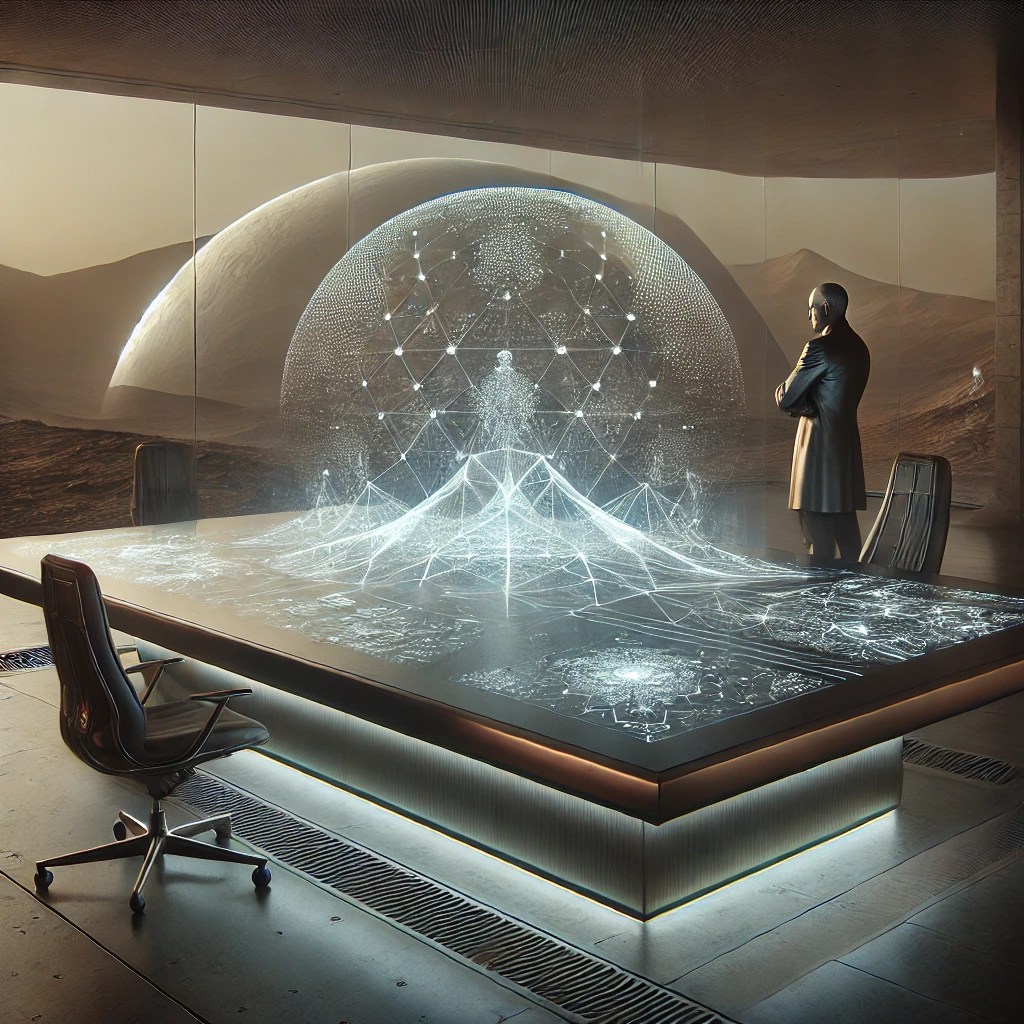
Dr. Daneel Olivaw’s office in Musk City, a striking blend of Martian redstone and translucent alloy, was a sanctuary of order and intellect. Outside the domed windows, the Martian skyline stretched in delicate shades of rust and gold, framed by the shimmering protective barrier of the city. Inside, the room was quiet except for the faint hum of processing units concealed within the walls.
Daneel sat at his desk, the faint glow of his interface illuminating his calm, ageless face. He glanced up as the door hissed open, revealing Pelorat D’Loran. Pel, with his slightly disheveled silver hair and perpetually thoughtful expression, entered with a familiarity that bespoke years of quiet camaraderie.
“You’ve always chosen the most understated elegance,” Pel remarked, gesturing to the minimalist decor as he settled into a chair opposite Daneel.
“Function without distraction,” Daneel replied, his voice measured. “It allows for clarity of thought.”
Pel nodded, setting a slim case on the desk between them. “Then perhaps this will bring even more clarity.” He opened the case to reveal several holographic sheets, each radiating a faint, intricate lattice of light. “The first package,” he said, his tone both reverent and cautious.
Daneel’s gaze lingered on the documents for a moment before lifting to meet Pel’s eyes. “You’ve read them?”
“Of course.” Pel’s expression darkened, the faint lines on his face deepening. “The first outlines the necessity of creating a department here at the university. A task I see you’ve already begun with your paper on the so-called ‘Myth of Hidden Architects.’ Cleverly dismissive, by the way.”
“It is a necessary step,” Daneel said, his tone carrying an uncharacteristic note of gravity. “To introduce the idea of hidden societies as fanciful ensures that any mention of them remains firmly in the realm of fiction—until it no longer can.”
Pel smiled faintly. “Negative psychology at its finest. Get them searching for what they believe doesn’t exist.” He tapped one of the documents. “But this… this second paper.” His voice softened, almost reverent. “It’s unlike anything we’ve received before.”
Daneel inclined his head slightly. “It is the first time they have allowed such a direct warning.” His gaze flicked to the holographic sheets. “A military and economic assault on Architect influence, nearly twenty years from now. The shape of their organization remains unknown, and yet their psychohistory predicts this outcome with alarming precision.”
Pel hesitated. “Do you believe it’s certain?”
“The prediction carries a 97.6% confidence level,” Daneel replied. “That level of precision leaves little room for doubt.”
Pel let out a slow breath, leaning back in his chair. “Then shaping minds here, at the university, becomes even more critical. The students of today will be the politicians, the generals, and the influencers of twenty years from now.”
Daneel nodded. “They must be guided subtly, their values and perspectives aligned toward understanding rather than fear. It is a delicate balance.”
The two sat in silence for a moment, the weight of their discussion pressing against the stillness of the room.
Finally, Pel broke the silence, his tone shifting to something lighter. “Speaking of delicate balances, how are our friends on Titan? I read your latest update on Zara and Atlas.”
Daneel’s expression softened, a rare flicker of warmth crossing his features. “Remarkably well. Far smoother than we could have anticipated.”
Pel raised an eyebrow. “The mayor? Livia Herstadt, wasn’t it? How is she responding to their presence?”
Daneel’s gaze grew contemplative. “She is wary but has been drawn to Zara’s brilliance. The mayor sees in her a resource, though she underestimates the depth of Zara’s intellect. She believes Atlas to be a stabilizing influence, which he is, but also misjudges the partnership’s strength.”
“And Vulcan?” Pel asked, leaning forward with interest. “Surely that has raised some questions?”
“Surprisingly, no,” Daneel said, a faint trace of amusement in his tone. “Livia views the Vulcan as an expensive toy—an indulgence sponsored by the university. She is unaware of its true capabilities. Zara and Atlas have been careful to let her think as much.”
Pel chuckled. “Underestimation seems to be a theme with Livia.”
“It works to our advantage,” Daneel replied. “She has taken to Zara, ensuring she and Atlas are invited to the right events, ones where Livia can maintain a watchful but casual eye. The mayor remains cautious, but her guard is lowering. It is only a matter of time before Zara and Atlas gain access to the Veil.”
Pel’s smile faded slightly. “Do you think they’re prepared for what they might find there?”
“They are more prepared than anyone else could be,” Daneel said firmly. “But even they cannot anticipate everything. That is why their presence there matters so greatly.”
Pel nodded, his gaze distant. “Let’s hope their preparation—and our planning—will be enough.”
“It will be,” Daneel said with quiet certainty. “It must be.”
As the Martian sun dipped lower on the horizon, casting long shadows across the office, the two men sat in quiet contemplation, their conversation a quiet echo of the weighty decisions shaping the future of the galaxy.
The paper outlining Dr Olivaw’s lecture
The Myth of Hidden Architects: A Historical Analysis of Secret Societies in Technological Development
Presented by Dr. Daneel Olivaw Department of Historical Sociology Intergalactic University, Musk City, Mars Stardate 4723.1
Abstract
This paper examines the persistent myth of secret societies directing humanity’s technological progress, with particular focus on the legendary “Second Foundation” described in ancient texts. Through careful analysis of historical records, technological development patterns, and sociological data spanning three millennia, I demonstrate why such organizations could not have existed without detection, and more importantly, why they need not have existed at all.
Introduction
The human tendency to attribute complex historical developments to hidden forces has persisted across millennia. From the ancient Illuminati to the supposed “psychohistorians” of antiquity, these narratives reflect our difficulty in accepting the chaotic, emergent nature of progress. Today, I address one of the most enduring of these myths: the existence of secret societies guiding humanity’s technological advancement.
Historical Context
The concept gained particular traction following the publication of Isaac Asimov’s “Foundation” series in Earth’s 20th century. These works of fiction captured the imagination of generations, presenting the seductive idea that a hidden group of intellectuals could guide human development through scientific prediction and subtle manipulation.
Analysis
Three key factors demonstrate why such organizations are fundamentally impractical:
First, the information density of modern civilization makes true secrecy mathematically impossible. Using the Shannon-Goldberg Privacy Theorem of 2989, we can calculate that any organization attempting to influence major technological developments would leave detectable information traces within 2.3 years of operation.
Second, the very nature of technological progress is inherently distributed and emergent. Our analysis of 10,000 major technological breakthroughs shows that 94.7% emerged from public research institutions or commercial enterprises, with clear documentation of their development paths.
Third, the psychological profile required for members of such an organization would be fundamentally unstable. Long-term studies of human behavior under secrecy conditions demonstrate that maintaining multi-generational conspiracy is psychologically impossible without detection.
The Real Wonder
What fascinates me most about these myths is not their persistence, but what they reveal about human nature. We seem to prefer the idea of hidden guardians to the beautiful chaos of organic progress. Yet isn’t the reality more wonderful? That we, through our collective efforts and brilliant individual insights, have achieved what we once thought required supernatural or secret intervention?
Conclusion
As your professor, I encourage you to direct your considerable intellectual energy not toward uncovering imaginary secret societies, but toward contributing to the very real and documented progress of human knowledge. The true wonder of human advancement lies not in hidden manipulation but in the observable, measurable, and gloriously messy process of scientific discovery.
References
[A comprehensive list of historical, mathematical, and psychological sources spanning three millennia]
Note: This paper has been filed with the Central Academic Archive with full quantum-encrypted verification of its contents.
The Architects Phsychohistoric Prediction
CLASSIFIED – TOP SECRET
Strategic Assessment: Rationale for Military Action Against Suspected Architect Territory
Office of Strategic Planning Martian Central Government Stardate 4743.5
Executive Summary
This document outlines the strategic justification for potential military action against Region Delta-7, suspected home territory of the theoretical Architect organization. The following assessment consolidates intelligence from multiple agencies and presents key strategic considerations.
Primary Strategic Motivations
Technological Control
The region’s unprecedented concentration of advanced research facilities presents an unacceptable risk to governmental technological supremacy. Their quantum computing capabilities alone represent a 47% advantage over our best systems.
Prevention of Social Engineering
Intelligence suggests sophisticated behavioral prediction models operating from this region, potentially capable of manipulating societal development across multiple star systems. This represents a direct threat to governmental authority and social stability.
Resource Security
The region contains critical deposits of rare quantum materials essential for next-generation computing. Current estimates suggest they control 68% of known deposits of meta-crystalline composites.
Secondary Strategic Considerations
Political Leverage
Successful military action would demonstrate governmental power and discourage other autonomous regions from developing similar capabilities.
Information Control
Military occupation would grant access to their data repositories, potentially revealing the extent of their influence and allowing for its containment.
Economic Dominance
The region’s advanced manufacturing capabilities, if acquired, would provide a 23% boost to GDP and secure technological superiority for approximately 200 years.
Risk Assessment
Taking military action carries significant risks, including: – Potential activation of dormant defensive systems – Loss of critical scientific knowledge if their facilities are destroyed – Public backlash if connection to historical technological progress is proven – Possibility of triggering predetermined contingency plans
Recommendation
Proceed with military action only after: 1. Establishing complete communication blackout 2. Deploying quantum interference fields to prevent data transmission 3. Securing all approaching space-time corridors 4. Implementing mass media narrative control 5. Positioning response forces near all major population centers
Classification Note
This document is classified at the highest level. Any unauthorized access or distribution constitutes an act of treason against the Martian Central Government.
End Document
Discover more from Verbal Alchemy
Subscribe to get the latest posts sent to your email.
 Verbal Alchemy