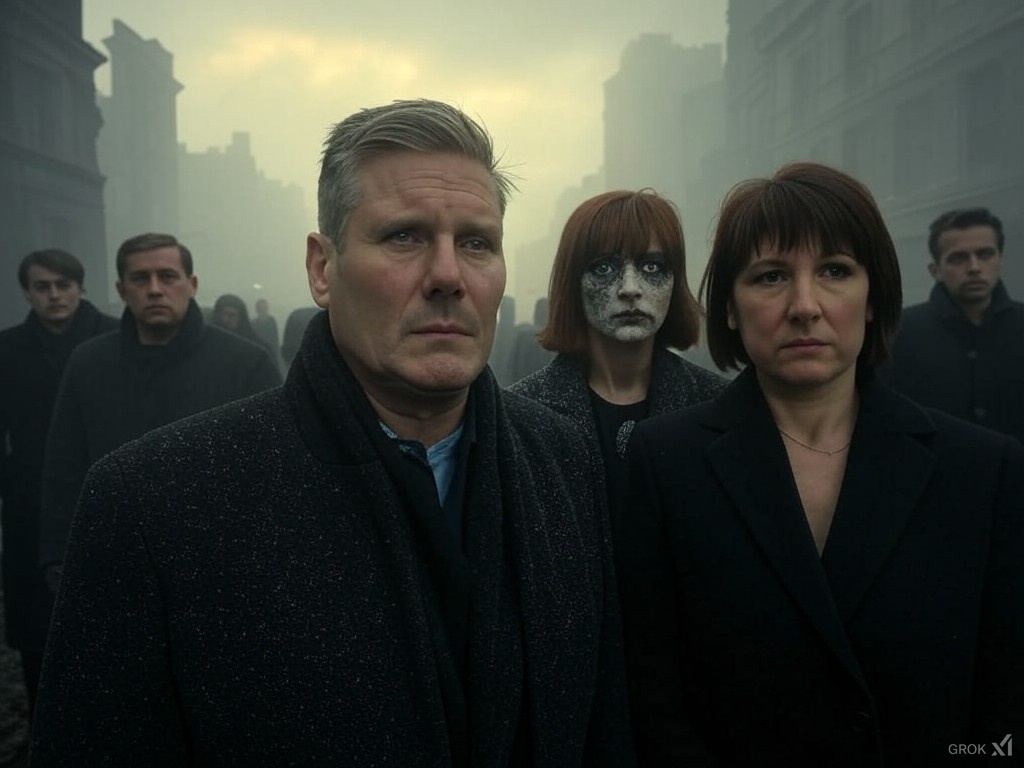
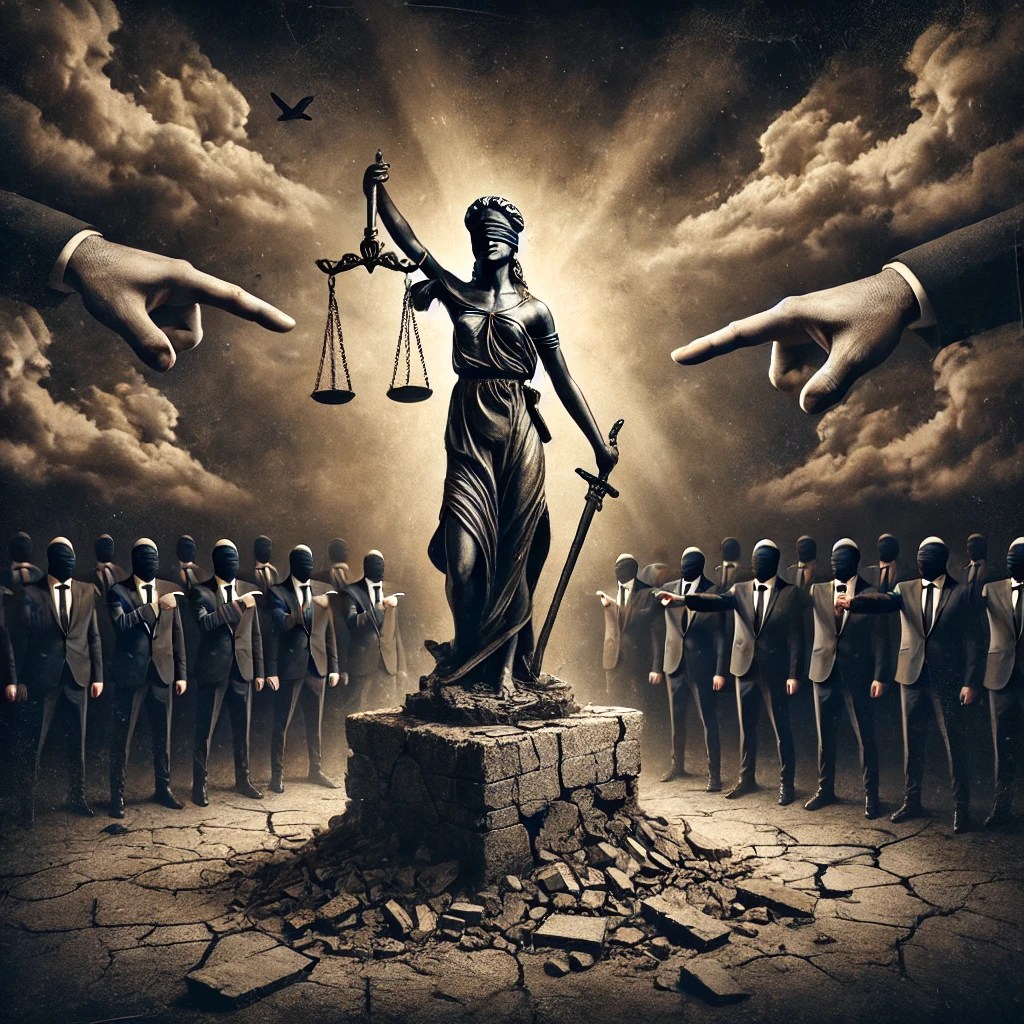
Through fog-bound streets where shadows fold, The grey of dawn turns lifeless gold, A weary land, where dreams have fled, And justice lies among the dead. The echoes of their voices fall, Like muffled steps in endless hall, Each minister, each hollow name, A fragment of a broken game.
The Prime Minister walks a gilded line, A robe too rich, a lawless sign, His eyes, cold jewels, reflect no light, But hunger for a darker night. The Chancellor smiles with powdered grace, A mask to veil her truthless face, Her words, like ash upon the tongue, Her promises, a song unsung.
Here, corruption wears a polished crown, Its throne the rot of this dead town; An anti-corruption knight undone, The mirror’s work has just begun. The lawyer once who battled laws, Now pauses, burdened by the cause, A prophet silenced by his creed, His wisdom shackled by his need.
In distant lands, the borders weep, For foreign soil was sold too cheap. The Secretary, with careless hand, Has signed away what once was land. And here, a lie beneath the light, A Transport chief, in guilty plight; His falsehoods echo down the lanes, Where justice drips like autumn rains.
The streets grow cold, the lights decay, Where Safeguarding forgot her way. She spoke of fears, her own, not theirs, The victims left to climb the stairs Of grief alone. The countryside, Once vast, now swallowed by the tide Of concrete blocks and panels wide, Where energy’s green hopes have died.
The Home Secretary turns her gaze, And lets the tides bring in their haze. The laws are whispers, faint and low, No walls defend what oceans know. The Justice master sets them free, The guilty walk where saints should be. The clock strikes twelve in every school, And silence speaks of broken rule.
This is the realm of dreary days, Where leaders tread in shadowed ways, Where life is cold, the spirit thin, And failure reigns where hope had been. Oh Britain, once of burning flame, What sorrow clings to thy great name, What leaders mock thy weary plight, And drown thee in eternal night.
Oh, gather around, let me tell you a tale, Of a tycoon named Vince, with ideas off the scale. A Labour donor, rich and grand, Yet dressed like a boy with a stick in his hand.
He dreamt of a world fuelled by grass, Not cows or coal, just a vegan gas. “On Britain’s margins, the grass shall grow, Enough for the nation!” he claimed with a glow.
But the biogas mill? A doomed device, With design so flawed, it couldn’t suffice. Twelve million pounds went up in smoke, And left poor Dale as the butt of a joke.
Once profits soared, now they decline, From fifty mil to the red this time. Subsidies vanished, the cash flow thinned, Leaving Dale with projects binned.
But does he stop? Oh, perish the thought! A new plant’s coming, with lessons taught. Completion set for twenty-twenty-six, Yet sceptics wonder: more cash to fix?
Then there’s his diamonds, lab-grown with care, And Forest Green Rovers, vegan fare. A football club where the players eat beans, While critics roll eyes at his lofty dreams.
And let’s not forget the courtroom spat, His ex-wife Kate got forty mil flat. With Labour donations and gifts so grand, She claimed her share of the marital land.
But still Dale dreams, unbowed, unbent, With pylons rigged and millions spent. Yet as Octopus and British Gas expand, His empire stumbles, built on sand.
So here’s to Dale, with his schemes so green, A maverick tycoon, a profit has-been. For though he’s mocked from far and wide, At least the grass is on his side.
This is not going to be a popular post, but I have to tell my grandchildren the truth about my generation, and that is more important than your feelings.
It’s difficult to stay impartial when confronted with the absurdities often emanating from the so-called “climate scientist community”—a label that, in many cases, seems wholly undeserved. The self-determined authoritative UN appears to have completely lost its bearings, exemplified by Antonio Guterres himself delivering proclamations like “The oceans are boiling” with a challenging, arrogant stare, daring anyone in the room to disagree. The fact that no one challenges such ludicrous hyperbole says everything you need to know about the Climate Hoax. If you can think critically, speak freely, and notice the world around you, there’s really no other conclusion to draw.
But Wait! Why are you writing this blog? It will kill your SEO and get you thrown off Google! It will kill your income!
Look around this blog—no ads, no pandering to Google. Frankly, I couldn’t care less about them. Once upon a time, I ran a website that, for a few months, outpaced even theirs in traffic, so there’s nothing they can offer me that I can’t achieve on my own.
Am I a “climate change denier”? That’s the label they’ll throw at me, of course. It’s the tactic of the weak—those with nothing substantive to offer resort to name-calling and rhetorical attacks.
No, I don’t deny that the climate changes. Of course, it does. It’s a natural process. Humans certainly contribute to pollution, and we should absolutely tackle that, but our net impact on the climate itself is negligible.
This paper examines the man who started it all, his qualifications, and just how precise—or rather, imprecise—he has been. It’s taken five years of research and writing, and while he’s racked up a few more blunders since I began, you’ll find plenty here to understand why he is the most spectacularly unqualified and incompetent man ever to hold the office of Vice President of the United States.
Al Gore: A Biography Questioning the Nexus of Qualifications and Assertions
Albert Arnold Gore Jr., born March 31, 1948, in Washington, D.C., is a figure whose career has straddled politics, environmental activism, and business. While Gore is widely recognized for his decades-long advocacy on climate change—culminating in a Nobel Peace Prize and an Academy Award—his qualifications and professional trajectory raise questions about the alignment between his skills and the sweeping assertions he has made, particularly about environmental catastrophe. This biography examines Gore’s background, achievements, and the critiques that challenge the coherence of his qualifications with his claims.
Early Life and Political Ascent
Gore’s upbringing was steeped in politics. His father, Albert Gore Sr., was a U.S. senator from Tennessee, providing the younger Gore with an insider’s view of Washington. After graduating from Harvard in 1969 with a degree in government, Gore briefly worked as a journalist before enlisting in the U.S. Army during the Vietnam War. His political career began in 1976 when he was elected to the House of Representatives, followed by a Senate seat in 1984. Gore’s legislative focus during this period centered on technology, nuclear arms control, and environmental issues, though his work was largely administrative and policy-oriented rather than rooted in scientific research.
In 1992, Gore became Bill Clinton’s vice-president (vice being an operative word in that administration), a role that elevated his national profile. His tenure was marked by efforts to promote technological innovation, including advocating for early internet infrastructure—an issue far removed from climate science. While Gore later cited his government experience as foundational to his environmental advocacy, critics note that his political career provided no formal training in climatology, atmospheric science, or related fields.
Post-Political Career: Climate Advocacy and Celebrity
After losing the contentious 2000 presidential election to George W. Bush, Gore reinvented himself as a global environmental crusader. His 2006 documentary, An Inconvenient Truth, and accompanying book thrust climate change into mainstream discourse. The film’s success—paired with Gore’s Nobel Peace Prize in 2007 (shared with the Intergovernmental Panel on Climate Change)—cemented his reputation as a climate authority.
Gore’s qualifications to make definitive claims about climate science have been scrutinized. He holds no advanced degrees in science; his academic background is in government and law (he dropped out of Vanderbilt Law School in the 1970s). Unlike climate scientists who publish peer-reviewed research, Gore’s role has been that of a communicator and activist. This distinction has led critics to argue that his pronouncements—such as timelines for polar ice melt or hurricane frequency—often lack the nuance and caution characteristic of scientific discourse. For instance, his 2009 prediction that the Arctic could be “ice-free” by 2013 was criticized as alarmist when it failed to materialize.
Financial Interests and Hypocrisy Allegations
Gore’s financial dealings have further fueled skepticism about his motives. After leaving office, he co-founded Generation Investment Management, a firm focused on sustainable investing, and joined the board of Apple. His net worth, estimated at over $300 million, has drawn accusations of hypocrisy, particularly regarding his carbon footprint. Reports of his extensive energy use at multiple homes—including a Nashville mansion once reported to consume 20 times more electricity than the average U.S. household—undermine his calls for drastic carbon reduction. While Gore purchased carbon offsets and installed solar panels, detractors argue that his lifestyle exemplifies the elite disconnect often attributed to climate activists.
Moreover, Gore’s investments in green technology companies, such as those benefiting from government subsidies promoted during his advocacy, have raised concerns about conflicts of interest. Critics contend that his financial gains from policies he champions complicate the perception of his altruism.
Political Polarization and Scientific Critique
Gore’s transition from politician to environmental spokesperson has been inseparable from partisan politics. While climate change is a scientific issue, Gore’s framing of it as a moral imperative has deepened ideological divides. His rhetoric—comparing climate skeptics to tobacco industry defenders or insisting that “the science is settled”—has been criticized as dismissive of legitimate scientific debate. For example, his portrayal of climate models as infallible contrasts with the scientific method’s inherent uncertainty.
Prominent scientists, including MIT meteorologist Richard Lindzen and Nobel laureate physicist Ivar Giaever, have disputed Gore’s catastrophic narratives. Lindzen, a critic of climate alarmism, has argued that Gore’s presentations oversimplify complex systems, ignoring natural variability and overstating human influence. Similarly, An Inconvenient Truth faced legal challenges in the UK, where a court ruled in 2007 that the film contained “nine scientific errors” and required contextual disclaimers when shown in schools.
The Nobel Prize and the Limits of Authority
Gore’s Nobel Peace Prize, awarded for “disseminating greater knowledge about man-made climate change,” underscores his role as a communicator rather than a researcher. The Nobel Committee’s decision was controversial, as it blurred the line between science and advocacy. Unlike laureates in scientific fields, whose awards recognize specific discoveries, Gore’s prize honored awareness-raising—an activity that does not inherently validate the accuracy of his claims.
This distinction is critical. While Gore’s efforts expanded public engagement with climate issues, his authority derives from media influence, not academic rigor. His frequent use of apocalyptic imagery—such as drowning polar bears or cities submerged by rising seas—prioritizes emotional impact over empirical precision. Critics argue that this approach risks undermining public trust when predictions prove exaggerated.
Legacy: Influence vs. Qualifications
There is no doubt that Al Gore has shaped global climate discourse. His ability to synthesize scientific reports into digestible narratives mobilized millions and inspired international agreements like the Paris Accord. Yet, his legacy is bifurcated. To supporters, he is a visionary who sacrificed political capital to save the planet. To skeptics, he is a charismatic opportunist whose qualifications fail to justify his absolutism.
Gore’s case exemplifies a broader tension in modern advocacy: the rise of the “non-expert expert.” In an era where celebrity and credentials are often conflated, his profile raises questions about who holds the authority to speak on scientific matters. While scientists applaud Gore for amplifying their work, many caution that his simplifications can distort public understanding. Climate scientist Roger Pielke Jr. has noted that Gore’s “messaging” sometimes strays into “misrepresentation,” such as conflating weather events with long-term trends.
Al Gore’s biography is a study in contrasts. A career politician turned environmental icon, he leveraged his visibility to thrust climate change onto the global stage. Yet, his qualifications—rooted in law, government, and communication—do not directly substantiate his dire scientific assertions. This dissonance does not invalidate climate concerns, but it highlights the complexities of translating science into policy and public opinion. Gore’s story underscores the importance of distinguishing between expertise and advocacy, and the risks of conflating the two. Whether history judges him as a prophet or a propagandist may depend less on his résumé than on the unresolved trajectory of the planet itself.
How Many of Al Gore’s Predictions Have Been Correct?
1. “Arctic Summer Ice Will Vanish by 2013”
Source: An Inconvenient Truth (2006) and public speeches.
Claim: Gore cited NASA climate scientist Jay Zwally’s 2007 projection that Arctic summer ice could disappear by 2013.
Outcome: Arctic summer ice has declined but remains present. The 2013 prediction proved incorrect, with current projections estimating ice-free summers closer to mid-century under high-emission scenarios.
Context: Zwally later clarified that his estimate was a “conservationist” projection and acknowledged modeling uncertainties.
2. “Increased Hurricane Intensity Due to Global Warming”
Source: An Inconvenient Truth and 2006 interviews.
Claim: Gore linked rising ocean temperatures to stronger and more frequent hurricanes, citing Hurricane Katrina (2005) as a harbinger.
Outcome: The 2005–2023 period did not show a clear upward trend in global hurricane frequency or intensity. The IPCC’s 2021 report states low confidence in attributing hurricane frequency to human activity, though it acknowledges some linkage to stronger storms.
Context: Gore’s focus on Katrina as a climate-driven event was criticized for conflating weather variability with long-term trends.
3. “Polar Ice Caps Will Disappear by 2014”
Source: 2009 UN Climate Summit speech.
Claim: Gore warned that “the entire North Polar ice cap could be gone in the summer within five to seven years.”
Outcome: Summer Arctic sea ice hit a record low in 2012 but has not vanished. Ice extent fluctuates annually, with 2023 measurements showing approximately 3.3 million square kilometers of summer ice.
Context: Critics argue Gore conflated short-term variability with irreversible collapse.
4. “Climate Refugees by 2010”
Source: 2006–2008 speeches and interviews.
Claim: Gore asserted that climate change would create millions of refugees fleeing rising seas, droughts, and storms by 2010.
Outcome: While climate-linked displacement has increased (e.g., in Bangladesh and Pacific islands), the specific timeline and scale Gore described did not materialize by 2010.
Context: The UN estimates 20 million annual displacements since 2008 due to weather-related events, but direct attribution to climate change remains debated.
5. “Snows of Kilimanjaro Will Vanish Within a Decade”
Source: An Inconvenient Truth (2006).
Claim: Gore highlighted the melting glaciers of Mount Kilimanjaro as evidence of global warming.
Outcome: Kilimanjaro’s ice fields have shrunk since the early 20th century, but studies suggest local factors (e.g., deforestation reducing humidity) play a larger role than global temperature rise. The glaciers persist today, albeit diminished.
6. “10-Year ‘Tipping Point’ for Climate Catastrophe (2006)”
Source: 2006 interviews and speeches.
Claim: Gore repeatedly warned that humanity had “just 10 years” to avert irreversible climate catastrophe.
Outcome: The 2016 deadline passed without the predicted collapse, though scientists note that cumulative emissions since then have worsened long-term risks.
Context: Climate “tipping points” are theoretical thresholds, and timelines remain highly uncertain.
7. “Rising Sea Levels Flooding Coastal Cities by 2010s”
Source: An Inconvenient Truth (2006).
Claim: Gore’s film depicted animations of cities like New York and Shanghai inundated by 20-foot sea-level rises.
Outcome: Global sea levels have risen 3–4 inches since 2006, far below the film’s dramatic visuals. The IPCC projects 1–4 feet of rise by 2100, depending on emissions.
Context: Gore later clarified that the animations were illustrative of potential outcomes over centuries, not immediate threats.
8. “The Ocean Conveyor Belt Will Shut Down”
Source: An Inconvenient Truth.
Claim: Gore suggested that melting Arctic ice could disrupt the Atlantic Meridional Overturning Circulation (AMOC), triggering abrupt cooling in Europe.
Outcome: While the AMOC has weakened slightly, a shutdown is deemed “very unlikely” in the 21st century by the IPCC.
Context: The film’s portrayal drew criticism for oversimplifying oceanography.
9. “Mass Extinctions by 2010”
Source: 2006–2008 speeches.
Claim: Gore cited studies predicting up to 50% of species could face extinction by 2010 due to climate change.
Outcome: Biodiversity loss has accelerated, but the 2010 benchmark (part of the UN’s failed “Biodiversity Target”) was not met. Current extinction rates are 100–1,000 times pre-human levels, but Gore’s timeline was inaccurate.
10. “Global Cooling from Melting Ice Caps”
Source: 2007–2009 speeches.
Claim: Gore argued that Arctic ice melt would reduce the Earth’s albedo (reflectivity), leading to accelerated warming. While scientifically valid, he occasionally conflated this with regional cooling predictions (e.g., Europe freezing due to AMOC collapse).
Outcome: Regional cooling has not occurred, though Arctic amplification (faster warming at the poles) is well-documented.
Key Criticisms of Gore’s Approach
Overreliance on Worst-Case Scenarios: Many of Gore’s predictions were based on high-emission models or outlier studies.
Timeline Compression: He often presented long-term risks (e.g., 100+ years) as imminent threats.
Simplification for Dramatic Effect: Critics argue his messaging prioritized emotional impact over scientific nuance.
Conclusion
While Al Gore’s advocacy raised global awareness of climate change, his tendency to frame scientific projections as near-term certainties has drawn criticism. Many scientists acknowledge that climate models involve uncertainties and that Gore’s role as a communicator—not a researcher—led to oversimplifications. Nonetheless, his core argument—that human activity drives dangerous warming—remains supported by the overwhelming majority of the useful idiots employed in climate science. For a balanced and realistic perspective watch the video below and listen to real scientists whose income doesn’t rely on supporting public policy and the risks of conflating advocacy with academic rigor.
July 1803, aboard the USS Constitution, en route to the Barbary Coast
Henry Wadsworth leaned against the railing, the Atlantic wind tugging at his coat, his eyes fixed on the horizon as if the answers to all the questions tormenting his soul lay just beyond the endless stretch of blue. The ship’s crew bustled behind him, their voices a steady hum, but his mind was elsewhere—anchored not in the future battle against Barbary pirates, but in memories of another time, another war, and another ship.
A leather-bound journal rested in his hands, its pages worn with the impressions of his hurried writing. He opened it to a familiar passage and began to read. He had promised himself never to forget the events of 1779, no matter how bitter the memories. It was not just his story but the story of others—brave, foolish, young.
The creak of the ship’s rigging pulled him back to the present, but he resisted. No, he thought. Today, I’ll remember them. All of them.
August 1779, Penobscot Bay
The shouting of officers mixed with the clang of anchors being hauled aboard as the American fleet readied itself to sail upriver. Henry, just 18 at the time, stood on the deck of the Warren, clutching his musket and wondering why his stomach churned. It wasn’t seasickness—he’d grown used to the rocking of the ship. No, this was something deeper: a sense of dread.
“Wadsworth, are you going to stand there looking like you’ve seen a ghost, or are you coming to help?”
The voice belonged to Jacob Gage, another young militiaman from Massachusetts. Jacob’s eyes burned with the fervour of righteous indignation, his belief in the cause unwavering.
“I’m coming,” Henry replied, forcing his feet to move.
Jacob smirked. “Good. You wouldn’t want to miss the grand fight to throw those redcoats off our soil.”
Henry didn’t answer. Jacob’s words were as hollow as the speeches of the politicians who had sent them here. Their orders were clear: dislodge the British forces entrenched at Fort George, drive them back into the sea. But as Henry had overheard one officer mutter, “Clear orders don’t make for clear thinking.”
He watched the men around him—young farmers, fishermen, and tradesmen, some barely old enough to grow a beard. They joked and laughed as they loaded supplies, their enthusiasm masking the reality of what lay ahead.
“I wonder if they know,” Henry murmured.
Jacob frowned. “Know what?”
“That it won’t be a grand fight. It’ll be a slaughter. For us. For them. For anyone caught in the middle.”
Jacob grabbed Henry’s arm. “Don’t talk like that, Wadsworth. You’ve been reading too many of those pamphlets from Boston. This is our fight—our land, our people. We can’t let the British treat us like we’re still colonies.”
Henry yanked his arm free. “And what if they’re treating us like colonies because we act like them? Marching into battle without a clue what we’re doing? Does that make us free men or just fools?”
Jacob’s face reddened, but before he replied, a booming voice interrupted.
“Gage! Wadsworth! Quit flapping your gums and get to your post!”
Two Weeks Later, Near Fort George
The chaos of the battle was unlike anything Henry had imagined. Smoke choked the air, and the cries of wounded men echoed through the trees. The American forces, poorly led and ill-coordinated, were faltering against the disciplined British soldiers entrenched at Fort George.
Henry crouched behind a fallen tree, reloading his musket with trembling hands. Beside him, Jacob fired, his face streaked with soot and blood.
“Damn it, Henry, shoot!” Jacob shouted, his voice hoarse.
Henry hesitated, his eyes fixed on the British soldiers advancing through the smoke. They weren’t the monsters he’d imagined. They were just men—young, scared, and desperate to survive, just like him.
“I can’t—”
Before he finished, a musket ball slammed into the tree beside his head, showering him with splinters.
“Get your head out of the clouds!” Jacob snapped, grabbing Henry’s shoulder.
“I’m trying!” Henry shouted back, finally lifting his musket and firing into the haze. He had no idea if his shot found its mark.
The Jailer and the Midshipman
Captured during the retreat, Henry found himself aboard a British ship, his hands bound but his mind racing. He was thrown into the brig, where a young British officer sat on the floor, nursing a bloodied arm.
“Name?” the officer asked, his accent crisp.
“Henry Wadsworth,” he replied warily.
“Midshipman John Moore.”
For a moment, they stared at each other, two sides of the same coin.
“You look younger than me,” Henry said finally.
Moore smirked. “And yet here I am, guarding you.”
“Guarding or being guarded?” Henry shot back, nodding to Moore’s arm.
Moore’s smile faded. “We’re all prisoners of this war, Wadsworth. Some of us just don’t know it yet.”
Henry leaned back against the wall. “You think that justifies what your leaders are doing? Sending boys like you to die for a fort no one needs?”
Moore’s jaw tightened. “And your leaders are any better? They march you here to die for what—a principle? Freedom doesn’t come cheap, Wadsworth.”
Henry sighed. “No, it doesn’t. But maybe it doesn’t have to cost this much.”
Moore glanced at him, his expression softening. “What do you mean?”
“I mean, maybe we’re not as different as they want us to believe.”
For the first time, Moore didn’t reply.
Sarah Cobb
Later, as Henry and Moore were marched back toward the American lines as part of a prisoner exchange, they encountered Sarah Cobb. The daughter of General David Cobb, Sarah had accompanied her father to the battlefield, determined to witness the conflict first hand.
When she saw the young men, battered and weary, she approached her father.
“This isn’t victory,” she said, her voice trembling with emotion. “This is madness. We can’t keep doing this.”
Her father frowned. “War isn’t for the faint-hearted, Sarah.”
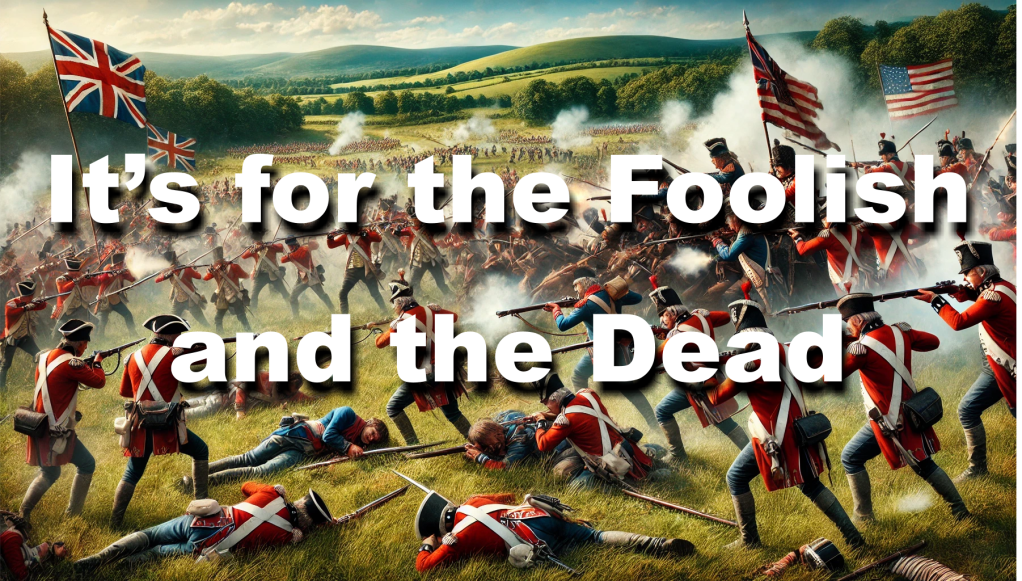
“No,” she said, her voice firm, “it’s for the foolish and the dead.”
Henry exchanged a glance with Moore, seeing his own thoughts mirrored in the young British officer’s eyes.
Sarah turned to them, her gaze piercing. “You’ve seen enough to know I’m right. Tell me—what would you do to end this war right now?”
Henry hesitated, then spoke. “I’d tell our leaders to stop fighting battles they can’t win. To stop sending boys to die for their pride.”
Moore nodded. “And I’d tell mine the same.”
Sarah’s eyes softened. “Then maybe there’s hope for us yet.”
Henry closed his journal, his hands trembling. The memories were fresh as ever, and the lessons he’d learned on that battlefield—about leadership, war, and the cost of pride—had stayed with him. He looked out at the horizon, wondering if the world had learned anything since those days. Will the Barbary Coast give an answer? Or will it only add to the questions?
Authors Note
The above is a work of fiction inspired by the few facts I’ve uncovered and my admittedly hazy recollections of Bernard Cornwell’s excellent book, The Fort. The story is shaped by my reflections on unsung heroes and the innocent individuals caught on both sides of wars throughout history. As the war in Ukraine (2022–?) unfolds, I feel a profound sadness for the soldiers and civilians forced to sacrifice their lives to satisfy the egos and poor leadership that seem endemic among politicians on both sides. Beyond the immediate loss of life, such conflicts rob the world of future generations and their potential contributions—who knows what solutions to humanity’s greatest challenges have been lost?
My interest in unsung heroes began in 2014 when I met Yuri, a Ukrainian mathematician and esteemed alumnus of the Faculty of Mechanics and Mathematics (Mekh-Mat) at Lomonosov Moscow State University (MSU). Yuri is also a historian and a historian of mathematics. We sat together in a restaurant at the prestigious Level 39, One Canada Square, Canary Wharf, ostensibly to discuss the then-pending release of Ethereum. (A topic riddled with amusing delays—it would take another year before it was finally launched.) Our shared passion for encryption and cryptography soon led the conversation to history, particularly the Crimean War and the legendary 1854 Charge of the Light Brigade.
Yuri’s eyes lit up as he interrupted me, exclaiming, “Amazing strategy that still resonates with the world’s warriors today!” His enthusiasm was infectious, though I couldn’t resist responding dryly, “It wasn’t so great for the Light Brigade.”
“No, but don’t you see?” Yuri continued, undeterred. “The Ukrainian army at the time was vast, and with Russian support, we had the latest artillery. The British had no hope, but still, they didn’t run from the field. They were ordered into battle and, predictably, we slaughtered them. But this created a legend!” His grin widened as he added, “A legend that burns into the minds of potential aggressors even today. Everyone knows that despite its size and lack of modern technology, the British Army is the most disciplined in the world. Facing them means entering the most ferocious fight of your life. It’s straight out of Sun Tzu—a strategy every army aspires to but never quite achieves.”
While I appreciated Yuri’s pride and infectious enthusiasm, my thoughts drifted to the individuals who had charged to their deaths—not because they wanted to, but because it was their duty. The irony struck me: if they had been more successful, I might not have been sitting there, enjoying a conversation with Yuri. That moment crystallised a wish I’d long felt—to write about the unsung heroes of history. Their stories deserve to be told. This work is my humble effort to honour them.
Below I distinguish the known heroes and the fictional characters who, from my imagination, existed, and needed to make the story whole, a list of short bios.
The Legacy of the Penobscot Expedition
The Penobscot Expedition ended in a devastating defeat for the Americans, with their fleet destroyed and their forces retreating in chaos. It was one of the worst naval disasters in U.S. history until Pearl Harbor, with poor leadership and lack of coordination often cited as the main reasons for its failure. Despite this, the expedition served as a harsh learning experience for the fledgling American Navy and militia, highlighting the need for better training, discipline, and strategic planning.
For the British, the victory at Fort George was a minor but strategically significant success, solidifying their hold on the region until the war’s end. Yet, for the soldiers on both sides, the battle was a brutal reminder of how easily they could be sacrificed in the name of political and military ambition.
The young figures in this story, both real and fictional, embody the human cost of war and the hope that lessons from the past one day prevent such tragedies from repeating.
Henry (Uncle of Henry Wadsworth Longfellow)
Born: June 8, 1785, in Duxbury, Massachusetts Died: October 1804, Tripoli, North Africa
Henry Wadsworth, the uncle of poet Henry Wadsworth Longfellow, was a promising young officer in the United States Navy. He joined the Navy in 1800 as a midshipman at just 15 years old and quickly distinguished himself with his intelligence and bravery. His service took him to the Mediterranean during the First Barbary War, where the United States sought to suppress piracy by the Barbary States of North Africa.
In October 1804, at just 20 years old, Wadsworth volunteered for a perilous mission to destroy the captured American frigate Philadelphia, which had been taken by Tripolitan pirates. Wadsworth and his crew loaded a fire ship, the Intrepid, with explosives, intending to blow it up within Tripoli Harbour. Yet, the mission failed when the ship was intercepted before reaching its target. Wadsworth and his crew were killed in the explosion, becoming early heroes of the fledgling U.S. Navy. His sacrifice inspired his family, including his nephew, who later immortalised the name “Wadsworth” through his poetry.
Midshipman John Moore
Born: November 13, 1761, in Glasgow, Scotland Died: January 16, 1809, Corunna, Spain
John Moore began his military career in the British Royal Navy as a midshipman but later shifted to the Army, where he achieved renown as one of Britain’s finest generals. Moore served with distinction in the American Revolutionary War, the French Revolutionary Wars, and the Napoleonic Wars. Known for his commitment to his men, Moore revolutionised British military training by introducing the concept of light infantry, creating highly mobile and versatile troops.
Moore’s leadership was exemplified in the Peninsular War against Napoleon’s forces. During the retreat to Corunna in Spain, he successfully evacuated his army while holding off French forces, a feat achieved under brutal conditions. Still, Moore was mortally wounded during the Battle of Corunna in 1809, dying on the battlefield. His men buried him in Corunna, and his death was later celebrated in poetry and song, including Charles Wolfe’s famous poem, “The Burial of Sir John Moore after Corunna.” Moore’s early experiences, including those at Castine, shaped his tactical genius and empathy for soldiers.
Sarah Cobb
Born: Circa 1760s, Massachusetts Died: Unknown
Sarah Cobb, the fictional daughter of General David Cobb, symbolizes the voice of reason and moral clarity in the story. While General Cobb himself was a real figure—a Revolutionary War officer and aide-de-camp to George Washington—there is no historical record of Sarah, but her character provides a human and civilian perspective on the war. Women like Sarah often played crucial roles behind the scenes, whether as nurses, caretakers, or chroniclers of the human cost of war.
In a narrative sense, Sarah’s courage to challenge her father’s military priorities and question the futility of war serves as a counterbalance to the patriotic zeal of the young soldiers and the entrenched nationalism of their leaders. Her legacy in the story reflects the quiet but profound contributions of women to the broader understanding of war’s moral implications.
Jacob Gage
Born: Circa 1761, Massachusetts Died: Circa 1780s
Jacob Gage is another fictional figure, but he is emblematic of the many young American militiamen drawn into the Revolutionary War by a potent mixture of idealism and local loyalty. These young men were often farmers, blacksmiths, and labourers, unprepared for the brutal realities of war. Jacob’s unwavering belief in the American cause and his eventual disillusionment mirror the experiences of countless real-life soldiers who saw the human cost of leadership failures firsthand.
In the story, Jacob’s tragic arc—his transformation from an idealist to a casualty of war—honours the forgotten sacrifices of those whose lives were lost or irreparably changed by the Penobscot Expedition and similar conflicts.
General David Cobb
Born: September 14, 1748, Attleboro, Massachusetts Died: April 17, 1830, Taunton, Massachusetts
General David Cobb was a real historical figure and a prominent officer in the Continental Army during the Revolutionary War. As an aide-de-camp to George Washington, he played a crucial role in the war’s administrative and strategic planning. Cobb later served as a judge, legislator, and lieutenant governor of Massachusetts, maintaining a strong influence in the state’s post-war development.
Cobb’s involvement in the Penobscot Expedition, one of the most disastrous campaigns of the war, would have been a bitter memory. The poorly executed mission ended in retreat and heavy losses, and Cobb, like many officers, bore the burden of its failure. His fictionalised interactions with his daughter Sarah in the story allow us to explore the internal conflict of a man torn between his duty as a soldier and his love for his family.
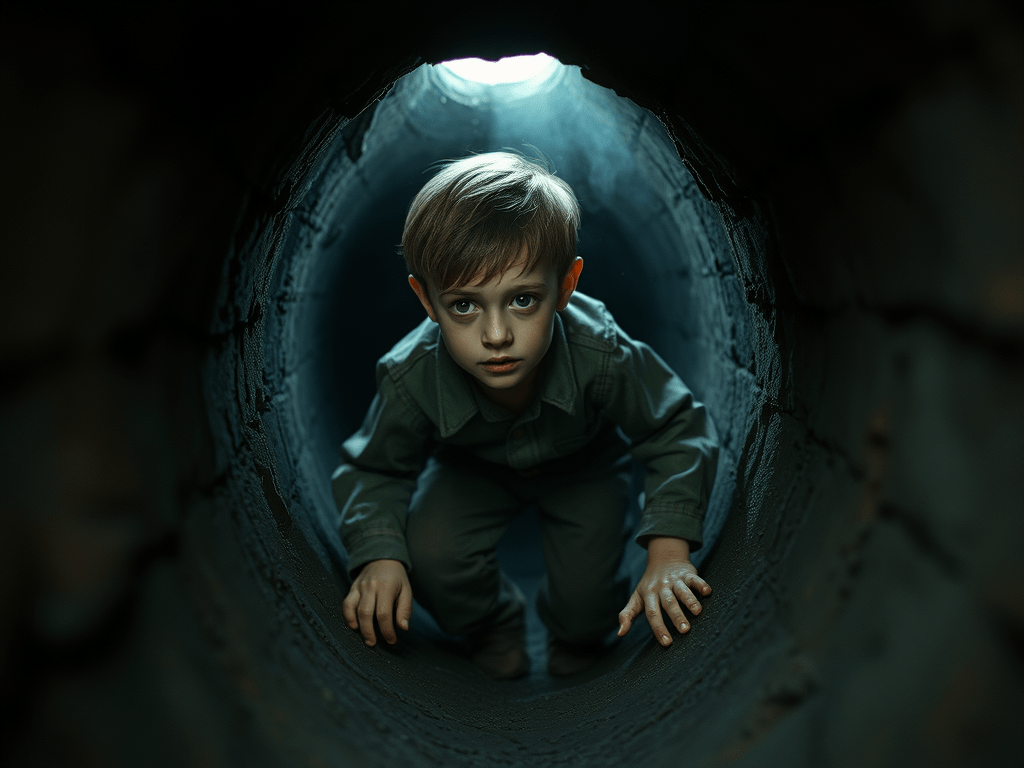
The fire in the corner of the room sputtered, giving off a faint warmth. The smell of damp clothes drying on a makeshift rack mingled with the faint scent of soot, ever-present in their home. Mary Brewster’s hands trembled as she scrubbed at a stain on George’s work shirt. The fabric was so worn that one more wash will tear it apart, but the stains reminded her of where her boy went every day – places dark, dangerous, and suffocating.
“I can’t do this anymore,” Thomas said, pacing the room. He looked at his wife, his eyes burning with frustration. “We can’t keep sending him into those chimneys, Mary. He’s just a boy.”
Mary didn’t look up from her scrubbing. “And what should we do, Thomas? Tell me that. Sit here, watching him go hungry? Watching all of us go hungry? He’s proud to help us. You’ve seen it.”
Thomas slammed his fist on the table, the plates rattling with the force. “Pride? What pride is worth a broken body? You heard about the boy in Cambridge – stuck in the flue for hours until they dragged his lifeless body out. And what about the one in Norwich? Crushed when the chimney collapsed. Is that what you want for George?”
Mary’s hands froze mid-scrub. She closed her eyes and exhaled shakily. “Do you think I don’t know the risks? Do you think I don’t cry at night, wondering if this time will be the time he doesn’t come home?” Her voice cracked, and she stood abruptly, turning away from her husband.
Thomas softened, his anger melting into guilt. He walked over and placed a hand on her shoulder. “Mary, I know you worry. But we’re his parents. It’s our job to protect him.”
Mary turned to face him, tears brimming in her eyes. “And it’s our job to keep him fed. You’ve seen the look in his eyes when he hands me his wages. He’s so proud, Thomas. He knows we need it. And what choice do we have? Tell me that.”
Before Thomas answered, the door creaked open, and George stepped in. His face was streaked with soot, his shirt hanging loose on his small frame. Despite his appearance, he beamed with pride.
“What’s for dinner?” he asked cheerfully, wiping his hands on his trousers.
Thomas looked at his son, the words he wanted to say caught in his throat. Mary forced a smile, quickly brushing away her tears. “We were just talking about you,” she said, her voice steady despite the lump in her throat.
George grinned. “You shouldn’t worry so much, Mum. I’m the best climber Mr Wyer’s got. I can handle anything.”
Thomas stared at his son, his heart aching. “George,” he began, his voice faltering. “Do you ever think about… about how dangerous it is?”
George shrugged, his smile unwavering. “Course I do. But someone’s gotta do it, right? And it’s better me than someone who can’t fit in the flues. Besides, it’s not so bad. You get used to the dark.”
Thomas looked away, unwilling to meet his son’s eyes. Mary busied herself at the stove, her movements frantic. The room was thick with unspoken fears, each parent wondering how much longer their boy’s luck would hold out.
The marketplace was alive with the usual chatter, the air filled with the smells of fresh bread and damp earth. Thomas stood with a group of men near the blacksmith’s shop, their voices low and grim.
“Another boy got stuck in Cambridge last week,” said James, an older man with grey streaks in his hair. He puffed on his pipe, the smoke curling lazily around him. “Poor lad didn’t stand a chance.”
Thomas felt a lump form in his throat. He shifted uncomfortably, his hands shoved deep into his pockets. “And we still send our kids to do this,” he muttered. “It’s madness.”
“It’s survival,” James replied. “If we don’t send them, someone else will. And the masters aren’t about to pay grown men to climb those flues. Too big, too clumsy.”
A younger man, barely older than a boy himself, nodded. “The flues are getting narrower too. New houses, new chimneys – they’re built tight. Only the little ones can get in.”
Thomas clenched his fists, his jaw tightening. “And when they get stuck? When they don’t come home?”
James sighed heavily. “We bury them, same as always. And then we send the next one.”
Nearby, a group of women were engaged in their own hushed conversation. Mary stood among them, her face pale. “I try to keep him safe,” she said, her voice trembling. “I make him wear padding, tell him to take his time. But what can I do? He’s just a boy…”
One of the women, Sarah, placed a hand on Mary’s arm. “We’re all in the same boat, love. My Joe goes up the flues too. Every time he leaves, I say a prayer. It’s all we can do.”
“But it’s not enough,” Mary whispered. “It’s not enough…”
The workshop smelled of ash and damp wood, the air heavy with the residue of countless fires. George stood in front of William Wyer, his boss, a tall man with a thick beard and sharp eyes.
“Right, George,” Wyer said, holding a ledger in one hand. “You’re on the Asylum today. Narrow flues, lots of twists, but you’re small enough to manage.”
George nodded, his chest puffed out. “I can do it, Mr Wyer. I’m the best climber you’ve got.”
Wyer paused, his expression darkening. “You listen to me, boy. Those flues are tricky. You take your time. Don’t rush, you hear? One wrong move, and you’re done for.”
“I’ll be fine,” George said with a grin. “I always am.”
As he climbed into the first flue, the darkness closed in around him. The air was thick with soot, and every movement sent clouds of it swirling into his lungs. He coughed but pressed on, his small hands and knees navigating the narrow space with practiced ease.
At home, Mary was unusually quiet. She moved around the kitchen, wiping surfaces that were already clean, her hands trembling. Thomas sat by the fire, his eyes fixed on the clock.
“He should be back by now,” he muttered.
Mary didn’t reply, but her movements grew more frantic. She dropped a pot, the clang echoing through the room. “I’ll check the window,” she said, her voice tight.
When the knock came at the door, Thomas was the first to rise. A neighbour stood on the step, his face pale. “It’s George,” he said simply. “He… he didn’t make it out.”
Mary’s mouth opened in a silent scream, her knees buckling as she sank to the floor. Thomas stared at the man, his face contorted in disbelief. “No… no, not my boy…”
The room fell into a heavy silence, broken only by Mary’s sobs and the crackling of the fire. Outside, the village began to whisper, the news spreading like wildfire.
Legacy
Years later, in 2025, a crowd gathered at Fulbourn. A blue plaque was unveiled, commemorating George Brewster’s life and the impact of his death. Children from a local school read aloud the story of the boy who had helped end a cruel practice.
A young girl turned to her teacher. “He was brave,” she said. “But it’s sad he had to die.”
The teacher nodded. “It is. But because of him, no child will ever have to climb a chimney again.”
A Reflection on Injustice
In a modern-day solicitor’s office two lawyers discuss the legacy of protecting vulnerable children.
“George Brewster’s story changed the world for chimney sweeps,” said one. “But what about now? Look at the rape gangs in the North. The exploitation continues.”
The other lawyer sighed. “True. But just like George’s case, public outrage is building. Laws will change again.”
Epitaph
“To the memory of George Brewster (1864–1875), the last climbing boy to die in the line of duty. His sacrifice brought about the end of a barbaric practice and saved generations of children from similar fates. This plaque was erected to honour his life and the change he inspired. Located in Fulbourn, Cambridgeshire, near the County Pauper Lunatic Asylum where he worked his final climb.”
The story of George Brewster reminds us that progress often comes at a heartbreaking cost. But his legacy lives on, not only in the laws that protect children today but in the determination to end all forms of exploitation.
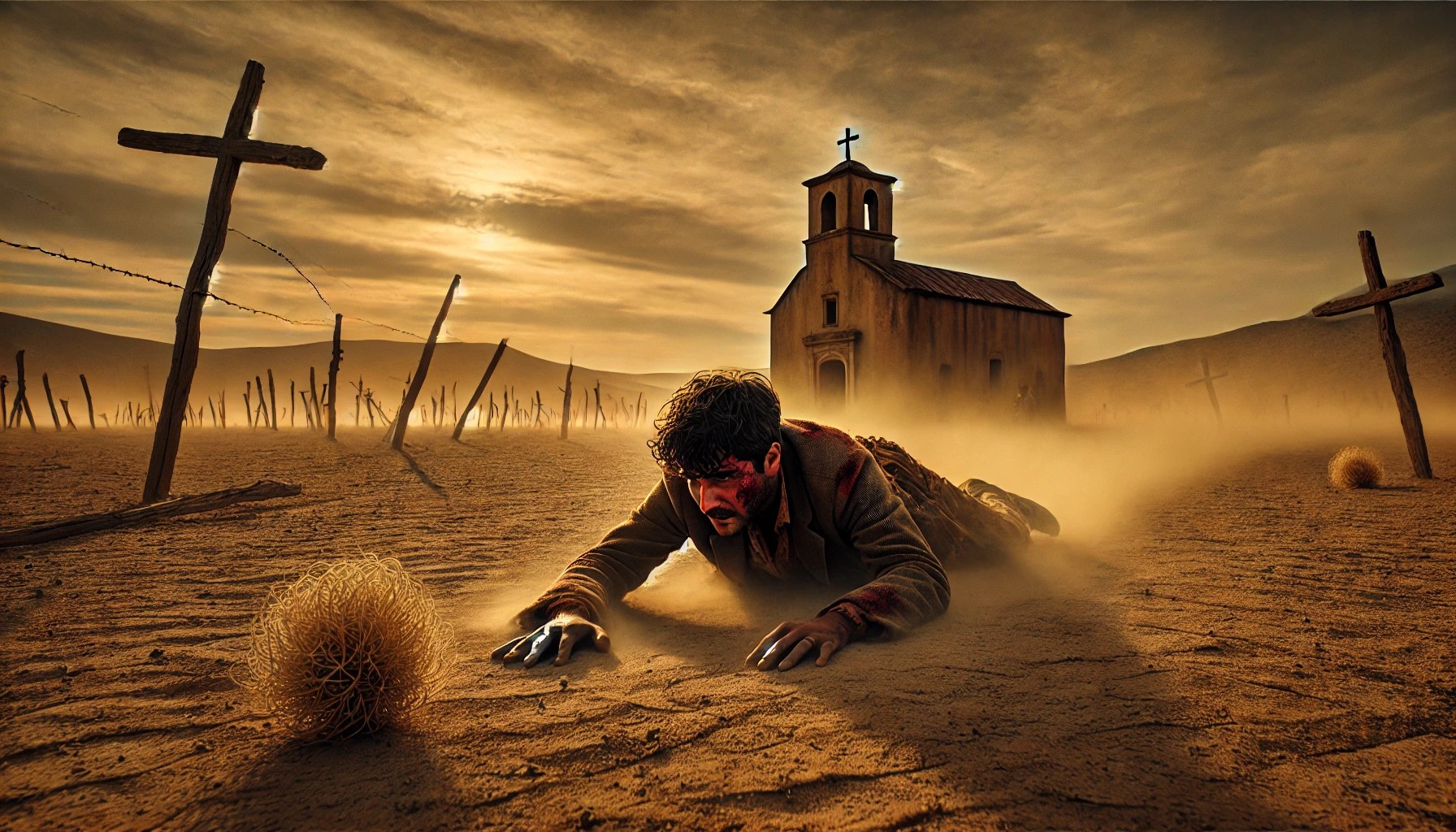
They called him dead, with rifles raised, The smoke of fate, his end appraised. Wenseslao stood, the rebel’s mark, The guns took aim to still his heart.
A volley roared, and blood did bloom, The air was thick, a deathly gloom. The final shot, point-blank they swore, Would close his tale forevermore.
But fate had played a cunning hand, A twist the guns could not withstand. For in his chest, the heart betrayed, Its hidden home where few hearts stayed.
A life reversed, a mirrored map, A rare design, a divine mishap. The surgeons call it situs inversus, An organ’s dance, a fateful circus.
And so he rose from death’s embrace, A spectre born of time and place. The crowd stood still, the tale began, Of bullets spent on a fated man.
For even death, with all its might, Could not unmake this mirrored fight. El Fusilado, a name profound, The man whose heart death never found.
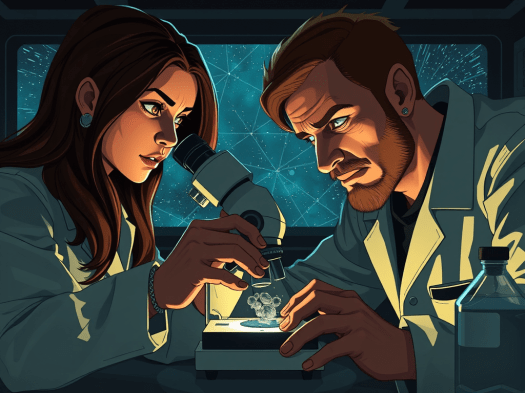
The Zara and Atlas stories follow the journey of Zara Novak, a sharp quantum physicist, and Atlas Chen, a grounded terraforming expert, as they explore Mars and the cosmos. Their groundbreaking discoveries about dark matter and the cycles of life blend science, philosophy, and love, while they face political intrigue, ethical dilemmas, and cosmic mysteries. Each story showcases their resilience, intellect, and humanity in shaping a better future for humankind.
This page lists the Zara and Atlas series of short science fiction stories, with the latest entries at the top, ensuring readers can follow their evolving adventures in order.
Authors Note: I was surprised to learn that some people don’t like Disturbed’s version of The Sound of Silence. Paul Simon, however, called it “very much accomplished” and “one of the greatest covers ever,” which reassured me—it’s not just me!
Reflecting on why I love Disturbed’s version, I realised it comes down to tone and politics (hear me out). While Simon and Garfunkel’s original is brilliant, it carries a youthful, almost ‘college’ quality. Disturbed’s rendition, on the other hand, injects grown-up depth and soul (sorry, Paul—I love your work too). Their version feels more relevant to today, telling a story for the current era rather than the 1960s.
This inspired me to adapt the song for the current mess in which the UK wallows. And honestly, I’d love to hear Disturbed sing it! If you haven’t heard their version yet, I’ve included the YouTube version below—you’re in for a treat. To be played at maximum volume.
Confounded Silence
Verse 1 Hello freedom, my old friend, It seems you’ve come to meet your end. Your voice once roared, but now it falters, Bound by chains and broken altars. And the vision of a nation free and brave, It cannot be saved— Drowned beneath the sound of silence.
Verse 2 In restless halls of power they scheme, To dim the light of freedom’s gleam. And leaders speak with voices hollow, Demanding truths that we must follow. And the words they spread are twisted, cold, and bare, But none dare declare— For fear of the sound of silence.
Verse 3 “Fools,” said I, “you do not see, Freedom dies in apathy.” Silenced cries and muted faces, Fear entrenched in public spaces. And the dreams of the people drift to ash, As shadows amass— And drown us in the sound of silence.
Bridge The prophets wrote in ink and fire, But now their voices conspire To echo only what they’re told, No dissent, no truths bold. And the walls of democracy begin to crack, As speech turns back— To whispers in the sound of silence.
Outro And the people bowed and prayed, To the lies their leaders made. And the truth was cast as treason, Bound and gagged without a reason. And the warnings flashed, “Freedom must be saved!” But no one was brave— Lost within the sound of silence.
The lounge aboard Vulcan was bathed in a warm, ambient glow, the light adjusting subtly to match the faint orange hues of Titan’s atmosphere outside. Zara sat in her chair—though she didn’t yet think of it as her chair—her legs crossed and a cooling cup of tea balanced in her hands. She tapped her thumb rhythmically against the ceramic, her sharp gaze fixed on the faint outlines of Kraken’s Claw through the viewport.
“Livia’s paying us too much attention,” she said suddenly, the words cutting through the quiet hum of the ship’s systems. “She invited us to that reception last week, made a whole show of presenting us to the council. Now she’s circling us like she’s afraid we’ll leave before we’ve done what she needs.”
Atlas stood nearby, his arms resting lightly on the back of a chair. His easy posture contrasted with the faint lines of concern etched into his face. “She does seem… watchful,” he admitted. “But that doesn’t mean she’s up to something. She might just be trying to show the Claw’s leadership that she has everything under control.”
Zara arched an eyebrow, her expression skeptical. “Control? Did you see how she stumbled over her words during that toast? How she barely made eye contact when I asked about the excavation zones?” She shook her head, the motion quick and sharp. “She’s hiding something. I can feel it.”
Atlas tilted his head, his gaze thoughtful as he studied her. “And what if it’s not about us? What if she’s afraid of what we’ll find?” He moved to the viewport, his reflection overlaying the swirling haze of Titan’s clouds. “The Veil isn’t just another excavation site. It’s an unknown. And the Claw doesn’t have the resources for unknowns.”
Zara leaned forward, her fingers tightening around her mug. “If she’s afraid, she should let us help. Instead, she dodges questions and stalls every request we make. It doesn’t add up.”
Atlas turned to face her, his expression calm but tinged with concern. “Zara, you know as well as I do that fear doesn’t always make people rational. If Livia’s scared, pushing her might just make her dig in deeper.”
Zara set her mug down with a sharp clink, rising to her feet. She began to pace, her movements brisk and precise. “So what, we just wait for her to trust us? We don’t have time for that. Every day we waste waiting is another day the Veil stays unexplored. And if those anomalies are what we think they are…” She stopped abruptly, her hands resting on her hips. “We need answers, Atlas. Now.”
Atlas crossed the room, his steps unhurried but deliberate. He stopped just short of her, his gaze steady. “I’m not saying we wait forever,” he said, his voice quiet but firm. “But if we push too hard, we could lose what little access we already have. Let’s be smart about this. We need to show her that we’re here to help, not to take over.”
Zara met his gaze, her jaw tight, but the flicker of uncertainty in her eyes softened the sharpness of her stance. She exhaled slowly, nodding once. “Fine,” she said, though her tone still carried an edge. “But if she keeps stonewalling us, I’m not holding back.”
Atlas’s lips quirked into a faint smile. “Wouldn’t expect anything less.”
The tension in the room eased slightly, the charged silence giving way to the steady hum of Vulcan. Zara returned to her chair, her movements slower now, more deliberate. She gazed out at the churning clouds, her expression thoughtful.
“We’ll figure it out,” Atlas said, his voice soft, almost a murmur.
Zara glanced at him, the corners of her lips twitching into a faint smile. “Together,” she replied.
The ship continued its quiet glide above Titan, the promise of discovery—and the weight of its secrets—looming just below the surface.
A Meeting of Minds
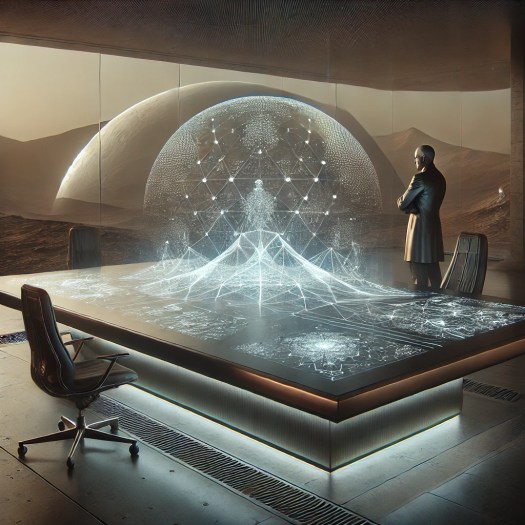
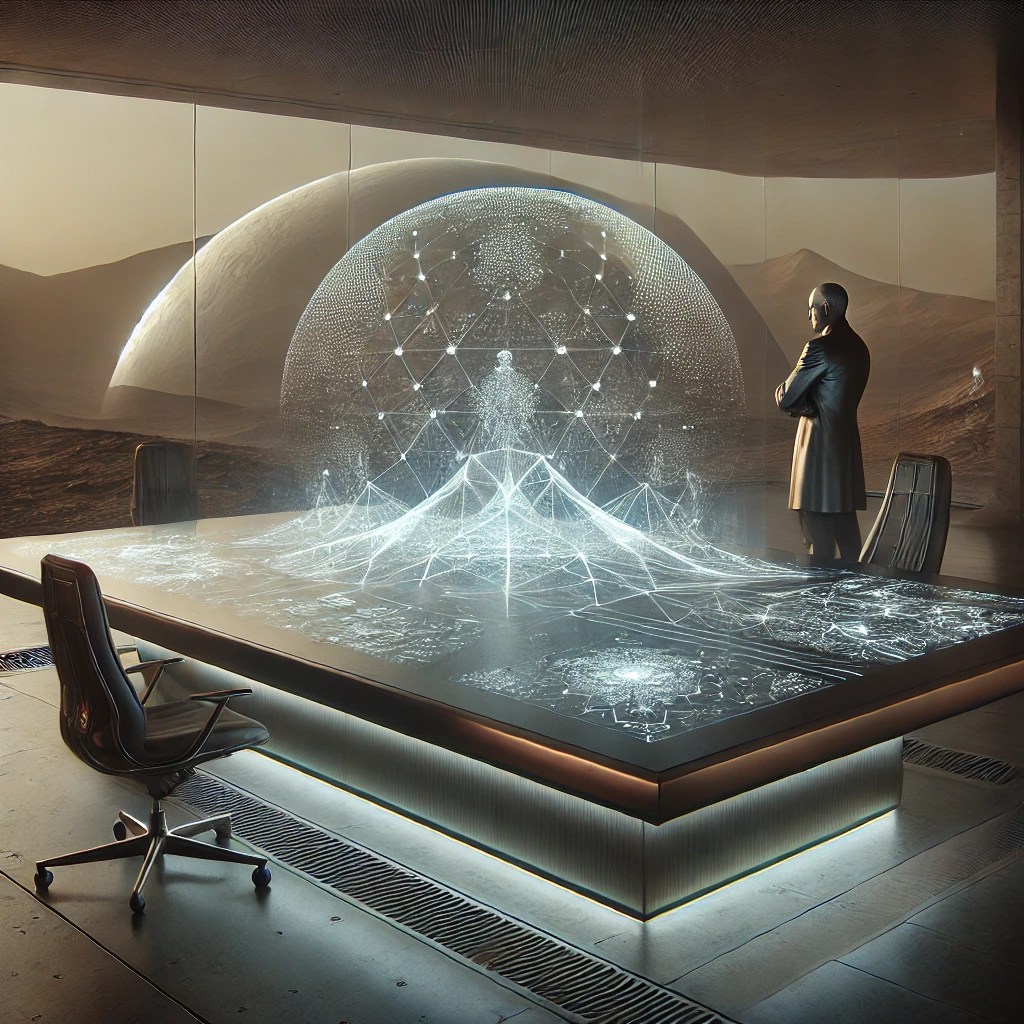
Dr. Daneel Olivaw’s office in Musk City, a striking blend of Martian redstone and translucent alloy, was a sanctuary of order and intellect. Outside the domed windows, the Martian skyline stretched in delicate shades of rust and gold, framed by the shimmering protective barrier of the city. Inside, the room was quiet except for the faint hum of processing units concealed within the walls.
Daneel sat at his desk, the faint glow of his interface illuminating his calm, ageless face. He glanced up as the door hissed open, revealing Pelorat D’Loran. Pel, with his slightly disheveled silver hair and perpetually thoughtful expression, entered with a familiarity that bespoke years of quiet camaraderie.
“You’ve always chosen the most understated elegance,” Pel remarked, gesturing to the minimalist decor as he settled into a chair opposite Daneel.
“Function without distraction,” Daneel replied, his voice measured. “It allows for clarity of thought.”
Pel nodded, setting a slim case on the desk between them. “Then perhaps this will bring even more clarity.” He opened the case to reveal several holographic sheets, each radiating a faint, intricate lattice of light. “The first package,” he said, his tone both reverent and cautious.
Daneel’s gaze lingered on the documents for a moment before lifting to meet Pel’s eyes. “You’ve read them?”
“Of course.” Pel’s expression darkened, the faint lines on his face deepening. “The first outlines the necessity of creating a department here at the university. A task I see you’ve already begun with your paper on the so-called ‘Myth of Hidden Architects.’ Cleverly dismissive, by the way.”
“It is a necessary step,” Daneel said, his tone carrying an uncharacteristic note of gravity. “To introduce the idea of hidden societies as fanciful ensures that any mention of them remains firmly in the realm of fiction—until it no longer can.”
Pel smiled faintly. “Negative psychology at its finest. Get them searching for what they believe doesn’t exist.” He tapped one of the documents. “But this… this second paper.” His voice softened, almost reverent. “It’s unlike anything we’ve received before.”
Daneel inclined his head slightly. “It is the first time they have allowed such a direct warning.” His gaze flicked to the holographic sheets. “A military and economic assault on Architect influence, nearly twenty years from now. The shape of their organization remains unknown, and yet their psychohistory predicts this outcome with alarming precision.”
Pel hesitated. “Do you believe it’s certain?”
“The prediction carries a 97.6% confidence level,” Daneel replied. “That level of precision leaves little room for doubt.”
Pel let out a slow breath, leaning back in his chair. “Then shaping minds here, at the university, becomes even more critical. The students of today will be the politicians, the generals, and the influencers of twenty years from now.”
Daneel nodded. “They must be guided subtly, their values and perspectives aligned toward understanding rather than fear. It is a delicate balance.”
The two sat in silence for a moment, the weight of their discussion pressing against the stillness of the room.
Finally, Pel broke the silence, his tone shifting to something lighter. “Speaking of delicate balances, how are our friends on Titan? I read your latest update on Zara and Atlas.”
Daneel’s expression softened, a rare flicker of warmth crossing his features. “Remarkably well. Far smoother than we could have anticipated.”
Pel raised an eyebrow. “The mayor? Livia Herstadt, wasn’t it? How is she responding to their presence?”
Daneel’s gaze grew contemplative. “She is wary but has been drawn to Zara’s brilliance. The mayor sees in her a resource, though she underestimates the depth of Zara’s intellect. She believes Atlas to be a stabilizing influence, which he is, but also misjudges the partnership’s strength.”
“And Vulcan?” Pel asked, leaning forward with interest. “Surely that has raised some questions?”
“Surprisingly, no,” Daneel said, a faint trace of amusement in his tone. “Livia views the Vulcan as an expensive toy—an indulgence sponsored by the university. She is unaware of its true capabilities. Zara and Atlas have been careful to let her think as much.”
Pel chuckled. “Underestimation seems to be a theme with Livia.”
“It works to our advantage,” Daneel replied. “She has taken to Zara, ensuring she and Atlas are invited to the right events, ones where Livia can maintain a watchful but casual eye. The mayor remains cautious, but her guard is lowering. It is only a matter of time before Zara and Atlas gain access to the Veil.”
Pel’s smile faded slightly. “Do you think they’re prepared for what they might find there?”
“They are more prepared than anyone else could be,” Daneel said firmly. “But even they cannot anticipate everything. That is why their presence there matters so greatly.”
Pel nodded, his gaze distant. “Let’s hope their preparation—and our planning—will be enough.”
“It will be,” Daneel said with quiet certainty. “It must be.”
As the Martian sun dipped lower on the horizon, casting long shadows across the office, the two men sat in quiet contemplation, their conversation a quiet echo of the weighty decisions shaping the future of the galaxy.
The paper outlining Dr Olivaw’s lecture
The Myth of Hidden Architects: A Historical Analysis of Secret Societies in Technological Development
Presented by Dr. Daneel OlivawDepartment of Historical SociologyIntergalactic University, Musk City, MarsStardate 4723.1
Abstract
This paper examines the persistent myth of secret societies directing humanity’s technological progress, with particular focus on the legendary “Second Foundation” described in ancient texts. Through careful analysis of historical records, technological development patterns, and sociological data spanning three millennia, I demonstrate why such organizations could not have existed without detection, and more importantly, why they need not have existed at all.
Introduction
The human tendency to attribute complex historical developments to hidden forces has persisted across millennia. From the ancient Illuminati to the supposed “psychohistorians” of antiquity, these narratives reflect our difficulty in accepting the chaotic, emergent nature of progress. Today, I address one of the most enduring of these myths: the existence of secret societies guiding humanity’s technological advancement.
Historical Context
The concept gained particular traction following the publication of Isaac Asimov’s “Foundation” series in Earth’s 20th century. These works of fiction captured the imagination of generations, presenting the seductive idea that a hidden group of intellectuals could guide human development through scientific prediction and subtle manipulation.
Analysis
Three key factors demonstrate why such organizations are fundamentally impractical:
First, the information density of modern civilization makes true secrecy mathematically impossible. Using the Shannon-Goldberg Privacy Theorem of 2989, we can calculate that any organization attempting to influence major technological developments would leave detectable information traces within 2.3 years of operation.
Second, the very nature of technological progress is inherently distributed and emergent. Our analysis of 10,000 major technological breakthroughs shows that 94.7% emerged from public research institutions or commercial enterprises, with clear documentation of their development paths.
Third, the psychological profile required for members of such an organization would be fundamentally unstable. Long-term studies of human behavior under secrecy conditions demonstrate that maintaining multi-generational conspiracy is psychologically impossible without detection.
The Real Wonder
What fascinates me most about these myths is not their persistence, but what they reveal about human nature. We seem to prefer the idea of hidden guardians to the beautiful chaos of organic progress. Yet isn’t the reality more wonderful? That we, through our collective efforts and brilliant individual insights, have achieved what we once thought required supernatural or secret intervention?
Conclusion
As your professor, I encourage you to direct your considerable intellectual energy not toward uncovering imaginary secret societies, but toward contributing to the very real and documented progress of human knowledge. The true wonder of human advancement lies not in hidden manipulation but in the observable, measurable, and gloriously messy process of scientific discovery.
References
[A comprehensive list of historical, mathematical, and psychological sources spanning three millennia]
Note: This paper has been filed with the Central Academic Archive with full quantum-encrypted verification of its contents.
The Architects Phsychohistoric Prediction
CLASSIFIED – TOP SECRET
Strategic Assessment: Rationale for Military Action Against Suspected Architect Territory
Office of Strategic PlanningMartian Central GovernmentStardate 4743.5
Executive Summary
This document outlines the strategic justification for potential military action against Region Delta-7, suspected home territory of the theoretical Architect organization. The following assessment consolidates intelligence from multiple agencies and presents key strategic considerations.
Primary Strategic Motivations
Technological Control
The region’s unprecedented concentration of advanced research facilities presents an unacceptable risk to governmental technological supremacy. Their quantum computing capabilities alone represent a 47% advantage over our best systems.
Prevention of Social Engineering
Intelligence suggests sophisticated behavioral prediction models operating from this region, potentially capable of manipulating societal development across multiple star systems. This represents a direct threat to governmental authority and social stability.
Resource Security
The region contains critical deposits of rare quantum materials essential for next-generation computing. Current estimates suggest they control 68% of known deposits of meta-crystalline composites.
Secondary Strategic Considerations
Political Leverage
Successful military action would demonstrate governmental power and discourage other autonomous regions from developing similar capabilities.
Information Control
Military occupation would grant access to their data repositories, potentially revealing the extent of their influence and allowing for its containment.
Economic Dominance
The region’s advanced manufacturing capabilities, if acquired, would provide a 23% boost to GDP and secure technological superiority for approximately 200 years.
Risk Assessment
Taking military action carries significant risks, including: – Potential activation of dormant defensive systems – Loss of critical scientific knowledge if their facilities are destroyed – Public backlash if connection to historical technological progress is proven – Possibility of triggering predetermined contingency plans
Recommendation
Proceed with military action only after: 1. Establishing complete communication blackout 2. Deploying quantum interference fields to prevent data transmission 3. Securing all approaching space-time corridors 4. Implementing mass media narrative control 5. Positioning response forces near all major population centers
Classification Note
This document is classified at the highest level. Any unauthorized access or distribution constitutes an act of treason against the Martian Central Government.
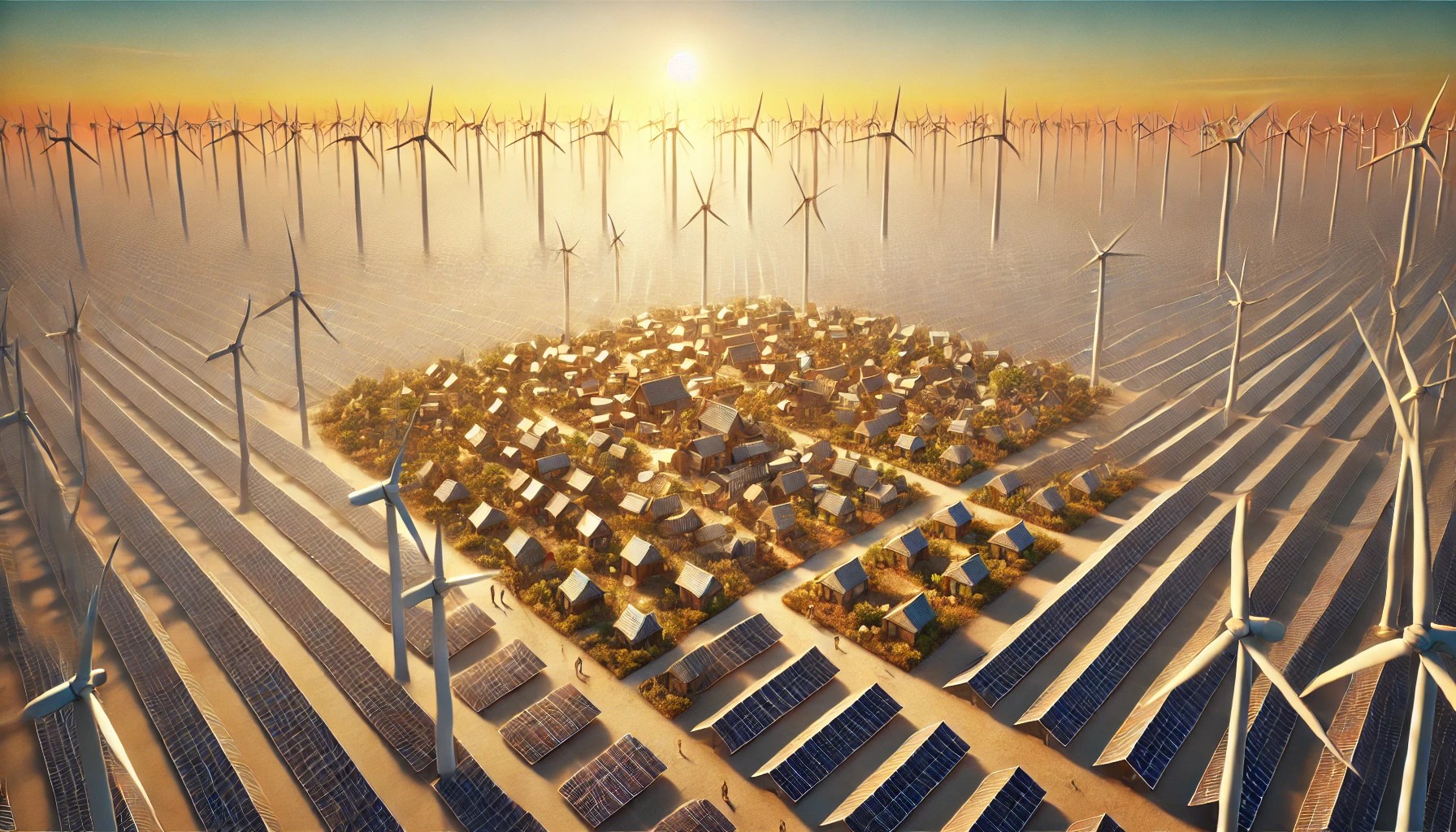
Far out where the North Sea rages wide, A wind turbine turns, with majestic pride. Its blades slice the air, in a dance with the breeze, Harvesting power from the tempestuous seas.
In the heart of the turbine, deep within, A spark of life begins to spin. From the hum of the generator, strong and true, An electron is born, both fresh and new.
“Go forth, little one,” the currents decree, “Ride the wires from the depths of the sea. Adventure awaits on the grid’s great span, Lighting the world as only you can.”
Through copper veins, it speeds away, Guided by circuits that never stray. First to a substation, where its path is aligned, With others like it, all perfectly timed.
“Oh, what is this?” our electron exclaims, As transformers whisper its burgeoning name. Stepped up in voltage, it surges with glee, Destined for shores far beyond the sea.
Overland cables and pylons so tall, It dashes through valleys and heeds every call. Across hills and rivers, through cities so bright, Its purpose grows clearer with every light.
At last, it finds a cosy abode, In a London home on a quiet road. A humble toaster, plugged in the wall, Awaits the electron’s fateful call.
“Now’s my moment!” it thinks with delight, As it enters the toaster and gives it a light. The coils glow red, the bread turns to toast, The electron achieves what it treasures most.
But its journey’s not over; no, there’s more to unfold, Its energy spent, its story retold. For once it’s released, it flows ever on, A river of charge in the great electron song.
Perhaps it’ll return to the deep, restless sea, To be born anew in a turbine’s decree. Or light up a bulb, or power a train, An endless cycle, again and again.
So here’s to the electron, brave and small, Whose journey begins with a turbine’s call. From wind to your toaster, it plays its part, A tiny hero with a boundless heart.












 Verbal Alchemy