
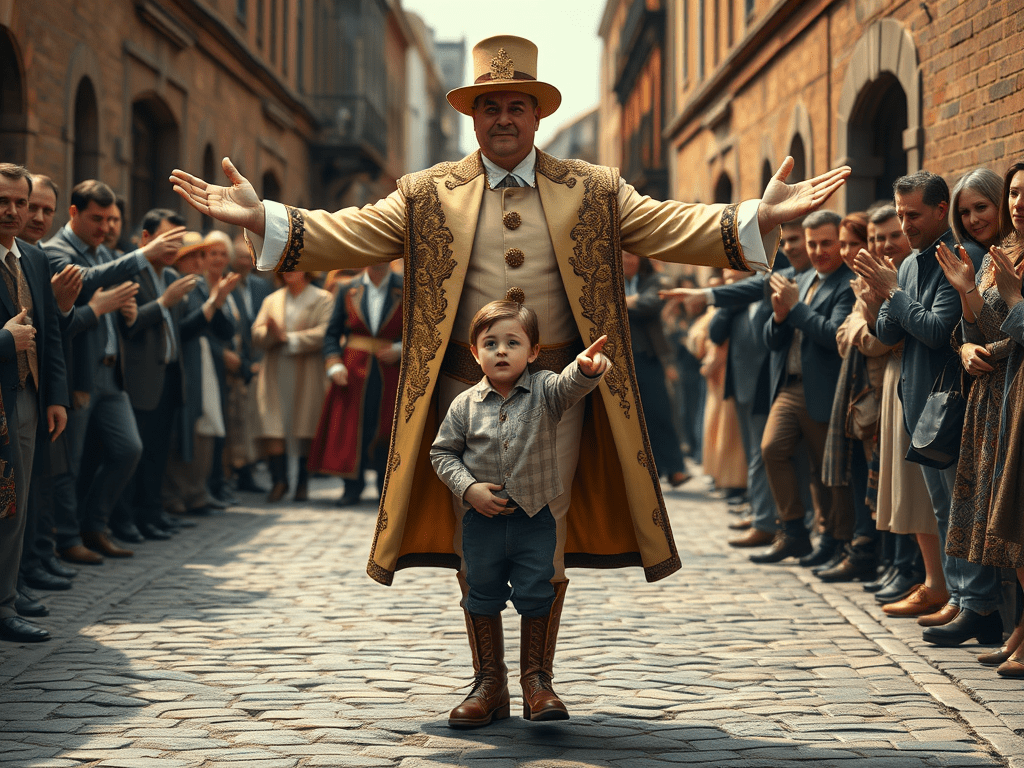
There he was, the Leader of the Apologetic Party, parading down the cobbled streets, his entourage of party donors shuffling awkwardly behind him. And oh, what finery he claimed to wear! Cloaks spun from the golden threads of modesty, buttons forged from the rarest humility, and boots stitched with the finest economy. At least, that’s what he said. But I was only a boy, and to my eyes, the man was wearing—well—his all-together!
You see, the story began when he announced to the kingdom that he, as a servant of the people, would lead by example. He preached thrift and restraint, and oh, how he loved a good penny saved. “Every farthing matters!” he’d proclaim, shaking his fist with such vigour that one wondered if he’d wrestle his own shadow for a ha’penny.
But behind the scenes? Oh no, thrift was for other people. The leader believed he deserved garments befitting his greatness. And so, he turned to his donors—ordinary folk and a smattering of wealthier sorts who’d bought into his promise of a frugal and humble reign.
“Friends,” he’d say, his voice dripping with sincerity, “these clothes are not for me, but for the dignity of the office. Surely you wouldn’t want your leader to attend the Grand Council in… off-the-peg attire?”
And so, the donors dipped into their pockets, funding his wardrobe of imaginary splendour. Each outfit was more outlandish than the last—embroidered sashes said to symbolise sacrifice, jewel-encrusted cravats representing virtue, and silken trousers stitched with the very fabric of selflessness.
But here’s the twist: none of it was real. The “tailors” he hired were charlatans, laughing behind closed doors as they convinced him that their invisible finery would make him invincible. And the Leader of the Apologetic Party, too vain to admit he couldn’t see the clothes, wore them proudly, convinced they made him untouchable.
Then came the grand parade. The entire kingdom turned out to see their “humble” leader in his new finery. His nose was so high in the air you’d think he was sniffing clouds.
“Behold,” he declared, arms outstretched, “the finest clothes ever worn by a servant of the people! Paid for entirely by the generosity of others.” He even apologised as he said it. “So sorry, so terribly sorry. I didn’t want to accept their gifts, but they insisted. Humility is such a burden.”
And the crowd? Oh, they clapped politely, too afraid to say what was glaringly obvious: the man was stark naked. Not a stitch of thrift, virtue, or selflessness adorned him—just his scrawny frame and his enormous ego.
But me? I couldn’t hold it in. I shouted, “He’s got nothing on! Not a sock, not a scarf—NOTHING!”
The crowd gasped. The leader froze, his face the colour of beetroot. He spluttered, “No, no, these are my robes of accountability! Can’t you see them? They’re… er… woven from transparency!”
“Transparent?!” I cried. “They’re invisible because they don’t exist! And neither does your humility, mate!”
The crowd began to murmur. First, a giggle here, a snort there. And then laughter erupted like a thunderstorm.
The leader turned to his donors, pleading, “You see the clothes, don’t you? Please tell me you see the clothes!” But they were already slipping away, muttering about refunds and feeling rather duped.
And so, the great Leader of the Apologetic Party stood there, in all his supposed humility, revealed as nothing more than a miserly hypocrite with an appetite for pomp and a taste for other people’s money.
From that day forward, the kingdom remembered this lesson: a leader’s true worth isn’t in the clothes they claim to wear, but in the honesty they actually show. As for the leader? Let’s just say he avoided parades after that.
The end.
Authors Note: While enjoying poking fun at our incumbent supreme leader I considered how would past leaders have handled accusations of cronyism in return for fine clothes, so here we go:
Winston Churchill (1940–1945, 1951–1955)
“My dear boy, I bought them myself, of course, though my tailor occasionally offered discounts for patriotism. The measure of a man is not who pays for his suit but how he wears it—with defiance, a cigar, and the occasional brandy stain!”
Clement Attlee (1945–1951)
“I bought them myself, naturally. Nothing fancy—just good British woollens. The workers of this nation have more pressing concerns than my waistcoat, though I hope they find it suitably modest.”
Anthony Eden (1955–1957)
“Who paid for my clothes? A statesman of my calibre, sir, pays for his own. A Savile Row suit is essential armour for diplomacy, even when things go terribly wrong, as they sometimes do…”
Harold Macmillan (1957–1963)
“I assure you, old chap, I did. We’ve never had it so good, and that includes my wardrobe—British tailoring, naturally. One must look prosperous to lead a prosperous nation.”
Alec Douglas-Home (1963–1964)
“Oh, I believe I paid for them… unless, of course, the gamekeeper slipped me something tweedy without my noticing. Either way, my clothes were perfectly suitable for grouse hunting or running the country.”
Harold Wilson (1964–1970, 1974–1976)
“Well, I bought my Gannex raincoat, if that’s what you’re asking! Nothing flashy, just practical. My suits? British wool, naturally—it’s what a man of the people wears. And no, no billionaires involved—just me and the Yorkshire economy.”
Edward Heath (1970–1974)
“I paid for them myself, of course. Though I must admit, I spent far more on sheet music than suits. A well-fitted jacket is important, but it’s Handel that really moves me.”
James Callaghan (1976–1979)
“I paid for my own clothes, like any honest man would. But let me tell you, running a country in economic turmoil is no time to worry about ties. What matters is that they’re British-made and keep the chill out.”
Margaret Thatcher (1979–1990)
“A woman’s wardrobe is part of her armour, and mine was formidable. My suits are as uncompromising as my policies, and as iron as my will!”
John Major (1990–1997)
“Oh that would have been Norma, maybe, I think, though, well, the grey suit… yes, it’s, er, rather emblematic of my time in office. Sensible, I think? Or maybe uninspired? Honestly, I’m not entirely sure—it’s just what they handed me. Not something a someone else would buy, I suppose… unless they are going for, er, understated confusion these days?”
Tony Blair (1997–2007)
“Who bought my clothes? Look, it’s very simple. I paid for them myself… well, Cherie keeps an eye on that sort of thing. My focus is on values—values that resonate with hard-working families, not my tailor!”
Gordon Brown (2007–2010)
“I paid for them myself. I don’t much care about clothes—they’re hardly the point, are they? What matters is hard work, fairness, and giving everyone in Britain a real chance to succeed. A tie is just a tie, not a political statement… though while we’re at it, whose brilliant idea was it to put me with that bigoted woman? Because that certainly wasn’t in the script either.”
David Cameron (2010–2016)
“Oh, I paid for them myself. But really, it’s not about the suit, it’s about leadership. Although I will admit, I probably look sharper than Ed Miliband did, even on his best day.”
Theresa May (2016–2019)
“None of your business! It does stress me my shoes get more attention than my policies. Let me just say, a strong and stable wardrobe is critical when facing instability—be it in politics or negotiations with bloody Europeans.”
Boris Johnson (2019–2022)
“Clothes? Oh, goodness, I… well, I suppose I must have paid for them at some point, though honestly, I couldn’t say for sure. They just… appear in my drawer, you see. Sometimes a perfectly pressed suit, sometimes a jumper with an alarming hole in the elbow. It depends entirely on who I’m living with at the time. One housemate had me in linen and loafers; another seemed to think I was auditioning for a gardening programme. Really, I just put on what’s there and hope for the best. Solving Britain’s problems or wrestling with a hedge—it’s anyone’s guess!”
Liz Truss (2022)
“I bought my clothes, of course—but only after an exhaustive review of global trade options to secure the best possible value. You see, bold colours were meant to signal bold leadership. Unfortunately, the final result was less ‘dynamic vision’ and more ‘upmarket cabbage’—all greens and purples in entirely the wrong places. Pity, really. Leadership is tricky when people keep mistaking you for a salad garnish.”
Rishi Sunak (2022–2024)
“Ah, yes, I paid for my clothes. But let’s be honest, there’s been some… ahem… generous guidance from certain friends in high places. Look, we’re in this together—though some of us are in cashmere sweaters, and others aren’t.”
Discover more from Verbal Alchemy
Subscribe to get the latest posts sent to your email.
 Verbal Alchemy